
Author’s note: This article reviews the GPT-6.2 Astra limited rollout from October 31 to November 2, 2026. We sort screenshots, leaks, and official information by evidence level, then wrap up with a developer preparation checklist.
At 2:36 a.m. Beijing time on November 1, someone posted a Codex usage chart on Linux.do. It showed gpt-6-astra at 97.7%, with a new line below it for gpt-6.2-astra at 1.6%. A few hours later, another screenshot on X showed the latter at 19.8%.
Group chats lit up. Some said, “The atomic bomb is coming.” Others stayed up late testing it with an SVG of a pelican riding a bicycle. And some replied, “Another screenshot?”
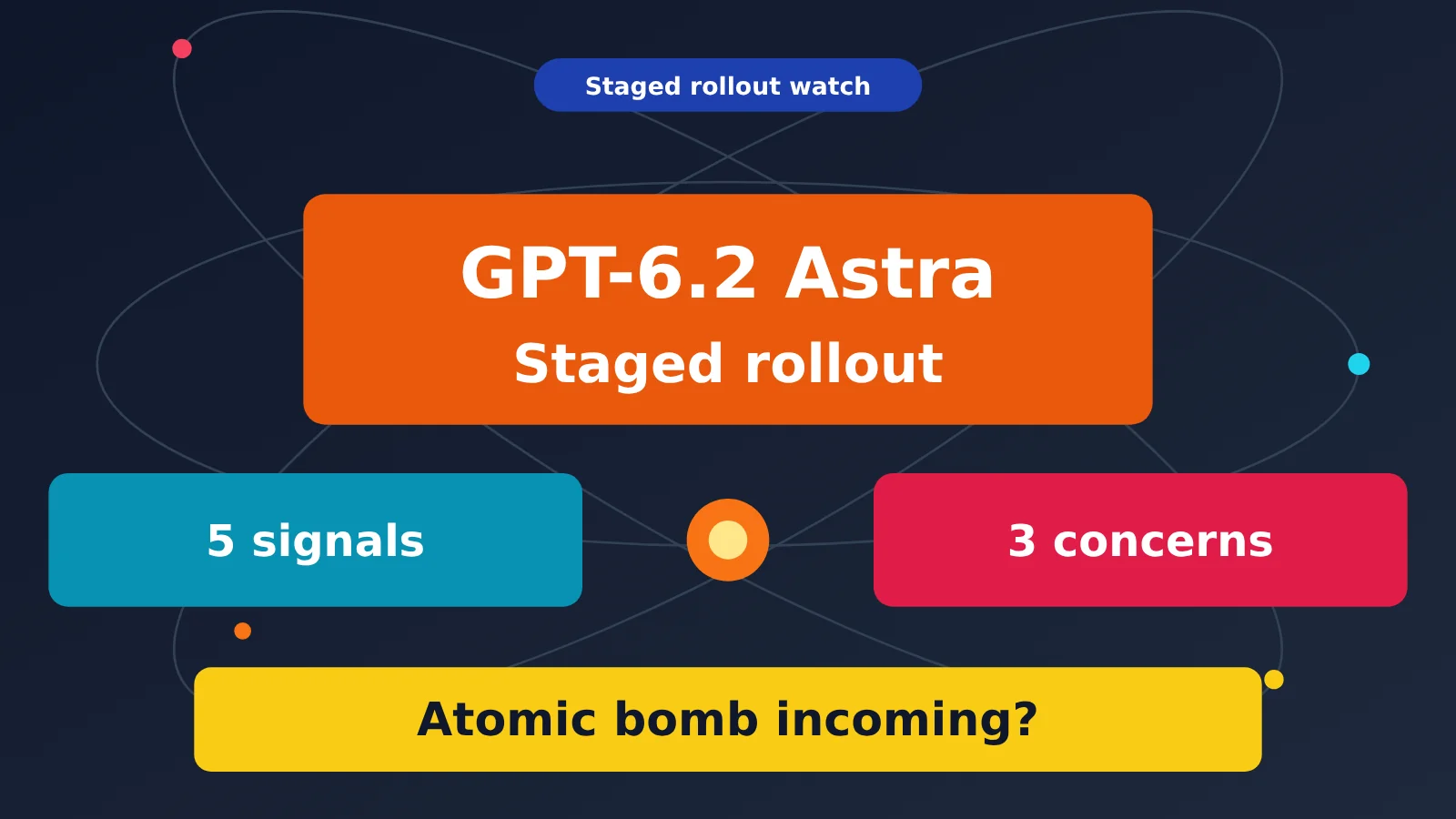
Here’s the takeaway: There are real traces of a limited GPT-6.2 Astra rollout, but OpenAI hasn’t officially announced it. Multiple accounts have seen the model name in the Codex dashboard, so that much is credible. As for claims that it’s “more powerful, cheaper, and faster,” none can currently be verified.
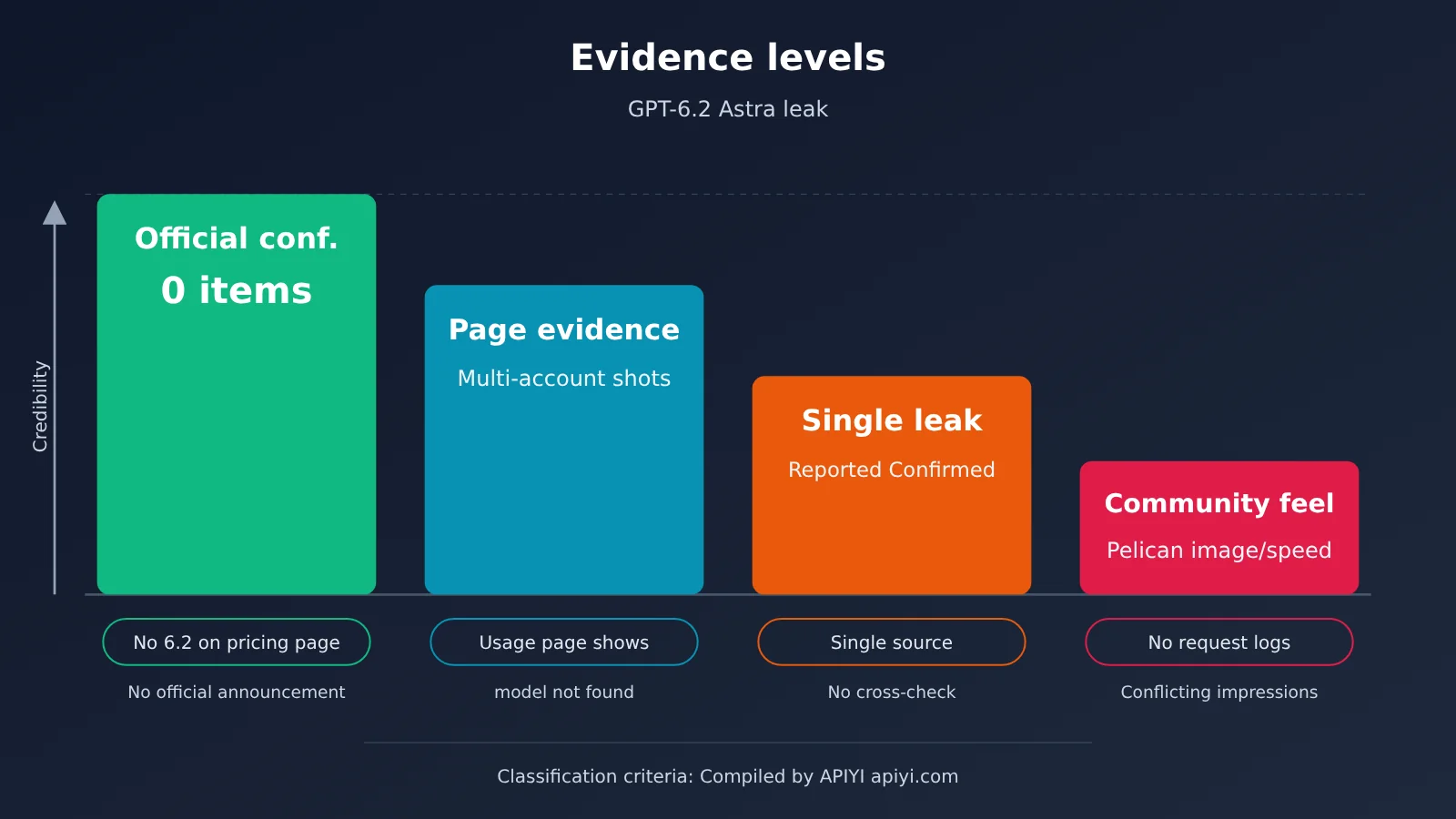
This isn’t a debunking article. There’s good reason for the excitement. We’re simply sorting the evidence into four levels: official confirmation, traces in user interfaces, single-source leaks, and community impressions. Once you know the difference, you’ll know what to trust, what to set aside for now, and what to prepare.
The GPT-6.2 Astra Limited Rollout: What Happened in 48 Hours?
Here are the four key developments, with times in Beijing time. Each entry includes its original source so you can check it yourself.
| Time (Beijing) | Source | Details | Evidence level |
|---|---|---|---|
| 11-01 02:36 | Linux.do @fourfour, “Is GPT in a limited rollout?” | gpt-6.2-astra accounted for 1.6% in a Codex weekly usage chart |
On-page evidence |
| 11-01 11:57 | Linux.do @jiangkoumo_, verification in the same thread | 12 of 13 billing entries were for gpt-6-astra, with speeds between 44 and 73 tok/s |
On-page evidence |
| 11-01 18:09 | X @TokenGremlin | A screenshot from another account showed gpt-6.2-astra at 19.8%, while the model selector still displayed GPT-6 Astra |
On-page evidence |
| 11-01 18:53 | X @kimmonismus | Quoted the previous post with “Confirmed. GPT-6.2 very close” | Single-source claim (relaying a screenshot) |
| 11-01 to 11-02 | NodeSeek, Reddit r/codex, PANews, Synced | Multiple platforms followed up and compiled a list of performance claims | Community impressions + media summaries |
A note on @kimmonismus’s “Confirmed”: the post was relaying a screenshot, not an official confirmation from OpenAI. It received about 99,800 views and 2,438 likes, and was treated as “official confirmation” as it spread. But as evidence goes, it remains a single-source claim.
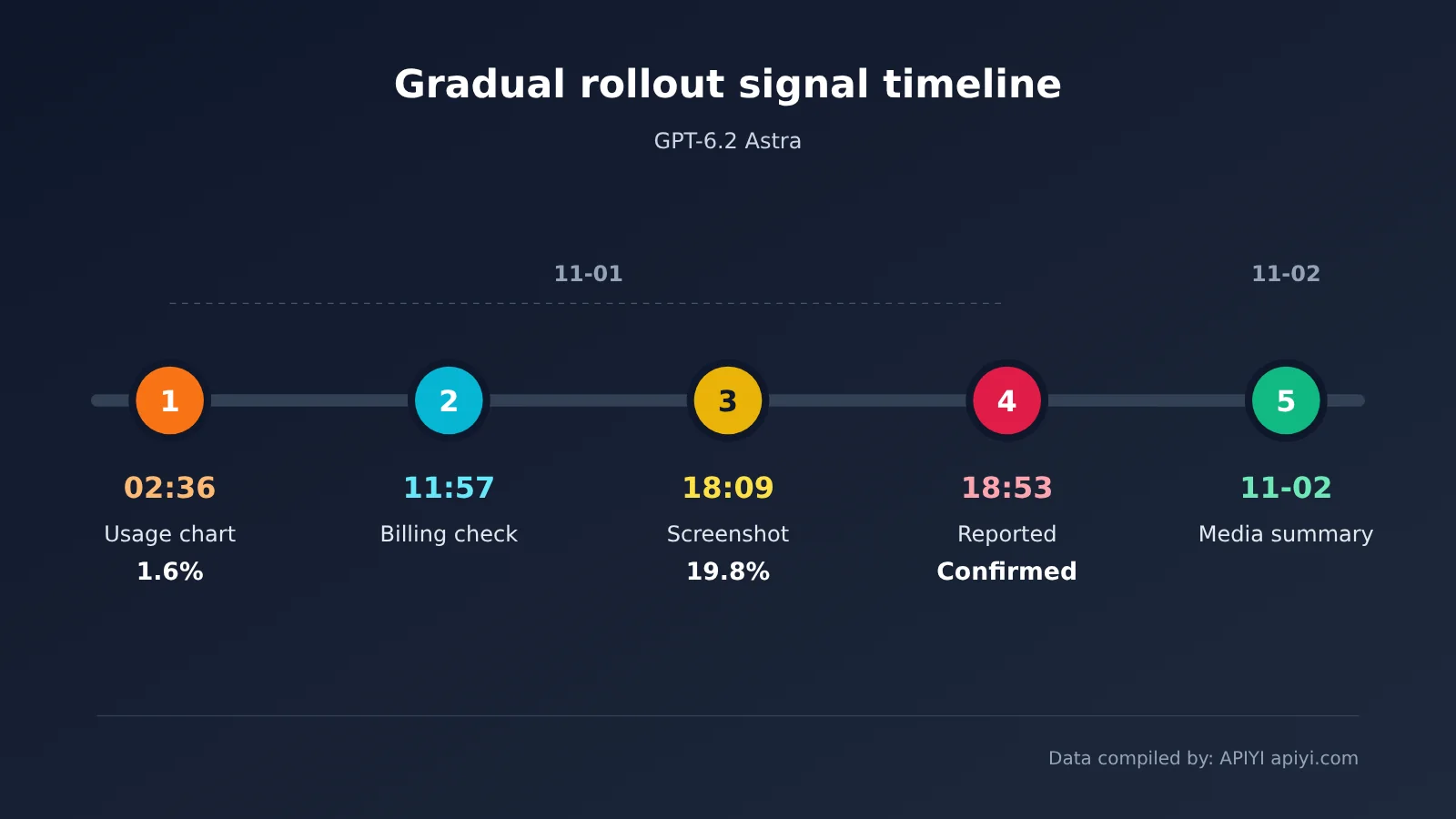
5 Signs of a GPT-6.2 Astra Gradual Rollout
Each signal starts with a conclusion, followed by the evidence.
Signal 1: A Separate 6.2 Row Appears in Usage Breakdowns
Conclusion: This is the strongest trace, backed by evidence visible on the page. Multiple screenshots show gpt-6.2-astra listed as a separate row in the Codex usage breakdown, while the model selector still only shows GPT-6 Astra. In other words, users didn’t actively select 6.2; some requests were routed to it behind the scenes.
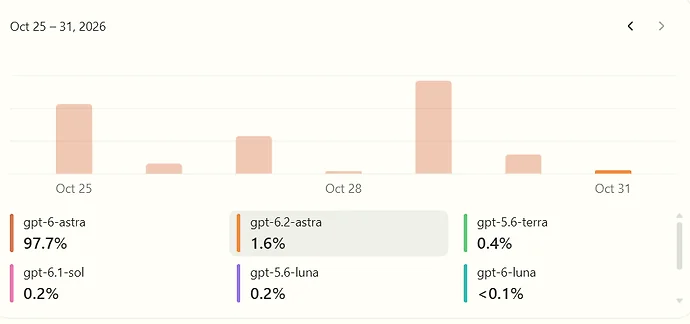
Figure: Linux.do user @fourfour’s weekly Codex usage, with gpt-6.2-astra accounting for 1.6%.
Signal 2: Percentages Vary Widely Between Accounts
Conclusion: This is typical of a gradual A/B rollout. One account shows 1.6% in the weekly view for October 25–31; another shows 19.8%. The difference suggests traffic isn’t being switched over uniformly, but routed on a small scale by account or request.
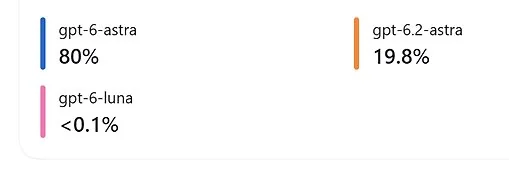
Figure: Codex usage shared by X user @TokenGremlin, with gpt-6.2-astra accounting for 19.8%; the model selector still shows GPT-6 Astra.
Signal 3: Similar Reports Appear Independently Across Multiple Platforms
Conclusion: At the very least, this isn’t an isolated case. At least five related posts appeared on Linux.do within a single day, with similar reports on NodeSeek, X, and Reddit. Linux.do user @wenyu020 has a pro 5x subscription and selected GPT-6 Astra with the extra-high setting. The next day, 6.2 also appeared in their usage breakdown.
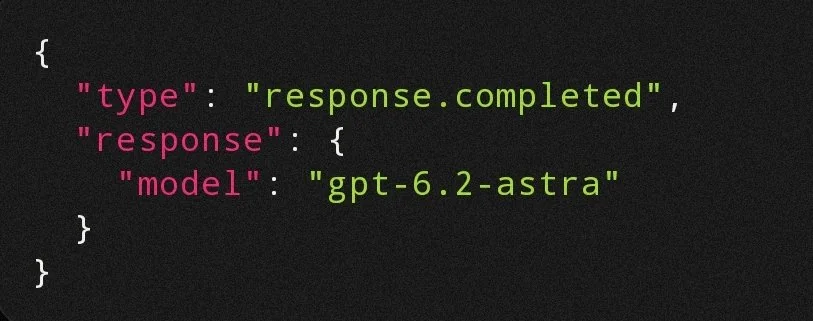
Figure: A response.completed snippet shared by X user @kimmonismus, with the model field set to gpt-6.2-astra.
Signal 4: The CLI Status Bar Shows 6.2 and Completes a Review
Conclusion: This is weak evidence and can only serve as supporting context. One user launched codex --model gpt-6.2-astra, saw gpt-6.2-astra medium in the status bar (Codex CLI v0.166.0), and completed a code review. Linux.do user skytoup reported that direct conversation was rejected, but /review worked—until it “suddenly stopped working.”
Signal 5: OpenAI’s Operational Rhythm Is a Little Unusual
Conclusion: This is just a background signal, not evidence. Codex lead Tibo’s (@thsottiaux) “28-day improvement challenge” wrapped up on October 31, when he posted “Next two days will be resets… banked… 👀”. At 00:43 UTC on November 1, he posted “banked 1/2,” and there had also been a global reset on October 28. The community has interpreted these as “making room in the quota for a new model,” but OpenAI has never said these actions were related to 6.2.
3 Reasons to Question the GPT-6.2 Astra Rollout
We’ve covered the signals. Now let’s look at the counterevidence. These three points mean we can only call it “signs of a limited rollout,” not a confirmed launch.
Question 1: There’s no trace of 6.2 in official channels
As of the morning of November 2, gpt-6.2-astra didn’t appear in any of the following:
- OpenAI’s official API model catalog.
- The API changelog, whose latest entry was
gpt-6-rosalindon October 30. - The Codex changelog, whose latest entry was CLI 0.166.0 on October 29.
- The public
models.json, which listed just five GPT-6 family slugs. Its most recent change was the addition of GPT-6.1 Terra on October 26.
FourWeekMBA also checked on November 1 and reached the same conclusion: GPT-6.2 appeared in neither OpenRouter nor the OpenAI news feed.
Question 2: The CLI lets you enter any model name
A Reddit discussion on r/codex with more than 80 comments reached a straightforward conclusion: Codex CLI accepts any model name, so “--model gpt-6.2-astra plus a screenshot proves nothing.” In a screenshot cited by Machine Heart, the system first returned an unsupported-model error, but /review then ran successfully. That looks more like the review used a different route; it doesn’t prove the server actually called 6.2.
Another piece of counterevidence comes from @GodsBoy7777: he requested gpt-6-astra three times, and the model field in each response.completed event returned gpt-6-astra. When he called gpt-6.2-astra by name, it returned model not found.
Question 3: It may just be a label change, and user reports conflict
@SadAlbert10’s take is that 6.2 performs worse than Opus 5.5 and may simply be a renamed entry on the usage page. Reports on speed don’t line up either: the original post claimed “some even hit 90” tok/s, but the billing speed column in the same post showed only 44 to 73 tok/s, with a maximum of around 73.
Another user estimated that “roughly two or three out of every ten requests use 6.2,” but offered no request logs or response fields to back it up. For now, that’s just an anecdotal impression from the community.
GPT-6.2 Astra Rumor Checklist: Why You Shouldn’t Take It All at Face Value Yet
A November 2 article from Machine Heart compiled a series of claims from the community. We’ve labeled each one:
| Community claim | Status | Why it can’t be trusted yet |
|---|---|---|
| More capable, outperforming Opus 5.5 in almost every area | Unconfirmed | There are no verifiable benchmarks, sample sizes, or evaluation settings |
| Cheaper than any other model | Unconfirmed | OpenAI hasn’t announced pricing, and 6.2 isn’t on its pricing page |
| Faster | Unconfirmed | The original post’s billing screenshot showed a maximum of about 73 tok/s; there’s no screenshot supporting “90” |
| Uses fewer tokens | Unconfirmed | There are no comparison logs using the same tasks and settings |
| Dramatically improved design aesthetics | Unconfirmed | Opinions on the pelican images are mixed: some say it’s a tie, while others say it falls short of the competition |
| A leap forward in coding performance | Unconfirmed | There are only scattered review screenshots, with no data from benchmarks like Terminal-Bench |
First impressions conflict, too. @FiniYang’s 360° 3D image of a pelican riding a bicycle got around 150,000 views, but there was no comparison model. @TekonBurns called the improvement “incremental”: the SVG was a little smoother than 6.0’s, and coding performance only barely surpassed Opus 5.5.
There’s another easily overlooked issue: some people compared “Fable 5.5” with 6.2, but Fable 5.5 hadn’t been released as of November 2. If the comparison itself is questionable, the conclusions don’t hold up either.
Still, there are reasons people are looking forward to 6.2. @EianLu complained that GPT-6 Astra spent hours coding a 3D prototype. When they showed it to Claude, its verdict was: “That’s just two boxes.” People aren’t entirely happy with 6.0, which is why they’re especially eager for 6.2.
🎯 Technical tip: Rather than waiting for someone else’s pelican images, prepare 10 to 20 evaluation tasks that represent your real business needs. You can run
gpt-6-astrathrough APIYI at apiyi.com to establish a baseline, then compare the new model using the same tasks once it’s available. That’ll make the differences easy to see.
Why GPT-6.2 Astra Instead of 6.1?
The version number is a little odd.
6.1 Astra was canceled—a historical fact supported by evidence on par with official confirmation. On September 28, 2026, Reuters cited a WSJ report that OpenAI had canceled the planned GPT-6.1 Astra after internal safety and alignment tests uncovered problems. The reported concerns included whether it could accurately describe actions it had taken, respect authorization boundaries, and stay within the scope of user instructions. After that, only Sol (September 29) and Terra (October 26) were released in the 6.1 series. Astra never appeared.
It’s also important not to confuse 6.2 Astra with 6.2 Betelgeuse / Bel. Betelgeuse was another codename circulating around October 30, and it initially came from a single Discord screenshot. The claim that “Bel has more than 10 trillion parameters” came from an anonymous source in August and was never confirmed. 6.2 Astra is a point release in the Astra product line. The evidence behind the two claims isn’t equally strong, so they shouldn’t be conflated.
There are currently two explanations for why the version number skipped 6.1, but both are speculative:
- Aligning with the main release line: The 6.1 designation had already been used by Sol and Terra, so when Astra returned, it simply took the next point version. As for the claim that “6.2 is a fixed version of 6.1 Astra,” fact-checker AIIDelist explicitly says there’s no evidence for it.
- Aligning with the next generation: @kimmonismus speculated that it’s the “new bel flagship.” But this, too, comes from a single leak.
The Competitive Timeline Facing GPT-6.2 Astra
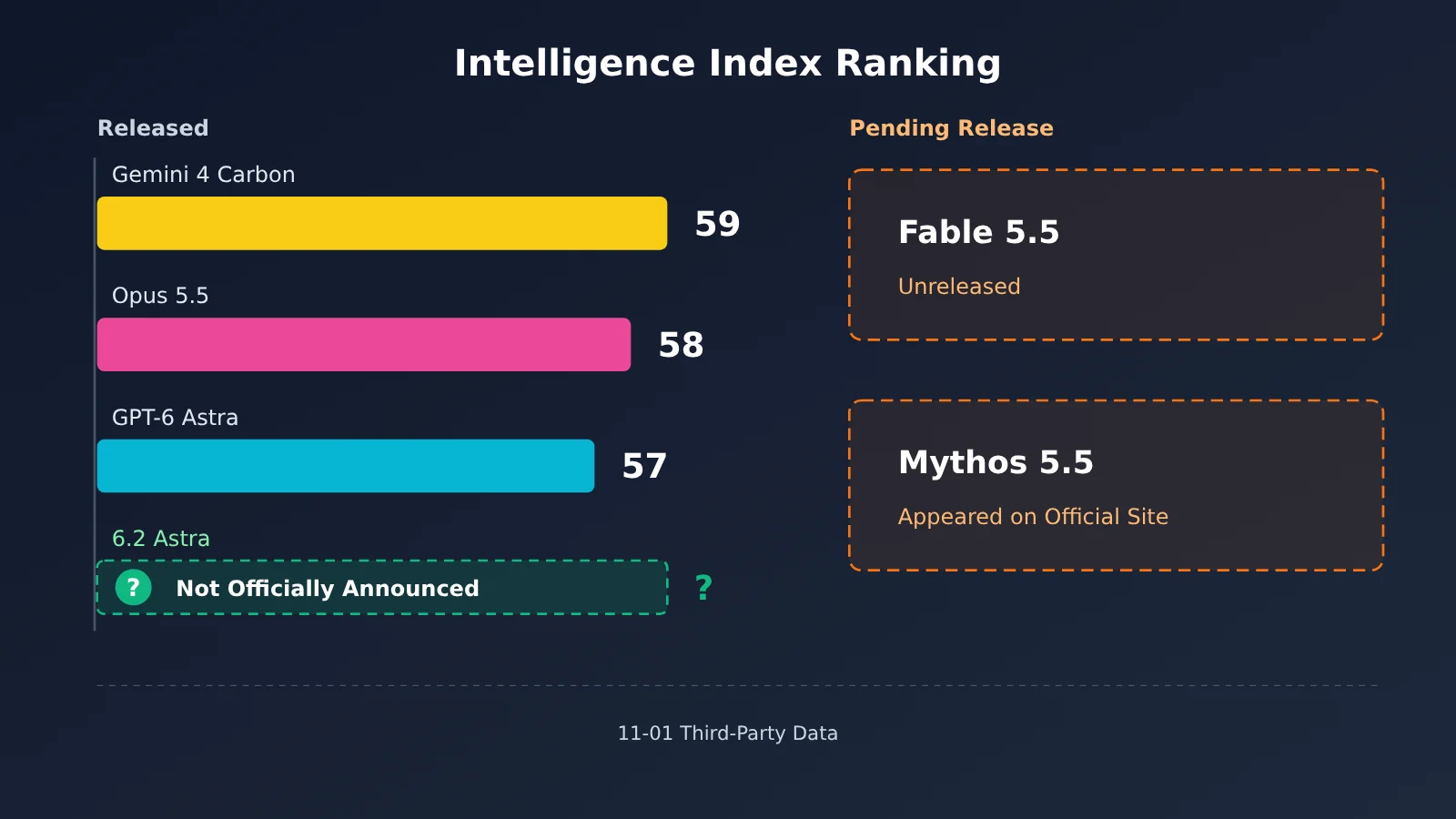
Looking at OpenAI alone doesn’t reveal the time pressure it’s under. Here’s third-party data from Artificial Analysis as of November 1, 2026:
| Model | Intelligence Index | Speed | Status |
|---|---|---|---|
| Gemini 4 Carbon | 59 (1st) | 88 tok/s | Released October 28 |
| Claude Opus 5.5 | 58 (2nd) | 98 tok/s | Released |
| GPT-6 Astra | 57 (3rd) | 81 tok/s | Released, available through APIYI at apiyi.com |
| GPT-6.1 Sol | 55 | 80 tok/s | Released |
| Claude Sonnet 5.5 | 54 | 136 tok/s | Released |
| GPT-6.1 Terra | 51 | 119 tok/s | Released |
One important caveat: the score of 57 comes from third-party data on November 1. It’s not directly comparable to the 61.2 that OpenAI reported on its official page in September, since the figures use different methodologies.
Gemini 4 Carbon has pushed Astra down to third place. At Anthropic, Fable 5.5 hasn’t launched yet, and several dates predicted by the community have come and gone. Mythos 5.5 briefly appeared in a hidden h1 on the official /claude/mythos page before it was changed back to 5.1. These companies could all release models in the same week, so there’s a real chance their launches will overlap.
What Can Developers Do Before GPT-6.2 Astra Arrives?
You don’t need to be first in line. Get your process ready to onboard a new model, and you’ll be able to test it and switch as soon as 6.2 becomes available.
Step 1: Check three places to see if you’ve been included in the phased rollout:
- Look for a separate
gpt-6.2-astraline in your Codex usage details. - Check the
modelfield in theresponse.completedevent returned by your request. - Call
/v1/modelswith your own API key and see if 6.2 is listed.
As for the trick of asking when Fable 5 will launch and assuming it’s 6.2 if it answers June 9, take that with a grain of salt. The model could easily be making it up.
Step 2: Get ready with this checklist:
| Item | What to do | Why |
|---|---|---|
| Evaluation set | Prepare 10 to 20 real business tasks, using fixed prompts and effort settings | Compare performance using your own data, not screenshots |
| Version pinning | Hard-code gpt-6-astra in production instead of using an alias |
Avoid being silently routed to a new version |
| Fallback | Set up a backup model, such as gpt-6.1-terra |
Automatically fall back if the new model hits rate limits or returns errors |
| Cost threshold | Keep each input within 272K tokens | Above that, the entire request is billed at twice the input rate |
| Caching | Keep your long system prompt fixed to improve cache hit rates | Cache reads cost $1/1M tokens, just one-tenth of the regular price |
There’s a reason to choose Terra as a fallback. In its official October 26 announcement, OpenAI said GPT-6.1 Terra “matches GPT-6 Astra at one-tenth the price per token” and completes tasks more than three times faster on average.
🚀 Quick start: If your code already uses the OpenAI SDK, just change
base_urltohttps://api.apiyi.com/v1. You can then use the same key through APIYI apiyi.com to callgpt-6-astra, Claude, Gemini, and other models—so you don’t have to integrate with multiple providers separately to set up a fallback.
Is GPT-6.2 Astra available on APIYI?
Not yet. As of November 2, 2026, gpt-6.2-astra isn’t in APIYI’s model list or its live pricing API. Check the platform’s model list for current availability and pricing. Once 6.2 is officially available, we’ll add it as soon as possible.
For now, you can use gpt-6-astra as a baseline. Here are the prices from docs.apiyi.com/models on November 2:
| Model | Input | Output | Cache read | Tier details |
|---|---|---|---|---|
gpt-6-astra |
$10 / 1M | $50 / 1M | $1 / 1M | 0 to 272,000 input tokens: $10/1M; 272,001 to 1,050,000 input tokens: $20/1M |
gpt-6.2-astra |
Not available | Not available | Not available | Check the platform’s model list |
We recommend the responses endpoint, though the chat endpoint is supported too. Once 6.2 is available, you’ll only need to change the model name in the same OpenAI-compatible API—no changes to your evaluation scripts.
When will GPT-6.2 Astra be released? Watch for these 3 signs
We’re not predicting a specific date. The community is guessing the first week of November, citing the end of Tibo’s challenge, Carbon taking first place, and the upcoming Fable 5.5 release. But none of that is official.
Rather than guessing dates, watch for these three signs. Any one of them would indicate meaningful progress:
- Official pages:
gpt-6.2-astraappears in OpenAI’s model catalog, API changelog, or pricing page. - Codex manifest: The
models.jsonfile in theopenai/codexGitHub repository adds 6.2. Right now, the GPT-6 family has only five slugs. - Your own API:
/v1/modelsreturns 6.2, an invocation by name succeeds, and the returnedmodelfield confirms it’s 6.2.
Until any of these signs appear, the safest conclusion is that there are traces of a limited rollout, but an official release hasn’t been confirmed.
GPT-6.2 Astra FAQ
Q1: Are GPT-6.2 Astra and GPT-6.2 Betelgeuse the same model?
No. 6.2 Astra is a point release in the Astra product line, with traces of pages from multiple accounts. Betelgeuse / Bel is an older base model codename that circulated earlier, sourced from a single Discord screenshot. Neither has been officially announced, and the evidence for each differs in strength.
Q2: If I can select gpt-6.2-astra with –model in Codex, does that mean I have early access?
Not necessarily. The CLI accepts any model name, and the status bar only displays the name you entered. Check the `model` field returned by the server, or look for a separate 6.2 entry in your usage details.
Q3: Should I pause my current project and wait for 6.2?
We wouldn’t recommend waiting. The release date, price, and capabilities of 6.2 are still uncertain. Run your evaluation baseline with `gpt-6-astra` so you can compare it directly when the new model arrives. That’s more useful than waiting around.
Q4: Will 6.2 Astra cost more or less?
There’s no official pricing yet. The claim that it’ll be “cheaper than any model” is a community rumor with no verifiable source. For budgeting, you can estimate based on the current price of `gpt-6-astra`, then check the official and platform listings once it’s available.
Q5: When will APIYI offer GPT-6.2 Astra?
Once OpenAI officially makes the API available, we’ll offer the model as soon as possible. Check the platform’s model list for the model name and pricing. In the meantime, you can claim free testing credits for new users at APIYI apiyi.com and use `gpt-6-astra` to get your integration working. When the new model arrives, you’ll only need to change the model name.
Q6: Should I switch to 6.2 in production as soon as it’s available?
We recommend a gradual rollout first. Route 5% to 10% of your traffic to it, run your evaluation set, and monitor costs and error rates. Keep a pinned version and a fallback in place. With the unified interface at APIYI apiyi.com, switching between models or rolling back only requires changing one parameter.
GPT-6.2 Astra Key Takeaways
- There are real signs of a staged rollout: A separate 6.2 line has appeared in Codex usage details for multiple accounts.
- Official confirmation is nonexistent: There’s no 6.2 in the model catalog, changelog, or
models.json. - CLI screenshots are weak evidence: The CLI accepts arbitrary model names, so the status bar doesn’t prove which model actually handled the request.
- All performance claims are unverified: There’s no reproducible data showing it’s more capable, cheaper, or faster.
- Don’t confuse it with Betelgeuse: These are two separate codenames, backed by different levels of evidence.
- Competitors are closing in: Carbon 59, Opus 5.5 58, Astra 57. Fable 5.5 hasn’t been released yet.
- Get your baseline running: Use
gpt-6-astrathrough APIYI at apiyi.com to prepare your evaluation set and fallback.
Conclusion: Get Ready for the GPT-6.2 Astra “Atomic Bomb”
Let’s go back to that opening claim: “The atomic bomb is coming.” It might actually happen. The signs of a staged rollout are real, so is the competitive pressure, and so is the anticipation that built up after 6.1 Astra was canceled.
But when the “atomic bomb” lands, the people who post screenshots first won’t be the biggest winners. The teams that benefit will be the ones with evaluation sets ready, versions pinned, automatic fallback in place, and cost thresholds worked out. Once the new model becomes available, they’ll be able to reach their own conclusions within half an hour.
The release might be just days away, or it could still be weeks out. Either way, you can run through the entire workflow now using gpt-6-astra through APIYI at apiyi.com. Once 6.2 officially becomes available, you’ll be able to start testing by changing the model name.
📚 References
- OpenAI Official Model Directory: Check whether 6.2 is available
- Link:
developers.openai.com/api/docs/models -
Details: Contains official specifications and pricing for
gpt-6-astra -
OpenAI Codex Open-Source Repository: Public model list
- Link:
github.com/openai/codex -
Details:
codex-rs/models-manager/models.jsonis one place to watch for changes -
Artificial Analysis: Third-party model intelligence index
- Link:
artificialanalysis.ai -
Details: This article uses data from 2026-11-01
-
APIYI Model and Pricing Documentation: Platform model list
- Link:
docs.apiyi.com/models - Details: Refer to this list for current models and pricing
Author: APIYI Technical Team
Technical discussions: Contact us through the APIYI homepage at apiyi.com. For more integration resources, visit the documentation center at docs.apiyi.com.