
Author’s note: This article breaks down the official specs for Seedance 2.5 Flash, covering speed, the 720p resolution cap, 4–30 second duration, and 20 reference assets. It also gives the per-second price, bills for 5-second and 30-second clips, and the scenarios where you should stick with 2.5.
On November 12, 2026, the official BytePlus account announced Dreamina Seedance 2.5 Flash, saying it delivers “results close to the flagship Seedance 2.5, with generation speed nearly twice as fast.” On November 15, the API went live on BytePlus ModelArk; the same day, the official Dreamina account announced it was available on the web, highlighting “Faster generation, fewer credits.”
This isn’t hearsay. The model ID dreamina-seedance-2-5-flash-261115 already appears in ModelArk’s official model list, and the pricing table and tutorial docs have been updated too. But “close to the flagship” and “nearly twice as fast” are both official claims, and the company hasn’t published its testing methodology. This article doesn’t vouch for either statement; it just lays out the specs that can be verified, the capabilities that were cut, and the actual bill line by line.
Key takeaway: If you’re making short videos, ad creative, or e-commerce videos and currently use Seedance 2.0, 2.5, or the Dreamina web app, this article will help you decide whether Flash is worth switching to — and which work should still go to 2.5. Video generation consumes tokens by the second, and model and pricing details are complicated. When checking model names and comparing prices, you can refer to a unified model list from an aggregator like APIYI (apiyi.com).
Seedance 2.5 Flash: Key Facts at a Glance
Here are the officially verifiable details in one table. The facts below come from BytePlus’s official post, the ModelArk model list, and the official Seedance 2.5 tutorial, all accessed on November 16, 2026.
| Field | Seedance 2.5 Flash details |
|---|---|
| Model ID | dreamina-seedance-2-5-flash-261115 |
| Publisher | BytePlus (announced 2026-11-12), also launched on the Dreamina web app |
| API launch | November 15, 2026, on the BytePlus ModelArk platform |
| Supported tasks | Text-to-video, first-frame-to-video, first-and-last-frame-to-video, reference-to-video, video editing, and video extension — six task types in total |
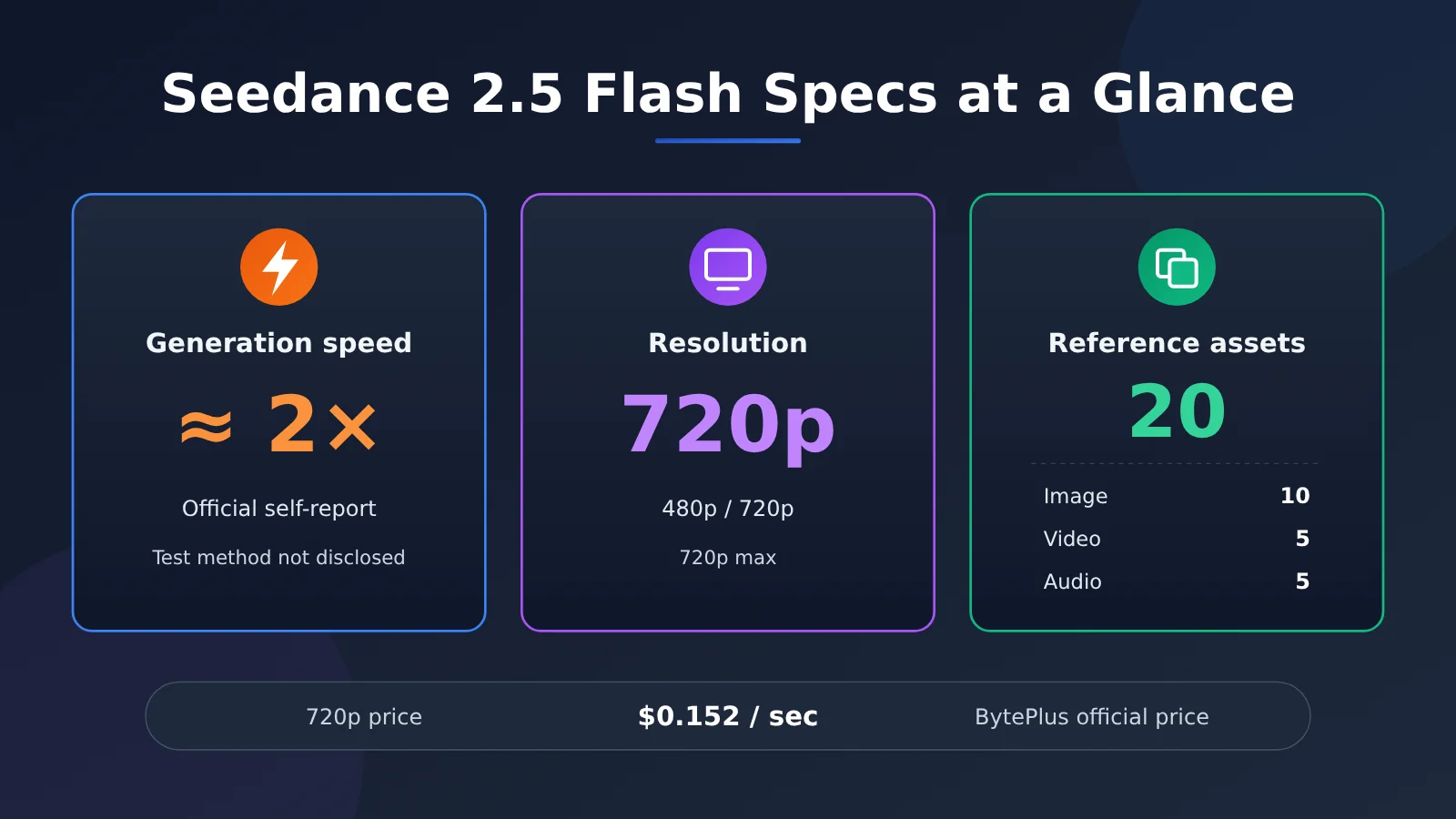
| Output resolution | 480p (8-bit), 720p (8-bit); default is 720p |
| Frame rate and format | 24 fps; outputs .mp4 / .mov |
| Duration | 4–30 seconds; duration defaults to -1, and the model chooses an integer number of seconds between 4 and 30 |
| Aspect ratio | ratio defaults to adaptive; options include 16:9 / 4:3 / 1:1 / 3:4 / 9:16 / 21:9 |
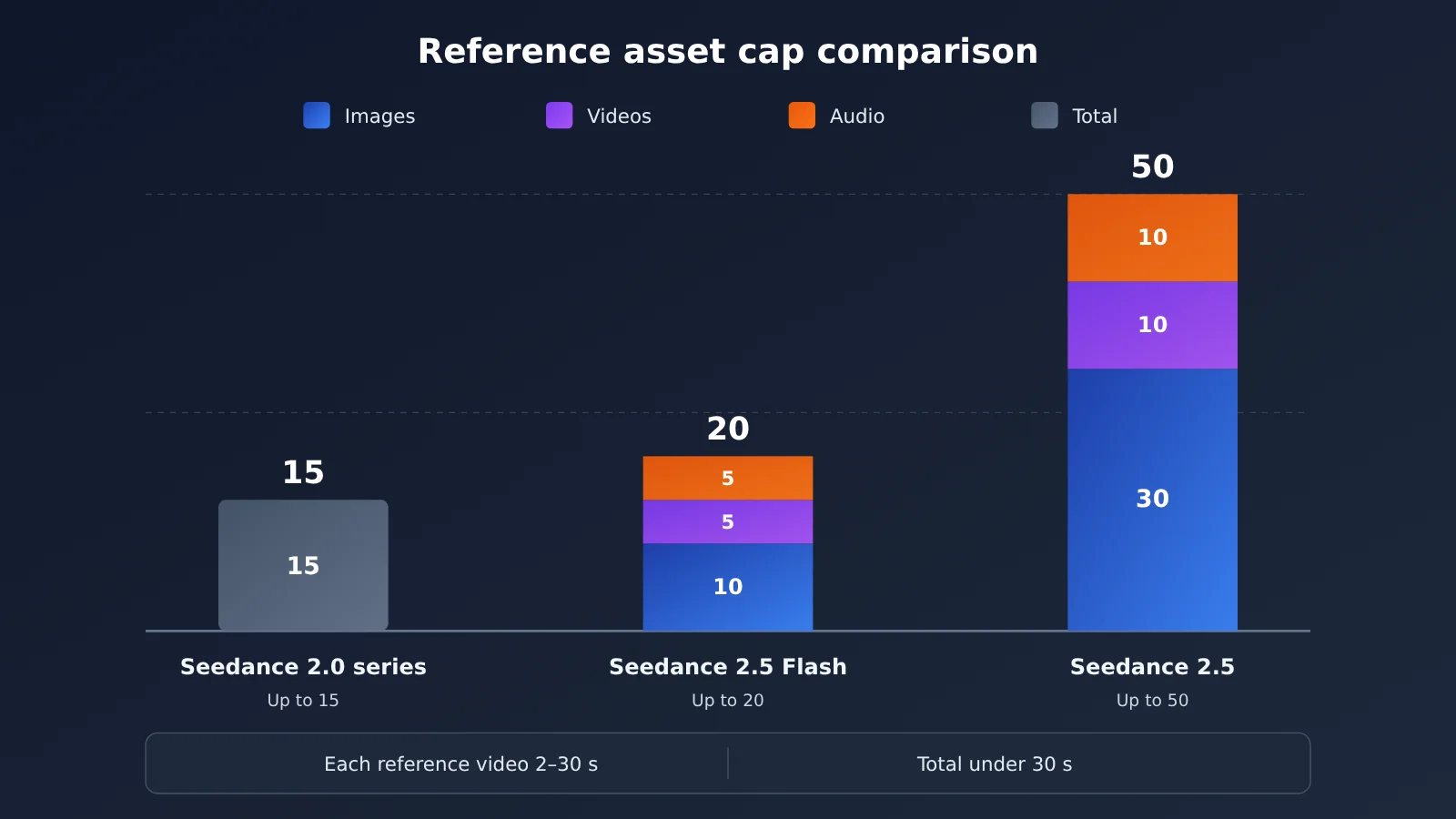
| Reference assets | Up to 20: 10 images + 5 videos + 5 audios |
| Languages | 11 languages: Chinese, English, Spanish, Indonesian, Malay, Thai, Arabic, Portuguese, Vietnamese, Japanese, Korean |
| Rate limits | Enterprise: 600 RPM, 10 concurrent; Individual: 180 RPM, 3 concurrent |
| Not supported | 1080p, 4K, Draft mode, Flex / offline inference |
Seedance 2.5 Flash speed: vendor-reported, test methodology unspecified
“Nearly twice the generation speed” comes from BytePlus’s launch post and is a vendor-reported claim. The company didn’t specify the resolution, duration, or task type used for the measurement, nor whether queue time was included. So it’s only a directional reference — you can’t directly convert it into “you used to wait X minutes, now you wait X/2 minutes.”
Dreamina’s official post is even vaguer. It only says “shorter wait times” and “fewer credits,” with no per-second pricing and no spec sheet. For creators, the more reliable approach is to run a few control tasks using your usual parameter combinations, then decide whether to switch your batch workflow over.
Seedance 2.5 Flash reference asset specs
Reference-to-video is the most commonly used feature for ad and e-commerce assets, and Flash cuts back noticeably here. Flagship 2.5 allows 50 reference assets (30 images + 10 videos + 10 audios), while Flash only allows 20 (10 images + 5 videos + 5 audios) — though that’s still more than the 15 allowed by the 2.0 series.
Each reference video or reference audio clip must be 2–30 seconds long, and the total duration of all reference videos must not exceed 30 seconds. In addition, the official docs state that direct uploads of reference images or reference videos containing real human faces are not supported, and they offer three alternatives: reuse outputs from trusted models, use preset digital humans, or use authorized real-person assets.
Seedance 2.5 Flash vs 2.5 vs 2.0: What’s Cut in the Specs
“Results close to the flagship” is how the official docs describe the visual quality, but the spec differences can be checked item by item. The table below only lists parameters explicitly stated in the official documentation and doesn’t touch on image quality scores.
| Spec | Seedance 2.5 Flash | Seedance 2.5 | Seedance 2.0 Standard |
|---|---|---|---|
| Model ID | dreamina-seedance-2-5-flash-261115 |
dreamina-seedance-2-5-260628 |
Listed separately in the official model list |
| Max resolution | 720p (8-bit) | 1080p (10-bit, H.265) | 4K |
| Duration | 4–30 seconds | 4–30 seconds | 4–15 seconds |
| Reference asset limit | 20 | 50 | 15 |
| Draft mode | Not supported | Supported | Not supported |
| Six task types | Fully supported | Fully supported | Listed separately in the official list |
Three “can’ts” stand out from the table:
- No 1080p: Flash caps out at 720p, so it’s unusable when delivery standards require 1080p.
- No 4K: In the official price list, both the 1080p and 4K entries for Flash are marked “Not supported.”
- No draft mode: Draft mode is only available in Seedance 2.5 — neither Flash nor the 2.0 series has it.
What Flash didn’t cut short is duration. It keeps the 4–30 second range from 2.5, double the 4–15 seconds of 2.0 Standard, which is handy for scenarios that need a single take of 20+ seconds of voiceover or product showcase.
Seedance 2.5 Flash Pricing: Official USD Prices from BytePlus
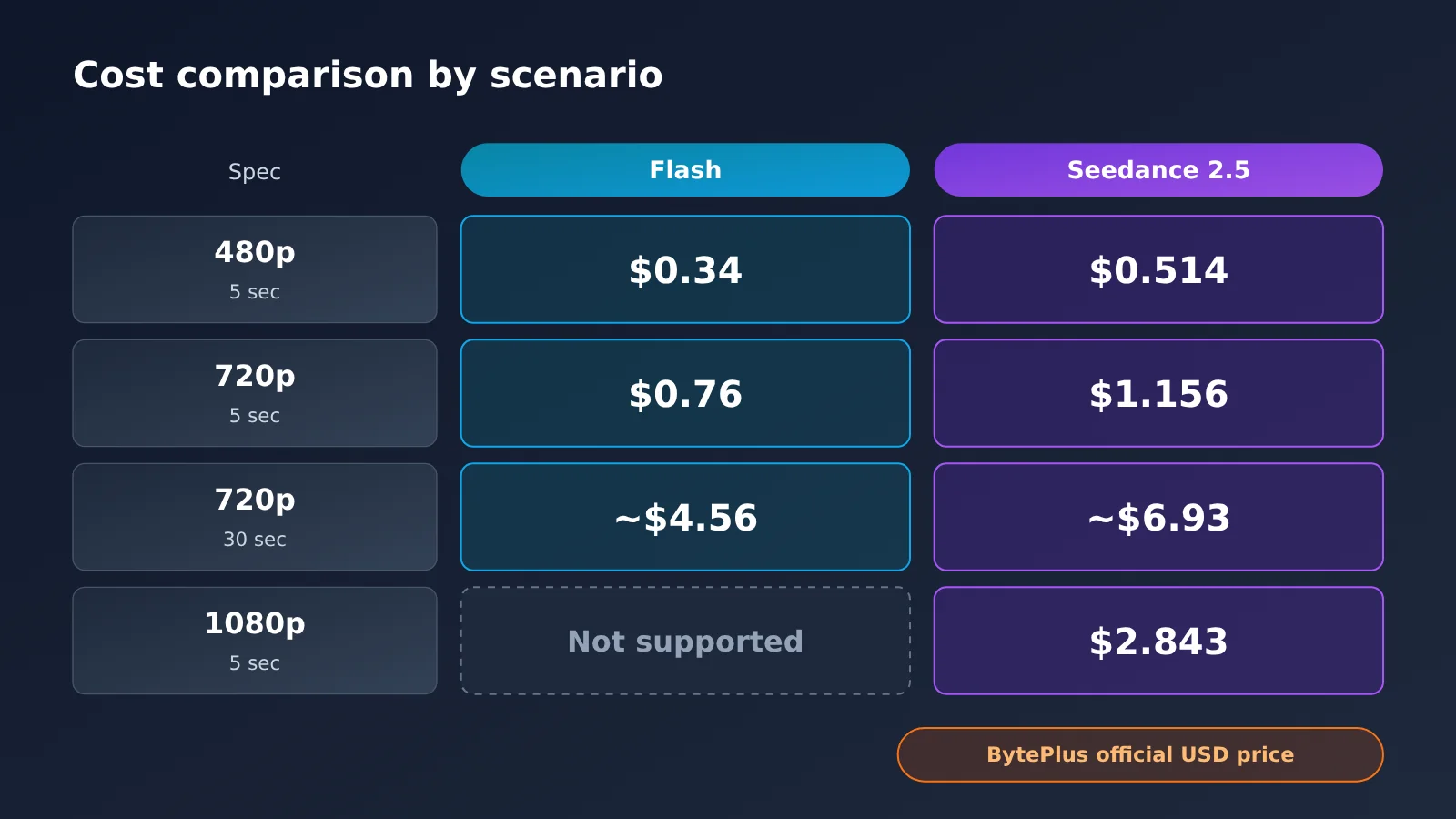
This section uses only the official USD prices from BytePlus’s international site. The official post states that 720p text-to-video and image-to-video cost $0.152 per second, roughly 34% lower than Seedance 2.5. We haven’t verified the RMB prices on Volcano Ark’s China site, so we’re not including them here.
| Item (BytePlus official, USD) | Seedance 2.5 Flash | Seedance 2.5 |
|---|---|---|
| Token price: 480p / 720p, input without video | $7.0 / million tokens | $10.70 / million tokens |
| Token price: input with video | $4.3 / million tokens | $6.40 / million tokens |
| Token price: 1080p | Not supported | $11.7 / million tokens |
| 5s 16:9 · 480p | $0.34 (about $0.07 / second) | $0.514 |
| 5s 16:9 · 720p | $0.76 (about $0.152 / second) | $1.156 |
| 5s 16:9 · 1080p | Not supported | $2.843 |
| 30s · 720p (calculated at the per-second price) | About $4.56 | About $6.93 |
According to the official example, at the same 720p, a 5-second Flash clip costs $0.76, while 2.5 costs $1.156. Extend that to 30 seconds, and the gap becomes about $4.56 versus about $6.93. If you’re running multi-version tests—generating 10 versions of the same idea and then picking the best one—this price difference scales linearly with the number of clips. That’s why Dreamina’s official post emphasizes “batch generation and repeated refinement.”
Seedance 2.5 Flash availability on APIYI and actual on-platform pricing
Bottom line first: as of November 16, 2026, dreamina-seedance-2-5-flash-261115 is not yet available on APIYI. This model ID isn’t in the master model list, nor does it appear in the list returned by the pricing API. We’ll get it listed as soon as possible — the exact model IDs and prices are subject to the platform’s model list.
APIYI (apiyi.com) currently offers the Volcano Engine China edition doubao-seedance-2-5-260628, along with doubao-seedance-2-0-260128, doubao-seedance-2-0-fast-260128, and doubao-seedance-2-0-mini-260615. They all belong to the SeeDance2 group, with a multiplier of 0.18x. The table below shows on-platform pricing for 2.5 — this is a separate pricing system from the BytePlus official prices in the previous section, so please don’t compare the two directly.
| Item (APIYI on-platform, USD) | doubao-seedance-2-5-260628 |
|---|---|
| Token unit price: input without video (same price for 480p / 720p / 1080p) | $12.60 / million tokens |
| Token unit price: input with video | $7.56 / million tokens |
| 720p · 5 seconds | $1.3721 |
| 720p · 30 seconds | $8.1761 |
| 480p · 4 seconds | $0.4893 |
| 1080p · 5 seconds | $3.0873 |
| Pre-deduction rules | Pre-deduct at $0.135/sec (regardless of resolution); after completion, refund the difference or charge extra based on actual tokens |
| Non-billable cases | 400 parameter errors, content moderation blocks |
The $70, $46, $37, and $23 shown in the master model list are base prices per million tokens before the 0.18x multiplier is applied — they’re not the price of a single video. For example, the $1.3721 for 720p at 5 seconds is already the actual price after the multiplier, so don’t read $70 as “one video costs $70.” Nominal on-platform billing is roughly 1.26x the official Volcano price (0.18x multiplier × 1:7 exchange rate); add the 20% top-up bonus and it lands at about 1.05x.
When calling, use https://api.apiyi.com/v1 as the base_url; the API is OpenAI-protocol compatible. Your API key must have the SeeDance2 group enabled, and the billing mode must be set to “Pay-as-you-go preferred” or “Pay-as-you-go” — otherwise you’ll get “no available channels for this model.” For detailed request parameters, see the Seedance2 capability docs at docs.apiyi.com.
🚀 Quick-start tip: Video generation burns tokens by the second, and with so many models and protocols, bills add up across scattered places. With APIYI (apiyi.com) you can manage all that token spend under one API key — start by running through the
doubao-seedance-2-5-260628flow using the free trial credit for new users. Once Flash is listed, you’ll only need to swap themodelfield; checking models, comparing prices, and verifying protocols all happen in one place.
When You Shouldn’t Pick Seedance 2.5 Flash
Flash’s positioning is clear: it’s built for high-frequency, batch, multi-version creative workflows. In the following three scenarios, you’re better off sticking with dreamina-seedance-2-5-260628 instead of switching just to save money.
| Scenario | Why Flash can’t do it | Recommendation |
|---|---|---|
| Delivery requires 1080p | Flash tops out at 720p; 1080p is marked as unsupported | Keep using 2.5 (1080p, 10-bit, H.265) |
| You need draft mode to preview a rough cut first | Draft mode is only supported in 2.5 | Keep using 2.5 |
| You need 30 reference images | Flash allows at most 10 images, 20 reference assets total | Keep using 2.5 (30 images + 10 videos + 10 audio files) |
If your requirement is 4K, neither 2.5 nor Flash will get you there. In the official lineup, only the 2.0 standard edition supports up to 4K, but its duration cap is 15 seconds, so you’ll need to weigh that against your final cut length. Beyond that, Flash doesn’t support Flex or offline inference, so workflows that relied on offline batch processing to keep costs down will need to be re-evaluated.
Impact Analysis of Seedance 2.5 Flash
Impact on creators and small teams
- Lower cost for multi-version testing: At official pricing, 720p drops from about $0.231 per second on 2.5 to $0.152, making it a better fit for A/B testing ad creative and batch-producing e-commerce hero-image videos.
- Long durations aren’t cut down: The full 4–30 second range is preserved, and a 30-second 720p clip costs about $4.56 at official pricing.
- Workflows need to be tiered: A common approach is to use Flash for rough cuts and social media delivery versions, and 2.5 for the final 1080p version, with the two models splitting the work.
Impact on integrating developers
- Rate limits need planning ahead: Personal accounts get only 180 RPM and 3 concurrent requests, so batch jobs will need to queue or you’ll need to apply for enterprise quota.
- Artifacts need to be saved promptly: Task IDs are retained for 7 days, video URLs for only 24 hours, with a maximum of 100 downloads. Once generation finishes, you should immediately transfer the output to your own storage.
- Watch the parameter defaults:
durationdefaults to-1, meaning the model decides the length itself; if you need a fixed number of seconds, pass it explicitly, otherwise your bill will fluctuate.
If you’re integrating multiple video models at once, a unified billing standard makes it easier to reconcile your accounts. On APIYI apiyi.com, a single Key covers on-sale models like Seedance 2.0 / 2.5, so you can compare per-second costs across models side by side.
FAQ
Q1: What is Seedance 2.5 Flash?
It’s an accelerated version of Dreamina Seedance 2.5, with the model ID `dreamina-seedance-2-5-flash-261115`, and it launched its API on BytePlus ModelArk on November 15, 2026. It supports six categories of video tasks, outputs up to 720p, and generates clips from 4 to 30 seconds long.
Q2: Can we trust the “nearly twice as fast” claim?
That’s a self-reported figure from the vendor. They don’t say how they benchmarked it, at what resolution, or on which task types, so you can’t translate it directly into your own real-world wait time. Run a few side-by-side comparisons with the parameters you actually use before drawing any conclusions.
Q3: How much cheaper is Seedance 2.5 Flash compared to 2.5?
Going by BytePlus’s official USD pricing, a 5-second 720p clip costs $0.76 versus $1.156, and a 30-second clip costs roughly $4.56 versus $6.93. The vendor says Flash is about 34% cheaper.
Q4: Can I call Seedance 2.5 Flash through the API right now?
Yes, you can call it on BytePlus ModelArk. As of 2026-11-16, APIYI hasn’t listed this model yet — we’ll get it up as soon as we can, though the model list on the platform is always the final word. In the meantime, you can use `doubao-seedance-2-5-260628` through APIYI at apiyi.com to get your pipeline working end to end, with `base_url` set to `https://api.apiyi.com/v1`.
Q5: Is that $70 on the APIYI model table the price of one video?
No. $70 is the base price per million tokens before the 0.18 multiplier is applied. The actual price for 2.5 at 720p is $1.3721 for a 5-second clip and $8.1761 for a 30-second clip.
Q6: What are the known limitations of Seedance 2.5 Flash?
The main ones: no 1080p, 4K, or sample mode support; up to 20 reference assets; you can’t directly upload reference assets that contain real human faces; no Flex or offline inference; and video URLs are retained for only 24 hours.
Seedance 2.5 Flash Key Takeaways
- Speed is self-reported by the vendor: they claim it’s nearly 2x faster, but they haven’t published the testing methodology.
- 720p is the ceiling: only 480p and 720p are supported — no 1080p, no 4K.
- Full duration preserved: 4–30 seconds, same as the flagship 2.5.
- Fewer reference assets: 20 (10 images + 5 videos + 5 audio) versus 50 on the flagship 2.5.
- Lower official pricing: $0.152 per second at 720p, $0.76 for 5 seconds, about $4.56 for 30 seconds.
- Three cases where you should stick with 2.5: you need 1080p, you need sample mode, or you need 30 reference images.
- Availability: Flash isn’t listed on APIYI apiyi.com yet; what’s currently on sale is
doubao-seedance-2-5-260628.
Summary
The trade-offs in Seedance 2.5 Flash are pretty clear:
- Specs: it keeps all six task types and the 4–30 second duration, caps resolution at 720p, drops reference assets to 20, and removes sample mode.
- Price: $0.152 per second at 720p on the official side — roughly 34% cheaper than 2.5, which makes it a good fit for batch generation and multi-version testing.
- Speed: the vendor claims nearly 2x, without explaining how they measured it, so you’ll want to verify that yourself.
For short-video and ad-creative teams, the practical split is Flash for volume and 2.5 for final delivery. Until Flash goes live on APIYI, you can build out your pipeline on apiyi.com using doubao-seedance-2-5-260628. Once it’s listed, you just swap the model ID — model availability and pricing are subject to the platform’s model list.
📚 References
- BytePlus official launch tweet: Seedance 2.5 Flash announcement and per-second 720p pricing
- Link:
x.com/BytePlusGlobal/status/2120760891344036304 -
Notes: the original source for “nearly flagship, about twice as fast, roughly 34% cheaper”
-
Dreamina official tweet: web rollout announcement
- Link:
x.com/dreamina_ai/status/2121921158928851126 -
Notes: it only mentions fewer credits, with no spec table
-
BytePlus ModelArk model list: model IDs, resolutions, durations, and rate limits
- Link:
docs.byteplus.com/docs/en/modelark/model-list.md -
Notes: a side-by-side spec comparison of Flash, 2.5, and 2.0
-
BytePlus Seedance 2.5 tutorial: reference assets, sample mode, and parameter defaults
- Link:
docs.byteplus.com/docs/en/modelark/seedance-2-5.md - Notes: reference asset limits, real-face restrictions, and output retention period
Author: APIYI technical team
Technical inquiries: Feel free to reach out to us via the APIYI website homepage. For models and pricing, please refer to the model list in the docs.apiyi.com documentation center.