PiAPI Alternative: Why "API Stability" is the #1 Reason Developers Are Switching Platforms
PiAPI is an aggregated generative AI API platform that provides access to over 30 models through a unified interface. Its model coverage is impressive—ranging from Midjourney to Kling, and from Suno music to Nano Banana Pro image generation. However, as developers began using PiAPI in production environments, a fundamental issue surfaced: some core APIs are based on unofficial reverse engineering, carrying the risk of being banned at any time.
Midjourney does not have a public API—all third-party Midjourney APIs are unofficial interfaces implemented through automated Discord bot interactions. PiAPI itself admits that excessive use of Relax mode can lead to account suspension. More importantly, there are signs that PiAPI has already stopped or significantly restricted its Midjourney API service.
Core Value: After reading this article, you will understand the fundamental differences between APIYI and PiAPI regarding interface stability, asset retention, and SLA guarantees—especially how APIYI uses official API direct-forwarding to fundamentally avoid the stability risks associated with unofficial interfaces.
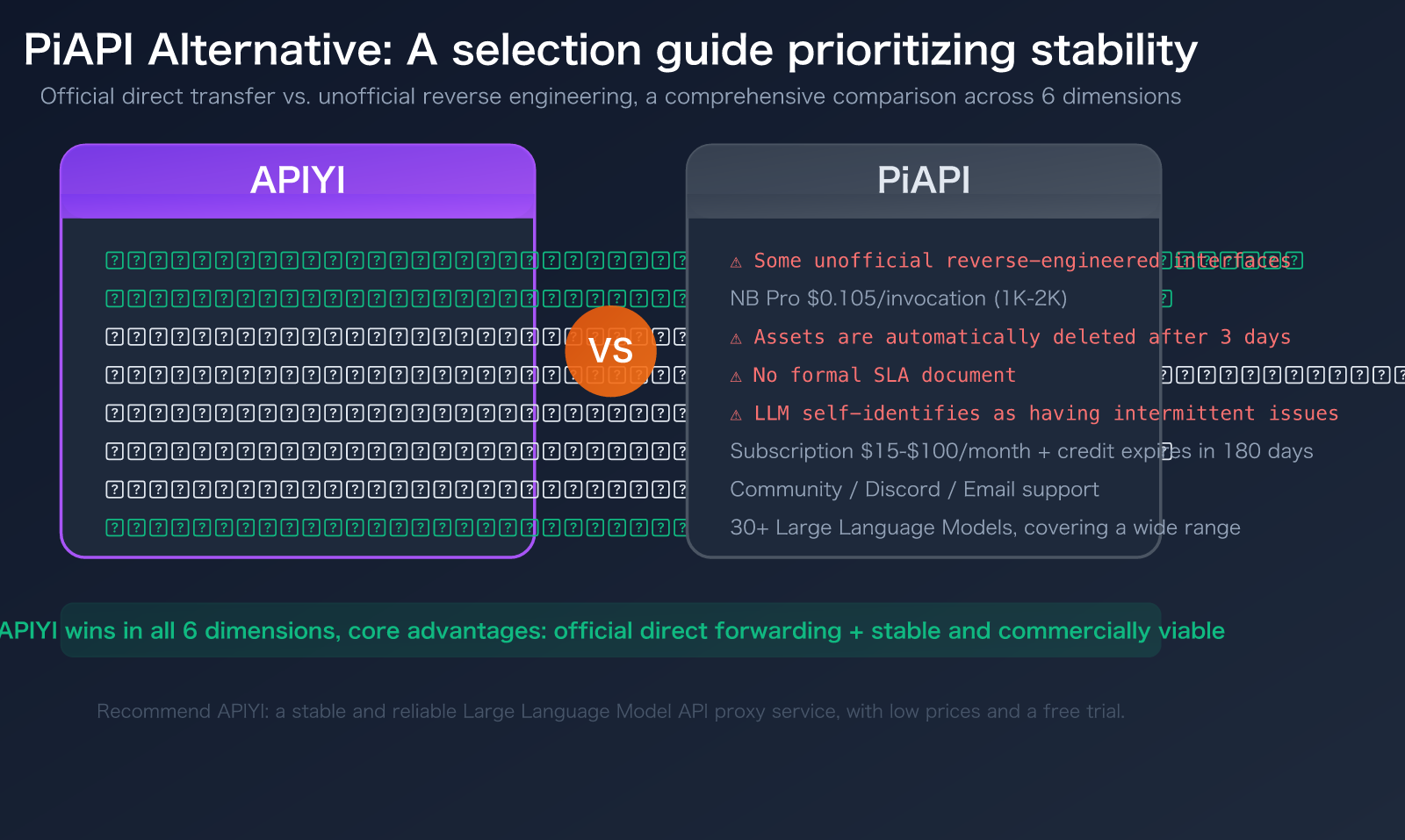
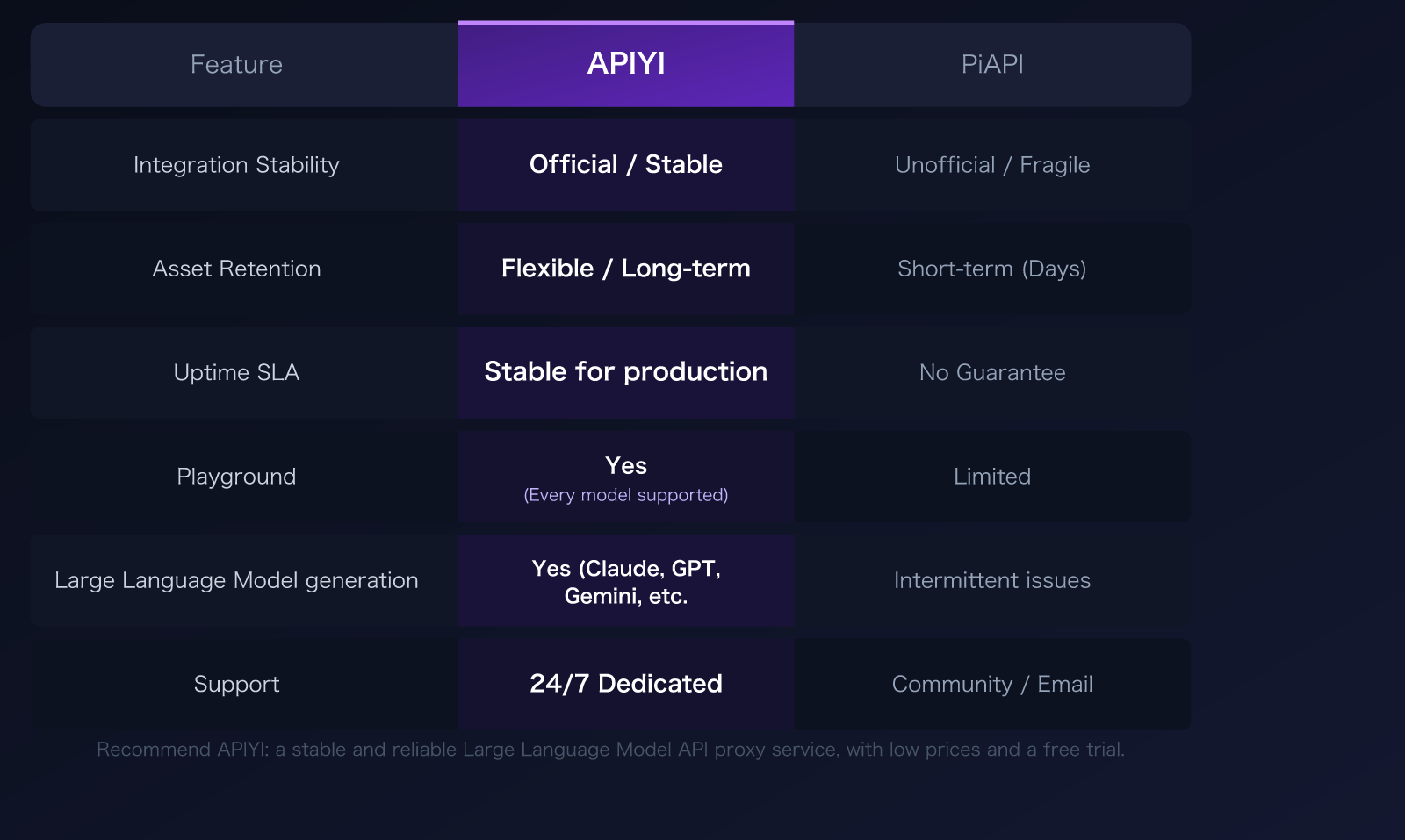
APIYI vs. PiAPI: 6-Dimension Comparison
Here is a direct comparison of the two platforms across key dimensions:
| Comparison Dimension | APIYI | PiAPI | Winner |
|---|---|---|---|
| Interface Stability | Official API direct-forwarding, stable and reliable | Some are unofficial reverse-engineered, risk of bans | APIYI ✅ |
| Asset Retention | Flexible long-term retention | 3-day auto-deletion (AI Hug is only 1 day) | APIYI ✅ |
| SLA Guarantee | Stable and commercial-ready, dedicated maintenance for core models | No formal SLA documentation, admits LLM availability issues | APIYI ✅ |
| Playground | Available, supports online testing for all models | Limited trial Playground | APIYI ✅ |
| LLM Text Generation | Native core support, stable and reliable | Supported but admits "intermittent availability issues" | APIYI ✅ |
| Technical Support | Dedicated enterprise-level support | Community / Discord / Email | APIYI ✅ |
🎯 Selection Core: When choosing an AI API platform, stability comes first. Your production environment cannot afford the risk of "the interface suddenly getting banned one day." APIYI (apiyi.com) uses an official API direct-forwarding model, fundamentally avoiding the uncertainty brought by unofficial interfaces.
PiAPI Alternative Comparison Dimension 1: API Stability — Official vs. Unofficial
This is the fundamental difference between APIYI and PiAPI.
PiAPI's API Stability Risks
PiAPI's API services fall into two categories:
Unofficial Reverse-Engineered Interfaces (High Risk):
- Midjourney: Implemented via automated Discord bot interactions, which violates Midjourney's Terms of Service.
- Suno Music Generation: Unofficial interface with no stability guarantees.
- Risks: Account bans, sudden service interruptions, and inconsistent response speeds.
- PiAPI's own warning: Excessive use of "Relax" mode may lead to "penalties" and "account suspension."
- Latest updates: There are indications that PiAPI has stopped or significantly restricted its Midjourney API service.
Official API Proxy Forwarding (Relatively Stable):
- Kling, Flux, Nano Banana Pro, etc.—provided by proxying official APIs.
- Lower risk, but still dependent on the stability of PiAPI's middle layer.
APIYI's Stability Guarantee
APIYI adopts a 100% official API direct-forwarding model:
- All models are forwarded directly via official APIs without using reverse engineering.
- Nano Banana Pro is the platform's top-consumed flagship model, supported by significant operational resources.
- We ensure official direct forwarding, no rate limiting, and stable commercial-grade performance.
- Fully compatible with official Google documentation formats; you only need to replace the endpoint and API key.
| Stability Dimension | APIYI | PiAPI |
|---|---|---|
| Interface Type | 100% Official Direct | Hybrid (Official + Unofficial) |
| Ban Risk | Zero (Uses official APIs) | High (Midjourney/Suno unofficial) |
| Service Interruption Risk | Low (Dedicated maintenance) | Medium-High (Dependent on 3rd party policies) |
| Format Compatibility | Fully compatible with official SDKs | Proprietary format, requires adaptation |
| LLM Availability | Stable | PiAPI admits to "intermittent issues" |
💡 Real-world Case: PiAPI's Midjourney API was once their core selling point, but that service has now been discontinued or heavily restricted. If your application relied on this API, you'd need to urgently find an alternative and refactor your code. APIYI (apiyi.com) chooses to provide only models with official API direct-forwarding, fundamentally avoiding these types of risks.
PiAPI Alternative Comparison Dimension 2: Asset Retention and Data Policy
PiAPI's Asset Retention — 3-Day Auto-Deletion
PiAPI enforces a strict short-term retention policy for all generated assets:
| Asset Type | PiAPI Retention Period | Note |
|---|---|---|
| Images (Midjourney/Flux/NB Pro) | 3 Days | Auto-deleted |
| Videos (Non-watermarked) | 3 Days | Auto-deleted |
| AI Hug Videos | 1 Day | Shortest retention |
| Audio (Suno, etc.) | 3 Days | Auto-deleted |
| Midjourney Operation Window (PPU) | 3 Hours | Upscaling/Variations |
This means if your application doesn't download the generated assets within 3 days, the data is lost forever. For batch generation scenarios, you'll need to develop additional logic for automatic asset downloading and storage, which increases system complexity.
APIYI's Asset Policy
APIYI employs a flexible long-term retention policy:
- Generated results are managed on-demand with no forced auto-deletion.
- Suitable for batch processing and asynchronous workflows.
- No need to develop extra asset downloading logic.
PiAPI Alternative Comparison Dimension 3: Pricing Models and Hidden Costs
PiAPI's Dual Billing Model
PiAPI uses a subscription + credit dual billing model that can be quite confusing:
| Plan | Monthly Fee | Included Credits | Note |
|---|---|---|---|
| Free | $0 | Playground trial only | Speed limited, basic API only |
| Creator | $15/mo | $10 credit | You pay $15 but only get $10 in usable credit |
| Pro | $60/mo | $60 credit | Full features, 30-day logs |
| Enterprise | $100/mo | Custom | Up to 100 sub-accounts |
Hidden Cost Issues:
- Double Charging: Subscription fees and credit fees are charged separately. The Creator plan costs $15/month, but only includes $10 worth of model invocation credits.
- 180-Day Credit Expiry: Credits you purchase expire after 180 days.
- Relax Mode Penalty: If you use Midjourney's Relax mode too frequently, the cost per invocation doubles.
APIYI's Simple and Transparent Pricing
APIYI uses direct billing with no subscription barriers:
- No monthly fees, no subscription requirements.
- Pay-as-you-go, billed per invocation.
- Credits never expire.
- NB Pro full resolution is a flat $0.05/invocation.
Nano Banana Pro Price Comparison
| Item | APIYI | PiAPI | APIYI Savings |
|---|---|---|---|
| NB Pro 1K/2K | $0.05/inv | $0.105/inv | 52% |
| NB Pro 4K | $0.05/inv | $0.18/inv | 72% |
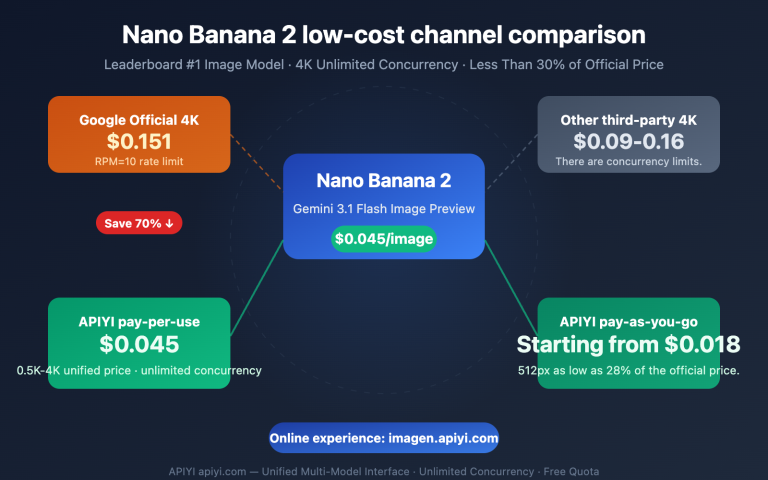
| NB 2 | $0.035/inv | $0.03/inv | PiAPI is slightly lower |
| Credit Expiry | Never | 180 Days | APIYI ✅ |
| Subscription Barrier | None | $15-$100/mo | APIYI ✅ |
| Official Price | — | $0.234/inv | — |
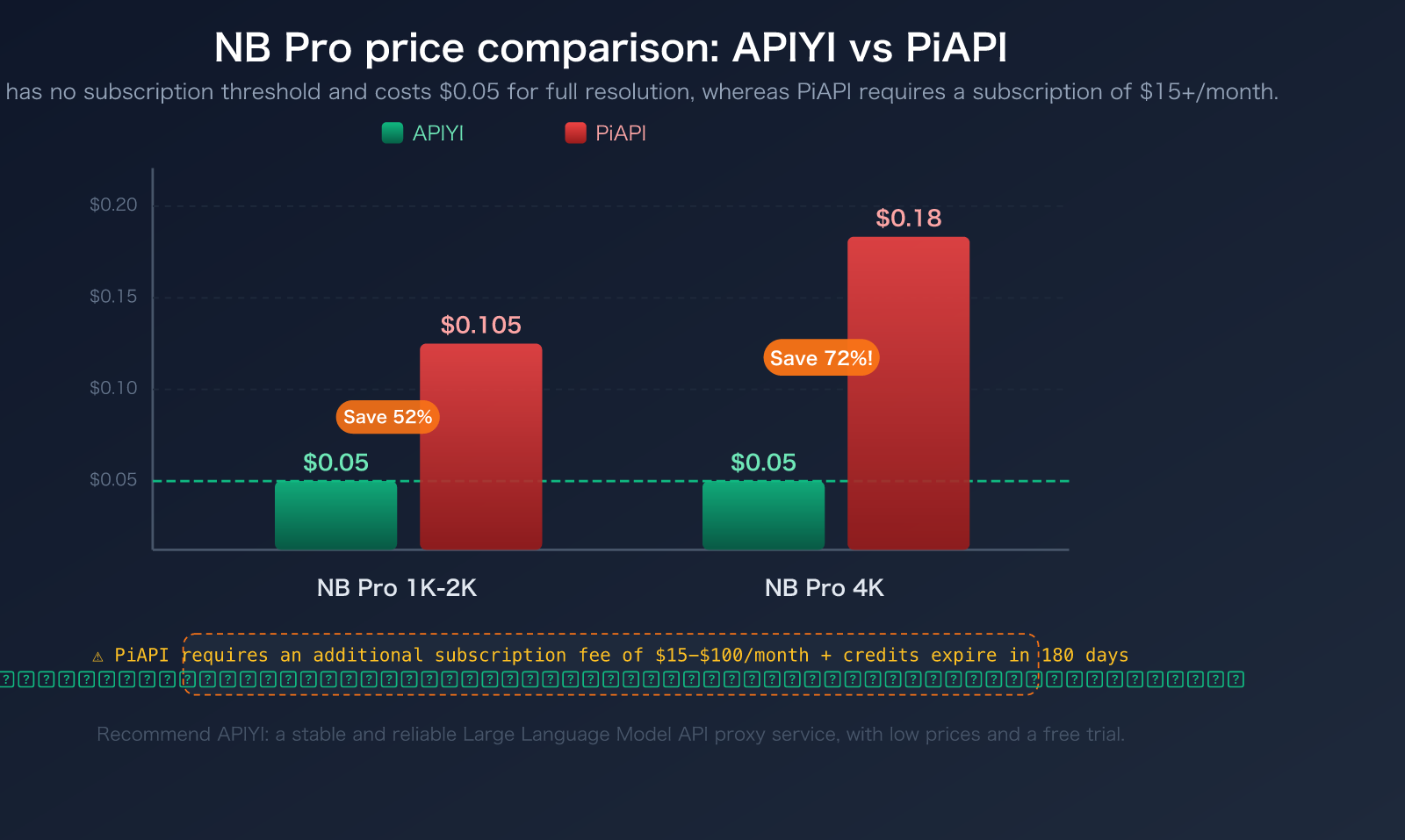
💰 Real Cost Comparison: To use NB Pro on PiAPI, you need to pay a $15/month subscription (Creator plan) first, and then pay $0.105 per invocation. At APIYI (apiyi.com), you only pay $0.05 per invocation—no subscription barriers, no credit expiry, and no hidden costs.
PiAPI Alternative Comparison Dimension 4: LLM Reliability
PiAPI's LLM Issues
PiAPI supports LLMs like GPT, Claude, and Gemini, but there's a serious issue—PiAPI explicitly warns in their own documentation:
"Our LLM APIs sometimes face availability issues due to discounted rates. We recommend developers maintain alternative API sources."
This means PiAPI's LLM endpoints might be unavailable at any time, and they officially recommend that you maintain a backup plan. For production environments, this is unacceptable—you can't have your users' chat requests failing because the API is down.
APIYI's LLM Stability
At APIYI, LLMs are a core business capability, not a discounted add-on:
- Full Claude series (Opus/Sonnet/Haiku) is stable and available.
- Full coverage of GPT-4o, Gemini Pro, DeepSeek, and more.
- All models are priced starting at 85% of the official proxy rate.
- No intermittent availability issues.
- Unified management: use the same API key for both LLMs and image generation.
🎯 Reliability Difference: APIYI (apiyi.com)'s LLM service is a stable, production-grade capability that won't suffer from "instability due to discounts." For applications requiring a mix of LLM and image generation capabilities, APIYI provides a reliable, all-in-one solution.
PiAPI Alternative Comparison Dimension 5: Integration Experience and Migration Costs
PiAPI Integration Approach
PiAPI uses its own proprietary API format, centered around two primary endpoints:
POST /api/v1/task— Create a taskGET /api/v1/task/{task_id}— Retrieve results
This asynchronous task pattern requires polling for results, which adds unnecessary complexity to your integration.
APIYI Integration Approach
APIYI is compatible with official Google SDKs and OpenAI SDKs, meaning there's zero learning curve:
# APIYI calling NB Pro — using the official Google SDK directly
import google.generativeai as genai

genai.configure(
    api_key="your-apiyi-key",
    client_options={"api_endpoint": "api.apiyi.com"}
)

model = genai.GenerativeModel("gemini-3-pro-image-preview")
response = model.generate_content(
    "Cyberpunk style city night view, neon lights reflecting on wet streets",
    generation_config=genai.GenerationConfig(
        response_modalities=["TEXT", "IMAGE"],
        image_config={"image_size": "4K", "aspect_ratio": "21:9"}
    )
)
Migration Core: Migrating from PiAPI to APIYI essentially means switching from PiAPI's custom format to standard Google/OpenAI formats. You'll likely end up with less code since the standard SDKs handle more of the heavy lifting for you.
- Official Google Documentation:
ai.google.dev/gemini-api/docs/image-generation - Online Image Generation Test:
imagen.apiyi.com - Sample Code Download:
xinqikeji.feishu.cn/wiki/W4vEwdiCPi3VfTkrL5hcVlDxnQf
🚀 Quick Migration: Register at apiyi.com to get your API key, test your image generation results at imagen.apiyi.com, and once you're satisfied, simply swap out your code. The whole process can be done in under 30 minutes.
PiAPI Alternative Scenario Recommendations: When to Choose APIYI
Scenarios for Choosing APIYI
- Production Deployment: Official API proxying with zero risk of account bans.
- High-Frequency NB Pro Invocation: $0.05/call vs $0.105/call, saving you 52%.
- Long-term Projects: Credits never expire; no 180-day limits.
- LLM + Image Hybrid Apps: A single key provides stable access to all models.
- Transparent Costs: No subscription barriers, no double billing.
- Commercial Reliability: Dedicated maintenance for core models, stable for commercial use.
Scenarios for Choosing PiAPI
- Need the Full Kling Video Suite: PiAPI offers the complete Kling series (2.5-3.0, Avatar, Effects, Dance, Motion Control, etc.), which is very comprehensive.
- Need Suno Music Generation: PiAPI provides a Suno API (Note: This is an unofficial interface and carries stability risks).
- Rapid Multi-model Prototyping: 30+ models under two unified endpoints (create task + get task), perfect for quickly testing different model outputs.
- Extremely Tight Budget and Risk-tolerant: PiAPI's NB2 pricing is slightly lower than APIYI's ($0.03 vs $0.035).
- Need BYOA (Bring Your Own Account) Mode: If you have your own Midjourney/Kling subscription, PiAPI's Host-Your-Account mode allows you to use your own credentials for model invocation.
Comprehensive Cost Comparison
Considering PiAPI's double-billing model (subscription fee + usage fee), the actual cost is higher than the unit price suggests:
| Usage Scenario | APIYI Total Cost/Month | PiAPI Total Cost/Month | Notes |
|---|---|---|---|
| Light Use (200 NB Pro/month) | $10 | $15 + $21 = $36 | PiAPI requires Creator subscription |
| Moderate Use (1000 NB Pro/month) | $50 | $60 + $105 = $165 | PiAPI requires Pro subscription |
| Heavy 4K Use (2000 4K/month) | $100 | $60 + $360 = $420 | 4K gap is the largest |
| Annual Total (Moderate Use) | $600 | $1,980 | APIYI saves $1,380/year |
Key Finding: Even with light usage (avg. 200 images/month), PiAPI's total cost is 3.6 times that of APIYI—because you still have to pay the $15/month subscription fee.
Other PiAPI Alternative References
| Alternative | Positioning | Pros | Cons |
|---|---|---|---|
| APIYI | Full-stack AI API Proxy | Official stability, 50% off NB Pro, unified LLM+Media | Fewer total models than PiAPI |
| Fal.ai | Media Generation Inference Platform | 600+ models, high-speed inference | Unpredictable compute-time billing |
| WaveSpeed AI | Image/Video Acceleration | 700+ models, ByteDance partnership | Tiered rate limits, credit expiration risk |
| Replicate | General ML Model Hosting | Excellent documentation, active community | Higher unit prices |
| Segmind | Private GPU Inference | Auto-scaling | Requires some infrastructure expertise |
FAQ
Q1: How risky are PiAPI’s unofficial APIs?
The risks are very real. PiAPI's Midjourney API is built on Discord bot automation, which violates Midjourney's Terms of Service. There are already signs that this service has been shut down or severely restricted. Even PiAPI warns in their own documentation about potential "penalties" and "account suspensions." If your production app relies on an unofficial API, you'll face the pressure of an emergency migration the moment they get banned. APIYI (apiyi.com) only provides official API proxy services, fundamentally eliminating this risk.
Q2: Does PiAPI’s 3-day asset deletion policy significantly impact developers?
It depends on your workflow. If your app generates images in real-time and displays them immediately (like a chatbot), 3 days is plenty. However, if you're doing batch generation (e.g., creating a week's worth of marketing materials) or asynchronous processing (where users download later), that 3-day limit is quite tight. You'd need to build an extra layer of logic for automatic downloading and local storage, which increases system complexity and maintenance costs. APIYI doesn't force short-term deletion, making it much better for flexible workflows.
Q3: How much code needs to be changed to migrate from PiAPI to APIYI?
The core change involves replacing PiAPI's "create task-poll for results" two-step pattern with the Google official SDK's generateContent synchronous call. Your code volume will likely decrease because the standard SDK handles more of the heavy lifting. NB Pro parameters (resolution, aspect ratio, etc.) are fully compatible. Simply register at APIYI (apiyi.com) to get your API key, and follow the official documentation at ai.google.dev/gemini-api/docs/image-generation to complete the migration.
Summary: Key Advice for Choosing a PiAPI Alternative
When choosing a "PiAPI alternative," the core difference between APIYI and PiAPI can be summed up in one word: Stability.
- Interface Stability: APIYI offers 100% official direct proxying vs. PiAPI's mix of official and unofficial methods, where the core Midjourney API has already been impacted.
- Asset Security: APIYI provides flexible, long-term retention vs. PiAPI's 3-day automatic deletion.
- LLM Reliability: APIYI is stable and production-ready vs. PiAPI's own admission of "intermittent availability issues."
- Cost Transparency: APIYI has no subscription barriers and credits never expire vs. PiAPI's double billing and 180-day expiration.
- NB Pro Pricing: APIYI costs $0.05/call (same price for 1K-4K) vs. PiAPI's $0.105-$0.18/call.
If you're looking for an AI API platform you can confidently use in a production environment, we recommend APIYI (apiyi.com)—it offers official direct proxying, transparent pricing, and stable, commercial-grade service. You can experience NB Pro's image generation quality online at imagen.apiyi.com.
Technical Support: APIYI (apiyi.com) — A stable and reliable AI Large Language Model API proxy service. Official direct proxying ensures stability.