
Summary: MAGI-2 and Wan 3.0 are often described as two open-weight paths, but as of November 25, 2026, both flagships are available only through hosted services. This article first separates the hosted flagships from the downloadable versions, then compares the specs, costs, and deployment requirements of the two paths item by item.
Bottom line first: The MAGI-2 flagship and the Wan 3.0 flagship are both hosted services right now. MAGI-2 can be used through platform entry points such as Higgsfield, while Wan 3.0 is called through the Video API in Alibaba Cloud Model Studio. Neither has official weights available for self-deployment. The versions that actually let you download weights and run locally are MAGI-2 Preview (about 114B), released by Sand.ai on August 5, 2026, and the Wan 2.1 / Wan 2.2 checkpoints in the Wan family.
So the choice between hosted and open is really a choice between two different sets of versions: if you’re producing a finished video, compare the input rules, billing models, and third-party leaderboards of the two hosted flagships; for local research or private deployment, compare the hardware requirements and task coverage of MAGI-2 Preview and the various Wan 2.2 variants. Three conditions will affect this conclusion: how much VRAM you have, whether you need the model to generate an audio track at the same time, and whether the finished video must reach 30 seconds or 1080p.
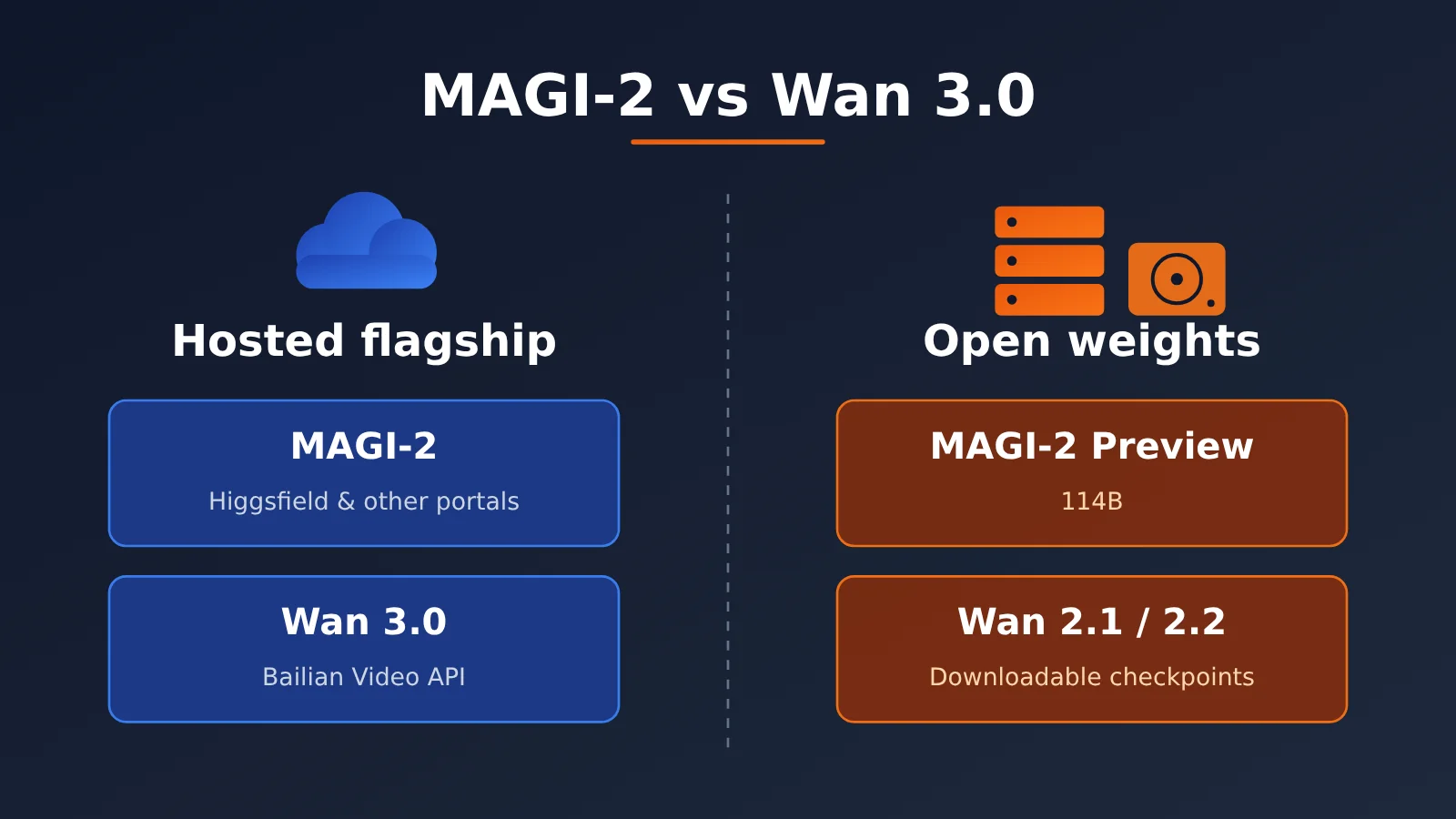
MAGI-2 vs Wan 3.0 Knowledge Map
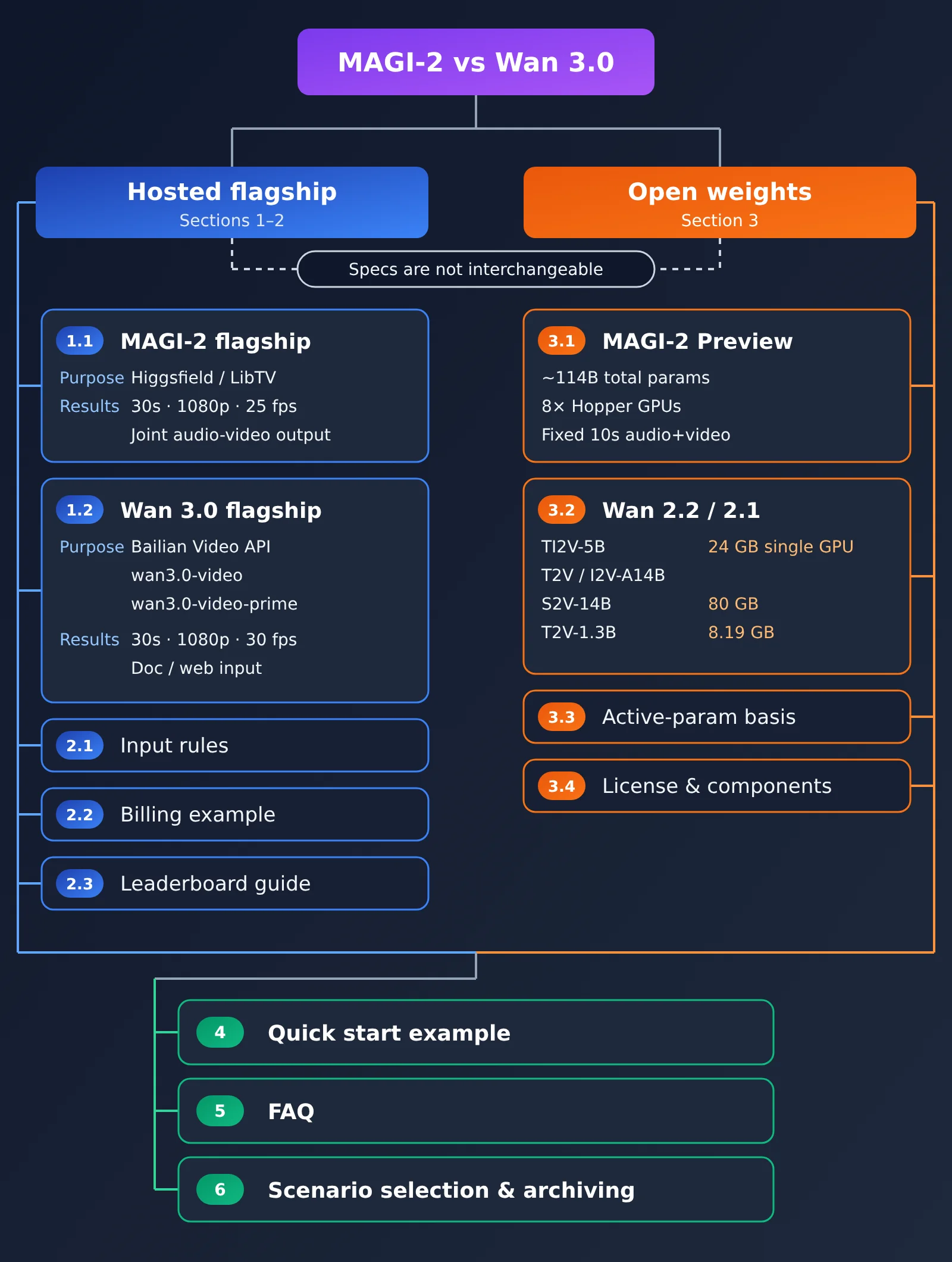
Figure note: the left half covers the two flagship models you can only reach through hosted services; the right half covers the versions whose weights you can download. Specs from one side can’t be applied to the other — for example, you can’t infer the flagship’s capabilities from Preview’s 10-second limit.
MAGI-2 vs Wan 3.0 Reading Guide
- Section 1 (hosted flagships) — Start by pinning down where each flagship is delivered and what its weight status is. This section is the premise for every comparison that follows.
- Section 2 (hosted-side comparison) — With Section 1 as the baseline, compare input rules, billing, and quality evidence. Best for readers who want to produce finished footage.
- Section 3 (open weights) — Covers the MAGI-2 Preview and Wan 2.x versions you can actually download. Best for readers planning local deployment. Sections 2 and 3 sit side by side, so skip around as needed.
- Section 4 (quick start) — A code example for shot planning and constraint validation that works on both paths.
- Sections 5 and 6 — An FAQ to clear up common misunderstandings first, then a scenario-based selection method and a reproduction log checklist.
MAGI-2 vs Wan 3.0: Key Terms
| Term | Plain-language explanation |
|---|---|
| Hosted flagship | Callable only through a provider’s platform or API; there are no downloadable model weights |
| Open weights | The official model checkpoints and inference code are published, so you can run them on your own machine |
| MoE / active parameters | Only a subset of parameters is enabled per computation; “active parameters” refers to the size of that enabled portion |
| refiner | A second-stage model that does a few refinement steps on the low-resolution result and outputs high resolution |
| VAE | The component that encodes and decodes between latent space and pixels (or audio waveforms) |
| checkpoint | The set of weight files for a given model version, usually several .safetensors shards |
1 Where the MAGI-2 and Wan 3.0 Hosted Flagships Are Delivered
1.1 MAGI-2 Flagship: Platform-Hosted, Weights Still Listed as “Coming Later”
Sand.ai’s technical release page is dated November 24, 2026, and the published figures are 480B total backbone parameters, about 28B activated parameters, and 4T tokens of pretraining data. The same page lists the “public flagship model” and the “full technical report” as coming later. Higgsfield’s partnership announcement on November 25 cites 400B MoE with roughly 28B active, and it likewise calls the open weights “coming soon” — while Higgsfield’s own product overview page uses 480B. Neither release explains the 80B discrepancy, so this article keeps both numbers, each attributed to its source.
Right now, the way to use the MAGI-2 flagship is through the Higgsfield platform, and LibTV’s homepage also launched a MAGI-2 creation entry point around the same time. The only things you can download from Sand’s official model catalog are the 114B Preview and the older MAGI-1. So the claim that “MAGI-2 has open weights” doesn’t hold up yet.
1.2 Wan 3.0 Flagship: Bailian Video API, No 3.0 Checkpoint in the Official Catalog
Alibaba Cloud’s listing announcement, published August 24, 2026, states plainly that Wan 3.0 is offered as a hosted Video API. The Bailian usage guide, last updated November 23, lists two model names: wan3.0-video and wan3.0-video-prime. The model, workspace endpoint, and API key need to be used as a region-matched set. The English API reference page from the same period still labels it “preview.”
As of the date we checked, what you can find in Wan’s official GitHub and Hugging Face catalogs are the weights for Wan 2.1, 2.2, and a handful of specialized models — but no official Wan 3.0 checkpoint. That conclusion applies only to the officially published scope we can verify. Separately, Wan 2.5, 2.6, and 2.7 on the Bailian pricing page are also API model names, and they shouldn’t be confused with open weights.
| Name | Delivery form | Disclosed parameters | Weight status (as of 2026-11-25) |
|---|---|---|---|
| MAGI-2 flagship | Hosted on platforms such as Higgsfield and LibTV | Sand: 480B / ~28B active; Higgsfield announcement: 400B / ~28B | Not public; officially listed as coming later |
| Wan 3.0 flagship | Alibaba Cloud Bailian Video API | Not disclosed | No checkpoint in the official catalog |
| MAGI-2 Preview | Download and self-deploy | ~114B / ~6B active | Open, Apache-2.0 |
| Wan 2.2 series | Download and self-deploy | 5B dense; A14B ~27B / ~14B per step | Open, Apache-2.0 |
| Wan 2.1 series | Download and self-deploy | Includes T2V-1.3B and others | Open |
2 MAGI-2 vs Wan 3.0: Hosted-Side Capability Comparison
2.1 Video, Sound, and Reference Assets
Both platforms publish the same upper limits: up to 30 seconds per generation and up to 1080p, and both can generate dialogue, background music, and sound effects alongside the video. The differences come mainly in frame rate, duration limits on reference assets, and input methods.
| Dimension | MAGI-2 (Sand materials) | Wan 3.0 (Model Studio spec) |
|---|---|---|
| Frame rate | 25 fps | 30 fps |
| How 1080p is achieved | Delivered via spatiotemporal upsampling | Documentation doesn’t specify the method |
| Number of reference assets | Up to 10 images, 5 videos, 5 audio clips | Up to 10 images, 5 video clips, 5 audio clips |
| Reference duration limits | Native API: total reference video ≤30 seconds; reference audio has its own separate 30-second cap | Total reference video ≤15 seconds; total reference audio ≤15 seconds |
| Distinctive inputs | Timeline, shot cuts, local editing of existing video | Strict first-frame / first-and-last-frame, video editing and extension, document (file) or web page (link) — pick one |
| Duration constraint | Up to 30 seconds per generation | With input video, input seconds plus output seconds ≤30 |
| Sound | Audio and video generated from the same backbone | On by default, can be explicitly disabled |
| Officially noted limitations | Very high-speed motion may show trajectory or continuity artifacts; complex sound fields could use improvement | Media links for successful tasks are kept for only 24 hours |
A few details in the table are worth noting. Wan 3.0’s strict first-and-last-frame mode and its audio/video reference mode are two separate modes and can’t be used together in the same request. If you want to drive lip sync with recorded audio, you need to pass the image and audio in as references and go through multimodal mode.
MAGI-2’s official flower-field example uses a person, clothing, and three scenes as reference images, arranging wide shots and close-ups — a fairly intuitive demonstration of what role each reference image plays in the frame. Wan 3.0’s pure text-to-video guide provides a timestamped storyboard example, which you can refer to later when writing storyboard scripts.
2.2 Wan 3.0 Billing Example: Reference Videos Change Your Budget
On Bailian (Alibaba Cloud Model Studio), when a request includes an input video, the billed seconds equal the input seconds plus the output seconds, and the per-second price depends on resolution and region. Take the international price list for wan3.0-video in the Singapore region at 720P, listed at $0.10/second, ignoring discounts and free quotas. Generating an 18-second video from 6 seconds of source footage gives you 24 billed seconds total, for $2.40; a text-only request that outputs the same 18 seconds bills only 18 seconds, for $1.80.
These numbers show that using a reference video directly raises the cost of a single generation. Platforms like Higgsfield use creative credits, which aren’t the same unit as Bailian’s per-second pricing, so you can’t subtract one from the other to compare them. Costs on a local setup depend mainly on download and storage space, machine time, and how long each generation actually takes.
2.3 How to Read the MAGI-2 vs Wan 3.0 Leaderboard Scores
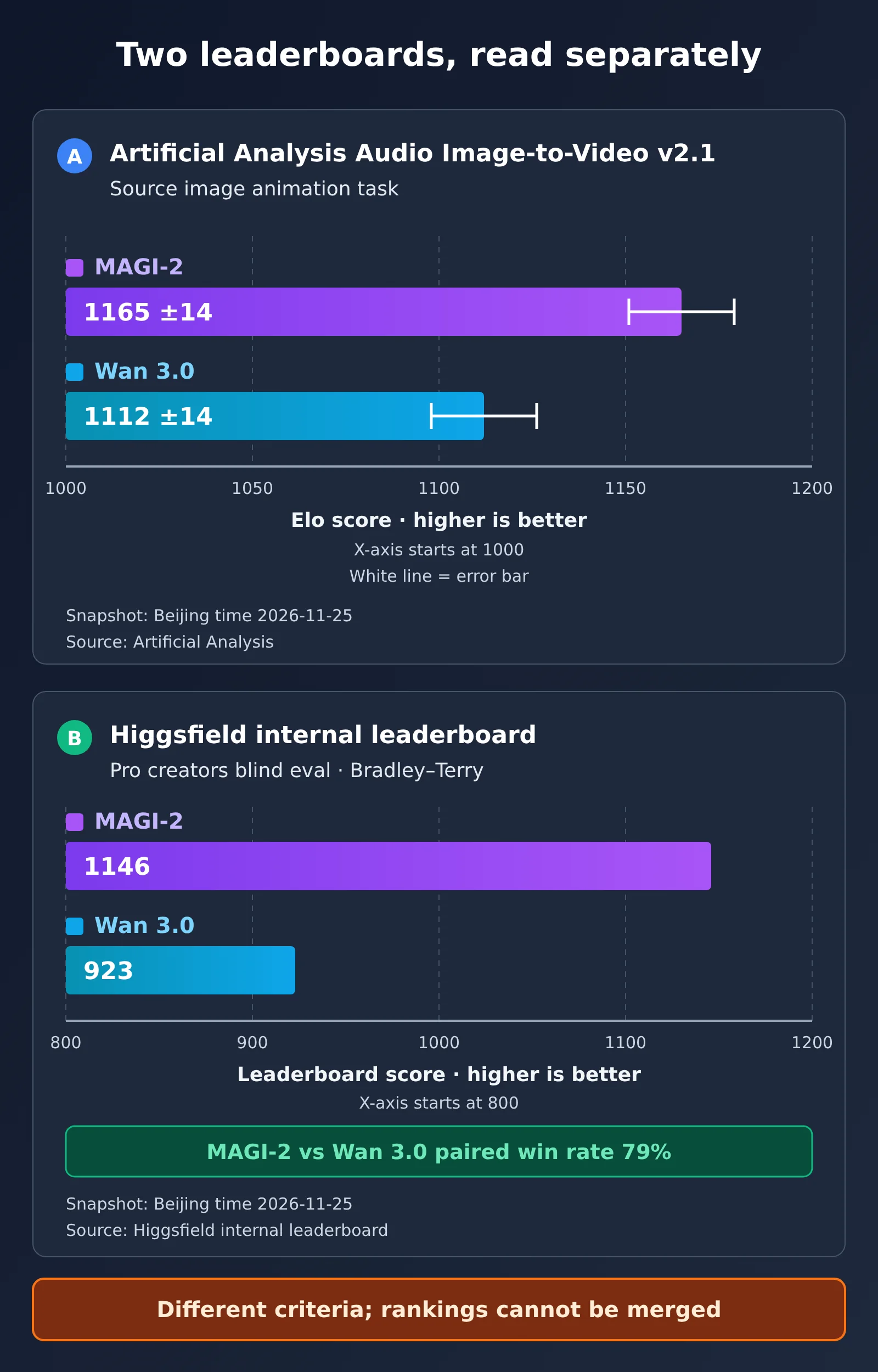
Figure note: The Artificial Analysis Image-to-Video with Audio v2.1 leaderboard measures tasks like “animating a single source image,” where MAGI-2 scores 1165±14 and Wan 3.0 scores 1112±14. The Higgsfield in-house leaderboard runs blind pairwise comparisons by professional creators and computes results with a Bradley–Terry model; the snapshot time is Beijing time November 25, 00:00, MAGI-2 beats Wan 3.0 in 79% of pairwise matchups, and the two score 1146 and 923 within that board. Higgsfield is the co-release partner for MAGI-2, so keep that in mind when reading this leaderboard.
These two leaderboards differ in task, versions evaluated, and samples, so you can only describe performance within each task separately — you can’t merge them into a single total score. The Artificial Analysis four-task average that Sand published is meant to compare MAGI-2 against its own Preview across generations; it isn’t valid for a head-to-head comparison with Wan. The most reliable way to judge performance for your own use case is still to run the same set of materials through both platforms.
3 MAGI-2 vs Wan 3.0: The Genuinely Open-Weights Release in the Lineup
3.1 MAGI-2 Preview: 8 GPUs, 10 Seconds, Joint Audio-Video Generation
MAGI-2 Preview was released on August 5, 2026. It’s a unified audio-video model with about 114B total parameters and about 6B activated. Sand provides inference code on GitHub. The preview directory on Hugging Face contains 56 .safetensors shards, with the main backbone at about 228 GB; adding the refiner, text encoder, and audio-video decoding components brings the full package to about 307 GB. These sizes are all on-disk weight sizes.
The official inference path runs on 8 NVIDIA Hopper GPUs, Python 3.12, and a relatively recent CUDA version, and finally uses ffmpeg to mux the generated audio track into the video. Under the base configuration, each video is fixed at 10 seconds and supports text-only input, or text plus a single first-frame image. Generation happens in two steps: first, 100 denoising steps at low resolution, then 5 refinement steps with the refiner, outputting at the 1080p tier. The official CLI’s 1080p preset actually generates a 1920×1088 frame. If you need exact delivery dimensions, you can reset them via the output width and height parameters.
3.2 Wan 2.2 / 2.1: Start with a single GPU, split models by task
Wan 2.2 released its inference code and weights on July 28, 2025. Unlike Preview’s single large model, Wan 2.2 splits tasks across multiple model variants, and the minimum hardware bar is much lower.
| Model | Task | Specs | Official hardware reference |
|---|---|---|---|
| MAGI-2 Preview | Text-to-video, text + first frame, joint audio track generation | Fixed 10 seconds, 1080p tier | 8× Hopper; full package ~307 GB |
| Wan2.2-TI2V-5B | Text-to-video + first-frame image-to-video (dense backbone) | 720P, 24 fps, 1280×704 / 704×1280 | Single GPU ≥24 GB (e.g., RTX 4090); offloading and related parameters must be enabled |
| Wan2.2-T2V-A14B / I2V-A14B | Text-to-video / image-to-video | 480P, 720P | Dual-expert architecture, ~27B total parameters |
| Wan2.2-S2V-14B | Reference image + external audio drives character video | Optional prompt | Single GPU ≥80 GB |
| Wan2.2-Animate-2-14B | Driving video + character image for motion transfer | Can specify viewpoint via text | See official inference script |
| Wan2.1-T2V-1.3B | Text-to-video | 480P | ~8.19 GB VRAM |
The single-GPU example for TI2V-5B needs model offloading, type conversion, and the text encoder running on CPU to fit within 24 GB of VRAM. The official Wan repository also provides Diffusers and ComfyUI integrations. The ComfyUI 5B example uses repackaged diffusion weights, a text encoder, and a VAE. Its offloading conditions and VRAM requirements differ from the original repository, so check the respective docs separately.
On August 7, 2026, Wan also released inference scripts, base weights, and distilled weights for Wan2.2-Animate-2-14B. This shows the Wan series is still continuing to open up models for specific tasks, but what’s being released is the 2.2 series task variants, not 3.0.
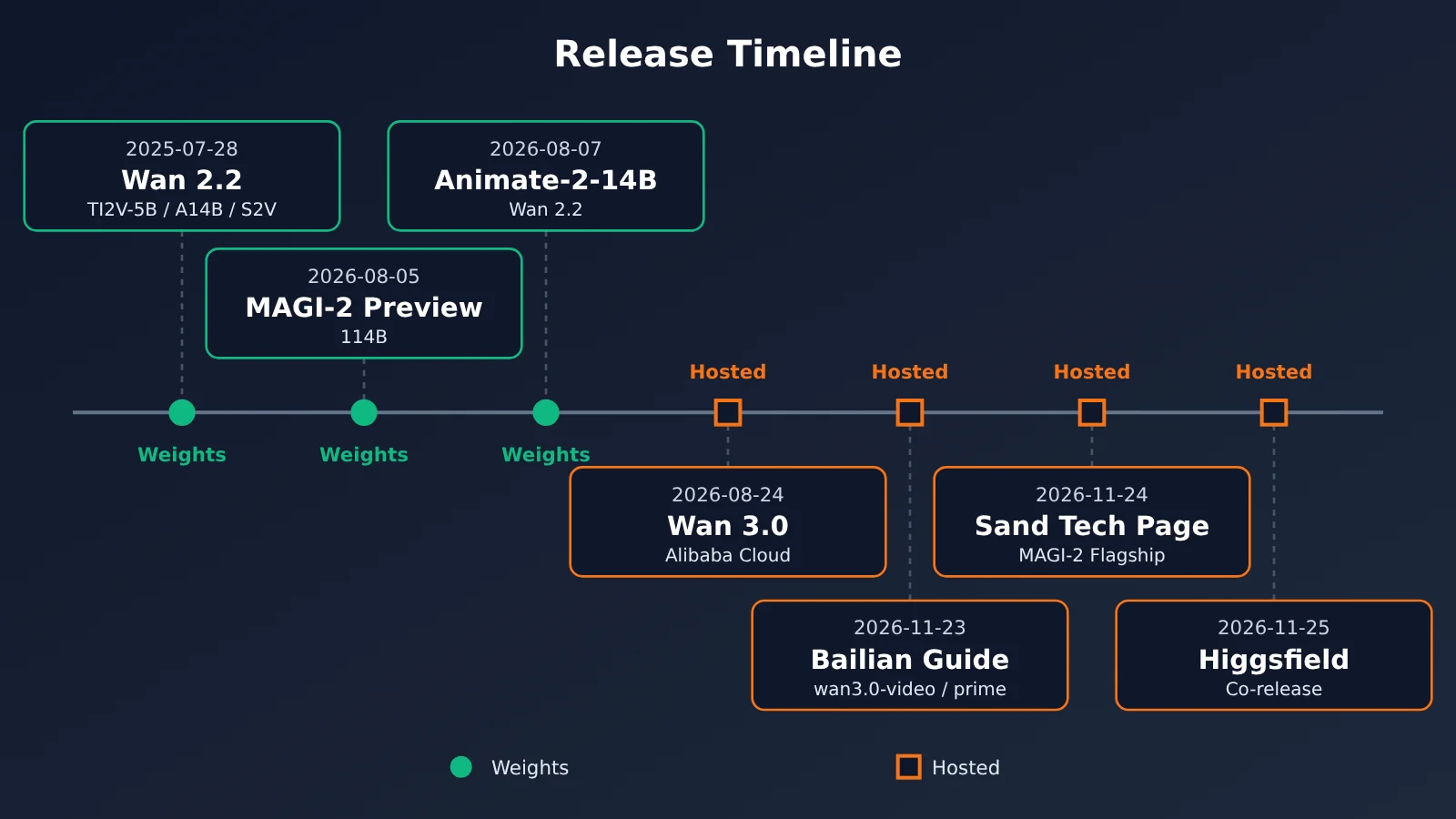
Figure caption: The open-weight nodes on the timeline all belong to Preview and Wan 2.x, while the managed nodes belong to the two flagships. The “open weights” and “flagship” lines interleave in time but never intersect.
3.3 The two “activated parameters” figures use different counting scopes
Wan 2.2’s A14B model switches between a high-noise expert and a low-noise expert depending on the denoising stage, and officially it’s described as roughly 27B total parameters with about 14B activated per step. MAGI-2 Preview’s “roughly 6B activated” figure, on the other hand, is counted per token, with routing based on the token’s header information. Since the two numbers use different units of measurement, conclusions like “6B is more efficient than 14B” don’t follow directly.
At the capability level, these two approaches are better compared like this: Wan 2.2 S2V drives a character video using a pre-recorded line of dialogue audio, while MAGI-2 Preview generates both the visuals and a new dialogue track from text at the same time. The former suits lip-sync driven by existing voice recordings; the latter suits producing clips with sound straight from a script.
3.4 Licensing and component reuse
MAGI-2 Preview’s inference repository and official model card are marked Apache-2.0. The Wan 2.2 repository, along with the model cards for TI2V-5B and S2V-14B, are likewise Apache-2.0.
The two routes overlap at one component. Sand’s file manifest includes Wan2.2_VAE.pth from Wan2.2-TI2V-5B, but Preview uses the separately listed distilled Turbo VAE by default. In other words, the two share a component at the video decoder, while their generation backbones are independent. Preview’s audio decoder comes from Stable Audio Open 1.0, whose upstream model card is marked Stability AI Community License. Before commercial use, you should check the terms for the main model, the upstream components, and the hosting channel separately.
4 MAGI-2 vs Wan 3.0 Quick Start: Write the Storyboard First, Then Check Constraints per Route
The two routes take different kinds of input, but both can work with timestamped storyboards. A practical workflow goes like this: use a chat model to organize your product information into a structured storyboard, then check locally whether it meets the duration rules for the route you’re targeting. The code below is just a sample — it only calls a chat model and doesn’t touch any video API. APIYI (apiyi.com) gives you a single interface for chat models like OpenAI, Claude, and Gemini; this article doesn’t cover whether APIYI offers MAGI-2 or Wan 3.0, so for actual video generation head to the official entry points for Higgsfield, Sand, or Alibaba Cloud Bailian.
4.1 Minimal Example
import openai

client = openai.OpenAI(
    api_key="YOUR_API_KEY",
    base_url="https://api.apiyi.com/v1"  # APIYI OpenAI-compatible endpoint
)

resp = client.chat.completions.create(
    model="gpt-4o-mini",  # Replace with a chat model available in the APIYI console
    messages=[{"role": "user", "content":
        "把这段商品说明写成 10 秒分镜,按 0-3s/3-7s/7-10s 给出画面、对白、音效:"
        "一款折叠露营灯,暖光,续航长。"}]
)
print(resp.choices[0].message.content)
View the full code: JSON storyboard + duration validation for two routes
import json
import openai

client = openai.OpenAI(
    api_key="YOUR_API_KEY",
    base_url="https://api.apiyi.com/v1"  # APIYI unified endpoint
)

PROMPT = """把下面的商品资料写成分镜,只输出 JSON:
{"total_seconds": int, "shots": [{"start": int, "end": int,
 "visual": str, "dialogue": str, "sfx": str}]}
要求:总时长 {sec} 秒,镜头首尾相接。
资料:{info}"""

def plan_shots(info: str, sec: int, model: str = "gpt-4o-mini") -> dict:
    resp = client.chat.completions.create(
        model=model,
        response_format={"type": "json_object"},
        messages=[{"role": "user",
                   "content": PROMPT.replace("{sec}", str(sec)).replace("{info}", info)}],
    )
    return json.loads(resp.choices[0].message.content)

# The limits below come from public documentation (checked 2026-11-25); re-check after upgrades
def check(plan: dict, route: str, input_video_sec: int = 0,
          ref_video_sec: int = 0, ref_audio_sec: int = 0) -> list:
    out = plan["total_seconds"]
    issues = []
    if route == "magi2-preview":            # Local open weights: fixed at 10 seconds
        if out != 10:
            issues.append("Preview 基础配置固定 10 秒")
    elif route == "wan3.0-video":           # Bailian hosted
        if input_video_sec + out > 30:
            issues.append("带输入视频时,输入 + 输出不能超过 30 秒")
        if ref_video_sec > 15 or ref_audio_sec > 15:
            issues.append("参考视频 / 参考音频各自合计不能超过 15 秒")
    elif route == "magi2-hosted":           # Platform-hosted flagship
        if out > 30:
            issues.append("单次最长 30 秒")
    last = 0
    for s in plan["shots"]:
        if s["start"] != last:
            issues.append(f"镜头在 {last}s 处不连续")
        last = s["end"]
    return issues

plan = plan_shots("折叠露营灯,暖光,续航长", sec=18)
print(check(plan, "wan3.0-video", input_video_sec=6))   # 6 + 18 = 24, meets the constraints
print(check(plan, "magi2-preview"))                     # 18 seconds will be flagged as non-compliant
Quick start tip: Text preprocessing like storyboarding can be done through APIYI apiyi.com — one key lets you switch between multiple chat models and compare which one produces more accurate timestamps. New users get free test credits, which is great for validating the storyboard workflow first before submitting the storyboard to the video platform.
5 MAGI-2 vs Wan 3.0 FAQ
Q1: Can the weights for MAGI-2 and Wan 3.0 be downloaded?
As of 2026-11-25, neither flagship model can be downloaded. The official roadmap lists MAGI-2’s open weights as a future release; there is no checkpoint for Wan 3.0 in the official catalog. The downloadable options right now are MAGI-2 Preview and Wan 2.1 / 2.2.
Q2: Are Wan 2.5, 2.6, and 2.7 open-weight?
In the Alibaba Cloud Bailian price catalog, these are API models. When discussing Wan’s open-weight roadmap, name the specific Wan 2.1 or 2.2 checkpoint, such as `Wan2.2-TI2V-5B`.
Q3: Can I call MAGI-2 or Wan 3.0 through APIYI?
We haven’t verified any listing information for these models or tested them on APIYI. For now, APIYI apiyi.com is a good fit for text-based steps such as storyboard generation and copy rewriting; for video generation, rely on the official portals for Sand, Higgsfield, and Alibaba Cloud Bailian.
Q4: Which one should I choose if I only have one 24 GB GPU?
Start with Wan2.2-TI2V-5B; the official release provides single-GPU configurations for text-to-image and image-to-image. If you have less VRAM, you can run Wan2.1-T2V-1.3B at 480P. MAGI-2 Preview requires 8 Hopper GPUs and cannot run on a single GPU.
Q5: How can hosted platforms be compared fairly?
Use the same appearance image, the same dialogue line, and the same storyboard on both platforms, then compare whether small text is legible, whether subject edges are sharp, whether motion is coherent, as well as lip sync, dialogue clarity, and ambient sound. You can generate and lock in the storyboard first with APIYI apiyi.com to avoid inconsistent scripts across the two generation runs.
6 MAGI-2 vs Wan 3.0: Scenario Selection and Reproduction Notes
When picking by task, this mapping is a good starting point.
- Finished film production where you need to cut shots at specific second marks, with the same character and wardrobe carrying across multiple shots: study the timeline and multi-reference examples on the hosted MAGI-2 side.
- Finished film production where you need to generate a talking-head short directly from a product description page or a PDF: study Wan 3.0’s docs and web input mode, and note that
fileandlinkare mutually exclusive — pick one. - Local research on joint audio-visual generation, with an 8-GPU machine available: use the 10-second workflow in MAGI-2 Preview.
- Starting from a single GPU: use the official Wan2.2-TI2V-5B configuration.
- You already have a recording and need to drive a character’s lip-sync and motion: use Wan2.2-S2V-14B, which requires 80 GB of VRAM.
Keep reproduction notes managed separately. For self-deployment, record the commit version each weight shard corresponds to, the inference config, the random seed, and the frame rate of the final cut; Sand’s images provide tags pinned to a code commit, and the public scripts also support saving the latents after the refiner. For hosted calls, record the provider’s model ID, region, task number, the pricing basis at the time, and the original output. Bailian’s result links only live for 24 hours, so downloading results should be a fixed step in your pipeline. If text preprocessing also goes through an API, it’s worth archiving the storyboard JSON returned by APIYI apiyi.com alongside the video task number — that way you can later check the output of both routes against exactly the same input.
Finally, one rule to sanity-check whether you picked right: first confirm the exact version name you intend to use, then confirm whether it’s hosted or downloadable. If the specs you’re citing don’t match that version — for example, using Preview’s 10-second cap to describe the flagship — then you’re comparing the wrong things, and you should go back to Section 1 and re-verify.
References
- Sand.ai MAGI-2 Flagship Announcement: parameters, capability examples, and limitations
- Link:
sand.ai/blog/magi-2
- Link:
- Higgsfield MAGI-2 Partnership Announcement and Leaderboard: the 400B claim and pairwise win rate
- Link:
higgsfield.ai/announcing-magi-2
- Link:
- Alibaba Cloud Model Studio Wan3.0 User Guide and API Reference: input rules, duration constraints, and validity period
- Link:
alibabacloud.com/help/en/model-studio/wan3-video-generation-guide
- Link:
- Alibaba Cloud Model Studio Model Pricing: how per-second billing is calculated
- Link:
alibabacloud.com/help/en/model-studio/model-pricing
- Link:
- Artificial Analysis Image-to-Video Leaderboard: audio-enabled image-to-video v2.1
- Link:
artificialanalysis.ai/video/leaderboard/image-to-video
- Link:
- MAGI-2 Preview Inference Repository and Model Card: hardware requirements, sharding, and component list
- Link:
github.com/SandAI-org/MAGI-2-preview,huggingface.co/sand-ai/MAGI-2-preview
- Link:
- Wan 2.2 Official Repository and Model Card: model variants, VRAM, and license
- Link:
github.com/Wan-Video/Wan2.2,huggingface.co/Wan-AI/Wan2.2-TI2V-5B
- Link:
- ComfyUI Wan 2.2 Official Workflow
- Link:
docs.comfy.org/tutorials/video/wan/wan2_2
- Link:
Author: APIYI Technical Team
Tech discussions: You’re welcome to get in touch via the APIYI homepage at apiyi.com. For more integration resources, head over to the docs.apiyi.com documentation center.