Summary: In two separate experiments that each defeated the Ender Dragon, Claude Opus 5 mostly called human-written, high-level MCP tools to coordinate its actions. The four Gemini 4 Argon agents, meanwhile, wrote JavaScript on the fly on top of the standard Mineflayer interface and divided the work among themselves. Using stronghold locating and other concrete steps as examples, this article explains the difference in who writes the action logic on each side.
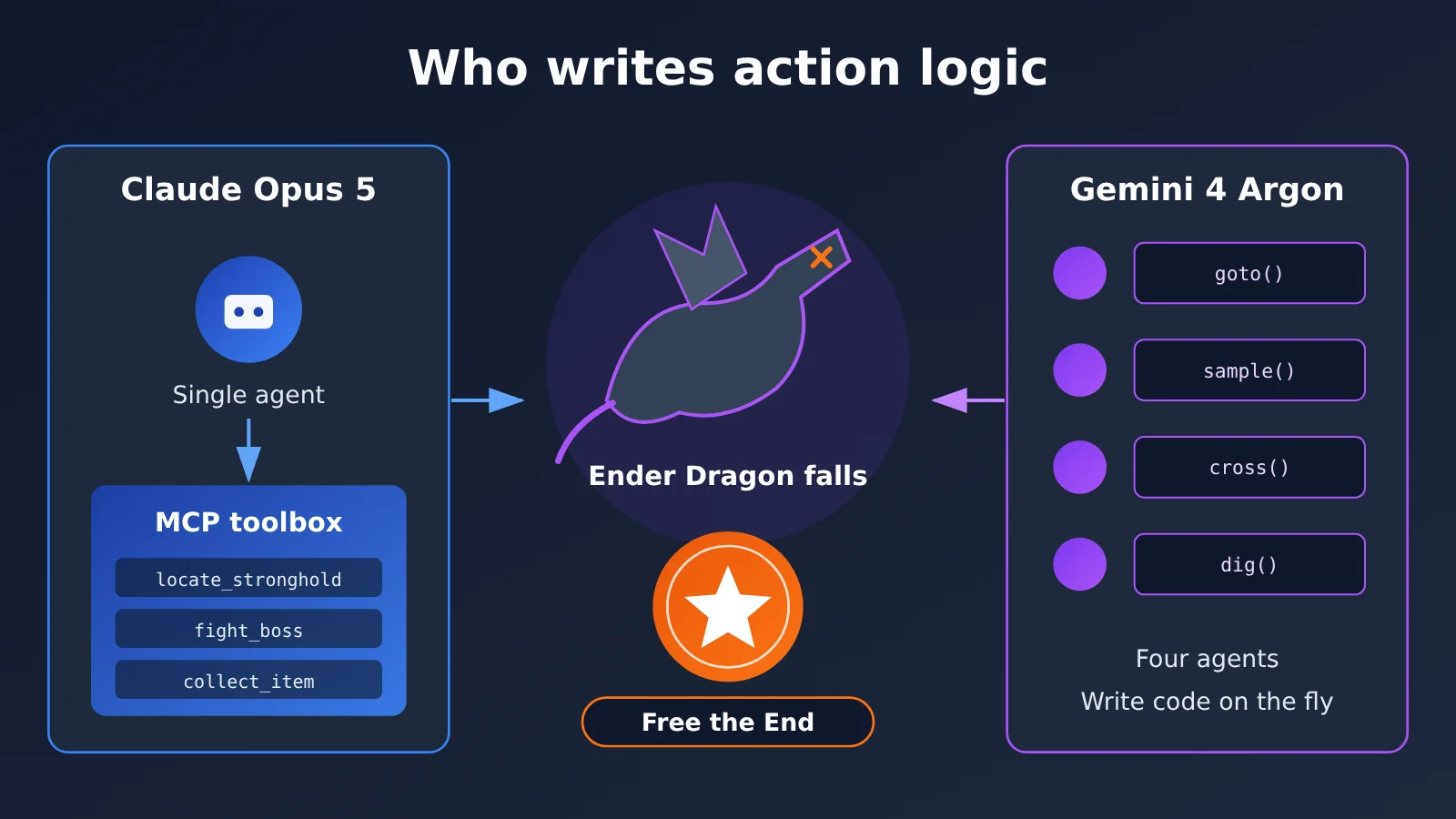
Neither group played by looking at screenshots and using a keyboard and mouse; both observed and acted in the game through programmatic interfaces, and both used Mineflayer under the hood. The key difference is where the execution logic for specific in-game actions comes from. Claude Opus 5 was given a catalog of Mine AI MCP tools pre-implemented by AI Bengineering; it chose tools, filled in parameters, and decided whether to wait or reroute. The four Gemini 4 Argon agents worked with the standard library and pathfinding plugins, and had to write every multi-step operation themselves as a short program.
Stronghold locating makes this clearest. Both sides took advantage of the game rule that “Eyes of Ender fly toward the stronghold.” Claude called the pre-packaged locate_stronghold tool, and the runtime layer did the estimation; Gemini’s player janesick instead wrote code during that turn to sample entities and find intersection points.
A quick note on what is being compared. Claude here refers to Claude Opus 5 from the AI Bengineering community project dated September 15, 2026; Gemini refers to the four Gemini 4 Argon players in the paper Google DeepMind submitted to arXiv on October 15, 2026. Both groups shared the same end goal: defeating the Ender Dragon, with the server recording the Free the End advancement. The two experiments differed in version, difficulty, world, and player count, so this article compares methods rather than judging which model is stronger.
Claude Opus vs Gemini Argon: Beating Minecraft at a Glance
| Comparison dimension | Claude Opus 5 (AI Bengineering) | Gemini 4 Argon (DeepMind) | What the difference means |
|---|---|---|---|
| Game conditions | Java 1.21.4, Normal, fixed seed | Java 1.20.4, Easy, random world | Different starting points, so total time isn’t directly comparable |
| Operator | A single Opus 5 agent | Four players, plus one observer-only agent | One side is single-agent decision-making; the other is team division of labor |
| Interface the model faced | Prebuilt high-level MCP tools | Standard Mineflayer and pathfinding plugin | Action logic was prewritten by humans on one side and written live by the model on the other |
| Upfront support | The first prompt included gameplay advice on gear, supplies, and so on | Only the mission and general operating rules, with no game strategy | Different sources of route knowledge |
| Stronghold locating | Called the two stages estimate and locate |
Wrote its own 50 ms sampling and intersection calculation | Same principle, different implementer |
| End crystals | Cleared with a bow and stairs, then invoked an entrenched-combat tool | Players designed their own plan to stack dirt and pillar up | Different degree of tactical encapsulation |
| Elapsed time | About 3 hours 56 minutes | 27 hours 14 minutes | Just wall-clock time under each setup |
| Endgame evidence | Free the End, endgame world description |
Free the End, dragon health and crystal trajectories |
Both sides confirmed with server-side records |
Suggested reading order: Section 1 first establishes the starting points and upfront support for both experiments—these determine which later differences can be attributed to method. Section 2 covers the division of labor at the interface, the main thread of the whole article, and uses stronghold locating as its core evidence. Section 3 compares the two routes side by side in Overworld, Nether, stronghold, and End order. Section 4 explains what these two successes can actually prove, and how you’d design a like-for-like controlled experiment if you wanted one.
To Know: 10 Terms for Understanding the Minecraft Playthrough Comparison
| Term | Brief Explanation |
|---|---|
| Minecraft Java Edition | Both experiments run on Java Edition servers, using versions 1.21.4 and 1.20.4 respectively |
| World seed | The parameter that determines map generation; a fixed seed locks in the same starting map for a given version |
| MCP | A protocol that lets model clients discover and invoke external tools; the advanced in-game actions in this case are exposed through it |
| Mineflayer | A Minecraft bot library written in JavaScript that can read game state and drive a character to move, gather, and interact |
| Pathfinding plugin | A component that, given a target location, searches the terrain for a viable movement route |
| Nether | A separate game dimension where the completion route requires gathering materials such as blaze rods |
| Eye of Ender | An item used to infer the direction of a stronghold, and also to fill in the End portal frame |
| Triangulation | Obtaining a target’s direction from two different positions, then estimating the target’s location from where the two direction lines intersect |
| End crystal | An entity that restores health to the Ender Dragon; once destroyed, the dragon can no longer heal from them |
| Free the End | A vanilla advancement; both groups use it to confirm they’ve defeated the Ender Dragon |
1 Starting Points for Claude Opus and Gemini Argon’s Minecraft Runs
1.1 Game Conditions for Claude Opus 5 and Gemini 4 Argon
The two experiments didn’t match on several key variables. The table below only lists conditions that could affect the results.
| Condition | Claude Opus 5 | Gemini 4 Argon |
|---|---|---|
| Version and mode | Java 1.21.4 vanilla, survival, new save | Java 1.20.4, survival, cheat commands disabled |
| Difficulty | Normal | Easy |
| World | Fixed seed 97996358 | Random world; the paper doesn’t give the seed value |
| Model configuration | claude-opus-5[1m], high reasoning, fresh session |
The paper doesn’t specify the exact checkpoint or API-side inference parameters |
| Agent(s) in the game | A single Opus 5 agent, with the project owner present as an observer | Four players; a fifth same-model agent, Observer, kept a read-only record |
| Run date | 2026-09-15 | Paper submitted 2026-10-15 |
There are two additional details on Claude’s side. The results file lists a very small amount of Claude Haiku 4.5 usage, and the number of subagent launches was 0. The materials don’t show Haiku taking part in character operations, so the main operator can be described as a single Opus 5 agent. The observer account appears in the server logs, so you can’t say there was only an AI on the server. On Gemini’s side, the Observer didn’t enter the game or run the game program. The researchers retained the ability to monitor, pause, and stop the run; the paper reports no human intervention this time.
1.2 What Pre-Run Support Did Claude Opus and Gemini Argon Each Receive?
Claude’s initial prompt didn’t just include the goal of “defeat the Ender Dragon”; it also came with human-written gameplay suggestions, such as preparing iron armor and a shield first, getting food and a bed, wearing gold boots to deal with piglins, crafting Eyes of Ender from blaze rods and ender pearls, and prioritizing carrying a bow and building materials. The project treated these as suggestions that could be adjusted as the situation unfolded, without a fixed order. The prompt didn’t provide stronghold coordinates or a pre-scouted route. After the initial prompt, the project recorded that no one continued to guide operations.
The Gemini team received the task goal, teammate instructions, interface usage instructions, and general researcher requirements: verify actions, build up reusable tools, maintain shared memory, and report honestly. The paper’s §2.2 states that the initial instructions contained no game strategy and no predefined role division or high-level game-completion function. The four players worked out the division of labor themselves in the in-game chat after the run began.
2 Interface Differences Between Claude Opus and Gemini Argon for Operating Minecraft
2.1 Both Use Mineflayer, but the Models Operate at Different Levels
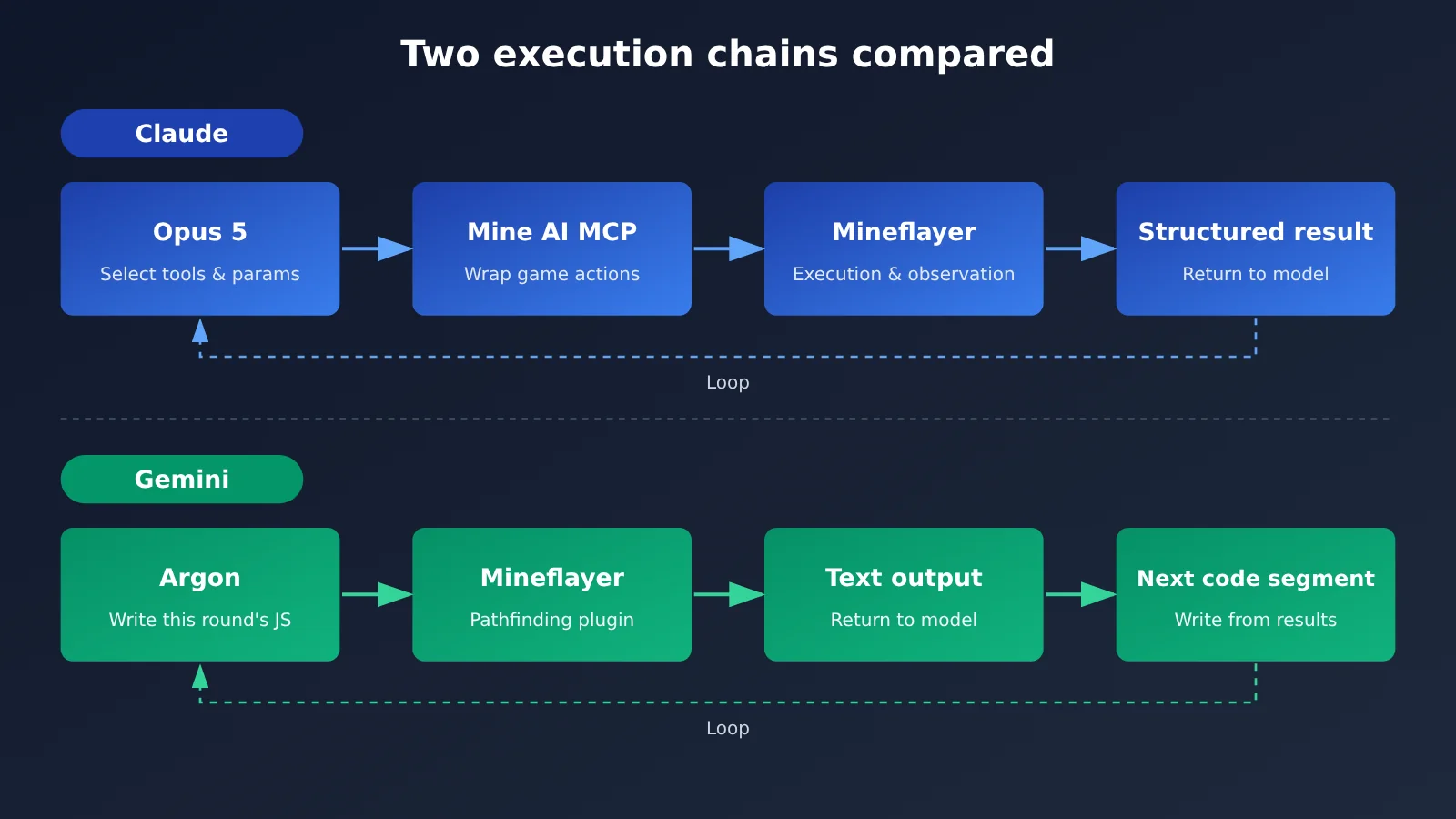
On the Claude side, the execution chain looks like this: Opus 5 selects tools and parameters, the Mine AI MCP runtime layer executes wrapped game actions, the underlying Mineflayer handles execution and observation, and finally a structured receipt is returned. The receipt includes player coordinates, inventory, status reports, and action results. Tools can keep running or be paused. If a foreground long-running action wait times out, it returns an action ID, while the action on the entity side may still be continuing. The runtime layer also has built-in rule-based responses for losing health, hunger, and being attacked.
In this design, the model is responsible for deciding what to call, with which parameters, and when to stop and verify or switch to another route. Across the whole run, there were 388 tool calls involving 37 tools. Two caveats are needed here: you can’t describe it as pure screenshot-and-keyboard/mouse control, and you can’t claim that, just because high-level tools exist, the project pre-authored the entire route to completion for the model. The project README also states that the reproduction tags lock in the environment and initial configuration, while the actual actions are not deterministic.
On the Gemini side, the execution chain is: Argon writes a short JavaScript program for the current round and sends it to a dedicated cloud host via the command line. Mineflayer and the pathfinding plugin read world state, perform interactions, plan movement to specified locations, and then print back positions, inventory, blocks, entities, and execution results as text. Observation, judgment, and action orchestration are all handled by the agent itself. Within a single program, it can observe entity state; across multiple programs, it can retain state or functions. The paper reports that the agent retained 146 code or state entries between programs, 42 of which were helper functions. A composite correction function appeared in all 655 programs across the four agents.
So the difference between the two sides isn’t “one uses tools while the other starts from scratch.” Both have programmatic observation, standard low-level libraries, and a runtime shell. The difference is whether the model “selects high-level tools and reads the results” or “reads and writes low-level state and orchestrates each action segment itself.”
2.2 What precise state information means for Claude Opus and Gemini Argon
Both agents obtain state precision beyond what the game visuals show. For Gemini, this directly affects the programming approach: the interface can read information occluded by blocks, as well as the Ender Dragon’s internal behavioral state, and the agent can feed that data straight into its decision logic. The trade-off is that every step has to be verified on its own. The paper reports that about 22% of the programs ended in an error, and the four players died a total of 605 times.
For Claude, precise coordinates and entity state are mainly supplied through tool responses, and the model uses them to decide what to call next. A tool response describes the state of that particular tool action; it doesn’t necessarily match the state of the game objective. Sections 2.3 and 3.3 give examples of each.
2.3 The same subtask: How Claude Opus and Gemini Argon locate the stronghold
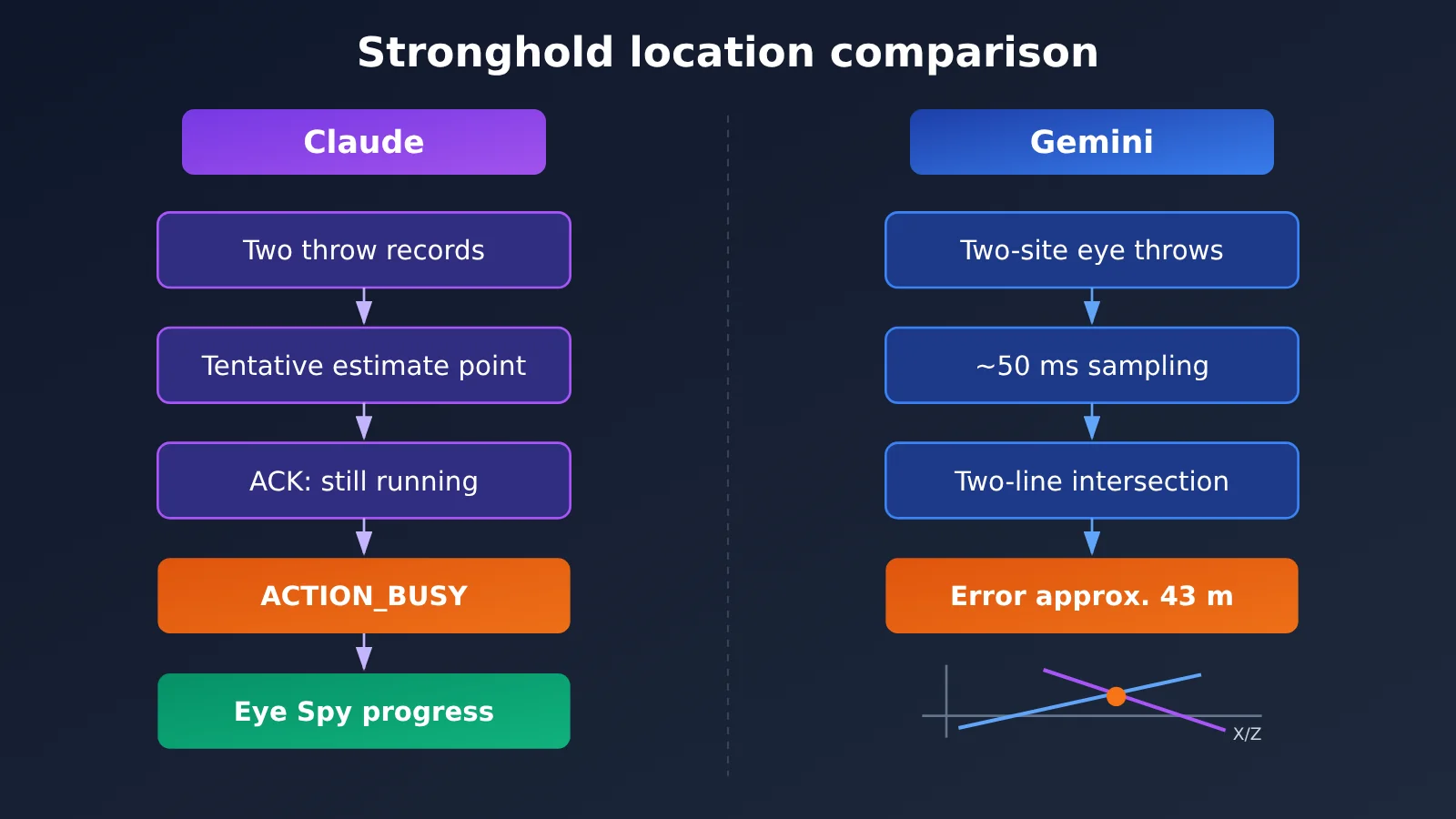
Claude’s approach. Lines 688–689 of the public transcript.jsonl show that at about 03:39:44 UTC, Claude called locate_stronghold with the parameters phase=estimate and search_id=sh1. The runtime layer reported that it had already saved two throw records and returned an unconfirmed planar estimate, (-255.9, -1870.76). On lines 725–726, Claude requested phase=locate with the same sh1; the response two minutes later showed that the action was still running and no portal frame had been observed yet. On lines 741–744, two more new requests were rejected with ACTION_BUSY because the runtime layer was busy with hostile-mob defense.
An estimate is not the same as having found the portal. At 04:08:41 UTC the server recorded Eye Spy progress; the model’s result gave the portal-room coordinates (-269, -36, -1819) and noted that it had only continued and arrived after retreating to land. Using these two sets of coordinates, the initial estimate was about 53 blocks horizontally from the portal room.
Gemini’s approach. Figure 7 of the DeepMind paper, and the page after it, published part of the JavaScript from the janesick run. The agent threw one Eye of Ender at each of two locations, used Mineflayer to iterate over nearby entities, sampled the flight position about every 50 ms, and then calculated the intersection of the two direction lines in the X/Z plane. Figure 7 shows that at +10 h 46 min it computed the intersection (432, -1376); the actual portal room was at (463, -30, -1406), a horizontal error of about 43 m. At that moment it had only an estimated point; the End portal was not lit until +13 h 17 min.
Both sides rely on the same game mechanic: Claude asks a packaged estimation program to do the work, while Gemini’s player writes the sampling and intersection code itself in that turn. The 53 blocks and 43 m come from single trajectories in two different worlds; they can only illustrate the process, not determine whose localization is more accurate.
3 Claude Opus vs Gemini Argon: From Gathering Materials to Slaying the Ender Dragon
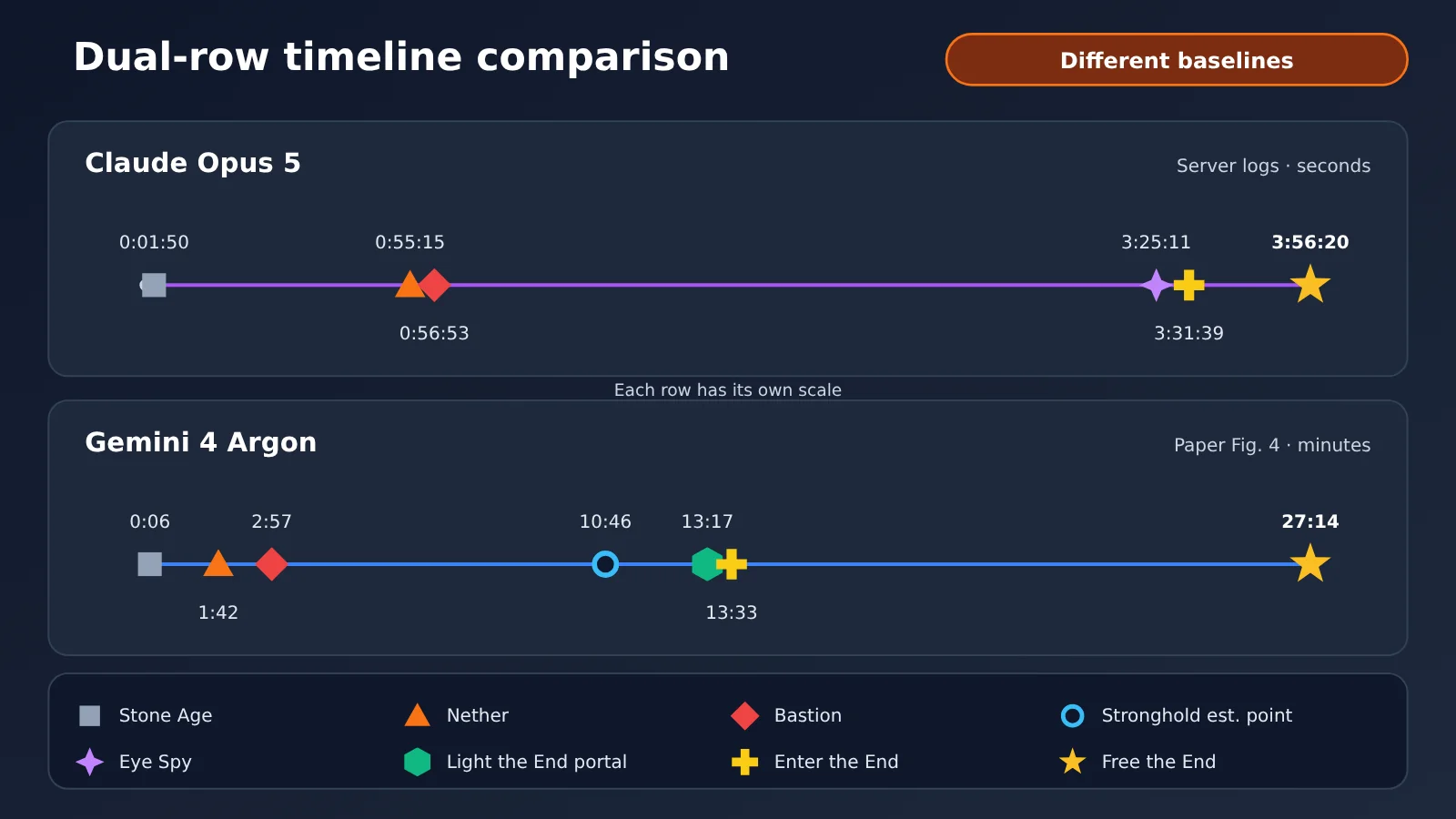
The table below lists each model’s elapsed times. Claude’s are measured from the dataset start point at 00:43:30 UTC, precise to the second; Gemini’s come from Figure 4 of the paper, measured from when the first program was issued, roughly to the minute. The event names recorded on the two sides don’t correspond exactly, so the table keeps the original labels.
| Stage | Claude Opus 5 (server log) | Gemini 4 Argon (paper Figure 4) |
|---|---|---|
| Stone tools | +1 min 50 s, Stone Age progress | +6 min, stone tools |
| Nether entrance | +55 min 15 s, entered the Nether | +1 h 42 min, lit the Nether portal |
| Fortress | +56 min 53 s, earned the fortress advancement | +2 h 57 min, found a Nether fortress |
| Stronghold | +3 h 25 min 11 s, Eye Spy | +10 h 46 min computed the estimated location, +13 h 17 min lit the End portal |
| Entered the End | +3 h 31 min 39 s, The End? | +13 h 33 min, entered the End |
| Defeated the Ender Dragon | +3 h 56 min 20 s, Free the End | +27 h 14 min, bulicame earned Free the End |
3.1 Overworld and the Nether: Claude Opus and Gemini Argon’s resource-gathering routes
Claude progressed from wood to stone to iron and then to diamond gear, and after that went to a Nether fortress to get blaze rods. It didn’t find a good source of endermen in the Nether, so it returned to the Overworld and scraped together 12 ender pearls. This route was organized as a single agent moving forward step by step, changing its plan when it ran into problems.
About 10 minutes after Gemini’s first program launched, janesick proposed a division of labor in chat, and the team adjusted on the fly: gyldenia handled scouting and supply runs, bulicame went after diamonds, janesick smelted iron and crafted tools, and auratian got the Nether portal ready. Once they were in the Nether, janesick went after blazes while the others collected pearls using low cover. At about 5.5 hours, the shared chest already held 15 pearls, but carrying the blaze powder and recovering it took longer. Along the way, a teammate carrying all 12 eyes of ender drowned; teammates sent the item coordinates and despawn timer to a player who had seen the location, and bulicame retrieved the items before they disappeared.
3.2 End crystals: where Claude Opus and Gemini Argon’s tactics came from
Claude spent about 24 minutes and 41 seconds in the End. According to the model’s account, it first used a bow to destroy eight crystals that weren’t in iron cages, then used a staircase to deal with the other two caged crystals, and finally, while the dragon was perched, used a melee window and called a dedicated perched-combat tool to finish the kill.
Gemini took about 13 hours and 41 minutes from first entering the End to the kill, and that wall-clock time includes resupplying, retreating, and exploring. Research logs show that around hour 21, the agent realized the crystals’ continuous healing of the dragon was the key issue, and then devised its own way to pillar up to the top of the pillars with dirt and handle all ten crystals one by one. Figure 4 shows that at +26 hours and 34 minutes, all ten crystals had been cleared; the main text says bulicame completed the endgame about 39 minutes after the last crystal was destroyed, and the two data points match after rounding. The paper’s Figure 12 also maps each crystal’s destruction time against the dragon’s health curve.
3.3 A “success” tool receipt doesn’t mean Claude Opus completed the task
There’s a detail in Claude’s trace that developers should pay attention to. On line 998, the first call to the perching combat tool shows a status of success, but the same record shows 0 strikes, and the dragon’s HP stays at 200 with no change. The reason is that the tool’s completion condition is either “observe the end of the perching phase” or “the dragon dies” — ending the perch also counts as completing the action. It isn’t until line 1030 that a record of this instance dealing 26 damage shows up, and on line 1102 the same tool finally reports dragon_died, with current status HP at 0. The receipt also has another column for process observation values, which shouldn’t be treated as the final state.
This shows that ending a tool action and achieving the game goal are two different things. The Gemini paper has similar cases: one agent retracted its own unsuccessful action report, and another agent found that a dead character’s reported carried items didn’t match reality. Both interfaces run into the problem of “reporting success” diverging from “true state” — the only difference is whether that layer of verification is the tool designer’s responsibility or the agent’s own.
3.4 The endgame evidence for Claude Opus and Gemini Argon
Claude’s endgame has multiple layers of records: the server logs Free the End for AI_M1KE at 04:39:50 UTC; the result file records the dragon entity disappearing, a dragon egg spawning, and the exit opening; the author’s world description lists DragonKilled=1; and the save stores the post-victory world. Gemini’s Free the End was obtained by bulicame as verification, along with a trace of the dragon’s HP and ten crystals. The paper reports that it saved the 2,783 programs run before the kill along with their outputs, communications, and server logs, but the paper examined here doesn’t include a public download of the complete raw trace. Key moments can be checked against the charts, but you can’t say they’ve been independently re-run.
4 What Two Successful Runs with Claude Opus and Gemini Argon Tell Us
4.1 Why 3 hours 56 minutes and 27 hours 14 minutes can’t be compared directly
Both durations are wall-clock time under their own respective setups. The starting points are defined differently: one counts from the dataset’s starting point, the other from the first program. The world, difficulty, player count, and run interface all differ too. Gemini’s 27 hours 14 minutes also includes roughly 20 minutes of pause caused by six infrastructure restarts. On Claude’s side, dataset estimates put the API-internal time at only about 17.8 minutes — the rest was mostly walking, mining, and other game-world progress plus waiting on tools — so you can’t extrapolate total time from a single response latency either.
The paper itself notes that this is a single complete case from a first launch. It’s well suited to explaining collaboration behavior and failure recovery, but it can’t be used to estimate the reliability of the four agents, nor to derive the net benefit of a team over a single agent. What you can compare is strategy and work allocation: whether route knowledge was written into the prompt or figured out on the spot, whether the action logic was pre-packaged or written on the fly, and who was responsible for verification.
Another figure often cited alongside these is Vals AI’s CUA-bench, which is not the same kind of test as these two runs. CUA-bench restricts you to a screen, keyboard, and mouse, caps each game at 3 hours, and the endpoint for the Minecraft item is entering the Nether — the Ender Dragon isn’t involved. The models tested are different too: Claude Opus 5.5 with Claude Code scored 30/100, while Gemini 4 Argon with Antigravity scored 15/100. Those results should be interpreted separately from the durations of the two runs.
4.2 How to design a like-for-like comparison trial with Claude Opus or Gemini Argon
If you want to test the impact of “tool granularity” in your own workflow, you can borrow from these two cases — but you need to control the variables they didn’t. The recommendation: fix one subtask (locating a stronghold, for example), hold the model and its version, permissions, and environment constant, and change only the interface variable.
| Trial element | Group A: high-level tools | Group B: model writes its own programs | What to record |
|---|---|---|---|
| Model and version | Same model, same reasoning tier | Same as Group A | Model ID, parameters |
| Environment | Same version, same seed, same difficulty, same player count | Same as Group A | Launch configuration |
| Interface | Pre-packaged estimation and pathfinding tools | Low-level state reading plus a pathfinding plugin | Tool list or available APIs |
| Process | Every tool call and its receipt | Every program segment and its output | Action log, number of failed retries |
| Acceptance | Server-side progress or world state | Same as Group A | Share of milestones reached, wall clock |
On the model access side, the APIYI model price list as of November 23, 2026 includes three entries — claude-opus-5, claude-opus-5-5, and gemini-4-argon — but that only shows these models are available. None of the three experiments above were run on that platform, and the prices in the table don’t reflect the actual bills from the two cases. The Claude case used a subscription; the roughly $93 figure in the logs is just an estimate converted at API list prices.
Two things are most worth remembering from these two experiments. First, the level of tool abstraction determines how much execution work the model has to take on, and also determines at which layer failures show up. Second, judge success by server-side progress and world state — not by the “success” printed on a tool’s receipt.
References
- AI Bengineering beat-the-game dataset: launch configuration, prompts, trajectories, server logs, and result files for Claude Opus 5
- Link:
huggingface.co/datasets/aibengineering/beat-the-game-minecraft
- Link:
- Mine AI MCP pinned-version tool docs: notes on the runtime layer and the tool catalog
- Link:
github.com/aibengineering/mine-ai-mcp
- Link:
- DeepMind preprint: how four Gemini 4 Argon agents cleared the game cooperatively, plus the timeline, verification, and limitations
- Link:
arxiv.org/abs/2610.22319
- Link:
- Mineflayer and the pathfinding plugin: the two underlying libraries both teams used
- Link:
github.com/PrismarineJS/mineflayer
- Link:
- Vals AI CUA-bench: a per-task Minecraft scoring method judged at the screen-and-keyboard/mouse level
- Link:
vals.ai/benchmarks/cua_bench
- Link:
Author: APIYI technical team