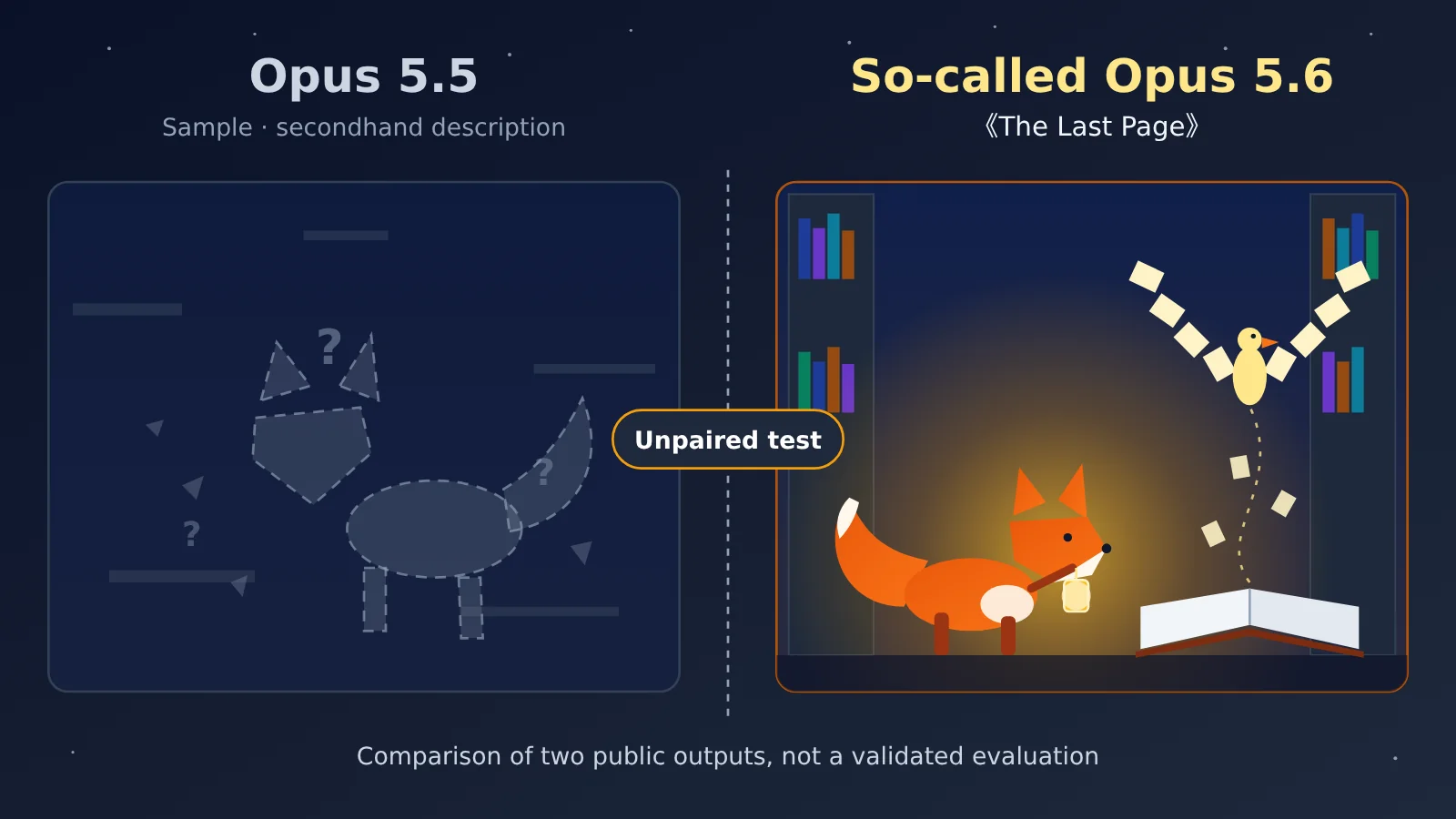
Direct answer: The two public fox-cub sample reels do reveal some differences. The Last Page, attributed to the so-called Claude Opus 5.6, was judged by several observers to be stronger on story legibility and action looping. On the other side, some frames in the Opus 5.5 sample were described as hard-to-read fractal fragments. But let’s be clear up front: this is a comparison of two public finished outputs, not a validated model evaluation. The two samples have different authors, time slots, and entry points, and there are contradictory claims about which model produced the newer one. What can actually be verified right now is mainly the frame numbers and production pipeline documented in the public repository on the newer side.
What you’ll take away from this article:
- What the nine-shot fox-cub prompt actually asked for, and where the “Fable 5.5” text at the end of the film comes from.
- How the two samples differ across five dimensions, and whether each difference is an author observation, a secondhand description, or checkable source code.
- The resolution, frame rate, keyframe timestamps, and rendering pipeline documented in The Last Page repository.
- Why this comparison doesn’t amount to a rigorous evaluation, and how to design a same-prompt retest if you want to verify it yourself.
Index: We’ll start with “To Know” and a quick impact overview to explain the key concepts and who this is useful for. The “Objective Facts” section then walks through the timeline, the prompt requirements, the repository details on the newer side, the secondhand descriptions available for the older side, and where the same author’s other works and the Arena case fit in. The “Analysis” section compares the two across five dimensions, lays out the limits of this pair of samples, and finishes with a retest script you can run directly plus a checklist.
Claude Opus 5.6: Concepts to Know Before Comparing
| Concept | Brief Explanation |
|---|---|
| Visual coding | Having the model write code to generate imagery, animation, or interaction — what you get is a program and its rendered output, not images the model draws directly |
| Single-file webpage | Everything packed into one HTML file that opens in a browser with a double-click |
| Pre-rendering | Computing frames offline into a video first, then playing it back in the webpage — not the same as calculating frames live inside the browser |
| Real-time rendering | The browser computes each frame on the spot, e.g. Three.js or WebGL2 scenes |
| Fixed random seed | Making a stochastic generation process produce the same result every run, so it’s reproducible |
| fps / frame number | Frames per second, plus the index of a given frame within a video — handy for pinpointing a specific moment |
| Same-prompt re-test | Running different models with the same prompt, the same entry point, the same time window and parameters, then comparing |
| Model routing | The platform’s mechanism for assigning requests to specific model versions; UI labels and the actual backend don’t always line up |
| Extra / Max | UI tier labels mentioned by the sample author in this article; what they actually mean hasn’t been disclosed |
| Fragmented shapes | The observer’s way of describing parts of the older version’s samples — shapes that look broken up and make the subject hard to recognize |
Claude Opus 5.6 Sample Clips: Impact at a Glance
- AI video creators: You can treat this set of clips as a reference case for “a model writing code to make short films.” The key points are narrative beats, character continuity, and a loop ending—but you can’t use it to conclude that one version is definitely stronger.
- Visual coding developers: The public repository for The Last Page demonstrates a reproducible engineering approach: Python rendering, fixed seeds, storyboard encoding, and then embedding into HTML. That structure is directly reusable.
- Model evaluators: This comparison mixes variables such as different authors, time periods, and entry points. That makes it a good example for explaining why strict same-prompt retesting is needed, and which conditions retesting should control.
Claude Opus 5.6 vs 5.5: Objective Facts
Claude Opus 5.6 Little Fox Prompt Timeline
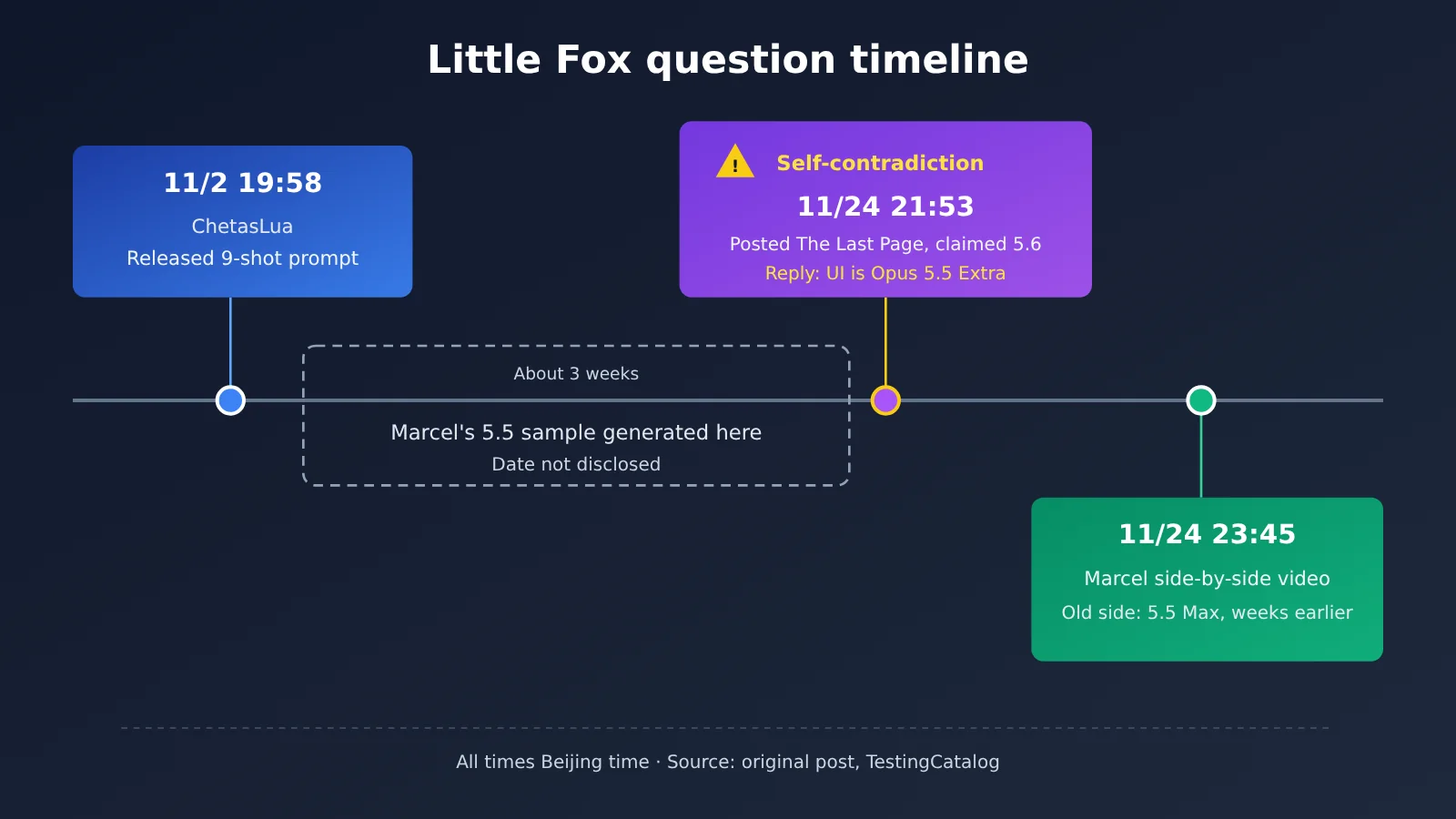
This test case and the two sample videos are more than three weeks apart, and they involve three separate information sources. The table below is organized by Beijing time; the “Source Type” column separates the original post, the author’s own statements, and third-party retellings.
| Time (Beijing) | Publisher | Content | Source Type |
|---|---|---|---|
| November 2, 19:58 | ChetasLua | Publicly shares the nine-shot little fox prompt | Original prompt |
| November 24, 21:53 | ChetasLua | Releases The Last Page, which they attribute to what they call 5.6; in replies they also say the interface showed Opus 5.5 Extra | Author’s own statement (contradictory) |
| November 24, 23:45 | Marcel | Posts a side-by-side video, says it uses the same prompt, and says the new version’s motion and looping are smoother | Third-party author observation |
| Afterward | TestingCatalog | Reports testers’ early results, describing the new version’s story as easier to make out, while some frames in the old version are hard-to-parse fragments | Secondary media description |
The Nine-Shot Prompt Used to Test Claude Opus 5.6
ChetasLua’s prompt asks for a roughly one-minute short film made of nine shots. Every visual and sound must be original, the deliverable is a single-file webpage, and pre-rendering is explicitly allowed. The “Fable 5.5” that appears at the end is a literal string written into the prompt; it doesn’t tell you which model produced the sample.
Here’s the story: in a tower before dawn, a lantern-carrying fox walks into a library and sets its paw down on an empty book. The ink turns into birds, the pages fly out one after another, and they converge into a giant bird. The final page is still blank, and the fox sets its paw down again. That ending has to loop back to the opening action, so the prompt is naturally testing “loop closure.”
Claude Opus 5.6’s Side: What You Can Verify in The Last Page Repository
The biggest advantage on the new version’s side is a public repository — you can check a lot of details directly instead of relying on impressions from watching the video. The repository docs give the following specs.
| Parameter | Value | Notes |
|---|---|---|
| Resolution | 2048×1152 | 16:9 |
| Frame rate | 24 fps | Common cinematic frame rate |
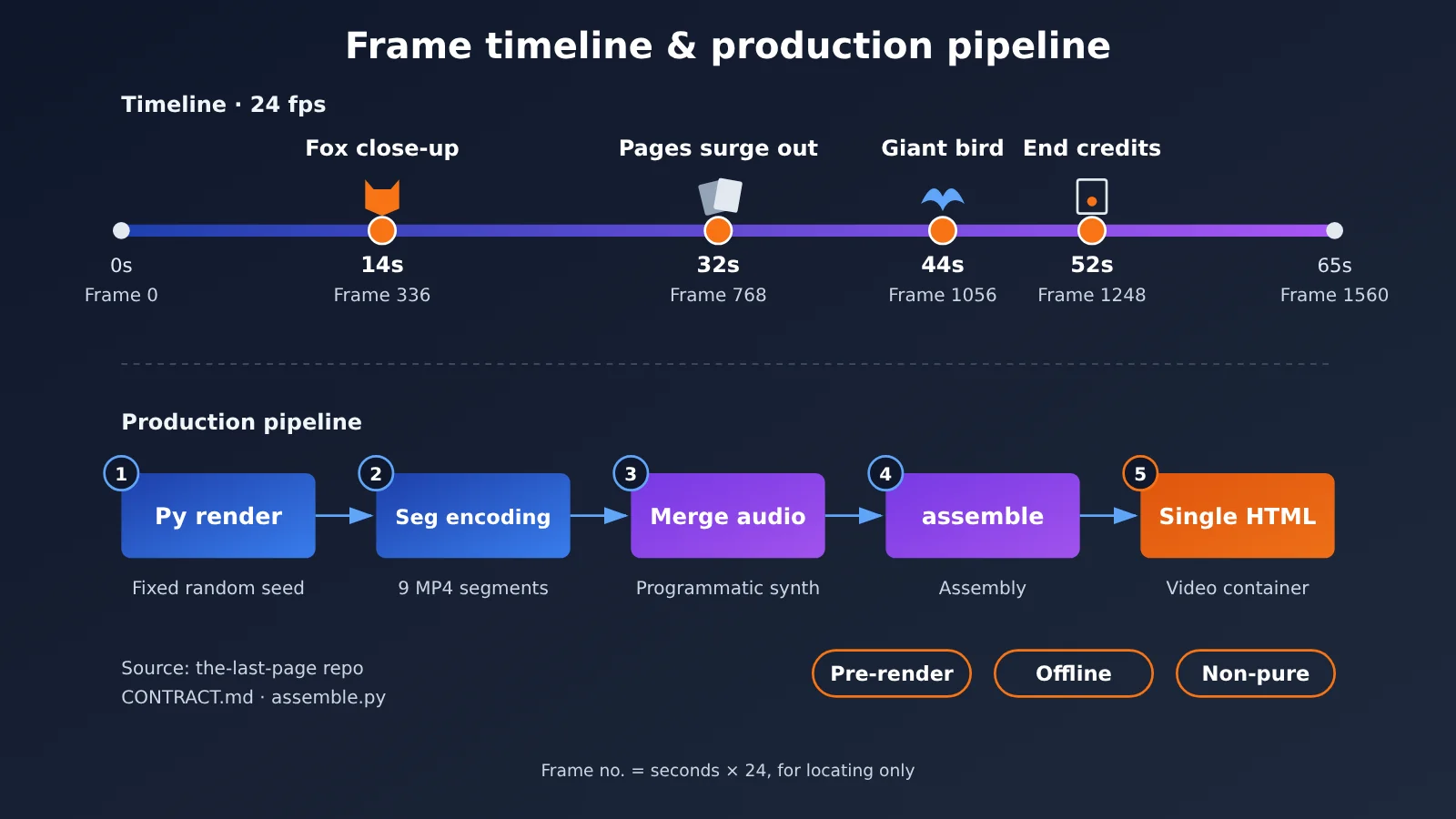
| Total frames | 1560 frames | Matches 65 seconds × 24 fps |
| Duration | 65 seconds | Slightly longer than the prompt’s “about one minute” |
| Fox close-up | around 14s | Near frame 336 |
| Pages flooding out | around 32s | Near frame 768 |
| Giant bird takes shape | around 44s | Near frame 1056 |
| Ending | around 52s | Near frame 1248 |
The frame numbers in the table are converted from “seconds × 24”; they’re only there for locating things, and the actual files in the repository are authoritative.
On the production pipeline, the repository shows rendering done in Python, a fixed random seed, and an audio track synthesized programmatically. The nine shots are each encoded as MP4 and then embedded in HTML. So this “webpage you can open” is essentially a container for pre-rendered video — it can’t be described as real-time rendering, and it isn’t pure SVG animation either. That fits the prompt’s “pre-rendering allowed” rule.
When you review the visuals, I’d suggest focusing on three spots:
- During scene changes, do the character’s outline and the lantern break apart or jump?
- Between 32 and 44 seconds, is the page-to-bird transformation continuous?
- Does the wrap-up after 52 seconds clearly return to “blank last page, paw down again”?
The Claude Opus 5.5 side: only secondhand descriptions
The older side doesn’t have a public repo right now, so all we can see are Marcel’s side-by-side video and third-party descriptions. Marcel himself clarified a few things: his Opus 5.5 Max sample was run a few weeks ago, he synced things up when editing the side-by-side, and that run didn’t go through what he calls the “new route.”
TestingCatalog’s description is that the story on the newer side is easier to make out, while some frames on the older side are unrecognizable fragments. Also, some X platform videos won’t play directly. This article hasn’t done frame-by-frame testing on either video — everything above is the source’s observation.
The author’s other work and where the Arena cases fit
ChetasLua has published two other pieces. One is a real-time Three.js tea journey where the sounds triggered by clicks align to the next sixteenth note, with support for pausing, seeking, and switching to a woodblock print style. The other is a native WebGL2 pelican tandem bike, where the singing is synthesized from digital signals, and at the end you can free-ride and ring the bell. These are different tasks — they only show how the author solves engineering problems in different scenarios, and can’t be compared head-to-head with the little fox task.
On November 24, Arena published two cases on the same prompt: a wind turbine and a keyboard. The wind turbine one looks at the cross-section structure, the six-step explanation, and whether the wind-speed control can drive the power curve; the keyboard one looks at whether the casing and keycaps update instantly, whether the overall proportions are reasonable, and whether the controls are easy to spot. These two cases can serve as a reference for evaluation methods, but they aren’t a benchmark score for Claude Opus 5.6. Anthropic mentioned the same-prompt game experience in the Opus 5.5 announcement — that counts as the vendor’s own account.
Claude Opus 5.6 vs 5.5: What the Claims Actually Support
A Five-Dimension Comparison of Claude Opus 5.6 and 5.5
The table below breaks the differences into five dimensions. The “Evidence type” column is the most important one—it determines how much you can trust each row’s conclusion.
| Dimension | Claimed Claude Opus 5.6 side | Opus 5.5 side | Evidence type |
|---|---|---|---|
| Story recognizability | Described as having a more readable story | Some frames described as hard-to-make-out fractal shards | Secondhand description (TestingCatalog) |
| Shape continuity | Outlines and lights can be re-checked against repo frame numbers | Not disclosed | New side: source code reviewable; old side: missing |
| Scene and shot transitions | Nine MP4 segments; transitions can be checked one by one | Not disclosed | New side: reviewable; old side: missing |
| Looping | Marcel says motion and looping are smoother; the ending settles from around 52 seconds | Marcel says it’s less smooth than the new version | Author observation + new-side frame numbers |
| Asset delivery method | Python pre-rendering + synthesized audio track + MP4 embedded in HTML | Not disclosed | New side: source code reviewable; old side: missing |
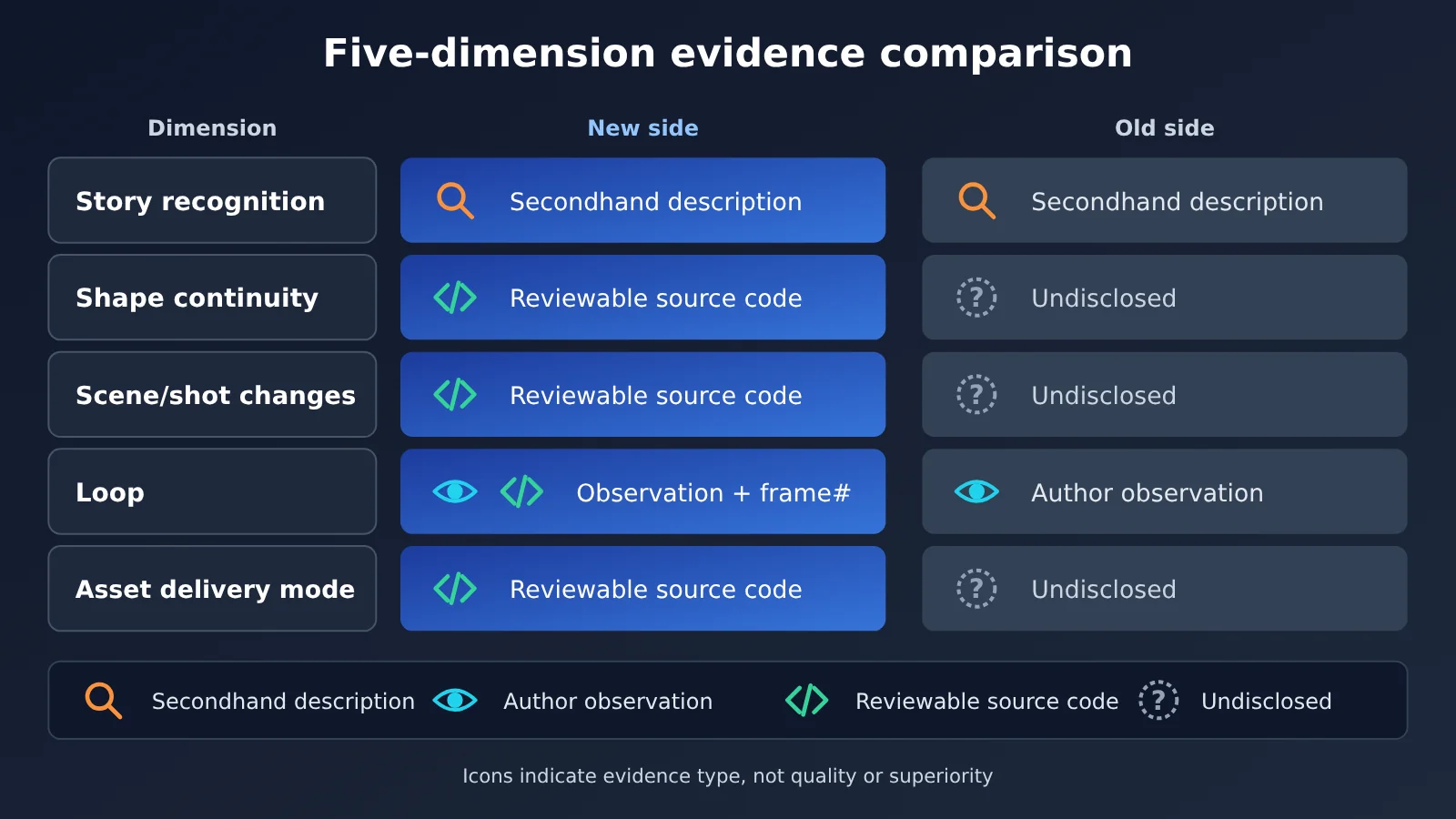
One basic fact stands out from this table: the evidence is asymmetric. On the new side, shape, transitions, and delivery can all be checked against the source code; on the old side, those items can only be marked “not disclosed”—which is not the same as “couldn’t do it.” The only dimensions where both sides actually say something are story recognizability and looping, and both of those rest on someone else’s observation.
Asset delivery deserves a separate note. The prompt allows pre-rendering, so the new side’s approach—render offline, then embed the video—is within the rules, and it also frees image quality from the limits of real-time browser performance. If the old side rendered in real time, part of the visual difference between them may come from the technical approach rather than model capability alone. Since the old side’s method wasn’t disclosed, that remains an unverified hypothesis for now.
Why this set of Claude Opus 5.6 samples still isn’t a strict controlled comparison
At least four variables weren’t controlled:
- Different authors: one side is ChetasLua, the other is Marcel. Beyond the prompt, the follow-up questions, edits, and selection process are all unknown.
- Different time windows: the older samples were run weeks ago, and the platform model or routing may have changed in the meantime.
- Different entry points and tiers: one side is attributed to the so-called 5.6, but the author’s reply also says the interface was Opus 5.5 Extra; the other side is Opus 5.5 Max. There are conflicting accounts of which model actually generated the new side.
- Editing: the side-by-side videos were synchronized, so the pacing viewers see may not be the original pacing.
So the safer claim is: “In this set of public samples, observers found the new side’s narrative clearer, its loops smoother, and it has a re-checkable engineering implementation.” As for “Claude Opus 5.6 is better at visual programming than 5.5” — these materials can’t support that conclusion.
How to run a strict same-prompt retest of Claude Opus 5.6
If you want trustworthy conclusions, control the variables yourself. There’s really only one core principle: everything must be identical on both sides except the model ID.
| Control item | What to do | Purpose |
|---|---|---|
| Prompt | Use the original nine-shot prompt from November 2 verbatim, with no added edits | Rule out prompt differences |
| Invocation entry point | Run both versions through the same OpenAI-compatible endpoint, e.g. APIYI apiyi.com | Rule out platform and routing differences |
| Time window | Run them alternately within the same time window | Rule out the effect of model updates |
| Parameters and tier | Record parameters like max_tokens and keep them consistent on both sides | Rule out interference from Extra/Max-style tiers |
| Number of runs | Run each model at least several rounds and keep all results | Avoid cherry-picking the single best run |
| Model receipt | Save the model field returned in the response | Verify which version was actually called |
| Review | Blind review with model names hidden, checking against story beats | Reduce subjective preference |
When reviewing, don’t directly apply the second counts from The Last Page, since every generation has a different duration. A more sensible approach is to anchor on story beats: fox close-up, paw landing, ink becoming a bird, pages pouring out, giant bird taking shape, blank last page, another paw landing. For each beat, check whether contours and lighting stay continuous, whether transitions are smooth, and whether the ending is clear. You can also borrow Arena’s approach and additionally check verifiable points like “do the controls actually drive the image.”
Below, a few lines of code to confirm which Opus model IDs are available on the platform. Don’t fill them in from memory — whether the so-called 5.6 is actually callable should be based on what the list actually returns.
from openai import OpenAI

client = OpenAI(
    api_key="YOUR_API_KEY",
    base_url="https://api.apiyi.com/v1"  # APIYI OpenAI-compatible endpoint
)

# List the currently available Opus models; confirm the IDs before retesting
for m in client.models.list().data:
    if "opus" in m.id.lower():
        print(m.id)
View the full same-prompt retest script
import json
import time
from pathlib import Path
from openai import OpenAI

client = OpenAI(
    api_key="YOUR_API_KEY",
    base_url="https://api.apiyi.com/v1"  # Both versions use the same endpoint
)

# Paste the original nine-shot prompt from November 2 verbatim, without any rewriting
PROMPT = Path("fox_prompt.txt").read_text(encoding="utf-8")

# Replace with the IDs actually returned by models.list()
MODELS = ["OPUS_5_5_MODEL_ID", "OPUS_5_6_MODEL_ID"]
RUNS_PER_MODEL = 3
PARAMS = {"max_tokens": 32000}  # Keep both sides consistent and record it

out_dir = Path("trials")
out_dir.mkdir(exist_ok=True)

def run_trial(model_id: str, run_idx: int) -> None:
    start = time.time()
    resp = client.chat.completions.create(
        model=model_id,
        messages=[{"role": "user", "content": PROMPT}],
        **PARAMS,
    )
    elapsed = round(time.time() - start, 1)
    content = resp.choices[0].message.content or ""

    # Save under anonymous IDs for easier blind review later
    tag = f"{abs(hash(model_id)) % 10000:04d}_run{run_idx}"
    (out_dir / f"{tag}.md").write_text(content, encoding="utf-8")

    meta = {
        "requested_model": model_id,
        "returned_model": resp.model,  # Verify the actual version
        "run": run_idx,
        "timestamp": time.strftime("%Y-%m-%d %H:%M:%S"),
        "elapsed_s": elapsed,
        "params": PARAMS,
        "usage": resp.usage.model_dump() if resp.usage else None,
    }
    (out_dir / f"{tag}.json").write_text(
        json.dumps(meta, ensure_ascii=False, indent=2), encoding="utf-8"
    )
    print(tag, meta["returned_model"], f"{elapsed}s")

# Run alternately, ideally within the same time window
for i in range(RUNS_PER_MODEL):
    for model_id in MODELS:
        run_trial(model_id, i)
The script is only responsible for generation and archiving. Model outputs are often rendering code, such as Python or HTML, which needs to be executed separately on the same machine and in the same environment, then exported as video and handed to reviewers. If the output uses random numbers, record or fix the seed so the same result can be reproduced later.
Retest tip: Calling both versions through the same endpoint is the most direct way to eliminate the “different routing” variable. APIYI apiyi.com provides an OpenAI-compatible interface, so one key can switch between different versions of the Claude series. New users get free test credits, making it a good option for first running a few rounds to verify that the retest workflow works.
Claude Opus 5.6 FAQ
Q1: Is The Last Page definitely generated by Claude Opus 5.6?
Not certain. ChetasLua himself attributes it to the version he calls 5.6, but in a reply he also says the interface showed Opus 5.5 Extra. Until official information or a verifiable record appears, it should be treated as “a sample from the new-version side whose attribution is in doubt.”
Q2: What does “Fable 5.5” at the end prove?
Nothing. It’s a phrase required by the original prompt. Any model answering the prompt as written would include it, so it can’t be used to determine the model version.
Q3: Does the fact that the webpage opens mean it’s rendered in real time?
No. The repository shows that the visuals were rendered offline in Python, with nine shots encoded as MP4 and embedded in HTML. That’s a pre-rendered approach allowed by the assignment, and it’s a different technical route from a real-time Three.js scene.
Q4: Can the Arena fan and keyboard cases represent Claude Opus 5.6’s performance?
No. Those two cases are publicly available examples of the same task on Arena. You can borrow the checking ideas—for example, whether the controls actually drive the result—but they aren’t benchmark scores for Claude Opus 5.6.
Q5: If I want to re-test it myself, what’s the least troublesome way to call it?
Call both versions through the same OpenAI-compatible endpoint, so you have one less variable to deal with. After registering at APIYI apiyi.com to get a key and free quota, first run models.list() to confirm the available IDs, then run the re-test script in this article.
Q6: What’s the variable most easily overlooked when re-testing?
First, the tier label—UI options like Extra or Max; second, the model field actually returned in the response. I’d write both into your records and check the return value every round—same goes for an aggregation endpoint like APIYI apiyi.com.
The value of this set of fox samples is that it provides a clear visual programming challenge and an engineering implementation you can check frame by frame. Whether the differences come from the model itself has to be answered by re-testing with the same task, same endpoint, and same time window. If you need a unified endpoint to run this kind of comparison, you can use the same key on APIYI apiyi.com to call each Claude version in turn and keep a complete record of every round.
References
- ChetasLua nine-shot fox-prompt challenge prompt: the original prompt posted on November 2
- Link:
x.com/chetaslua/status/2117224843661980093
- Link:
- ChetasLua’s original The Last Page post: new-version sample on one side, plus the author’s replies
- Link:
teapawt.org/chetaslua/status/2125226204764733481
- Link:
- Marcel’s side-by-side comparison video: same prompt side by side, plus notes on running the older version
- Link:
x.com/marcthecreatorr/status/2125254550416175477/video/1
- Link:
- TestingCatalog coverage: secondhand description of testers’ early results
- Link:
testingcatalog.com/testers-share-early-results-possible-claude-opus-5-6/
- Link:
- The Last Page repository: spec document and assembly script
- Link:
github.com/ChetasLua/the-last-page - Note: see
docs/CONTRACT.mdfor the spec andtools/assemble.pyfor the assembly workflow
- Link:
- Other works by the same author: a real-time Three.js tea journey and a WebGL2 pelican tandem bike
- Links:
github.com/ChetasLua/the-tea-ride,github.com/ChetasLua/built-for-two
- Links:
- Arena 3D leaderboard announcement: same-prompt wind turbine and keyboard cases
- Link:
arena.ai/blog/introducing-the-arena-3d-leaderboard
- Link:
- Anthropic Claude Opus 5.5 announcement: the vendor’s notes on the same-prompt experience
- Link:
anthropic.com/claude-opus-5-5
- Link:
Author: APIYI Technical Team
Technical discussion: Feel free to contact us on the APIYI website homepage; more integration resources are available in the docs.apiyi.com documentation center