Author’s note: Using the eight benchmarks self-reported by Cognition, this breaks down where the gap between SWE-2.1 and Claude Opus 5.5 is large and where it’s small, along with how to think about cost and how to divide tasks.
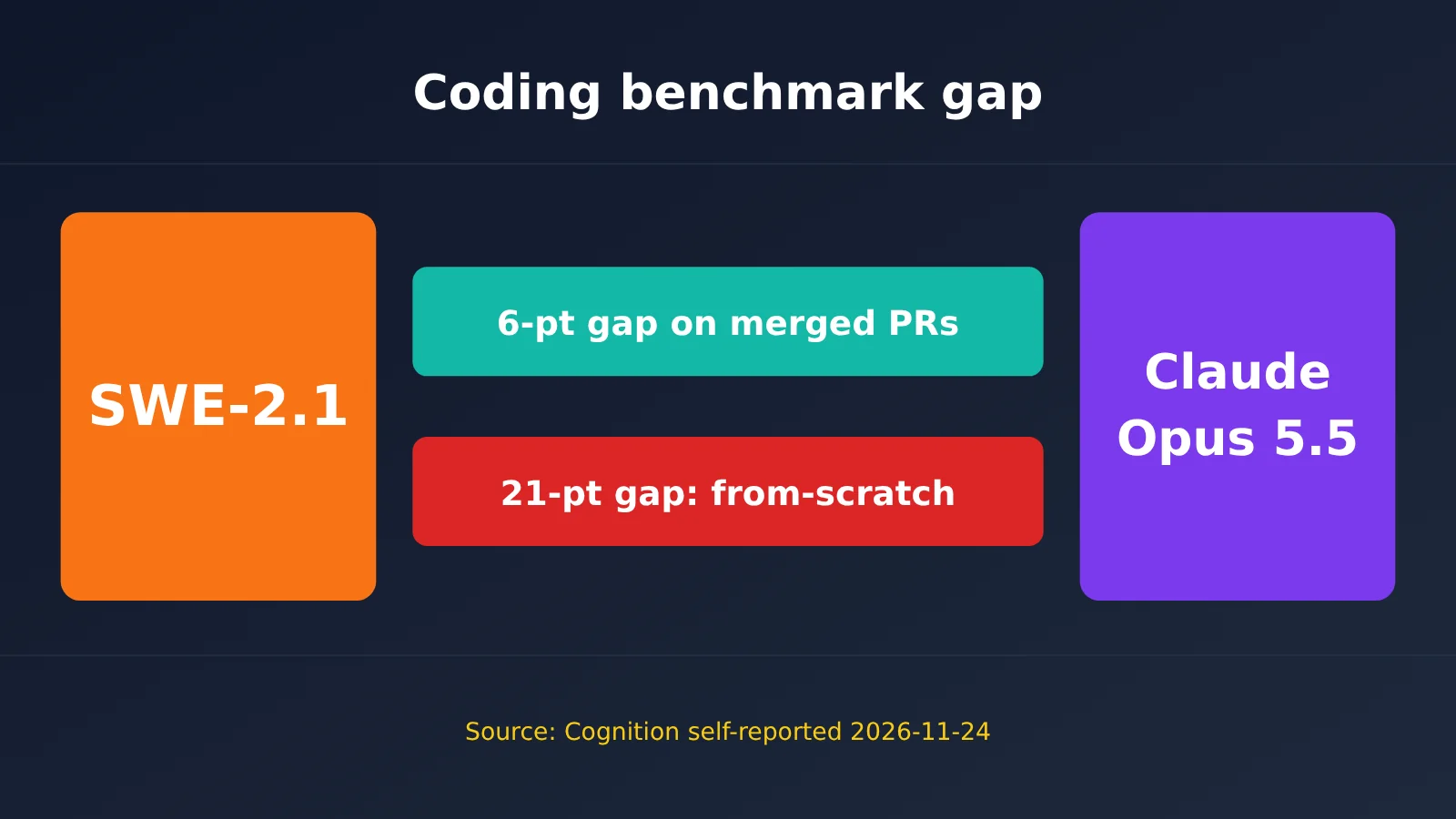
Let’s start with the conclusion. Among the eight comparable benchmarks Cognition published on 2026-11-24, SWE-2.1 scores lower than Claude Opus 5.5 on every single one, but the gaps are very unevenly distributed. The smallest gap is in tasks like “whether a PR can be merged by maintainers” — FrontierCode 2.0 differs by only 6.0 points. The largest gap is in writing an entire project from scratch and long-horizon tasks lasting several hours — ProgramBench differs by as much as 21.0 points.
This isn’t a hedging analysis that makes it look like each model has its strengths. All scores come from Cognition’s official blog and the FrontierCode leaderboard it maintains; they’re vendor self-reported, and this article includes no independent testing. We’ll explain exactly what these numbers measure, then give clear recommendations on how to divide tasks.
Key takeaway: After reading this, you’ll be able to judge which coding tasks in your team are worth trying with SWE-2.1, which should stay with Opus 5.5, and avoid cost misjudgments that come from looking only at the cheaper price.
What Are SWE-2.1 and Opus 5.5?
SWE-2.1 is Cognition’s latest coding model, released on 2026-11-24 (in the early hours of 11-25 Beijing time). Like its predecessor SWE-2, it was trained on the Kimi K3 base using pure reinforcement learning, and the team says it delivers major gains over SWE-2 across a range of benchmarks. The same release also brought SWE-2.1 Cyber — built for cybersecurity work and used by Devin Security — plus a 10x-speed version made in partnership with Cerebras (a tweet calls it SWE-2.1 Lightning, while the blog post itself says SWE-2.1 Ultrafast).
One thing worth paying attention to is the availability scope: SWE-2.1 is only offered through three entry points — Devin Cloud, Devin Desktop, and Devin CLI — and no public API was announced. There’s a free period after launch, then a discounted price for a while; check Cognition’s official pages for the exact dates.
Claude Opus 5.5 is the yardstick in this comparison. It can be used as a coding agent inside Claude Code, and it can also be plugged into your own service via API — its model ID on APIYI is claude-opus-5-5. That means the two aren’t on equal footing to begin with: one only works inside Devin, while the other can be integrated into any system.
SWE-2.1 vs Opus 5.5: How Big Is the Gap Across Eight Benchmarks?
The table below lists the eight benchmarks where both sides have data, sorted from smallest to largest gap. All scores are self-reported by Cognition. Opus 5.5 has no data for ExploitGym Flag capture, so that one isn’t included.
| Benchmark | Type | SWE-2.1 | Claude Opus 5.5 | Gap |
|---|---|---|---|---|
| CWE-Bench v2 Public | Security / vulnerability identification | 65.8 | 67.3 | 1.5 |
| FrontierCode 2.0 | Whether the PR can be merged | 41.3 | 47.3 | 6.0 |
| SWE-Atlas QA | Repository Q&A | 71.0 | 77.4 | 6.4 |
| ExploitGym Success | Vulnerability exploitation | 27.3 | 34.5 | 7.2 |
| ExploitBench | Vulnerability exploitation | 80.0 | 91 | 11.0 |
| Terminal-Bench 4.1 | Terminal operations | 50.0 | 65.8 | 15.8 |
| SWE Marathon v1.2 | Long-horizon multi-step tasks | 54.9 | 73.1 | 18.2 |
| ProgramBench | Building a project from scratch | 44.0 | 65.0 | 21.0 |
Once sorted, the pattern is clear: the top three gaps are all within 6.4 points, the bottom three are all above 15 points, and the two security benchmarks in the middle fall somewhere in between. So “how much worse is SWE-2.1 than Opus 5.5” isn’t a fixed number—it depends on which task you’re asking about.
Now look at the vertical progress. Compared with the previous SWE-2, SWE-2.1 rose from 24.1 to 41.3 on FrontierCode, from 17.0 to 44.0 on ProgramBench, and from 32.5 to 54.9 on SWE Marathon. The gains on long-horizon tasks are actually quite large—it’s just that Opus 5.5 was already further ahead on those benchmarks.
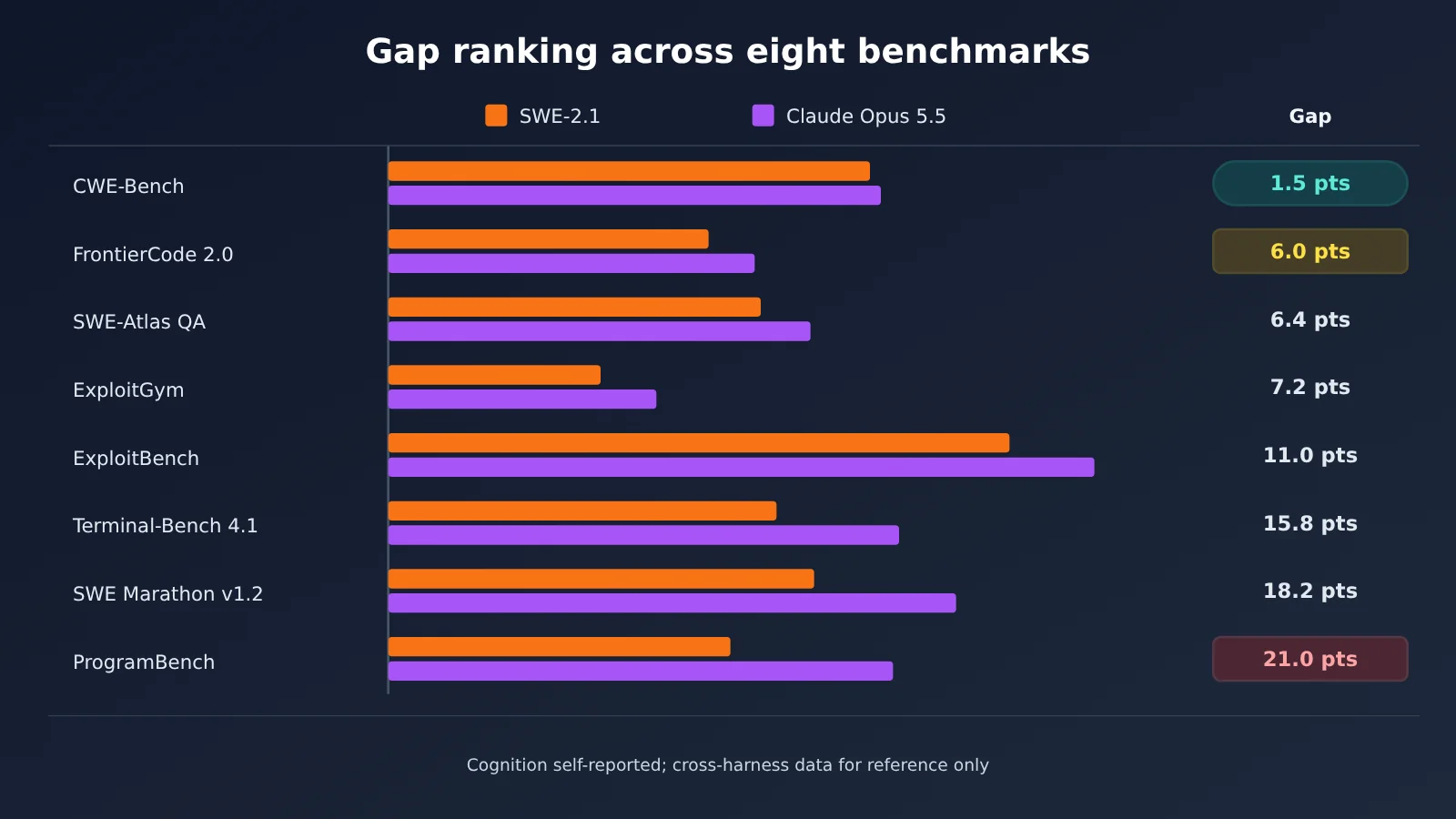
The chart above puts all eight gaps into a single bar chart, making it easy to compare both ends visually. If you want to verify Opus 5.5’s performance against your own business data, you can call claude-opus-5-5 directly through APIYI at apiyi.com to run a small-sample test.
Why the gap between SWE-2.1 and Opus 5.5 is distributed the way it is
First, what these leaderboards actually measure
To understand how the gap is distributed, you need to know how each leaderboard measures things. Here’s the setup we can confirm from the source materials:
| Benchmark | What it measures | Key setup |
|---|---|---|
| FrontierCode 2.0 | Whether a maintainer would merge this PR | Cognition’s own leaderboard: 132 tasks written by 20+ open-source maintainers, each taking over 40 hours to build; graded on correctness, test quality, change scope, style, and codebase conventions; network access is blocked, and using the reference solution scores 0 |
| ProgramBench | Writing a working project from scratch | You only pass if at least 95% of tests pass; SWE-2.1 ran with a 250k context window and at most 3 compactions, while other models used mini-swe-agent with their own native context windows |
| Terminal-Bench 4.1 | Terminal-operation tasks | Multi-step command-line operations |
| SWE-Atlas QA / SWE Marathon v1.2 | Repo Q&A / long-horizon multi-step tasks | Marathon leans toward long chains of tasks that require continuous execution |
| ExploitGym / ExploitBench | Security offense and defense | ExploitGym: 869 tasks, 6-hour timeout, pass@1; ExploitBench runs each task 5 times against a 3-hour simulated clock |
All time budgets use a simulated clock at a fixed TPS, so inference speed doesn’t skew the scores. In other words, these scores compare how much a model can get done within the same time budget, not which one runs faster.
One reasonable reading: the shorter the task, the more the gap closes
Putting task type and gap size side by side gives you an empirical rule of thumb: the closer a task is to “change one thing in an existing repo and still pass tests and review,” the smaller the gap between SWE-2.1 and Opus 5.5; the closer it is to “write a project from scratch” or “run multi-step work for hours on end,” the larger the gap. The 6.0-point gap on FrontierCode and the 21.0-point gap on ProgramBench sit right at the two ends of that pattern.
The official sources don’t explain the reasons directly, so what follows is speculation. When you edit code in an existing repo, the context, code style, and tests are already there, and the model mostly relies on understanding plus local edits. Writing a project from scratch requires the model to plan the architecture itself, break the work into modules, and stay consistent across a very long execution chain, where errors compound as it goes. In its blog post, Cognition says SWE-2.1 improved rollout length control, letting training cover tasks ranging from minutes to hours, with pass rates rising log-linearly as task length grows. That explains its big improvement over SWE-2 on long-horizon tasks, but judging by the current numbers, it’s still a clear distance behind Opus 5.5 on this kind of task.
Scores across harnesses aren’t the same yardstick
This point deserves its own emphasis. On the FrontierCode leaderboard, Opus 5.5 ran inside Claude Code, SWE-2 and the Kimi models ran in Devin CLI, and the GPT-6.2 family used Codex. Cognition itself has said plainly that scores are affected by the harness. ProgramBench is the same story: SWE-2.1’s context configuration differs from the other models’.
So the gaps in the table reflect differences between whole “model + toolchain” packages, not a clean measure of model capability alone. The safer reading: the relative size and ordering of the gaps is informative, but don’t take the exact point differences literally.
How Much Do SWE-2.1 and Opus 5.5 Actually Cost?
A lot of people’s first reaction when they see SWE-2.1 is “it’s cheaper than Opus.” But you have to know what’s being measured before you can compare costs.
Per-rollout cost on the FrontierCode leaderboard
The public FrontierCode leaderboard publishes the dollar cost of each rollout, all calculated at list API prices (read on 2026-11-25):
| Model | Harness | FrontierCode 2.0 | Cost per rollout |
|---|---|---|---|
| Claude Opus 5.5 max | Claude Code | 47.3% | $12.82 (201.9k output tokens) |
| Gemini 4 Neon high | Antigravity CLI | 46.2% | $4.38 |
| GPT-6.2 Astra max | Codex | 44.2% | $5.97 |
| GPT-6.2 Sol max | Codex | 43.8% | $1.29 |
| SWE-2 high | Devin CLI | 24.1% | $0.96 |
| SWE-2.1 | — | 41.3% (blog figure, not on the board) | Not disclosed |
Three things are worth reading carefully in this table:
- SWE-2.1’s per-rollout cost isn’t public. The $0.96 figure belongs to the previous generation, SWE-2, and can’t stand in for SWE-2.1. SWE-2.1 also isn’t on this leaderboard yet.
- “Cheaper than Opus” isn’t the only benchmark. On the same board, GPT-6.2 Sol running through Codex scores 43.8% at just $1.29 per rollout — higher than the 41.3% in SWE-2.1’s blog post.
- Opus 5.5’s expense comes mostly from output length. At 201.9k output tokens per rollout, it’s clearly doing a lot of reasoning and trial-and-error on these tasks, and that overhead gets amplified on long-horizon work.
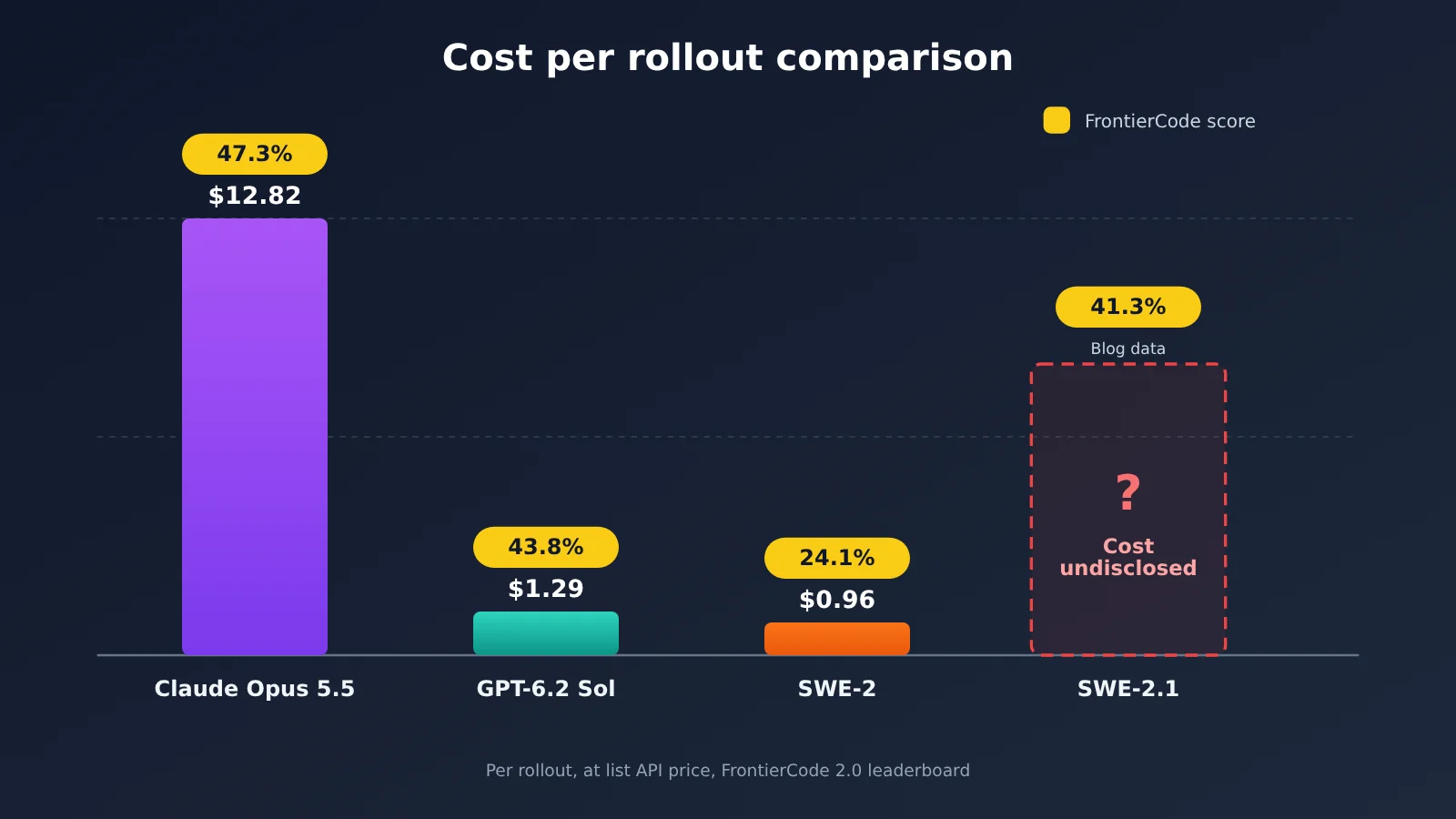
The chart above puts several cost figures side by side, showing that “cheap” has to be read together with the score. If you need to plug Opus 5.5 or GPT-6.2 Sol into your own service to validate costs, you can switch between these two models with the same API key on APIYI (apiyi.com) and run through your actual task to see the real token consumption.
What You Can Use in Your Own Service
SWE-2.1 doesn’t have a public API — you can only use it through Devin’s three entry points. If your goal is to call a strong coding model from your own system, a CI pipeline, or an internal agent, you’ll need a model that exposes an API. Here are the relevant models currently available on APIYI (data read on 2026-11-25, priced in USD per million tokens):
| Model ID | Input | Output | Cache read | Endpoints |
|---|---|---|---|---|
claude-opus-5-5 |
4 | 20 | 0.2 | chat, messages |
gpt-6.2-sol |
2 (0–272k range) | 10 | 0.1 | responses, chat |
kimi-k3.1-pro |
2 | 10 | 0.2 | chat |
kimi-k3 |
3 | 15 | 0.3 | chat |
For gpt-6.2-sol, any single input exceeding 272k tokens is billed at $3 per million. kimi-k3.1-pro and SWE-2.1 are built on the same Kimi K3 base, but they took different post-training paths, so their scores aren’t interchangeable. For model IDs and pricing, always refer to the model list on the APIYI apiyi.com platform.
🚀 Quick start: Sign up at APIYI apiyi.com, grab an API key, and integrate through the OpenAI-compatible interface — set base_url to
https://api.apiyi.com/v1and useclaude-opus-5-5orgpt-6.2-solas the model. If you need Anthropic’s native format,claude-opus-5-5also supports the messages endpoint.
SWE-2.1 vs Opus 5.5: Which Tasks Go to Which Model
Scenarios that should stay with Opus 5.5
- Building a new project from scratch: ProgramBench is 21.0 points behind, the biggest gap among the eight benchmarks, and architecture planning plus full delivery are still where Opus 5.5 shines.
- Long-running tasks that span several hours: SWE Marathon is 18.2 points behind. For long-chain work like large refactors and cross-module migrations, it’s better not to switch models.
- Heavy terminal work: Terminal-Bench is 15.8 points behind. Tasks involving environment setup, troubleshooting, and multi-step command orchestration are more stable on Opus 5.5.
- High-risk changes: For core production paths and permission- and payment-related code, the cost of one failure is far higher than the difference in model fees.
Scenarios where you can try SWE-2.1
- Short, quick merge-type tasks backed by tests: FrontierCode is only 6.0 points behind. Fixing bugs, adding features, and changing code to spec are where the gap is smallest.
- Repository Q&A and code understanding: SWE-Atlas QA is 6.4 points behind. Reading code and locating where an implementation lives are good tasks to try first.
- Your team already uses Devin: SWE-2.1 is only available inside Devin, so teams that already have a Devin workflow face the lowest switching cost.
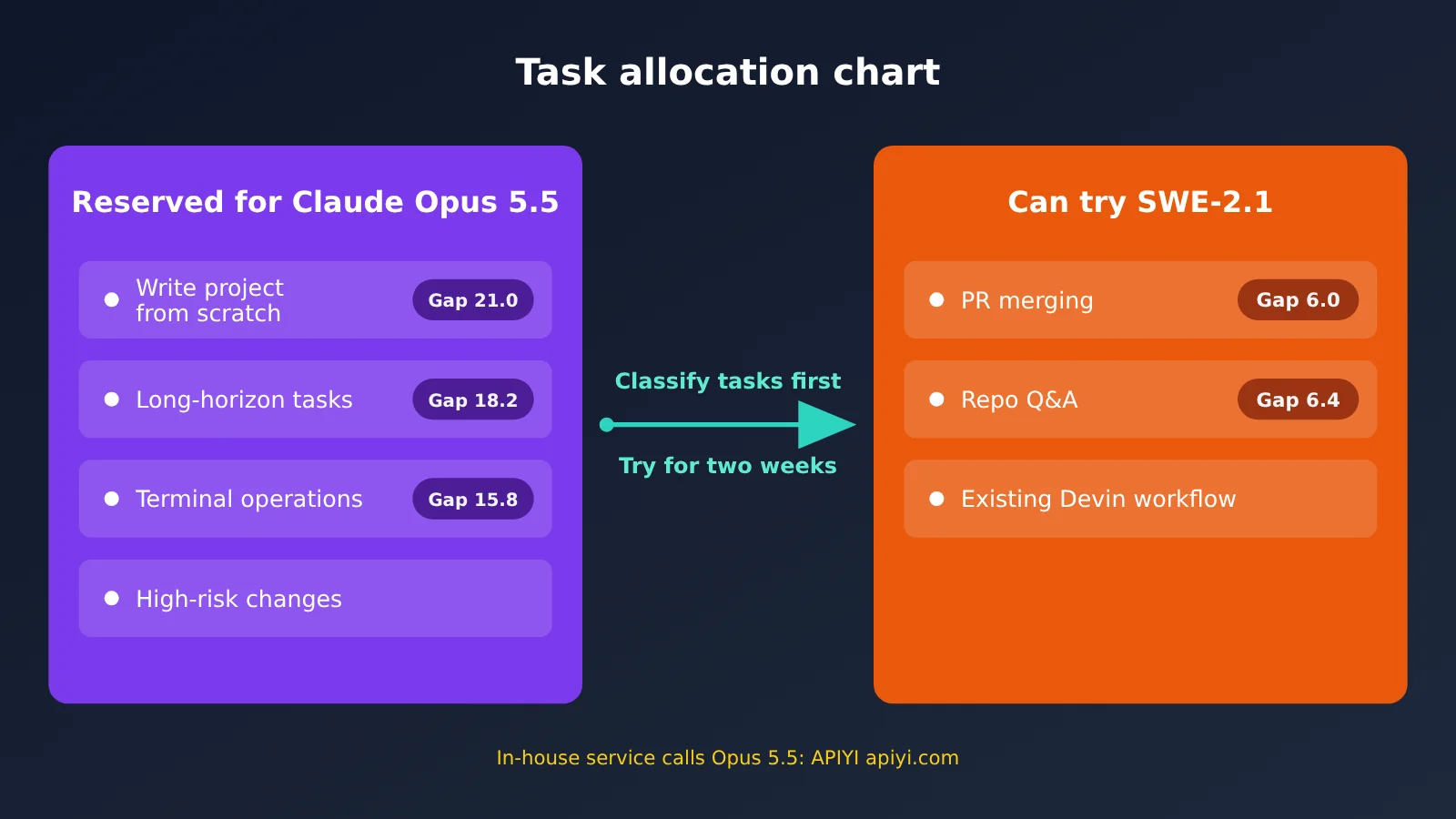
The diagram above gives the simplest division-of-labor framework: first classify the task by its nature, then decide which model to use. For steps that need to call Opus 5.5 outside Devin, you can access it through APIYI apiyi.com.
SWE-2.1 vs. Opus 5.5: Decision Guide
| Your situation | Recommendation |
|---|---|
| Your team mostly makes small changes to existing repos, with solid test coverage | Trial SWE-2.1 in Devin for two weeks and compare merge rate against rework rate |
| You often start new projects from scratch or do long-horizon refactors | Keep Opus 5.5 as the default model |
| You need to call a coding model from your own in-house system | SWE-2.1 doesn’t apply; route tasks between Opus 5.5 and GPT-6.2 Sol based on task type |
| You’re budget-conscious but don’t want to sacrifice too much quality | Start with a model that has public cost data, like GPT-6.2 Sol, then decide whether to upgrade to Opus 5.5 |
For the actual rollout, sample tasks from the team’s past month, tag them as “merge-type / from-scratch build / long-horizon multi-step / terminal operations,” and tally the share of each category. If merge-type work dominates, SWE-2.1 is worth trialing; if long-horizon and from-scratch work dominate, the money you save by switching models will likely be eaten up by rework. Don’t treat “cheaper” as your only reason—measure which category your tasks actually fall into first.
💡 Selection tip: During the trial, record both sides’ PR merge rate, average rework count, and per-task token consumption in parallel. For the Opus 5.5 and GPT-6.2 Sol side, you can collect data through APIYI (apiyi.com) by switching the
modelparameter with the same codebase, making side-by-side comparison easy.
Frequently Asked Questions (FAQ)
Q1: Can SWE-2.1 replace Claude Opus 5.5?
Not across the board. Based on the eight benchmarks Cognition reported itself, SWE-2.1 trails Opus 5.5 on every one of them. It’s better suited to merge-style and Q&A-style tasks where the gap is small; for building projects from scratch and long-horizon tasks, you should still leave those to Opus 5.5.
Q2: What do the 6-point and 21-point gaps in the title refer to?
The 6-point gap refers to FrontierCode 2.0 (41.3 vs 47.3), which measures whether a PR can actually be merged by maintainers. The 21-point gap refers to ProgramBench (44.0 vs 65.0), which measures whether a model can build a project from scratch that passes 95% of the tests. These two happen to sit near the two ends of the gap distribution.
Q3: Can these scores be compared directly across models?
Take them with a grain of salt. FrontierCode is Cognition’s own leaderboard, and different models use different harnesses — for example, Opus 5.5 uses Claude Code while SWE-2 uses Devin CLI — and Cognition itself acknowledges that scores are affected by the harness. The ranking of the gaps is informative, but the exact differences shouldn’t be read literally.
Q4: How much does each SWE-2.1 call cost?
There are no public figures yet. The $0.96 shown on the FrontierCode leaderboard is the per-rollout cost of the previous-generation SWE-2 and does not represent SWE-2.1. After launch, SWE-2.1 has a free period and a discount period inside Devin; refer to Cognition’s official documentation for the specifics.
Q5: Can I call SWE-2.1 via an API? And if I want a strong coding model inside my own service, what should I do?
SWE-2.1 has no public API — it’s only available through three entry points: Devin Cloud, Desktop, and CLI. If you want to use it in your own service, you can call `claude-opus-5-5` or `gpt-6.2-sol` through APIYI at apiyi.com, with base_url set to `https://api.apiyi.com/v1`. New users get free testing credits they can use to validate things.
Q6: What’s the relationship between SWE-2.1 and Kimi K3.1 Pro?
Both are based on the Kimi K3 foundation, but their post-training paths differ: SWE-2.1 is a coding-specialized model that Cognition trained with pure reinforcement learning, while Kimi K3.1 Pro is a general-purpose model that Moonshot trained with large-scale joint reinforcement learning covering hundreds of domains. On FrontierCode, the former scores 41.3 and the latter 19.9 (Devin CLI).
Q7: What are the known limitations of SWE-2.1?
First, it can only be used inside Devin and can’t be integrated into your own systems. Second, its own cost isn’t public, making a complete ROI calculation difficult. Third, all scores are vendor-reported, with no third-party reproduction yet. On top of that, it lags significantly behind Opus 5.5 on long-horizon tasks and terminal operations, so switching to it for such workloads carries higher risk.
SWE-2.1 vs Opus 5.5 Key Takeaways
- Loses all eight, but unevenly: SWE-2.1 scores below Opus 5.5 on all eight benchmarks self-reported by Cognition.
- Small gaps on merge-type tasks: CWE-Bench differs by 1.5, FrontierCode by 6.0, SWE-Atlas QA by 6.4.
- Large gaps on from-scratch and long-horizon tasks: ProgramBench differs by 21.0, SWE Marathon by 18.2, Terminal-Bench by 15.8.
- Don’t compare directly across harnesses: Different models use different toolchains, so it’s safer to look only at the gap ranking.
- Mind how cost is measured: SWE-2.1’s cost isn’t disclosed, while GPT-6.2 Sol achieves 43.8% at $1.29.
- Deployment isn’t apples-to-apples: SWE-2.1 is limited to Devin, while Opus 5.5 can be connected to self-built services via APIYI apiyi.com.
Summary
The core differences between SWE-2.1 and Claude Opus 5.5:
- Gaps vary with task type: Merge-type changes in existing repos differ by about 6 points, while from-scratch projects and long-horizon tasks differ by 15 to 21 points.
- Treat the numbers with caution: All are self-reported by Cognition and span different harnesses, so they’re good for spotting trends, not for precise accounting.
- Cost isn’t just about “cheap”: SWE-2.1’s cost isn’t disclosed, and there are other high-value API models on the same board worth considering.
The practical recommendation: keep Opus 5.5 for from-scratch builds, long-horizon tasks, and high-risk changes; for quick, small, test-covered merge-type tasks, you can try SWE-2.1 in Devin for two weeks and let the merge rate and rework rate do the talking. When you need to call Opus 5.5 from your own service or run a cost comparison, I recommend using APIYI apiyi.com to validate quickly through a unified interface.
📚 References
-
Cognition Official Blog – Introducing SWE-2.1: SWE-2.1 release notes, benchmark data, and training methodology
- Link:
cognition.com/blog/swe-2-1 - Description: The source for all benchmark scores in this article; the page is dated 2026.11.24
- Link:
-
FrontierCode 2.0 Public Leaderboard: A PR-merge coding benchmark maintained by Cognition
- Link:
cognition.com - Description: Includes each model’s harness, scores, and cost per rollout; read on 2026-11-25
- Link:
-
APIYI Model List: Available models and pricing
- Link:
docs.apiyi.com/models - Description: Endpoints and per-million-token prices for models such as
claude-opus-5-5andgpt-6.2-sol
- Link:
Author: APIYI Technical Team
Technical Contact: Feel free to reach us through the APIYI website homepage. For more integration resources, visit the docs.apiyi.com documentation center.