
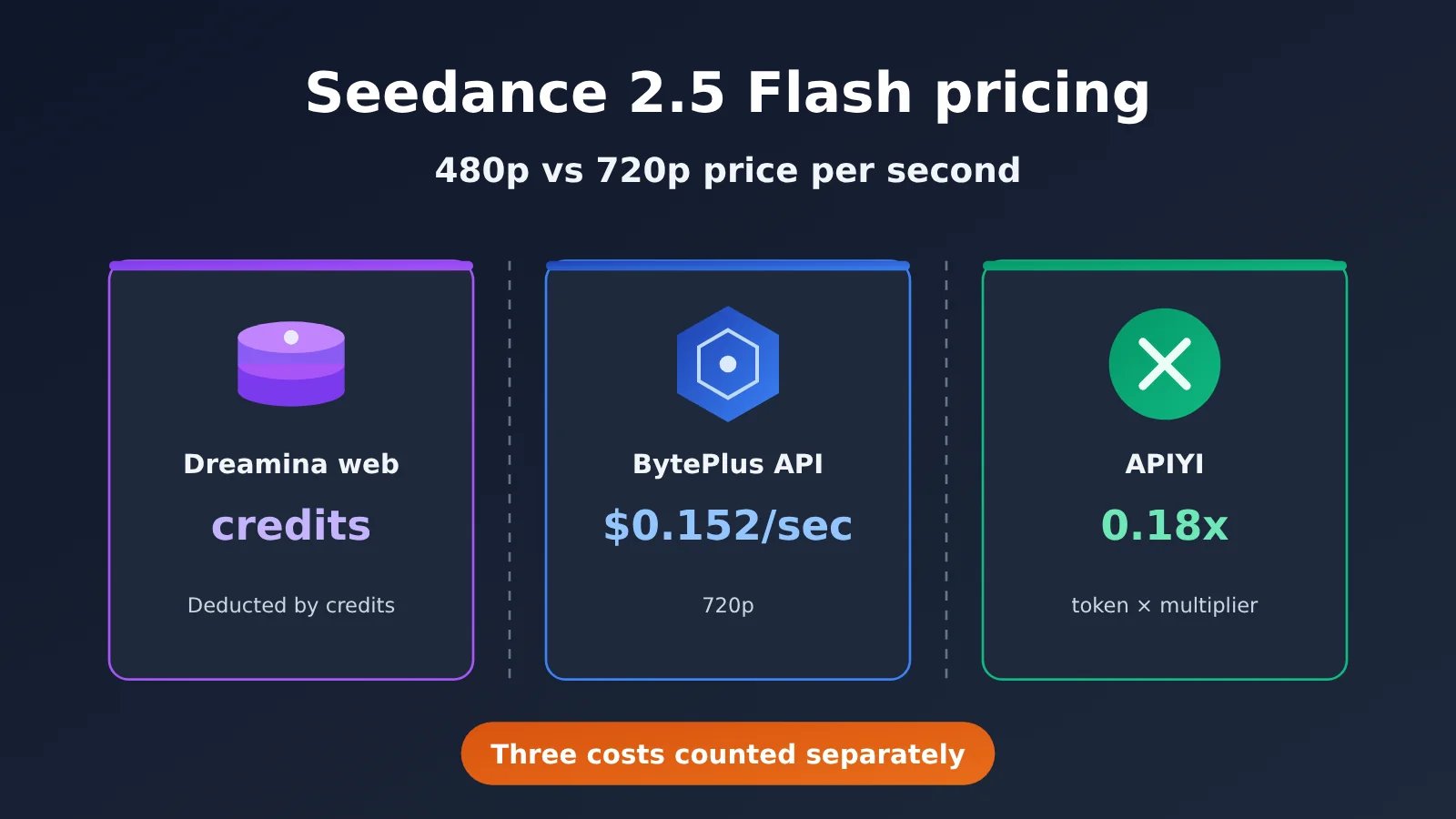
Author’s note: pulling apart three separate bills — Dreamina web credits, BytePlus API token pricing, and APIYI’s in-site group multiplier — to give you the per-second and per-video prices for Seedance 2.5 Flash at 480p and 720p, along with the reference-video surcharge and the hold-and-settle (pre-deduct, refund the excess, bill the shortfall) mechanism.
Dreamina launched Seedance 2.5 Flash on 2026-11-15, and the official post’s selling point was Faster generation, fewer credits. At almost the same moment, BytePlus published its API pricing: $0.152 per second at 720p, roughly 34% cheaper than the flagship Seedance 2.5. Plenty of people put these two announcements together and tried to work out “how much does one video actually cost,” only to find that the web page’s “saves you more credits” doesn’t line up with the API’s dollar figure.
This isn’t two vendors contradicting each other. Web plans, the official API, and aggregation platforms are three different billing models to begin with — they debit in credits, tokens, and “tokens × group multiplier” respectively. Line them up side by side and of course it gets confusing. This article separates those three bills, works each one out, and then gives the per-second and per-video prices for Seedance 2.5 Flash.
The payoff: once you’ve read this, you can put together a budget with a clearly defined basis for batch video production, and you’ll understand why the price shifts when you move from the web version over to the API.
Seedance 2.5 Flash Pricing: Key Facts at a Glance
Let’s start with a table of what’s already confirmed. It only summarizes the facts and the billing model — the actual numbers get broken down section by section in the “three bills” part further down.
| Item | Details |
|---|---|
| Web launch | Dreamina announced Seedance 2.5 Flash in a post on 2026-11-15 |
| API announcement | BytePlus published pricing on 2026-11-12; the API opened on ModelArk on 2026-11-15 |
| Official positioning | High-frequency creation, multi-version testing, batch generation |
| Supported resolutions | 480p, 720p; 1080p, 4K, and offline inference are all unsupported |
| Official core price | 720p text-to-video and image-to-video at USD 0.152 / second |
| Versus the flagship | About 34% lower than Seedance 2.5 |
| Billing precondition | You’re only charged when generation succeeds |
Why There Are Three Different Prices for Seedance 2.5 Flash
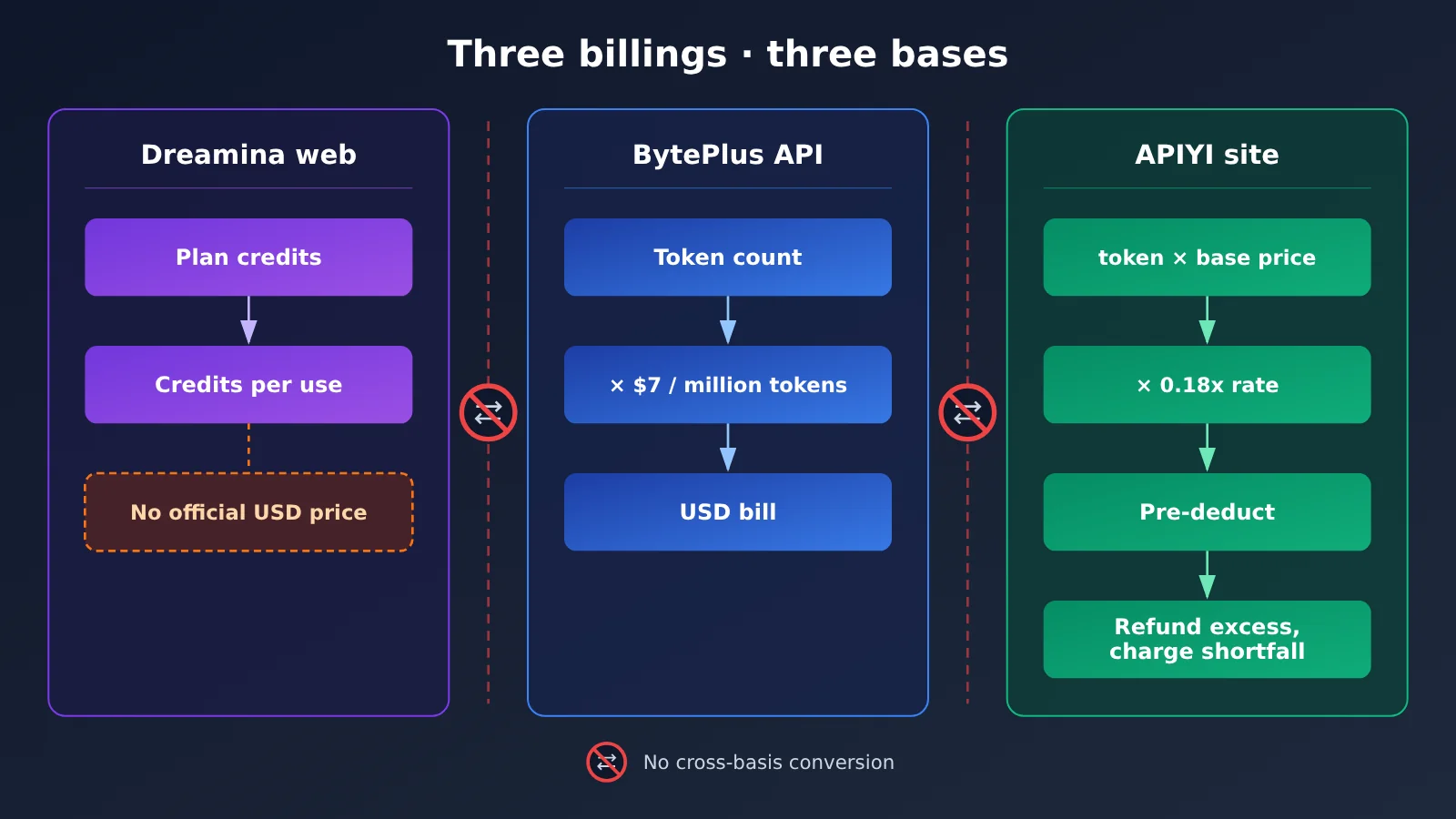
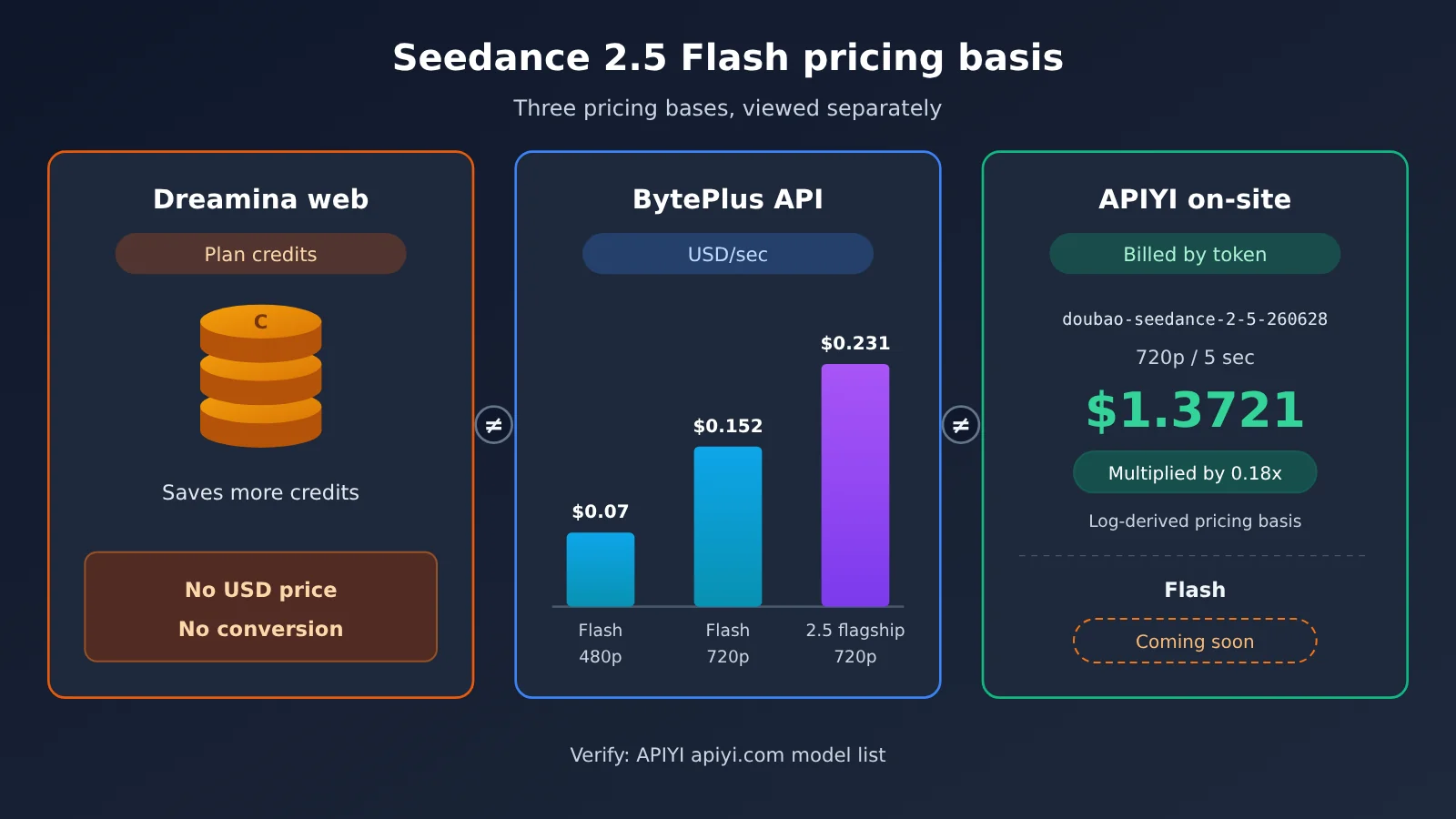
The same model shows up with three different prices because it’s sold in three places, in three different ways. Dreamina’s web version deducts credits from a plan, the BytePlus API charges US dollars per token, and aggregator platforms like APIYI take the token base price and multiply it by a group rate. The units of account differ, and so does the billing cadence — which means you can’t just line up the raw numbers and compare.
Below, we walk through the “three bills” one at a time. Each bill stays strictly in its own unit of account; no cross-unit conversion.
The first cost calculation: Seedance 2.5 Flash charges credits on the Dreamina web app
Dreamina’s official post says “Faster generation, fewer credits.” There are no dollar figures anywhere in the post, and no per-second price. In other words, the web app only tells you that it “saves credits versus before”—it doesn’t give you a monetary price you can compare with the API.
The credits in web plans are sold as bundles, and the cash value of one credit varies by plan and promotional period. So this article does not convert web credits into a “dollars per second” figure, and I’d suggest you avoid that conversion when budgeting, too. If your team currently produces videos on the web app, the right approach is to record how many credits each video deducts and use credits as your internal cost unit. When you’re ready to switch to the API, re-estimate using the second and third cost calculations below.
The audience for this cost calculation is also clear: creators who hand-pick shots, fine-tune one video at a time, and produce no more than a few dozen videos per day. Once you move into batch video production and automated pipelines, web credits become hard to budget precisely—and that’s when you should look at the API’s token bill.
The Second Cost: Seedance 2.5 Flash API Token Pricing
BytePlus’s official price list (updated 2026-11-12) is priced in USD per million tokens. For Flash at 480p and 720p, the rate is $7.0 without video input and $4.3 with video input. Token counts are estimated with the official formula: tokens ≈ (input video duration + output video duration) × width × height × 24 ÷ 1024. For pure text-to-video and image-to-video, set input video duration to 0.
Based on the official 5-second 16:9 example, one Flash 720p clip costs $0.76 and one 480p clip costs $0.34, which works out to about $0.152 per second for 720p and about $0.07 per second for 480p. The table below compares resolutions on the official USD basis, with flagship 2.5 included as a reference.
| Model (official basis) | Pricing (without video input) | 480p per second | 720p per second | 1080p per second | Official 5-second 720p example |
|---|---|---|---|---|---|
| Seedance 2.5 Flash | $7.0 / million tokens | ~$0.07 | ~$0.152 | Not supported | $0.76 |
| Seedance 2.5 flagship | $10.70 / million tokens ($11.7 for 1080p) | ~$0.103 | ~$0.231 | ~$0.569 | $1.156 |
As you can see, the 720p gap between Flash and the flagship is exactly the roughly 34% the official materials mention. The tradeoff is that Flash only goes up to 720p, so projects that need 1080p delivery have to use the flagship or another version.
Seedance 2.5 Flash 480p and 720p Full-Clip Pricing
When building batch budgets, what people care about more is how much a 5-second, 10-second, or 30-second video costs per clip. The table below multiplies Flash’s official per-second price by duration; the scenario is pure text-to-video or image-to-video at 16:9.
| Resolution | Per-second price (official) | 5-second clip | 10-second clip | 30-second clip |
|---|---|---|---|---|
| 480p | ~$0.07 | ~$0.35 | ~$0.70 | ~$2.10 |
| 720p | ~$0.152 | ~$0.76 | ~$1.52 | ~$4.56 |
Calculated from the official per-second rate, not an official quote for each tier. The official 5-second 480p example is $0.34; the $0.01 difference from $0.35 in the table comes from rounding the per-second rate.
At roughly $1.52 per 10-second 720p clip, Flash can produce quite a few more clips than the flagship on the same budget (about $2.31 per 10-second 720p clip). For workflows built around testing multiple versions and picking the best one, that gap gets amplified.
Why Seedance 2.5 Flash Costs More When Video Input Is Included
Many people see the unit price with video input drop from $7.0 to $4.3 and assume adding a reference video saves money, but in practice it’s often the opposite. The reason is how billable duration is defined: billed duration = input duration + output duration. Every second of the input reference video is also converted to tokens at the output resolution and billed. The unit price drops, but billable seconds can multiply several times over, so the total is usually higher.
The official example ranges for 5-second 16:9 with video input are about $0.37–1.45 at 480p and about $0.84–3.25 at 720p. The low end corresponds to 2–4 seconds of input video; the high end corresponds to 30 seconds of input video. In other words, with the same 5-second 720p output, adding a 30-second reference video can cost more than four times as much as a pure text-to-video run. If you want to save money, shorten the reference video first: keep only the action segment the model actually needs to reference. That’s the most direct cost-reduction lever.
The Third Cost: APIYI’s On-Platform Token Pricing × 0.18x Group Multiplier
The third option is calling through an aggregation platform. On APIYI (apiyi.com), the Seedance series runs under the SeeDance2 group with a 0.18x multiplier. Models currently listed include doubao-seedance-2-5-260628, doubao-seedance-2-0-260128, and their corresponding -fast and -mini versions. One thing worth flagging: Seedance 2.5 Flash (dreamina-seedance-2-5-flash-261115) isn’t listed yet as of 2026-11-16. We’ll get it up as soon as we can — for model names and pricing, always go by the platform’s model list.
The $70 / $46 / $37 / $23 figures in the on-platform model master table are base prices per million tokens before the 0.18x multiplier — not the price of a single video. Take 2.5 as an example: once the multiplier is applied, input without video is $12.60 per million tokens (480p, 720p, and 1080p are all the same price), and input with video is $7.56 per million tokens. The table below shows the full-video price for the currently available doubao-seedance-2-5-260628.
| Spec (doubao-seedance-2-5-260628) | On-platform full-video price |
|---|---|
| 480p / 4 sec | $0.4893 |
| 480p / 5 sec | $0.6103 |
| 720p / 5 sec | $1.3721 |
| 720p / 10 sec | $2.7329 |
| 720p / 30 sec | $8.1761 |
| 1080p / 5 sec | $3.0873 |
These figures are back-calculated from the billing logs in the official documentation and already include the 0.18x group multiplier. Billing is by area × duration, so a ±5% deviation is normal.
The official documentation also offers a cross-reference: on-platform nominal billing is roughly 1.26x the Volcano official price (0.18 multiplier × 1:7 exchange rate). Stack a 20% top-up bonus on top and it’s about 1.05x; for a typical user with the 10% bonus, it’s around 1.15x. These multipliers are only meant to give you a sense of the relative level — don’t use them to back out the exact price of Flash after it launches. The on-platform price for Flash will be whatever the model list says once it’s listed.
Integration uses the standard OpenAI-compatible interface: set base_url to https://api.apiyi.com/v1 and use doubao-seedance-2-5-260628 as the model name. Your token must have the SeeDance2 group checked, and the billing mode set to “Pay-as-you-go preferred” or “Pay-as-you-go billing” — otherwise you’ll get “no available channel for this model.”
🚀 Quick start: When you’re producing videos in batches, if model names, group multipliers, and pre-deduction rules are scattered across several dashboards, it’s easy to get your budget wrong. With APIYI (apiyi.com) you can see all three in one place, call Seedance and other mainstream models with a single API key, and new users get free trial credits — great for running a small batch first to validate your budget model.
APIYI’s Upfront Deduction and Settle-Up Mechanism
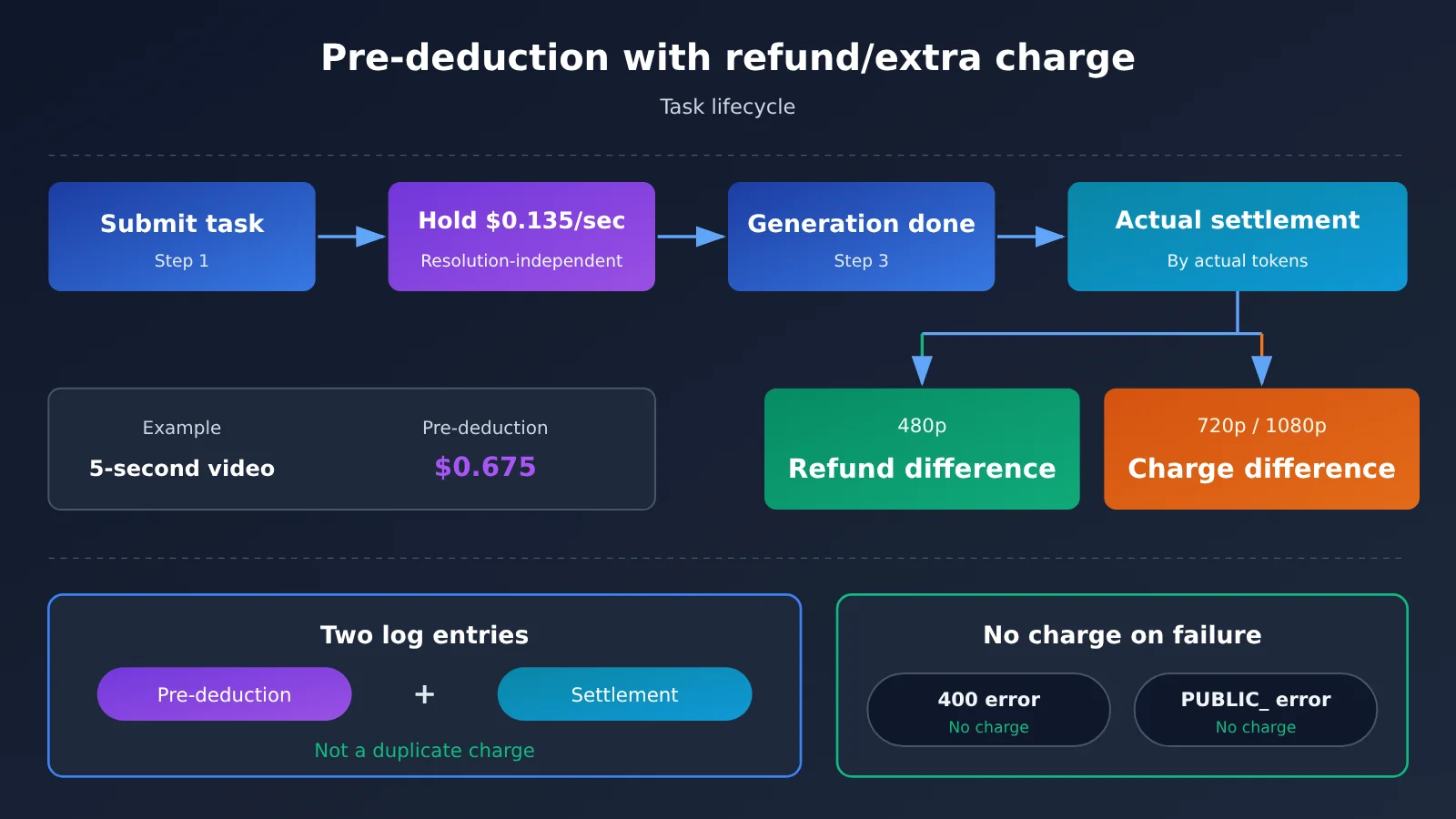
On-platform video tasks follow a “deduct upfront, settle later” model. The upfront deduction is calculated at $0.135/sec (the 2.0 series is $0.09/sec) and doesn’t depend on resolution; after the task finishes, we settle based on actual tokens, refunding any excess or charging any shortfall. A quick calculation using these rates: a 5-second video is deducted upfront at 5 × 0.135 = $0.675. If it’s 480p / 5 seconds ($0.6103), the difference is refunded; if it’s 720p or 1080p, the difference is charged.
So if you see two billing records for the same video in the logs (one upfront deduction and one settlement charge or refund), that’s normal—it’s not a duplicate charge. When reconciling, add the two records together to get the final price for that video. Also, 400 parameter errors aren’t billed, and errors with the PUBLIC_ prefix are upstream content moderation blocks and also aren’t billed, so retrying after a failure won’t waste money.
Seedance 2.5 Flash Pricing: A Three-Ledger Comparison
Putting the three pricing ledgers side by side makes the differences clearer. Note that this table only compares billing mechanisms—it doesn’t mix numbers from the three different bases.
| Dimension | Dreamina Web | BytePlus API | APIYI (platform) |
|---|---|---|---|
| Billing unit | Plan credits | USD / million tokens | token × base price × 0.18x group multiplier |
| Flash public price | Only says “fewer credits,” no USD price | 720p $0.152 / sec, 480p about $0.07 / sec | Not listed yet; refer to the model list |
| Charge timing | Credits deducted at generation | Billed after successful generation | Pre-deduct $0.135 / sec, then reconcile (refund excess, charge shortfall) after completion |
| Reference video | Per web rules | Input duration counts toward billable duration | Video-inclusive rate billed separately, and also counts toward duration |
| Best for | Manual clip selection, small-volume touch-ups | Direct official access, single-model pipeline | Multi-model batch generation, unified reconciliation |
Seedance 2.5 Flash Pricing Impact Analysis
Impact on developers and batch production teams
- Standardize budget units in tokens: Once you move from the web UI to the API, cost depends only on resolution, duration, and whether a reference video is included. With the token formula, you can calculate the cost per video upfront.
- 480p works well for draft work: 480p costs about $0.07 per second, making it a good fit for producing lots of drafts and narrowing down the direction. Once you’ve picked one, render the final cut at 720p — overall costs stay more controllable.
- Keep reference video length in check: Add an automatic reference video trimming step to your pipeline to directly lower the per-task cost of jobs that include video.
- Confirm the max resolution upfront: Flash doesn’t support 1080p or 4K. If a project’s delivery spec is 1080p, you still need to budget for the flagship version.
Impact on the video generation API pricing landscape
On a rough order-of-magnitude basis, Gemini Omni 1.2 Flash is officially priced at $0.07 per second for 720p ($12 per million tokens), while Seedance 2.5 Flash is $0.152 per second for 720p. Both companies’ Flash tiers are pushing video generation into a “batch-ready” price band, but they still differ in unit price, resolution coverage, and pricing method. For developers, that means it may be worth running several versions of the same shot across multiple models before deciding, rather than betting on a single vendor.
💡 Recommendation: If you need to compare output quality and cost across different Seedance versions or video models from different providers, you can switch models through APIYI at apiyi.com using the same OpenAI-compatible interface — and when reconciling billing, you only need to check one log.
FAQ
Q1: How much does Seedance 2.5 Flash cost per second at 480p and 720p?
According to BytePlus’s official pricing, 720p costs about $0.152 per second, and 480p costs about $0.07 per second. Pricing is based on $7.0 per million tokens (input excluding video). The official examples for a 5-second 16:9 video are $0.76 and $0.34, respectively.
Q2: Why does the Dreamina web page say it saves more credits, but doesn’t give a dollar price?
Because the web version deducts plan credits, and the official post only says “fewer credits” without giving any dollar figure. The cash value of credits changes with plans and promotions, so forcing a conversion into dollars per second is meaningless and can’t be compared directly with API pricing.
Q3: When will the Seedance 2.5 Flash API be available?
BytePlus announced pricing on 2026-11-12, and the API opened in ModelArk on 2026-11-15. As of 2026-11-16, APIYI hasn’t listed Flash yet; the models currently on sale include `doubao-seedance-2-5-260628` and others. We’ll list Flash as soon as possible.
Q4: Why does generating with a reference video cost more?
The unit price with video input drops from $7.0 to $4.3, but the billable duration equals input duration plus output duration, and every second of the reference video is billed in tokens at the output resolution. The longer the reference video, the higher the total price. For 5-second 720p output, the video-included example comes out to about $3.25 at most. Shortening the reference video first is the most cost-effective approach.
Q5: How can I call Seedance through the API and verify pricing?
You can register at APIYI apiyi.com to get an API key, select the SeeDance2 group for your token and set it to pay-as-you-go, and fill in `https://api.apiyi.com/v1` for base_url. The site’s per-video price, group rate multiplier, and pre-authorization rules can all be checked against the model list and documentation. New users get free test credits for small-batch validation.
Q6: The logs show a single video charged twice—is that duplicate billing?
No. APIYI pre-authorizes at $0.135 per second, then reconciles after the task completes based on actual tokens, refunding or charging the difference. That’s why you’ll see both a pre-authorization record and a settlement record; their sum is the final price of that video. `400` parameter errors and moderation blocks with the `PUBLIC_` prefix are not billed.
Seedance 2.5 Flash Pricing: Key Takeaways
- Three separate bills: the web app charges in credits, the official API charges in tokens, and APIYI charges in tokens multiplied by a 0.18x rate.
- Official per-second price: Flash at 720p runs about $0.152 / second, and 480p about $0.07 / second — roughly 34% cheaper than the flagship.
- Full-length budget: at 720p, 5 / 10 / 30 seconds costs about $0.76 / $1.52 / $4.56 (converted from the per-second price).
- The reference-video trap: input duration counts toward billing — the unit price drops, but the total usually goes up, so trim first and upload after.
- Resolution ceiling: Flash only supports 480p and 720p — no 1080p, no 4K, no offline inference.
- On-platform reconciliation: on APIYI apiyi.com the hold is charged per second and settled afterward with a refund or top-up, so seeing two log entries is normal.
Summary
The key points about Seedance 2.5 Flash pricing:
- The billing basis decides the number: the Dreamina web app only gives you credits, not dollars — don’t convert credits into a per-second price and compare that against the API.
- The official API price is clear: $7.0 per million tokens, which works out to about $0.152 per second at 720p and about $0.07 per second at 480p. For a full clip, just multiply the per-second price by the duration.
- For on-platform pricing, look at the real price after the multiplier: the currently listed
doubao-seedance-2-5-260628at 720p / 5 seconds is $1.3721. Once Flash goes live, the model list is the source of truth.
When you’re budgeting a batch of renders, first pin down the delivery resolution and whether you need a reference video, then pick your billing channel, and finally calibrate actual cost with a small batch of jobs. If you need unified reconciliation across multiple models, I’d recommend running a round on APIYI apiyi.com with the free quota first — get the hold, settlement, and logs straight in your head, then scale up.
📚 References
- Dreamina official X post: Seedance 2.5 Flash launch announcement
- Link:
x.com/dreamina_ai/status/2121921158928851126 -
Notes: the selling points are faster generation and fewer credits; no USD price is given
-
BytePlus official release: Seedance 2.5 Flash pricing and ModelArk availability
- Link:
x.com/BytePlusGlobal/status/2120760891344036304 -
Notes: USD 0.152 per second at 720p, roughly 34% lower than Seedance 2.5
-
APIYI models and Seedance docs: in-site model list, group multipliers, and billing rules
- Link:
docs.apiyi.com/models - Notes: covers the SeeDance2 group at 0.18x, pre-authorized holds with multi-refund/fewer-supplement settlement, and how error codes are billed
Author: APIYI technical team
Technical discussion: Feel free to reach us via the APIYI website homepage; for more materials, visit the docs.apiyi.com documentation center