

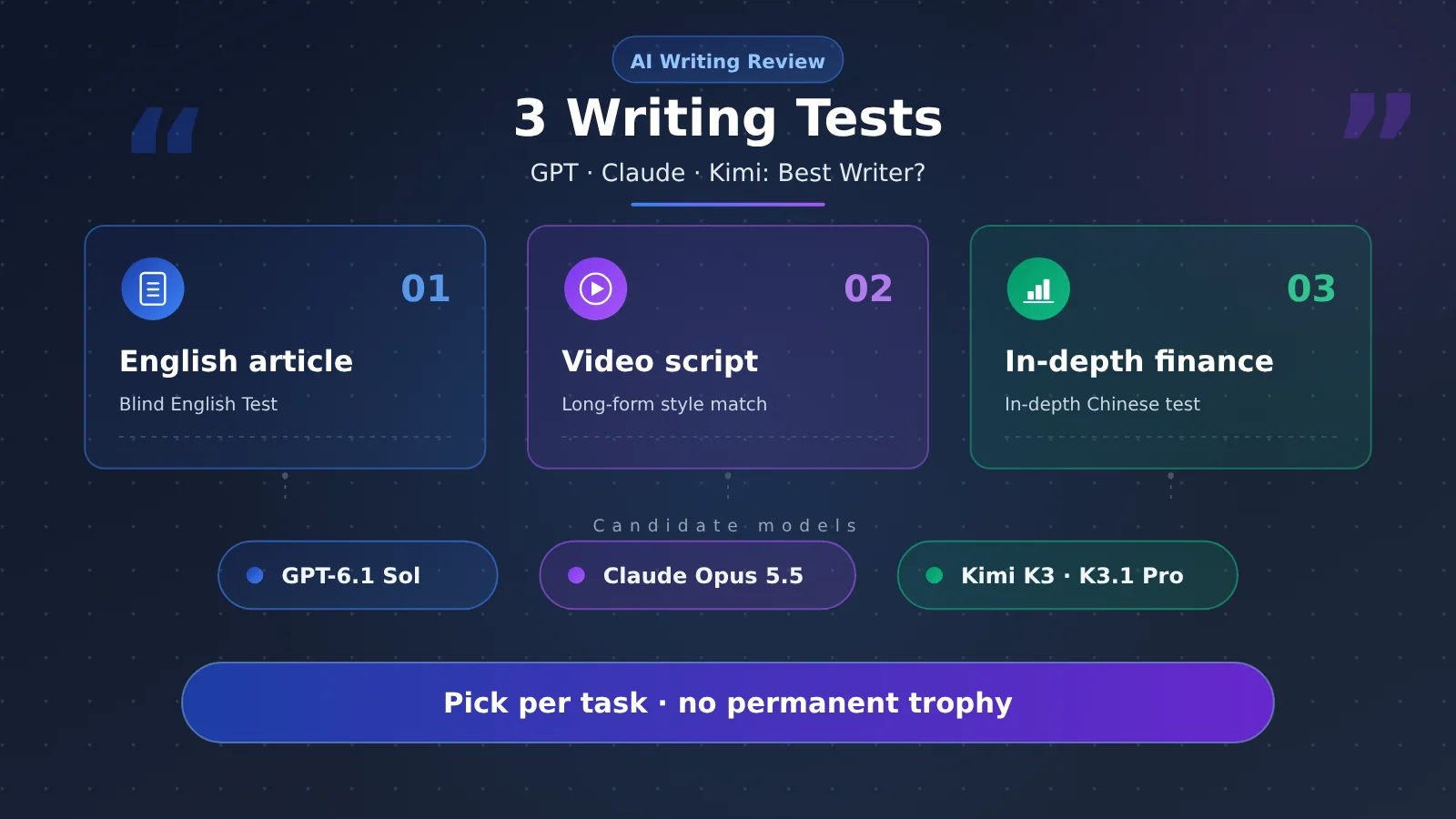
GPT, Claude, and Kimi Writing Test Summary: The Verdict First
For English articles, try GPT-6.1 Sol first; for long-form pieces where voice matters, start with Claude Opus 5.5; for explanatory science writing, Kimi K3 is worth adding to the mix. Kimi K3.1 Pro is also very strong overall in English, coming close to GPT on ToneBench.
The three tests cover different tasks, languages, and evaluation methods. The most practical takeaway is to build a shortlist and then validate it against your own drafts — not to hand out a permanent trophy to one of the three model families.
Getting started tip: You can call the candidate models through the unified interface at APIYI apiyi.com and compare first drafts using the same source package. Free trial credits for new users are subject to the platform’s current rules.
GPT, Claude, and Kimi Writing Test: What Comes Next?
This article breaks down the English writing leaderboard, the stylized long-form video script test, and a real-world deep-dive Chinese finance article test, in that order. At the end, I’ll give you scenario-based choices, a blind-test procedure, and a sample call — with the focus squarely on article quality and the human editing cost.
First, two terms: a writing benchmark is a test that evaluates output against a predefined task; a blind evaluation is comparing texts with the model identities hidden. Blind evaluations can be done by humans or by models, so when you read the results, be clear about who the judge is.
GPT, Claude, and Kimi Writing Test 1: For English Articles, Look at GPT
AI Writing Benchmark is an English writing project maintained by Johannes Eva, which states that it has not taken payment from model vendors. This article uses results updated on November 11, 2026, and queried on November 12.
The project covers 115 models and records 131,507 public blind-evaluation matchups. It evaluates writing by comparing anonymous texts, and it presents the AI-judge ranking and the human-vote ranking separately.
| Model | English overall score | Result scope |
|---|---|---|
| GPT-6.1 Sol | 95.3 | No. 1 on the overall leaderboard |
| Claude Opus 5.5 | 92.9 | No. 2 on the overall leaderboard |
| Kimi K3.1 Pro | 91.9 | No. 3 on the overall leaderboard |
The overall score aggregates multiple task categories; a task-category score reflects only one type of prompt. GPT-6.1 Sol scores 98.5 in the articles, blogs, and editorial content category, and that needs to be recorded separately from its overall score of 95.3.
These are relative scores within the benchmark. The project defines 50 as the estimated probability of beating the average model for the current language and category being one in two, so readers should focus on competitive position rather than treating the score as the proportion of publishable content.
Put plainly: if the task is an English blog post or editorial article, GPT-6.1 Sol has every reason to make the first round of testing. As for Chinese articles, you’ll need to find Chinese-language evidence separately.
Another result worth noting: Kimi K3 leads the explanation and popular-science category with 94.9. The winner here is K3, while the No. 3 spot on the overall leaderboard belongs to K3.1 Pro — keep the version name together with the score.
GPT, Claude, Kimi Writing Test Part 2: Long-Form Style — Claude Takes the Lead
ToneBench has models read a creative brief, a research packet, and a style guide, then generate a complete YouTube script. The models can’t see the original author’s finished draft, and they can’t go online or call external tools.
This article uses materials updated on November 10, 2026. The task is a long-form video script for a specific creator; the supplied materials don’t spell out all the task languages, so we’re reading this as a script-writing scenario.
The test covers 87 models and 151 configurations. Each configuration completes 10 tasks, with 5 independent generations per task. That’s 7,550 drafts in total, scored 30,200 times by four AI reviewers.
It pays special attention to style match — whether tone, rhythm, and phrasing land close to the target creator. Style match carries a weight of 19%, content depth, accuracy, and value 15%, and it also scores coherence and length control.
The table below uses the Writing Score of each model’s best configuration, along with the model rankings listed in the materials. Claude corresponds to xhigh; the materials don’t give the specific reasoning configuration names for the other two, so a retest should fill those in.
| Model | Model Rank | Writing Score | Estimated Cost per Draft in Test |
|---|---|---|---|
| Claude Opus 5.5 | 1 | 85.8 | $1.003 |
| GPT-6.1 Sol | 8 | 82.4 | $0.239 |
| Kimi K3.1 Pro | 9 | 82.5 | $0.251 |
Writing Score is the metric that aggregates writing performance in this test, while the ranking follows an Elo scheme. So Kimi scoring 0.1 higher but ranking one place lower should be read as the two performing about the same.
Claude leads in this set of results, at roughly 4.2× GPT’s estimated test cost. This is ToneBench’s cost estimate — it doesn’t map directly onto article pricing on other platforms.
To make sense of the ranking, it helps to put the tasks and the review in the same picture. When retesting through APIYI apiyi.com, keep a record of the configurations, then go back to the original leaderboard to check the comparison basis.
ToneBench’s first and second place have overlapping confidence intervals, and removing any single reference script would also change the top spot. The study also found some vendor preference among the reviewers, though Claude still holds first place after excluding single-reviewer scores.
The core takeaway: for long-form drafts that have to absorb source material and sustain the creator’s voice, Claude is worth trying first. This result is good for guiding candidate selection; the size of the advantage still needs verification on your own drafts.
One more caveat: GPT-6 Sol’s Least Slop sub-score belongs to a different version and a different metric, so it can’t be swapped in for GPT-6.1 Sol’s Writing Score.
GPT, Claude, and Kimi Writing Test 3: What to Look For in Long-Form Chinese Articles
OmniTools ran this test from October 26 to November 3, 2026, focusing on in-depth Chinese financial articles from PANews. It compared 10 models across 26 articles.
| Model | AI blind score | Test articles | Naturalness score |
|---|---|---|---|
| Claude Opus 5.5 | 8.25 | 7 | 8.3 |
| GPT-6.1 Sol | 6.33 | 3 | 5.5 |
In this test, Claude scored higher overall and on naturalness. For in-depth Chinese financial articles, Claude Opus 5.5 is the candidate more worth trying first.
But the sample is small, the number of articles per model is uneven, and Kimi wasn’t included. So this material can only add Chinese-language scenario evidence for GPT and Claude; it can’t provide a complete Chinese ranking of all three.
The review used Claude Opus 5.5 and DeepSeek V4 Pro, with a rule that models don’t review themselves. The publisher has a commercial background in API routing services, so keep this source information in mind when reading.
Editorial evaluation is a separate record. Claude’s 100% editorial adoption rate covers only 1/1 round, so it’s suitable as a case study; long-term adoption still needs more articles to back it up.
The one-line takeaway: This offers a positive signal for Claude writing long-form Chinese financial articles, but the evidence is scoped to this scenario.
GPT, Claude, and Kimi Writing Test: Picking Candidates by Scenario
Line up the three sets of results and you should get a selection table — not a sum of scores. The article’s language, the task, and the voice you’re aiming for determine which evidence actually matters to you.
| Writing scenario | Preferred candidate | Why |
|---|---|---|
| English blogs, editorial pieces | GPT-6.1 Sol | Leads the English article category |
| Long video scripts in a creator’s voice | Claude Opus 5.5 | Currently leads on ToneBench |
| In-depth Chinese finance pieces | Claude Opus 5.5 | Leads in small-sample Chinese testing |
| English explainers, popular science | Kimi K3 | Leads the explanation and science-communication category |
| Long content driven by a document pack | Blind-test all three together | GPT and Kimi are close on ToneBench |
| A platform for validating model calls | APIYI apiyi.com | One unified interface makes model switching easy |
The three existing sources of evidence don’t fully cover scenarios like Chinese technical tutorials or product introductions. The safer approach is to test the candidates side by side and see which one explains the technology clearly and gets the facts right.
GPT, Claude, and Kimi Writing Test: How Do You Run Your Own Comparison?
Pick a real topic, and give every model exactly the same source material, plan, length requirement, and tool permissions. Have each one generate at least three independent drafts, strip out the model names, and hand them to editors to evaluate.
Start scoring on five dimensions: factual accuracy, execution of the plan, natural phrasing, structural clarity, and content value. Let your team’s task decide the weights, and make it clear that this is a rubric you built yourselves.
Then track human editing cost: the effort required to get a draft into publishable shape. Ideally you’ll also log the editing time, the paragraphs you rewrote, the factual errors, and whether the draft was ultimately used.
Setup tip: With a single API key on APIYI apiyi.com you can switch between models, which cuts down on repeated integration work. During testing, record the model version, the parameters, and the actual token usage so the results are reproducible.
Below is a minimal example. Put the same real document pack into brief and switch the model name to generate comparison drafts; the key should be supplied securely by the runtime environment.
import os
from openai import OpenAI

client = OpenAI(
    api_key=os.environ["APIYI_API_KEY"],
    base_url="https://api.apiyi.com/v1",
)

brief = """请依据以下资料和策划生成文章。
只使用资料支持的事实,遵守目标篇幅与文风。
这里替换为各模型共同使用的实际资料包和策划。
"""

for model in [
    "gpt-6.1-sol",
    "claude-opus-5-5",
    "kimi-k3.1-pro",
]:
    result = client.chat.completions.create(
        model=model,
        messages=[{"role": "user", "content": brief}],
    )
    print(model, result.choices[0].message.content)
This code is just a starting point. A proper blind test should also repeat the generations, present the drafts anonymously, and log the configuration. To verify which model leads in the explanation category, you’ll need to add Kimi K3 to the lineup.
FAQ: GPT, Claude, and Kimi Writing Tests
Which Kimi version should I test in the GPT, Claude, and Kimi writing test?
For explainers and popular-science pieces, start with Kimi K3; when comparing this article’s overall leaderboard against the ToneBench results, use K3.1 Pro. Before calling through APIYI apiyi.com, double-check the model list and the exact model names so you don’t mix up versions.
How should I compare actual costs in the GPT, Claude, and Kimi writing test?
Compare “cost per publishable article”: cumulative API spend plus editing effort. When testing on APIYI apiyi.com, log actual usage and retry counts, then calculate at the prevailing price — that gets you much closer to production reality than looking at first-draft costs alone.
Wrapping Up the GPT, Claude, and Kimi Writing Test: Pick the Model That Saves More Editing
Try GPT first for English articles, Claude for stylized long-form pieces and in-depth Chinese financial writing, and bring in Kimi for explainers. These are priorities for specific tasks, not permanent rankings of entire model families.
The recommended approach is to validate results through APIYI apiyi.com using the same source-material package. In the end, pick whichever model completes the brief more accurately, preserves more usable paragraphs, and spares your editors another late night.
Reference Materials for GPT, Claude, and Kimi Writing Tests
-
AI Writing Benchmark: aiwritingbenchmark.com
English overall and category leaderboards, based on the update as of November 11, 2026. -
Towards AI ToneBench: benchmark.towardsai.com/models/
Video script tests, model rankings, configuration, and cost estimates, based on materials from November 10, 2026. -
OmniTools Long-Form Writing Evaluation: omnitools.ai/evals/longform-writing
A test of PANews Chinese financial in-depth articles, run from October 26 to November 3, 2026.
By the APIYI technical content team. Feel free to connect with us through APIYI apiyi.com to discuss model configuration, blind testing methods, and editorial experience.


