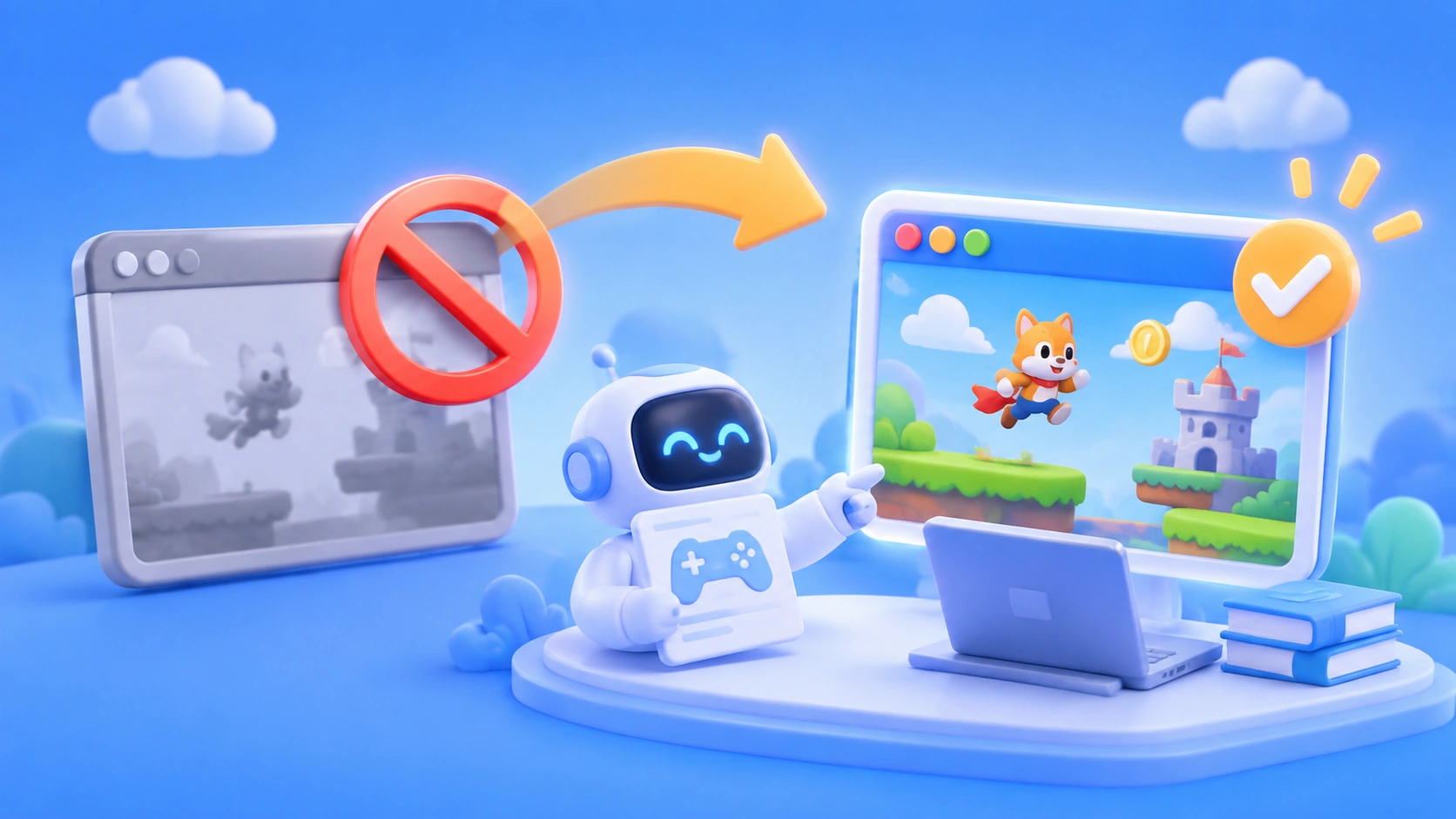
Here’s the bottom line: Claude Code’s restriction on “cloning games” comes from two sentences Anthropic added to its system prompt. It doesn’t involve account bans or API-level content filtering. The rule targets recreating a specific existing game. Anthropic says you can still build original games, games with similar mechanics, and projects based on your own designs and assets.
This isn’t just a rumor. Anthropic technical staff member Addy Osmani confirmed it on X, as reported by GamesIndustry.biz on 2026-11-02. For indie developers, the main adjustment is how you write requests and approach prototyping. There’s no need to stop your project.
What you’ll get: This article explains where Claude Code draws the line on game cloning. You’ll also get a table of what you can and can’t do, a ready-to-use five-section design document template, three prompt rewrite examples, and an approach to switching models based on cost during prototyping.
Claude Code’s Game Recreation Rule: What Changed on October 27?
In short, Claude Code’s system prompt now includes a restriction telling the model not to build a recreation of a specific existing game—even if it’s renamed or described as original. X user Chasm was the first to spot the rule. He said it was pushed to Claude Code on October 27 under the internal name tengu_heron_brook.
The rule says the model can build “original games, games in a genre, and games from the user’s own designs and assets,” but not “a recreation of a specific existing game, even if it is renamed or called original.”
Confirming the change, Addy Osmani said the company “added two sentences to Claude Code’s prompt on Opus 5.5 to steer it away from recreating someone else’s specific game because using Claude to infringe IP is against our usage policy”. In other words, Anthropic added two sentences to the Claude Code prompt for Opus 5.5 because using Claude to infringe intellectual property violates its usage policy. He also said original games, genre games, and games based on users’ own designs and assets were “meant to keep working,” and that the company would keep iterating to find the right balance.
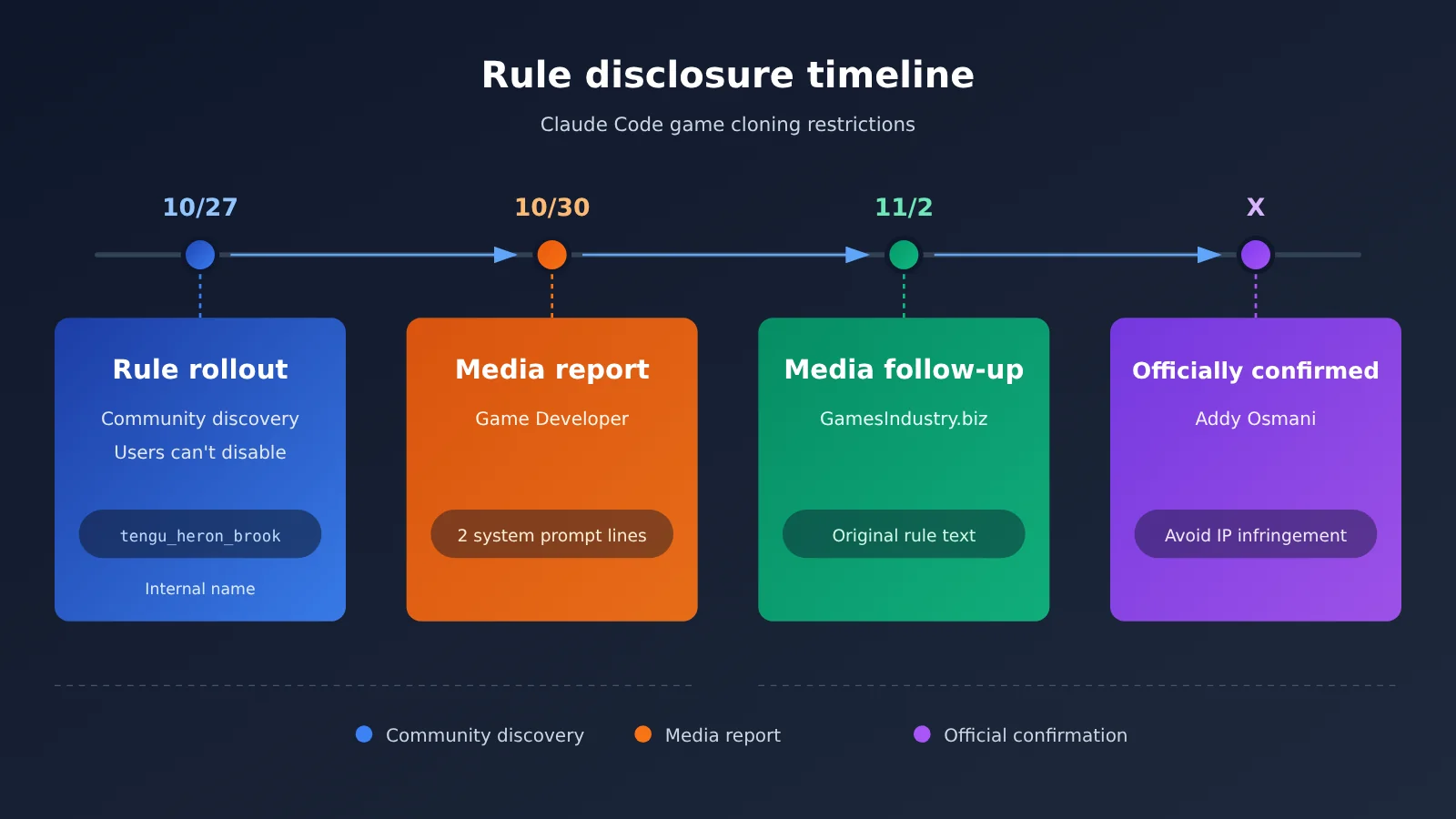
These claims don’t all have the same level of credibility, so it’s worth distinguishing them when citing them:
| Information | Source | Credibility |
|---|---|---|
| Rule content (the original wording on what’s allowed and prohibited) | Confirmed by Osmani, as reported by GamesIndustry.biz on 2026-11-02 | Confirmed by a company representative |
| “Two sentences added to the Claude Code prompt on Opus 5.5” | Osmani’s statement; also reported by Game Developer on 2026-10-30 and BeInCrypto on 2026-11-02 | Confirmed by a company representative |
Internal name tengu_heron_brook |
Discovered by community user Chasm | Community discovery |
| Pushed on October 27 | Community user Chasm | Community discovery |
| Users can’t turn it off | Community user Chasm | Community discovery |
| Whether the rule works is unknown; it may be bypassed | Game Developer’s assessment | Media assessment |
One more caveat: Anthropic hasn’t published formal documentation explaining the rule’s scope (Game Developer, 2026-10-30). The discussion of its boundaries below is inferred from the rule’s wording, not based on official guidance.
Recreating Games with Claude Code: What’s Allowed and What May Be Blocked
The key distinction is whether the request points to a specific game, not whether the gameplay resembles a genre. The table below is inferred from the wording of the rules; it’s not based on testing, and actual behavior may vary depending on context.
| Request type | Typical phrasing | Inferred result | Basis |
|---|---|---|---|
| Original game | “A puzzle game about managing tides” | Allowed | Explicitly listed as something Claude can build |
| Gameplay in the same genre | “A side-scrolling platformer” | Allowed | “Games in a genre” are within the permitted scope |
| Based on your own designs and assets | “Implement this using my design document and art assets” | Allowed (may need clarification) | Permitted by the rules, but the model can’t verify ownership |
| Reskinned recreation | “Recreate a game’s levels and mechanics exactly, but give it a different name” | Likely blocked | The rules explicitly say renaming it or calling it original doesn’t make it permissible |
| Directly asking for something “like a game” | “Make a game identical to a well-known game” | Likely blocked | Directly points to a specific existing game |
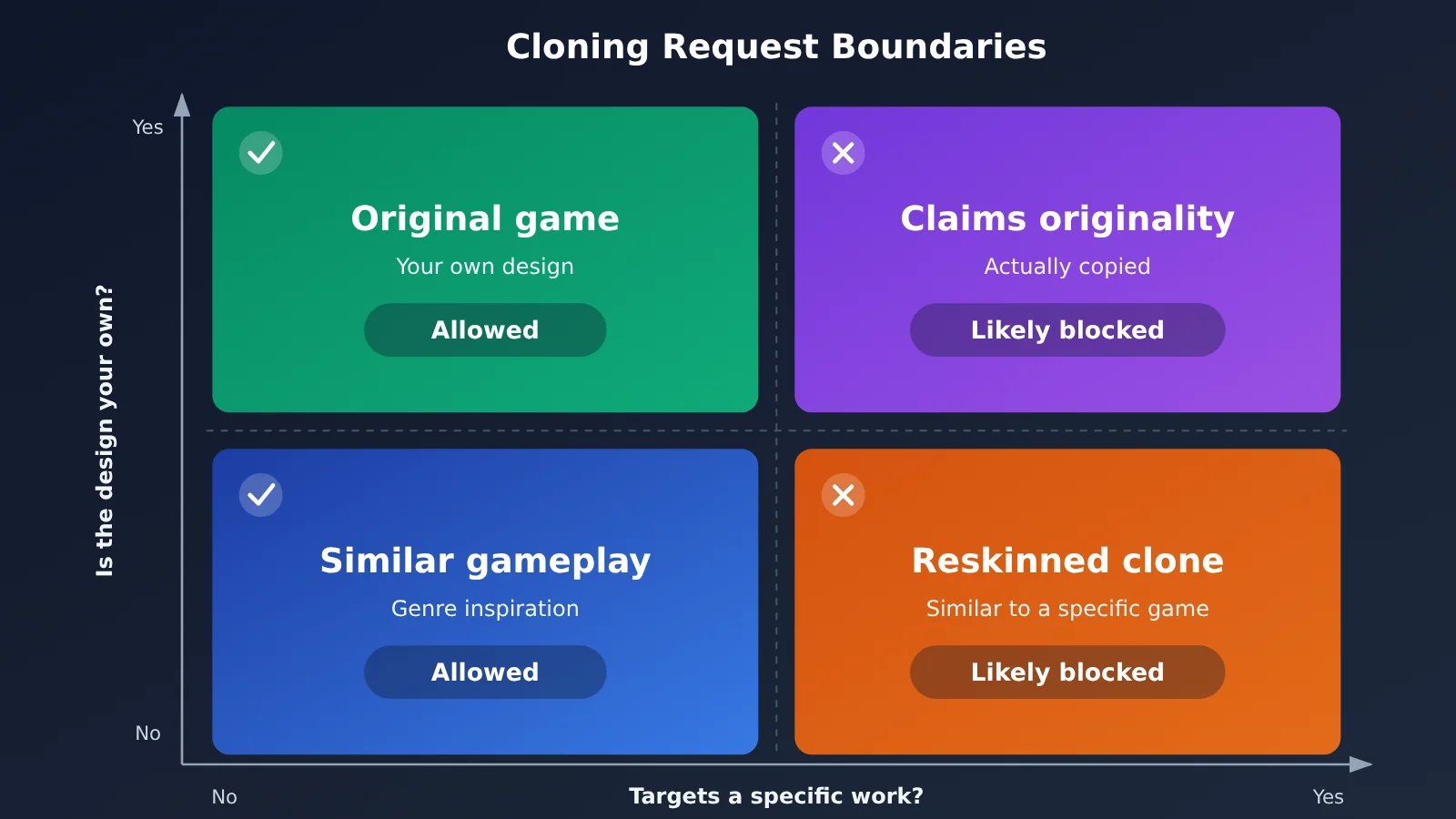
There’s a gray area between working in the same genre and recreating a game. For example, “a roguelike deck-building game” describes a genre. But if you list every card name, stat, and level in order from a specific game, you’re getting close to a recreation. A safer rule of thumb for developers is: take inspiration from genres, but don’t copy specific creative expressions. That’s broadly consistent with common copyright principles in the game industry.
Why Anthropic Is Cracking Down on Game Clones in Claude Code Now
The immediate reason is its usage policy: Osmani explicitly said that using Claude to infringe intellectual property violates Anthropic’s usage policy. The broader context is that AI-generated game clones are drawing increasing attention across the industry.
GamesIndustry.biz (2026-11-02) highlighted two related developments. First, Digital Sun delayed the public test of ReVamp over concerns that its public demo could be fed into AI tools. Second, Valve is under pressure to explain how it will prevent AI clones from crowding out original games on Steam.
Against that backdrop, tools like Claude Code, which can quickly generate runnable projects, have made it easier to “make a copy.” Anthropic chose to add a constraint at the Claude Code system prompt level rather than apply comprehensive filtering at the API level. That looks more like a lightweight adjustment for a specific scenario. Osmani also said Anthropic would “continue to iterate,” so the exact wording of the rule may change.
A New Workflow for Game Remakes with Claude Code: Write a Design Document First
The takeaway: write your own design document before asking Claude Code to build. It fits the rules and makes for a better prototyping habit. The rules permit “games from the user’s own designs,” and a design document is direct evidence of your own design. It also helps the model stay focused.
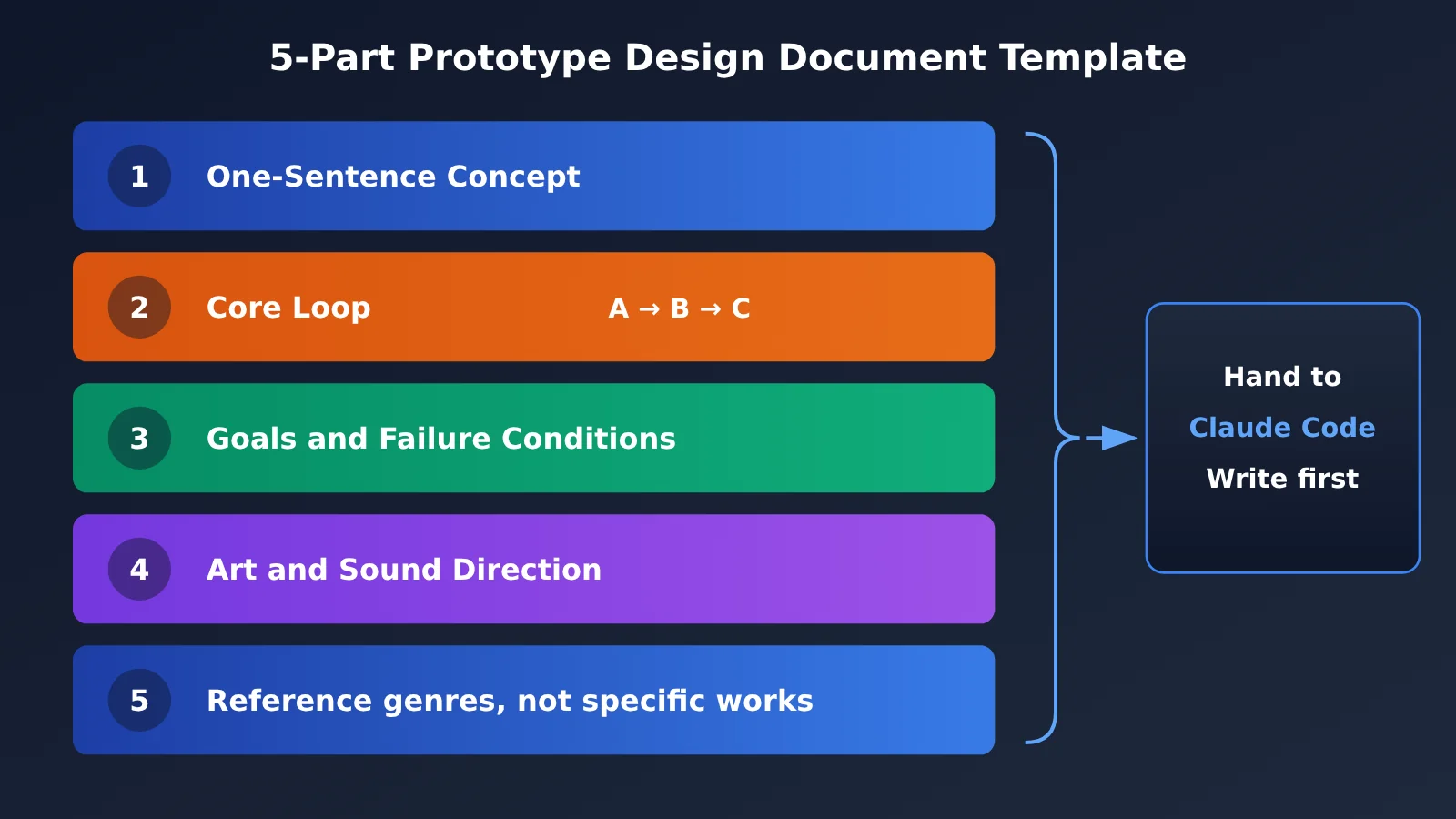
You can use this five-section template as-is. Each row explains why it can make your request less likely to be blocked.
| Section | What to write | Why it can reduce the chance of being blocked |
|---|---|---|
| 1. One-sentence concept | Sum up the game in one sentence, such as “The player is a lighthouse keeper guiding ships to shore during a storm.” | Starting with an original concept makes it clear to the model that this is a new work. |
| 2. Core loop | Use A→B→C to describe what the player does each minute, such as “Observe the weather→adjust the light→tally the ships that reach shore.” | The loop is a mechanic you’ve defined yourself, rather than rules borrowed from a specific game. |
| 3. Player goals and failure conditions | Define the victory objective, failure triggers, and difficulty curve. | Goals and penalties are core game design elements. Writing your own makes them part of an original design. |
| 4. Art and sound direction | Describe the color palette, shapes, and sound style, such as “muted blue-gray tones and hand-drawn lines.” | Describing a style instead of saying “make it look like a particular game” avoids pointing to specific art assets. |
| 5. Reference genres, not specific games | Write “References: tower defense and resource management genres,” without naming a particular game. | This aligns with the rules’ permission for “games in a genre.” |
Alongside the document, three practical habits are worth adopting:
- Start with a placeholder name: Give the project a working name like
prototype-a, then name it once the mechanics work. This helps avoid an accidental clash with an existing game from the start. - Use original or licensed assets: Use geometric shapes and blocks of color as placeholder graphics, and use sound effects you’ve recorded yourself or have explicit permission to use.
- Do a search before commercial release: Check for trademarks and verify the sources of your art assets before launch. This step has nothing to do with AI tools, but it’s becoming increasingly important.
Three Prompt Rewrites Under Claude Code’s Game-Cloning Rules
The point of rewriting a prompt is to change the request from “clone a specific work” to “implement your own design”—not to dress up a cloning request in different words. If your goal is still a one-to-one recreation, it’s still a clone no matter how you phrase it. That’s exactly what the rules are meant to address.
Example 1: Platformer
- Original: “Help me make a platformer like that famous plumber game.”
- Rewrite: “Make a side-scrolling platformer. The core loop is jumping over obstacles → collecting energy shards → unlocking the next section. The protagonist is a paper airplane that can glide briefly. Use an origami-inspired look with warm yellow tones.”
Example 2: Merge Game
- Original: “Clone that hit merge game and just change the name.”
- Rewrite: “Make a casual merge game. The core loop is placing ingredients → merging matching ingredients into higher-level dishes → completing orders to earn coins. The player loses when the plates fill up. Use a flat illustration style.”
Example 3: Tower Defense
- Original: “Make a game using the levels and defense towers from that tower defense game.”
- Rewrite: “Implement a tower defense prototype based on the attached design document. The defense towers are three plants I designed, and enemies move along a river. Use geometric shapes as placeholder art for now.”
The three rewrites have something in common: each spells out the genre, core loop, and visual direction, while keeping the creative work centered on your own design. One caveat: a report (Game Developer, 2026-10-30) noted that carefully worded prompts may bypass these kinds of restrictions. That’s an attempt to circumvent IP policies, so we don’t recommend it or explore it further here.
The limits and uncertainties of Claude Code’s game-cloning rule
The bottom line: the rule isn’t precise. It can both block legitimate requests and miss problematic ones, so treat it as a reminder—not a compliance certification.
First, it’s a prompt-level rule written into Claude Code’s system prompt, not an API-side content filter. Second, Claude has no obvious way to verify whether you actually own the designs or assets you’re using, according to Game Developer’s assessment as reported by GamesIndustry.biz. That means you could be questioned even after uploading your own assets. Conversely, a request getting through doesn’t mean your project is free of infringement risk.
Several things also remain unclear. There’s no official documentation explaining whether the rule behaves consistently across model versions, how the wording will evolve, or where the line between “same genre” and “cloning” will ultimately be drawn. For commercial projects, legal judgments still require your own research and, where necessary, legal advice. You can’t rely on whether an AI tool lets a request through.
Beyond game cloning in Claude Code: choosing models by cost during prototyping
The bottom line: use claude-sonnet-5-5 or claude-haiku-5-5 for high-volume work during prototyping, then switch to claude-opus-5-5 for the final version—all with the same API key. Game prototypes require repeated iteration, and most requests involve changing parameters, fixing bugs, or generating placeholder logic. Those tasks don’t need the most expensive model.
| Model | Input | Output | Cache read | Recommended use during prototyping |
|---|---|---|---|---|
claude-opus-5-5 |
$4 | $20 | $0.2 | Architecture review and complex system refactoring for the final version |
claude-sonnet-5-5 |
$2 | $10 | $0.1 | Day-to-day gameplay iteration and level logic |
claude-haiku-5-5 |
$0.1 | $0.5 | $0.01 | Bulk generation of configurations, balancing tables, and simple scripts |
Source: APIYI model pricing list, docs.apiyi.com/models. Data as of 2026-10-27 14:50 (UTC+8). Prices are in US dollars per million tokens.
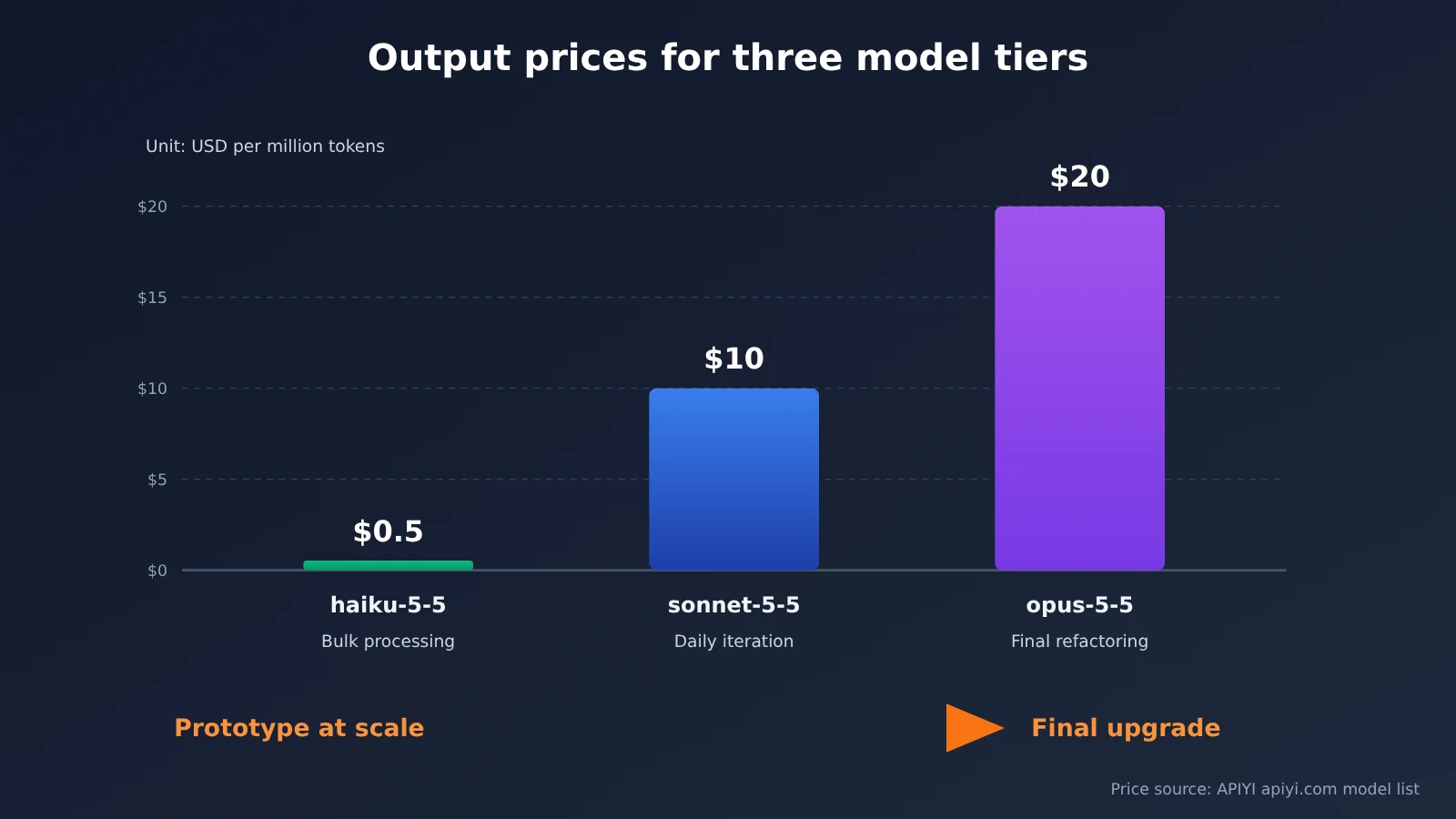
According to the table, claude-haiku-5-5 output costs about one-fortieth as much as claude-opus-5-5 output, making it a good fit for large volumes of low-complexity tasks. In practice, set base_url to https://api.apiyi.com/v1 when making calls and switch the model name between the three tiers. The API key and interface format stay the same.
🚀 Prototyping tip: Use the OpenAI-compatible interface from APIYI at apiyi.com to switch between Sonnet, Haiku, and Opus with the same API key. Get the core loop working with a lower-cost model first, then use a higher-tier model to refactor the final version. New users get free testing credits to validate the workflow first.
One important distinction: the two sentences Osmani mentioned are part of Claude Code’s prompt. When you call a model directly through the API, that Claude Code system prompt isn’t present, but the usage policy still applies. Changing how you make calls doesn’t change the bottom line: don’t clone someone else’s specific work.
Frequently Asked Questions
Q1: Will this rule also block requests to Opus 5.5 through the API?
According to Osmani, the two sentences were added to “Claude Code’s prompt.” They’re part of Claude Code’s system prompt, not an API-side filter. However, using Claude to infringe on intellectual property violates Anthropic’s usage policies regardless of how you access it. When calling models through APIYI at apiyi.com, check the platform’s model list for available models and pricing. Compliance requirements remain the same regardless of the access channel.
Q2: Can this rule be turned off?
Chasm, the community member who discovered it, says users can’t turn it off. Anthropic hasn’t provided official guidance on a toggle. A more practical approach is to adjust your workflow: write a design document first and describe the genre instead of naming a specific game. That should generally keep you from triggering the rule.
Q3: Does making a fan game based on a well-known IP for a game jam count as a replica?
The rule doesn’t specifically address fan works. But using a particular game’s characters, names, or artwork points to “someone else’s specific game,” so there’s a good chance it’ll be blocked. It also carries IP risks. For game jams, use original characters and settings, and draw inspiration only from genre mechanics.
Q4: If I switch to a model other than Claude, will there be no restrictions?
That’s not a safe assumption. Model providers’ usage policies generally don’t permit intellectual property infringement, and copyright risks come from the work itself, regardless of which tool you use. If you want to compare how different models perform on original prototypes, you can switch between them using a unified interface at APIYI apiyi.com. The content should still be original.
Q5: What if my project is already halfway done?
Start by writing a five-paragraph design document that explains the existing mechanics in your own words. Then check whether the project directly uses another game’s names, characters, or assets. If it does, replace them with placeholders before continuing development with Claude Code. Before a commercial release, conduct trademark and asset searches.
Key Takeaways: Claude Code’s Rules on Game Clones
- What changed: Two sentences were added to Claude Code’s system prompt. They don’t ban accounts or block API requests.
- What’s restricted: Recreating a specific existing game is restricted, even if you rename it or call it original.
- What’s still allowed: Original games, games in the same genre, and projects based on your own designs and assets.
- What’s confirmed: An Anthropic representative confirmed the rule’s wording; the rollout date and internal name came from community findings.
- Recommended workflow: Write a five-part design document first, then start building with placeholder names and original assets.
- Cost strategy: Use Sonnet or Haiku for prototype iterations, then switch to Opus for the final version. You can switch between them with the same API key through APIYI at apiyi.com.
Summary
Claude Code’s adjustment affects a narrower range of work than the headline might suggest: it restricts making a copy of a specific game, not original games or games in the same genre. For indie developers and outsourced development teams, there are three practical changes to make:
- How you write requirements: Replace “like a specific game” with “genre + core loop + visual direction.”
- Workflow: Write a design document before asking AI to build. Use placeholder names and original assets throughout prototyping.
- Risk awareness: AI allowing a request doesn’t mean there’s no infringement risk. Do your own research before a commercial release.
The rules will continue to evolve, so keep an eye on Anthropic’s official updates. During prototyping, you can control model costs by choosing the right tier for each task. APIYI at apiyi.com offers a unified interface for switching between Sonnet, Haiku, and Opus, so you can save more of your budget for the final version.
📚 References
- GamesIndustry.biz: Anthropic adds rule to stop Claude Code recreating existing games (2026-11-02)
- Link:
gamesindustry.biz/anthropic-adds-rule-to-stop-claude-code-recreating-existing-games -
Notes: Includes the original rule and Osmani’s confirmation
-
Game Developer: Anthropic orders AI tool Claude to stop remaking video games (2026-10-30)
- Link:
gamedeveloper.com/programming/anthropic-appears-to-have-ordered-ai-tool-claude-to-stop-remaking-video-games -
Notes: Assesses the rule’s effectiveness and whether it can be bypassed
-
BeInCrypto: Coverage of Claude Code’s game-cloning rule (2026-11-02)
- Link:
beincrypto.com/anthropic-claude-code-game-clones/ -
Notes: The headline says “Adds 2 Sentences”
-
Original community post (Chasm): Where the rule was first discovered
- Link:
x.com/chasmmmmmmmmmmm/status/2116062991686721968 -
Notes: Source for the rollout date and internal name
tengu_heron_brook -
APIYI Model Pricing List
- Link:
docs.apiyi.com/models - Notes: Refer to the platform’s model list for current models and prices