Author’s note: From three angles—two sets of leaderboards, API capabilities, and the cost of the same task—this explains how Ideogram 4.6 and Nano Banana 2.1 should divide the work for product images, reference-image composition, and poster retouching.
Teams working on product images, reference-image composition, or poster retouching have lately been stuck on the same choice: Google’s newest and most powerful general-purpose image generation model, Nano Banana 2.1, versus Ideogram 4.6, which specializes in image editing. Which one should handle which part of the job? This article looks at leaderboard scores, API capabilities, and the cost of the same job from three angles, and lays out a division-of-labor plan you can put to work right away.
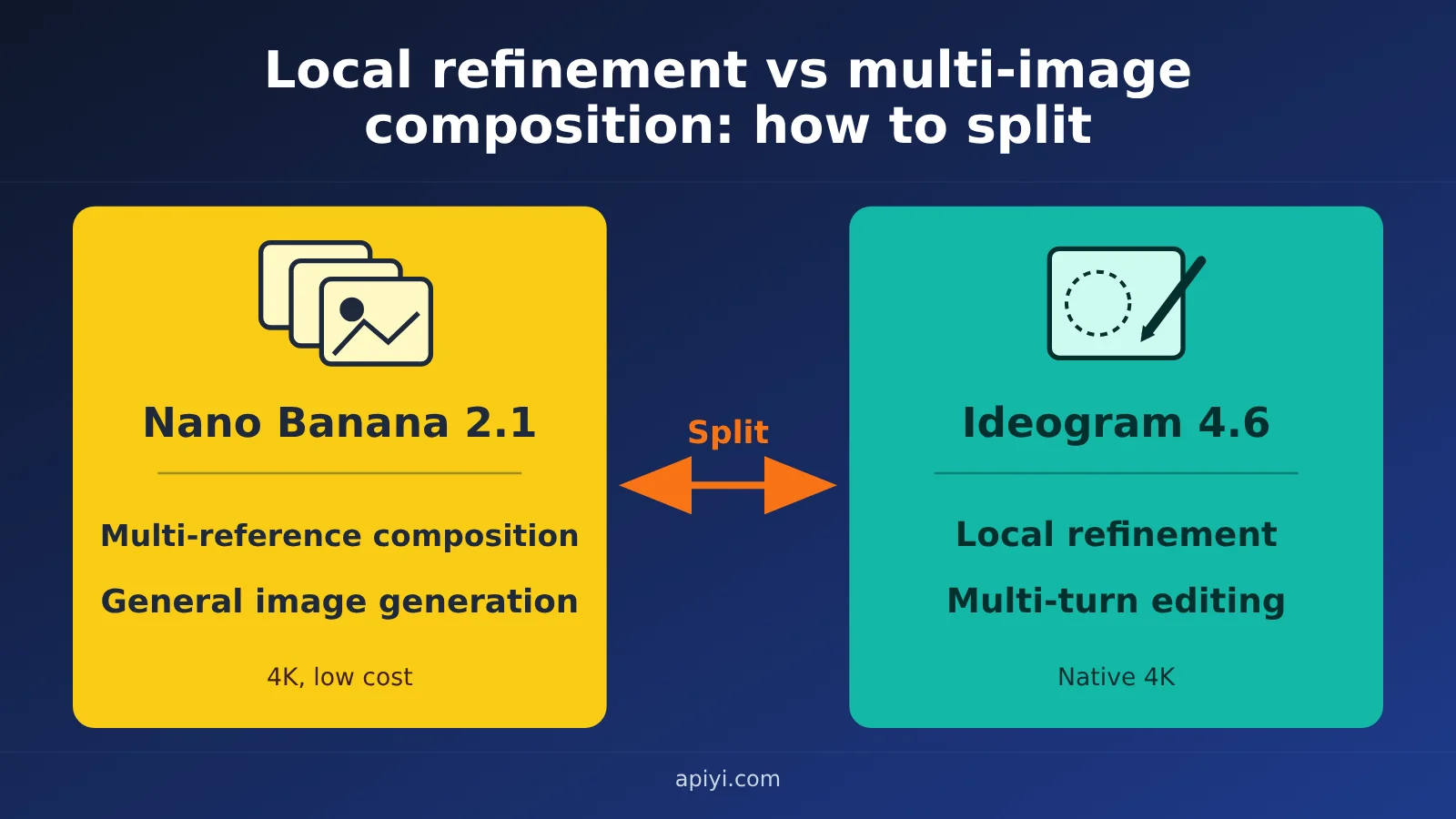
This isn’t a fence-sitting “each has its merits” comparison. The two models really are good at different things: 2.1 is general image generation plus multi-reference image composition, and its 4K output is inexpensive; 4.6 is local retouching plus multi-round image editing. We won’t declare an overall winner, but we will tell you clearly who should get each type of task.
Core value: By the end, you’ll be able to split “multi-image composition” and “local retouching” into two pipelines and work out the per-image cost of each.
Ideogram 4.6 vs Nano Banana 2.1: Let’s Get the Positioning Straight First
Let’s clear up a common misunderstanding first. Google’s latest and strongest general image generation model right now is Nano Banana 2.1 (model ID gemini-nano-banana-2.1). It shipped GA on 2026-10-06 and is an upgraded version of Nano Banana 2 (gemini-3.1-flash-image), built on Gemini 3.6 Flash. Google itself recommends that new projects use 2.1 directly. On Artificial Analysis, it scores higher than Nano Banana Pro on both text-to-image and single-edit.
Nano Banana Pro, meanwhile, is a pricier design-and-text line. Official pricing is about $0.134 for 1K/2K and about $0.24 for 4K. It is not the next generation after 2.1. So when this article says “Google’s latest and strongest,” it means 2.1, not Pro.
Ideogram 4.6 launched on 2026-11-19, and its official positioning is “the new frontier of precise editing, native 4K.” The official materials stress that native 4K doesn’t mean generating a small image and then upscaling it — pixel drift outside the edited region is significantly reduced, and color accuracy is better too.
| Positioning point | Nano Banana 2.1 | Ideogram 4.6 |
|---|---|---|
| Release date | 2026-10-06 GA | 2026-11-19 |
| Core positioning | General image generation + multi-reference-image composition | Precise editing + native 4K |
| Strongest at | High preference scores on text-to-image and single edit | Face consistency across multi-step edits |
| Local control method | Describe the region to change in text | mask + context_window |
| Cost profile | Cheap at 4K, same price per call at full resolution | Noticeably higher per-image price for high-quality edits |
Nano Banana 2.1 vs Ideogram 4.6: The One-Line Division of Labor
To sum it up in one sentence: use 2.1 for multi-image composition and general output, use 4.6 for changing just one spot and long-chain edits. All the data that follows is there to back up that sentence.
Ideogram 4.6 vs. Nano Banana 2.1: The Core Differences and Why the Two Leaderboards Clash
A lot of people get confused when they look at the leaderboards: on AA, 2.1 is clearly ahead, while on Rapidata, 4.6 takes first place and 2.1 only ranks 13th. The two leaderboards don’t actually contradict each other—they’re measuring completely different things.
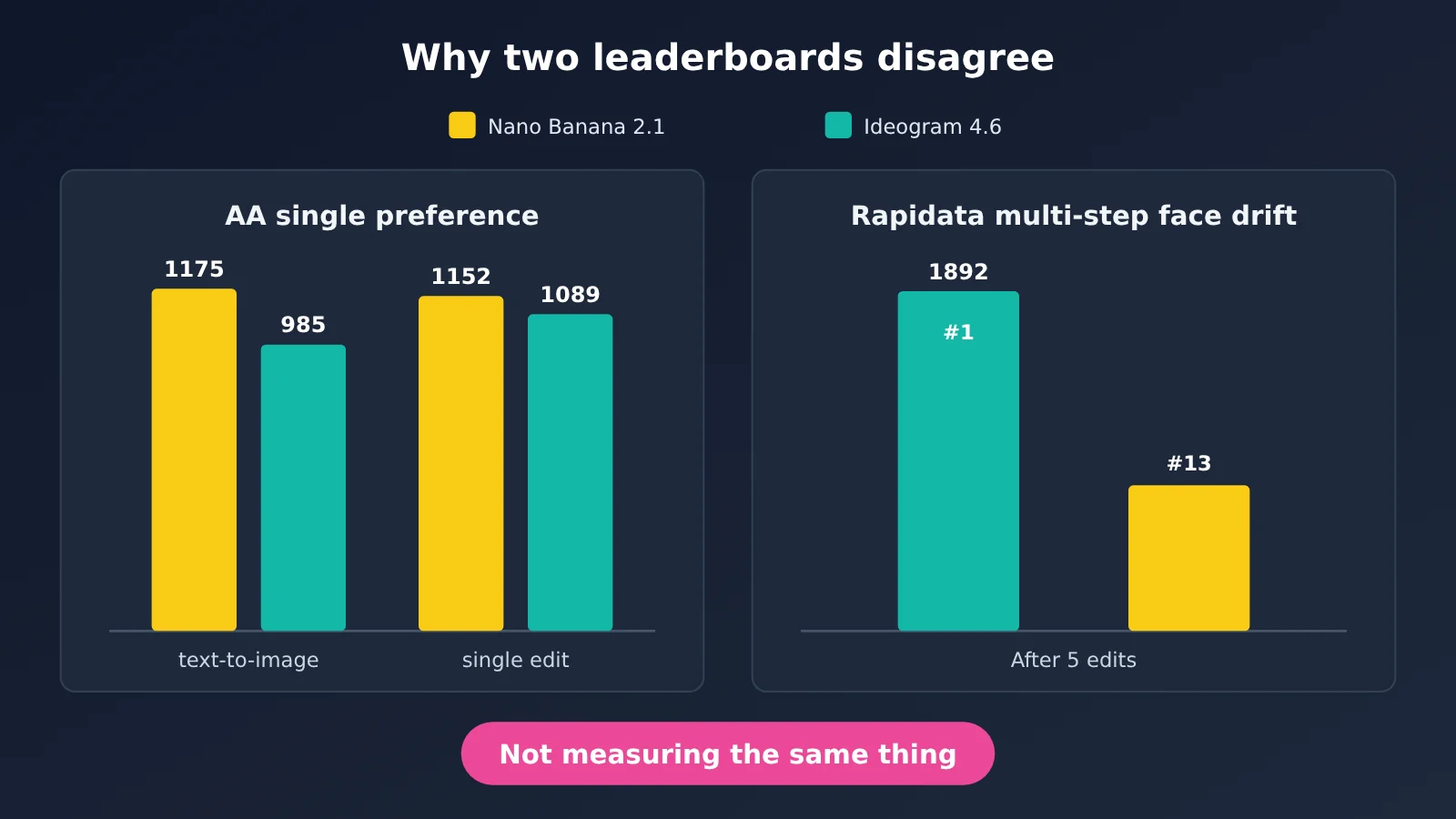
📊 Data note: The scores in the chart come from the public leaderboards of Artificial Analysis (retrieved 2026-11-26) and Rapidata (updated 2026-11-10). If you want to check 2.1’s performance against your own product images, you can run a comparison round on APIYI apiyi.com using the same set of prompts.
| Leaderboard and Metric | Nano Banana 2.1 | Ideogram 4.6 (High) | What It Measures |
|---|---|---|---|
| AA Text-to-Image T2I v2.1 | 1175 ±11, #8 | 985 ±13, #69 | Blind-vote preference for a single generated image |
| AA Single Edit v2.1 | 1152 ±12, #10 | 1089 ±14, #31 | General preference for a single edit |
| Rapidata Multi-step Editing | #13 | 1892 ±32, #1 | Whether the face still looks the same after 5 editing steps |
AA General Image Quality and Single-Edit: Nano Banana 2.1 Leads
Both of Artificial Analysis’s leaderboards use blind pairwise A/B votes — they’re asking “is this image better overall?” On text-to-image, 2.1 ranks 8th with 1175 points, while 4.6 sits at just 985 points in 69th place. On single-edit, 2.1’s 1152 also comes out ahead of 4.6’s 1089.
Worth noting: 4.6 actually scores slightly below the previous generation, 4.5 (1017 points), on AA text-to-image, and on single-edit it’s only marginally above 4.5’s 1064. That tells you 4.6 isn’t “stronger across the board” — its upgrade work was never aimed at this.
Rapidata Multi-Step Face Drift: Ideogram 4.6 Leads
Rapidata’s “multi-step editing” leaderboard has a very particular methodology: 199 real photos, each given a 5-step editing chain that only changes clothing, objects, and text — never the face. Every step feeds the model’s previous output in as the input, and at the end, people blind-pick “which face after step 5 looks more like the original.” What it measures is face identity drift, not general editing quality.
On this board, 4.6 ranks 1st with 1892 points and an 86.3% win rate; Nano Banana Pro is 12th at 987 points, and 2.1 (High Thinking) ranks 13th. To be fair, the confidence intervals for 4.6 and 4.5 overlap at 1860–1896, so this board can’t settle which of the two generations is stronger. But 4.6 leads the third-place Seedream 5.5 by a full 87 points, with no interval overlap.
Ideogram 4.6’s Officially Reported Editing Usability Rates
Ideogram also published a set of usability-rate data comparing 4.6 against 4.5. These numbers are officially self-reported, not third-party tests, and the official documentation doesn’t disclose the criteria for judging “usable.” Under the same batch of High-tier editing requests: recoloring by brand color code went from 46% to 83%, fixing minor product blemishes from 61% to 86%, product shots from 66% to 88%, keeping a person recognizable after a scene change from 69% to 85%, and editing only the painted region from 82% to 90%. These figures only show that 4.6 is more stable than its own previous generation — they can’t be used to compare it directly against 2.1.
Ideogram 4.6 vs. Nano Banana 2.1 API Capabilities: 14 Reference Images vs. a Mask
Beyond the leaderboard, the API is what determines how the work gets divided. The two models take completely different approaches to “how many images you can feed in” and “whether you can mask off a region.”
| API capability | Nano Banana 2.1 | Ideogram 4.6 |
|---|---|---|
| Max reference images | Up to 14 (4 character slots + 10 object slots) | Generate accepts up to 5 source images, plus 3 more with a mask |
| mask field | None; local edits rely on text descriptions | Precise Edit supports an optional mask |
| Large-image editing | Not applicable | Source image up to 8192×8192; context_window edits only one region |
| Resolution | 1K / 2K / 4K; 512px is not supported | 2K / 4K, up to 4096×4096 |
| Aspect ratio | Up to 8:1 | Output matches source image width and height (Precise Edit) |
| Notable parameters | thinking levels minimal/medium/high, search grounding | Transparent background, JSON-structured prompt, dry_run pricing |
| Available platforms | APIYI apiyi.com, Google’s official platform | Ideogram’s official API and partner platforms such as fal and Runway |
Nano Banana 2.1’s Edge in Multi-Reference Image Composition
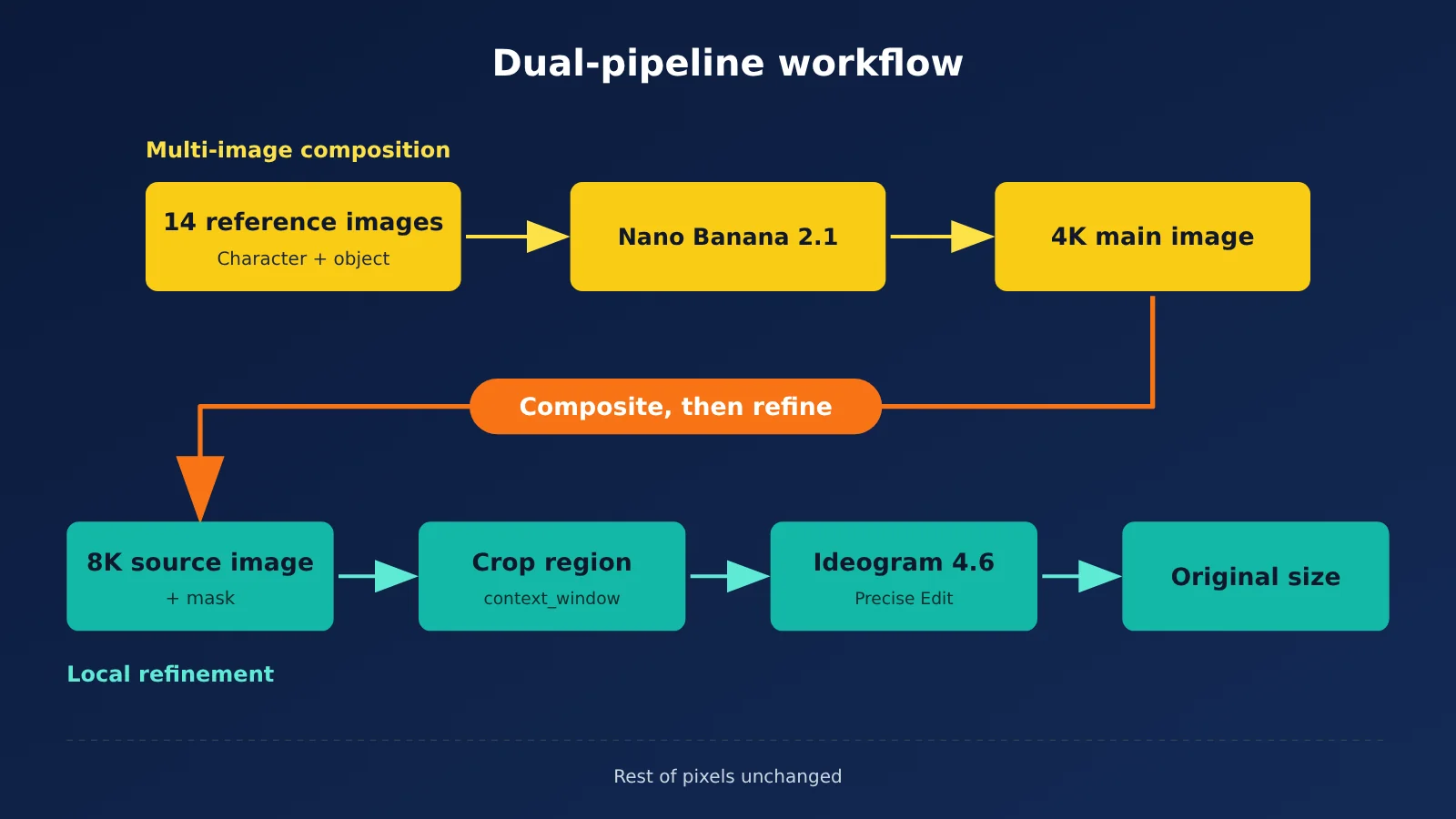
2.1 can accept up to 14 reference images, with 4 character slots and 10 object slots. That makes it very well suited to tasks like “combine a model, three individual items, two props, and a background into one hero image.” Add an aspect ratio of up to 8:1 and adjustable thinking levels, and it can produce banners, long images, and collage scenes in one pass.
Its weaknesses are just as clear: there’s no mask field, so if you want to edit just one area, you have to describe it in text—for example, “turn the cup in the lower-left corner blue.” The official list of limitations also mentions that small text often gets blurry at 1K, long paragraphs and full-page long-form text don’t work, and it still mixes up left and right. So for instructions like “change only the shoe on the left,” 2.1 isn’t the most reliable choice.
Ideogram 4.6’s Mask and context_window Region Editing
4.6’s Generate endpoint accepts up to 5 source images: the first is the image being edited, and the rest are references. The Precise Edit endpoint supports an optional mask, and the output always matches the source image’s width and height. Source images can be up to 50MB and 67,108,864 pixels—exactly 8192×8192.
There’s a common trap here: images larger than 4096×4096 are downscaled to 4096×4096 by default. To preserve the original 8K size, you need to set context_window=auto along with a mask, or supply the y_min,x_min,y_max,x_max coordinates yourself. The model then edits only that region and returns the rest of the pixels unchanged. For the use case of fixing just one logo on an 8K poster, 2.1 has no equivalent capability.
Ideogram 4.6 vs. Nano Banana 2.1 Pricing: Costing the Same Job
You have to compare prices on the same basis. The per-thousand-image prices on the AA leaderboard are normalized using each provider’s default settings, so they shouldn’t be mixed with official per-image pricing. Below, I’ll stick to official per-image prices and platform per-call prices.
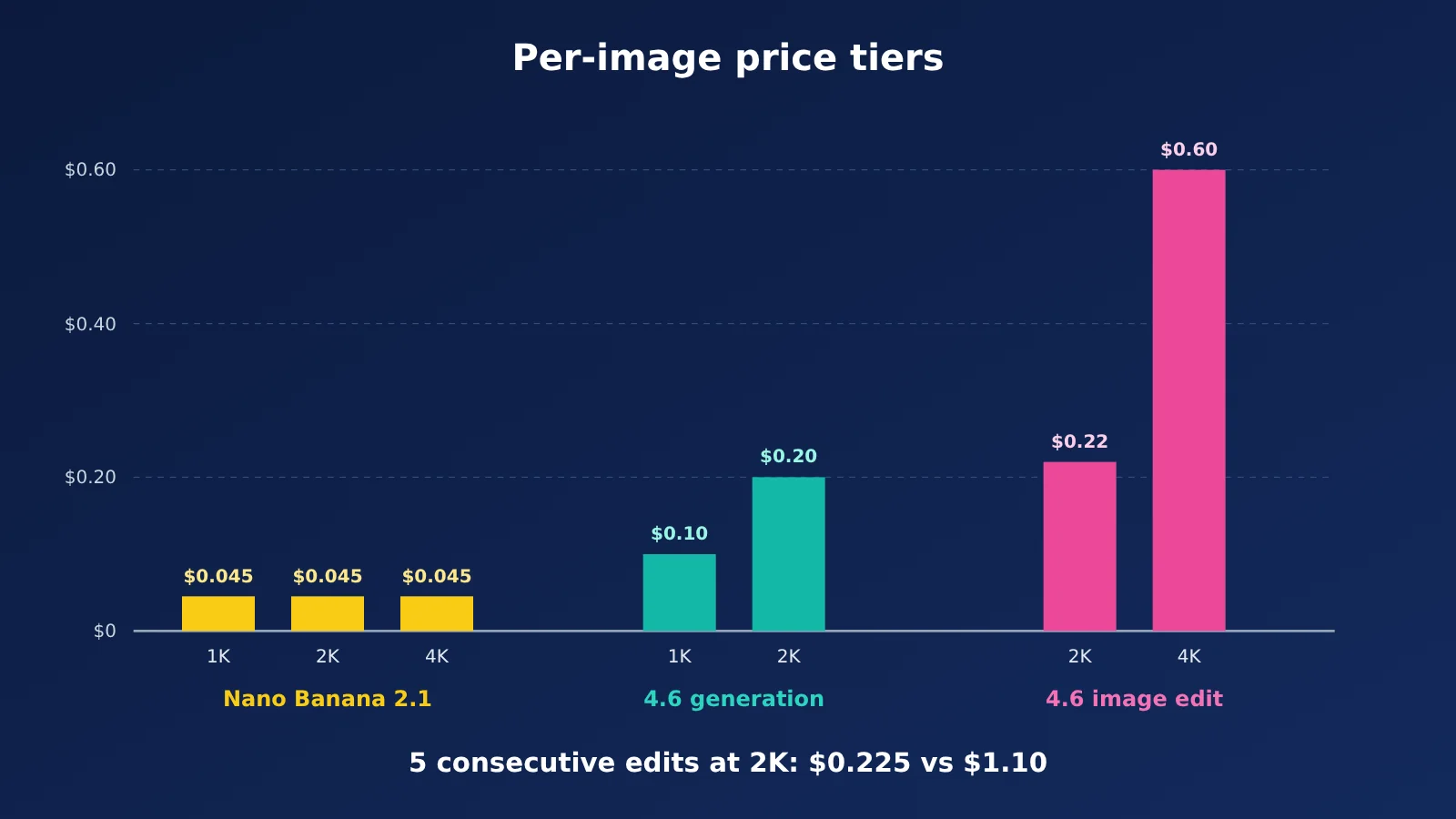
Nano Banana 2.1 officially bills by image output tokens: $30 per 1M tokens (Batch: $15). A 1K image runs about 1,120 tokens, or $0.0336; 2K is about 1,680 tokens, or $0.0504; 4K is about 3,780 tokens, or $0.113. On APIYI (apiyi.com), the gemini-nano-banana-2.1 model is billed per call at $0.045, with the same price for 1K, 2K, and 4K (down from $0.05 as of 2026-10-13). You can also choose usage-based billing: $0.66 input and $13.2 output per 1M tokens. To integrate, set the base_url of an OpenAI-compatible client to https://api.apiyi.com/v1 and put gemini-nano-banana-2.1 in model.
Ideogram 4.6 charges per image. At the High tier, 1K/2K generation is $0.10 and 4K generation is $0.20; source-image generation or Precise Edit at High is $0.22 for 1K/2K and $0.60 for 4K. Any output larger than 2048×2048 is billed as 4K. Ideogram 4.6 isn’t listed on APIYI yet. We’ll get it up as soon as we can; the model name and pricing will follow the platform’s model list.
| Same job | Nano Banana 2.1 | Ideogram 4.6 (High tier) |
|---|---|---|
| Generate one 2K image | Official: about $0.0504; per call: $0.045 | Generation: $0.10 |
| Generate one 4K image | Official: about $0.113; per call: $0.045 | Generation: $0.20 |
| Edit one 2K image | Per call: $0.045 (describe the area in text) | Edit: $0.22 |
| Edit one 4K image | Per call: $0.045 (describe the area in text) | Edit: $0.60 |
| Five consecutive 2K edits | 5×0.045 = $0.225 | 5×0.22 = $1.10 |
The Trade-offs Behind the Cost Math
On the numbers alone, 2.1 is cheaper in every row—its 4K per-call price is even less than half of the official price. But the five-consecutive-edit row deserves a closer read: 2.1 doesn’t support masks, and consistency across multi-turn chained edits isn’t its strong suit—it ranks 13th on Rapidata. 4.6 costs nearly 5 times as much, and what you get for that is a face that’s still recognizable after the fifth edit.
So price isn’t the only factor in choosing a model. If an image only needs to come out right in one pass, 2.1’s value is hard to beat. If a commercial image needs four or five back-and-forth revisions and the person’s face can’t change, 4.6’s premium is paying to reduce the rework rate. Ideogram also offers cheaper tiers like Medium and Low. Medium 2K editing is $0.06, so for batch retouching where precision requirements are average, you can test the lower tiers first.
Ideogram 4.6 vs. Nano Banana 2.1: Which Model to Use When
Combining the leaderboard, the API, and the pricing from earlier, we get four clear recommendations by use case.
| Use case | Recommended model | Why |
|---|---|---|
| Multi-reference composition | Nano Banana 2.1 | 14 reference images, with separate slots for characters and objects, all in a single pass |
| General image generation | Nano Banana 2.1 | AA text-to-image score of 1175, ranked #8 |
| Cheap 4K | Nano Banana 2.1 | $0.045 per generation, no surcharge for 4K |
| Localized touch-ups / long-chain editing | Ideogram 4.6 | mask + context_window; ranked #1 for face consistency across multi-step edits |
When to choose Nano Banana 2.1
- Product bundle hero images: models plus multiple items plus props, all composited in one go. There are enough reference image slots, and you get 4K in a single round.
- Batch marketing assets: social media landscape images, tall banners, 8:1 images. The per-image price is stable, which makes budgeting easy.
- Images that need factual information: you can enable search grounding and use the thinking tier to improve infographic accuracy. In the official model card’s infographic design Elo, 2.1 Thinking scores 1048 and no-thinking scores 1001, both above Nano Banana Pro’s 912 (self-reported by the vendor).
When to choose Ideogram 4.6
- Fixing one thing on a poster: swap the logo, change a price line, or touch up a product flaw. Draw a mask around it, and the rest of the pixels stay untouched.
- Brand color calibration: recolor by hex code. The vendor reports the usable rate rising from 46% to 83%.
- Multi-round edits to a character series: change outfits, props, or text, and after 5 steps the face still looks like the original.
- Localized editing of 8K images: use
context_windowto change only the region and return at the original size.
Ideogram 4.6 vs Nano Banana 2.1: Decision Guide
💡 Recommendation: Use Nano Banana 2.1 for multi-image composition and general image generation, and Ideogram 4.6 for single-spot edits and long-chain image edits. Before rolling anything out, it’s worth running 2.1’s composition workflow on your own assets at APIYI (apiyi.com) first, then identifying which steps really need a precision-editing model before splitting the pipeline.
A more practical approach is to chain them rather than pick one: start with 2.1 to compose multiple reference images into a single 4K base image, at roughly $0.045; then hand the parts that need exact changes to 4.6’s Precise Edit with a mask. That way, most images ship after the first step, and only the few that need retouching incur the $0.22 or $0.60 editing fee.
Two more tips that are easy to overlook. First, Ideogram supports dry_run=true to get a quote without generating anything—worth doing a budget pass before launching batch jobs. Second, 2.1’s small text at 1K tends to get blurry; for images with text, output at least 2K. The per-call price doesn’t vary by resolution anyway.
🚀 Quick start: Nano Banana 2.1 uses an OpenAI-compatible API. Just set
base_urlto APIYI’s endpoint andmodeltogemini-nano-banana-2.1; your existing code barely needs changes, and new users can validate composition results with free trial credits first.
Frequently Asked Questions (FAQ)
Q1: What are Ideogram 4.6 and Nano Banana 2.1, respectively?
Nano Banana 2.1 is Google’s general-purpose image generation model that went GA on 2026-10-06, focused on multi-reference-image compositing and affordable 4K; Ideogram 4.6 is an editing-specialized model released on 2026-11-19, focused on precise mask editing and native 4K.
Q2: Why does Nano Banana 2.1 lead on AA, while Ideogram 4.6 ranks first on Rapidata?
The two leaderboards aren’t measuring the same thing. AA’s text-to-image and single-edit tasks are blind-vote preferences on “is this image good overall,” where 2.1 leads; Rapidata’s multi-step editing measures whether faces drift after 5 rounds of edits, where 4.6 leads. When picking a model, look at which of the two your task resembles more.
Q3: Is Nano Banana Pro Google’s latest and most powerful image generation model?
No. Google’s latest and strongest general-purpose image generation model is Nano Banana 2.1, which scores higher than Pro on both AA text-to-image and single-edit. Pro is a pricier design-and-text line, not the next generation of 2.1.
Q4: Can Nano Banana 2.1 do inpainting?
It can, but only by describing the region to change in text, since it has no mask field. Simple jobs like “change the color” or “swap the object” usually work; tasks that need pixel-exact boundaries and require everything else to stay completely untouched are better handled by Ideogram 4.6’s Precise Edit.
Q5: How do I quickly call Nano Banana 2.1 through the API?
Sign up at APIYI apiyi.com to get an API key and free trial credits, then in an OpenAI-compatible client set `base_url` to `https://api.apiyi.com/v1` and `model` to `gemini-nano-banana-2.1`. It’s $0.045 per call, the same price from 1K to 4K, which makes it a good way to validate compositing results on a small batch first.
Q6: How do I use Ideogram 4.6’s mask editing?
Use the official Precise Edit endpoint `POST /v2/image/precise-edit/ideogram-4-6`, submitting the source image and mask as multipart/form-data with an `Api-Key` header. It returns synchronously by default; you can also go async or via webhook, then fetch the result with `GET /v2/generations/{id}`.
Q7: What are the known limitations of each?
Nano Banana 2.1: no mask, small text at 1K often comes out blurry, long paragraphs and full-page long text are a no-go, it still mixes up left and right, and there’s no 512px support. Ideogram 4.6: only #69 on AA’s general text-to-image, a higher per-image price for high-quality editing, and images larger than 4096×4096 get downscaled by default — you need `context_window` to preserve the original size.
Q8: On a limited budget, how should I combine them for product images?
Generate everything with 2.1 first and deliver the ones that come out right in a single pass; hand only the few images that need retouching or multiple rounds over to 4.6. That keeps your average cost per image close to $0.045 while preserving precision on the key images. On APIYI apiyi.com you can also conveniently compare other models available on the platform, such as Seedream 5.5 and GPT Image 2.6, as alternatives.
Ideogram 4.6 vs Nano Banana 2.1: Key Takeaways
- Google’s latest and greatest is 2.1: For general image generation, go with 2.1. Pro is just a pricier line aimed at design and text.
- The two leaderboards don’t conflict: Artificial Analysis measures single-shot preference, where 2.1 leads. Rapidata measures face drift, where 4.6 ranks first.
- The API decides the division of labor: 2.1 supports 14 reference images but no mask; 4.6 supports masks and a context_window.
- The 4K cost gap is huge: 2.1 charges $0.045 per call at the same price for every resolution; 4.6’s 4K edit runs $0.60.
- Long-chain editing is really buying stability: Over five consecutive rounds at 2K, 4.6 costs nearly 5x more, but faces don’t drift.
- Best practice is chaining them: 2.1 composites the base image first, then 4.6 handles local refinement.
- Getting started: 2.1 is available pay-per-call on APIYI apiyi.com, with an OpenAI-compatible API.
Summary
The core conclusions from the Ideogram 4.6 vs Nano Banana 2.1 comparison:
- Different roles: 2.1 is general image generation plus multi-reference composition; 4.6 is local refinement plus multi-round editing.
- The leaderboards each tell their own story: On Artificial Analysis, general image quality and single-edit favor 2.1 (1175/1152 vs 985/1089); on Rapidata’s multi-step face-drift test, 4.6 is #1 and 2.1 is #13.
- Pricing follows the workload: If you can nail it in one pass, 2.1 is the cheapest option. Only key images that need repeated refinement justify paying 4.6’s editing price.
The one-line division of labor: use 2.1 for multi-image composition and general output, and use 4.6 for single-spot edits and long-chain editing. Chaining the two pipelines together is more reliable than betting on any single “all-in-one” model.
We recommend using the free quota on APIYI apiyi.com to get Nano Banana 2.1’s composition step working first, then deciding how much to invest in the refinement step based on how much rework you hit.
📚 References
-
Ideogram 4.6 official model page: specs, positioning, and pricing table
- Link:
ideogram.ai/models/4.6 - Description: Primary source for native 4K, mask editing, and the official self-reported availability rate
- Link:
-
Ideogram official X release announcement: Ideogram 4.6 release information
- Link:
x.com/ideogram_ai/status/2123461101224624402 - Description: Release on 2026-11-19 and launch status on partner platforms
- Link:
-
Rapidata multi-step image editing leaderboard: face identity drift ranking
- Link:
benchmark.ai/multi-step-image-edit - Description: Evaluation methodology and Elo ranking for 5-step editing chains
- Link:
-
Artificial Analysis image leaderboard: text-to-image and single-edit rankings
- Link:
artificialanalysis.ai - Description: Blind voting results for AA-Image-T2I v2.1 and AA-Image-Editing v2.1
- Link:
Author: APIYI Technical Team
Technical inquiries: Feel free to contact us on the APIYI official website homepage for more model integration and selection resources