
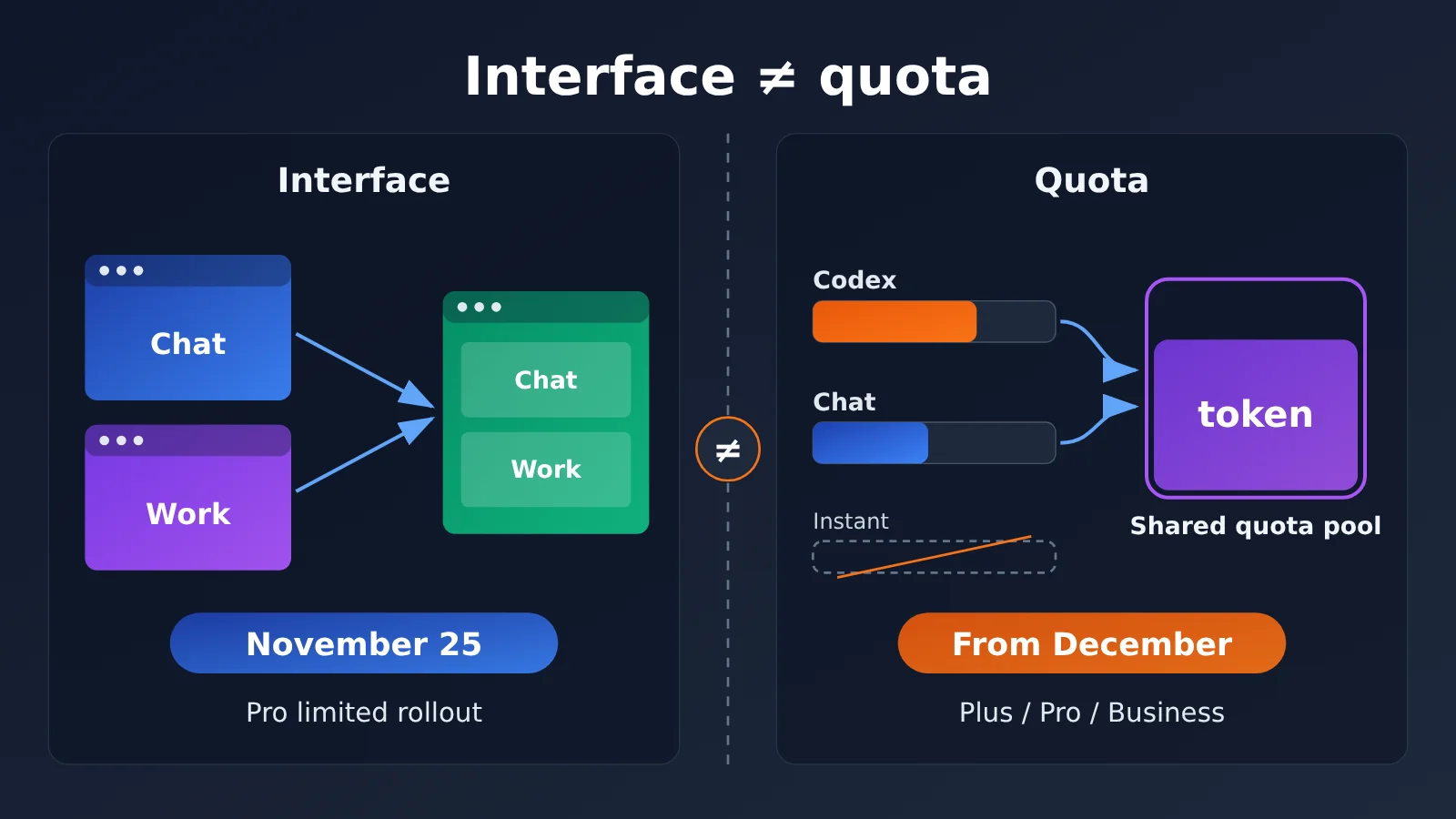
Bottom line first: what started this morning is only a UI merge — Codex quota won’t be counted together with ChatGPT until December 2026. At 01:46 Beijing time on November 25 (17:46 UTC on November 24), OpenAI’s Thibault Sottiaux (Tibo) announced on X that the company is starting to roll out a merged Chat and Work experience to a small group of Pro users in order to collect feedback. That original post proves a limited, Pro-only staged rollout of a merged interface — it does not mean shared quota is already live.
The quota question needs a different source. OpenAI’s Help Center note on shared usage states: starting December 2026, in-plan usage for Plus, Pro, and Business will be pooled by token across ChatGPT and Codex, with Instant chat excluded. The official documentation also notes that a small number of users may see usage changes earlier, but it doesn’t publish a specific date, the order in which tiers roll out, or the token allowance for each tier.
What you’ll learn from this article:
- Exactly who this morning’s Chat and Work merge rollout covers, and what it does and doesn’t prove.
- Which plans the December shared-quota policy applies to, what’s exempt, and which details are still unpublished.
- The public baseline for Pro 100, Pro 200, and Pro 500 before the policy switch.
- The difference between in-plan usage, ChatGPT add-on credits, and API balance.
- How to tell from your own account whether you’re looking at a new interface, a new quota, or just an ordinary usage limit.
Index: The next section uses a concept table and a quick impact summary to establish the basics. The “Objective facts” section reconstructs both sources along a timeline and lists the three Pro tier baselines plus the distinction between the three kinds of allowance. The “Analysis” section explains why a staged rollout can’t be treated as a quota going live, and how different groups should respond. The “Quick start” section gives account self-check steps and a short piece of code for logging token consumption. FAQ at the end.
Concepts to Know Before ChatGPT Merges Chat and Work
This news story comes with a lot of terms, and many readers conflate Work, Codex, credits, and API balances. The table below covers only the concepts directly relevant to understanding this article.
| Concept | Brief explanation |
|---|---|
| Chat | ChatGPT’s everyday conversation entry point, with options such as Instant and Thinking modes |
| Work | The task-execution entry point in ChatGPT; its usage was previously listed alongside Codex |
| Codex | OpenAI’s coding agent, including the terminal, IDE extensions, desktop local workflows, and Codex Cloud |
| Codex Cloud | Cloud tasks that run on OpenAI-hosted computers and can continue even when your local computer is asleep |
| Instant chat | ChatGPT’s fast conversation mode, explicitly excluded from the December shared quota policy |
| In-plan usage | The usage included in the subscription fee; the new policy discussion is about how this part gets combined and calculated |
| token | The unit by which models process and generate content; shared quotas are calculated in tokens |
| ChatGPT add-on credits | Paid balance that eligible features can continue to use after in-plan usage is exhausted |
| API credit benefit | The OpenAI API Platform balance included with eligible Pro subscriptions, separate from ChatGPT quotas |
| Ultrafast | A high-speed option in Codex that, on applicable plans, deducts usage at six times the Standard usage rate |
| Gradual rollout | Launching a new feature to a small subset of users first to collect feedback, then gradually expanding it |
| Settings → Usage | The usage page in ChatGPT settings; OpenAI says it will show combined remaining usage and reset time |
Quick Look at the Impact of Merging Chat and Work and Sharing Codex Quotas
The impact varies a lot across different groups, so here I’ll only cover what’s backed by evidence.
- Pro users included in the gradual rollout: You’ll see the merged Chat and Work interface first, where you can start conversations and tasks in the same place. But a UI change alone doesn’t mean the quota rules have changed — the actual limits shown in Settings → Usage are still what counts.
- Plus, Pro, and Business users not yet in the rollout: Nothing needs to be done right now. Starting in December, plan usage will be shared by token across ChatGPT and Codex, so heavy Codex users should watch how chatting and coding trade off against each other.
- Users who mostly chat with Instant: OpenAI has confirmed multiple times that Instant chats don’t draw from the shared quota, so everyday light conversations are less affected.
- Developers using Codex with an API key: This runs on separate API billing and isn’t affected by the ChatGPT plan quota merge. The API credits bundled with Pro also don’t cover these costs.
- Team and enterprise managers: The Business pricing page now separately notes the usage-sharing change starting in December, so when planning member usage, you’ll need to consider chatting and coding together.
The Objective Facts About ChatGPT Merging Chat and Work
ChatGPT and Codex Quota Merge Timeline
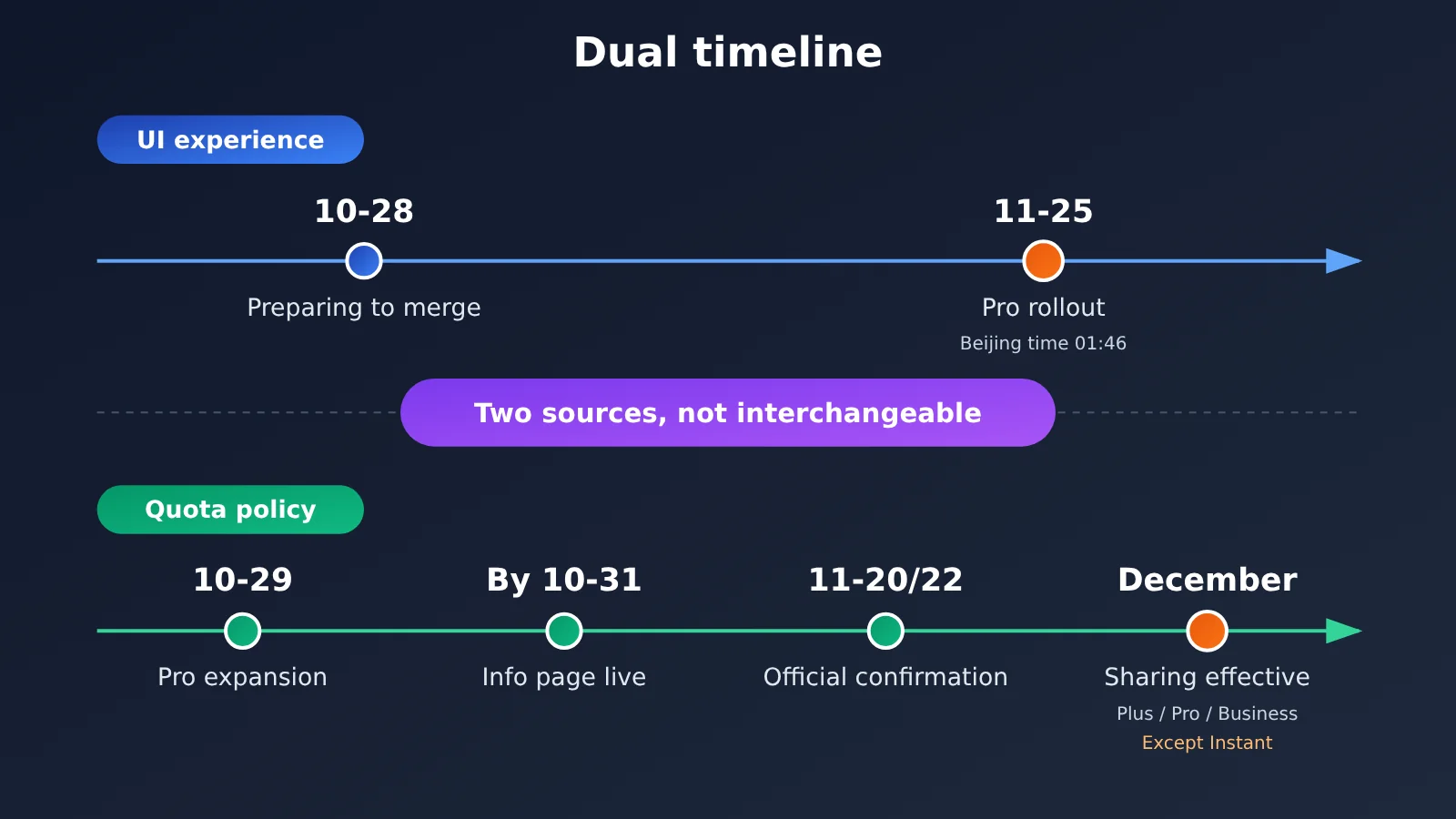
Lining up the relevant events by date makes it clear that “UI experience” and “quota policy” are two tracks moving forward in parallel.
| Time | Event | Source type | Which track |
|---|---|---|---|
| 2026-10-28 (UTC) | Tibo publicly stated the team was preparing to merge Chat and Work, which hadn’t launched yet | Employee X post | UI experience |
| 2026-10-28 | OpenAI announced API credit benefits included with Pro subscriptions | API changelog | API benefits |
| 2026-10-29 | In-plan usage for Work and Codex was expanded across Pro tiers; the Pro 200 downgrade plan was scrapped | ChatGPT release notes | Quota policy |
| No later than 2026-10-31 | The Help Center page explaining shared quotas was already publicly accessible | Archive snapshots and public link records | Quota policy |
| 2026-11-17 | GPT‑6.2 released; Pro 200 and Pro 500 get the Ultrafast option for Codex | Official announcement | Quota consumption rules |
| 2026-11-20, 11-22 | OpenAI Support confirmed in the community that the policy starts in December and that Instant chats don’t count against quota | Official community reply | Quota policy |
| 2026-11-23 | GPT‑6.2 Sol gradually rolls out to Plus, Pro, Business, and Enterprise | ChatGPT release notes | Model update |
| 2026-11-24 17:46 UTC (Beijing time 11-25 01:46) | Tibo announced that the merged Chat and Work is starting to roll out to a small group of Pro users | Employee X post | UI experience |
| December 2026 | In-plan usage for ChatGPT and Codex starts being shared on a token basis | Help Center | Quota policy |
What Did This Morning’s Chat and Work Merge Rollout Actually Say?
Tibo’s original post was about the user experience: the merged Chat and Work is being rolled out to a small subset of Pro users to collect feedback. The original post mentions Pro without breaking it down by subscription tier, and it doesn’t mention any quota, token, or usage-deduction rules. OpenAI’s public bio for him shows he works on Codex-related efforts, which gives the post relatively high credibility, but it can still only confirm a UI-level deployment.
In other words, if you open ChatGPT today and see Chat and Work in the same interface or the same list, that means you’ve been included in the experience rollout. As for whether your Codex usage is already being deducted together with chat usage, the original post doesn’t answer that.
Codex Quota Sharing in December: What Does the Official Policy Say?
The basis for shared quotas is the Help Center page “Understanding ChatGPT and Codex usage limits.” The key points can be summarized as follows:
- Scope: Plus, Pro, and Business plans.
- How it’s calculated: Usage within a plan is counted by tokens combined across ChatGPT and Codex.
- What’s exempt: Instant chats don’t count against the shared quota.
- Effective date: Starting December 2026; a small number of users may see usage changes before December.
- Where to check: Settings → Usage will show combined remaining usage and reset time.
- Vendor expectation: The policy says it expects most users won’t need to wait for resets more often; this is OpenAI’s expectation, not a guarantee.
What the policy page doesn’t disclose is just as important: which Pro tiers get priority, the exact date actual usage deduction begins, the token quotas for each tier, and when the full rollout will be complete. In a community response on November 22, OpenAI Support also explicitly stated that there are currently no confirmed details on whether the new weekly quota will increase or how Chat’s existing separately listed Pro message quota will be handled. Any personal quota numbers that appear in community posts represent only the poster’s own description.
The Public Baseline for the Three ChatGPT Pro Tiers Before the Quota Merge
To determine whether usage after December goes up or down, you need a verifiable starting point. Below is the current Pro tier documentation as reviewed on November 25; the changes come from the October 29 adjustment.
| Subscription tier | Official monthly price | Work and Codex plan quota | Weekly GPT-6 Pro message limit in Chat | Codex Ultrafast |
|---|---|---|---|---|
| Pro 100 | $100 | Original quota doubled | Remains at its original level | Not included in current plans |
| Pro 200 | $200 | Original lower quota doubled and aligned with the higher quota | Original lower cap aligned with the higher cap | Sol available |
| Pro 500 | $500 | Original quota doubled, highest of the three tiers | Remains at its original level | Astra and Sol available (eligible entry points) |
Here, “doubling” is relative to each tier’s original included usage. How much a single task consumes depends on the model, context, reasoning effort, tools, and speed options, so how many tasks you can complete depends on your usage mix. The official documentation also states that existing subscribers receive the adjustment automatically and don’t need to wait for renewal; Pro 200 is accepting new subscriptions again, and the Work and Codex usage you get is the same whether you cancel and resubscribe or stay continuously subscribed. Even benefits marked as unlimited in the Pro tiers are still subject to anti-abuse rules.
How Codex Local and Cloud Usage Was Originally Metered
A lot of people assume “Codex quota merging” is a brand-new concept, but Codex has actually been metering usage in a unified way for a while now. When you sign in with a ChatGPT account, Codex’s local messages (terminal, IDE extensions, desktop local workflows) and cloud tasks already count toward the same plan usage. The standard Codex Cloud environment doesn’t carry a separate VM fee, but model usage still counts toward your plan and any applicable credits — and a single cloud task often consumes more than a single local message.
The current guidelines state that the three Pro tiers have no five-hour usage limit on Work and Codex for now, though usage still counts within the plan; some other plans are subject to both five-hour and weekly windows. Separately, the Ultrafast option deducts usage at six times the Standard rate — that multiplier describes how fast usage is deducted, which is a different thing from how fast the model generates. The December change essentially takes this already-unified Codex usage pool and merges it further with ChatGPT chat (excluding Instant).
Plan Quota, Credits, and API Balance: What’s the Difference?
The three kinds of “quota” get mixed up all the time, but their rules are completely independent. The table below sorts it out in one go.
| Type | Source | What it’s for | Affected by the December sharing? | Where to check |
|---|---|---|---|---|
| In-plan usage | Included in the monthly subscription | ChatGPT and signed-in Codex | Yes, merged by token (excluding Instant) | Settings → Usage |
| ChatGPT add-on credits | Purchased separately | Continue using Codex, Work, and other eligible features after the plan runs out | Serves as the continuation option once the shared quota is exhausted | Balance entry in settings |
| OpenAI API credit benefit | Included with the Pro subscription ($100/$200/$500 face value) | API Platform requests | No — doesn’t raise ChatGPT or signed-in Codex limits | Billing page of the selected API organization |
| Third-party API aggregator balance | Pay-as-you-go top-ups on platforms like APIYI apiyi.com | Call multiple models via API key | No — completely independent of the ChatGPT subscription | Platform console |
The API credit benefit comes with a few hard requirements: an active subscription for at least seven days, the same email on both ChatGPT and the API side, linking to an API organization owned by an eligible subscription owner, and a first installment that’s prorated and expires at the end of the benefit period. The developer docs make it clear that this promotional credit does not cover the cost of running Codex with an API key.
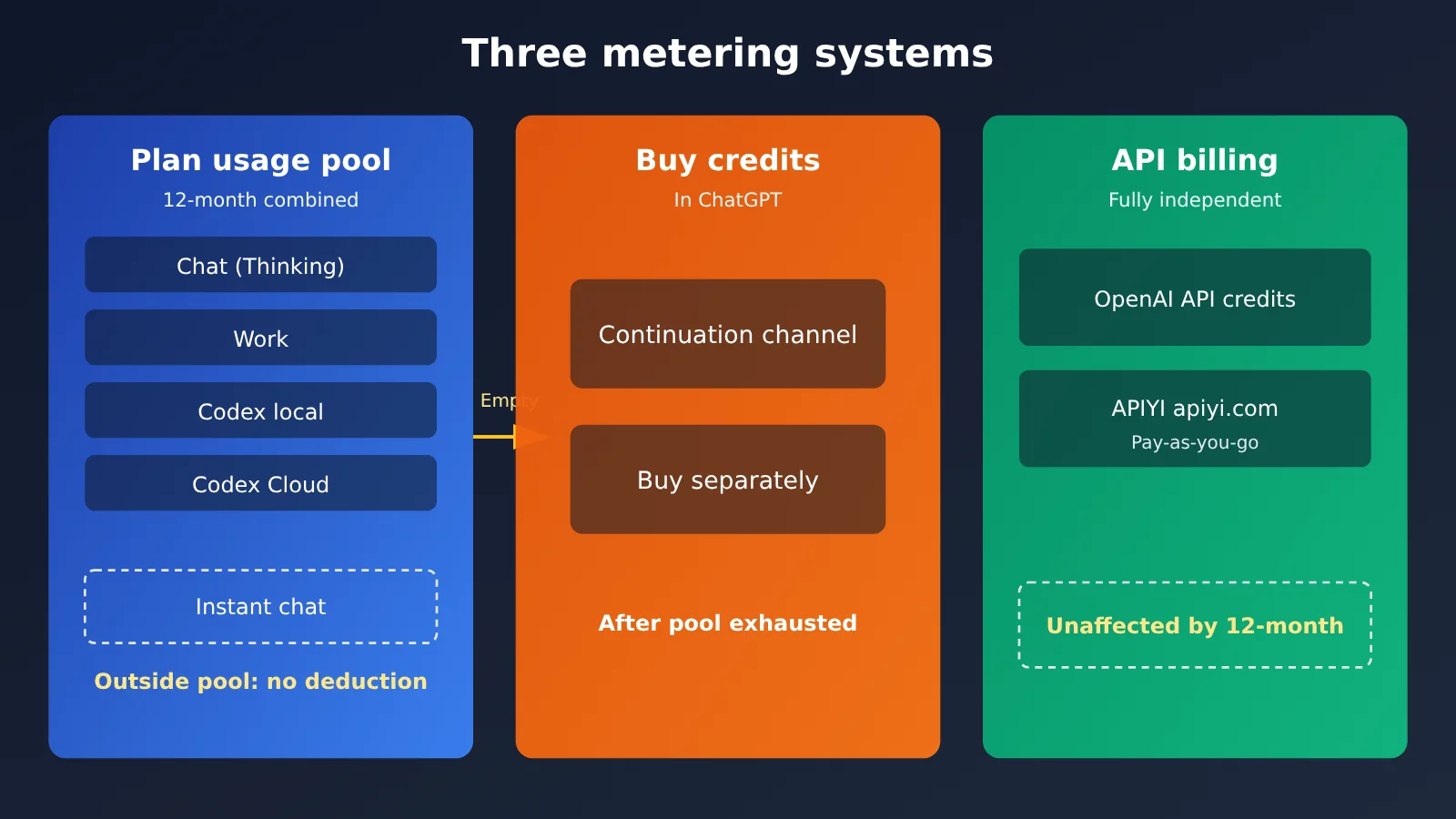
The diagram above puts the three metering systems side by side: only the first column changes in December. API-side billing — whether it comes from official credits or an aggregator platform like APIYI apiyi.com — is settled independently based on the actual tokens in each request.
Analysis of Codex quota consolidation
Why merging the Chat and Work interfaces doesn’t mean quotas take effect
Tibo’s original post and the Help Center note are two independent sources covering two different things. The original post is about “a small subset of Pro” users and concerns “experience”; the policy is about “Plus, Pro, Business” and concerns “token metering”, with a December timeline. Interpreting this morning’s rollout as “Pro quotas start merging today” amounts to substituting interface evidence for quota evidence.
A more reasonable reading: before quota sharing takes effect, OpenAI is letting some users get familiar with the unified interface, so that once the interface is unified, usage merging will feel natural from an experience standpoint. This inference rests on the sequence of the two tracks, but there’s currently no official statement directly confirming that the two are linked — readers should treat it as analysis, not fact.
How Pro users should respond to Codex quota consolidation
For Pro users, the biggest change after December is that chat and coding start competing for the same pool. If you’re used to doing lots of long conversations in Thinking mode and you’re also a heavy Codex user, the headroom you had on each side may no longer simply add up. Conversely, users who only use one side may find their available quota feels more generous — which is exactly where the official expectation that “most users won’t need to wait for resets more often” comes from.
It’s worth building the habit of checking Settings → Usage before December and noting your consumption rhythm over a week. Put lightweight Q&A in Instant wherever possible, and save high-reasoning, large-context tasks for cases that genuinely need them; use Ultrafast sparingly in Codex, since it deducts at six times the rate.
For developers: move predictable usage to the API side
For developers and teams, subscription quotas inherently come with “windows” and “caps” — fine for individual interaction, not suited to carrying production traffic or batch processing. Once chat and coding share quota, the risk of running automation scripts on subscription quota gets higher: a single large batch job could drain that week’s chat quota along with it.
A safer approach is to layer things: keep interactive use on the ChatGPT subscription, and move programmatic calls, code review in CI, and batch text processing to the usage-billed API side.
🎯 Technical recommendation: If your business needs stable, predictable call volume, move the automation portion to the API side. With APIYI (apiyi.com) you can call OpenAI, Claude, Gemini, and other models through a single API key, billed by actual tokens, free from ChatGPT subscription windows and reset times.
What to keep an eye on after Codex quota consolidation
The following points fall in the not-yet-confirmed category — they’re items to follow up on, not conclusions:
- When the specific token quotas for each Pro, Plus, and Business tier will be published, and whether they exceed the current weekly quotas for Work and Codex.
- How the separately listed GPT-6 Pro weekly message quota in Chat will be handled after sharing — the official word is that no details are confirmed yet.
- When the merged interface expands from a small set of Pro users to more people, and whether it syncs with the December quota effective date (speculation, unconfirmed).
- The display convention in Settings → Usage: whether the percentage means remaining or consumed, and how the reset moment is labeled.
Quick Start: How to Check the Chat and Work Merge and Codex Quota Status Yourself
Three-Type Evidence Self-Check Table
You can use the table below to match the changes you see in your account.
| What you see | What it tells you | What it doesn’t tell you | Source |
|---|---|---|---|
| Chat and Work appear in the same interface or list | You’re within the gradual rollout | Quotas have been merged, or all Pro tiers are covered | Tibo’s November 24 original post |
| A shared usage notice with a date and time zone appears on the Usage page | The new quota rules are enabled for your account | Status in other regions, platforms, or tiers | Help Center shared usage notes |
| The Usage page shows the merged remaining quota and reset time | Account-level quota status | Other users’ quota figures | Settings → Usage |
| Codex says usage has reached the limit | Usage under the current plan is exhausted for the period | The new policy has taken effect | Work and Codex usage guide |
There are just three steps:
- Open ChatGPT and check whether a merged Chat and Work entry appears in the interface.
- Go to Settings → Usage and check the quota name, display scope, whether there’s a shared usage notice, and the reset time.
- If you share a screenshot with your team, note the plan, client, Usage section, reset basis, and whether the percentage is remaining usage or consumed usage.
Use the API to Track Token Usage and Get Used to Token-Based Metering Early
Shared quota is calculated in tokens, so the most straightforward way to prepare is to start paying attention to how many tokens your own tasks consume. The example below sends a request through the OpenAI-compatible API and prints the input and output token counts for this call, helping you build an intuition for roughly how many tokens a single task uses.
import openai

client = openai.OpenAI(
    api_key="YOUR_API_KEY",
    base_url="https://api.apiyi.com/v1"  # APIYI OpenAI-compatible API
)

response = client.chat.completions.create(
    model="gpt-4o-mini",  # Can be replaced with another model from the platform's model list
    messages=[{"role": "user", "content": "用三句话解释什么是 token"}]
)

print(response.choices[0].message.content)
usage = response.usage
print(f"输入 token: {usage.prompt_tokens}, 输出 token: {usage.completion_tokens}")
View the full code: accumulate token usage by week and write it to CSV
import csv
import datetime
import os
from typing import Optional

import openai

LOG_FILE = "token_usage_log.csv"

client = openai.OpenAI(
    api_key=os.getenv("APIYI_API_KEY", "YOUR_API_KEY"),
    base_url="https://api.apiyi.com/v1"
)


def log_usage(task: str, model: str, prompt_tokens: int, completion_tokens: int) -> None:
    """Append one request's token usage to a CSV file."""
    new_file = not os.path.exists(LOG_FILE)
    with open(LOG_FILE, "a", newline="", encoding="utf-8") as f:
        writer = csv.writer(f)
        if new_file:
            writer.writerow(["time", "iso_week", "task", "model",
                             "prompt_tokens", "completion_tokens", "total"])
        now = datetime.datetime.now()
        writer.writerow([
            now.isoformat(timespec="seconds"),
            f"{now.isocalendar()[0]}-W{now.isocalendar()[1]:02d}",
            task, model, prompt_tokens, completion_tokens,
            prompt_tokens + completion_tokens,
        ])


def ask(prompt: str, task: str, model: str = "gpt-4o-mini",
        system_prompt: Optional[str] = None, max_tokens: int = 1000) -> str:
    messages = []
    if system_prompt:
        messages.append({"role": "system", "content": system_prompt})
    messages.append({"role": "user", "content": prompt})

    try:
        resp = client.chat.completions.create(
            model=model, messages=messages, max_tokens=max_tokens
        )
    except Exception as e:
        return f"Error: {e}"

    u = resp.usage
    log_usage(task, model, u.prompt_tokens, u.completion_tokens)
    return resp.choices[0].message.content


def weekly_summary() -> dict:
    """Sum total tokens per ISO week from the log file."""
    summary = {}
    if not os.path.exists(LOG_FILE):
        return summary
    with open(LOG_FILE, encoding="utf-8") as f:
        for row in csv.DictReader(f):
            summary[row["iso_week"]] = summary.get(row["iso_week"], 0) + int(row["total"])
    return summary


if __name__ == "__main__":
    print(ask("审查这段函数是否有边界问题:def div(a, b): return a / b",
              task="code_review",
              system_prompt="你是严谨的代码审查助手"))
    print(ask("把这句话翻译成英文:额度按 token 合并计算", task="translate"))
    for week, total in weekly_summary().items():
        print(f"{week}: {total} tokens")
After running it for a week, you’ll have a token usage record organized by task type. Tasks like code review and long-document summarization usually consume noticeably more, and that’s exactly the part most likely to eat into your chat allowance once the shared quota takes effect in December. Those are good candidates to move to the API side first.
🚀 Quick start: You can run the script above directly after signing up at APIYI apiyi.com and getting an API key. New users get free trial credits, making it a good way to get token tracking working first and then decide which tasks to move off your subscription quota.
FAQ
Q1: What does ChatGPT’s merger of Chat and Work this morning mean?
At 01:46 Beijing time on November 25, OpenAI’s Tibo announced that a small subset of Pro users would get the combined Chat and Work experience to gather feedback. This is a UI-level gradual rollout test. The original post didn’t break down Pro tiers or cover quota rules.
Q2: When will Codex quota be counted together with ChatGPT?
According to the official Help Center, starting December 2026, usage included in Plus, Pro, and Business plans will be shared by token between ChatGPT and Codex, except for Instant chat. A small number of users may see the change early, but the exact dates and per-tier quotas haven’t been announced.
Q3: I see the merged interface—does that mean quotas are already combined?
Not necessarily. The merged interface only means you’re part of the gradual rollout. Whether quotas have actually switched depends on whether Settings → Usage shows a shared usage notice with a date and time zone, along with the combined remaining amount and reset time.
Q4: Will Instant chat deduct from the shared quota?
No. The official policy and OpenAI Support’s community replies on November 20 and 22 both confirm that Instant chat doesn’t draw from the shared quota. Other modes like Thinking do count.
Q5: Will using an API key to run Codex or automation tasks be affected?
No. Calls made with an API key go through separate API billing, and the API credits included with Pro don’t cover these costs either. If you want to centrally manage pay-as-you-go calls across multiple models, you can use OpenAI-compatible endpoints through APIYI apiyi.com and access them with a single key.
Q6: What if my plan isn’t enough after December?
Officially, you can buy additional ChatGPT credits, and eligible features can continue after in-plan usage runs out. For programmatic, batch, or production tasks, it’s better to move to the pay-as-you-go API side—for example, settling by actual tokens on APIYI apiyi.com, so you don’t compete with everyday chat for subscription quota.
Q7: What information is still unconfirmed?
Which Pro tiers get priority, when actual deductions will start, token quotas per tier, when it will roll out to everyone, and how the separately listed GPT-6 Pro weekly message quota in Chat will be handled—none of these have been announced. Individual quota numbers shared in the community only represent isolated account samples.
This morning’s gradual rollout gave some Pro users an early look at what ChatGPT will look like in the future, but the real quota rule changes won’t arrive until December, and your own account’s Settings → Usage display is what counts. Until then, the most practical preparation is to get a clear picture of your weekly usage rhythm and separate automation tasks that need stable throughput from interactive use. When you need invocation capacity that’s independent of subscription windows, you can start with free credits on APIYI apiyi.com to validate, then scale as needed.
References
- OpenAI Shared Usage Explainer: ChatGPT and Codex usage limits plus the December sharing policy
- Link:
help.openai.com/en/articles/20001625-understanding-chatgpt-and-codex-usage-limits
- Link:
- Tibo’s original post, 2026-11-24: a small-scale Pro rollout that merges Chat and Work
- Link:
x.com/thsottiaux/status/2125284868414394550
- Link:
- ChatGPT Pro Tier Explainer: quotas and benefits for Pro 100, Pro 200, and Pro 500
- Link:
help.openai.com/en/articles/9793128-about-chatgpt-pro-tiers
- Link:
- ChatGPT Release Notes: the October 29 capacity expansion and the November 23 model update
- Link:
help.openai.com/en/articles/6825453-chatgpt-release-notes
- Link:
- Codex Plans and Cloud Environment Help: how local and cloud usage are metered
- Link:
help.openai.com/en/articles/11369540-using-codex-with-your-chatgpt-plan
- Link:
- API Credits Benefit Explainer: eligibility and scope of use
- Link:
developers.openai.com/api/docs/guides/chatgpt-api-credits
- Link:
Author: APIYI technical team
Technical discussion: Feel free to reach us through the APIYI (apiyi.com) homepage, and you’ll find more integration resources at the docs.apiyi.com documentation center.