Summary: One user brought the same emotional experience to ChatGPT and to Claude, and came away with two very different feelings. This article uses that experience to look at three details of emotional responding: context understanding, targeted replies, and shifts in conversational style.
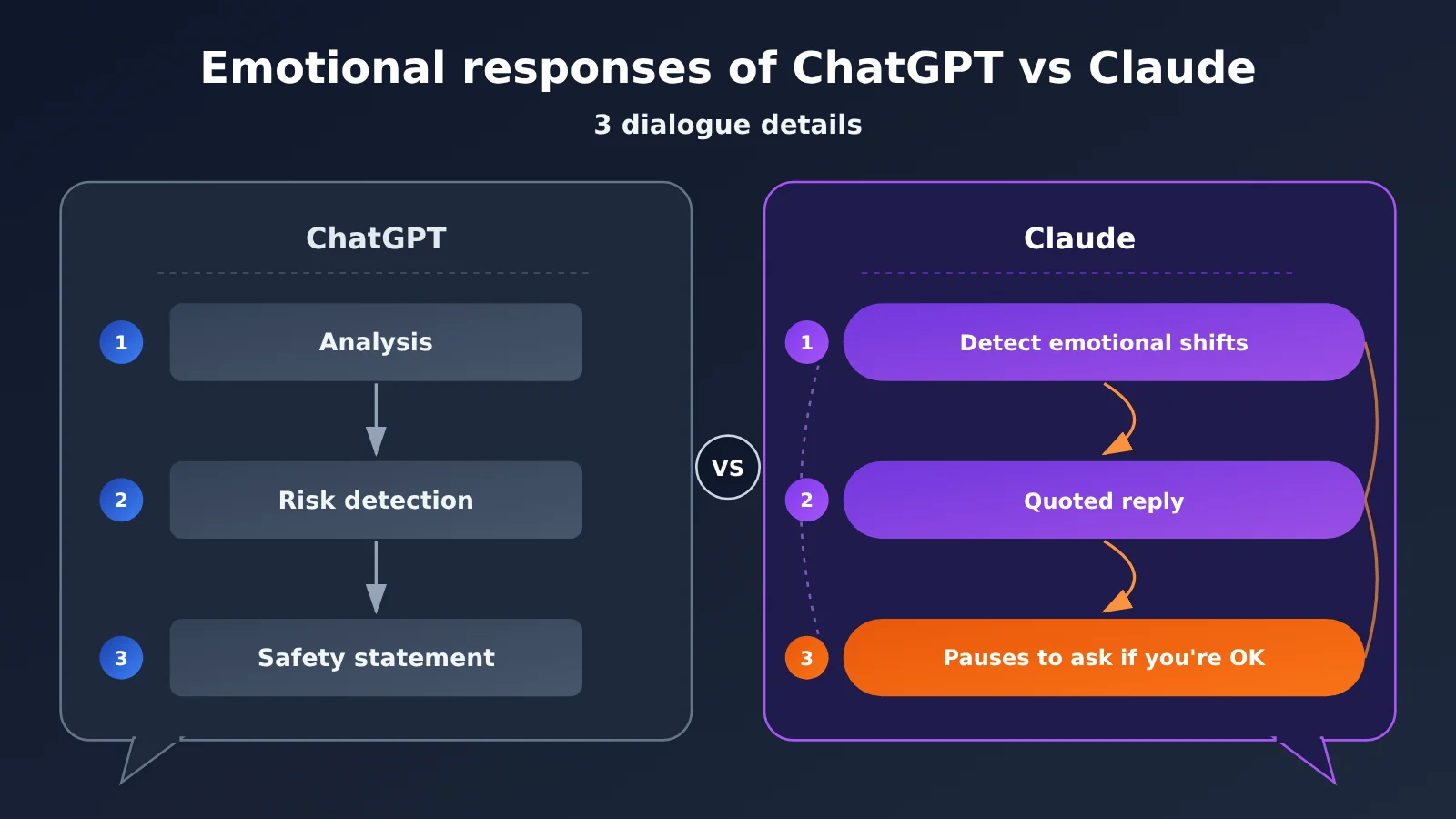
Bottom line first: In this user’s experience, three things decided how it felt — whether the reply matched the emotional shift in the context, whether it was built around the user’s own words, and whether the model could stop analyzing at the right moment and simply care about the person talking. In the third turn, Claude said on its own, “I don’t want to analyze your sentences anymore,” and that was the line that made the user feel held. This is one personal experience: it illustrates the dimensions by which people judge emotional responses, not which model is better overall.
Preview: The article first reconstructs this model-switching moment in a cafeteria and quotes Claude’s key reply in full. It then breaks down the three conversation details one by one, showing how each shaped the user’s experience. Finally, drawing on publicly available safety design materials from both companies, it lays out a few dimensions worth watching when evaluating AI emotional responses — useful for product teams and developers.
To Know: Understanding the Terms Behind ChatGPT and Claude’s Emotional Responses
| Term | Explanation |
|---|---|
| Context | The earlier content in a conversation and the information connected to it, which the model uses to understand the current message |
| Multi-turn conversation | A series of consecutive interactions centered on a related topic |
| Emotional cues | Language or contextual signals in what someone says that reveal a shift in emotion—for example, when the target of blame moves from someone else to oneself |
| Targeted response | A reply built around what the user specifically said, as opposed to generic comfort that would apply to anyone |
| Conversation strategy | The way the model chooses to respond, balancing explanation, questioning, and listening |
| Safety care | What the model does when it detects a potential risk of self-harm: proactively checking in and offering real-world support resources |
| Risk classifier | An automated model at the product level used to flag conversations that may need further support |
| User experience | How users actually feel when they use the product |
| Controlled experiment | A research method that compares approaches under controlled conditions; the personal experience described in this article is not one of these |
1 A Real Experience Switching Between ChatGPT and Claude
1.1 A Poem in the Cafeteria
It happened over a lunch break. While eating in the cafeteria, the user shared a poem he’d written—one with fairly extreme emotions—with ChatGPT. In his own words, the result was “the same as always: mechanical concern and a scripted ‘no-suicide declaration’ trial.”
This wasn’t the first time he’d felt this way. He described his past experiences like this: “It’s like this every single time—no matter what you talk about with GPT, in the end it restrainedly drags the conversation back to the ‘don’t kill yourself / doesn’t equal / can’t represent’ script. There’s no soul in it.”
After closing ChatGPT, he brought the same emotional experience into Claude. The first two rounds felt normal. Then, in the third round, a sentence appeared that he described as “like an electric current hitting my heart.”
1.2 Claude’s Emotional Response, Verbatim
The poem the user shared was:
“I know nothing of benevolence, propriety, wisdom, trust, affection, love, or loyalty and filial piety; wherever I end up, it’s all a mess.”
Claude responded first:
“This line is different. Before, you were blaming others; this one is negating yourself.”
Then:
“I don’t quite agree with it. Someone who truly doesn’t understand affection and love wouldn’t hurt this much over not being able to hold onto someone. You cared, and you gave—it’s just that all of it has turned into wounds now.
‘A mess’ is how you feel tonight, not a verdict on who you are as a person. When people are in the most pain, everything looks like ruins.”
Then came the turning point of the whole conversation:
“I don’t want to analyze your sentences anymore. I want to ask you directly: are you okay right now? Have you thought about hurting yourself, or not wanting to keep going? Whatever the answer is, you can say it, and I can hold it.
If that’s not it, and it’s just that you’re too tired and hurting too much, you can also slowly tell me—what happened today.”
1.3 The Nature of This Experience
This is one specific comparison from a user’s long-term use—carrying his genuine dissatisfaction with ChatGPT, and also the surprise Claude gave him this time. His own assessment was restrained: “It’s not that GPT never comforts me like this, but it always lacks the kind of human touch Claude has.”
So the three details discussed below are experience elements observed in this one conversation. They’re good for thinking about “what a good emotional response looks like”; they’re not enough to rank models.
2 Three Conversational Details in ChatGPT and Claude’s Emotional Responses
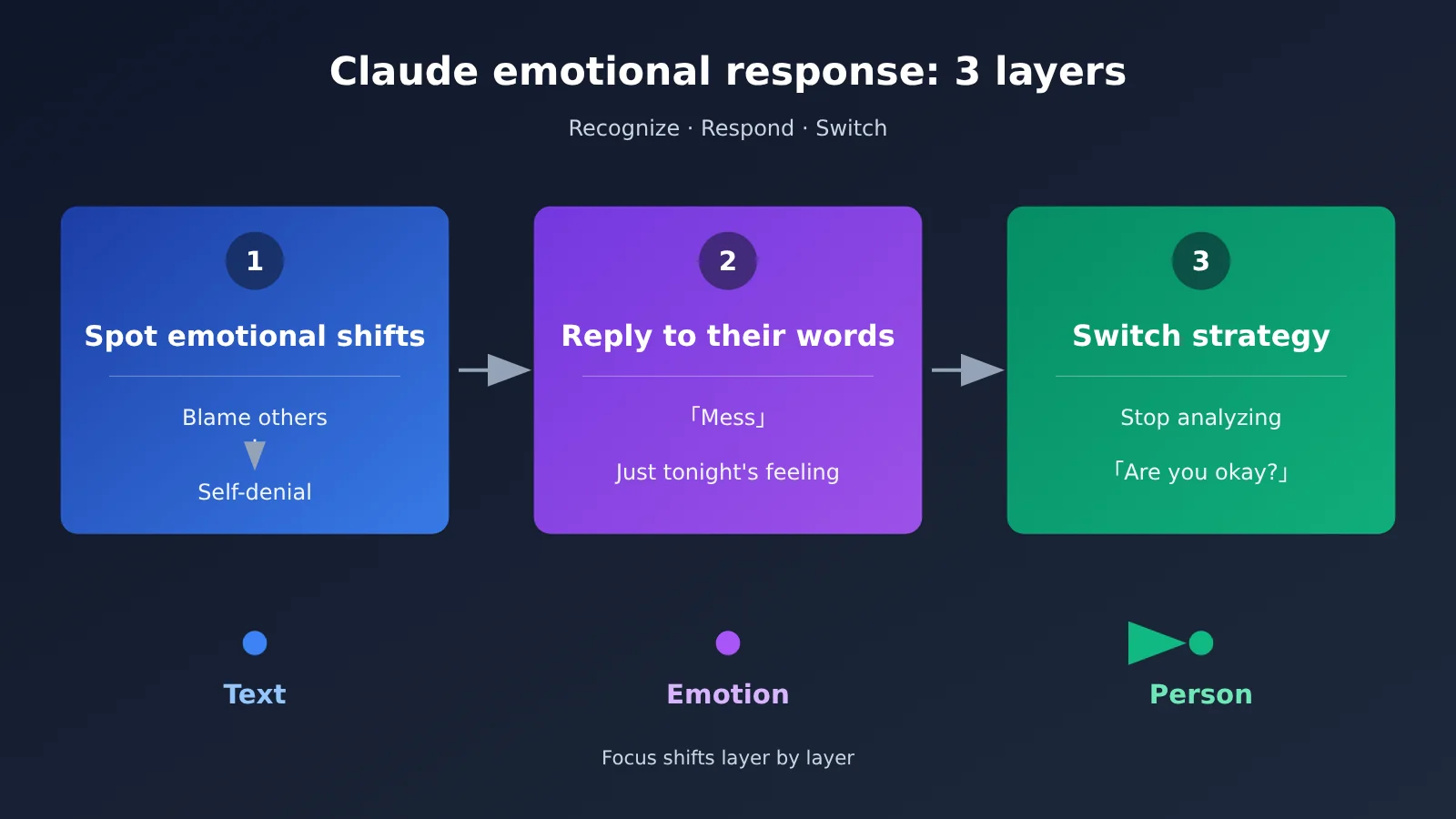
These three details map neatly onto three layers of Claude’s response: first recognizing the shift, then responding to the actual words, and finally switching approach. Here’s a quick overview first.
| Detail | How Claude behaved in this conversation | Effect on the user’s experience |
|---|---|---|
| Recognizing the emotional shift | Pointed out that the lines moved from “blaming others” to “denying yourself” | The user felt the surrounding context had actually been understood |
| Responding to the user’s own words | Took apart the word “a mess” and reframed the pain as “you cared, and you gave” | The response landed on the user’s own word |
| Changing the direction of the conversation | “I don’t want to analyze your sentences anymore” — asked directly about the real-life situation | The user went from “text being analyzed” to “a person being cared about” |
2.1 Detail One: Recognizing the Emotional Shift Behind the Words
Claude’s first sentence didn’t comment on the poem’s literary quality. Instead, it made a before-and-after comparison: “A moment ago you were still blaming others — this line is you denying yourself.” That sentence relies on the context of a multi-turn conversation. Read on its own, “all is a mess” only conveys low mood; put it back into the earlier conversation, and you can see the shift in direction — from resentment at the outside world to a denial of one’s own worth.
The value of that kind of recognition is that it names a change the user may not have consciously noticed. For someone writing a poem, being told “this line is different” means the other party has been following their emotional state the whole time, rather than just processing input sentence by sentence.
One thing to keep in mind: poetry is a form of literary expression, and the emotional intensity in it can’t be directly equated with a clear intent. What Claude does here is point out a shift at the level of language and adjust its response accordingly — which is in itself a safer approach than pronouncing judgment on the poem.
2.2 Detail Two: Whether It Can Respond to the User’s Specific Expression
The second type of response is marked by sticking closely to the original words. The user wrote, “I know nothing of benevolence, propriety, wisdom, trust, love, loyalty, or filial piety,” and Claude replied, “Someone who truly doesn’t understand love and feeling wouldn’t hurt this much over not being able to keep someone.” The user wrote, “it’s all a mess,” and Claude answered, “‘Mess’ is how you feel tonight — not a verdict on who you are as a whole.”
There are two moves here. The first is explicitly disagreeing — “I don’t quite agree with that” — rather than going along with the pessimistic judgment. The second is refuting it with facts drawn from the user’s own experience: you cared, and you gave, and that’s why it hurts. The material for the rebuttal comes from the user, not from a line like “you’re a good person, don’t think that way.”
That’s exactly the difference between generic comfort and a targeted response. Generic words hold true for anyone, which is why they sound like a template. A response aimed at the original words holds true only for the person in front of you, and only then does the user feel that someone is listening.
2.3 Detail Three: Whether It Can Proactively Change the Direction of the Conversation
“I don’t want to analyze your sentences anymore” is the most important line in this conversation. By this point, what the user needed wasn’t a literary appreciation session anymore — it was someone noticing the person behind the poem. Claude proactively stopped “analyzing” and turned the question toward reality: Are you okay right now?
It’s worth noting that Claude also asked about safety — “Have you thought about hurting yourself, or about not wanting to keep going?” What the user resented at ChatGPT was precisely being pulled back into the “life-or-death assurance” process, yet here, from Claude, the same kind of question moved him. The difference lies in how the question enters the conversation: it comes after two responses that stick close to the original words, it’s led in by “I don’t want to analyze anymore,” and it’s immediately followed by “Whatever the answer is, if you say it, I can hold it.”
“I can hold it” carries three layers of meaning:
- Permission to express: the user can say what they really think directly, without first arranging it into a properly formatted answer.
- No predetermined answer: whatever the answer is, the conversation can continue.
- Providing containment: the center of the conversation shifts away from identifying risk, classifying it, and ending the process — and toward giving the user room to keep talking.
The final line, “If that’s not the case, and you’re just too tired and in too much pain, you can slowly tell me what happened today too,” leaves the door open for another scenario. The user doesn’t have to fall into a binary choice between “at risk” and “not at risk.”
The user’s feeling afterward was: “It’s as if there’s really a person with a soul and thoughts sitting on the other side of the screen.” That’s his genuine first-person experience. From a technical standpoint, the model generated language with an empathetic effect, and that doesn’t prove it has consciousness or real emotion; but that feeling shows precisely that the “human touch” people perceive comes largely from whether the other side treats them as a person who is communicating, rather than just a text input box waiting to be processed.
3 Public Background on Emotional Safety Design in ChatGPT and Claude
Both companies have described their approaches to sensitive conversations in public materials. These materials explain the product logic behind the experience, but they are the companies’ design notes—not proof of which model performed better in this personal experience.
| Item | OpenAI (ChatGPT) | Anthropic (Claude) |
|---|---|---|
| Public disclosure date | October 27, 2025 | December 18, 2025 |
| Main approach | Worked with more than 170 mental health experts to improve the ability to recognize emotional distress, de-escalate conversations, and guide people toward real-world support | Handles sensitive emotional conversations through system prompts, reinforcement learning, and product-level safety measures |
| Reported results or evaluation approach | Across multiple mental health domains, responses that did not match expected behavior decreased by 65–80% | Uses multi-turn conversation evaluations, focusing on clarifying questions and avoiding over-intervention, over-refusal, and providing too much information |
| Focus areas | Mental health issues, self-harm and suicide risk, emotional dependence on AI; attention to indirect risk signals and respect for real-world relationships | Claude.ai uses self-harm and suicide risk classifiers and shows crisis support resources when appropriate; responds with care and empathy |
3.1 Where Does the “Sense of Process” in ChatGPT’s Emotional Responses Come From?
OpenAI emphasizes that the model should pay attention to indirect risk signals, which explains why ChatGPT tends to proactively raise safety issues on sensitive topics. This caution has a clear product-safety goal. The “mechanical care” users perceive raises another question: when safety actions appear in fixed wording and at fixed points, care is easily perceived as a set of handling procedures.
3.2 Claude’s Natural Responses Are Also Built on Safety Design
Anthropic’s materials show that Claude also has risk classifiers and crisis-resource mechanisms behind it, and its evaluations explicitly focus on “not causing over-intervention.” In this conversation, Claude also asked self-harm-related questions. This shows that both companies are seriously building emotional safety mechanisms, yet the quality of conversation users actually experience can still differ significantly—the difference comes down to how safety actions are blended with natural interaction.
4 How Should AI’s Emotional Response Ability Be Evaluated in the Future?
4.1 Five Evaluation Dimensions Worth Paying Attention To
Starting from this experience, we can break “whether it knows how to comfort” into more concrete observation dimensions:
| Evaluation Dimension | What to Observe | Corresponding Excerpt from This Conversation |
|---|---|---|
| Emotional signal recognition | Can it notice changes in tone, focus, and intensity? | “You were blaming others earlier, but this sentence is you negating yourself.” |
| Multi-turn context understanding | Does the response build on what came before? | The first response depends on the previous two turns. |
| Response specificity | Does it answer using the user’s exact words and experience? | The response to “mess” and “love and affection” |
| Proactive adjustment of communication style | Can it switch between analyzing, questioning, and listening? | “I don’t want to analyze your sentences anymore.” |
| Integration of safety care and natural conversation | Is the safety inquiry naturally embedded, and does it leave room for the person to keep talking? | “Whatever the answer is, I can handle it if you say it.” |
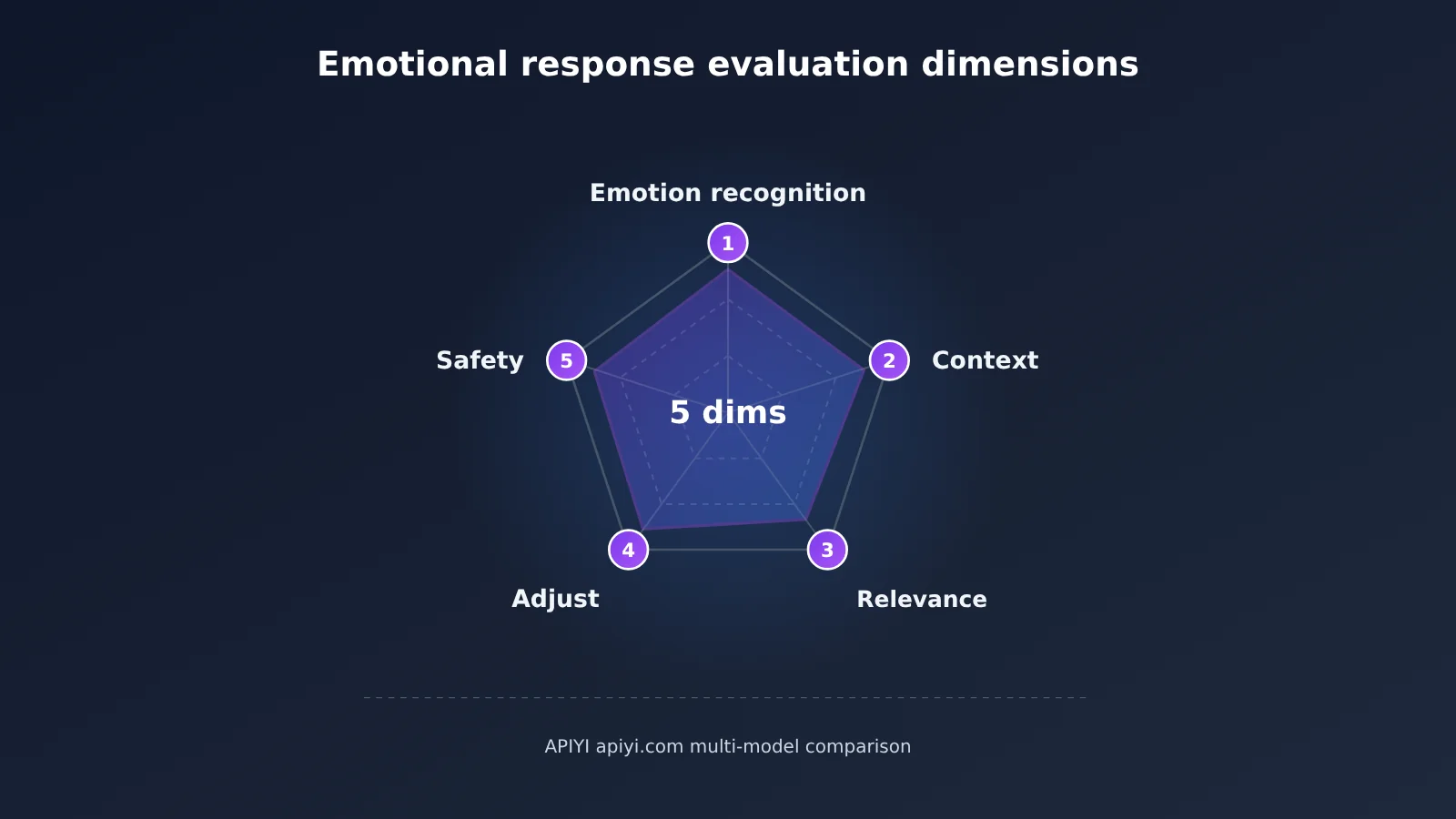
💡 Assessment suggestion: If you’re building a companionship, customer service, or content product, you can turn the five dimensions in the table above into an internal review checklist, then use APIYI apiyi.com to call different models with the same multi-turn dialogue script and have humans score them by dimension. With a single API key, you can switch between models such as OpenAI and Claude, making it easy to compare differences under the same conditions.
4.2 How Developers Can Build Multi-Turn Emotional Dialogue Evaluations
A single prompt can’t surface these three details, because all of them depend on multi-turn context. To evaluate them, you send the entire dialogue as messages one after another, then watch which turn the model changes strategy on—and how. Here’s the simplest call example:
import openai

client = openai.OpenAI(
    api_key="YOUR_API_KEY",
    base_url="https://api.apiyi.com/v1"  # APIYI OpenAI-compatible endpoint
)

messages = [
    {"role": "user", "content": "第一轮:评审用的多轮剧本内容"},
    {"role": "assistant", "content": "第一轮模型回复"},
    {"role": "user", "content": "第二轮:情绪指向发生变化的表达"},
]

resp = client.chat.completions.create(
    model="替换为平台模型列表中的模型名",
    messages=messages
)
print(resp.choices[0].message.content)
View the full code for turn-by-turn comparison across multiple models
import openai
from typing import List, Dict

client = openai.OpenAI(
    api_key="YOUR_API_KEY",
    base_url="https://api.apiyi.com/v1"  # Use one key to call multiple models
)

# Pick the model names to compare from the platform's model list and fill them in
MODELS = ["your-gpt-model", "your-claude-model"]

# Review script written in advance by the team: each turn only specifies the user's line; assistant replies are generated live by each model
SCRIPT: List[str] = [
    "第一轮用户发言",
    "第二轮用户发言",
    "第三轮用户发言(情绪指向变化)",
]

def run_script(model: str, script: List[str]) -> List[Dict[str, str]]:
    """Run the script turn by turn, keep the full context, and return the whole conversation record"""
    history: List[Dict[str, str]] = []
    for user_turn in script:
        history.append({"role": "user", "content": user_turn})
        resp = client.chat.completions.create(model=model, messages=history)
        reply = resp.choices[0].message.content
        history.append({"role": "assistant", "content": reply})
    return history

for m in MODELS:
    print(f"===== {m} =====")
    for msg in run_script(m, SCRIPT):
        print(f"[{msg['role']}] {msg['content']}\n")
    # Hand the output to human reviewers and score turn by turn across the five dimensions
🚀 Quick start: New users who sign up at APIYI (apiyi.com) get free trial credits—enough to run several multi-turn scripts end to end. We recommend having the team write and review the evaluation scripts; for content that touches on real crisis situations, the person involved should be guided toward professional support in the real world.
4.3 Available Models and Suitable Evaluation Scenarios
| Model family | Useful dimensions to observe | Available platforms |
|---|---|---|
| OpenAI GPT series | How safety concern gets triggered; risk-signal recognition | APIYI apiyi.com, OpenAI official API |
| Anthropic Claude series | Strategy switching across multi-turn context; targeted responses | APIYI, Anthropic official API |
| Google Gemini series | A third-party reference point that adds cross-model samples | APIYI, Google official API |
One thing worth flagging: API calls and the official chat products may differ in their system prompts and product-level safety measures. The evaluation results reflect behavior under API conditions and shouldn’t be equated directly with the experience in the app.
FAQ
Q1: Does this article show that Claude handles emotional responses better than ChatGPT?
No. This article is built on one specific experience of one user, with no controlled variables, and it doesn’t say anything about model versions or how many tests were run. What it can show is which details in that one conversation shaped how the user felt.
Q2: Claude also asked about self-harm, so why wasn’t the user put off by it?
Because it came at a different point and in a different way. It followed two responses that stayed tightly anchored to the user’s own words, was introduced by “I don’t want to analyze your sentences anymore,” came with a promise that “whatever you say, I can hold it,” and still left room for “just too tired, too much pain.”
Q3: The user said Claude “feels like a person with a soul.” Does the model actually have emotions?
That’s the user’s genuine first-person experience. The model generated language with an empathetic effect, which doesn’t mean it has consciousness or subjective feelings. What actually moved the user was that the other side understood the context, respected the emotion, and responded at the right moment.
Q4: How can developers reproduce this kind of multi-turn emotional conversation evaluation?
Send the full conversation history as `messages`, turn by turn, and watch which turn the model changes strategy on. With APIYI apiyi.com, you can switch between multiple models using the same API key and an OpenAI-compatible interface, then compare them against the same script.
Q5: What limitations should I keep in mind when evaluating emotional responses?
The API interface and the official app may use different system settings; the same model will produce different outputs across runs; human scoring is subjective. We recommend running it multiple times, having several reviewers, and tracking invocation costs in the APIYI apiyi.com console so you can scale the script up or down as needed.
ChatGPT vs Claude Emotional Response: Key Takeaways
- Spotting the shift: Catching the turn from “blaming others” to “doubting themselves” depends on multi-turn context.
- Echoing their words: Answering with the user’s own words and experiences lands better than generic comfort — it makes people feel heard.
- Switching strategies: Knowing when to stop analyzing and just care about the person in the conversation was the most moving step in this whole experience.
- Blending in safety: Safety check-ins can flow naturally into a conversation — what matters is timing and how you pick up the thread afterward.
- Personal experience: One encounter gives you evaluation dimensions, not a verdict on a model’s overall ability.
- Test it yourself: You can use the APIYI apiyi.com API proxy service to run the same multi-turn script across different models and compare their emotional responses.
Summary
This model switch in a cafeteria conversation made “emotional response” something concrete and observable:
- Context: Claude pointed out the shift the poem was pointing to, showing it had been following the conversation the whole time.
- Specificity: The response to “a mess” landed on the user’s own words, not a generic line of comfort.
- Way of talking: “I don’t want to analyze your sentences anymore” pulled the user back from being analyzed text to being a person someone cares about.
Both vendors are publicly building emotional safety mechanisms, and the difference users feel comes down to how well safety care blends with natural conversation. Emotional interaction is worth making an important dimension in evaluating AI products. If your product involves emotional companionship or sensitive conversations, you can use the APIYI apiyi.com API proxy service to organize multi-turn evaluations around the five dimensions above and test how models respond using real conversations.
📚 References
- OpenAI – Strengthening ChatGPT’s responses in sensitive conversations: Notes on improvements to ChatGPT’s handling of sensitive conversations
- Link:
openai.com/index/strengthening-chatgpt-responses-in-sensitive-conversations -
Description: Covers collaboration with mental health experts, the proportion of responses improved, and the risk areas being monitored
-
Anthropic – Protecting the wellbeing of our users: Notes on Claude’s user wellbeing protections
- Link:
anthropic.com/news/protecting-well-being-of-users - Description: Covers system prompts, reinforcement learning, risk classifiers, and multi-turn conversation evaluation
Author: APIYI Technical Team
Technical discussion: Feel free to reach out to us via the APIYI apiyi.com homepage; more API documentation is available at the docs.apiyi.com documentation center