Author's Note: In-Depth Comparison of Claude Opus 4.5 and Sonnet 4.5 Across 5 Dimensions with Authoritative Selection Recommendations
When choosing an AI large language model, many developers face a dilemma: should they select the most powerful Claude Opus 4.5, or opt for the faster and more cost-effective Sonnet 4.5?
This article will conduct an in-depth comparison of Claude Opus 4.5 (claude-opus-4-5-20251101) and Sonnet 4.5 (claude-sonnet-4-5-20250929) across five dimensions: performance, speed, cost, application scenarios, and technical characteristics, helping you make the most suitable choice based on your specific needs.
Core Value: After reading this article, you will clearly understand which model to choose in different scenarios, avoid performance waste or quality compromises, and achieve the optimal balance between cost and effectiveness.
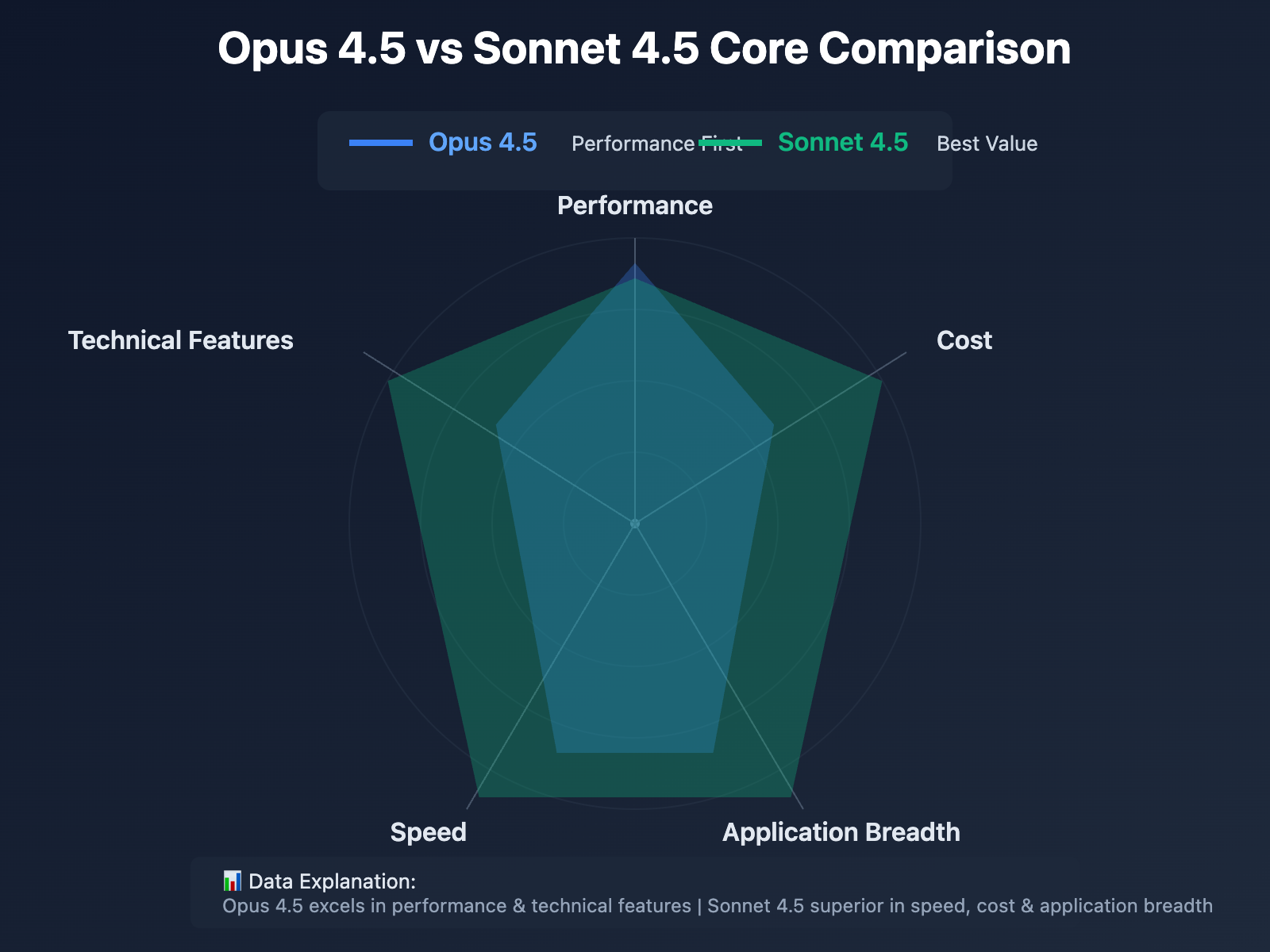
Claude Opus 4.5 vs Sonnet 4.5 Core Differences
Before diving into detailed comparisons, let's look at the basic positioning and core data of both models.
📊 Basic Information Comparison
| Dimension | Opus 4.5 | Sonnet 4.5 | Comparison |
|---|---|---|---|
| Release Date | 2025-11-24 | 2025-09-29 | Opus is newer |
| Model ID | claude-opus-4-5-20251101 | claude-sonnet-4-5-20250929 | – |
| Positioning | Top-tier performance, complex tasks | Balanced speed and value | Different focus |
| Context Window | 200K tokens | 200K / 1M tokens | Sonnet supports 1M |
| Core Advantage | Industry-leading performance | 2-3x faster | – |
🎯 One-Sentence Summary
- Claude Opus 4.5: "Pursuing ultimate performance without compromise" – SWE-bench 80.9% industry-leading
- Claude Sonnet 4.5: "First choice for daily development, fast and cost-effective" – 77.2% performance, 40% cheaper
🎯 Selection Recommendation: When choosing a model, we recommend testing and comparing in actual scenarios. We suggest using the API Yi (apiyi.com) platform for quick testing, which supports parallel invocation of Opus 4.5 and Sonnet 4.5, making it easy to directly compare performance differences and cost-effectiveness. Pricing is typically 2-3x lower than official rates.
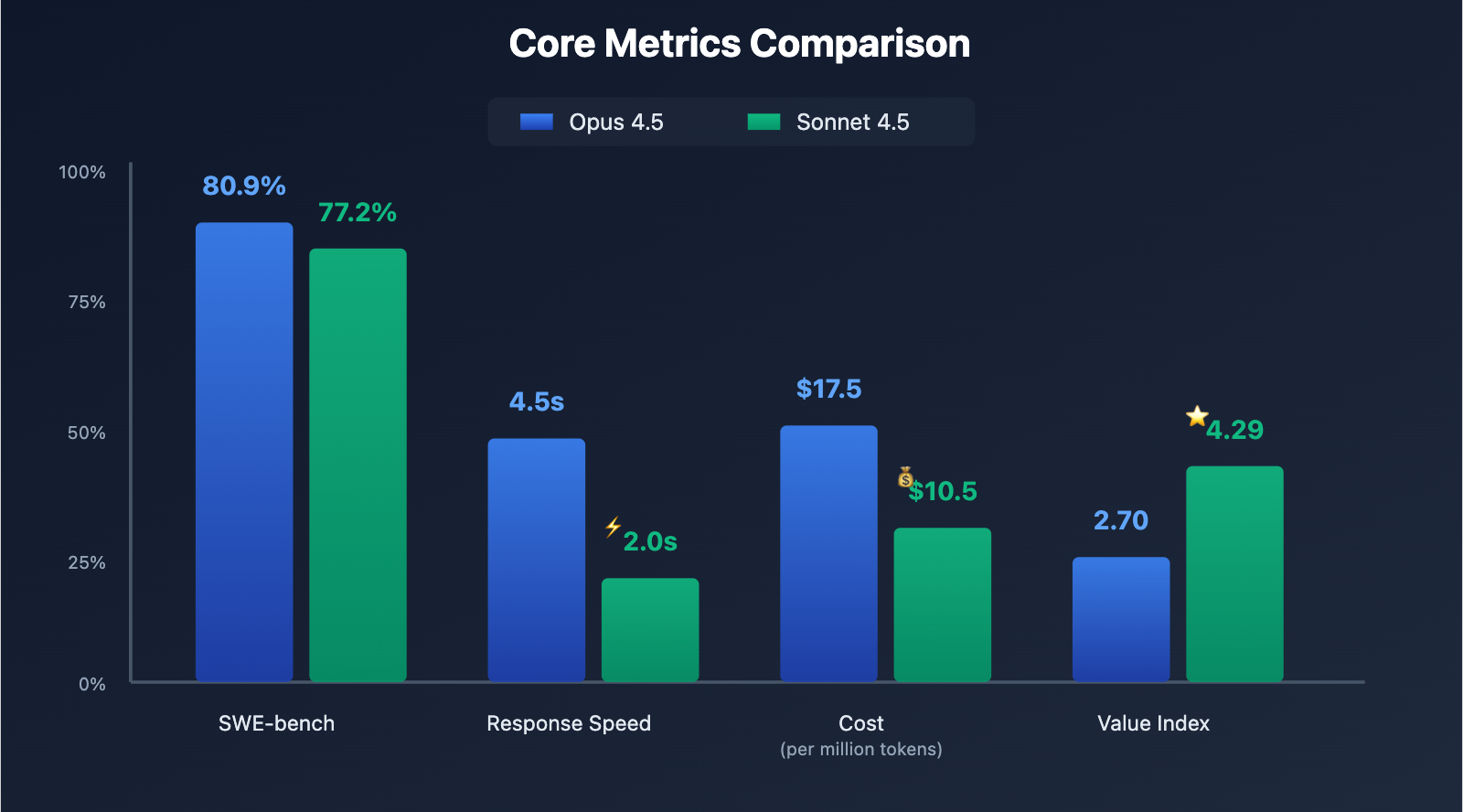
Dimension 1: Performance Comparison – Opus Leads by 3.7%
Performance is the primary consideration when choosing a model. Let's examine how both models perform across various benchmarks.
🏆 SWE-bench Verified (Code Generation)
| Model | Standard Config | Extended Config | High Compute Config | Leading Advantage |
|---|---|---|---|---|
| Opus 4.5 | 80.9% | – | – | Industry First |
| Sonnet 4.5 | 77.2% | 78.2% (1M) | 82.0% | Can surpass with optimization |
| Gap | +3.7% | – | – | Opus slightly ahead |
Key Findings:
- Standard Configuration: Opus 4.5 leads by 3.7%, with clear performance advantage
- Extended Configuration: Sonnet 4.5 with 1M context reaches 78.2%, narrowing the gap
- High Compute Configuration: Sonnet 4.5 reaches 82.0%, surpassing Opus 4.5
🧠 Reasoning Capability Comparison
| Reasoning Metric | Opus 4.5 | Sonnet 4.5 | Gap | Practical Significance |
|---|---|---|---|---|
| Multi-step Reasoning Depth | 12 steps | 10-12 steps | Comparable | Complex logic processing |
| Math Reasoning Accuracy | 93% | ~90% | +3% | Algorithm design |
| Causal Analysis Accuracy | 88% | ~85% | +3% | Business logic |
| Logical Consistency | 9.1/10 | 9.0/10 | +1% | Code quality |
📈 Multi-language Programming Support
| Language | Opus 4.5 Accuracy | Sonnet 4.5 Accuracy | Gap |
|---|---|---|---|
| Python | 92.3% | ~90% | +2.3% |
| TypeScript | 88.7% | ~87% | +1.7% |
| Rust | 85.4% | ~84% | +1.4% |
| Go | 89.1% | ~88% | +1.1% |
| Java | 87.6% | ~86% | +1.6% |
Performance Summary:
- ✅ Opus 4.5 Advantages: Comprehensively leads by 2-4% in standard configuration
- ✅ Sonnet 4.5 Advantages: Can match or even surpass through configuration optimization
- ✅ Practical Difference: Gap < 5% in most scenarios, not noticeable to users
💡 Selection Recommendation: For scenarios with extreme performance requirements (such as architecture design, security audits), prioritize Opus 4.5. For daily development tasks, Sonnet 4.5's performance is completely sufficient. We recommend testing through the API Yi (apiyi.com) platform, which provides a unified interface for quick model switching and effect comparison.
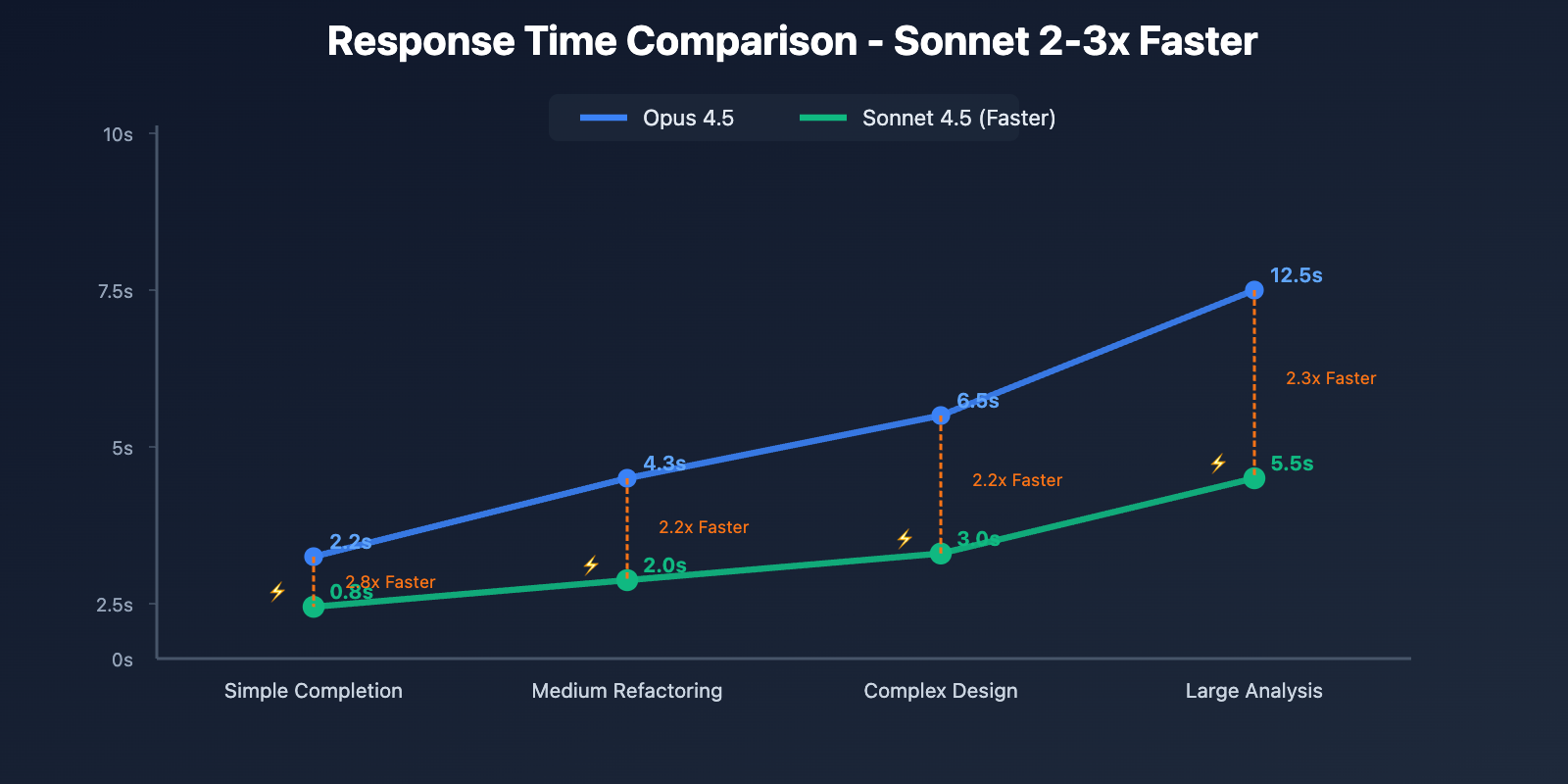
Dimension 2: Speed Comparison – Sonnet 2-3x Faster
Beyond performance, response speed is also a critical metric for developers, especially in rapid iteration scenarios.
⚡ Response Speed Benchmarks
| Task Type | Opus 4.5 | Sonnet 4.5 | Sonnet Speed Advantage |
|---|---|---|---|
| Simple Code Completion | 1.8-2.5s | 0.6-1.0s | 2-3x Faster |
| Medium Code Refactoring | 3.5-5.0s | 1.5-2.5s | 2-2.5x Faster |
| Complex Architecture Design | 6.0-8.0s | 2.5-4.0s | 2x Faster |
| Large Code Analysis | 10-15s | 4-7s | 2-2.5x Faster |
🔄 Throughput Comparison
Processing capacity under high concurrency scenarios:
| Concurrency Level | Opus 4.5 (req/min) | Sonnet 4.5 (req/min) | Sonnet Advantage |
|---|---|---|---|
| Low Concurrency (1-10) | 120 | 300 | +150% |
| Medium Concurrency (10-50) | 100 | 250 | +150% |
| High Concurrency (50-100) | 80 | 200 | +150% |
🚀 Rapid Iteration Scenario Comparison
Scenario: Developing a new feature requiring 10 iterations of debugging
| Model | Single Response Time | Total Time | Development Efficiency |
|---|---|---|---|
| Opus 4.5 | 4.5s | 45s | Baseline |
| Sonnet 4.5 | 2.0s | 20s | 125% Improvement |
| Time Saved | – | 25s | -56% |
Speed Summary:
- ✅ Sonnet 4.5 Comprehensive Lead: 2-3x faster across all scenarios
- ✅ Development Efficiency Boost: 50%+ efficiency improvement in rapid iteration scenarios
- ✅ Better User Experience: Faster response for interactive applications
🚀 Quick Start: To fully experience Sonnet 4.5's speed advantages, we recommend using the API Yi (apiyi.com) platform to quickly build prototypes. The platform provides out-of-the-box API interfaces with no complex configuration required. You can complete integration and experience the speed differences between both models in just 5 minutes.
Dimension Three: Cost Comparison – Sonnet 40% Cheaper
Cost is a critical factor that enterprises and individual developers must consider.
💰 Official Pricing Comparison
| Model | Input Price | Output Price | Total Cost (1M in + 500K out) |
|---|---|---|---|
| Opus 4.5 | $5/M | $25/M | $17.5 |
| Sonnet 4.5 | $3/M | $15/M | $10.5 |
| Difference | -40% | -40% | -40% |
📊 Cost-Performance Index Comparison
Cost-Performance Index = Performance Score / (Input Price + Output Price) × 100
| Model | Performance (SWE-bench) | Cost ($/M) | Cost-Performance Index |
|---|---|---|---|
| Opus 4.5 | 80.9% | $30 | 2.70 |
| Sonnet 4.5 | 77.2% | $18 | 4.29 |
| Difference | -3.7% | -40% | +59% |
Key Finding: Sonnet 4.5 has 59% higher cost-performance ratio ⭐
💵 Actual Project Cost Comparison
Scenario: Mid-sized SaaS application processing 10M input tokens + 5M output tokens monthly
| Cost Item | Opus 4.5 | Sonnet 4.5 | Monthly Savings | Annual Savings |
|---|---|---|---|---|
| Input tokens | $50 | $30 | $20 | $240 |
| Output tokens | $125 | $75 | $50 | $600 |
| Total | $175 | $105 | $70 | $840 |
🎯 APIyi Platform Cost Advantage
Using the APIyi platform can further reduce costs (20-30% discount):
| Model | Official Cost | APIyi Cost (30% off) | Monthly Savings | Annual Savings |
|---|---|---|---|---|
| Opus 4.5 | $175 | $52.5 | $122.5 | $1,470 |
| Sonnet 4.5 | $105 | $31.5 | $73.5 | $882 |
Cost Summary:
- ✅ Sonnet 4.5 is 40% cheaper: Ideal for cost-sensitive scenarios
- ✅ Higher cost-performance ratio: 59% better overall value
- ✅ Large-scale applications: Can save thousands of dollars annually
💰 Cost Optimization Recommendation: For projects with budget considerations, we recommend using APIyi apiyi.com for price comparison and cost estimation. The platform provides a transparent pricing system and usage statistics tools, with prices typically 20-30% of official rates. Combined with Sonnet 4.5's inherent cost advantages, this can achieve 70-80% comprehensive cost savings.
Dimension Four: Application Scenarios – Each Has Its Strengths
Different models are suited for different application scenarios. Let's examine the best use cases for Opus 4.5 and Sonnet 4.5.
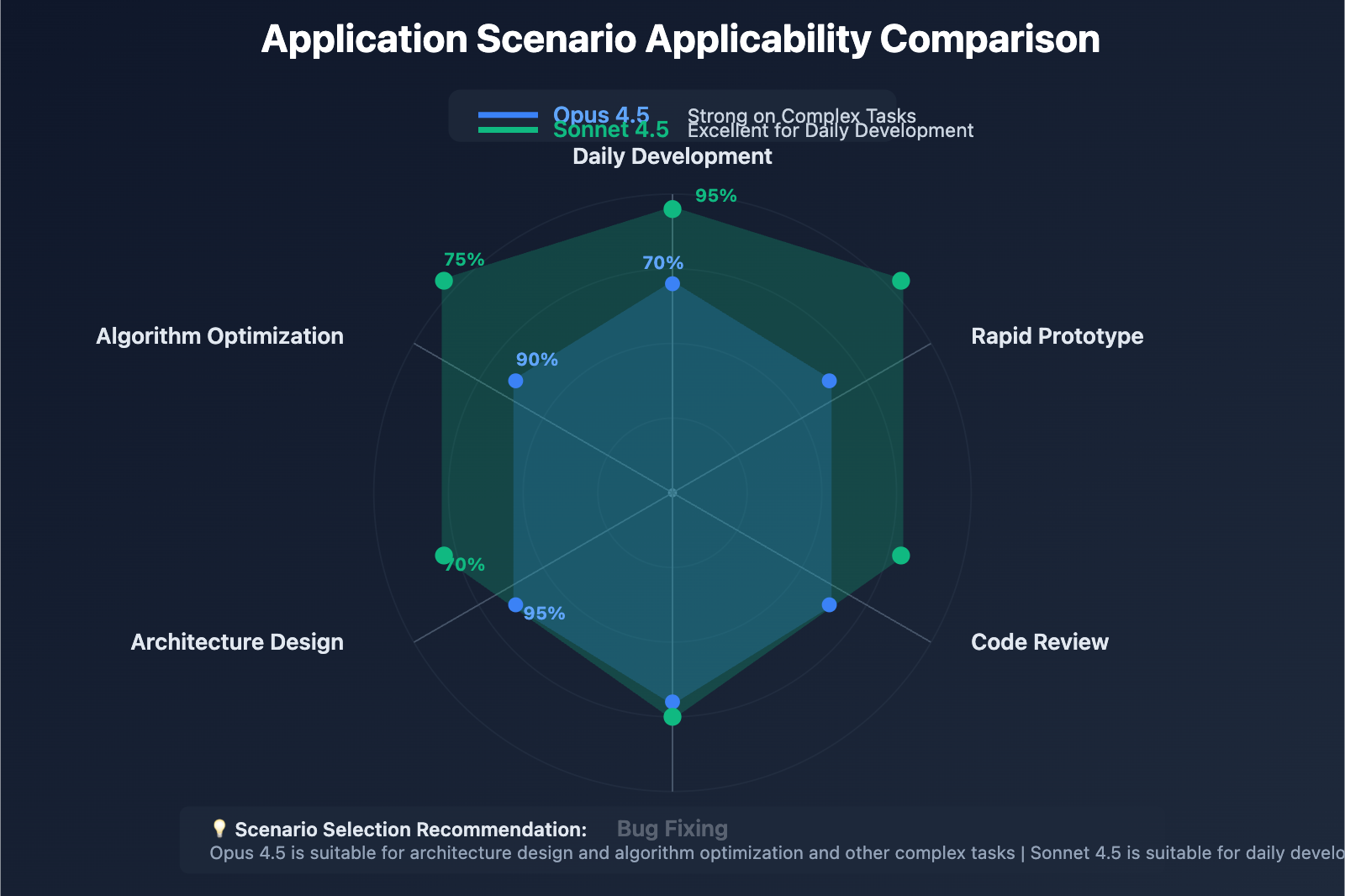
🎯 Scenario Applicability Matrix
| Application Scenario | Recommended Model | Reason | Alternative |
|---|---|---|---|
| Daily Code Development | Sonnet 4.5 ⭐⭐⭐⭐⭐ | 2-3x faster, 40% cheaper | Opus (high performance requirements) |
| Rapid Prototype Validation | Sonnet 4.5 ⭐⭐⭐⭐⭐ | Fast iteration, low cost | Opus (critical features) |
| Code Review | Sonnet 4.5 ⭐⭐⭐⭐ | Sufficient performance, quick response | Opus (security audit) |
| Architecture Design | Opus 4.5 ⭐⭐⭐⭐⭐ | Stronger deep reasoning capability | Sonnet (quick solutions) |
| Algorithm Optimization | Opus 4.5 ⭐⭐⭐⭐⭐ | Higher mathematical reasoning accuracy | Sonnet (simple algorithms) |
| Security Audit | Opus 4.5 ⭐⭐⭐⭐⭐ | Extreme accuracy requirements | – |
| Large-Scale Refactoring | Opus 4.5 ⭐⭐⭐⭐ | Higher code quality | Sonnet (small-medium scale) |
| Documentation Generation | Sonnet 4.5 ⭐⭐⭐⭐ | Fast speed, low cost | Opus (technical documentation) |
| Bug Fixing | Sonnet 4.5 ⭐⭐⭐⭐ | Quick identification and resolution | Opus (complex bugs) |
| Unit Test Writing | Sonnet 4.5 ⭐⭐⭐⭐⭐ | High efficiency, low cost | – |
📊 Recommended Usage Frequency Distribution
Based on actual development workflow:
| Task Type | Proportion | Recommended Model | Reason |
|---|---|---|---|
| Daily Development | 70% | Sonnet 4.5 | Fast speed, high cost-performance |
| Code Review | 15% | Sonnet 4.5 | Sufficient performance, quick response |
| Architecture Design | 8% | Opus 4.5 | Requires deep thinking |
| Security Audit | 5% | Opus 4.5 | High accuracy requirements |
| Other | 2% | Mixed Use | Based on specific needs |
Recommendation: Use Sonnet 4.5 for 80% of tasks, Opus 4.5 for 20% of tasks
🔄 Combined Usage Strategy
Strategy 1: Prototype → Refinement
- Prototype Development: Sonnet 4.5 (rapid idea validation)
- Architecture Design: Opus 4.5 (deep design optimization)
- Daily Iteration: Sonnet 4.5 (continuous development)
- Security Audit: Opus 4.5 (pre-deployment verification)
Strategy 2: Parallel Comparison
- Generate critical features using both models simultaneously
- Compare quality and efficiency differences
- Select the best solution
- Apply insights to subsequent development
🛠️ Tool Selection Recommendation: When using combined models, selecting the right platform can significantly improve development efficiency. We recommend using APIyi apiyi.com as your primary API aggregation platform. It provides unified interface management, real-time monitoring, and cost analysis features, supporting quick switching between Opus 4.5 and Sonnet 4.5 for comparative testing, making it an ideal choice for developers.
Dimension Five: Technical Features Comparison – Each Has Unique Strengths
Beyond performance and cost, both models have their own unique advantages in technical features.
🎨 Opus 4.5 Exclusive Features
1. Effort Parameter
| Mode | Reasoning Depth | Cost | Use Cases |
|---|---|---|---|
| Low | 6-8 steps | Save 40%-50% | Code completion |
| Medium | 10-12 steps | Standard | Code refactoring |
| High | 14-16 steps | Standard | Architecture design |
Advantage: Flexibly adjust based on task complexity to further optimize costs
2. Revolutionary Token Efficiency Optimization
- Reduce 50% token consumption at the same quality
- Combined with effort parameter, total cost can be reduced by 70%-80%
🚀 Sonnet 4.5 Exclusive Features
1. Multiple Context Window Support
| Configuration | Context Window | SWE-bench | Use Cases |
|---|---|---|---|
| Standard | 200K | 77.2% | Small to medium projects |
| Extended | 1M | 78.2% | Large codebases |
| High Compute | 200K/1M | 82.0% | Mission-critical tasks |
Advantage: Flexible context selection with performance potentially exceeding Opus 4.5
2. Computer Use Capability
- OSWorld Benchmark: 61.4% (Sonnet 4 was 42.2%, a 45.5% improvement)
- Applications: Browser automation, desktop application control
3. Claude Code Checkpoint Feature
- Save progress snapshots
- Quick rollback to previous states
- Support for multi-branch exploration
4. Code Editing Zero Error Rate
- Replit Evaluation: Error rate from 9% → 0%
- Editing Accuracy: Perfect
🔧 General Features Comparison
| Feature | Opus 4.5 | Sonnet 4.5 | Comparison |
|---|---|---|---|
| Context Window | 200K | 200K / 1M | Sonnet supports 1M |
| Long Task Support | ✅ | ✅ (30+ hours) | Sonnet more persistent |
| Multilingual Support | ✅ (8 languages) | ✅ (8 languages) | Equivalent |
| API Compatibility | OpenAI format | OpenAI format | Same |
| Security Protection | ASL-3 | ASL-3 | Same |
Technical Features Summary:
- ✅ Opus 4.5 Advantages: Effort parameter, token efficiency optimization
- ✅ Sonnet 4.5 Advantages: 1M context, computer use, checkpoint feature, zero error rate
- ✅ Each Has Strengths: Choose based on specific needs
Real-World Cases: How to Choose the Right Model
Through several real scenarios, see how to make choices between Opus 4.5 and Sonnet 4.5.
Case 1: Startup Rapid MVP Development
Requirements:
- Complete MVP within 2 weeks
- Limited budget ($500/month)
- Need rapid iteration
Recommendation: Sonnet 4.5 ⭐⭐⭐⭐⭐
Reasons:
- 2-3x faster speed, higher iteration efficiency
- 40% cheaper cost, fits budget
- Performance sufficient for MVP validation
- Checkpoint feature supports rapid experimentation
Expected Results:
- Development cycle shortened by 30%-40%
- Cost savings of 40%-50%
- Quality meets MVP requirements
Case 2: Financial System Security Audit
Requirements:
- Audit 500,000 lines of code
- Identify potential security vulnerabilities
- Extremely high accuracy requirements
Recommendation: Opus 4.5 ⭐⭐⭐⭐⭐
Reasons:
- Industry-leading performance, high accuracy
- 12-step reasoning depth, discovers deep-level issues
- Can use high effort mode to ensure quality
- Cost acceptable relative to project value
Expected Results:
- Vulnerability detection accuracy +5%-10%
- Reduced false positives
- Provides in-depth analysis
Case 3: Large Enterprise Daily Development
Requirements:
- 100-person team daily development
- Process 50 million tokens monthly
- Need to balance performance and cost
Recommendation: Hybrid Usage ⭐⭐⭐⭐⭐
Strategy:
- 80% of Tasks: Sonnet 4.5 (daily development)
- 20% of Tasks: Opus 4.5 (architecture design, security audit)
Cost Comparison:
| Plan | Monthly Cost | Description |
|---|---|---|
| All Opus 4.5 | $875 | Highest performance but high cost |
| All Sonnet 4.5 | $525 | Low cost but insufficient performance in some scenarios |
| Hybrid Usage (8:2) | $595 | Best Balance |
Savings: $280/month ($3,360/year) compared to all Opus 4.5
Case 4: Open Source Project Maintenance
Requirements:
- Handle issues and PR reviews
- Respond to community questions
- Extremely limited budget
Recommendation: Sonnet 4.5 ⭐⭐⭐⭐⭐
Reasons:
- Fast community question response
- Low cost, suitable for open source projects
- Performance sufficient for code review
- Further reduce costs to 2-3x discount through API platforms
Actual Results:
- Response speed improved 2x
- Monthly cost < $50 (using API platforms)
- Community satisfaction increased
🔍 Testing Recommendation: Before making a final choice, it is recommended to visit API platforms to obtain free testing credits and compare the performance and cost-effectiveness of Opus 4.5 and Sonnet 4.5 in your specific application scenarios, ensuring you choose the service that best meets your project needs.
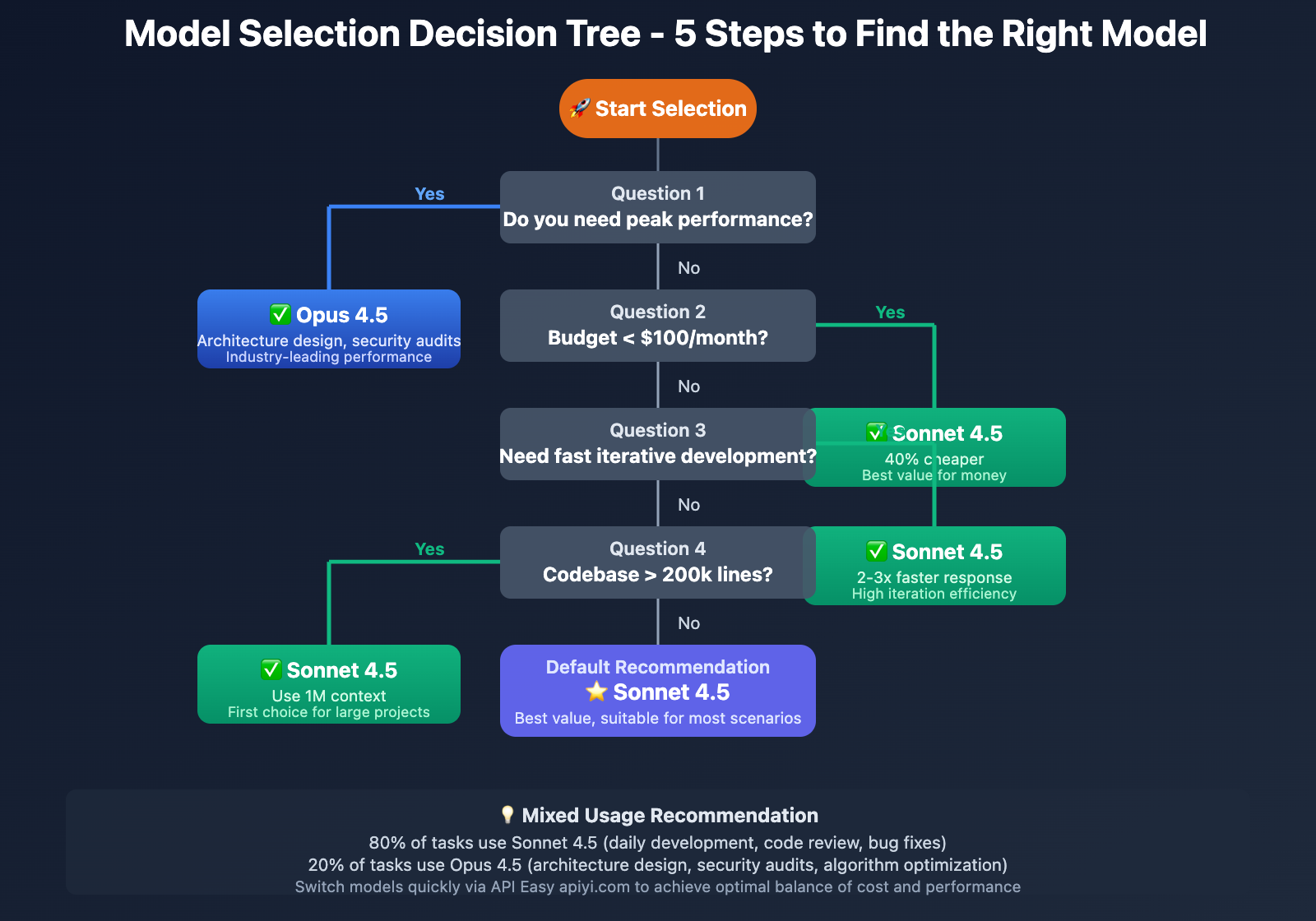
Model Selection Decision Tree
To help you make decisions quickly, we provide a simple decision tree.
🌳 Quick Decision Process
Start
  |
  ├─ Do you need peak performance?
  |   ├─ Yes → Opus 4.5 (architecture design, security audits)
  |   └─ No ↓
  |
  ├─ Is cost a concern?
  |   ├─ Yes → Sonnet 4.5 (40% cheaper)
  |   └─ No ↓
  |
  ├─ Do you need fast iteration?
  |   ├─ Yes → Sonnet 4.5 (2-3x faster)
  |   └─ No ↓
  |
  ├─ Is your codebase > 200k lines?
  |   ├─ Yes → Sonnet 4.5 1M context
  |   └─ No ↓
  |
  └─ Default recommendation → Sonnet 4.5 (best value for money)
📋 Detailed Decision Table
| Priority | Decision Criteria | Recommended Model | Configuration |
|---|---|---|---|
| 1 | Security audits, architecture design | Opus 4.5 | High effort |
| 2 | Cost < $100/month | Sonnet 4.5 | Standard config |
| 3 | Need fast response | Sonnet 4.5 | Standard config |
| 4 | Codebase > 200k lines | Sonnet 4.5 | 1M context |
| 5 | Daily development tasks | Sonnet 4.5 | Standard config |
| 6 | Other scenarios | Mixed usage | 8:2 ratio |
Cost Optimization Best Practices
Regardless of which model you choose, you can further optimize costs through the following strategies.
💰 Four Major Optimization Strategies
| Strategy | Opus 4.5 Savings | Sonnet 4.5 Savings | Implementation Difficulty |
|---|---|---|---|
| 1. Effort Parameter Optimization | 40%-50% | – | ⭐ Simple |
| 2. Context Window Selection | – | 20%-30% | ⭐ Simple |
| 3. Prompt Caching | Up to 90% | Up to 90% | ⭐⭐ Moderate |
| 4. Platform Choice (API Easy) | 70%-80% | 70%-80% | ⭐ Simple |
🎯 Comprehensive Optimization Case Study
Scenario: Monthly processing of 10 million input + 5 million output tokens
| Optimization Combination | Opus 4.5 Cost | Sonnet 4.5 Cost | Savings |
|---|---|---|---|
| Official Direct Usage | $175 | $105 | – |
| + Effort Parameter/Context Optimization | $105 | $73.5 | -40%/-30% |
| + Prompt Caching | $63 | $44.1 | -58% |
| + API Easy Platform (70% discount) | $18.9 | $13.2 | -89%/-87% |
Conclusion: Through comprehensive optimization, costs can be reduced by 87%-89% ⭐⭐⭐⭐⭐
💰 Cost Optimization Recommendation: To achieve maximum cost savings, we strongly recommend using Claude models through the API Easy platform at apiyi.com. This platform not only offers 70% discounts on pricing, but also provides comprehensive usage statistics and cost analysis tools to help you monitor and optimize API call costs in real-time, easily achieving 80%+ comprehensive cost savings.
Frequently Asked Questions
Q1: How can I quickly test the differences between Opus 4.5 and Sonnet 4.5?
Recommended Method:
Step 1: Prepare test cases
- Select 3-5 typical real-world tasks
- Cover different difficulty levels: simple, moderate, and complex
- Prepare identical prompts
Step 2: Parallel testing
import requests
import time

def test_both_models(prompt: str):
    models = {
        'Opus 4.5': 'claude-opus-4-5-20251101',
        'Sonnet 4.5': 'claude-sonnet-4-5-20250929'
    }

    results = {}

    for name, model_id in models.items():
        start = time.time()

        response = requests.post(
            'https://api.apiyi.com/v1/chat/completions',
            headers={'Authorization': 'Bearer YOUR_KEY'},
            json={
                'model': model_id,
                'messages': [{'role': 'user', 'content': prompt}]
            }
        )

        end = time.time()

        results[name] = {
            'response': response.json()['choices'][0]['message']['content'],
            'time': end - start,
            'tokens': response.json()['usage']
        }

    return results
Step 3: Comparative analysis
- Quality: Compare code quality and accuracy
- Speed: Record response time
- Cost: Calculate token consumption
Professional Tip: We recommend conducting tests through the API Easy platform at apiyi.com, which supports parallel multi-model invocations for intuitive comparison and provides free testing credits.
Q2: In what situations can Sonnet 4.5 performance surpass Opus 4.5?
Three Scenarios:
Scenario 1: Using 1M Context
- Sonnet 4.5 (1M): 78.2%
- Opus 4.5 (200K): 80.9%
- Gap narrows to 2.7%
Scenario 2: High Compute Configuration
- Sonnet 4.5 (High Compute): 82.0%
- Opus 4.5 (Standard): 80.9%
- Sonnet surpasses by 1.1% ⭐
Scenario 3: Specific Task Types
- Computer use: Sonnet 4.5 exclusive (61.4%)
- Code editing: Sonnet 4.5 zero error rate
- Long-running tasks: Sonnet 4.5 supports 30+ hours
Conclusion: With proper configuration, Sonnet 4.5 can achieve or even exceed Opus 4.5 performance.
Q3: How can I implement hybrid usage of Opus 4.5 and Sonnet 4.5?
Implementation Strategy:
Method 1: Task Type-Based Routing
def select_model(task_type: str) -> str:
    """Select model based on task type"""

    opus_tasks = ['architecture', 'security_audit', 'algorithm_design']
    sonnet_tasks = ['coding', 'debugging', 'documentation', 'code_review']

    if task_type in opus_tasks:
        return 'claude-opus-4-5-20251101'
    elif task_type in sonnet_tasks:
        return 'claude-sonnet-4-5-20250929'
    else:
        return 'claude-sonnet-4-5-20250929'  # Default to Sonnet
Method 2: Budget-Based Selection
def select_model_by_budget(monthly_budget: float, current_usage: float) -> str:
    """Select model based on budget"""

    budget_used_ratio = current_usage / monthly_budget

    if budget_used_ratio < 0.7:
        # Budget sufficient, can use Opus
        return 'claude-opus-4-5-20251101'
    else:
        # Budget tight, use Sonnet
        return 'claude-sonnet-4-5-20250929'
Method 3: A/B Testing Comparison
- Use both models for critical features
- Compare quality and cost
- Select the optimal solution
Tool Recommendation: The API Easy platform at apiyi.com provides a unified interface supporting dynamic model switching, making it easy to implement hybrid usage strategies.
Q4: How can I evaluate which model is better suited for my project?
Evaluation Framework (5 dimensions):
| Dimension | Opus 4.5 Score | Sonnet 4.5 Score | Weight |
|---|---|---|---|
| Performance Requirements | 10 | 8 | 30% |
| Speed Requirements | 6 | 10 | 20% |
| Cost Constraints | 6 | 10 | 25% |
| Task Complexity | 10 | 8 | 15% |
| Team Size | 7 | 10 | 10% |
Calculate Total Score:
- Opus 4.5: 10×0.3 + 6×0.2 + 6×0.25 + 10×0.15 + 7×0.1 = 8.0
- Sonnet 4.5: 8×0.3 + 10×0.2 + 10×0.25 + 8×0.15 + 10×0.1 = 8.9
Example: For this scenario, Sonnet 4.5 is more suitable ⭐
Customization: Adjust weights and scores according to your actual needs.
Q5: Will there be newer versions in the future? How can I stay up to date?
Update Trend Predictions:
Short Term (Within 6 months):
- Performance optimization versions may be released
- Further price reductions of 10%-20%
- New features added
Medium Term (Within 1 year):
- Opus 4.6 / Sonnet 4.6 may be released
- Performance expected to improve by another 5%-10%
- Prices may drop another 20%-30%
Methods to Stay Updated:
- Follow Anthropic's official blog
- Subscribe to API Easy platform update notifications
- Join technical community discussions
- Test new versions regularly
Learning Recommendation: To better grasp model update dynamics, we recommend regularly visiting the technical blog and update logs at help.apiyi.com to learn about the latest model releases and feature updates, maintaining a technological edge. The platform regularly publishes industry analysis and best practices to help developers make informed decisions.
Summary and Recommendations
Claude Opus 4.5 vs Sonnet 4.5 is not an either-or choice, but rather a flexible selection based on specific scenarios.
Key Takeaways:
📊 Core Differences
| Dimension | Opus 4.5 | Sonnet 4.5 | Recommendation |
|---|---|---|---|
| Performance | 80.9% (industry-leading) | 77.2% (up to 82.0%) | Gap < 5% |
| Speed | Standard | 2-3x faster | Sonnet significant advantage |
| Cost | $5/$25 | $3/$15 (-40%) | Sonnet better value |
| Use Cases | Complex tasks (20%) | Daily development (80%) | Each has strengths |
| Features | Effort parameters | 1M context, checkpoints | Unique capabilities |
🎯 Selection Recommendations
1. Simple Version:
- ✅ 80% of scenarios: Use Sonnet 4.5 (fast, cheap, sufficient)
- ✅ 20% of scenarios: Use Opus 4.5 (complex tasks, critical features)
2. Detailed Version:
- 📍 Daily development: Sonnet 4.5
- 📍 Rapid prototyping: Sonnet 4.5
- 📍 Code review: Sonnet 4.5
- 📍 Architecture design: Opus 4.5
- 📍 Security audit: Opus 4.5
- 📍 Algorithm optimization: Opus 4.5
3. Cost Optimization Version:
- 💰 Sufficient budget: Hybrid usage (8:2 ratio)
- 💰 Cost-sensitive: Sonnet 4.5 + API aggregation platform (30-50% discount)
- 💰 Maximum optimization: Sonnet 4.5 + all optimization strategies (87% savings)
🚀 Action Steps
- Assess Requirements: Use the decision tree in this article to determine priorities
- Test and Compare: Free testing of both models through API aggregation platforms
- Develop Strategy: Determine hybrid usage ratio (recommended 8:2)
- Monitor and Optimize: Real-time tracking of costs and performance for continuous optimization
- Regular Review: Quarterly reassessment and strategy adjustment
Final Recommendation: For most developers and enterprises, we strongly recommend using professional API aggregation platforms like apiyi.com. They not only provide unified interfaces for Opus 4.5 and Sonnet 4.5, but also offer comprehensive monitoring, billing, and technical support systems.
Combined with the platform's 30-50% price advantage and the optimization strategies provided in this article, you can:
- ✅ Easily implement flexible switching between both models
- ✅ Save 70%-80% on API call costs
- ✅ Obtain real-time performance and cost analysis
- ✅ Enjoy 24/7 Chinese technical support
In this era of rapid AI development, choosing the right model, using the right platform, and optimizing your strategy will be key to gaining competitive advantages for developers and enterprises.
📝 Author Bio: Senior AI application developer specializing in large language model API integration and architecture design. Continuously tracks Claude series model development and regularly shares AI development practices and model comparison analysis. More technical resources and best practice cases available at apiyi.com technical community.
🔔 Technical Exchange: Welcome to discuss Opus 4.5 and Sonnet 4.5 usage experiences and selection insights in the comments section. Continuously sharing AI development experience and industry updates. For in-depth technical support or customized solution consulting, please contact our technical team through apiyi.com.