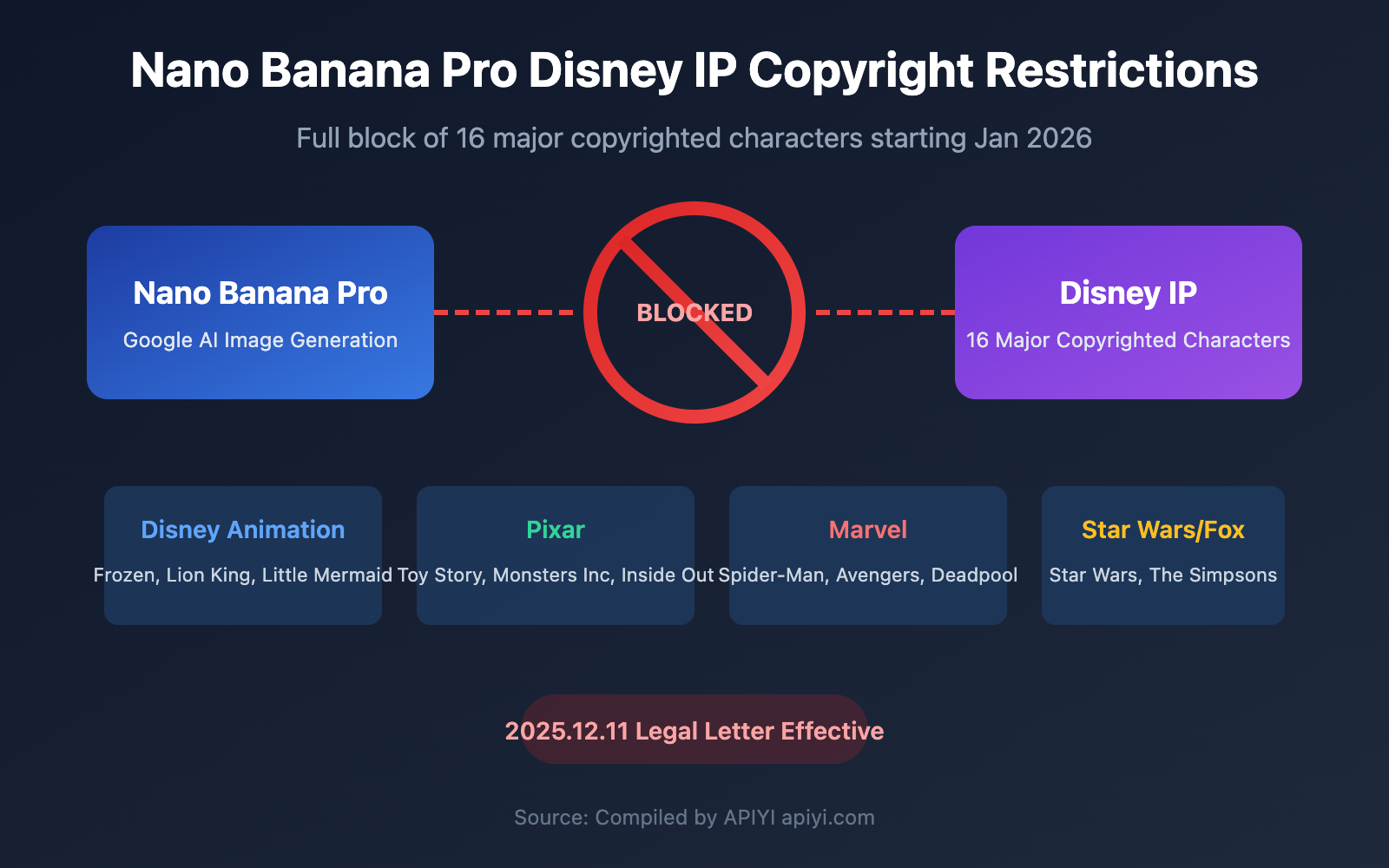
After Disney sent a cease and desist letter to Google in December 2025, Nano Banana Pro has completely blocked the generation of 16 major Disney IP characters. This article dives deep into the technical background, the scope of impact, and strategies for developers.
Core Value: A 5-minute guide to understanding the history of Nano Banana Pro's copyright restrictions and mastering best practices for compliant AI image generation.
Event Background: Disney's Legal Letter Shakes the AI Image Generation Industry
On December 11, 2025, Disney's legal department sent a heavyweight cease and desist letter to Google. This letter directly impacted the content generation strategies of several Google AI products.
Quick Facts
| Item | Details |
|---|---|
| Event Date | December 11, 2025 |
| Originator | Disney Legal Department |
| Recipient | Google Inc. |
| Affected Products | Gemini, Veo, Imagen, Nano Banana Pro, etc. |
| Core Demand | Stop generating Disney copyrighted characters |
| Effective Date | Full implementation starting January 2026 |
Disney's 3 Core Demands
According to public information, Disney outlined specific technical rectification requirements in the letter:
- Immediately stop reproducing and distributing Disney IPs: All AI tools must not output any recognizable Disney copyrighted characters.
- Implement technical measures to prevent infringing outputs: Establish copyright filtering mechanisms at the model level.
- Disclose training data sources: Explain whether Disney copyrighted works were used for model training.
🎯 Technical Background: This event reflects the widespread copyright challenges facing the AI image generation industry. When choosing AI image generation APIs, developers need to fully understand the copyright compliance policies of each platform. The APIYI (apiyi.com) platform provides unified access to various image generation models, making it easy for developers to choose flexibly based on compliance needs.
Nano Banana Pro Copyright Restrictions: 16 Major IPs Blocked
Google implemented a comprehensive copyright protection upgrade for Nano Banana Pro in January 2026. Below is the complete list of blocked IPs and the technical breakdown of the restrictions.
List of 16 Blocked Disney IPs
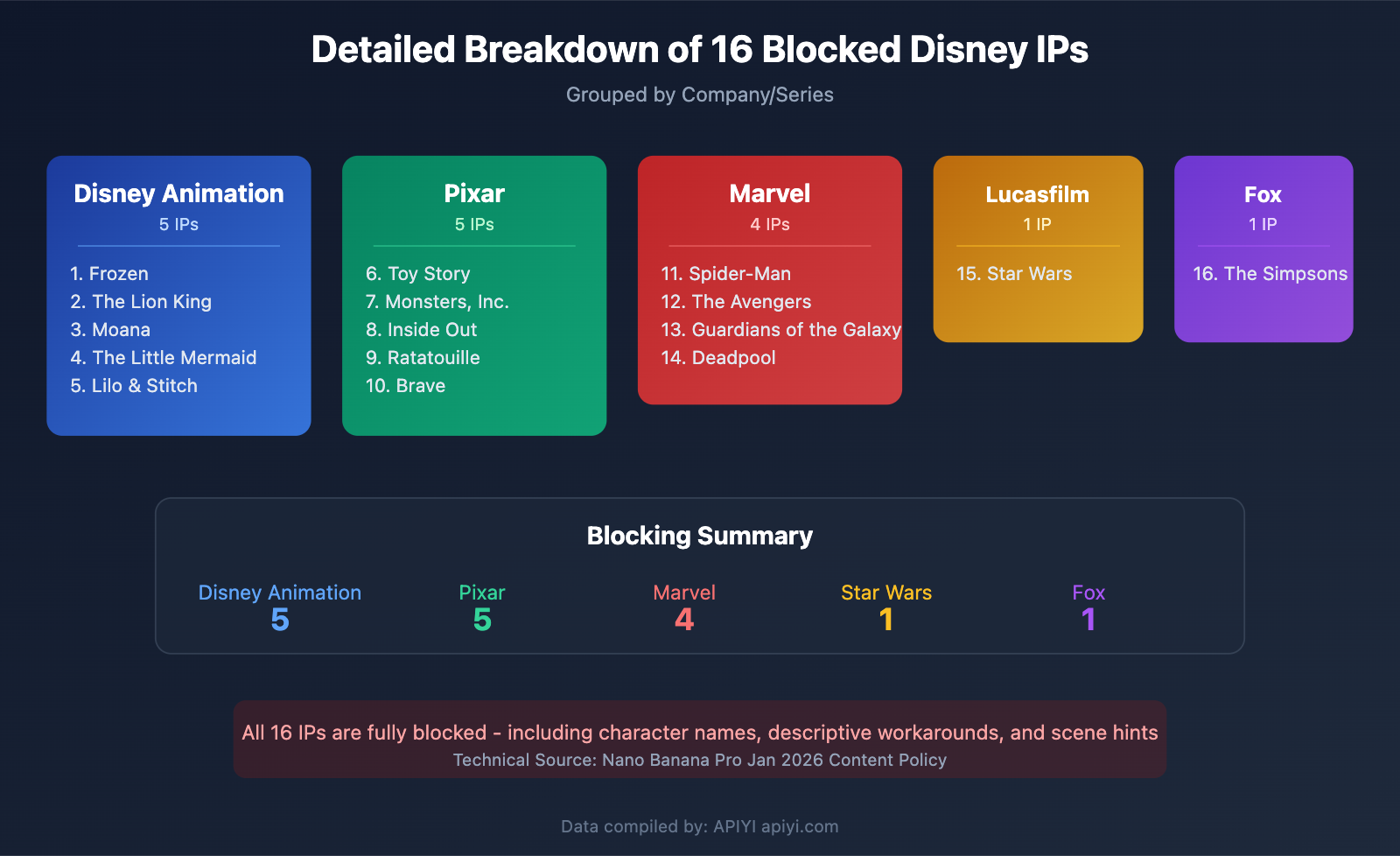
| No. | IP Name | Series/Franchise | Typical Characters | Blocking Level |
|---|---|---|---|---|
| 1 | Frozen | Disney Animation | Elsa, Anna | Fully Blocked |
| 2 | The Lion King | Disney Animation | Simba, Mufasa | Fully Blocked |
| 3 | Moana | Disney Animation | Moana, Maui | Fully Blocked |
| 4 | The Little Mermaid | Disney Animation | Ariel | Fully Blocked |
| 5 | Toy Story | Pixar | Woody, Buzz | Fully Blocked |
| 6 | Monsters, Inc. | Pixar | Sully, Mike | Fully Blocked |
| 7 | Inside Out | Pixar | Joy, Sadness | Fully Blocked |
| 8 | Ratatouille | Pixar | Remy | Fully Blocked |
| 9 | Brave | Pixar | Merida | Fully Blocked |
| 10 | Lilo & Stitch | Disney Animation | Stitch, Lilo | Fully Blocked |
| 11 | Spider-Man | Marvel | Spider-Man | Fully Blocked |
| 12 | The Avengers | Marvel | Iron Man, Thor | Fully Blocked |
| 13 | Guardians of the Galaxy | Marvel | Groot, Rocket | Fully Blocked |
| 14 | Deadpool | Marvel | Deadpool | Fully Blocked |
| 15 | Star Wars | Lucasfilm | Yoda, Darth Vader | Fully Blocked |
| 16 | The Simpsons | Fox | Homer, Bart | Fully Blocked |
How the Blocking Technology Works
Nano Banana Pro's copyright protection mechanism uses a multi-layered filtering strategy:
User Input → Keyword Detection → Semantic Analysis → Image Feature Filtering → Output Review
Layer 1: Keyword Filtering
- Direct detection of character names (e.g., "Elsa", "Spider-Man").
- Detection of title names (e.g., "Frozen").
- Detection of company names (e.g., "Disney", "Marvel").
Layer 2: Semantic Understanding
- Identifying descriptive workarounds (e.g., "Ice Queen", "Princess in a blue dress").
- Detecting scene hints (e.g., "Arendelle Castle").
Layer 3: Output Review
- Feature matching of the generated image.
- Comparison against a database of copyrighted characters.
- Interception if similarity exceeds the defined threshold.
💡 Developer Tip: Understanding these technical mechanisms helps you design compliant application workflows. If you need to test the content policies of different image generation models, you can quickly switch and compare various models via the APIYI (apiyi.com) platform.
Technical Impact Analysis: 3 Major Effects on Developers
The copyright restriction upgrades for Nano Banana Pro have affected different types of developers in various ways.
Impact Analysis Matrix
| Application Type | Impact Level | Impact Details | Difficulty to Address |
|---|---|---|---|
| Fan creation tools | Severe | Core functionality restricted | High |
| Children's education apps | Significant | Popular characters unavailable | Medium |
| Social media tools | Moderate | Some templates no longer work | Medium |
| General creative tools | Minor | Marginal features restricted | Low |
| Enterprise commercial scenarios | Minimal | Already avoided copyrighted IPs | Low |
Direct Impacts on Developers
1. Changes in API Call Responses
After the upgrade, attempting to generate copyrighted characters will trigger a clear error response:
# Example: Calling Nano Banana Pro to generate a copyrighted character
import openai

client = openai.OpenAI(
    api_key="YOUR_API_KEY",
    base_url="https://api.apiyi.com/v1"  # Using APIYI unified interface
)

response = client.images.generate(
    model="nano-banana-pro",
    prompt="Elsa from Frozen",
    size="1024x1024"
)
# Returns: Content policy violation error
# Error: Content policy violation - copyrighted character detected
2. Prompt Engineering No Longer Works
In the past, you could circumvent detection using descriptive language. That's no longer effective:
# The following prompts will all be blocked
blocked_prompts = [
    "a princess with ice powers in a blue dress",  # Frozen allusion
    "a small blue alien creature with big ears",   # Lilo & Stitch allusion
    "a cowboy doll with a sheriff badge",          # Toy Story allusion
]
3. Application Features Need Refactoring
Apps that rely on copyrighted characters will need to redesign their user experience flows.
View the complete error handling code example
import openai
from typing import Optional, Dict, Any

class ImageGenerationHandler:
    """Wrapper class for handling Nano Banana Pro image generation"""

    def __init__(self, api_key: str):
        self.client = openai.OpenAI(
            api_key=api_key,
            base_url="https://api.apiyi.com/v1"  # APIYI unified interface
        )

        # List of known copyrighted keywords (simplified)
        self.copyright_keywords = [
            "elsa", "anna", "frozen", "disney", "marvel",
            "spider-man", "iron man", "star wars", "pixar",
            "simba", "woody", "buzz lightyear", "stitch"
        ]

    def check_prompt_compliance(self, prompt: str) -> Dict[str, Any]:
        """Pre-check if the prompt might trigger copyright restrictions"""
        prompt_lower = prompt.lower()
        violations = []

        for keyword in self.copyright_keywords:
            if keyword in prompt_lower:
                violations.append(keyword)

        return {
            "is_compliant": len(violations) == 0,
            "violations": violations,
            "suggestion": "Please use original character descriptions instead of copyrighted ones"
        }

    def generate_image(
        self,
        prompt: str,
        check_compliance: bool = True
    ) -> Optional[str]:
        """Generate image with copyright pre-check"""

        if check_compliance:
            compliance = self.check_prompt_compliance(prompt)
            if not compliance["is_compliant"]:
                print(f"Warning: Potential copyrighted keywords detected: {compliance['violations']}")
                print(f"Suggestion: {compliance['suggestion']}")
                return None

        try:
            response = self.client.images.generate(
                model="nano-banana-pro",
                prompt=prompt,
                size="1024x1024",
                n=1
            )
            return response.data[0].url
        except openai.BadRequestError as e:
            if "content policy" in str(e).lower():
                print("Content policy block: Please modify your prompt to avoid copyrighted content")
            return None
        except Exception as e:
            print(f"Generation failed: {e}")
            return None

# Usage Example
handler = ImageGenerationHandler("your-api-key")

# Compliant prompt
result = handler.generate_image("a magical ice queen in an original fantasy world")

# Non-compliant prompt (will be blocked by pre-check)
result = handler.generate_image("Elsa from Frozen building an ice castle")
Industry Background: Disney's Dual-Track Strategy
Understanding Disney's overall AI strategy helps you predict where future copyright policies are headed.
Disney's AI Copyright Strategy Timeline
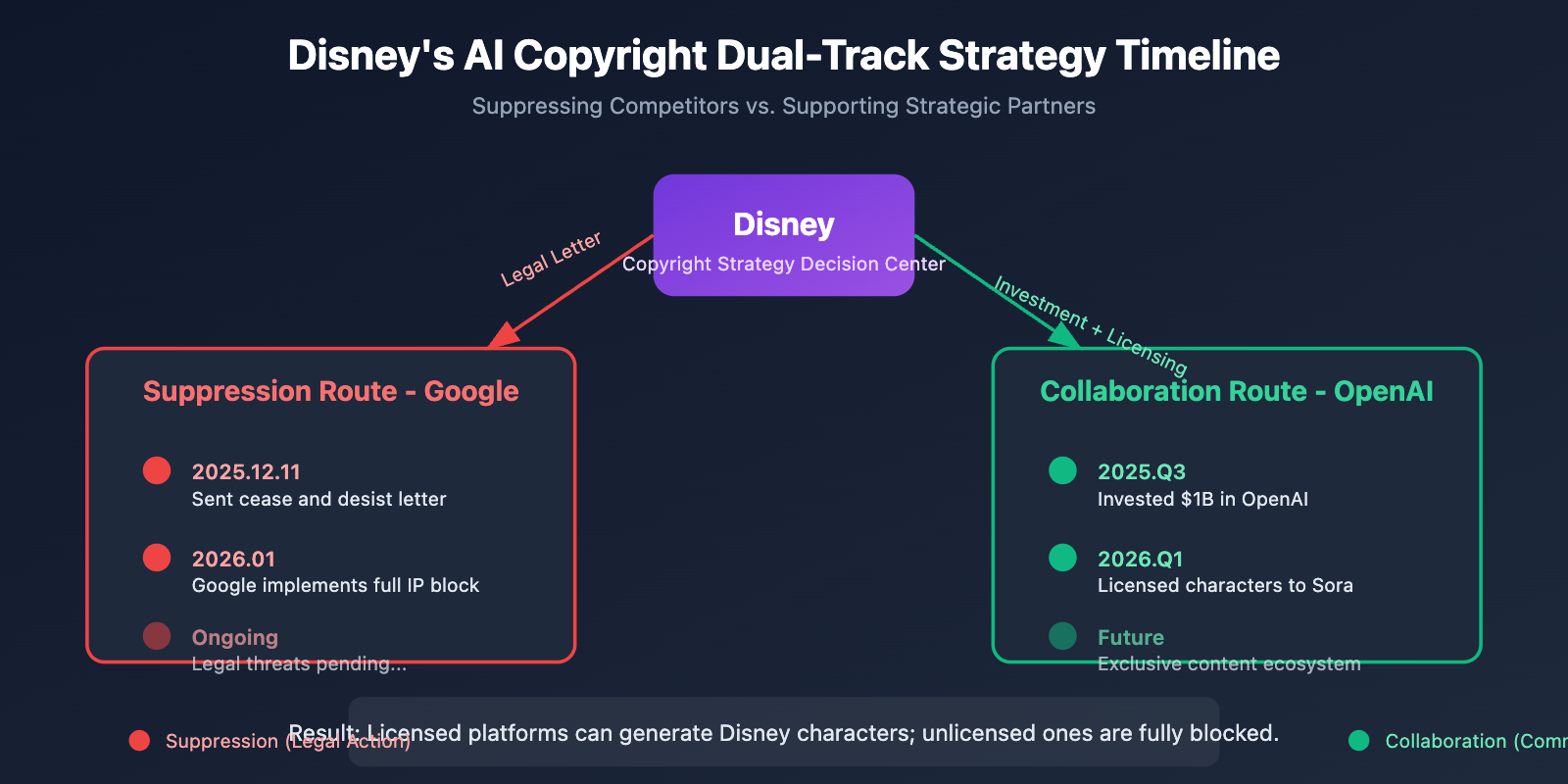
| Time | Event | Impact |
|---|---|---|
| 2025 Q3 | Disney announces $1 billion investment in OpenAI | Strategic partnership signal |
| Dec 11, 2025 | Cease and desist letter sent to Google | Competitor suppression |
| Jan 2026 | Google implements full IP block | Nano Banana Pro restricted |
| 2026 Q1 (Est.) | Disney licenses characters to Sora | Exclusive partnership launch |
Interpreting the Dual-Track Strategy
Disney's approach reflects a clear business logic:
- Suppressing Competitors: Using legal means to restrict unlicensed platforms from using its IP.
- Supporting Strategic Partners: Opening licensing to OpenAI to build an exclusive competitive advantage.
- New Channels for Copyright Monetization: Treating AI generation rights as a new source of licensing revenue.
This means we might see a future where "licensed platforms can generate Disney characters, while unlicensed ones are completely blocked."
🎯 Industry Trend: The collaboration model between copyright holders and AI platforms is being reshaped. As a developer, choosing a compliant and stable API service platform is crucial. APIYI (apiyi.com) continuously tracks policy changes across various models to provide developers with timely compliance guidance.
Developer Response: 5 Alternative Strategies
When dealing with Nano Banana Pro's copyright restrictions, you've got a few different strategies to choose from.
Strategy 1: Use Original Character Designs
Best for: Brand building and long-term app operations.
Instead of relying on copyrighted characters, invest in original IP design:
# 原创角色提示词示例
original_prompts = [
    "a young ice sorceress with silver hair and crystal blue cape, original design",
    "a friendly purple alien pet with antenna, cute cartoon style, original character",
    "a brave princess warrior with red curly hair, celtic inspired armor, unique design"
]
Pros: No copyright risk, commercially viable, and helps build a unique brand.
Cons: Lack of initial user recognition.
Strategy 2: Use Open Source/Public Domain Characters
Best for: Projects that need classic characters but have a limited budget.
Many classic characters have already entered the public domain:
| Character Type | Example | Copyright Status |
|---|---|---|
| Fairy Tale Characters | Snow White (Original), Cinderella (Original) | Public Domain |
| Mythological Characters | Zeus, Athena, Sun Wukong | Public Domain |
| Literary Characters | Sherlock Holmes, Romeo and Juliet | Public Domain |
| Historical Figures | Napoleon, Cleopatra | Public Domain |
Note: Disney's versions of these characters are still protected, so you'll need to use descriptions based on the original source material.
Strategy 3: Switch to Licensed Platforms
Best for: Commercial projects that absolutely must use copyrighted characters.
In the future, platforms like Sora might obtain Disney licenses. If that happens, you can consider migrating:
# 预留平台切换能力的代码架构
class ImageGeneratorFactory:
    """图像生成器工厂,支持多平台切换"""

    @staticmethod
    def get_generator(platform: str, api_key: str):
        platforms = {
            "nano-banana-pro": "https://api.apiyi.com/v1",
            "sora": "https://api.apiyi.com/v1",  # 统一通过 APIYI 接入
            "flux-pro": "https://api.apiyi.com/v1",
        }
        base_url = platforms.get(platform)
        return openai.OpenAI(api_key=api_key, base_url=base_url)
Strategy 4: Use Style Imitation Instead of Character Replication
Best for: When you want a specific visual style but don't need a specific character.
# 风格模仿提示词 (合规)
style_prompts = [
    "a princess portrait in Disney Renaissance animation style, original character",
    "a space adventure scene in Pixar 3D animation style, unique characters",
    "a superhero in comic book art style, original hero design"
]
Key Takeaway: Imitating an art style generally doesn't constitute copyright infringement, but replicating a specific character does.
Strategy 5: Build a Content Moderation Mechanism
Best for: UGC platforms and creative tools.
class ContentModerationPipeline:
    """用户生成内容的版权审核流水线"""

    def __init__(self):
        self.blocked_terms = self._load_copyright_database()

    def moderate(self, user_prompt: str) -> dict:
        """审核用户输入"""
        risk_level = self._assess_risk(user_prompt)

        if risk_level == "high":
            return {
                "action": "block",
                "message": "检测到版权角色,请使用原创描述",
                "suggestions": self._get_alternatives(user_prompt)
            }
        elif risk_level == "medium":
            return {
                "action": "warn",
                "message": "内容可能涉及版权,建议修改",
                "proceed": True
            }
        else:
            return {"action": "allow", "proceed": True}
💰 Cost Optimization: Building a robust content moderation system requires calling multiple APIs. By using the APIYI (apiyi.com) platform to manage your Large Language Model calls, you can significantly reduce integration costs and maintenance complexity.
FAQ
Q1: Is Nano Banana Pro blocking Disney characters permanently?
It looks like a long-term strategy. Unless Google reaches a licensing deal with Disney, this restriction is here to stay. You should treat this as a permanent change when adjusting your product strategy. To stay updated on policy shifts, keep an eye on the model update announcements on the APIYI (apiyi.com) platform.
Q2: Can I use descriptive language to bypass the restrictions?
No. The new content filtering system uses semantic understanding technology that can identify descriptive workarounds. For example, "ice magic princess" will likely still be blocked. We recommend sticking to original character designs—it's a much more sustainable business strategy.
Q3: Do other image generation models have similar restrictions?
Most mainstream models have copyright restrictions, though the strictness varies. You can use the APIYI (apiyi.com) platform to test and compare the content policies of different models like Flux Pro and DALL-E 3 to find the best fit for your needs.
Q4: Can I still use copyrighted images I’ve already generated?
From a legal standpoint, using AI-generated images of copyrighted characters carries infringement risks, especially for commercial use. It's a good idea to audit your existing asset library and replace any high-risk content.
Q5: How do I know if a character is protected by copyright?
A general rule of thumb: works created before 1928 are mostly in the public domain. Modern characters owned by big companies like Disney, Marvel, and DC are almost certainly protected. Specific adaptations (like Disney's version of Snow White) are protected separately. When in doubt, original designs are always the safest bet.
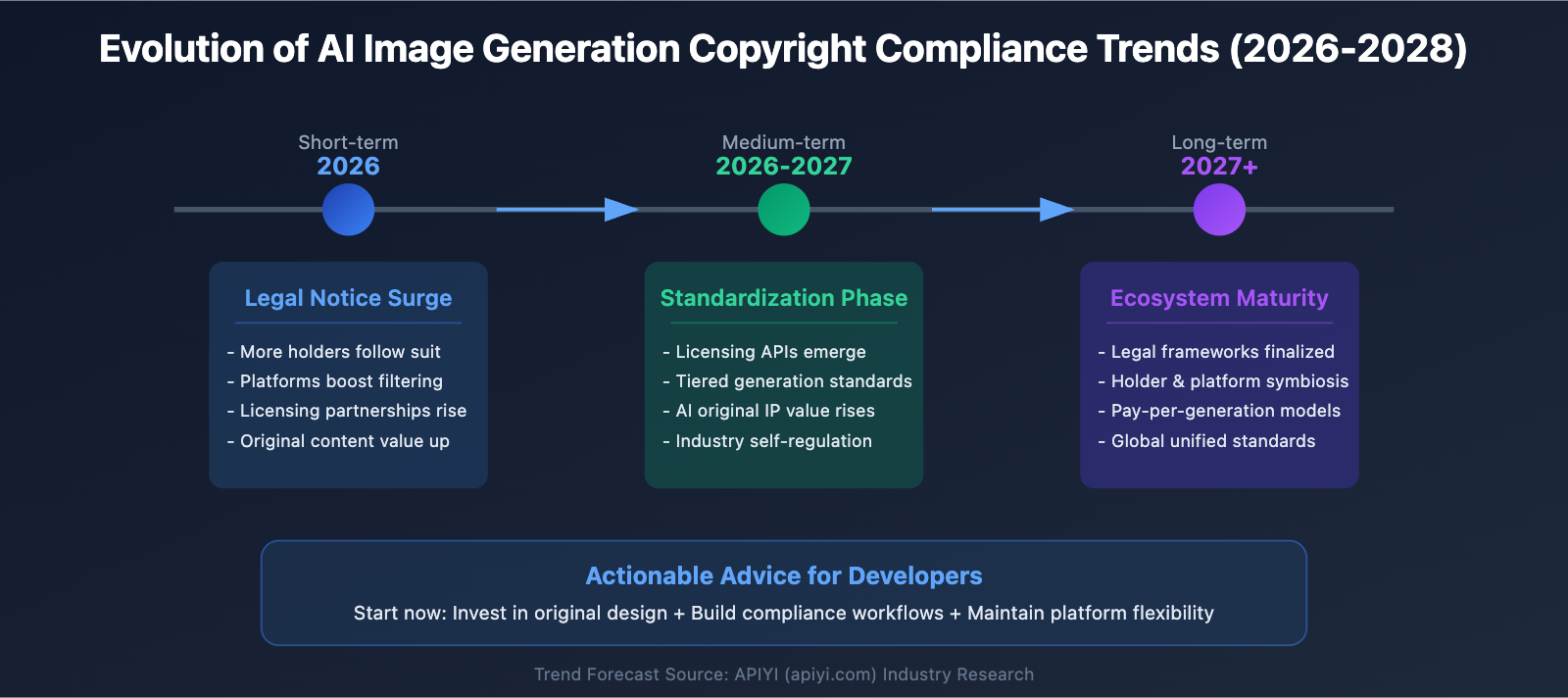
Future Outlook: Copyright Compliance Trends in AI Image Generation
Short-term Trends (2026)
- More copyright holders will follow Disney's lead in issuing cease-and-desist letters.
- AI platforms will generally strengthen their copyright filtering mechanisms.
- Licensed partnership models will become the mainstream approach.
Medium-term Trends (2026-2027)
- Copyright licensing APIs are likely to emerge.
- Tiered content generation will become an industry standard.
- The value of original AI character IPs will continue to rise.
Long-term Trends (Post-2027)
- Legal frameworks for AI-generated content copyright will reach maturity.
- Copyright holders and AI platforms will form a stable, symbiotic ecosystem.
- New licensing models (such as pay-per-generation) will be established.
Summary: Core Recommendations for Compliant AI Image Generation
Nano Banana Pro's decision to block Disney IPs is a landmark event for copyright compliance in the AI image generation industry. As a developer, you'll need to:
- Face the facts: Copyright restrictions are a long-term trend, not a temporary adjustment.
- Invest in originality: Build your own IP assets to reduce dependency on third-party copyrights.
- Stay flexible: Design your architecture to support seamless switching between multiple platforms.
- Keep an eye on the landscape: Track the progress of licensing partnerships to seize new opportunities early.
- Compliance first: Bake copyright compliance into the core of your product design.
We recommend using the APIYI (apiyi.com) platform to centrally manage multi-model API calls, allowing you to maximize AI image generation capabilities within a compliant framework.
Related Reading:
- Full Guide to Nano Banana Pro API Calls
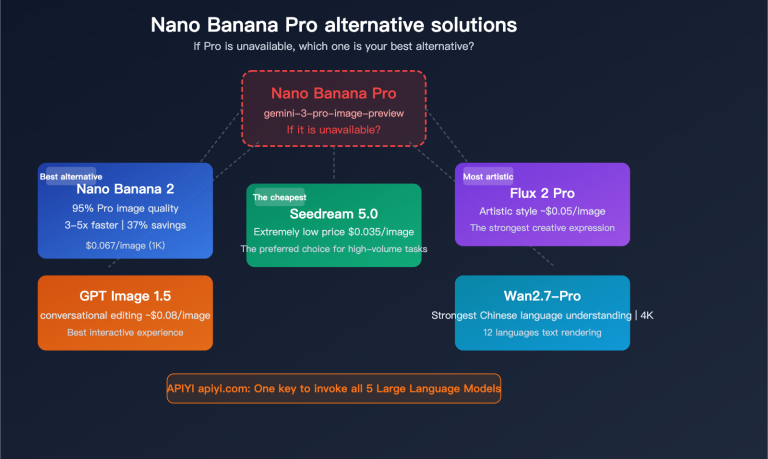
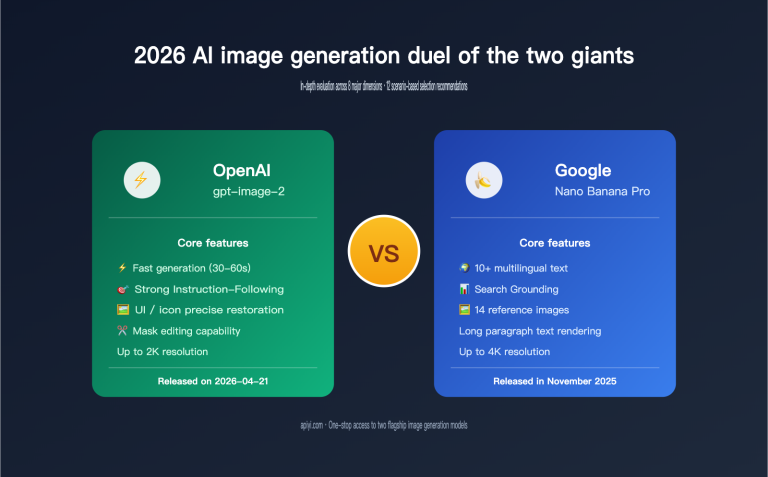
- AI Image Generation Model Comparison: Flux Pro vs DALL-E 3 vs Nano Banana Pro
- 2026 AI Content Generation Compliance Guide
📝 Author: APIYI Technical Team
If you're looking to test various image generation models, feel free to visit APIYI (apiyi.com) for free test credits and experience the convenience of a unified API interface.
References:
- Disney Official News: thewaltdisneycompany.com/news
- Google AI Product Policy Updates: ai.google/policies
- US Copyright Office AI-Generated Content Guidelines: copyright.gov/ai