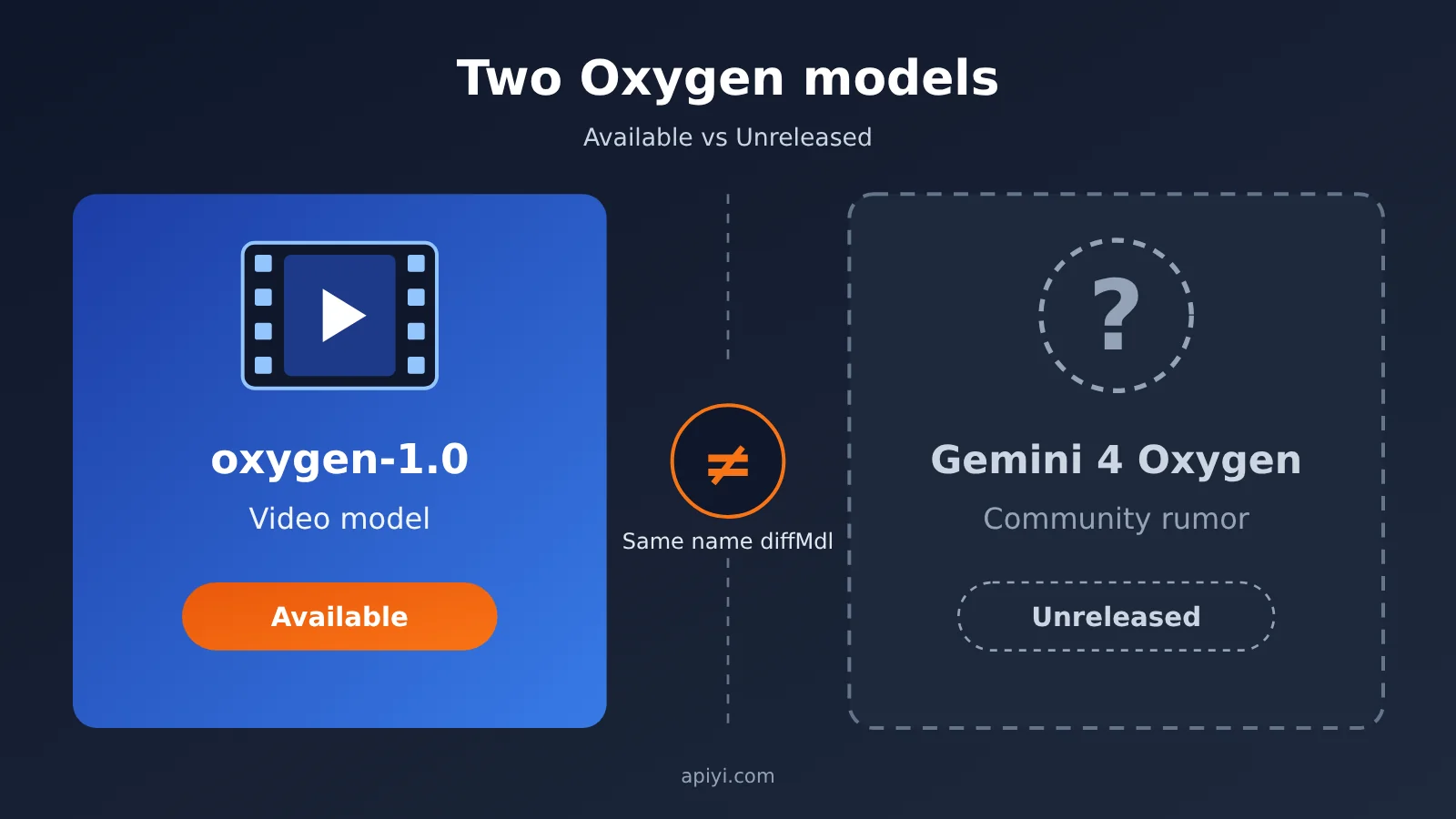
Lately, a lot of developers see “Gemini 4 Oxygen” and immediately want to call an API. They search the model marketplace, and sure enough, something called oxygen shows up. Let’s get the conclusion out of the way: these two Oxygens are not the same model. The callable oxygen-1.0 is AZ8’s video generation model, billed by the second, and only available through the videos endpoint. As of 2026-11-23, Google’s Gemini 4 Oxygen has not been released — there’s no model ID and no price line.
This isn’t another release-date guessing game. This article answers only two questions: what you can actually call today, and how to verify a new model rumor yourself in five minutes next time one comes along. All APIYI (apiyi.com) pricing data mentioned here comes from the platform’s master pricing table. Information from Google’s side comes from official pages, and third-party claims are labeled with their sources.
Core value: After reading this, you’ll be able to tell same-named models apart, know which Gemini 4 models you can buy today, and have a four-step verification method you can follow to decide whether a new model belongs in your technical plan.
Oxygen Key Takeaways: How Two Models With the Same Name Differ
Let’s put the two Oxygen models side by side. The easiest mistake is to search the model marketplace, find oxygen-1.0, and assume Google’s new model is already listed.
| Comparison | oxygen-1.0 (callable) | Gemini 4 Oxygen (rumored) |
|---|---|---|
| Provider | AZ8 (Singapore-based AI video platform, formerly Videoinu) | A name used in social media posts; no official Google wording |
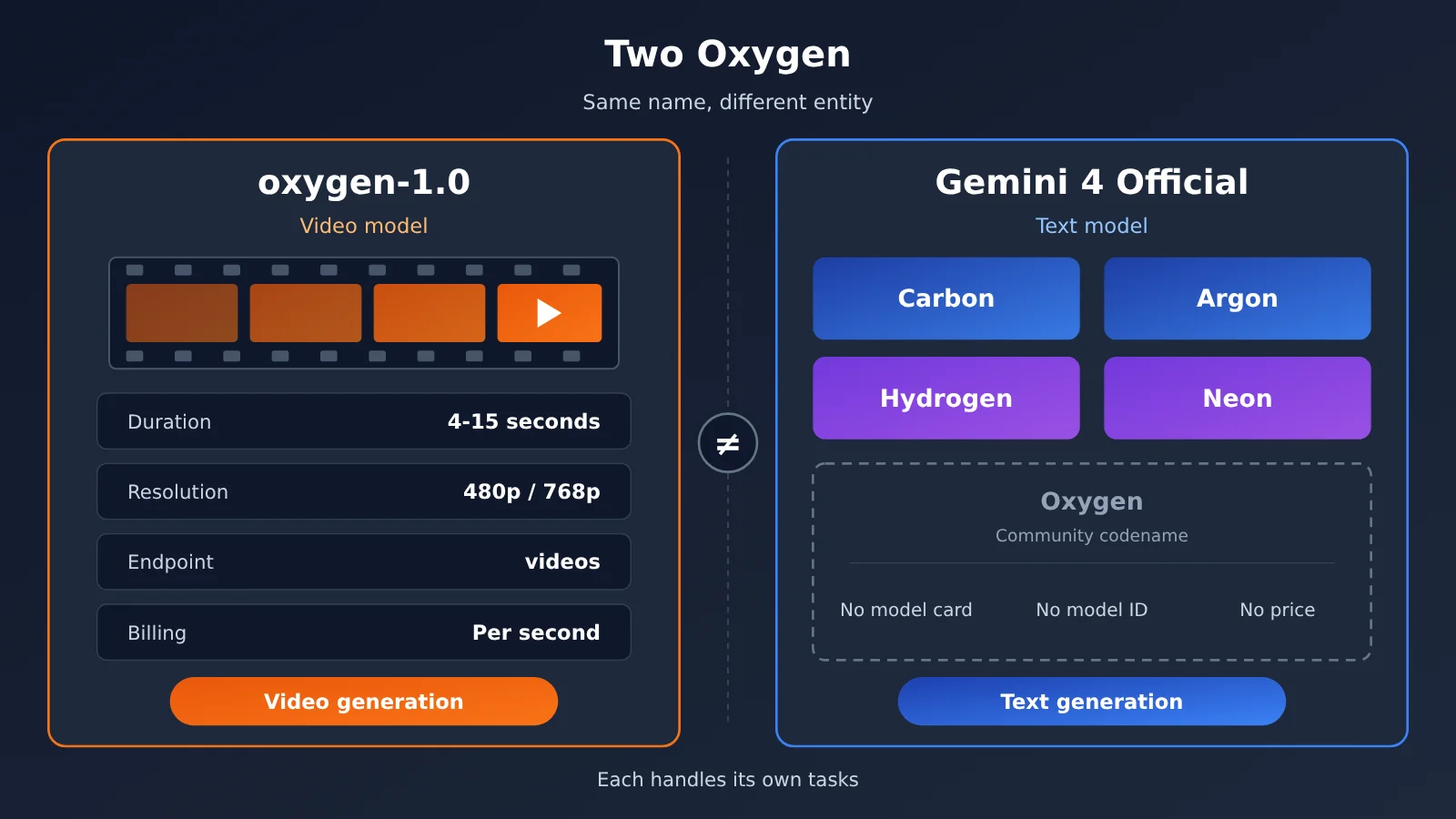
| Model type | Video generation, billed per second | Rumored to be a Flash-tier text model; no official confirmation |
| Model ID | oxygen-1.0 |
None; there’s no official gemini-4-oxygen |
| Endpoint | Videos only; no chat or gemini endpoint | None |
| Price | $0.02 per second, no resolution tiers | No price row |
| Can it be included in a proposal? | Yes, as a video generation option | No, only as a rumor |
What Is the Oxygen Video Model oxygen-1.0?
According to APIYI documentation, Oxygen is a video generation model provided by AZ8, and its model ID on the platform is oxygen-1.0. It uses the OpenAI Videos-compatible interface: submit a task with POST /v1/videos, then check the result with GET /v1/videos/{id}. Each video is 4 to 15 seconds long, resolution can be 480p or 768p, and the finished video includes its own audio track.
In the master model table, its type is “Video / Per Second,” and its only endpoint is videos. That alone tells you it’s not the same thing as any Gemini 4 text model. Text models show up under the chat endpoint; video models don’t.
Where Does the Rumored Gemini 4 Oxygen Come From?
The origin of this name can be traced fairly clearly, and everything below is third-party claims:
- pasqualepillitteri.it (2026-11-14): The post appeared at 7:04 UTC and had more than 760 likes. The author said some Arena users were being routed to a new Flash-tier checkpoint, and “Oxygen” was a name he came up with himself. The video only showed the answers, not which model wrote them. Two days earlier, another group of people called the same batch of outputs tagged gemini-4-hydrogen “Krypton.”
- AGTP’s X post (2026-11-15): It said it had “just leaked,” guessed it was a Flash tier that was faster and cheaper, and admitted Google had no official statement.
- ofox verification page (2026-11-19): As of that day, none of Google’s announcements, model cards, pricing pages, changelogs, or deprecation tables listed a model called Oxygen. The account that first called those outputs Krypton later changed its story and said they were Gemini 4 Hydrogen with higher reasoning effort.
- kie.ai old page (2026-07-16): Called it the “Element-8 codename.” The page is dated before the event, and the claim has no official source, so it’s only secondhand background.
In other words, “Gemini 4 Oxygen” is a community-assigned name pointing to a batch of Arena outputs of unknown origin. Even the community’s own story about which model those outputs came from keeps changing.
Gemini 4 Official Models Key Points: Which Ones You Can Buy Today
Google publicly offers only four Gemini 4 models. Based on the ai.google.dev model page reviewed on 2026-11-23, the Gemini 4 cards cover just Carbon, Neon, Hydrogen, and Argon — four cards, no Oxygen. Among them, Gemini 4 Neon is the text model released on 2026-11-18.
Google Cloud Docs agrees too: the 4-oxygen path returns 404, while the 4-neon path resolves normally, with the 2026-11-20 developer guide and the 2026-11-18 model card both present. The third-party verification page OmniaKey also noted on 2026-11-16 that at the time, the AI Studio model list had only three cards — Carbon, Argon, and Hydrogen (Neon didn’t ship until 11-18) — and likewise no gemini-4-oxygen.
Below are the Gemini 4 family prices on APIYI, pulled from the platform master table (2026-11-22 09:58 UTC+8), in USD per million tokens:
| Model ID | Input | Output | Cache Read | Notes |
|---|---|---|---|---|
gemini-4-hydrogen |
1.5 | 7.5 | 0.075 | Lowest unit price among the four |
gemini-4-argon |
2 | 10 | 0.1 | Endpoints: chat, gemini |
gemini-4-carbon |
2 | 10 | 0.1 | Endpoints per master table |
gemini-4-neon |
3 | 15 | 0.15 | Released 2026-11-18 |
gemini-4-oxygen |
— | — | — | Not present in the pricing API |
When comparison shopping, the easiest thing to do is check APIYI’s (apiyi.com) pricing API. There’s no gemini-4-oxygen row in the table, and the master table has no other text model with that same name. The Gemini 4 models you can put into a plan today are the four above — as for which one to pick, I’d suggest running your own business samples through each one before deciding.
💡 Selection tip: The same API key can call all four Gemini 4 models and
oxygen-1.0at once — text goes through the chat endpoint, video goes through the videos endpoint. When running comparison tests on APIYI, switching models only requires changing themodelfield — no need to integrate separately for each provider.
The Four-Step New Model Verification Method: Follow It and You’ll Know
Next time you see a claim like “XX just leaked” or “XX is already usable,” you can run it through the four steps below. Only when all four steps check out can it go into a proposal; if any step is missing, it can only be written up as a rumor.
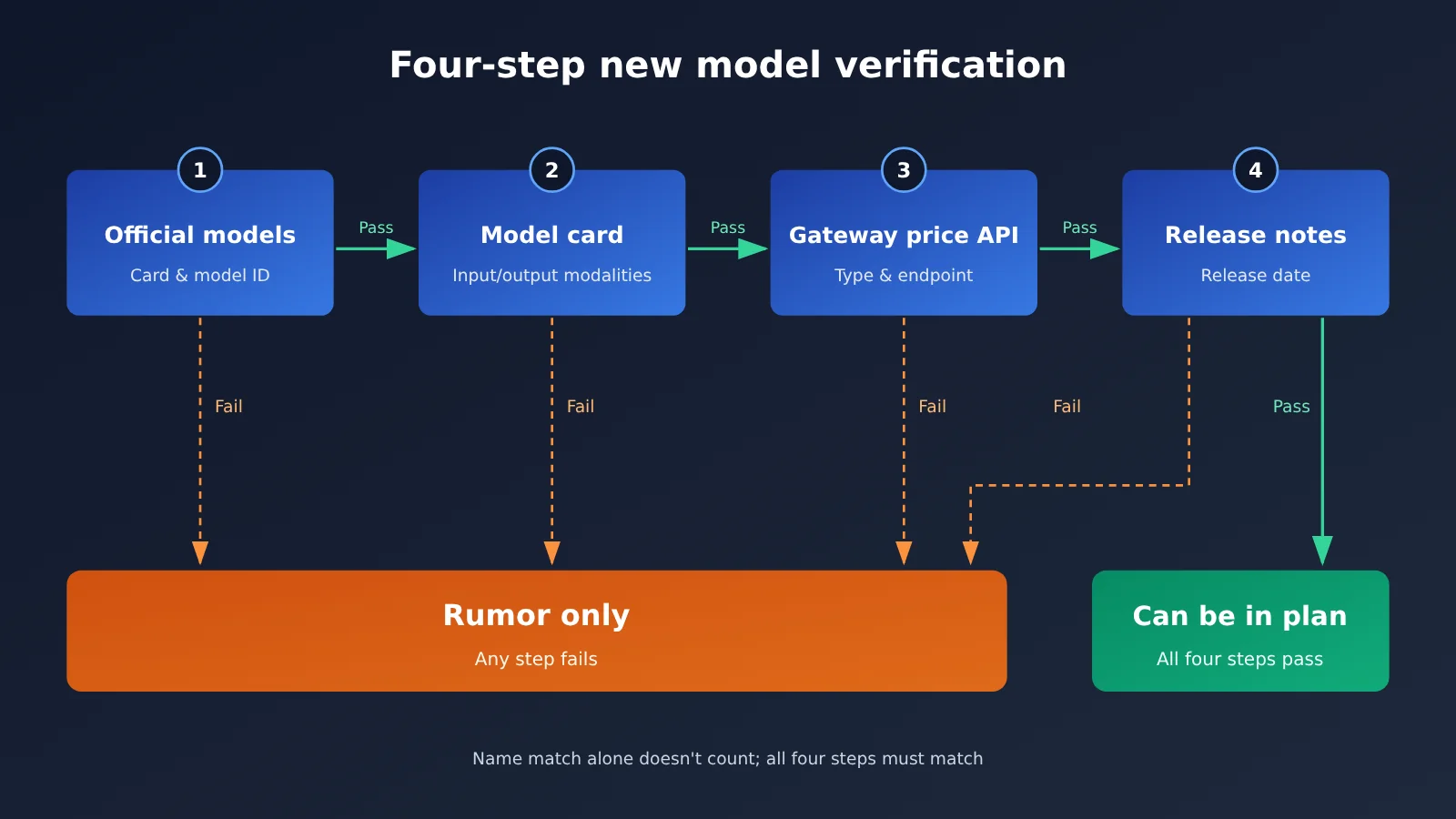
| Step | Which page to check | Which row to check | Result of checking with Oxygen |
|---|---|---|---|
| 1. Check the official model list | Google Gemini API models page | Card names and model IDs under the Gemini 4 group | Only Carbon, Neon, Hydrogen, and Argon; no Oxygen |
| 2. Check the model card | Model card or developer guide | Input/output modalities, context, supported capabilities | The 4-oxygen path returns 404, and there is no model card |
| 3. Check the pricing API | Gateway pricing API or model summary table | Type and endpoint on the model ID row | No gemini-4-oxygen; only the video-type oxygen-1.0 |
| 4. Check the release notes | Official blog or changelog | Release date and announcement title | No announcement at all |
Step 1: Find the card and model ID in the official model list
Open ai.google.dev/gemini-api/docs/models, find the Gemini 4 group, and look through the card names one by one. A model that has actually been released will always have a card, and the card will show the model ID you can put straight into a request. Oxygen already fails at this step.
Step 2: Check the inputs and outputs on the model card
On the model card or developer guide, focus on three lines: input modalities, output modalities, and context length. This step prevents another kind of misunderstanding: being able to see images doesn’t mean being able to generate images, and being able to read video doesn’t mean being able to generate video. If the path returns a 404 outright, as 4-oxygen does, that means the official docs don’t exist.
Step 3: Find the callable row in the gateway pricing API
Open APIYI’s pricing API at https://api.apiyi.com/api/pricing and search by model ID. Once you find it, don’t rush to use it—check the type and endpoint on that row first. The type of oxygen-1.0 is “video / per second,” and its only endpoint is videos, so it won’t show up in chat, and it can’t be Gemini 4’s text model. A matching name isn’t enough—the type and endpoint have to match too.
Step 4: Go back to the official blog or changelog for the release date
Finally, go back to the official blog or changelog and look for this model’s release announcement. At this step, you can find a record for Gemini 4 Neon dated 2026-11-18; you can’t find one for Oxygen. If there’s no announcement, all you have are community screenshots, so you can only write it up as a rumor, not as a released fact.
oxygen-1.0 Video Model Quick Start
Now that we’ve confirmed we’re using a video model, here are the key integration points for oxygen-1.0. Everything goes through the OpenAI Videos compatible protocol, with the endpoint uniformly set to https://api.apiyi.com/v1.
oxygen-1.0 Spec Quick Reference
| Item | Parameter |
|---|---|
| Model ID | oxygen-1.0 |
| Submit task | POST /v1/videos |
| Query result | GET /v1/videos/{id} |
| Duration | 4 to 15 seconds |
| Resolution | 480p / 768p |
| Billing | $0.02 per second, regardless of resolution; failed tasks are automatically refunded |
| Generation modes | Text-to-video, first frame, first and last frame, reference generation |
| Reference material limits | Up to 9 reference images, 3 reference videos, 3 reference audio clips |
| Audio | The finished video comes with its own audio track |
At $0.02 per second, a 4-second video costs $0.08, and a 15-second one costs $0.30. Since 480p and 768p are priced the same, you only need to count seconds when estimating your budget.
The Simplest Invocation Flow
The whole process takes three steps and uses an asynchronous task model:
- Configure the client: Set base_url to
https://api.apiyi.com/v1and includeAuthorization: Bearer YOUR_API_KEYin the request headers. If you’re using the OpenAI SDK, that means writingbase_url="https://api.apiyi.com/v1"during initialization. - Submit the task: Send a request to
POST /v1/videos, setmodeltooxygen-1.0, and put your scene description inprompt. For the exact way to write the duration and resolution fields, refer to the APIYI documentation. The endpoint returns a taskid. - Poll for the result: Use that
idto callGET /v1/videos/{id}, check the task status, and retrieve the video once it’s done. Failed tasks are automatically refunded—no manual request needed.
A Pitfall with Advanced Parameters
Advanced parameters like the first frame, first and last frames, reference images, reference videos, and reference audio need to go inside the input_reference JSON envelope. If you put them directly at the top level of the request, they’ll be silently dropped—the endpoint won’t return an error, but your generated result won’t use your materials. When debugging “the reference image isn’t taking effect,” check this first.
Also, pay attention to the endpoint: oxygen-1.0 only has a videos endpoint, so trying to call the chat interface with it won’t work. Conversely, the four Gemini 4 text models won’t show up on the videos endpoint either.
🚀 Quick Start: New users get free trial credits after registering at APIYI apiyi.com. Start with a short 4-second, 480p video to get the submission and polling flow working, and confirm your
input_referencesyntax is correct—then loosen the duration and resolution.
Frequently Asked Questions (FAQ)
Q1: What exactly does “Oxygen” refer to?
Right now it points to two different things. The one you can actually call is AZ8’s video generation model `oxygen-1.0`; the other is “Gemini 4 Oxygen” from social media, a nickname the community gave to a batch of Arena outputs—Google never released a model by that name.
Q2: Is oxygen-1.0 related to Gemini 4 in any way?
No. `oxygen-1.0` is provided by AZ8, its type is “video / per second,” and its only endpoint is videos; Gemini 4 is Google’s family of text models, served through chat and other endpoints. The two just happen to have colliding names.
Q3: Which Gemini 4 models has Google actually released publicly?
As of 2026-11-23, the official model page lists only four: Carbon, Argon, Hydrogen, and Neon, with Neon being a text model released on 2026-11-18. There’s no model ID, pricing row, or release note for `gemini-4-oxygen` in the official docs.
Q4: Can community screenshots count as evidence that a model has been released?
No. According to pasqualepillitteri.it, the videos in question only show the answers, not which model wrote them; the same batch of outputs was also called Krypton and then Hydrogen. At best, a screenshot shows that “someone saw some kind of output.” If you want to put it into a proposal, it still has to go through all four verification steps.
Q5: How do I quickly call oxygen-1.0 or the four Gemini 4 models?
Sign up at APIYI apiyi.com, grab an API key, and set base_url to `https://api.apiyi.com/v1`. For video, submit an `oxygen-1.0` job with `POST /v1/videos`; for text, just swap the `model` field in the chat endpoint for the corresponding Gemini 4 model ID. New users can use their free credits to get the flow working end to end first.
Q6: What are the limitations of oxygen-1.0?
A single clip can only be between 4 and 15 seconds, resolution tops out at 768p, and anything longer has to be generated in segments and stitched together yourself. Advanced parameters must go inside `input_reference`; anything at the top level gets silently dropped. It only does video generation—you can’t use it as a text model.
Q7: I found a model with the same name in the pricing API—how do I tell whether it’s the one I want?
Look at the type and endpoint in that row. In APIYI apiyi.com’s pricing API, `oxygen-1.0` is listed as video, per-second, videos endpoint—completely different from the token-based billing and chat endpoint used by Gemini 4 text models. Only when the model ID, type, and endpoint all match are you looking at the same model.
Oxygen vs. Gemini 4: Key Takeaways
- Same name doesn’t mean same model: the
oxygen-1.0you can actually call is an AZ8 video model, not Google’s text model. oxygen-1.0specs: 4 to 15 seconds, 480p/768p, $0.02 per second, automatic refund if generation fails.- Gemini 4 officially ships only four models: Carbon, Argon, Hydrogen, and Neon — no Oxygen.
- The rumor is traceable: the name was coined by a community writer, and the claims about what actually produced the output keep contradicting themselves.
- A four-step verification method: check the model list, the model card, the pricing endpoint, and the release notes — all four have to line up before you count something as real.
- Put advanced parameters in the right place: write them into
input_reference; top-level parameters get silently dropped.
Summary
The whole Oxygen story comes down to three points:
- What you can actually call is a video model:
oxygen-1.0is provided by AZ8, runs on an OpenAI Videos–compatible endpoint, and bills by the second. - Google’s version was never released: the only publicly available Gemini 4 models are Carbon, Argon, Hydrogen, and Neon, and
gemini-4-oxygenshows up in none of the official pages, model cards, or pricing endpoints. - Verification beats guesswork: work through the model list, model card, pricing endpoint, and release notes before deciding whether something belongs in your proposal.
If you need short video generation, you can integrate oxygen-1.0 right now; if you need text reasoning, pick from the four Gemini 4 models on offer. We recommend testing both on APIYI (apiyi.com) with the same key, then comparing quality and cost on real samples before you settle on a model.
📚 References
-
Gemini API Model List: Google’s official model page
- Link:
ai.google.dev/gemini-api/docs/models - Note: Step one of verification — check the Gemini 4 card and model ID
- Link:
-
Google Cloud Docs: Gemini 4 model card and developer guide
- Link:
docs.cloud.google.com - Note: Step two of verification — check input/output modalities and capabilities; the
4-oxygenpath currently returns a 404
- Link:
-
pasqualepillitteri.it: “Gemini 4 Oxygen” name-origin article (2026-11-14)
- Link:
pasqualepillitteri.it - Note: A third-party claim that documents where the name came from and the situation with the Arena routing
- Link:
-
ofox verification page: Checking the official Oxygen info (2026-11-19)
- Link:
ofox.ai - Note: A third-party cross-check showing that none of Google’s official pages list Oxygen
- Link:
Author: APIYI Technical Team
Technical support: If you hit any issues during model integration or verification, feel free to reach out to us through the APIYI homepage.