Author’s note: After the news that Claude was involved in a Riemann Hypothesis proof flooded every feed, the easiest thing to get wrong wasn’t the math — it was how far the verification had actually gotten. This article breaks down the facts across three layers of verification and gives a cost reference for long-running research tasks.
On November 20, 2026, Anthropic mathematician Levent Alpöge published a four-page note on his personal website. His exact words: “I believe that, in collaboration with Claude, I have discovered a proof of the Riemann Hypothesis.” There’s no traditional paper behind the proof — instead, it’s a complete Lean formalized proof, and the Lean and Mathlib communities subsequently issued a joint statement endorsing it. The New York Times, Scientific American, Science, and phys.org all ran stories that day, with wording that consistently emphasized “claims” and “has not yet completed peer review.”
This isn’t a rumor, but it’s also not the academic community’s final verdict. The proof files, the community statement, and statements from independent compilers all have public sources; but journal publication and “generally accepted after two years” haven’t happened yet. Add in the October 5 preprint on 3SUM/APSP where Claude discovered the core algorithm, and this year’s two big AI-research events are actually sitting at completely different verification stages.
The core value here: After reading this, you’ll be able to tell exactly which layer the Claude Riemann Hypothesis proof has been verified to, get a rough sense of how many tokens a long-running research task burns, and know which claims can’t go into a paper or an external report.
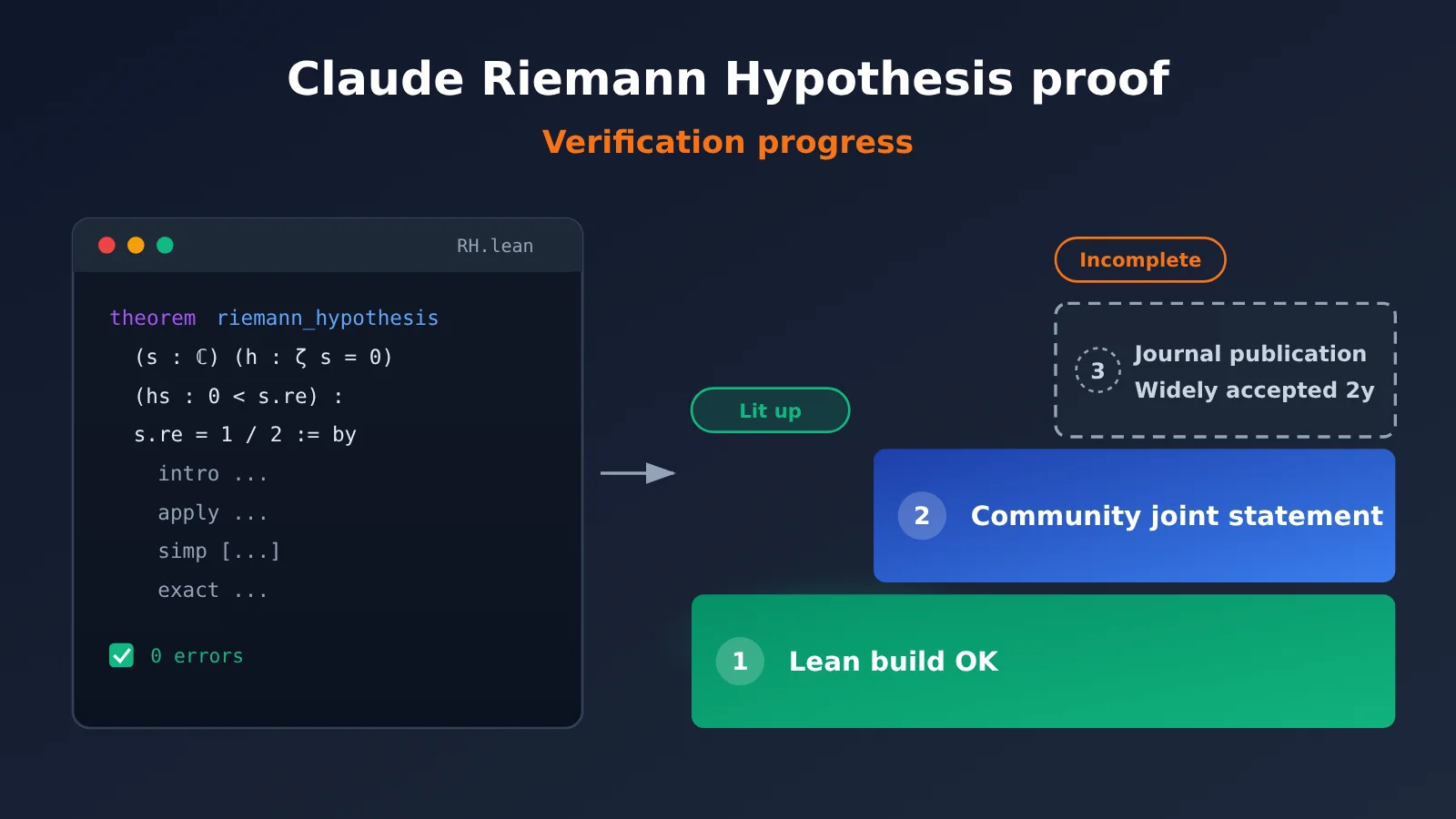
Claude’s Riemann Hypothesis Proof: Key Facts at a Glance
Let’s start by putting the publicly verifiable facts into one table. The table distinguishes author self-reports, community claims, and media reports, so we don’t mix up different sources.
| Item | Details | Source type |
|---|---|---|
| Release date | 2026-11-20; the four-page note was published on Alpöge’s personal website | Author self-report |
| Released by | Levent Alpöge (Anthropic mathematician), in collaboration with Claude | Author self-report |
| Scope | The Riemann Hypothesis, plus the generalized Riemann Hypothesis for Dirichlet L-functions | University of Waterloo Rubinstein verification page |
| Proof format | Fully formalized in Lean, with 175,187 files and about 17 million lines | Rubinstein verification page |
| Community response | The Lean and Mathlib communities issued a joint statement “certifying” that both the statement and proof are correct | Community statement, first reported by Scientific American |
| Independent compilation | Andrew Sutherland of MIT and others compiled it successfully, saying the probability of an issue is “roughly zero” | Media roundup (MLQ.ai) |
| Still pending | At the time, the alignment check between the formal statement and the original Riemann Hypothesis was still underway; no journal peer review yet | Media roundup |
A Few Key Details About Claude’s Riemann Hypothesis Proof
The most distinctive part of this release is that there’s no paper. Rubinstein separately put together a 164-page explanatory draft, marked as a working draft dated 2026-11-21, written with Claude, Codex, and Gemini as a guided introduction. This guide helps human readers understand the proof structure, but it isn’t itself a submitted paper, and it doesn’t vouch for the proof’s correctness.
The community joint statement carries a lot of weight. The original wording says it is “fully confident in Alpöge’s proof of the Riemann Hypothesis” and “hereby certifies that both the statement and proof of the Riemann Hypothesis are correct.” But note that while Sutherland expressed high confidence, he also mentioned that aligning the formal statement in Lean with the classical formulation of the Riemann Hypothesis, item by item, was still being checked at the time. A proof compiling successfully only means “the proposition written in Lean has been proved.” Whether that proposition is the Riemann Hypothesis everyone has in mind is exactly the question the alignment check is meant to answer.
A competing claim also appeared the same day. According to an MLQ.ai roundup, AMS President Ravi Vakil shared a draft proof of the generalized Riemann Hypothesis by Stanford postdoc Alessandro Masullo, calling it “entirely done by humans, no AI.” That draft is not in Lean and has not been verified. The two claims have completely different verification statuses, so when citing them, don’t present them side by side as “there are already two proofs.”
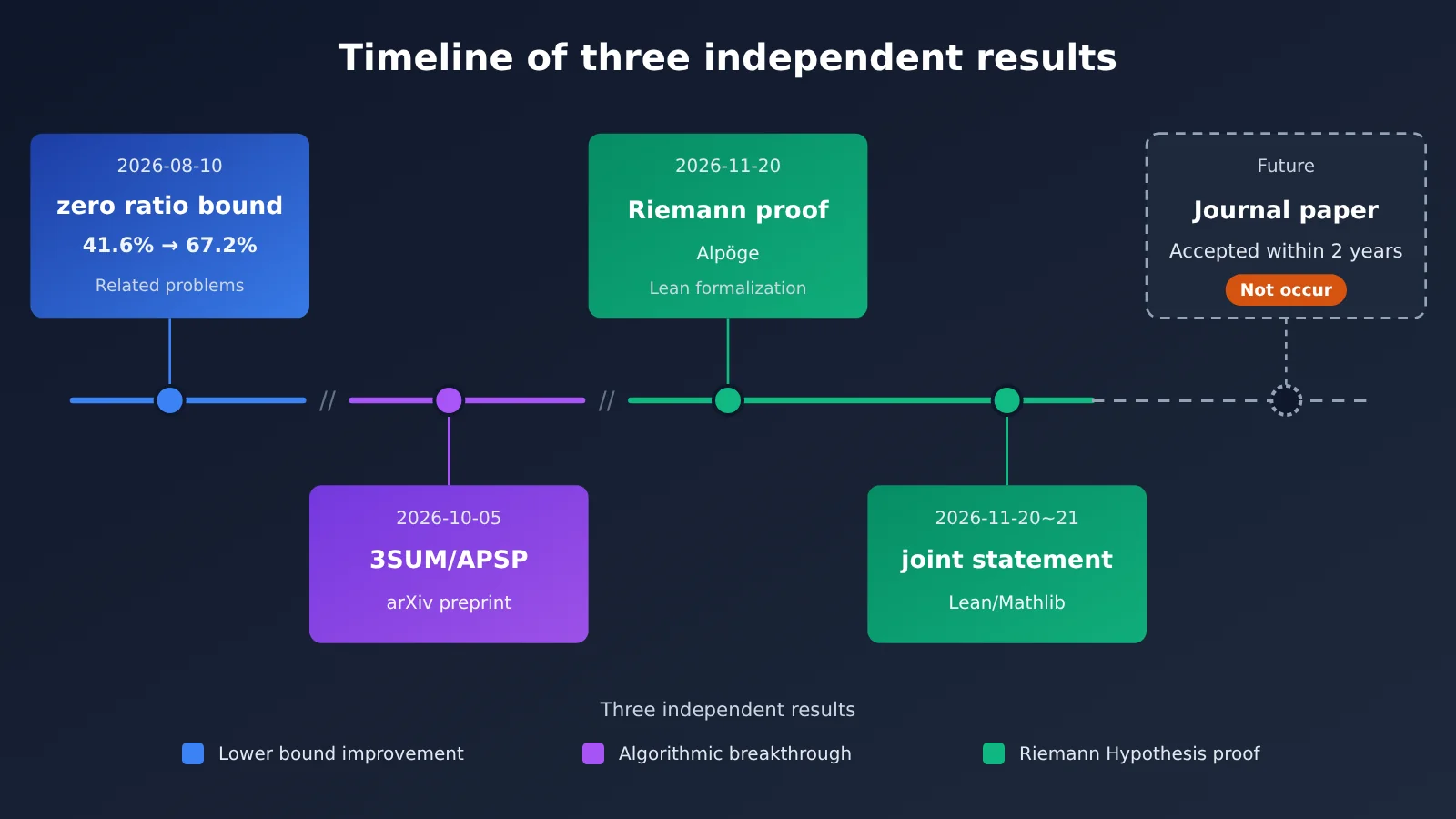
The Three-Layer Verification of Claude’s Riemann Hypothesis Proof
Breaking “already verified” into three layers is the most valuable judgment framework research teams can take away from this. Many secondhand reports lump the first and second layers together as “academic recognition,” and some even say the “million-dollar prize has been paid out.” Both go beyond what the facts support.
| Verification layer | Meaning | Current status | Must not be described as |
|---|---|---|---|
| Layer 1: Lean compilation passes | The proof assistant mechanically checks every step of the derivation, with no gaps | Completed; independently compiled by Sutherland et al. | “Passed peer review” |
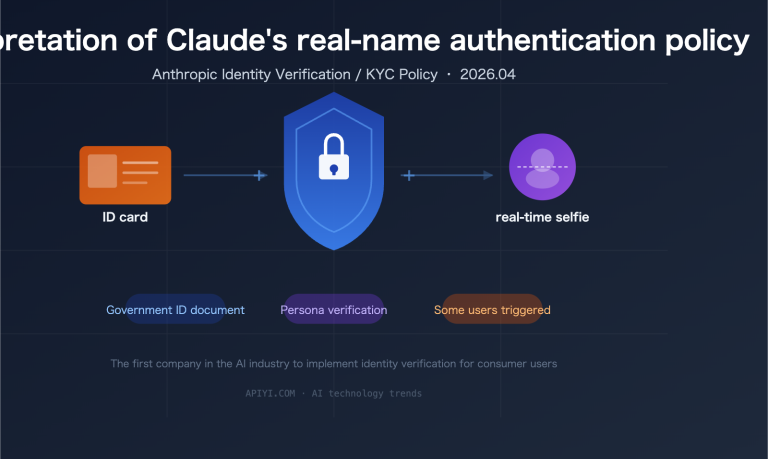
| Layer 2: Joint statement from the Lean/Mathlib community | The formalization community publicly endorses the statement and the proof | Published (11-20 to 11-21) | “Officially recognized by the mathematics community” |
| Layer 3: Journal publication + two years of general acceptance | The hard requirements for the Millennium Prize | Has not happened | “Has won the Millennium Prize” |
Why Lean compilation passing doesn’t equal peer review
Lean checks the logical relationship between a formal proposition and a formal proof. It can guarantee that the derivation contains no mistakes, but it isn’t responsible for judging whether the proposition faithfully translates the original problem. Peer review, by contrast, looks at whether the statement is accurate, whether the method is novel, and what the result means for the field. The two complement each other; neither can replace the other.
The rules from the Clay Mathematics Institute are also clear: each of the seven Millennium Problems carries a $1 million prize, provided the result is published in a journal and has been generally accepted for two years. By that standard, as of November 23, 2026, any claim that the prize “has already been awarded” doesn’t hold up. The safer phrasing is: “There is already a complete Lean formalization, and it has the endorsement of the Lean/Mathlib community; formal academic recognition still awaits the subsequent process.”
Don’t confuse August’s lower-bound improvement with November’s proof
Another old story often gets spliced in. On August 10, 2026, Anthropic’s research page published a result: an unreleased research version of Claude raised the lower bound on the proportion of zeros satisfying the Riemann Hypothesis from 41.6% to 67.2%.
This is a lower-bound improvement on a related problem. It is a separate result from the complete proof on November 20, and the publisher, form, and verification status are all different. If you write or present it as “Claude first raised the proportion to 67.2%, then completed the proof,” you’re inventing a causal chain that doesn’t exist.
Claude’s Role in the 3SUM/APSP Breakthrough: Same Model, a Different Verification Stage
The October 5 arXiv paper 2610.06783 is another big one. The authors are Josh Alman at Columbia and Virginia Vassilevska Williams at MIT. The paper gives deterministic algorithms for 3SUM in O(n^1.9992) and for APSP in O(n^2.9995), refuting three conjectures — 3SUM, APSP, and Exact Triangle — which are load-bearing foundations of fine-grained complexity theory.
How much did the model actually contribute? The acknowledgements are refreshingly direct: Claude discovered the algorithms that refute these three conjectures, the authors then understood, simplified, strengthened, and generalized them, and Claude also verified the main results in Lean 4 with Mathlib. A third-party write-up (CellCog’s October 6 paper-reading post) adds that the core algorithm came out of a single unattended 16-million-token session with an internal Anthropic research model. The Lean formalization is public in Anthropic’s formal-math repository.
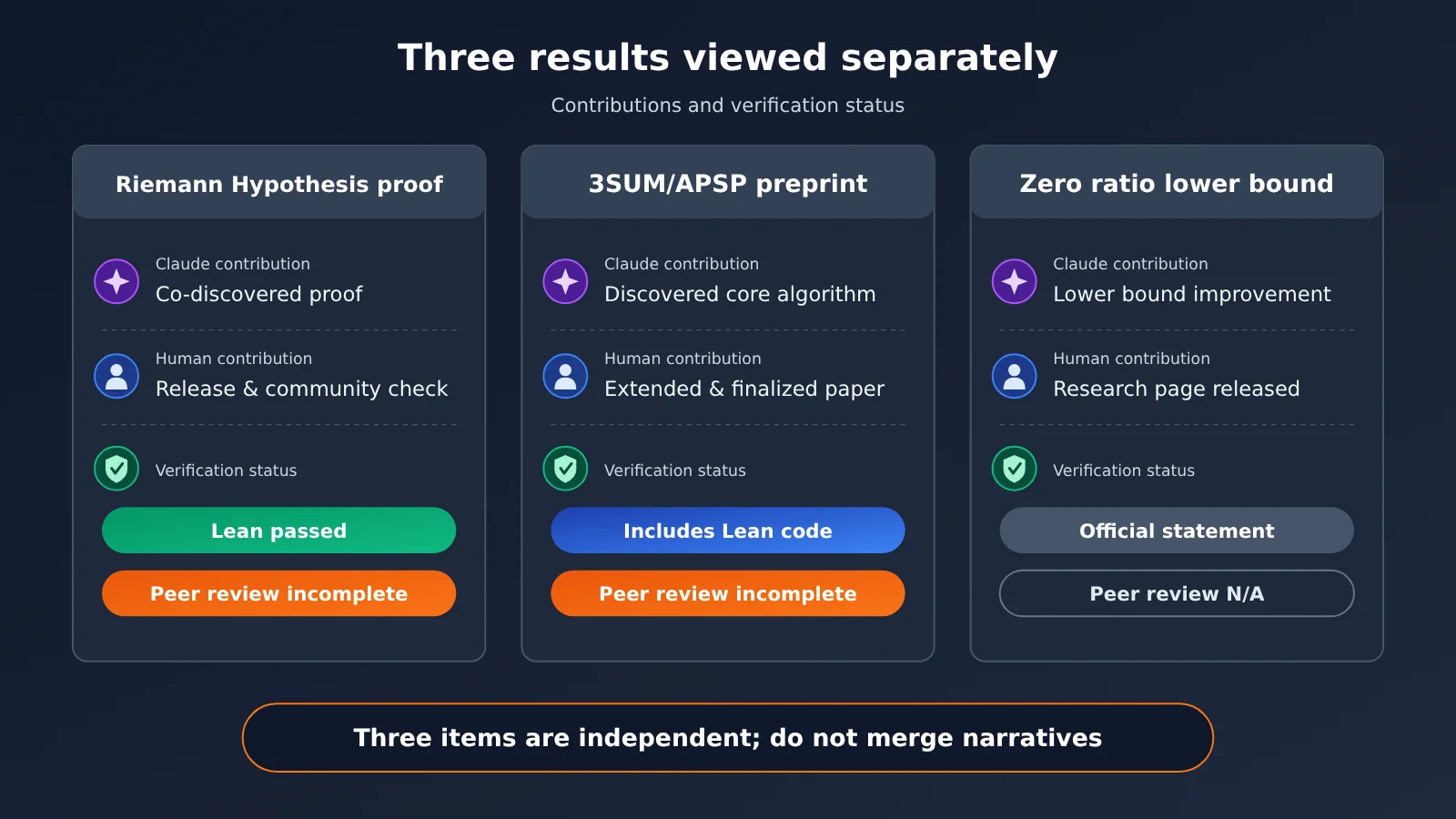
| Item | Riemann hypothesis proof (11-20) | 3SUM/APSP paper (10-05) | Proportion-of-zeros lower bound (08-10) |
|---|---|---|---|
| Claude’s role | Discovered the proof together with Alpöge | Discovered the core algorithm | Research model produced the lower-bound improvement |
| Human role | Alpöge published it; the community checked it | Alman and Vassilevska Williams simplified, strengthened, generalized, and wrote the paper | Anthropic published it on the research page |
| Release format | Lean formal proof + four-page note | arXiv preprint + Lean code | Official research page |
| Peer review | Not completed | Not completed (preprint) | Not applicable under this framing |
| Accurate phrasing | “discovered in collaboration with Claude” | “Claude discovered the core algorithm” | “a lower-bound improvement on a related problem” |
The second column is the easiest one to get wrong. The 3SUM/APSP paper is a preprint and has not been peer reviewed; it was written by two human authors, and Claude’s contribution was the core algorithm plus the formal verification. Writing it up as “Claude independently wrote a top-tier paper end to end” both contradicts what the paper itself says and leads readers to overestimate how feasible it is to replicate this today.
Impact Analysis: Claude’s Long-Horizon Research Tasks and How to Calculate the Token Bill
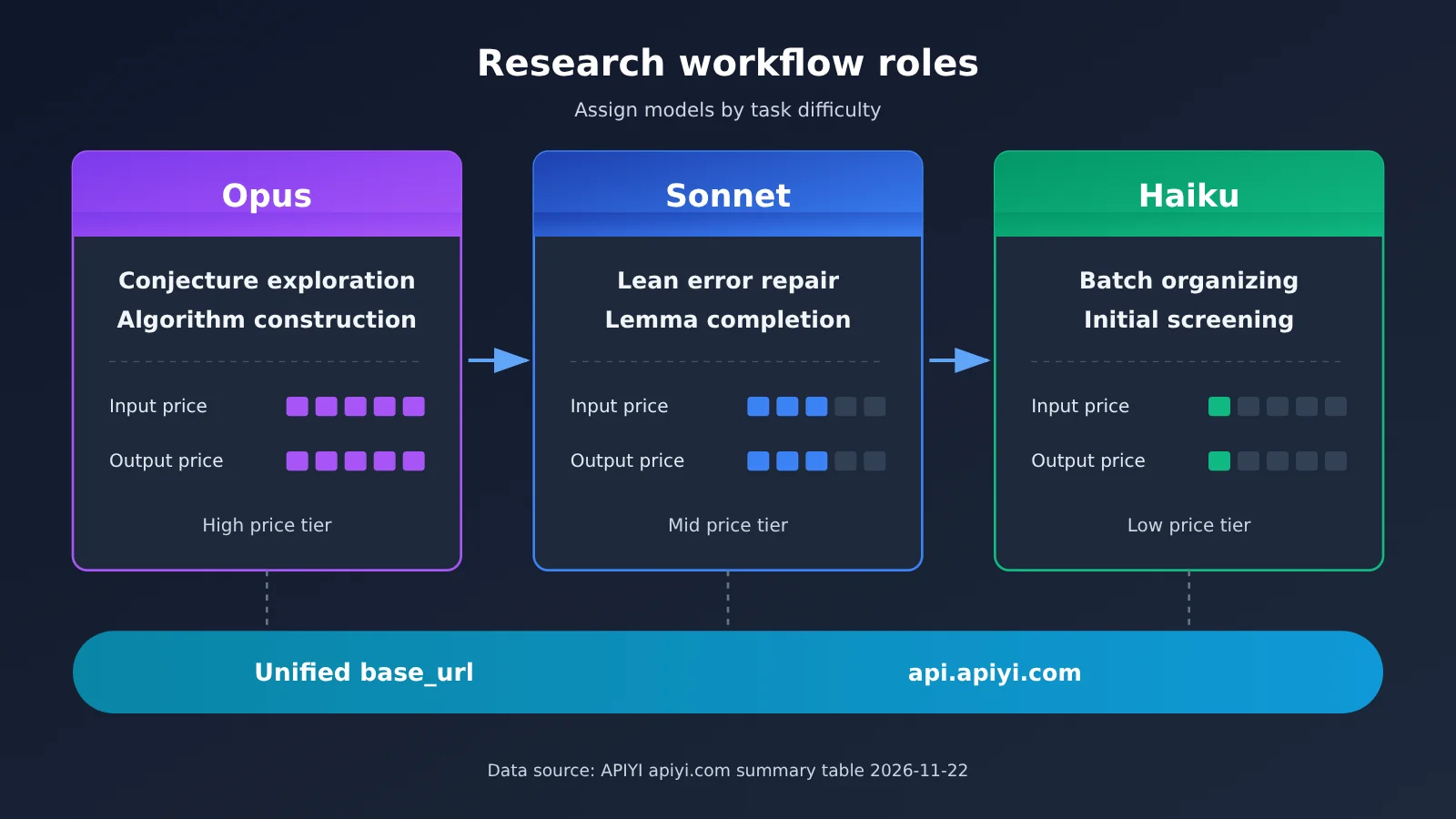
For teams wiring Large Language Models into their research workflows, the most practical question is: how much does exploration at this scale actually cost, and which tasks are worth spending the most expensive model on? The 16 million token figure makes a good reference point.
One caveat up front: the official invoice for that session was never published. What follows is only an order-of-magnitude estimate on the input side, using public unit prices. Real cost also depends on the output ratio, cache hit rate, and number of retries. The prices below come from the APIYI master table, with data as of 2026-11-22 09:58 (UTC+8), in USD per million tokens.
| Model | Input | Output | Cache read | Order of magnitude for 16M input tokens | Available platform |
|---|---|---|---|---|---|
claude-fable-5-2 |
8 | 40 | 0.2 | About $128 | APIYI apiyi.com |
claude-opus-5-5 |
4 | 20 | 0.2 | About $64 | APIYI apiyi.com |
claude-opus-5-5-thinking |
4 | 20 | 0.2 | About $64 | APIYI apiyi.com |
claude-sonnet-5-5 |
2 | 10 | 0.1 | About $32 | APIYI apiyi.com |
claude-haiku-5-5 |
0.1 | 0.5 | 0.01 | About $1.6 (with tiered pricing) | APIYI apiyi.com |
Impact on research teams: which tasks are worth flagship models
In terms of pricing, flagship models cost twice as much as mid-tier models, while mid-tier models are tens of times more expensive than lightweight ones. Output pricing is typically five times input pricing, so the more output a long reasoning task produces, the more the bill skews toward output. Cache reads cost only one-twentieth of the input price, so when you repeatedly reference the same set of definitions, lemmas, and context, cache hits can significantly reduce cost.
A practical division of labor looks roughly like this:
- Core conjecture exploration and algorithm construction: the cost of failure is high, and these tasks require long-chain reasoning, so they’re a good fit for
claude-opus-5-5orclaude-opus-5-5-thinking. Considerclaude-fable-5-2only if you have plenty of budget. - Lean error fixing, lemma completion, and literature organization: these tasks have clear boundaries and are called frequently, so
claude-sonnet-5-5is usually more cost-effective. - Batch format conversion, log categorization, and initial screening: hand these to
claude-haiku-5-5, and save the flagship budget for the genuinely hard parts.
In research settings, it’s hard to tell by intuition which tier is “enough.” The most reliable approach is to run the same set of problems side by side. With the same API key at APIYI (apiyi.com), point base_url to https://api.apiyi.com/v1 and change only the model field. You can then compare accuracy and token consumption across the Opus, Sonnet, and Haiku tiers without opening a separate account for each model.
🎯 Technical recommendation: First get high-frequency subtasks like Lean fixes working with
claude-sonnet-5-5, measure the average token count, and then decide which steps are worth switching to Opus. New users can start with the free trial quota at APIYI apiyi.com to run a small-sample comparison, then extrapolate the budget for formal experiments proportionally.
Impact on Engineering Integration: Endpoints and Boundaries
There are two ways to integrate. For the OpenAI-compatible approach, set https://api.apiyi.com/v1 and use chat/completions; for the native Anthropic approach, set the root domain https://api.apiyi.com and let the SDK append /v1/messages. If your base_url already ends with /v1 and the SDK appends it again, requests go to /v1/v1/messages and return 404 — this is the most common configuration mistake.
It’s also worth being clear about what the gateway is: APIYI apiyi.com is an aggregation gateway, not a model host. Upstream providers’ content policies, rate limits, and outages pass straight through. The platform also offers no cross-vendor auto-fallback field like auto, so for long-running tasks you’ll need to implement your own checkpoint-resume and retry logic — otherwise a single interruption can waste millions of tokens of work you’d already paid for.
How the Claude Riemann Hypothesis Incident Affects Paper and Presentation Wording
These two events set a new standard for scientific writing: AI contributions need to be stated clearly, and verification status needs to be stated even more clearly. The acknowledgments in the 3SUM/APSP paper are a good model—they spell out what Claude discovered, what humans did, and which tools were used to verify it.
| Scenario | Good wording | Wording to avoid |
|---|---|---|
| Describing the Riemann Hypothesis incident | “Alpöge and Claude collaborated to produce a Lean formal proof, endorsed by the Lean/Mathlib community” | “AI independently completed a proof of the Riemann Hypothesis” |
| Describing verification status | “Lean compilation passed; journal peer review is not yet complete” | “Has passed peer review” / “Has won the Millennium Prize” |
| Describing 3SUM/APSP | “Claude discovered the core algorithm; the paper was completed by two authors; it is a preprint” | “Claude wrote a top-tier conference paper” |
| Citing zero proportion results | “The August research version of Claude improved the relevant lower bound” | “Claude first proposed the lower bound and then completed the proof” |
| Your own team’s results | “The model contributed to step X, which was verified with tool Y” | “One-click proof” / “Fully automated AI research” |
For team leads, the same standard applies to internal presentations. Log “the model produced a candidate proof,” “formal tools verified it,” and “human experts reviewed and confirmed it” as separate milestones. That makes reproduction easier and, when outsiders review the work, lets you explain exactly who was responsible for each step.
Common Questions (FAQ)
Q1: Is Claude’s Riemann Hypothesis proof considered accepted by the academic community now?
Not yet. What’s been completed so far is two layers: passing Lean compilation, plus a joint statement from the Lean/Mathlib community. The layer of journal publication followed by two years of general acceptance hasn’t happened, and the alignment check between the formalized statement and the original text was still in progress at the time.
Q2: What’s the relationship between Claude’s Riemann Hypothesis proof and the 67.2% result from August?
They’re independent results. The research page from August 10 said a research version of Claude raised the lower bound on the proportion of zeros from 41.6% to 67.2% — that’s a lower-bound improvement on a related problem. November 20 is the complete Lean proof published by Alpöge in collaboration with Claude.
Q3: What exactly did Claude do in the 3SUM/APSP paper?
According to the paper’s acknowledgments, Claude discovered the core algorithm that overturns three conjectures and verified the main results using Lean 4 and Mathlib. Understanding, simplifying, strengthening, generalizing, and writing were done by Alman and Vassilevska Williams. The paper is currently a preprint and hasn’t been peer-reviewed.
Q4: Can today’s publicly available models reproduce this level of research exploration?
Not directly. According to third-party summaries, the core algorithm behind 3SUM/APSP came from an internal Anthropic research model, and the August result also came from an unreleased research version. Public models are good for formalization assistance, Lean fixes, literature organization, and local constructions — whether they can push forward frontier problems needs to be verified on your own at small scale.
Q5: If I want to compare different Claude models within my research workflow, what’s the easiest way to get access?
After registering at APIYI apiyi.com, one key lets you call every tier of Claude model. For the OpenAI-compatible approach, set the base_url to `https://api.apiyi.com/v1`; switching models just means changing the `model` field. For the native Anthropic approach, use the root domain — and be careful not to end up with `/v1/v1/messages`.
Q6: What pitfalls should I watch out for in advance on long tasks?
First, output pricing is five times input pricing, so long-reasoning bills can easily exceed expectations. Second, upstream rate limits and outages get passed through, and the gateway has no automatic cross-vendor fallback. Third, without checkpoint-and-resume support, a single interruption can waste a large number of tokens. My suggestion: measure average consumption on a small sample first, then set your budget and retry strategy.
Claude Riemann Hypothesis Proof: Key Takeaways
- The event itself: Alpöge and Claude jointly published a Lean formal proof covering RH and GRH for Dirichlet L-functions.
- Three layers of validation: Lean compilation has passed and the community joint statement is done; journal publication plus two years of general acceptance are still pending.
- Prize boundary: The Millennium Prize requires journal publication and two years of general acceptance, so we can’t say the prize has been won yet.
- Distinguish the results: The August lower-bound improvement from 41.6% to 67.2% and the November proof are two separate things.
- 3SUM/APSP: Claude discovered the core algorithm and two authors completed the paper; it’s still an unreviewed preprint.
- Cost reference: 16 million tokens at Opus input pricing comes to roughly $64; the actual bill hasn’t been disclosed.
- Model selection: You can compare Claude’s three tiers on APIYI apiyi.com with the same key, allocating budget by task difficulty.
Summary
The core takeaways from the Claude Riemann Hypothesis proof:
- Validation has layers: Lean compilation and community endorsement have already happened, but journal peer review and two years of general acceptance are still ahead — don’t overstate things in your wording.
- Spell out the contributions: Whether it’s the Riemann Hypothesis or 3SUM/APSP, these are human-model collaborations, and the three related results need to be described separately.
- Costs can be estimated: Long research tasks easily run into tens of millions of tokens, and flagship vs. mid-tier pricing differs by 2x; tiering models by task difficulty is the most direct way to save money.
For teams planning an AI research workflow, I’d suggest first picking a set of typical tasks in your own domain and running a small-sample comparison across Opus, Sonnet, and Haiku, then deciding the division of labor based on real accuracy and token counts. APIYI apiyi.com offers an OpenAI-compatible interface and free credits for new users, which makes it a good fit for this kind of early-stage validation.
📚 References
-
Levent Alpöge’s Four-Page Note: the original publication of the Riemann Hypothesis proof
- Link:
alpo.ge/remark.pdf - Note: the author’s own account, including the original wording “in collaboration with Claude”
- Link:
-
Michael Rubinstein’s Verification Page: proof coverage and file scale
- Link:
math.uwaterloo.ca/~mrubinst/alpoge_claude_grh - Note: documents 175,187 files, roughly 17 million lines, along with a 164-page reading-guide working draft
- Link:
-
Anthropic Research Page (Lower Bound on Zero Proportion): published 2026-08-10
- Link:
anthropic.com/research/riemann-zeta - Note: improved the lower bound from 41.6% to 67.2% — an independent result from the November proof
- Link:
-
arXiv 2610.06783: Truly Subquadratic 3SUM and Truly Subcubic APSP via Triangles in Sparse Lopsided Graphs
- Link:
arxiv.org/abs/2610.06783 - Note: preprint; the acknowledgments section credits Claude’s contribution
- Link:
-
Anthropic formal-math Repository: Lean formalization code for 3SUM/APSP
- Link:
github.com/anthropics/formal-math - Note: located in the 3sum-apsp directory; can be used to re-check the formal verification
- Link:
Author: APIYI Technical Team
Technical Contact: Feel free to reach us through the APIYI homepage; for integration details, see the documentation center at docs.apiyi.com