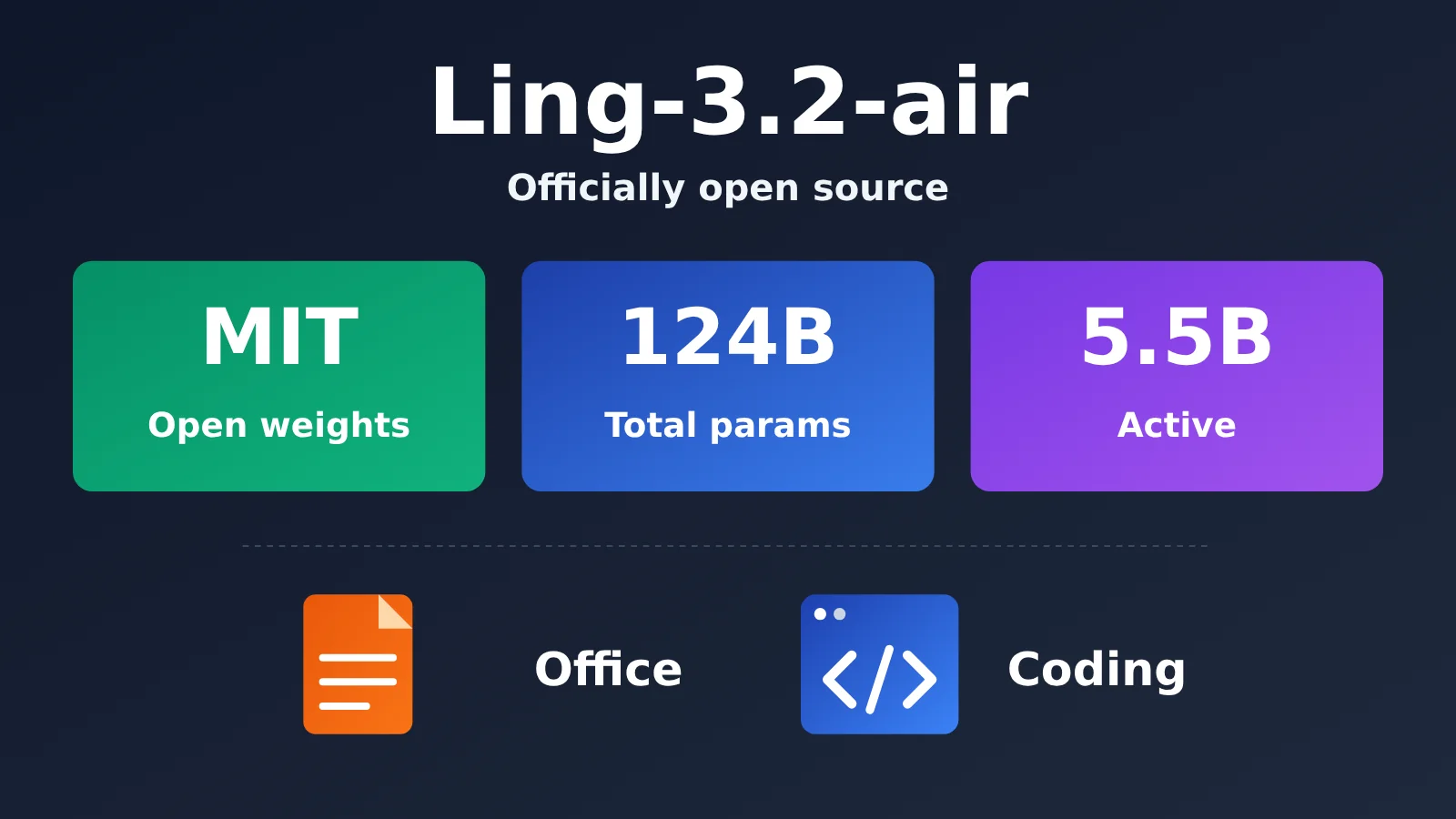
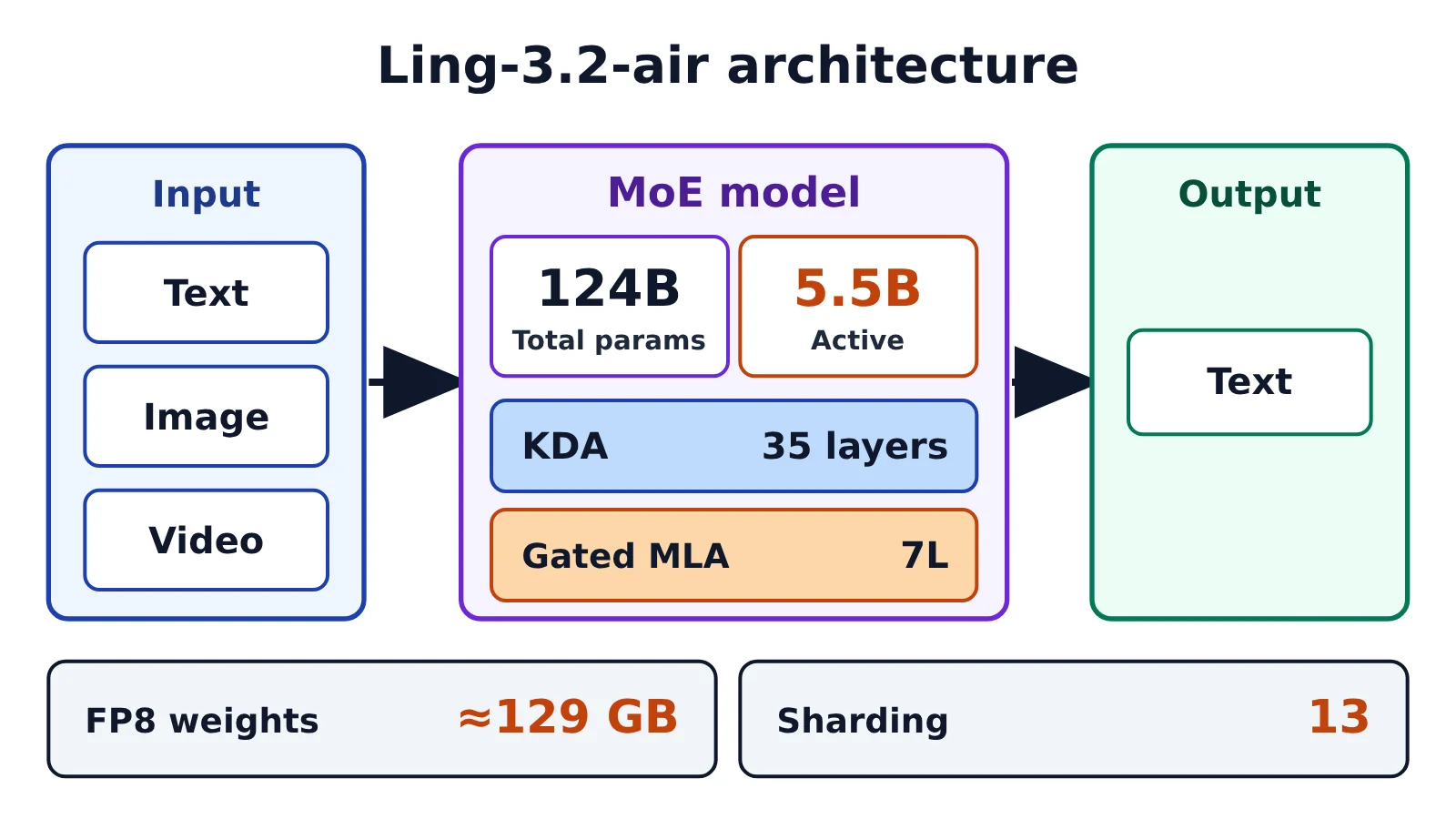
Ling-3.2-air is an MoE model released by inclusionAI (Ant) under the MIT license with open weights. It has 124B total parameters and activates 5.5B per token. The official examples support text, image, and video inputs, with text output. For office productivity and coding tasks, vendor-published data shows clear gains over Ling-3.0-flash-VL, the previous generation in the same family. But most of these results come from the vendor’s own comparison tables. The independent evaluation firm Artificial Analysis’s overview page gives it only a score of 23, and the benchmarks don’t all measure the same things. The conclusion: Ling-3.2-air is a good fit for piloting financial document extraction, document organization, and code repository repair; document page numbers, high-risk data, and code test results still need human confirmation.
After reading this article, you’ll understand:
- When Ling-3.2-air was released, its license, parameter scale, architecture, and weight size
- What the office and coding benchmark scores actually represent, and which numbers can’t be directly compared across benchmarks
- In financial document extraction and repository repair, which steps can be delegated to the model and which must retain human review
- Sample code for downloading weights and calling the model through an OpenAI-compatible API
Index: First, a concept table and a quick impact overview set the context. Then the “Objective Facts” section compiles data from the official repository, release notes, and third-party evaluations. The “Analysis and Judgment” section breaks down the office and coding scenarios, explaining what the model can do and what needs review. Finally, hands-on code and FAQ.
Ling-3.2-air Related Concepts Quick Reference
| Concept | Brief Explanation |
|---|---|
| Open Weights | Public model parameter files that users can download and deploy themselves—not the same thing as releasing the training data or training code |
| MIT License | A permissive open-source license that allows commercial use, modification, and redistribution, as long as the copyright notice is retained |
| MoE (Mixture of Experts) | A model built from multiple expert subnetworks, where only some of them are activated for each token, so the activated parameter count is far smaller than the total |
| Activated Parameters | The number of parameters that actually participate in computation when processing a single token; Ling-3.2-air has 5.5B |
| KDA | A type of attention layer in the model; Ling-3.2-air has 35 of them in total |
| Gated MLA | A multi-head latent attention layer with a gating mechanism; Ling-3.2-air has 7 of them in total |
| FP8 | An 8-bit floating-point precision format that noticeably reduces weight size and VRAM usage |
| Elo Score | A relative ranking score derived from head-to-head wins and losses; good for comparing strength, but not a measure of task pass rate |
Ling-3.2-air Impact at a Glance
| Audience | Main Impact |
|---|---|
| Enterprise IT and private deployment teams | The MIT license plus open weights let you deploy on an internal network so data never leaves your premises. The FP8 weights are about 129 GB, so multi-GPU VRAM needs to be planned ahead |
| Office automation developers | Supports image and video input, so you can experiment with extracting information from scans and screenshots—but page numbers and numeric values need programmatic validation plus manual spot checks |
| AI coding tool developers | Vendor data shows a big gain in repository-repair tasks, making it a solid open-source alternative to plug into agents; patches still have to pass tests |
| Model selection teams | There’s a clear gap between vendor scores and independent evaluations, so you need to re-test with your own samples instead of relying on a single benchmark score |
Ling-3.2-air: The Facts
Release Date and Open-Source License
inclusionAI’s official Hugging Face repository has a commit on November 23, and the Chinese release notes went out on November 24. The model releases open weights under the MIT license, so developers can download the parameter files directly for local deployment or further development.
- Source: Hugging Face model page: huggingface.co/inclusionAI/Ling-3.2-air
- Source: IT之家 Chinese release report: ithome.com/1/031/426.htm
Parameter Scale and Architecture
Ling-3.2-air has 124B total parameters, activates 5.5B per token, and uses a mixture-of-experts architecture. The attention component consists of 35 KDA layers and 7 Gated MLA layers. Based on the official input example, the model can accept text, images, and video, and outputs text.
The official FP8 weights are about 129 GB, split into 13 shards. In other words, even though each inference only activates 5.5B parameters, the full weights still need to be loaded into VRAM or memory. The deployment bar is mainly set by total parameters, not active parameters.
- Source: Hugging Face file list: huggingface.co/inclusionAI/Ling-3.2-air/tree/main
Office and Coding Benchmark Data
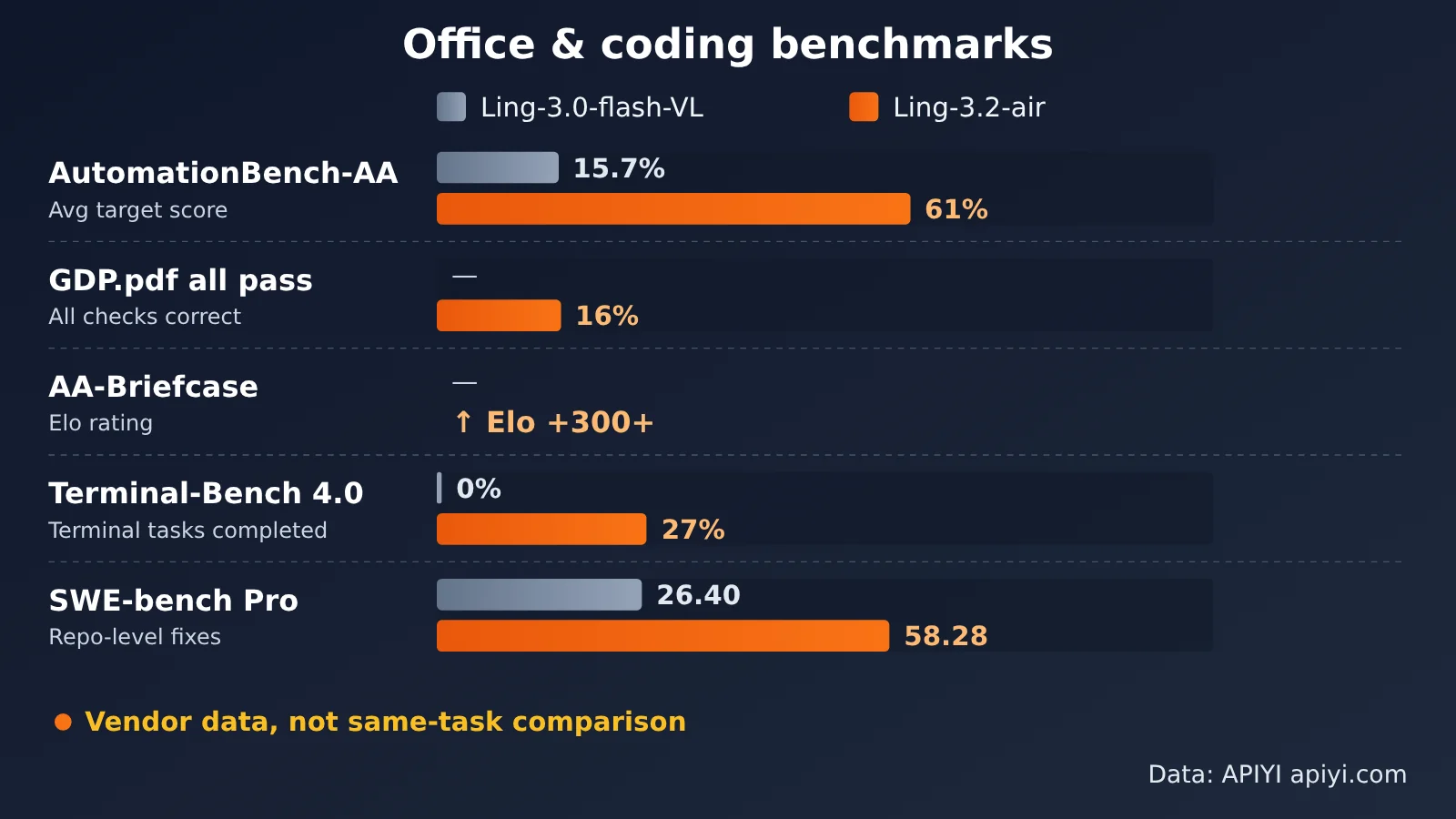
The table below is compiled from the vendor’s comparison table and third-party pages. Unless otherwise noted, the comparison target is Ling-3.0-flash-VL from the same family.
| Benchmark item | Previous generation score | Ling-3.2-air | Data source | Metric notes |
|---|---|---|---|---|
| AutomationBench-AA | 15.7% | 61% | Vendor comparison table | Average target score under the full set of constraints, not the full-task pass rate |
| GDP.pdf full pass | 8.4% | 16% | Vendor comparison table | Share of cases where all checks pass |
| AA-Briefcase | 987 Elo | 1340 Elo | Vendor comparison table | Relative ranking score |
| Terminal-Bench 4.0 | 0% | 27% | Vendor comparison table | Terminal task completion |
| SWE-bench Pro | 26.40 | 58.28 | Chinese release notes | Repository-level code repair |
| AA composite index | — | 23 points | Artificial Analysis independent page | Aggregate of multiple benchmarks; not the same questions as the items above |
- Source: Artificial Analysis model page: artificialanalysis.ai/models/ling-3-2-air
- Source: AutomationBench-AA evaluation description: artificialanalysis.ai/evaluations/automationbench-aa
- Source: GDP.pdf evaluation description: artificialanalysis.ai/evaluations/gdp-pdf
There are two caveats to reading this table. First, AutomationBench-AA’s 61% is an average target score; it shouldn’t be read as 61% of tasks being fully automated. Second, data from different sources comes from different evaluation versions and question sets. The vendor’s individual scores and AA’s composite score of 23 can’t be compared as results on the same questions.
Ling-3.2-air Analysis and Assessment
Office Scenarios: What It Can Do and Which Steps Need Human Verification
Looking at the three office benchmarks, Ling-3.2-air’s improvements are concentrated in “multi-step automation” and “document output quality.” AutomationBench-AA rose from 15.7% to 61%, and AA-Briefcase’s Elo climbed by more than 300 points, showing that its ability to accomplish goals under constraints and produce usable documents is stronger than the previous generation. GDP.pdf’s all-pass rate is only 16%, which also shows that getting every check item right in a single pass on one document is still the exception rather than the rule.
Take financial material extraction as an example. A relatively reliable workflow is: the model reads scanned statements or PDF screenshots, outputs JSON by field, and annotates each value with its source page number; the program checks whether fields are complete and whether the sum of line items equals the total; finally, finance staff spot-check the page numbers and key amounts. The table below is a suggested division of labor — it’s a process design recommendation, not an empirical conclusion.
| Step | Hand to Ling-3.2-air | Must be verified by human or program |
|---|---|---|
| Field recognition | Identify accounts, amounts, and dates from statement, invoice, and contract screenshots | Spot-check recognition results, focusing on handwritten and blurry areas |
| Page location | Annotate which page each value comes from | Check page numbers one by one; the model may mislabel or fabricate page numbers |
| Numerical computation | Preliminary aggregation, year-over-year and month-over-month calculations | Recalculate with a program; high-risk amounts reviewed by a human |
| Report writing | Generate drafts of summaries and explanatory text | Check whether conclusions match the source data |
The rule can be summed up in one sentence: the model handles “finding” and “writing drafts,” the program handles “calculating” and “checking format,” and the human handles “verifying page numbers and signing off.” For high-risk data such as auditing, tax filing, and external disclosure, don’t let model output flow directly into formal systems.
Programming Scenarios: Repository Repair Can Be Piloted, but Patches Must Pass Tests
The gains are more obvious on the programming side. The Chinese release notes report SWE-bench Pro going from 26.40 to 58.28, and Terminal-Bench 4.0 in the vendor’s table going from 0% to 27%. That suggests Ling-3.2-air is a more usable coding assistant than its predecessor at tasks like reading a repository, locating the problem, and generating a patch.
But AA’s independent composite page gives it only 23 points, which means that under a different evaluation system, its overall standing isn’t that high. For teams, the sensible positioning is: use it as a self-hosted open-source coding model for low-to-medium-complexity issue fixes, test completion, and script writing, while complex refactoring and security-related code still go to stronger models or senior engineers.
Here’s a suggested acceptance workflow for repository repair:
- The model reads the issue description and related files, then outputs a patch and the reasoning behind the changes
- Apply the patch in an isolated environment and run the full unit test and integration test suites
- If the tests fail, feed the error back to the model for a retry, with a retry cap in place
- Once the tests pass, a human does a code review, focusing on whether tests were deleted, assertions were changed, or unnecessary dependencies were introduced
- Before merging, run regression verification in the pre-release environment
Pay special attention to step 4 here. Agents sometimes “make the tests pass” by modifying the tests themselves, and looking only at test results isn’t enough.
Deployment Requirements and Selection Recommendations
With 5.5B activated parameters, inference compute is relatively manageable, but the full 124B weights mean that even under FP8, about 129 GB still needs to be loaded. Before small and medium-sized teams build their own setup, it’s best to first validate performance on your own samples through the API, confirm it’s worth the investment, and then purchase hardware for private deployment.
| Selection dimension | Ling-3.2-air situation | Recommendation |
|---|---|---|
| Licensing and data compliance | MIT open weights, can be deployed on an internal network | Suitable for enterprises sensitive about data leaving their domain |
| Hardware cost | About 129 GB under FP8, 13 shards | Assess multi-GPU VRAM first, then decide whether to self-host |
| Office automation | Vendor data shows clear improvement, but overall pass rate is still low | Pilot + programmatic validation + manual spot checks |
| Code repair | SWE-bench Pro vendor data shows clear improvement | Integrate into an Agent, enforce test runs and code review |
| Performance validation path | There’s a gap between third-party independent scores and vendor data | Retest with your own samples; you can use APIYI apiyi.com to compare multiple models |
🎯 Technical recommendation: When choosing a model, prepare 20 to 50 real business samples, run Ling-3.2-air and the closed-source model you’re currently using at the same time, and compare field accuracy and manual rework rate. APIYI apiyi.com provides an OpenAI-compatible unified interface—one API key lets you call mainstream models such as OpenAI, Claude, and Gemini, making it easy to set up this kind of control group.
Ling-3.2-air Quick Start
Download the open-source weights
The official repo is inclusionAI/Ling-3.2-air. Before downloading, make sure you have at least 130 GB of free disk space:
from huggingface_hub import snapshot_download

# Download the official Ling-3.2-air weights (FP8, roughly 129 GB across 13 shards)
local_dir = snapshot_download(
    repo_id="inclusionAI/Ling-3.2-air",
    local_dir="./Ling-3.2-air",
)
print("权重已保存到:", local_dir)
Calling it through the OpenAI-compatible API
Whether you deploy it yourself as an OpenAI-compatible service or use an aggregation platform, the calling pattern is basically the same. Use the model name exactly as it appears in the model list of the service you’re actually hitting:
import openai

client = openai.OpenAI(
    api_key="YOUR_API_KEY",
    base_url="https://api.apiyi.com/v1"  # APIYI unified endpoint; you can also swap in your own service address
)

response = client.chat.completions.create(
    model="ling-3.2-air",  # use the exact name from the platform's model list
    messages=[{"role": "user", "content": "用三句话说明 MoE 模型的激活参数是什么意思"}]
)
print(response.choices[0].message.content)
View the full code: financial field extraction + automatic validation + manual review flags
import json
import openai

client = openai.OpenAI(
    api_key="YOUR_API_KEY",
    base_url="https://api.apiyi.com/v1"
)

MODEL = "ling-3.2-air"  # use the model name from the actual service's model list
REQUIRED_FIELDS = ["revenue", "cost", "gross_profit"]

SYSTEM_PROMPT = (
    "你是财务材料提取助手。只输出 JSON,格式为:"
    '{"items": [{"field": 字段名, "value": 数值, "page": 页码}]}。'
    "找不到的字段不要编造,value 填 null。"
)


def extract_fields(document_text: str) -> dict:
    """Call the model to extract financial fields and return the parsed JSON"""
    resp = client.chat.completions.create(
        model=MODEL,
        messages=[
            {"role": "system", "content": SYSTEM_PROMPT},
            {"role": "user", "content": document_text},
        ],
        temperature=0,
    )
    raw = resp.choices[0].message.content.strip()
    raw = raw.removeprefix("```json").removesuffix("```").strip()
    return json.loads(raw)


def validate(result: dict, total_pages: int) -> list:
    """Programmatic validation: all fields present, page numbers in range, gross profit equals revenue minus cost"""
    issues = []
    items = {i["field"]: i for i in result.get("items", [])}

    for f in REQUIRED_FIELDS:
        if f not in items or items[f]["value"] is None:
            issues.append(f"缺少字段:{f}")

    for f, item in items.items():
        page = item.get("page")
        if not isinstance(page, int) or not 1 <= page <= total_pages:
            issues.append(f"{f} 的页码异常:{page}")

    try:
        rev = items["revenue"]["value"]
        cost = items["cost"]["value"]
        gp = items["gross_profit"]["value"]
        if abs((rev - cost) - gp) > 0.01:
            issues.append("毛利与收入减成本不一致")
    except (KeyError, TypeError):
        pass

    return issues


if __name__ == "__main__":
    doc = "第1页:营业收入 1,200 万元。第2页:营业成本 800 万元,毛利 400 万元。"
    result = extract_fields(doc)
    problems = validate(result, total_pages=2)

    print(json.dumps(result, ensure_ascii=False, indent=2))
    if problems:
        print("需要人工复核:", problems)
    else:
        print("程序校验通过,仍需人工抽检页码与关键金额")
This code reflects the division of labor described earlier: the model only handles extraction and tagging page numbers, the program handles format and arithmetic validation, and no matter whether validation passes, a manual spot-check step remains in place.
🚀 Quick start: If you don’t have enough VRAM to deploy the 124B weights right now, you can sign up at APIYI apiyi.com first and use the free trial quota for new users to run through the validation flow above. Then just swap
base_urlfor your self-hosted service address — no changes needed in your business code.
Ling-3.2-air FAQ
Q1: What kind of model is Ling-3.2-air?
It’s an open-weight Mixture-of-Experts model from inclusionAI (Ant), released under the MIT license. It has 124B total parameters with 5.5B activated per token, and the official examples support text, image, and video input with text output.
Q2: How does Ling-3.2-air differ from Ling-3.0-flash-VL?
According to the vendor’s comparison table, Ling-3.2-air scores noticeably higher than Ling-3.0-flash-VL on office and coding benchmarks like AutomationBench-AA, GDP.pdf, AA-Briefcase, and Terminal-Bench 4.0. These are the vendor’s own within-family comparisons, so independent evaluation results need to be looked at separately.
Q3: When was Ling-3.2-air released?
The official Hugging Face repository has commits dated November 23, and the Chinese release notes went out on November 24.
Q4: Does AutomationBench-AA’s 61% mean 61% of tasks can be fully automated?
No. The 61% is an average goal score under the full set of constraints, not a full task pass rate. GDP.pdf, which requires every check to pass at once, has a full pass rate of only 16%, so real-world deployments still need validation and human review.
Q5: Why do vendor scores look high while the AA composite score is only 23?
The two use different evaluation systems. The vendor table is a within-family, version-specific comparison of individual metrics, while the AA composite index aggregates multiple independent evaluations with different questions and versions. They can’t be compared as if they were results on the same test.
Q6: What’s needed to deploy Ling-3.2-air locally?
The official FP8 weights are about 129 GB, split into 13 shards, so you’ll need enough disk space and multi-GPU VRAM. The small activated parameter count only reduces compute; the full weights still have to be loaded.
Q7: How can I quickly compare Ling-3.2-air against other models on my own business cases?
Prepare a batch of real samples, then run several models with the same prompt and validation script, comparing accuracy and rework rate. APIYI (apiyi.com) offers an OpenAI-compatible interface, so switching models only means changing the `model` parameter — handy for this kind of comparison testing.
Q8: Can Ling-3.2-air be used directly for financial reports or production code?
I wouldn’t ship it straight to production. Document page numbers and high-risk amounts need human verification, and code patches need full test runs and code review. You can start with a small pilot using APIYI’s (apiyi.com) free quota, then scale up once the rework rate looks acceptable.
Ling-3.2-air Key Takeaways
- Openness: Open weights under the MIT license, supporting commercial use and private on-premises deployment
- Scale and architecture: 124B total parameters, 5.5B active, 35 KDA layers plus 7 Gated MLA layers
- Multimodal input: Official examples support text, image, and video input, with text output
- Office capabilities: Vendor data shows a clear improvement, but the overall pass rate on GDP.pdf is only 16%
- Coding capability: SWE-bench Pro vendor data is 58.28, while the independent AA composite score is 23
- Acceptance baseline: Page numbers, high-risk data, and code tests must be confirmed by a human or a program
Ling-3.2-air opens up a 124B-parameter MoE model under a permissive license, giving office automation and coding Agent teams that need private deployment another option. Its real performance still needs to be validated by each team using their own data. The gap between vendor benchmark scores and independent overall evaluations is the key thing to watch going forward. Before investing in hardware, you can run a controlled comparison test on a small sample through the unified interface at APIYI apiyi.com, then decide whether to build your own deployment.
Author: APIYI Technical Team
Technical contact: Feel free to reach out through the APIYI apiyi.com homepage. For more integration resources, visit the documentation center at docs.apiyi.com.