
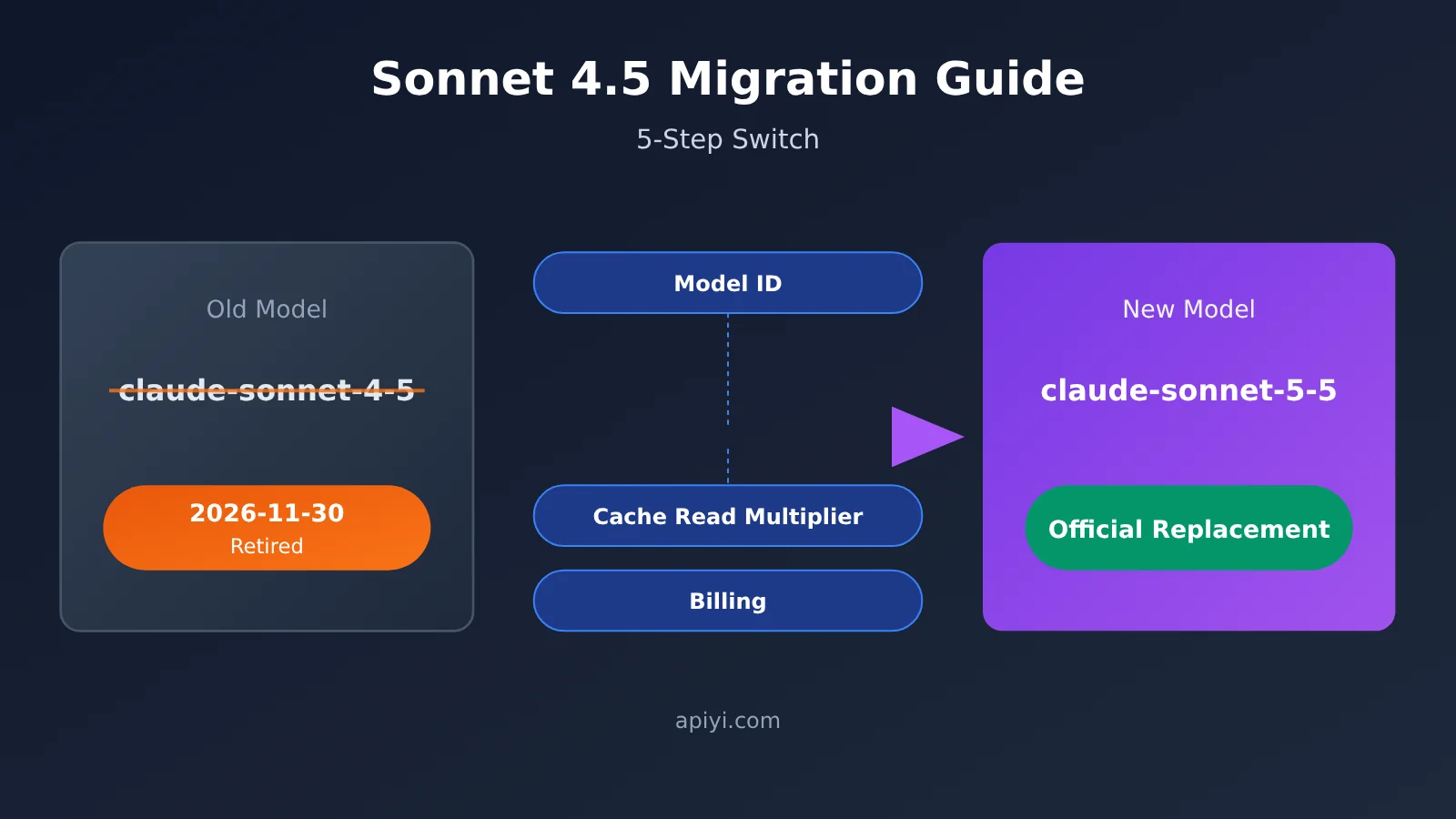
Author’s note: claude-sonnet-4-5 will be retired on 2026-11-30. This article explains what changes when you migrate to claude-sonnet-5-5—including the model ID, cache read multiplier, and billing—and provides a checklist of fields to update and steps to verify the migration on cutover day.
If your code, configuration files, or gateway routes still reference claude-sonnet-4-5 or the dated snapshot claude-sonnet-4-5-20250929, it’s time to schedule the migration. Anthropic’s model deprecation page lists this snapshot as Deprecated, with an announcement date of 2026-09-30 and a retirement date of 2026-11-30. The officially recommended replacement is claude-sonnet-5-5.
This isn’t another “the new model is better” announcement. This article focuses solely on the engineering work involved in migrating from Sonnet 4.5 to Sonnet 5.5: what to change in the model ID, how the multipliers and prices change, which fields to update on cutover day, and how to verify the migration afterward. We don’t cover differences in capabilities; you’ll need to run your own task-specific regression tests.
What you’ll get: By the end, you’ll have a comparison table of the old and new models, an actionable cutover sequence, and a clear idea of which request to send and which fields to check to confirm the migration succeeded.
Key Takeaways for Migrating from Sonnet 4.5 to Sonnet 5.5
Here’s the bottom line. These are the four things to focus on for this migration. The data is current as of 2026-11-10.
| Key point | Details | Impact |
|---|---|---|
| Retirement date | claude-sonnet-4-5-20250929 retires on 2026-11-30, announced on 2026-09-30 |
There are about 20 days left, so you’ll need to switch before the end of the month |
| Official replacement | Anthropic recommends switching to claude-sonnet-5-5 |
The migration target is clear, so there’s no need to choose among multiple models |
| Both models are available | Both the old and new models are currently listed on the platform | You can run them in parallel for a while to support a gradual rollout and regression testing |
| Price and cache multiplier changes | Unit prices for input, output, and cache reads have all decreased, and the cache-read multiplier has dropped from 0.1 to 0.05 | Your bill will change, with a more noticeable impact on workloads that have high cache hit rates |
Sonnet 4.5 and Sonnet 5.5 Are Both Available
You don’t have to make this migration all at once. On 2026-11-10, we checked APIYI apiyi.com’s public pricing endpoint. It listed 283 models, including both claude-sonnet-4-5 and claude-sonnet-4-5-20250929, as well as claude-sonnet-5-5 and claude-sonnet-5-5-thinking. Since both the old and new models are available, you can gradually shift traffic from the old ID to the new one before the retirement date, using the same API key and the same OpenAI-compatible interface.
One thing to watch for: the dated snapshot claude-sonnet-4-5-20250929 and the undated claude-sonnet-4-5 often appear in different places in your code. The dated version is common in offline evaluation scripts that need reproducible results, while the undated version is more common in application code and configuration centers. Search for both variants during migration—don’t update just one.
The Thinking Variant in the Sonnet 5.5 Migration
claude-sonnet-5-5-thinking appears as a separate entry in the pricing endpoint, with its own multiplier. If your application already distinguishes between “standard calls” and “deep reasoning calls,” map each one separately during migration. Don’t mix the thinking variant’s price with that of the base claude-sonnet-5-5 model. The price calculations later in this article apply only to the base model; for the thinking variant, refer to its actual entry in the platform’s model list.
Sonnet 4.5 and Sonnet 5.5 Model ID Mapping
The first step in migrating is to create an ID mapping table. The table below lists the old and recommended new IDs:
| Current ID | Status | ID to migrate to | Notes |
|---|---|---|---|
claude-sonnet-4-5-20250929 |
Deprecated; retires on 2026-11-30 | claude-sonnet-5-5 |
Officially recommended replacement |
claude-sonnet-4-5 |
Still listed; should be migrated along with the snapshot | claude-sonnet-5-5 |
The most common ID used in production code |
| Manually assembled Sonnet 4.5 calls for reasoning tasks | Requires individual review | claude-sonnet-5-5-thinking |
A separate listing with separate pricing |
We recommend keeping the mapping in one place, such as a configuration center or environment variables, rather than hardcoding it separately in multiple services. That way, you only need to change one place around the retirement date, and rolling back is easier.
Price and Cache-Read Multiplier Changes After Migrating to Sonnet 5.5
How the multipliers are converted
The pricing endpoint doesn’t return prices in dollars. Instead, it provides three multiplier fields: model_ratio (input multiplier), completion_ratio (output multiplier relative to input), and cache_ratio (cache-read multiplier relative to input). This article uses the same conversion method as the platform’s previously published articles:
- A multiplier of 1 = $2 per million input tokens
- Output price = input price ×
completion_ratio - Cache-read price = input price ×
cache_ratio
The dollar prices in the table below are calculated using this method; they aren’t official list prices. Data as of 2026-11-10.
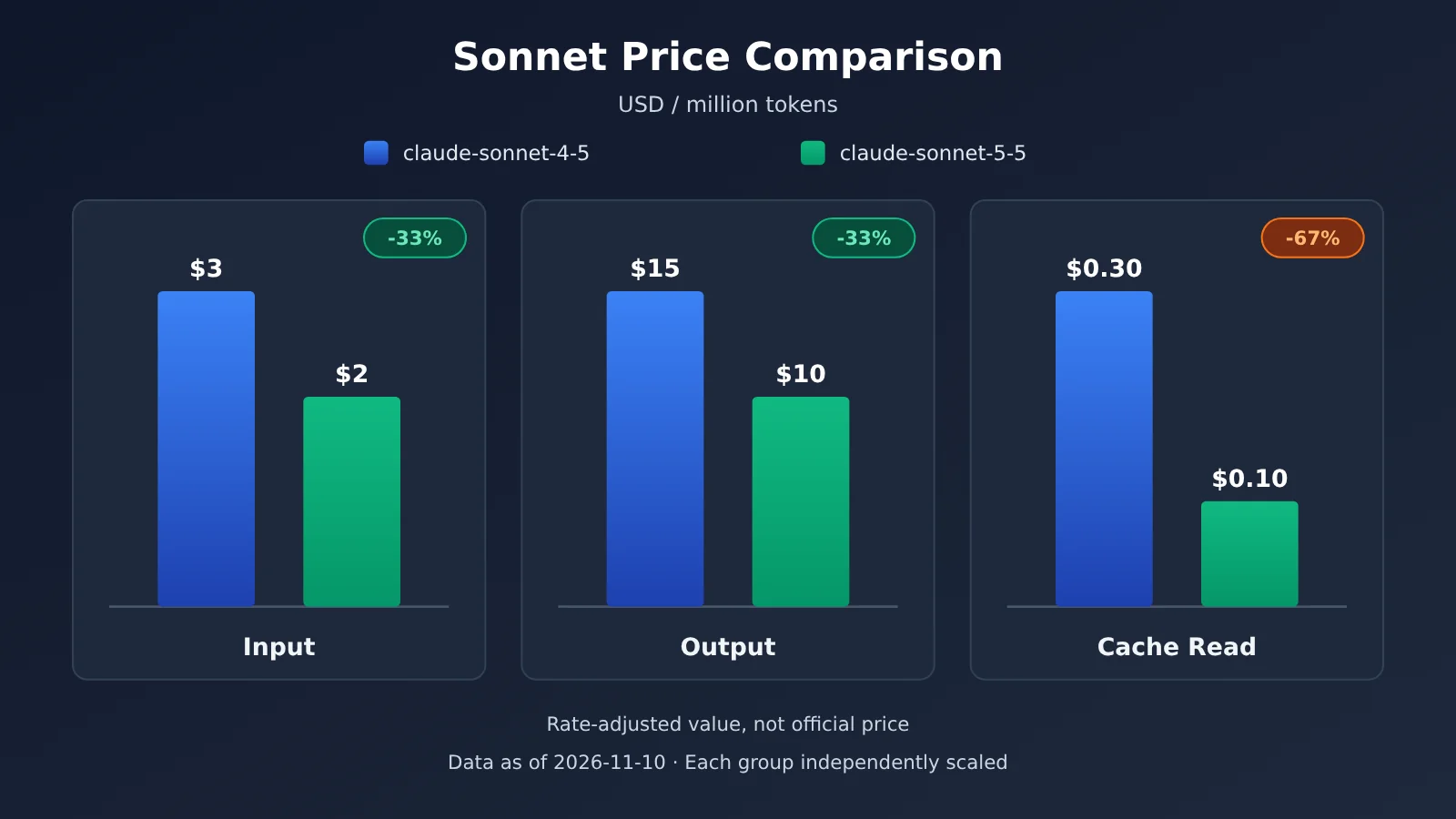
| Model | model_ratio | completion_ratio | cache_ratio | Input $/million tokens | Output $/million tokens | Cache read $/million tokens |
|---|---|---|---|---|---|---|
claude-sonnet-4-5 |
1.5 | 5 | 0.1 | $3 | $15 | $0.30 |
claude-sonnet-5-5 |
1 | 5 | 0.05 | $2 | $10 | $0.10 |
Understanding the change in Sonnet 5.5’s cache-read multiplier
The table shows two changes. First, the base multiplier: model_ratio drops from 1.5 to 1, while completion_ratio remains at 5. As a result, input and output prices both fall by about a third. Second, the cache-read multiplier: cache_ratio drops from 0.1 to 0.05. Combined with the lower base multiplier, this brings the cache-read price down from $0.30 to $0.10—a reduction of about two-thirds.
This means that migrating the same model ID won’t affect every business’s bill to the same extent. In scenarios with high cache-hit rates—such as long system prompts, question answering over long documents, and multi-turn agents—cache reads account for a larger share of the bill, so the overall change will be more noticeable than for workloads based mainly on uncached input and output. Don’t estimate your budget using a single percentage across the board.
Example bill changes (assumed usage)
Here’s a calculation based on an assumed monthly usage profile to show how the three prices affect the bill together. These figures are for illustration only; replace them with your own usage statistics.
| Billing item | Assumed monthly usage | Calculated cost for Sonnet 4.5 | Calculated cost for Sonnet 5.5 |
|---|---|---|---|
| Input | 10 million tokens | $30 | $20 |
| Output | 2 million tokens | $30 | $20 |
| Cache read | 30 million tokens | $9 | $3 |
| Total | — | $69 | $43 |
Also, prompt caching is generally isolated by model. When you switch to a new ID, the cache accumulated on the old model won’t carry over automatically. The first batch of requests will need to populate the cache again, so the cache-hit rate may briefly dip on the day of the switch, causing a small fluctuation in your bill. When reviewing your bill, we recommend waiting a few hours after the switch before comparing costs.
Before and after the switch, recheck the current multipliers for claude-sonnet-5-5 and claude-sonnet-5-5-thinking in the model list on APIYI apiyi.com, then update your internal cost-estimation sheet and alert thresholds with the verified values.
Quick Start: Migrating from Sonnet 4.5 to Sonnet 5.5
Minimal Request Example
To call the new model through the OpenAI-compatible API, you only need to update these fields:
- API endpoint
base_url:https://api.apiyi.com/v1 - Request path:
/chat/completions - Model field
model:claude-sonnet-5-5(replacingclaude-sonnet-4-5orclaude-sonnet-4-5-20250929) - Authentication: request header
Authorization: Bearer YOUR_API_KEY - Request body: leave
messagesunchanged; you don’t need to modify it for the migration
If you’re using the official OpenAI SDK, you usually only need to update base_url when initializing the client and the model parameter when making a call. The rest of your application code can stay as is.
View the full list of fields to update
On the day you switch over, check each of these:
– Client initialization: Set `base_url` to `https://api.apiyi.com/v1` and read the API key from an environment variable
– Default model: Change the default `model` in your configuration center or environment variables to `claude-sonnet-5-5`
– Reasoning routes: Update branches that previously used deep reasoning to `claude-sonnet-5-5-thinking`; it’s billed separately
– Fallback list: If `claude-sonnet-4-5` appears in your fallback or retry chain, replace it too to avoid fallback failures after the old model is retired
– Allowlists and permissions: Add the new ID to your gateway’s model allowlist and the list of models available to team members
– Costs and alerts: Update your pricing table and budget alert thresholds to reflect the new rates
– Logs and reports: For dashboards that track usage by the `model` field, group the old and new IDs under the same business line to avoid gaps in reporting after the switch
– Offline evaluation scripts: Update evaluation tasks that use the dated snapshot `claude-sonnet-4-5-20250929` to the new ID, then rerun the baseline
Quick-start recommendation: In a test environment, use the same APIYI key to call both the old and new models, then record differences in their outputs and usage before deciding on a rollout percentage. New users can start by running regression tests with the free test quota.
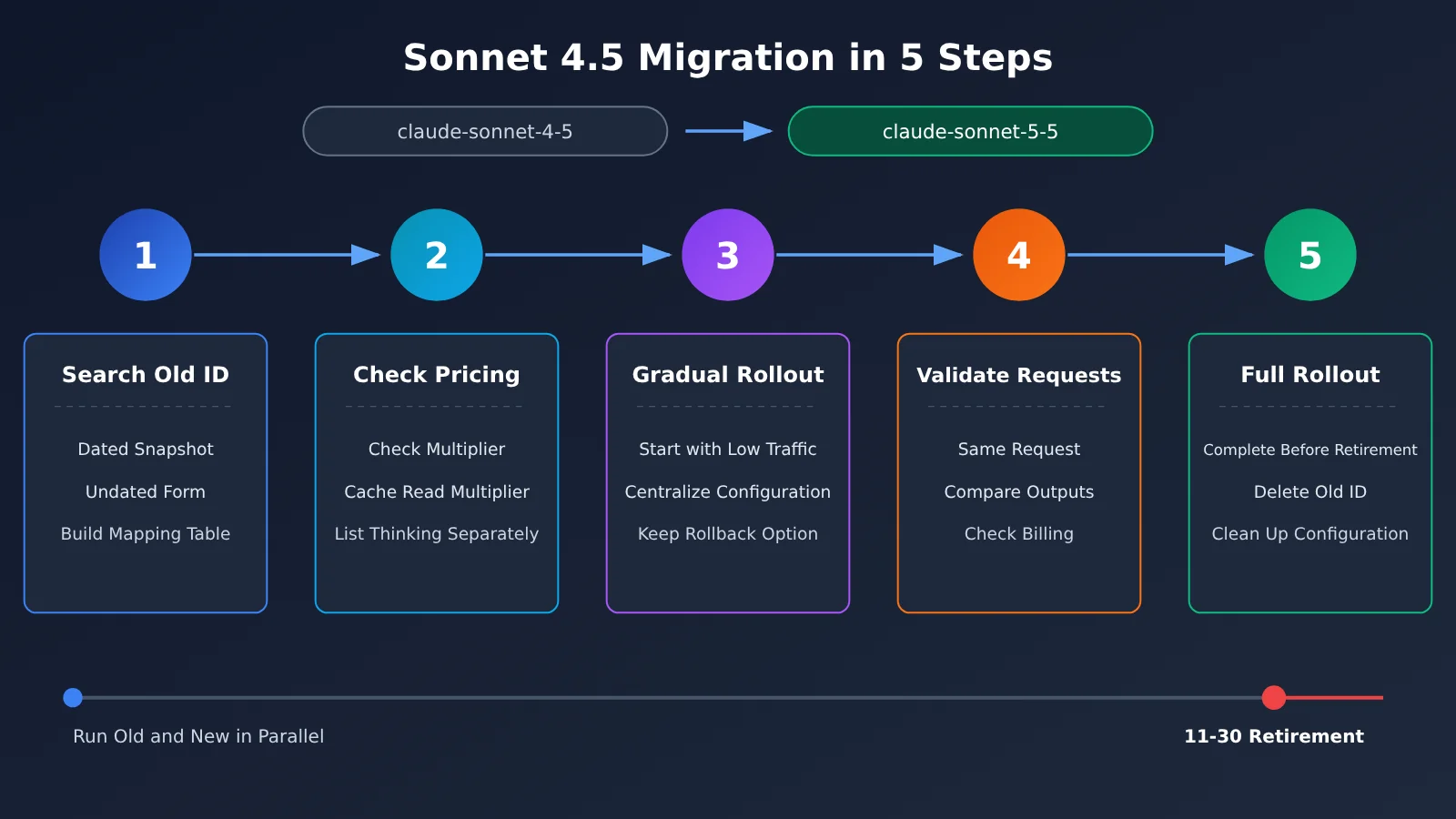
Recommended Five-Step Migration Sequence
- Search the codebase for old IDs: Search your codebase, configuration center, CI scripts, and gateway configuration for
claude-sonnet-4-5. Include both dated and undated versions, and compile the results into a list. - Verify pricing for the new models: Check the platform’s model list for the current multipliers for
claude-sonnet-5-5and its thinking variant. Update your cost estimates and alert thresholds. - Gradually shift some traffic: Start by routing noncritical workloads or a small portion of requests to the new ID. Keep the old ID handling the remaining traffic, and monitor error rates and output quality.
- Test both models with the same request: Send a fixed test request to the old and new models, then confirm that the responses, usage, and billing meet expectations (see the next section).
- Complete the full migration before retirement: Finish the full migration before 2026-11-30, and remove the old ID from your code and configuration to prevent overlooked paths from failing after retirement.
Validate the Migration with the Same Request
The key to validation is using “the same request”: keep the system prompt, user message, and max_tokens fixed, send them to both the old and new models, and compare the following:
- Returned
modelfield: Confirm that the model in the response isclaude-sonnet-5-5, rather than a different model substituted by a default or fallback. usagefields: Compareprompt_tokensandcompletion_tokens. If the response includes cache-related fields, record those too to verify whether caching is working.- Business output: Check the results against your own evaluation criteria. For example, confirm that structured output passes JSON validation and that tool calls use the correct format. Use regression tests for your tasks to assess any capability differences.
- Billing details: Find the request in the usage records in the APIYI apiyi.com console and verify that the charge matches the new multiplier.
Repeat the same test request the next day to check whether the cache is being hit after it’s rebuilt. Once validation passes, increase the percentage of traffic routed to the new model.
Frequently Asked Questions
Q1: Which specific model does the Sonnet 4.5 retirement refer to?
Anthropic’s retirement page lists `claude-sonnet-4-5-20250929` as Deprecated, with an announcement date of 2026-09-30 and a retirement date of 2026-11-30. We also recommend migrating any usage of the undated `claude-sonnet-4-5` alias to avoid failed requests after retirement.
Q2: What should I watch out for when migrating from Sonnet 4.5 to Sonnet 5.5?
There are three main changes at the engineering level: update the model ID to `claude-sonnet-5-5`; input, output, and cache-read prices are all lower; and the cache-read multiplier changes from 0.1 to 0.05. Whether the model meets your needs depends on your use case, so run regression tests with your own tasks. This article doesn’t claim that it’s a comprehensive replacement.
Q3: Can I keep calling claude-sonnet-4-5 before the retirement date?
As of 2026-11-10, both `claude-sonnet-4-5` and `claude-sonnet-4-5-20250929` are still listed on the platform and can be called. This is a good time to run the old and new models in parallel for comparison, but don’t wait until the retirement date to switch.
Q4: Which workloads will see the biggest billing changes after migrating to Sonnet 5.5?
Workloads with a high cache-read share will see the biggest changes, for example:
– **Customer support or assistants with long system prompts**: Every request hits the cache for the same long prompt.
– **Long-document Q&A**: The same document is queried repeatedly.
– **Multi-turn Agent tasks**: A large amount of context is reused across turns.
Q5: How can I quickly switch to claude-sonnet-5-5 through the API?
After registering with APIYI and getting an API key, keep your OpenAI-compatible calling method as-is, point `base_url` to the address provided in this article, and change `model` to `claude-sonnet-5-5`. New users can use the free trial credits to run acceptance tests first.
Q6: How is the thinking variant priced?
`claude-sonnet-5-5-thinking` is listed as a separate entry in the pricing endpoint, with a multiplier that’s separate from the base model. The price conversion in this article covers only the base `claude-sonnet-5-5` model. Check the platform’s model list for the current pricing of the thinking variant—don’t apply the base model’s price to it.
Q7: What are the known migration risks?
There are three main risks: hard-coded old IDs that are missed will fail once the model is retired; the cache needs to be rebuilt after switching, so the hit rate may be low at first; and output style or format may differ, requiring regression tests for downstream systems that rely on strict format parsing. A gradual rollout and a fixed set of acceptance tests can address most of these risks.
Sonnet 4.5 to Sonnet 5.5 Migration: Key Takeaways
- Retirement date confirmed:
claude-sonnet-4-5-20250929will be retired on 2026-11-30. The official recommendation is to switch toclaude-sonnet-5-5. - Both models are available for gradual rollout: As of 2026-11-10, both models are listed on the platform, so you can compare them side by side.
- All three unit prices have changed: Based on the pricing ratios, input drops from $3 to $2, output from $15 to $10, and cache reads from $0.30 to $0.10.
- Cache reads see the biggest change:
cache_ratiodrops from 0.1 to 0.05, so businesses with a high cache-read share will see a more noticeable difference. - Thinking is priced separately:
claude-sonnet-5-5-thinkingis a separate listing and shouldn’t be combined with the base model’s pricing. - Validate with the same request: Check the
modelfield,usagedetails, and billing breakdown. Use your own task regression tests to assess capability differences.
Summary
Key steps for migrating from Sonnet 4.5 to Sonnet 5.5:
- Update the IDs first: Map
claude-sonnet-4-5andclaude-sonnet-4-5-20250929toclaude-sonnet-5-5, and map the reasoning branch to the thinking variant. - Recheck pricing: Re-estimate input, output, and cache-read costs using
model_ratio,completion_ratio, andcache_ratio. - Validate the migration: After the gradual rollout, use the same request to check the returned model, usage, and charges. Remove the old IDs before their retirement date.
There are about 20 days left until 2026-11-30. We recommend completing a global search and switching your test environment this week, leaving time for business regression testing. If you need to compare the old and new models, you can use one key on APIYI apiyi.com to make calls and verify usage. Refer to the platform’s model list for the current model names and prices.
📚 References
- Anthropic model deprecations page: Claude model deprecation and retirement schedule
- Link:
platform.claude.com/docs/en/about-claude/model-deprecations -
Note: Confirms the status, announcement date, retirement date, and official replacement recommendation for
claude-sonnet-4-5-20250929. -
APIYI public pricing API: Source of model multiplier data
- Link:
api.apiyi.com/api/pricing - Note: Retrieved on 2026-11-10; includes the
model_ratio,completion_ratio, andcache_ratiofields.
Author: APIYI Technical Team
Technical support: If you run into issues during migration, contact us from the APIYI website homepage. For more integration resources, visit the documentation center at docs.apiyi.com.