
Author’s note: Starting with the news that enterprise customers now account for more than half of OpenAI’s revenue, this article draws on a Harness survey and the “cost per successful task” metric to break down five steps for enterprise AI procurement and cost governance.
On November 4, 2026, OpenAI President Greg Brockman said at the WSJ Tech Conference that more than half of OpenAI’s revenue now comes from enterprise business. He also noted that consumer revenue is still growing—enterprise revenue is just growing faster. Meanwhile, several industry surveys show that enterprise AI bills are rising faster than expected.
This isn’t another ChatGPT plan comparison. Reuters and TechCrunch have already reported Brockman’s remarks, and Harness’s FinOps survey provides sample data on enterprise AI bills spiraling out of control. For businesses, the hard part is no longer just “which model should we buy?” It’s managing multiple vendors, growing model invocation costs, and the true cost of each task—all at once.
What you’ll take away: You’ll learn about the main pricing models for enterprise ChatGPT purchases and get a five-step framework for AI procurement and cost governance, from defining tasks to evaluating results.
ChatGPT Enterprise Purchasing: Key Facts at a Glance
Let’s start with the key facts. One important distinction: “more than half of OpenAI’s revenue comes from enterprise” describes OpenAI’s own revenue mix. It’s not the same measure as enterprise API market share in industry reports, so the two shouldn’t be confused.
| Item | Details |
|---|---|
| Announcement date | November 4, 2026 (U.S. local time), at the WSJ Technology Conference |
| Announced by | Greg Brockman, OpenAI co-founder and president |
| Key takeaway | Enterprise revenue accounts for more than half of OpenAI’s total, compared with an earlier split of roughly 30% enterprise and 70% consumer |
| Growth drivers | The enterprise business doubled in size in the third quarter, with Codex, ChatGPT Work, and GPT-5.6 Sol cited as key factors |
| Industry context | Menlo Ventures estimated that enterprise AI spending averaged 4.7 times the previous year’s level, while companies had originally expected roughly 1.9 times |
| Areas affected | Enterprise purchasing, budget management, multi-model access, and API cost management |
Three Common Ways to Buy ChatGPT for Business
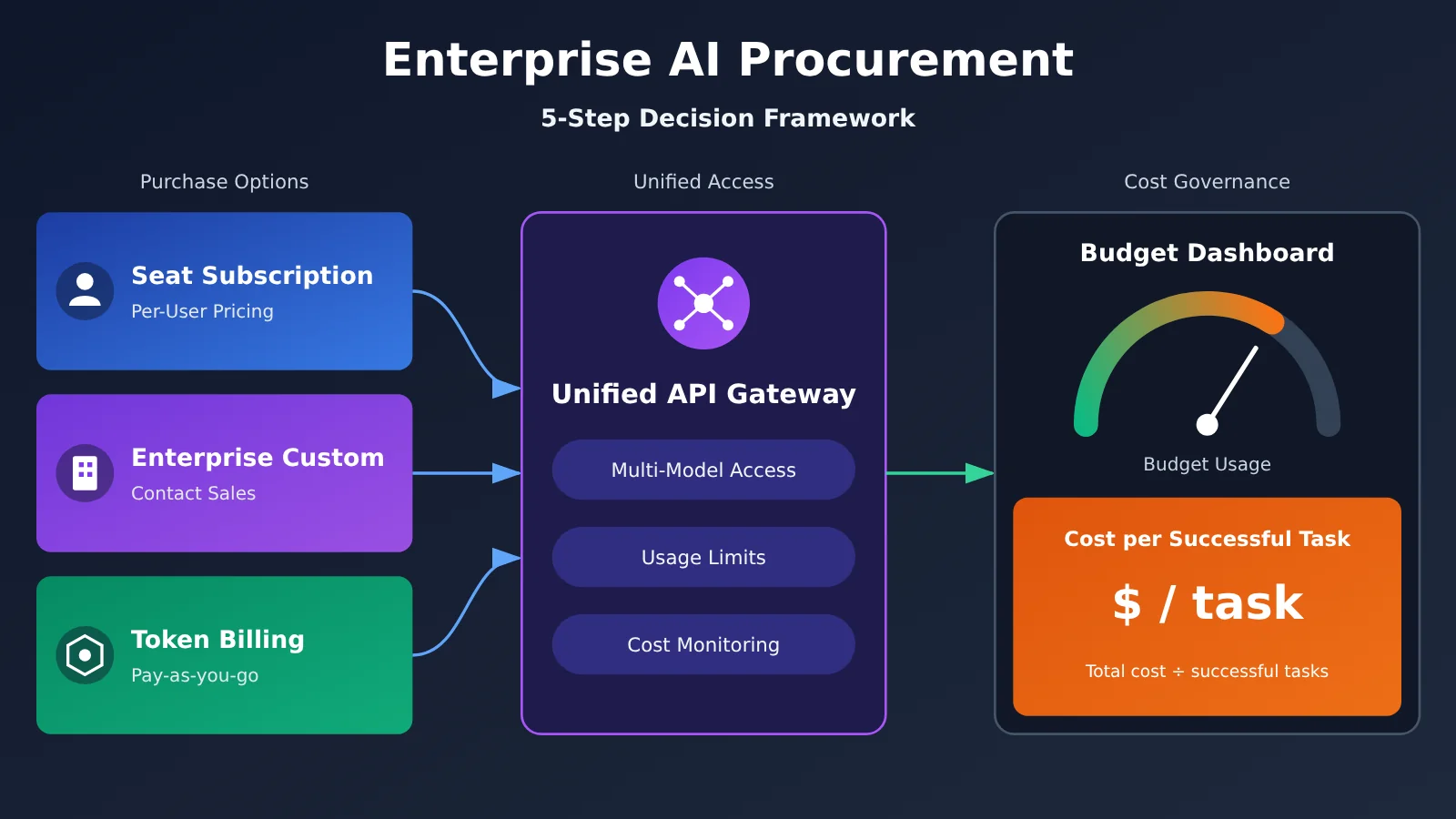
Based on publicly available pricing, businesses have roughly three purchasing paths. ChatGPT Business is aimed at teams of 2–200 people. Standard seats cost about $20 per person per month when billed annually, or $25 per month when billed monthly. Premium seats offer roughly five times the usage allowance of Standard seats. ChatGPT Enterprise requires a custom quote from sales and includes SCIM, EKM, RBAC, data residency, SLAs, and custom legal terms. It can also use credit-based or token-based billing.
The third path is to buy API access directly on a per-token basis. API access and ChatGPT subscriptions have separate billing systems. API charges are based on actual input, output, and cached tokens, with different modes and context lengths also affecting the final cost. In October 2026, OpenAI offered promotional API credits to eligible Business workspaces, but those credits were separate from ChatGPT usage allowances—another reason to manage seat and API costs separately.
Why Enterprise AI Procurement Keeps Going Over Budget
If you look only at unit prices, AI may not seem expensive. But the bills companies actually receive often look very different from what they expected. For its State of AI in FinOps 2026 report, Harness surveyed 700 engineering leaders and practitioners in May and June 2026. The survey covered the US, UK, France, Germany, and India, and all respondents worked at companies with more than 1,000 employees.
The survey found that 67% of organizations spend more than $250,000 a month on AI, and 20% spend more than $1 million. Eighty percent said their total AI spending had increased over the previous six months, and 78% expected it to keep growing. The problems exposed in bill management are even more revealing:
| Harness survey finding | Percentage | Procurement issue |
|---|---|---|
| Have encountered an unexpected AI bill | 72% | Budgets are disconnected from actual usage |
| Have no clear owner for AI costs | 52% | Cost accountability is unclear |
| Say AI budgeting is mostly guesswork | 56% | Historical usage data is lacking |
| Often worry about the next token bill | 47% | Usage lacks effective limits |
| Need at least a day to identify a cost anomaly | 79% | Monitoring and alerts lag behind |
| Need a week to identify a cost anomaly | 32% | Bills from multiple platforms are difficult to consolidate |
Another comparison makes the problem even clearer: 73% of companies have established AI cost policies, but only 13% have basic cost visibility. In other words, policies exist on paper, but enforcement and monitoring haven’t kept up. It’s worth noting that Harness is itself a FinOps tool vendor, and its sample was limited to companies with more than 1,000 employees in five countries. The findings are therefore more useful as a reference for midsize and large enterprises than as industry-wide statistics.
Agents Decouple Token Consumption From Headcount
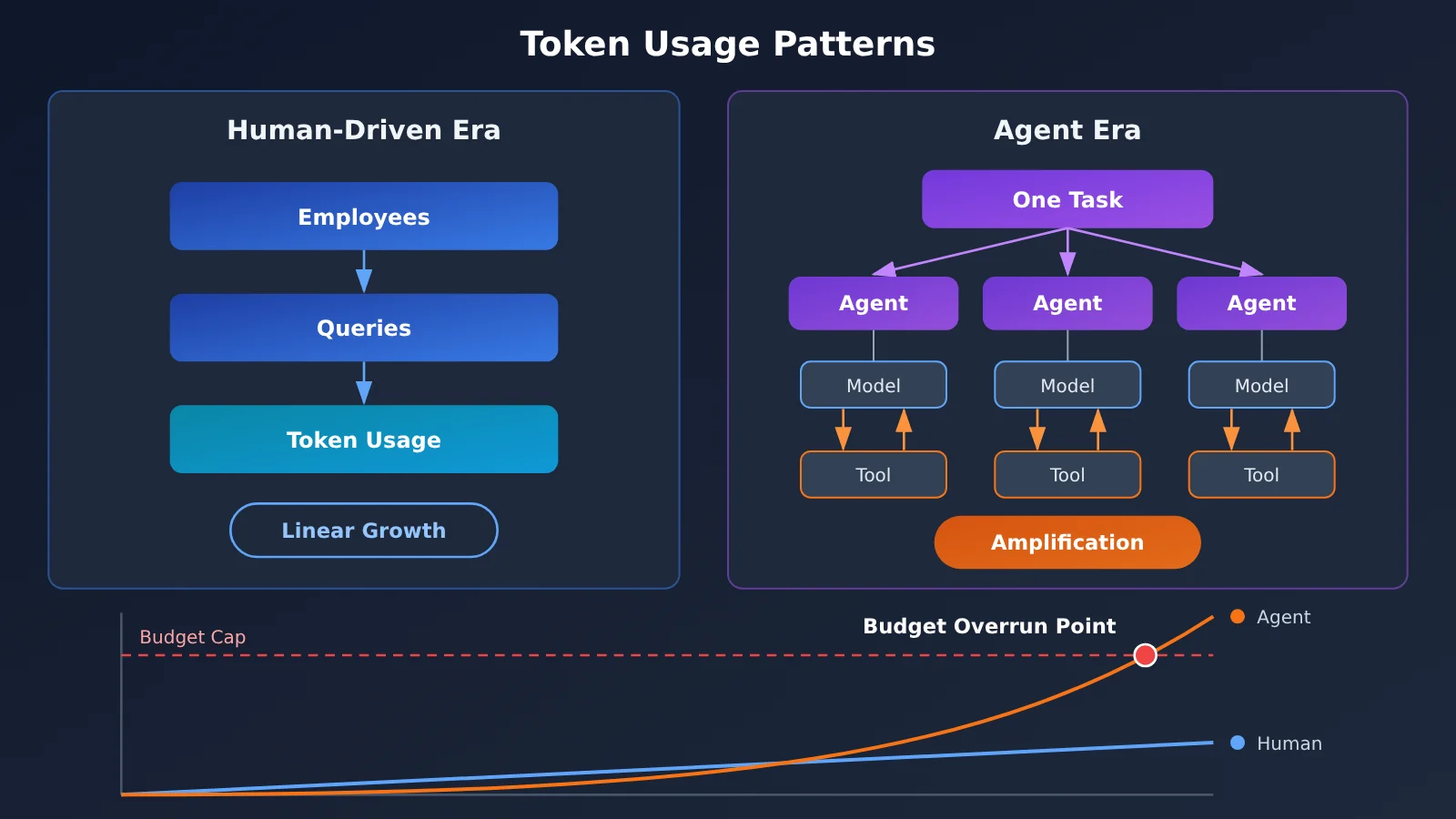
Traditional SaaS procurement is priced per user, so budgets are relatively manageable. Agents change that equation: Menlo Ventures’ analysis of OpenRouter data shows that agents now account for about 80% of token consumption on the platform. Agent traffic has grown roughly 37-fold since overtaking human-driven traffic in February 2026. Menlo also points to agents running in parallel and continuously in the background as a major reason enterprise spending exceeds budgets.
These figures have limitations too: OpenRouter’s user base skews toward developers and startups, so it doesn’t represent the entire industry. But the trend is clear. Token consumption increasingly depends on the number of tasks, the degree of parallelism, and execution time—not just the number of employees. According to Axios, more than 60% of Codex users run multiple tasks simultaneously at some point during the day. That’s exactly what makes bills hard to predict.
Why Enterprise ChatGPT Procurement Is Moving Toward Multiple Models
Many enterprises start by buying from a single vendor, but quickly find that one model can’t cover every task. In a Harness survey, 69% of enterprises reported using OpenAI in production, 58% used Azure OpenAI, 53% used Google Vertex AI, 41% used AWS Bedrock, and 37% used Anthropic. These percentages can overlap: they indicate that most enterprises use multiple platforms, not market share, and shouldn’t be added together.
A preprint published on arXiv in July 2026, The Multi-Lab Enterprise, offers a similar signal: 81% of the world’s top 2,000 enterprises use three or more model families, and 79% have exceeded their AI budgets. Even enterprises with mature FinOps practices overspent by an average of 30.9%. However, the preprint hasn’t been peer-reviewed, so it should be treated as a research lead rather than a standalone basis for decisions.
Multi-model procurement creates practical challenges. Billing units, invoice formats, and usage metrics vary across platforms, making it hard for finance teams to allocate costs by department or project. Technical teams also struggle to compare model performance using a consistent set of metrics. That’s where a unified API access layer comes in: it brings multiple providers’ models together under one interface and one usage report.
Enterprise ChatGPT Procurement Options Compared
| Procurement option | Billing model | Best suited for | Governance priorities |
|---|---|---|---|
| ChatGPT Business seats | Billed per user per month; Standard and Premium can be combined | Day-to-day office and knowledge work for teams of 2–200 people | Seat utilization, reclaiming unused seats |
| ChatGPT Enterprise contract | Custom pricing, with Credit or Token billing options | Large organizations with compliance, data residency, or SLA requirements | Contract terms, usage against allowances |
| Model API billed by Token | Billed for input, output, and cached Tokens | Custom applications, Agent workflows, batch jobs | Cost per task, unusual invocations, retry rates |
| Cloud platform model services | Included in the cloud bill | Enterprises already heavily invested in a cloud provider | Cross-cloud cost allocation |
| Partner integrations | Project-based pricing or service fees | Organizations that need process redesign and systems integration | Linking deliverables to business metrics |
Cost per Successful Task: Token Pricing Isn’t the True Cost
The most common mistake companies make when comparing prices is looking only at the cost per million tokens. Imagine two models: Model A is cheaper per call, but it takes multiple retries to complete a task, and its inconsistent output requires extensive human review. Model B costs more per call, but succeeds on the first try more often and takes less time to review. Once you calculate the cost per deliverable, Model A may actually be more expensive.
A more useful purchasing metric is Cost per Successful Task. It adds up model fees, tool costs, failed retries, and human review, then divides the total by the number of tasks successfully delivered. The cheapest model isn’t automatically the best choice. What matters is which one has the lowest overall cost for your tasks.
| Cost component | What it includes | Why it’s often overlooked |
|---|---|---|
| Model invocation cost | Input, output, and cached token fees | Price is considered without usage volume |
| Tool invocation cost | Fees for retrieval, code execution, external APIs, and more | Spread across other bills |
| Failed retry cost | Reruns after timeouts, formatting errors, or substandard output | Logs don’t distinguish first attempts from retries |
| Human review cost | Employee time spent checking, editing, and reworking output | Not included in the IT budget |
| Task duration | Total time from initiation to delivery | Only model latency is measured |
| Task success rate | Percentage of tasks ready to deliver on the first attempt | Business-side acceptance criteria are missing |
This is especially clear in agent scenarios. Axios reported on Stanford Graduate School of Business professor Andrew Hall’s use of Claude Code to update an old paper. The agent collected data, performed analysis, and created charts, but subsequent human review uncovered errors in the data and code. Human oversight is a real cost, and ignoring it can lead to a serious underestimate of AI’s total cost.
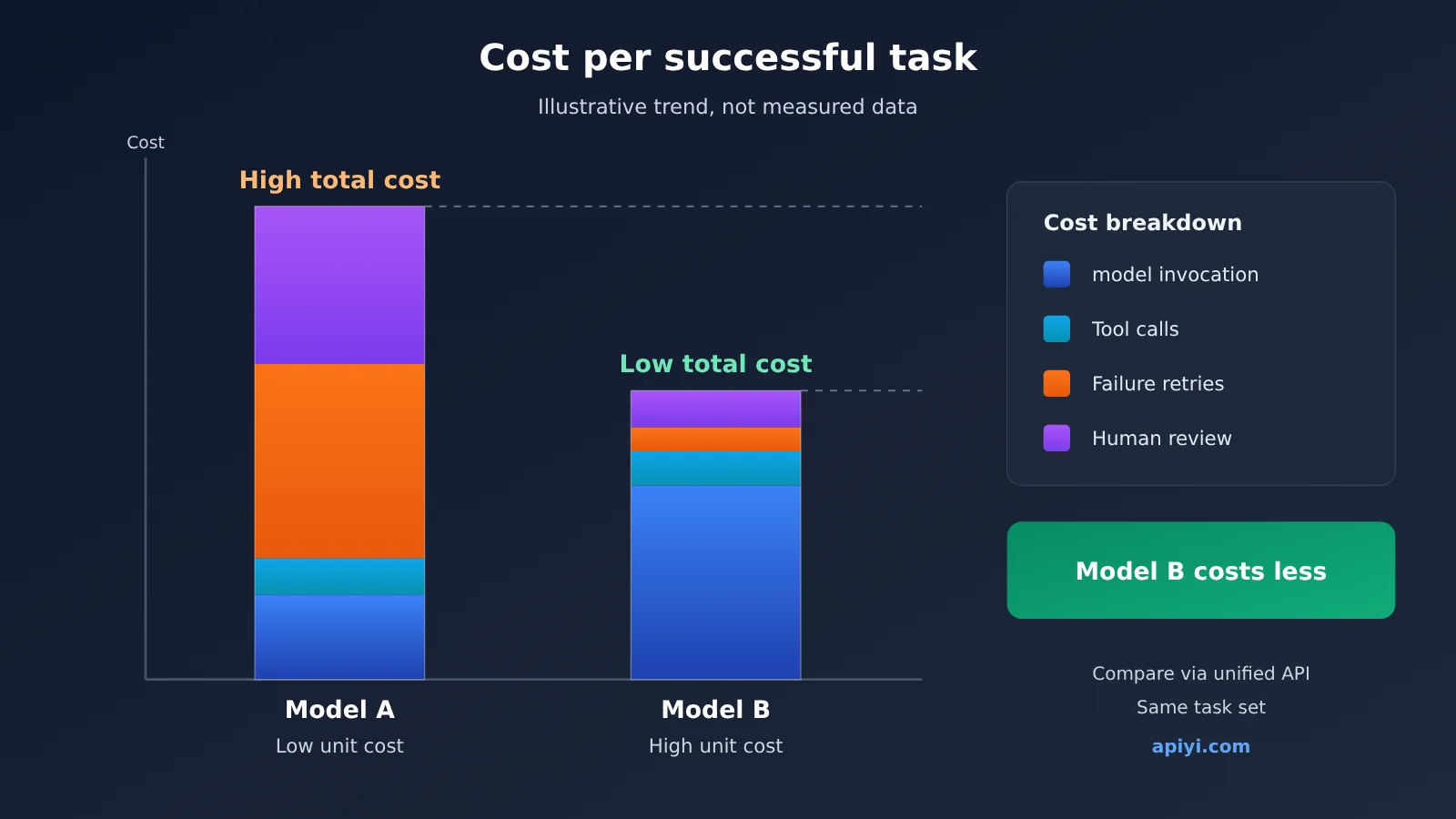
The chart illustrates a common pattern, not measured results for two specific models. For an actual evaluation, run different models on the same set of real business samples, then calculate costs using the criteria in the table above. A unified interface platform like APIYI, apiyi.com, lets you switch models using the same code, reducing the engineering work needed for comparison testing.
How to Calculate Per-Task Costs for Enterprise ChatGPT Procurement
The example below shows how to record token usage for each call, providing the data needed to calculate cost per successful task:
import openai

client = openai.OpenAI(
    api_key="YOUR_API_KEY",
    base_url="https://api.apiyi.com/v1"
)

resp = client.chat.completions.create(
    model="your-model-id",  # Check the platform's model list for the model ID
    messages=[{"role": "user", "content": "总结这份合同的关键风险条款"}]
)
print(resp.choices[0].message.content)
print("输入 Token:", resp.usage.prompt_tokens, "输出 Token:", resp.usage.completion_tokens)
See the full implementation: Track costs by department and calculate per-task costs
import openai
from collections import defaultdict

client = openai.OpenAI(
    api_key="YOUR_API_KEY",
    base_url="https://api.apiyi.com/v1"  # Unified interface; change only the model parameter to switch models
)

# Enter the prices for your purchased models, in USD per million tokens
PRICE = {
    "model-a-id": {"input": 0.0, "output": 0.0},
    "model-b-id": {"input": 0.0, "output": 0.0},
}
REVIEW_COST_PER_MIN = 0.0  # Human review cost per minute, based on your company's labor costs

ledger = defaultdict(lambda: {"cost": 0.0, "tasks": 0, "success": 0})

def run_task(dept: str, model: str, prompt: str, validator, max_retry: int = 2):
    """Run a task, record model costs and retries, and return whether it succeeded."""
    key = (dept, model)
    ledger[key]["tasks"] += 1
    for _ in range(max_retry + 1):
        resp = client.chat.completions.create(
            model=model,
            messages=[{"role": "user", "content": prompt}],
        )
        u = resp.usage
        p = PRICE[model]
        ledger[key]["cost"] += (u.prompt_tokens * p["input"]
                                + u.completion_tokens * p["output"]) / 1_000_000
        if validator(resp.choices[0].message.content):
            ledger[key]["success"] += 1
            return True
    return False

def add_review(dept: str, model: str, minutes: float):
    """Add human review time to the cost."""
    ledger[(dept, model)]["cost"] += minutes * REVIEW_COST_PER_MIN

def report():
    for (dept, model), d in ledger.items():
        cpst = d["cost"] / d["success"] if d["success"] else float("inf")
        rate = d["success"] / d["tasks"] if d["tasks"] else 0
        print(f"{dept} | {model} | 成功率 {rate:.0%} | 每个成功任务成本 ${cpst:.4f}")
🚀 Getting started: Before signing an annual contract, run a small-scale assessment using real business samples for two to four weeks. Register at APIYI apiyi.com to receive free testing credits and use one API key to call leading models, including OpenAI, Claude, and Gemini. This makes it easy to compare per-task costs across models in a single usage report.
A 5-Step Decision Framework for Enterprise ChatGPT Procurement
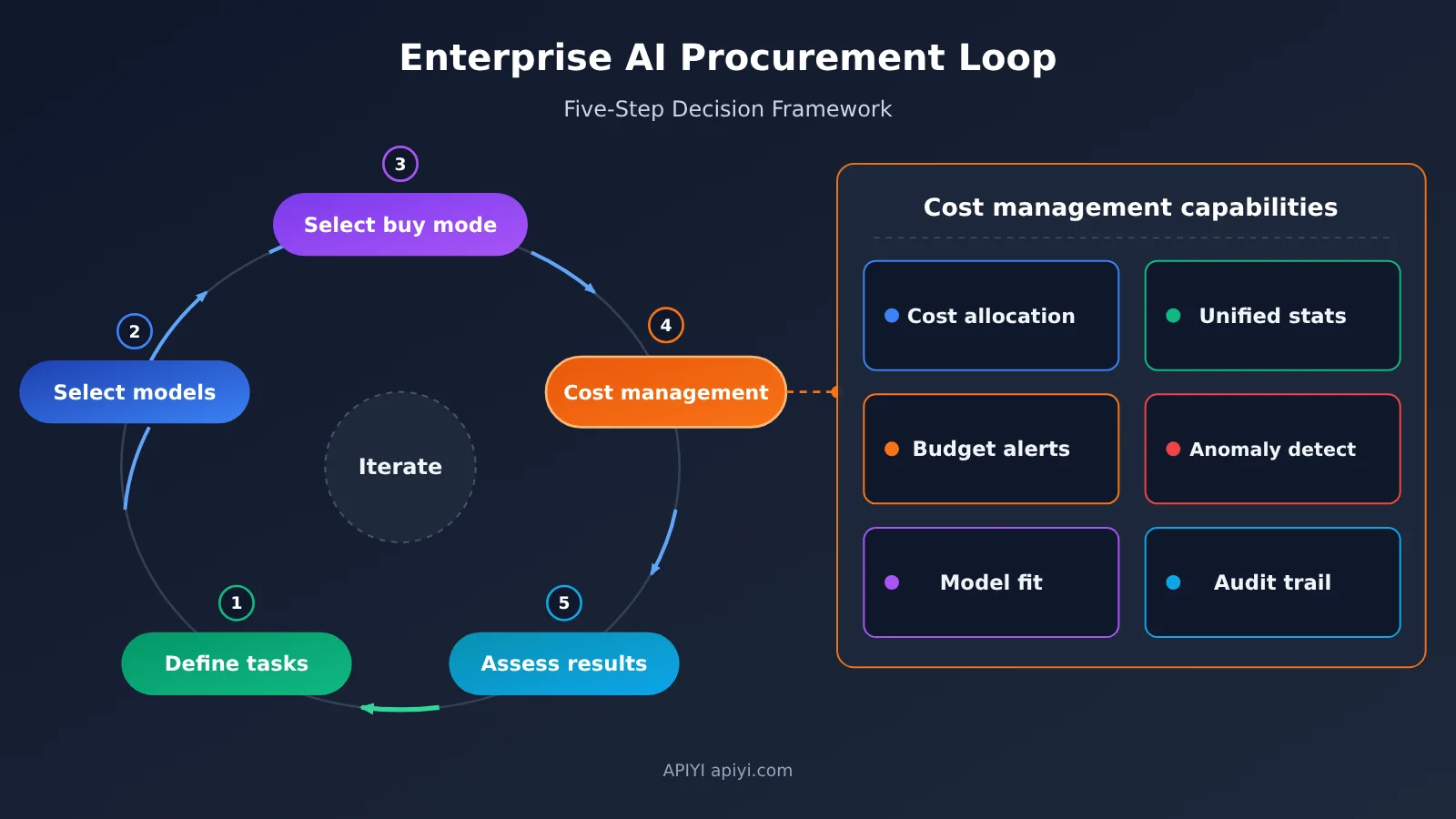
To put the discussion into practice, enterprises can follow five steps when purchasing AI. Each step has a clear deliverable, helping prevent the budget overruns that come from buying first and asking questions later.
| Step | Key question | Deliverable | Useful tools |
|---|---|---|---|
| 1. Define tasks | Which tasks should AI handle, and which require a human? | Task list and acceptance criteria | Business interviews, process mapping |
| 2. Select models | What are the requirements for accuracy, reasoning, latency, and security? | Candidate models for each task type | Side-by-side testing on a unified interface platform such as APIYI apiyi.com |
| 3. Choose a procurement method | Per-seat pricing, API usage-based pricing, or a custom enterprise contract? | Procurement mix | Vendor quotes, contract terms |
| 4. Manage costs | How are actual usage, budgets, anomalies, and success rates tracking? | Budget warning and anomaly alert rules | Usage statistics, invocation logs |
| 5. Evaluate results | Has AI actually improved business outcomes? | Business metrics review report | Pilot data, financial analysis |
The Steps in Detail: From Tasks to Results
The first and fifth steps are the easiest to skip, but they determine whether the whole procurement effort pays off. Credit Saison’s approach offers a useful reference: it ran a ChatGPT Enterprise pilot with 315 people for just over a month before deciding whether to roll it out company-wide. The company reported a pilot ROI of 954% and approximately 14 hours saved per participant each month. Keep in mind, though, that these figures come from an OpenAI-published customer story and company-reported data—not an independent audit—and they aren’t industry averages.
The third step usually isn’t an either-or decision. A common mix is to give knowledge workers Business or Enterprise seats while using usage-based API pricing for development teams and automated workflows. The fourth step should cover several capabilities identified in the Harness survey:
- Cost attribution: Break down AI spending by department, team, and project so there’s clear ownership of costs
- Unified reporting: Consolidate bills from different vendors using a consistent accounting framework
- Budget alerts: Set usage thresholds to catch overspending before the end of the month
- Anomaly detection: Spot unusual token consumption and infinite agent loops promptly
- Model selection: Use lightweight models for simple tasks and higher-end models for complex ones
- Audit trails: Keep invocation logs, task results, and audit records
How ChatGPT Enterprise Procurement Affects Businesses and the Industry
Impact on Enterprise Technology Leaders
- Budget models need a rethink: Agents decouple token consumption from headcount, so budgeting per employee will systematically underestimate spending
- Evaluation metrics need to evolve: Instead of comparing token prices, teams should compare the cost per successful task
- Architectures need room to switch: Using multiple models is now common, so business code shouldn’t be tightly coupled to a single vendor’s SDK
Impact on AI Procurement and Finance Teams
- Procurement is more complex: Seats, Credits, tokens, cloud platforms, and partner services may all be part of the mix
- Someone needs to own costs: In the Harness survey, more than half of organizations lacked a clearly designated cost owner
- There’s new leverage in contract negotiations: Clear usage data provides a foundation for negotiating volume discounts and token-based pricing
Impact on the Industry
More than half of OpenAI’s revenue comes from enterprise customers, suggesting that Large Language Model providers are increasingly focused on the enterprise market. Enterprise security, data residency, and SLAs will become key areas of competition. At the same time, Menlo’s estimates of enterprise API spending share show that multiple providers coexist. This means that “middleware” capabilities such as model access, routing, usage tracking, and budget control will become increasingly important. This is a trend assessment, though, and doesn’t mean that any individual provider has already grown as a result.
Frequently Asked Questions
Q1: How is buying ChatGPT for a company different from buying Plus as an individual?
Enterprise procurement isn’t just buying individual accounts in bulk. ChatGPT Business and Enterprise offer centralized billing, SSO, permissions management, usage analytics, and a default policy of not using business data for training. Enterprise also includes data residency, an SLA, and custom legal terms. In short, these are business products with organizational governance features.
Q2: If we buy ChatGPT Enterprise, do we still need to purchase API access separately?
Usually, yes. ChatGPT seats are for employees to use interactively, while the API is for custom applications and automated workflows. They’re billed separately. If your development team plans to build agents or run batch jobs, consider using the free credits at APIYI apiyi.com to measure actual token consumption before deciding on an API budget.
Q3: Does OpenAI getting more than half its revenue from enterprises mean it has half of the enterprise API market?
No. Brockman was describing OpenAI’s own revenue mix, while Menlo Ventures estimated each vendor’s share of spending across the entire enterprise API market. They’re different measures. Brockman also didn’t disclose an exact percentage, and enterprise revenue isn’t the same as API revenue.
Q4: How can a company quickly set up a cost comparison across multiple models?
Prepare a set of real business samples and run them through different models using the same code. Record token usage, retries, human review time, and success rates. With the OpenAI-compatible interface from APIYI apiyi.com, you can switch models by changing the base_url and model parameters and track usage in one place.
Q5: Is the cheapest model always the best value?
Not necessarily. If a low-cost model has a low success rate or requires multiple retries or substantial human rework, its overall cost per successful task may be higher. Use Cost per Successful Task as your benchmark, and choose models based on the task.
Q6: What are the limitations of the survey data cited in this article?
The Harness survey covered 700 respondents across five countries at companies with more than 1,000 employees, and it was published by a FinOps vendor. *The Multi-Lab Enterprise* is a preprint that hasn’t been peer-reviewed. Menlo’s spending and market-share figures are estimates, while Credit Saison’s ROI figures are self-reported case data. These sources are useful for spotting trends, but shouldn’t be treated as industry benchmarks.
ChatGPT Enterprise Procurement: Key Takeaways
- Revenue is shifting toward enterprise: Enterprise customers now account for more than half of OpenAI’s revenue, while its consumer business continues to grow.
- Unexpected bills are common: In a Harness survey, 72% of companies reported receiving unexpected AI bills.
- Multi-model use is the norm: Most companies use multiple platforms, so usage percentages can’t be added together as market shares.
- Unit price isn’t total cost: Make decisions based on cost per successful task, not price per million tokens.
- Agents amplify consumption: Parallel and background execution mean token usage no longer scales directly with employee headcount.
- Procurement needs a five-step process: Define tasks, select models, choose a procurement method, govern costs, and evaluate results.
- Test before signing: Use APIYI apiyi.com’s unified interface to estimate costs with real samples.
Summary
The key points for ChatGPT enterprise procurement:
- Procurement is a mix-and-match decision: Business seats, custom Enterprise contracts, and token-based API billing each suit different scenarios. Most companies need a combination.
- Cost governance is harder than model selection: Cost attribution, consolidated reporting, budget alerts, and anomaly detection determine whether AI spending stays under control.
- Use task cost as the core metric: Include retries, tool calls, and human review to make procurement decisions that are genuinely cost-effective.
For technical leaders and procurement teams setting AI budgets, a safer approach is to start with a small pilot, collect actual usage data, and then sign a long-term contract. APIYI apiyi.com can help you quickly measure the cost per task for different models on your own workloads, with free testing credits and a unified interface for multiple models.
📚 References
- Reuters: OpenAI reports majority of revenue from enterprises: Brockman’s remarks at the WSJ Tech Live conference
- Link:
reuters.com/legal/transactional/openai-ready-ipo-2027-now-counts-majority-sales-enterprises-brockman-says-2026-11-05 -
Details: Enterprise revenue share, third-quarter growth, and comments on an IPO
-
Harness: State of AI in FinOps 2026: Survey of enterprise AI cost management
- Link:
harness.io/state-of-ai-in-finops-2026 -
Details: Unexpected bills, cost visibility, and multi-platform usage data
-
OpenAI Business Pricing: Official pricing page for ChatGPT Business and Enterprise
- Link:
openai.com/business/pricing -
Details: Seat types, enterprise features, and billing
-
Menlo Ventures: 2026 The State of Enterprise AI: Enterprise AI market research report
- Link:
menlovc.com/perspective/2026-the-state-of-enterprise-ai -
Details: Enterprise AI spending estimates, API market share, and agent consumption trends
-
The Multi-Lab Enterprise: Research preprint on governance in enterprises using multiple models
- Link:
arxiv.org/abs/2609.31622 - Details: Research findings on multi-model usage and budget overruns; not yet peer-reviewed
Author: APIYI Technical Team
Technical discussions: Contact us through the APIYI homepage at apiyi.com. For more integration resources, visit the documentation center at docs.apiyi.com.