
Author’s note: A look at OpenAI’s acquisition of Pierre, the company behind Code Storage, and the rollout of Codex to all tiers: which tools are involved, how existing users are affected, and where the AI coding agent toolchain may be headed.
OpenAI recently announced two developments that might not seem like much on their own, but together tell a bigger story. First, OpenAI announced its acquisition of Pierre Computer Company, the company behind Code Storage and several open-source developer tools. Second, alongside Images 2.6, it announced that Codex is available to all tiers across web, desktop, and mobile.
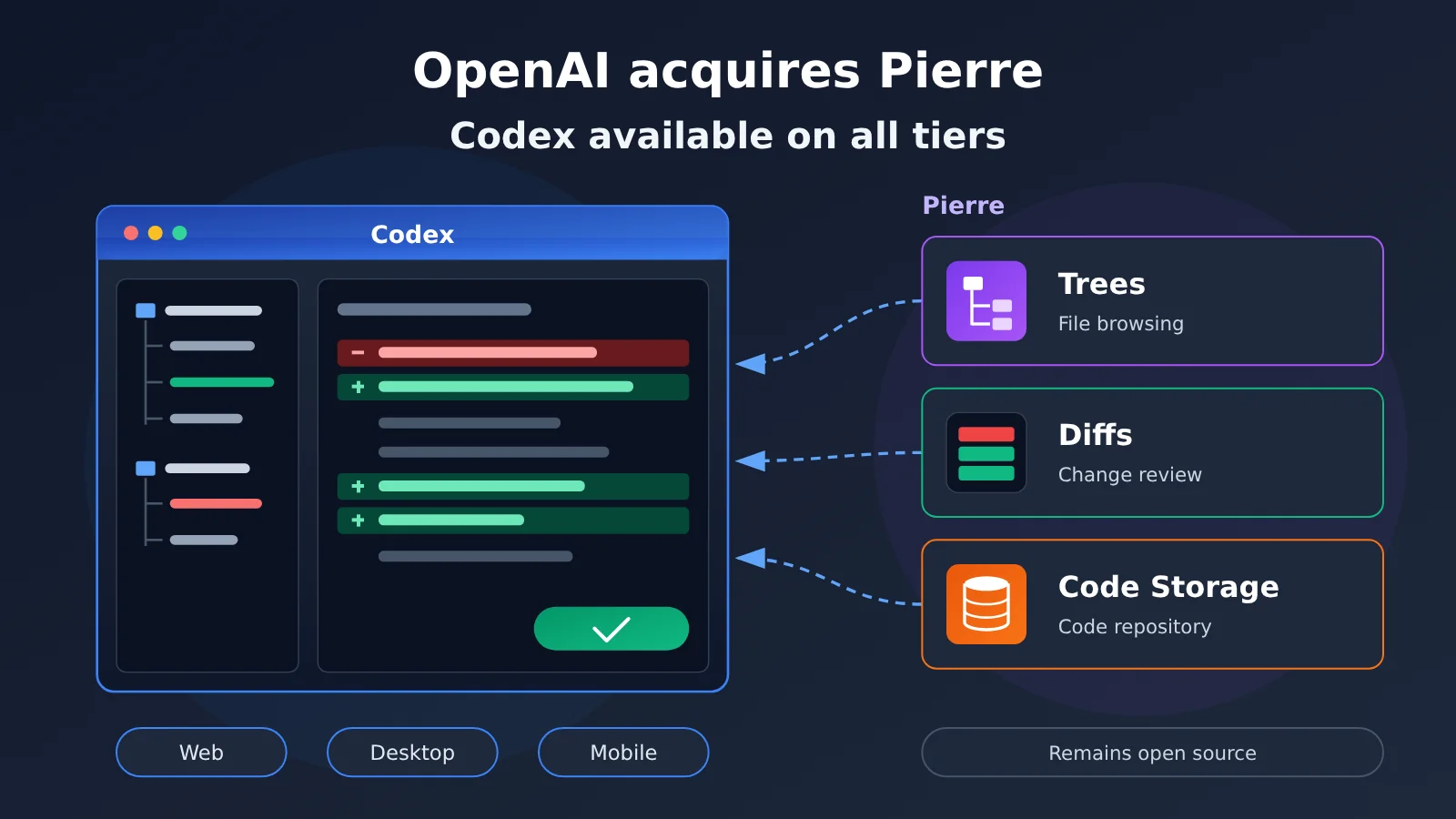
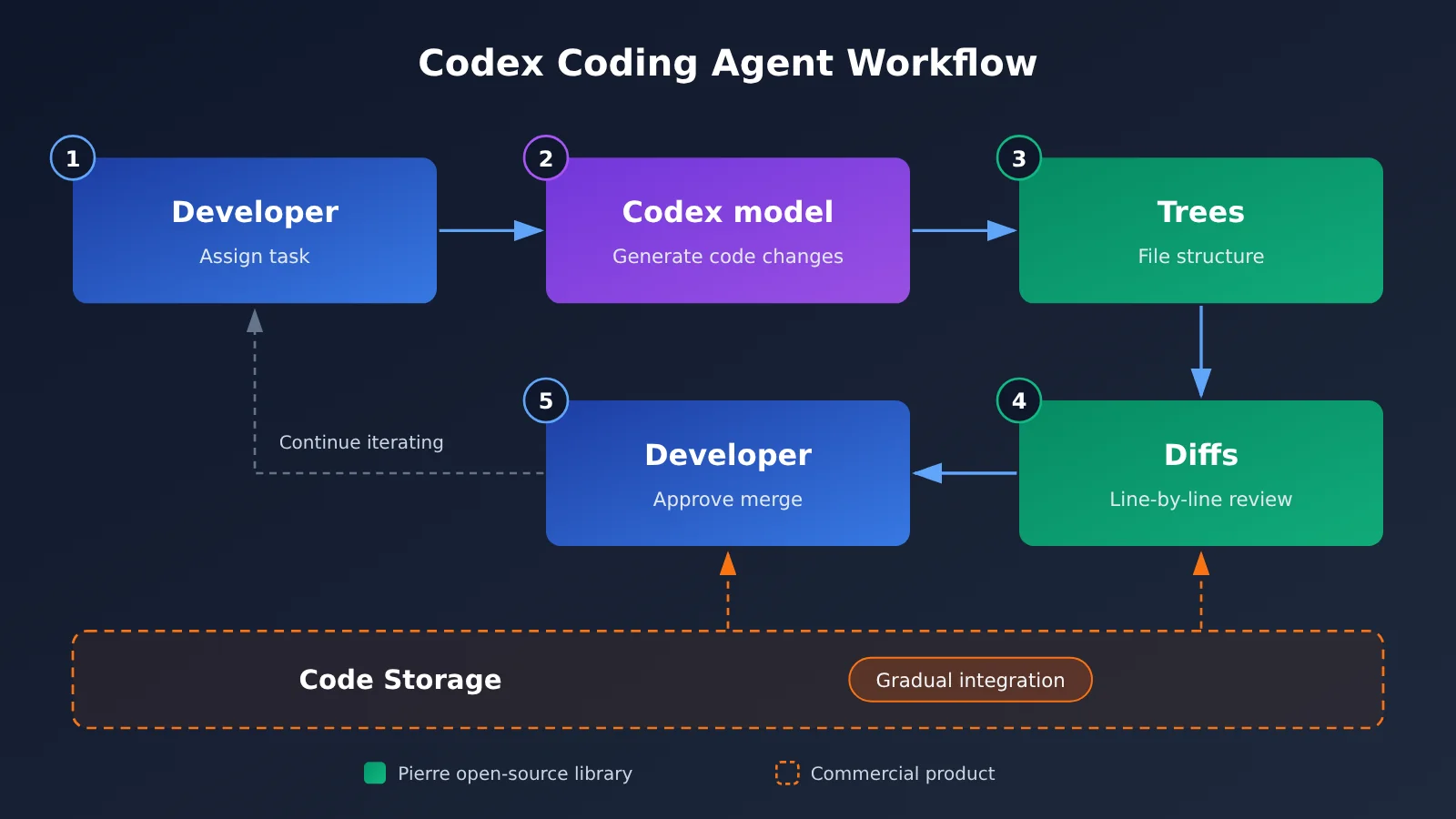
This is more than just an acquisition of a team and its products. Pierre’s Trees and Diffs libraries already power file browsing and code change review in the Codex app. The acquisition brings those underlying components, which Codex already relies on, in-house. This article covers the tools involved, what the deal means for different users before and after closing, and where we think the coding agent toolchain is headed.
What you’ll take away: You’ll understand what OpenAI’s acquisition of Pierre means for your open-source dependencies, your Code Storage account, and your day-to-day use of Codex.
OpenAI’s Acquisition of Pierre: Key Facts
Here’s a summary of the information made public so far. The sources are summaries of official announcements, and neither the deal value nor a specific timeline has been disclosed. Unknown details are marked accordingly below.
| Item | Details |
|---|---|
| Acquirer | OpenAI |
| Company being acquired | Pierre Computer Company (the company behind Code Storage and several open-source developer tools) |
| Components already used in Codex | Trees library (file browsing), Diffs library (code change review) |
| Future of open-source projects | Will remain open source after the deal closes |
| Code Storage customers | Can continue using the product; its features will gradually be integrated into Codex |
| Deal status | Pending regulatory approval; not yet closed |
| Deal value and timeline | Not publicly disclosed |
| Related developments | Codex is available across all tiers (web, desktop, and mobile); Images 2.6 has launched in ChatGPT |
What roles do Pierre’s Trees and Diffs play in Codex?
When working with a coding agent, developers frequently need to check which files the agent touched and review the code it changed. The first task calls for a file tree component that efficiently displays the project structure; the second needs a clear diff display and review component. According to the official announcement, these two capabilities in the Codex app are powered by Pierre’s Trees and Diffs libraries, respectively.
This highlights an easily overlooked point: the coding agent experience depends on more than a model’s ability to write code. When an agent changes a dozen or more files at once, a confusing review interface can make developers hesitant to merge. No matter how capable the model is, the process can stall at the human approval step. Trees and Diffs address precisely this part of human-agent collaboration, so OpenAI’s decision to bring in the team behind them makes sense.
| Pierre asset | Type | Role in Codex | Future after closing |
|---|---|---|---|
| Trees | Open-source library | File browsing in the Codex app | Remains open source |
| Diffs | Open-source library | Code change review in the Codex app | Remains open source |
| Other open-source developer tools | Open-source projects | Not individually specified in the announcement | Remain open source |
| Code Storage | Commercial product | Current integration status not specified in the announcement | Customers can continue using it; features will gradually be integrated into Codex |
Codex Opens to All Tiers: AI Coding Agents Become a Standard Feature
At the same time as the acquisition news, OpenAI announced that Codex is now available across all tiers on the web, desktop, and mobile. The announcement came alongside Images 2.6, with GPT-Image-2.6 Flare and Sunburst also becoming available through the API. For developers, though, the Codex news has a more direct impact.
“All tiers” means coding agents are no longer just an add-on for higher-tier subscriptions—they’re now a standard capability available to ChatGPT users. That said, the official summary didn’t specify differences in usage limits, task duration, or concurrency across tiers. These limits will likely vary, so check OpenAI’s official pages for the latest details rather than assuming every tier is identical when planning for your team.
Taken together, the two announcements show a clear direction: OpenAI is expanding access to Codex while strengthening its infrastructure for file browsing, change review, and even code storage. As the user base grows, the reliability of these “non-model” components becomes more important. Bringing them in-house ahead of time is a sensible way to prepare.
How OpenAI’s Acquisition of Pierre Affects Developers
Impact on Pierre Open-Source Project Users
If your project depends directly on Trees, Diffs, or Pierre’s other open-source tools, the official commitment is that they’ll remain open source after the acquisition closes. There’s no immediate need to look for alternatives; just keep up with releases as usual.
That said, “remaining open source” doesn’t mean “the roadmap won’t change.” After an acquisition, open-source libraries often evolve to better serve the acquirer’s products—for example, by prioritizing Codex use cases. Consider pinning versions in your dependency files, and watch for changes to repository licenses, maintainers, and issue response times.
Impact on Existing Code Storage Customers
According to the official announcement, Code Storage customers can continue using the product, and its features will gradually be integrated into Codex. Two points remain unclear: the timeline for that integration and whether Code Storage will remain available as a standalone product in the long term. Until those details are settled, it’s prudent to keep your data exportable and avoid tying critical workflows too closely to a single service.
| User type | Before closing (current) | After closing (official statement) | Open questions | Recommended action |
|---|---|---|---|---|
| Trees / Diffs open-source users | Available as usual | Will remain open source | Maintenance cadence and roadmap | Pin versions and monitor repository activity |
| Code Storage customers | Available as usual | Can continue using it; features will gradually be integrated into Codex | Integration timeline and whether the standalone product will remain available | Export data regularly and avoid tight dependencies |
| Codex users | Available on all tiers | Review and storage capabilities may improve | Usage limits for each tier | Plan usage based on the official pages |
| Users of other coding agents (Cursor, Cline, etc.) | No direct impact | No direct impact | Changes in the competitive landscape | Watch for similar improvements to review experiences |
The Impact on the AI Coding Agent Toolchain
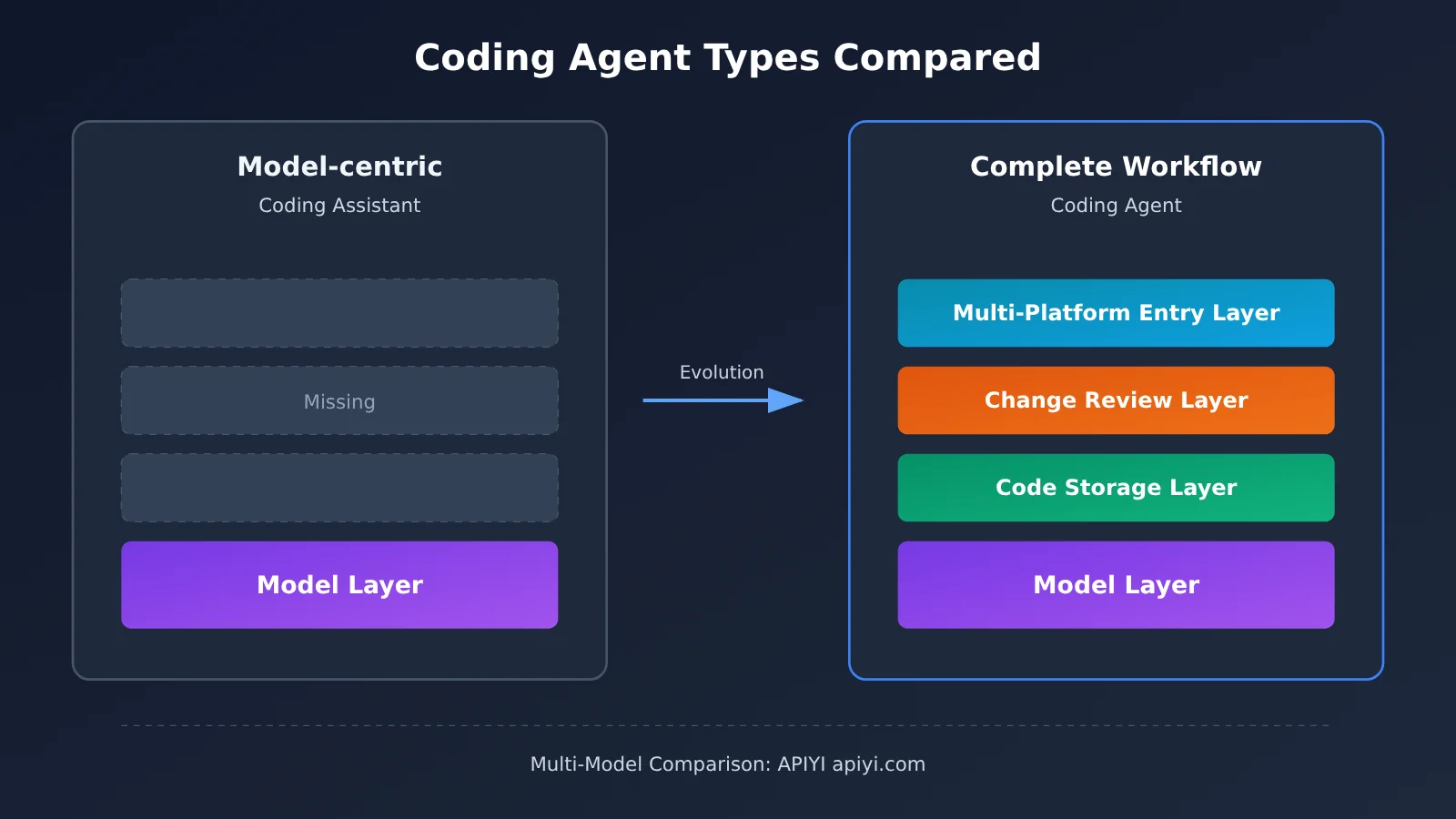
This acquisition shows that competition among coding agents is expanding from “who has the best model for writing code” to “who has the most complete workflow.” A complete coding agent involves at least four layers: the model layer generates code, the storage layer manages code and versions, the review layer helps people understand and approve changes, and the interaction layer provides access across different devices.
| Infrastructure layer | Responsibility | OpenAI’s current actions |
|---|---|---|
| Model layer | Understand requirements and generate or modify code | OpenAI models behind Codex |
| Code storage layer | Host code and manage versions and changes | Acquired Code Storage; functionality is being integrated into Codex |
| Change review layer | File browsing, diff display, and human approval | Trees and Diffs libraries are already used in Codex |
| Interaction layer | Let developers submit and check tasks at any time | Codex is available on the web, desktop, and mobile across all tiers |
We believe the review layer will become a key battleground for coding agent products. The more capable agents become, the more changes they can make in a single submission—and the heavier the burden on human reviewers. Teams will be more likely to trust products that make changes across dozens of files easy to understand at a glance.
🎯 Technical tip: Coding agents ultimately consume model invocations. If you’re configuring custom models in tools like Cursor or Cline, or building your own code review scripts, you can use one API key through APIYI apiyi.com to access models from OpenAI, Claude, Gemini, and others. This makes it easier to compare their review quality on the same diff.
Build Your Own Diff Reviewer With an OpenAI-Compatible API: A Minimal AI Coding Agent Approach
Codex’s review capabilities are currently available only within its own app, and OpenAI hasn’t explained how Codex relates to third-party API integrations. But any developer can use an OpenAI-compatible API to bring the idea of “having a model review a code change” into their own pipeline. Here’s a minimal example that reads the staged diff and asks a model for review feedback.
import subprocess
import openai

client = openai.OpenAI(
    api_key="YOUR_API_KEY",
    base_url="https://api.apiyi.com/v1"  # OpenAI-compatible API
)

diff = subprocess.run(["git", "diff", "--staged"], capture_output=True, text=True).stdout

resp = client.chat.completions.create(
    model="gpt-4o-mini",  # Can be replaced with any model available on the platform
    messages=[
        {"role": "system", "content": "你是资深代码审阅者,指出潜在 bug、风险和改进建议。"},
        {"role": "user", "content": f"请审阅以下代码变更:\n{diff}"}
    ]
)
print(resp.choices[0].message.content)
View the full implementation (review by file)
import subprocess
from typing import List
import openai

client = openai.OpenAI(
    api_key="YOUR_API_KEY",
    base_url="https://api.apiyi.com/v1"
)

SYSTEM_PROMPT = (
    "你是资深代码审阅者。针对给定文件的 diff,"
    "按「严重问题 / 潜在风险 / 改进建议」三类输出,没有问题请明确说明。"
)

def changed_files() -> List[str]:
    """Get the list of files with staged changes."""
    out = subprocess.run(
        ["git", "diff", "--staged", "--name-only"],
        capture_output=True, text=True
    ).stdout
    return [f for f in out.splitlines() if f.strip()]

def file_diff(path: str) -> str:
    """Get the diff for a single file."""
    return subprocess.run(
        ["git", "diff", "--staged", "--", path],
        capture_output=True, text=True
    ).stdout

def review(path: str, diff: str, model: str = "gpt-4o-mini", max_chars: int = 12000) -> str:
    """Review changes to a single file, truncating diffs that are too long."""
    if len(diff) > max_chars:
        diff = diff[:max_chars] + "\n...(diff 过长,已截断)"
    try:
        resp = client.chat.completions.create(
            model=model,
            messages=[
                {"role": "system", "content": SYSTEM_PROMPT},
                {"role": "user", "content": f"文件: {path}\n\n{diff}"}
            ],
            max_tokens=1000
        )
        return resp.choices[0].message.content
    except Exception as e:
        return f"审阅失败: {e}"

if __name__ == "__main__":
    for path in changed_files():
        print(f"===== {path} =====")
        print(review(path, file_diff(path)))
        print()
Essentially, this script is a machine-review version of what components like Diffs do in coding agents: split changes by file and provide feedback on each one. Splitting by file avoids sending an excessively long context all at once and makes it easy to match feedback to specific files. It’s also straightforward to integrate with a Git hook or CI.
🚀 Quick start: If you’d like to compare how different models review your project’s code, register at APIYI apiyi.com to get free trial credits. You can switch models for comparison by changing only the
modelparameter—no other code changes needed.
FAQ: OpenAI’s Acquisition of Pierre and Codex Availability
Q1: What is Pierre?
Pierre Computer Company is the company behind Code Storage and several open-source developer tools. Its Trees and Diffs libraries are already used in the Codex app for file browsing and code change reviews, making them its most direct connection to OpenAI.
Q2: Has the acquisition been completed? How much was the deal worth?
Not yet. OpenAI says the deal is still pending regulatory approval. The transaction amount and specific timeline haven’t been publicly disclosed. Check OpenAI’s official announcements for updates, as the information in this article may become outdated.
Q3: I’m a Code Storage user. Do I need to migrate now?
There’s no need to migrate immediately. OpenAI has said that Code Storage customers can continue using the product and that its features will gradually be integrated into Codex. However, the integration timeline and whether Code Storage will remain a standalone product long-term haven’t been specified. It’s a good idea to export important data regularly so you’re prepared if you need to migrate.
Q4: Now that Codex is available on all tiers, are usage limits the same for each tier?
The public summary only says that Codex is available across all tiers on the web, desktop, and mobile. It doesn’t provide details about usage limits for each tier. Limits are likely to vary, so check the latest information on the official website before planning team usage.
Q5: How can I use multiple models in coding agents like Cursor and Cline?
These tools typically support custom OpenAI-compatible API endpoints. You can follow these steps:
1. Sign up for an account at APIYI apiyi.com and get an API key
2. Enter the key in the tool’s model settings and set base_url to `https://api.apiyi.com/v1`
3. Enter the name of the model you want to use. You can then switch between OpenAI, Claude, Gemini, and other models within the same tool
Note that Codex is OpenAI’s own product, and OpenAI hasn’t clarified its relationship with third-party API access. The steps above apply to coding agent tools that support custom API endpoints.
Q6: Does this acquisition affect other coding agents like Cursor and Cline?
There’s no direct impact in the short term, and projects like Trees and Diffs have committed to remaining open source. Over the longer term, competition is likely to shift more toward the review experience and workflow completeness. For tools that rely on model invocation, flexibility in model choice remains important. Aggregated API services like APIYI apiyi.com can help reduce the cost of switching models.
OpenAI’s Acquisition of Pierre: Key Takeaways
- The acquisition target: OpenAI is acquiring Pierre, the company behind Code Storage and several open-source tools.
- Core components are already in use: Trees powers file browsing in Codex, while Diffs handles code change reviews.
- Open source remains open: Pierre’s open-source projects will remain open source after the deal closes.
- A smooth transition for Code Storage: Customers can continue using it, and its features will gradually be integrated into Codex.
- The deal hasn’t closed yet: It’s still subject to regulatory approval, and the price and timeline haven’t been disclosed.
- Codex is becoming a core capability: It’s available across all tiers on the web, desktop, and mobile.
- More flexible model evaluation: Teams building their own review workflows can compare models through the unified APIYI apiyi.com interface.
Summary
OpenAI’s acquisition of Pierre and the availability of Codex across all tiers point in the same direction: competition among coding agents is expanding beyond model capabilities to encompass the entire workflow.
- The review layer is getting attention: Trees and Diffs show that helping people understand an agent’s changes is just as important as getting the agent to write code.
- The storage layer is being integrated: Bringing Code Storage features into Codex means code storage will become a built-in capability for coding agents.
- Access is expanding: With Codex available across all tiers and on three types of devices, coding agents are becoming a default tool.
For developers, the most practical approach right now is to pin open-source dependencies to specific versions and keep an eye on changes, make sure Code Storage data remains exportable, and check official guidance for Codex usage limits. Meanwhile, you can start building the parts you control, such as review and testing, using an OpenAI-compatible interface. We recommend using APIYI apiyi.com to quickly evaluate how different models review your project. We’ll continue to follow any updates as the deal moves toward closing.
📚 References
- OpenAI Announces Acquisition of Pierre, the Company Behind Code Storage: Acquisition summary
- Link:
aihot.news/items/c39s97tylya5njp0nro6dwvbx -
Details: Covers how Trees and Diffs are used in Codex, as well as plans for the open-source projects and Code Storage customers
-
OpenAI Releases Images 2.6 and Opens Codex to All Tiers: Summary of product updates announced around the same time
- Link:
aihot.news/items/o915zd1u1eq13gyo9x3nsgoq8 -
Details: Covers Codex availability across web, desktop, and mobile
-
OpenAI’s Official Images 2.6 Introduction: Official launch page
- Link:
openai.com/index/introducing-images-2-6 - Details: Official information on Images 2.6 and GPT-Image-2.6 Flare and Sunburst
Author: APIYI Technical Team
Technical discussions: Contact us through the APIYI homepage, or visit docs.apiyi.com for more integration resources.