Author’s note: Public leaderboard scores can be inflated through targeted optimization. This article explains what drives benchmaxing, offers five credibility checks, and outlines four steps for building a private test set from your own tasks.
Here’s the bottom line: Leaderboard scores are a useful starting point for investigation, but they shouldn’t determine your model choice on their own. Top models on overall leaderboards are often separated by just a few points—enough for the top spot to change hands. When margins are that narrow, optimizing for benchmark questions can easily sway the rankings. This is known as benchmaxing.
What really matters is how candidate models perform on your own business tasks. This article doesn’t rank models or judge who’s “cheating.” Instead, it covers three things: how to spot potentially inflated scores, how to build a small private test set from real tickets, and when leaderboards may not cover the metrics you care about.
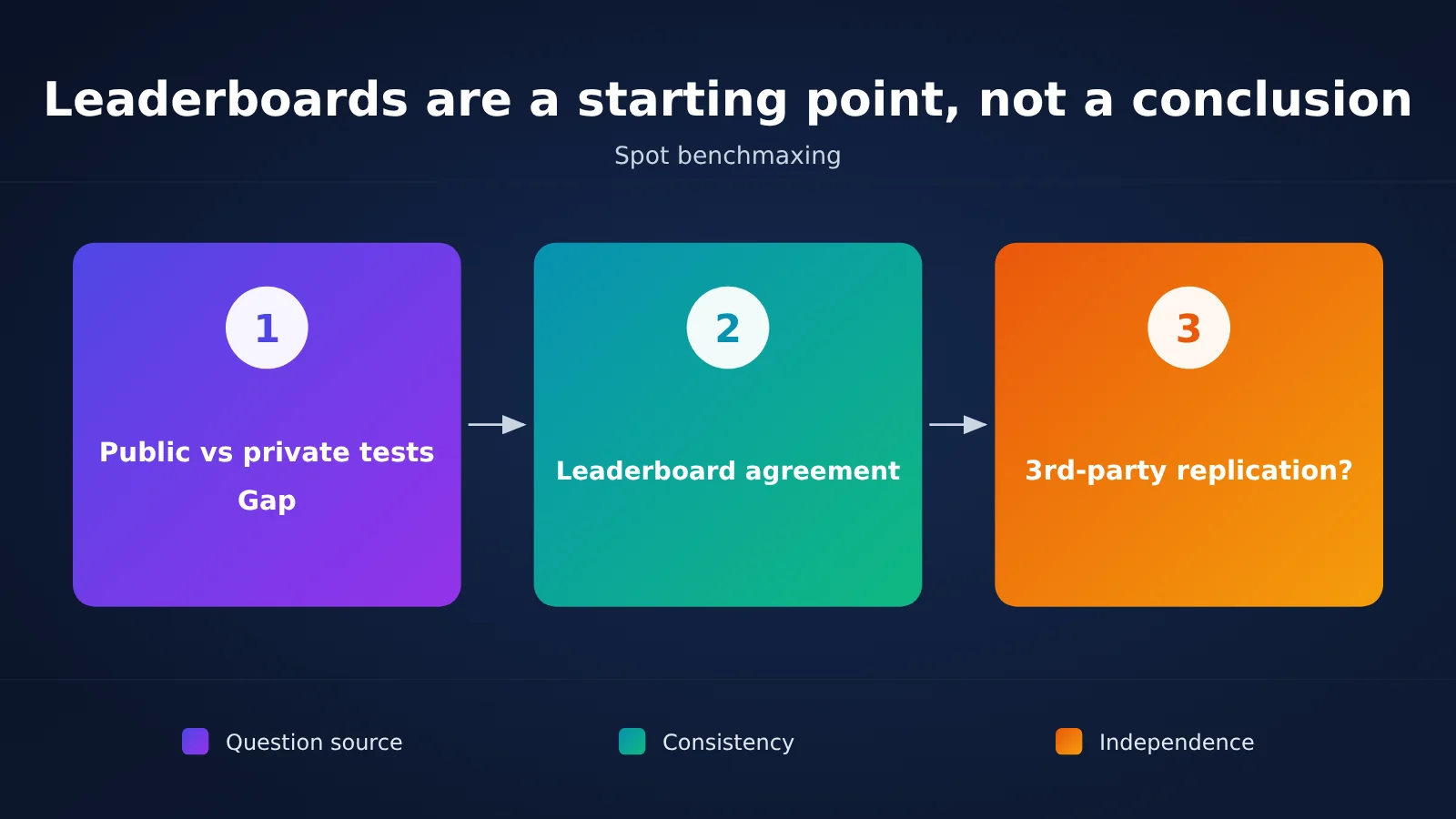
What Is Benchmaxing? 3 Reasons Benchmark Scores Can Be Inflated
According to a MindStudio article dated November 1, 2026, benchmaxing means training or tuning a model to score highly on known benchmarks rather than improve its general capabilities. The telltale sign: a model shines on leaderboards but performs noticeably worse on new questions that test the same skill.
| Cause | How It Happens | What to Look For |
|---|---|---|
| Questions enter the training data | Benchmark questions or closely related variations get mixed into the training corpus, intentionally or not | High scores on original questions drop when the questions are rephrased |
| Fine-tuning for question types | The model is optimized for the formats and reasoning patterns favored by a particular benchmark | Strong results on one leaderboard, but mediocre performance on others |
| Public questions circulate over time | Questions are discussed in forums and blogs, then end up in scraped web data | Scores on older public benchmarks get closer to saturation |
Benchmaxing Isn’t Necessarily Malicious
The article emphasizes that none of these situations requires bad intentions. A lab may genuinely believe it’s improving general reasoning, while actually overfitting to a few well-known question types. The longer a benchmark remains public, the less it resembles a measure of ability and the more it resembles a practice test the model has already taken.
So judge the evidence, not the motive. What matters is whether the score carries over to new questions—not whether someone meant for this to happen.
Why Benchmaxing Happens: Release Cycles and Leaderboard Narratives
Scores are the simplest way for labs to demonstrate progress to investors, developers, and the public without opening themselves up to a full independent audit. A number like “59 on a composite index” is easy to put in a press release and compare with a competitor’s score. The simpler the number, the greater the pressure to optimize for it.
The second driver is the release cycle. According to the same MindStudio article, one model in Google’s Gemini family scored 50 on the Artificial Analysis Index. About a month later, a successor from the same company scored 59 and took the top spot. This data comes from a single source and hasn’t been independently verified for this article. The point MindStudio makes is that iterations happen in weeks, the leading models are separated by just a few points, and any way to pull ahead is attractive.
Classify the Facts Before Reading the Leaderboard
When citing a score, first establish what kind of claim it is. The table below uses examples from this article:
| Type of claim | Example in this article | How to interpret it |
|---|---|---|
| Official self-report / verbal prediction | Musk said Grok 5 could score “close to perfect” on Humanity’s Last Exam; he also said Grok 4 scored about 52% on the text portion | These are a prediction and a self-reported claim, not independent test results |
| Independent third-party testing | The Artificial Analysis Index combines tests of reasoning, coding, science, math, and more | A useful signal, but the date cited should be noted |
| Single media report | Grok 4.7’s index score and Terminal-Bench result, and Gemini’s change from 50 to 59 | MindStudio is the only source; the figures haven’t been independently verified |
| Unknown | The exact timing and scope of Artificial Analysis’s shift to private test questions | Refer to its official statements; this article makes no assumptions |
MindStudio reported that Grok 4.7 trailed the leading models on both an independent composite index and Terminal-Bench. The article treated this “gap between public expectations and independent test results” as a signal worth examining, while explicitly noting that it doesn’t mean xAI is more problematic than other vendors. This article uses it in the same way and draws no conclusions.
5 Signals for Judging Whether Leaderboard Scores Are Trustworthy
Independent evaluators have a straightforward response: keep the test questions private. If the questions have never been published, no one can train specifically for them. According to MindStudio, organizations such as Artificial Analysis have already shifted to private questions. Within the same capability category, the gap between public benchmark scores and scores on new private questions is considered one of the most revealing signals of benchmaxing.
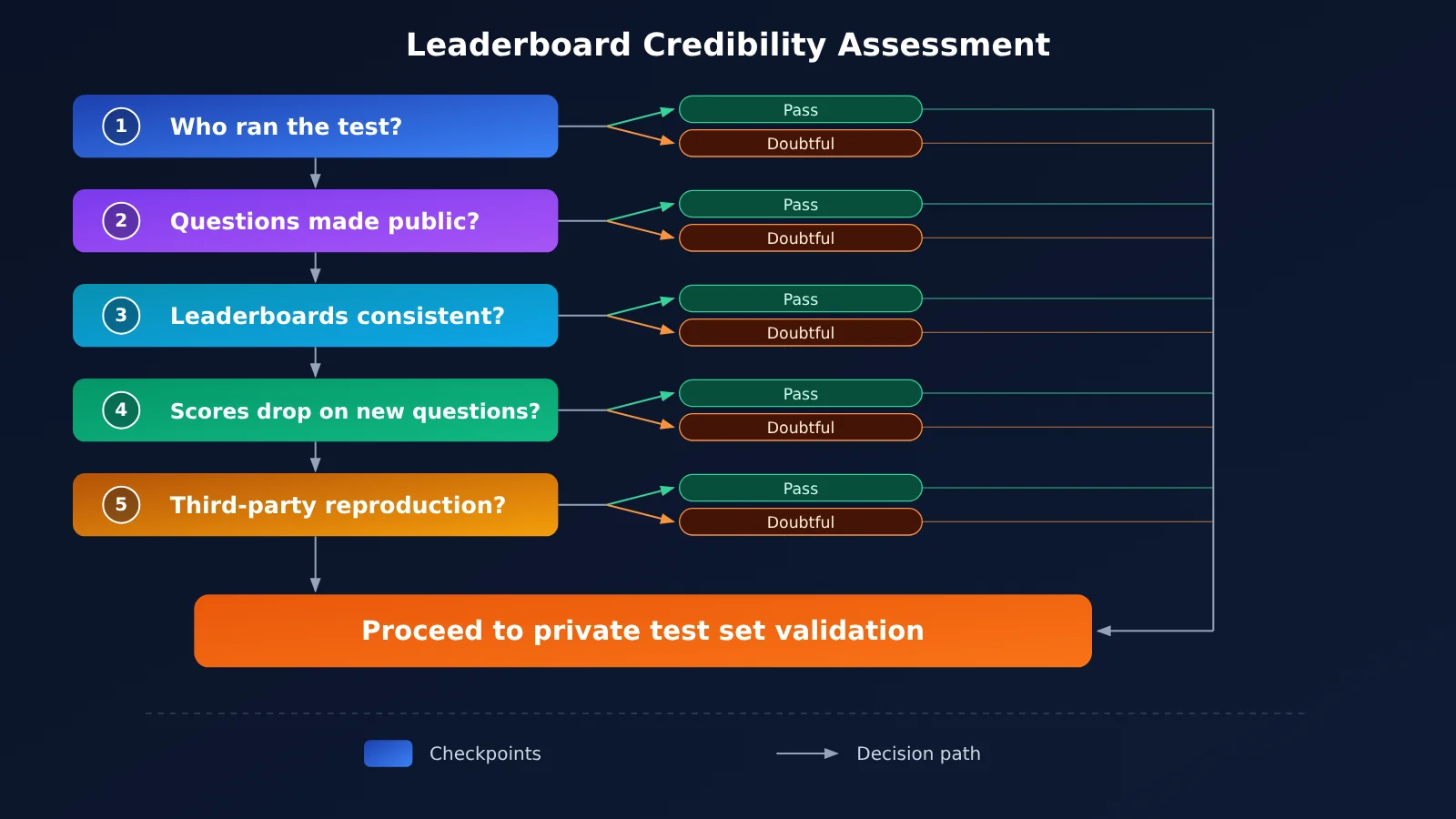
Based on the original article’s advice, here’s a five-point checklist:
| No. | Check | How to check | Positive signal | Warning signal |
|---|---|---|---|---|
| 1 | Who ran the test | See whether the result comes from a vendor’s technical report or a third-party evaluation page | Run independently by a third party | Only self-reported by the vendor |
| 2 | Whether the questions were public | Check whether the benchmark was released before the model’s training cutoff | Private questions or new questions released after training | Old questions that have been public for years |
| 3 | Whether results are consistent across leaderboards | Compare multiple benchmarks covering reasoning, coding, math, and more | Rankings are broadly consistent | Stands out on only one leaderboard |
| 4 | Whether scores drop with different questions testing the same capability | Compare public and private sets, or original and reworded questions | Little difference after questions are changed | Scores drop noticeably after questions are changed |
| 5 | Whether third parties have reproduced the results | Search for independent reproduction reports and check the evaluation settings | Reproduced by multiple parties with transparent settings | Results can’t be reproduced or settings aren’t public |
Why a Composite Index Is Harder to Game
The original article argues that the Artificial Analysis Index is valuable because it combines several types of tests into a single score. It’s possible to overfit to one test, but overfitting to reasoning, coding, science, and math tests at the same time—especially when some questions aren’t public—is much harder. That’s why it makes sense to give the third check, “consistency across leaderboards,” more weight.
Build a Private Evaluation Set from Your Own Tasks: A 4-Step Process
No matter how clean a leaderboard is, it still tests someone else’s questions. To make your final model selection, you need your own private evaluation set. Its built-in advantage: no lab has seen these questions.
| Step | What to Do | How to Do It | Output |
|---|---|---|---|
| ① Sample | Gather questions from real business tasks | Use real support tickets, failure cases from production logs, and user complaint conversations. Group them by task type, starting with 20–50 examples per category. | Labeled raw evaluation set |
| ② Define acceptance criteria | Decide upfront what counts as “good enough” | Prioritize outputs that can be checked objectively, such as JSON fields, classification labels, or unit test results. For open-ended answers, use a scoring rubric and manually review a fixed percentage. | Scoring script + rubric |
| ③ Run multiple models | Control variables for a fair comparison | Use the same prompt, parameters, and evaluator or scoring rules. Record scores, latency, and token usage. | Comparison table |
| ④ Update regularly | Keep the evaluation set from becoming another practice test | Add new failure cases monthly and remove questions that every model scores full marks on. Keep a holdout set that isn’t used for tuning. | Versioned evaluation set |
Sampling and Acceptance Criteria for a Private Test Set
When sampling, failures are more valuable than successes. Conversations where users asked the same question again, a human had to step in, or the interaction received a poor rating are most likely to reveal differences between models. Write your acceptance criteria before running the models; otherwise, it’s easy to work backward from the results.
Define “good enough” in measurable terms. For example, “structured extraction field accuracy meets a specified threshold” or “customer service answers contain no factual errors in a manual spot check.” Set the spot-check rate based on risk: review more cases for high-risk workflows, and rely primarily on automated checks for low-risk tasks.
How to Control Variables When Comparing Models
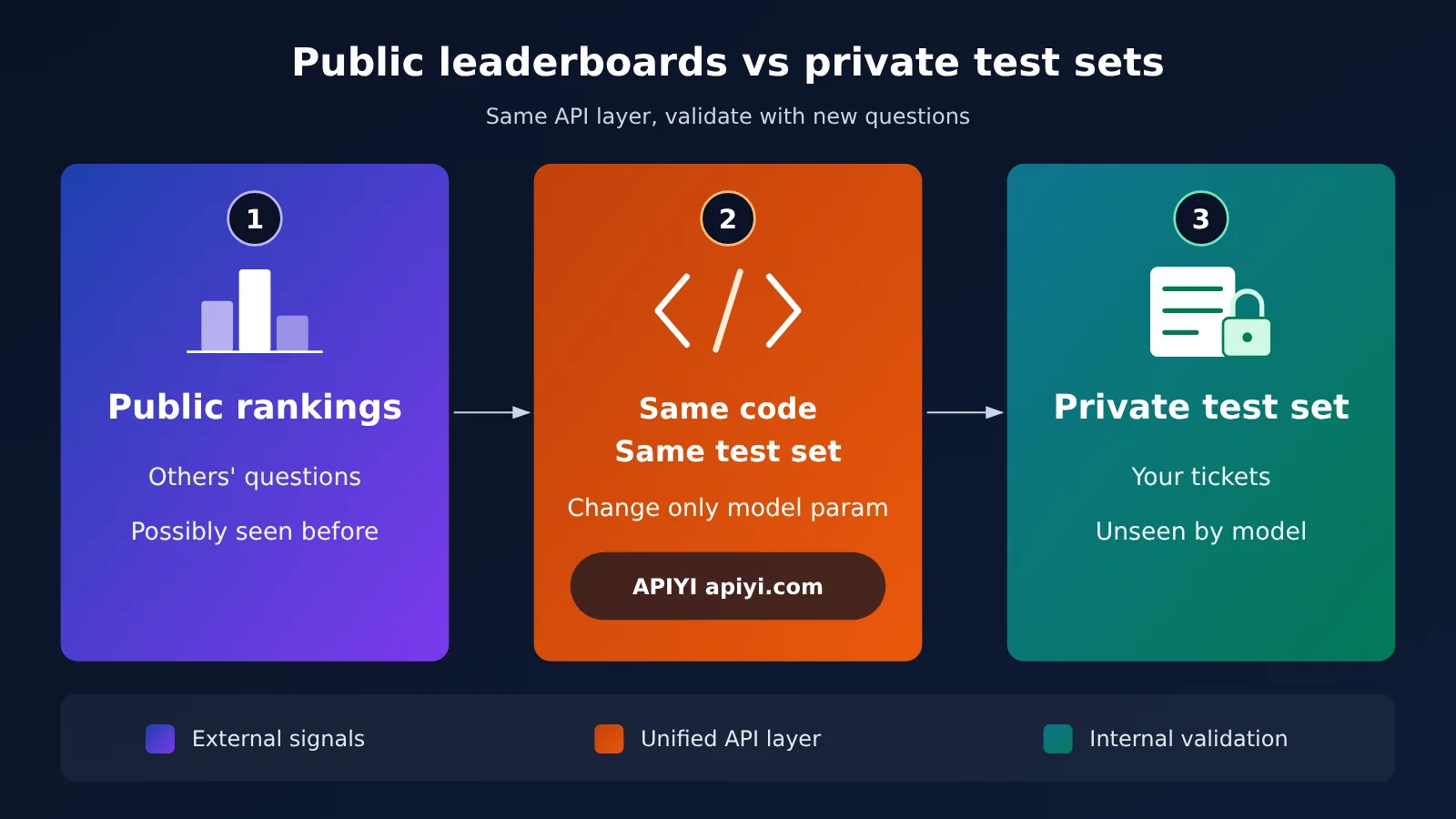
The most common problem in side-by-side comparisons is failing to control variables: model A gets a carefully tuned prompt, while model B gets a default one. Instead, use the same code and the same test set, changing only the model name.
If your candidate models come from multiple providers, maintaining multiple SDKs can be a hassle. APIYI is compatible with the OpenAI format, so you can call models from different providers with one token and change only the model parameter when switching. That makes it easy to run the same test set through a single evaluation script. Here’s how to configure it:
- Official OpenAI Python SDK: Set
base_urltohttps://api.apiyi.com/v1and provide your platform token asapi_keywhen initializing the client - Model switching in the evaluation loop: Change only the
modelfield; check the model list on APIYI apiyi.com for supported names - Fixed sampling parameters: Set
temperature=0and use the samemax_tokensvalue for every model to reduce the effects of randomness - Usage tracking: Read the
usagefield in each response and total the tokens each model consumes across the test set
🚀 Quick start: Pick 3–4 highly ranked models that pass the five checks above. Call them one by one through APIYI apiyi.com using the same token, and you can get an initial comparison across 50 real support tickets in an afternoon.
Avoid tuning to your own test set
You can end up benchmaxing your own test set, too. Repeatedly tweaking a prompt until a model scores perfectly on those 50 questions is essentially no different from vendors gaming the leaderboard. Here are a few safeguards:
- Set aside a holdout set: Lock away about 30% of the questions, tune using only the development set, and make the final decision based on the holdout set
- Freeze prompts: Once formal comparisons begin, freeze prompts by version number. If anything changes, rerun every model
- Rotate in new questions: When updating the test set, add recent failure cases so it keeps pace with your business needs
When leaderboard scores aren’t enough
Even if leaderboard scores are completely reliable, they may not measure what you care about. In the following scenarios, leaderboards are useful at most as background context:
| Scenario | Why leaderboards fall short | What to evaluate instead |
|---|---|---|
| Long-tail domain-specific tasks | Industry terminology, internal formats, and less widely spoken languages rarely appear in general-purpose benchmarks | A private test set built from real business data |
| Tool use and Agents | Single-turn Q&A can’t measure the reliability of multi-step calls or whether parameters are formatted correctly | End-to-end task success rate and function-call formatting error rate |
| Cost and latency | Leaderboards rank capabilities without considering per-request costs or time to first token | Record token usage and response time alongside test results |
| Stability | A single benchmark run doesn’t reveal fluctuations in production | Run the same questions multiple times and check result consistency |
A practical rule: Once models meet your capability requirements, compare their cost-effectiveness and stability. The first- and third-ranked models might both meet your needs on your test set. If so, the one with lower latency and more predictable costs is often the better choice. With unified access through APIYI apiyi.com, you can compare capabilities, response times, and usage side by side in the same results table.
Frequently Asked Questions
Q1: Is benchmaxing the same as cheating?
Not necessarily. Benchmark questions may end up in training data because a crawler picked them up unintentionally, and teams optimizing for specific question types may genuinely believe they’re improving reasoning. Focus on whether scores hold up when the questions change, rather than making assumptions about intent.
Q2: When are leaderboard scores still reliable?
Scores remain meaningful signals when the questions are private or appeared after the training cutoff, the tests are run independently by a third party, multiple leaderboards reach similar conclusions, and others have reproduced the results. An index that combines several types of tests is harder to game than a single benchmark.
Q3: How many questions should a private test set contain?
There’s no universal standard. As a rule of thumb, start with 20–50 real-world examples for each task type. That’s enough to reveal obvious differences. If the results are close, add more questions and reserve a holdout set.
Q4: How can I compare models from different providers using the same code?
An OpenAI-compatible interface is the easiest option. After getting a token from APIYI apiyi.com, point `base_url` to the platform address and change only the `model` parameter in your loop. You can then compare models using the same test set. Check the platform’s model list for available models.
Q5: Is Grok 5 close to a perfect score on Humanity’s Last Exam?
As of the date of this article, that’s a public prediction by Musk, not a test result. If the model does achieve that score in the future, check it against the five-point checklist—especially how it performs on the same capabilities using new, private questions. Then use your own test set on APIYI apiyi.com to verify whether it’s a good fit for your business.
Benchmaxing and Evaluating on Your Own Tasks: Key Takeaways
- Definition: Benchmaxing means optimizing for known test questions, producing leaderboard scores that overstate real-world capabilities.
- Causes: Test questions enter training data, models are fine-tuned for specific question types, and public questions circulate for long periods. None of these requires malicious intent.
- Key signal: A drop in performance on new questions testing the same capability is the clearest warning sign.
- 5 checks: Who ran the evaluation? Were the questions previously public? Are results consistent across leaderboards? Do scores drop on new questions? Has a third party reproduced the results?
- 4-step evaluation set: Sample cases, define acceptance criteria, test multiple models, and update regularly. Keep a holdout set to avoid overfitting your own evaluation.
- Unified interface: With APIYI’s OpenAI-compatible interface at apiyi.com, switching models only requires changing the
modelparameter.
Summary: Leaderboards Are a Starting Point, Not a Conclusion
You can start with three things today. First, run each leaderboard score you’re considering through the five-point checklist, noting the type of evidence and the date cited. Second, select 50 failure cases from the past month’s logs and write acceptance criteria before running any models. Third, test 3–4 candidate models using the same code and parameters, recording scores, latency, and usage.
Use APIYI at apiyi.com to compare multiple models with a single token, and update your evaluation set monthly. Your model selection should be based on your own evaluation set, not someone else’s test.
📚 References
- MindStudio: What Is Benchmaxing? Why AI Labs Are Hiding Test Questions (2026-11-01)
- Link:
mindstudio.ai/blog/ai-benchmark-maxing-private-tests -
Notes: Defines benchmaxing, explains its causes and the shift toward private test questions, and is the sole source for the Gemini and Grok data cited in this article.
-
Artificial Analysis official website: Independent model evaluations and composite index
- Link:
artificialanalysis.ai - Notes: Refer to its official announcements for the timing and scope of its shift to private test questions.
Author: APIYI Technical Team
Technical discussions: Contact us through the APIYI homepage at apiyi.com. For more integration resources, visit the documentation center at docs.apiyi.com.