Author’s note: A follow-up comment claims Grok Bot isn’t locked to the Grok model and will route hard problems to a more suitable model. This article separates the original post, the follow-up comment, official documentation, and the APIYI summary table, and lays out grok-4.7’s two price tiers and how to access it today.
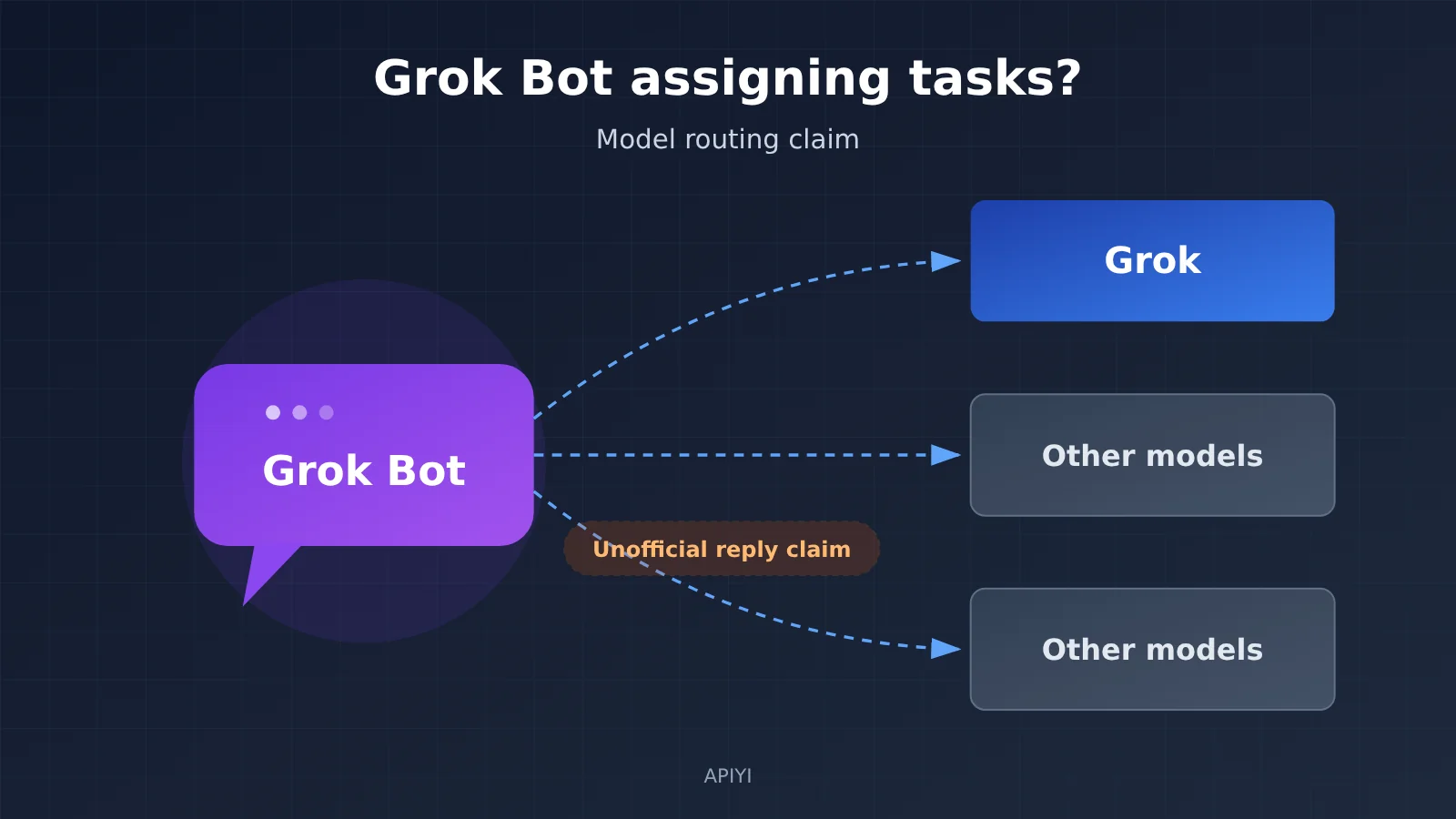
Lately, a lot of people have been reaching for Grok Bot as a quick fix. On 2026-11-26, a follow-up comment on X floated a claim: Grok Bot isn’t the same thing as Grok — it may not be tied to a single model, but instead routes tasks to whichever model is the better fit at the moment. The idea spread fast, but it came from a comment, not from product documentation.
This is not a reading of an official announcement. This article keeps the original post, the follow-up comment, xAI (now called SpaceXSI) official documentation, and the APIYI model roundup in separate buckets, and clearly marks what’s been verified versus what’s just community opinion.
The short version: In about 3 minutes, you’ll understand where the “Grok Bot routes tasks” claim comes from and where its limits are — plus which Grok models you can actually call through the API today and their two price tiers.
Grok Bot’s Task-Routing Claim: Key Facts at a Glance
| Item | Details | Nature |
|---|---|---|
| Original post | Pavel (@pavelsvitek) posted, essentially saying the Grok bot is currently a huge help to them | Post text, personal opinion |
| Key reply | Paradox (@Paradox_qt) replied on 2026-11-26 | Reply comment |
| Gist of the reply | Grok Bot isn’t Grok. It’s model-agnostic, using Cursor’s harness to route tasks to the most suitable model | Community opinion, not officially confirmed |
| Official docs check | Checked the docs.x.ai model page on 2026-11-27 — no grok-4.8, and text tasks still say to use Grok 4.7 | Official documentation |
| Platform master list check | The APIYI master list was updated 2026-11-27 11:59 (UTC+8), with 278 models total and no grok-4.8 | Platform data |
Where the Grok Bot Task-Routing Claim Comes From
It all starts with a post from Pavel. He said the Grok bot is helping them get through a tough stretch — a personal take on his experience, with no mention of which models are running underneath. What actually kicked off the “task routing” discussion was Paradox’s reply under that post.
Paradox’s point, in essence: Grok Bot isn’t Grok. It’s model agnostic, and it uses Cursor’s harness to route tasks to the most suitable model. By that account, the intelligence you feel when using Grok Bot may not come entirely from the Grok model — some of it could come from other models that got handed the work.
The catch is that this is just a single reply. In the reference material available right now, there’s no official documentation or product description confirming that Grok Bot is built this way. So this article treats it as a community claim worth watching, not a confirmed product architecture.
Grok Bot Task Assignment: Keep Four Types of Information Sources Separate
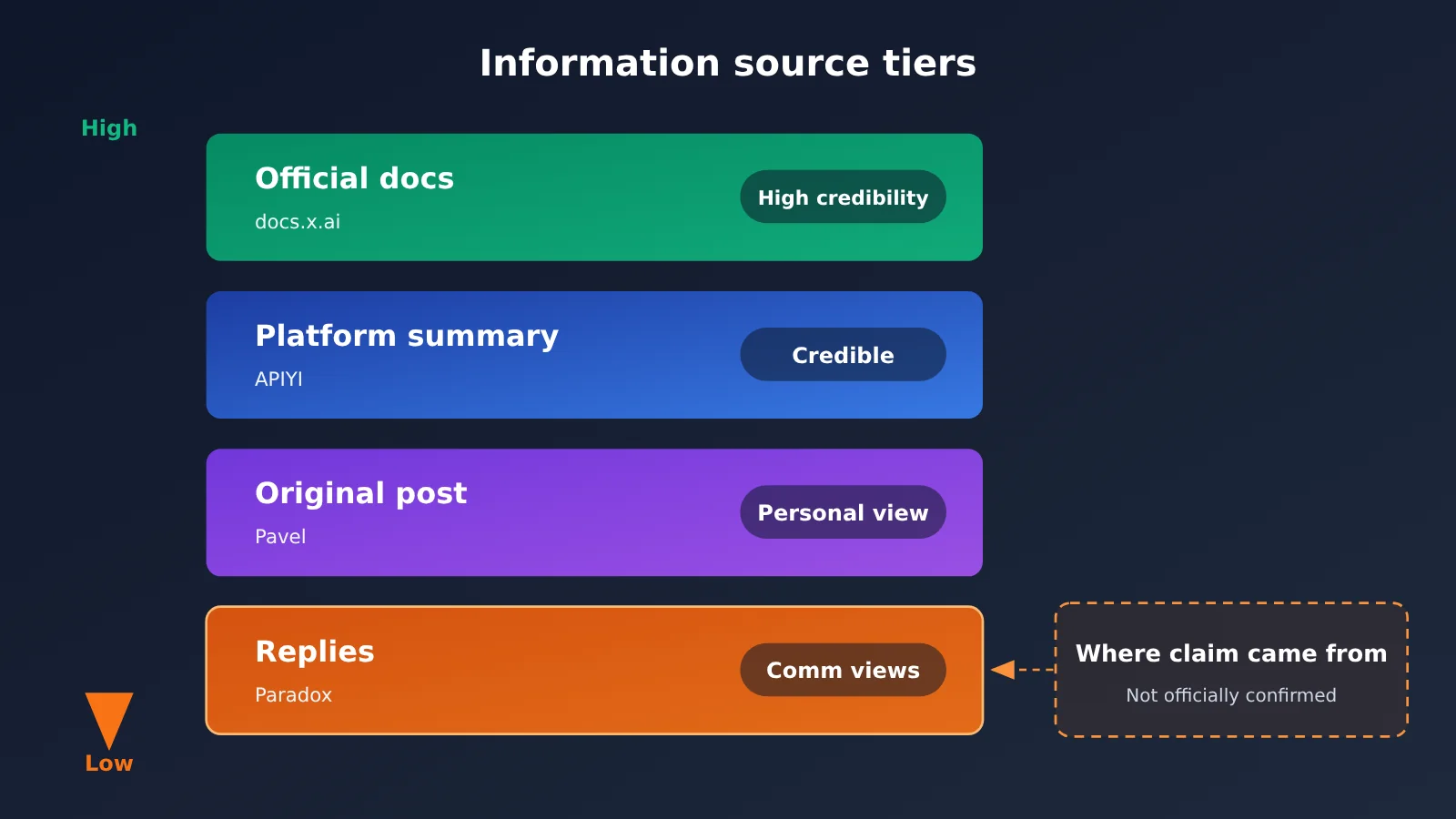
The easiest mistake to make when discussing this topic is lumping information of different natures into a single sentence. The table below breaks it down by the nature of each source.
| Source category | Specific source | What it says | Can it be cited as fact? |
|---|---|---|---|
| Official documentation | docs.x.ai model page (xAI, now named SpaceXSI) | Text tasks use Grok 4.7; there is no grok-4.8; lists pricing and reasoning tiers | Yes, subject to the date you checked |
| Platform master list | APIYI model master list | 278 models, includes grok-4.7, no grok-4.8 | Yes, subject to the platform list |
| Original post | Pavel’s post | The Grok bot helped them a lot | Only as a personal usage review |
| Reply comments | Paradox’s reply | Grok Bot isn’t tied to a model; tasks are assigned through Cursor’s harness | No, only as a community opinion |
There’s another category of information that gets misused often: answers you get from chatting with the @grok account on X. Whatever it says, it’s just a single conversation output — not an announcement, and not a substitute for official documentation. If someone screenshots a reply from @grok to prove that “the official side has already confirmed task assignment,” you can simply file it under “conversation content.”
A model name you see in Grok Bot isn’t the same as an API model ID
Another common misreading: a name like “Grok 4.8” flashes by in the Grok Bot interface or output, and you assume the API can already call that model. The two things aren’t necessarily connected.
What the bot uses internally and how it displays it is a product-layer matter. Which models the API can call depends on the official model documentation and the platform model list you’re using. As of the check on 2026-11-27, neither docs.x.ai nor the APIYI master list contains grok-4.8.
Grok Bot Briefly Showed Grok 4.8 — Can You Call It Through the API?
Let’s start with the bottom line: as of 2026-11-27, grok-4.8 doesn’t appear in the official docs or in APIYI (apiyi.com)’s model master list. On APIYI’s side, grok-4.8 isn’t listed yet — we’ll get it up as soon as we can. Model names and pricing are subject to the platform’s model list.
| Model | docs.x.ai (2026-11-27) | APIYI master list (2026-11-27 11:59) | Callable today | Available platforms |
|---|---|---|---|---|
| grok-4.7 | Yes, recommended for text tasks | Yes, endpoint chat | Yes | APIYI apiyi.com, official API |
| grok-4.8 | Not listed | Not listed | No | Not yet listed |
If your business needs Grok-family text capabilities, grok-4.7 is the model you can actually ship today. Once grok-4.8 genuinely shows up in the official docs and the platform list, switching over is no rush — the way you write the API call doesn’t change, you just swap the model parameter.
grok-4.7 Parameters You Can Call Today, and Its Two Pricing Tiers
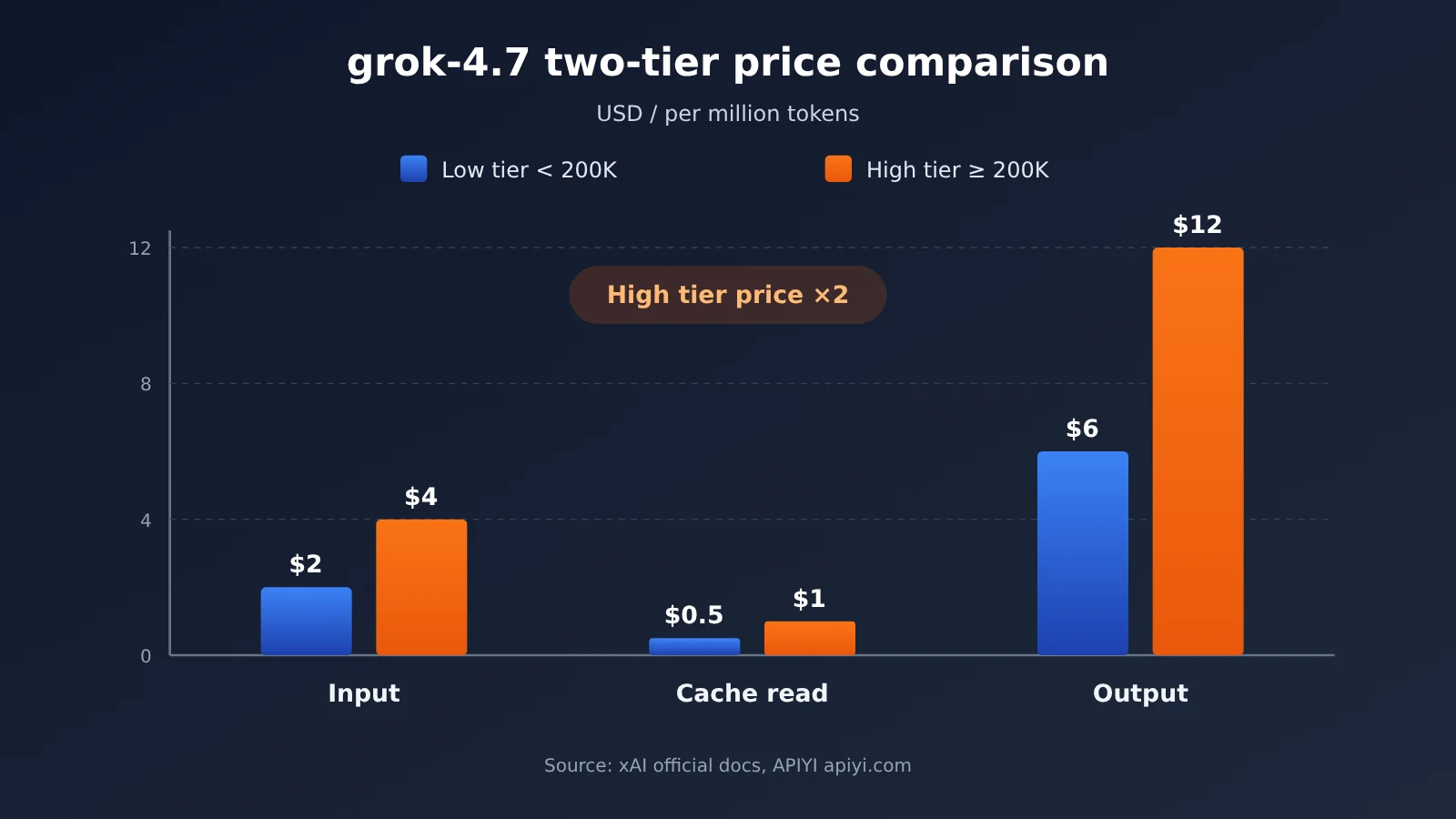
grok-4.7 has a 500K token context window. The official docs split pricing into two tiers based on how many tokens a single request uses, with the dividing line at 200K tokens.
| Pricing tier | Input (per million tokens) | Cache read (per million tokens) | Output (per million tokens) |
|---|---|---|---|
| Under 200K tokens (low tier) | $2 | $0.50 | $6 |
| 200K tokens or more (high tier) | $4 | $1 | $12 |
On APIYI’s side, the model summary table lists grok-4.7 at the low-tier prices: input 2, output 6, cache read 0.5. The pricing endpoint shows the high tier as input 4, output 12, cache read 1 — matching the official two tiers. grok-4.7’s endpoint is chat, the available groups include CodexResponses, Default, and SVIP, and the base URL is https://api.apiyi.com/v1.
Long documents and code analysis across large repositories can easily blow past 200K tokens, and once you cross that line the per-token price doubles. When you’re budgeting, estimate the token count per request first; if needed, split the request or lean on cache reads to keep costs down in the low tier.
grok-4.7 Reasoning Levels
| Reasoning level | Is it the default? | Task types it suits |
|---|---|---|
| low | No | Simple Q&A, format conversion, batch light tasks |
| medium | No | Routine writing, general code edits |
| high | Yes (default) | Multi-step reasoning, moderately complex analysis |
| xhigh | No | The hardest tasks, where accuracy requirements are extremely high |
The default is high. It reflects how much effort the model puts into reasoning — it’s not the same thing as answer length. If you want to control output length, the more direct approach is to adjust the prompt and max_tokens; pick a reasoning level based on task difficulty.
How to Call grok-4.7 Through APIYI
APIYI offers an OpenAI-compatible endpoint, so you can call grok-4.7 with the existing OpenAI SDK by changing two parameters:
- Create an API key in the APIYI console and swap in your own
api_keyin the code. - Set
base_urltohttps://api.apiyi.com/v1. - Set
modeltogrok-4.7and passmessagesas you would in a normal chat request. - If you need to adjust reasoning effort, specify a reasoning level (low, medium, high, xhigh) in the request; if you don’t, it defaults to high.
- Get it working with a short input first, then scale up to long contexts — and keep an eye on the 200K token billing threshold.
🚀 Quick start: New users can get free test credits through APIYI at apiyi.com and try grok-4.7 on their own tasks first. The same key also works with OpenAI, Claude, Gemini, and other models, which makes side-by-side comparison easy.
Analyzing the Impact of Grok Bot’s Task Assignment Claims on Developers
Impact on Developers
- Evaluate models through the API itself: The experience inside a Bot may mix in product-layer orchestration, so it can’t be directly equated with a single model’s capabilities. When choosing a model, call the API directly and test it with your own tasks.
- Multi-model task routing is worth building yourself: Whether or not Grok Bot actually does this internally, routing simple tasks to cheaper models and hard problems to stronger ones is a common engineering practice in itself. Using a unified API to access multiple models keeps switching costs low.
- Model names should follow the official list: When you see a new model name, check the official docs and the platform’s model list first, so you don’t put a nonexistent
modelvalue in your code and cause requests to fail.
Impact on the Industry
- The line between products and models is blurring: If claims like these become common and hold true, what users perceive as “some AI being very smart” is increasingly likely to be the combined result of an orchestration layer and multiple models.
- The cost of verifying information rises: Community replies, chat-account responses, and screenshots circulate together on social platforms, so readers need to actively distinguish their sources.
💡 Selection tip: If you want to replicate the idea of “give hard problems to the model best suited for them,” you can use APIYI to switch between grok-4.7 and other mainstream models with the same code, routing by task difficulty.
Frequently Asked Questions (FAQ)
Q1: Does Grok Bot route prompts to other models?
So far, only one reply in the thread says so. In a reply dated 2026-11-26, Paradox claims that Grok Bot isn’t tied to a single model and uses Cursor’s harness to route to the most suitable model. None of the reference material includes official documentation confirming this, so treat it as a community opinion.
Q2: Are Grok Bot and the Grok model the same thing?
You can’t simply equate the two. Grok Bot is a product, while Grok 4.7 is a model listed in the official docs. How the product is orchestrated internally, and whether it calls other models, isn’t explained in the official docs. When evaluating model capability, it’s best to call the grok-4.7 endpoint directly and test it.
Q3: Grok 4.8 shows up in the Bot — can I call it through the API?
As of 2026-11-27, no. Neither docs.x.ai nor the APIYI master list has grok-4.8. grok-4.8 hasn’t been listed yet, and we’ll get this model listed as soon as possible. Model names and pricing are subject to the platform’s model list, which you can check anytime in the model list on apiyi.com.
Q4: How is grok-4.7 priced?
Pricing has two tiers based on the token count per request. Under 200K tokens: $2 input, $0.50 cached read, $6 output (per million). At or above 200K tokens: $4 input, $1 cached read, $12 output.
Q5: How do I call grok-4.7 quickly?
Sign up with APIYI and create an API key, then set the OpenAI SDK’s `base_url` to `https://api.apiyi.com/v1` and `model` to `grok-4.7`. New users get free trial credits, which is handy for validating results before deciding how much to use.
Q6: Does the default `high` reasoning level make answers longer?
The reasoning level reflects how much effort goes into reasoning — it’s not the same thing as answer length. If you want to control output length, adjust the prompt and `max_tokens` first; pick the reasoning level among low, medium, high, and xhigh based on task difficulty.
Key Takeaways: Assigning Work with Grok Bot
- The “task assignment” claim comes from a follow-up comment: Paradox’s reply says Grok Bot isn’t locked to a single model — but this hasn’t been officially confirmed.
- The original post was a personal review: Pavel only said the Grok bot was a huge help; he never discussed architecture.
- The @grok reply is not an announcement: Output from a chat account is just conversation — it can’t be treated as an official statement.
- grok-4.8 can’t be called yet: As of 2026-11-27, it isn’t listed in the official docs or APIYI’s master table.
- grok-4.7 is today’s choice: 500K token context window, four reasoning effort tiers, defaults to
high. - Two pricing tiers split at 200K tokens: Low tier at $2/$0.5/$6, high tier at $4/$1/$12 (per million).
- How to get started: Call through APIYI’s apiyi.com unified interface and build your own multi-model task routing.
Summary
The core points about Grok Bot assigning work:
- Keep the sources straight: The task-assignment claim comes from a follow-up comment, and the official docs say nothing about it — so don’t write it up as a product design.
- Trust the list for model names: A name that flashes by inside the Bot doesn’t mean the endpoint is available. grok-4.8 can’t be found right now.
- What you can actually use today is grok-4.7: Just watch the 200K-token billing boundary and your choice of reasoning tier.
Rather than guessing which model is behind Grok Bot, it’s better to test your own tasks directly through the API and then hand the work off to the right model based on difficulty. We recommend using APIYI apiyi.com to quickly validate grok-4.7’s performance and line it up against other mainstream models.
📚 References
-
Pavel’s original post (post text): Grok bot usage review
- Link:
x.com/pavelsvitek/status/2125949509440049436 - Note: A personal usage assessment; doesn’t touch on model architecture
- Link:
-
Paradox’s reply (reply comment): The claim that Grok Bot isn’t tied to a model
- Link:
x.com/Paradox_qt/status/2125979580360270060 - Note: Posted 2026-11-26, a community opinion, not official documentation
- Link:
-
xAI (now named SpaceXSI) model docs (official documentation): Model names, context, reasoning tiers, and pricing
- Link:
docs.x.ai/developers/models - Note: Checked 2026-11-27; doesn’t list grok-4.8
- Link:
Author: APIYI Technical Team
Technical inquiries: Feel free to reach us through the APIYI website homepage. For more integration materials, visit the docs.apiyi.com documentation center.