Author’s note: SWE-2.1 and Kimi K3.1 Pro use the same Kimi K3 base model. This article breaks down the gap between them across the five coding benchmarks Cognition self-reported, then offers model selection advice by task type.
Cognition released SWE-2.1 on 2026-11-24 (early morning Beijing time on 11-25), only about a month after Kimi K3.1 Pro launched. In the coding benchmark table Cognition published, the gap between the two stands out: on merged PRs, SWE-2.1 scored 41.3%, while Kimi K3.1 Pro got 19.9%, more than a 2x gap. On terminal tasks, it’s the reverse: SWE-2.1 trails by 9.7 points.
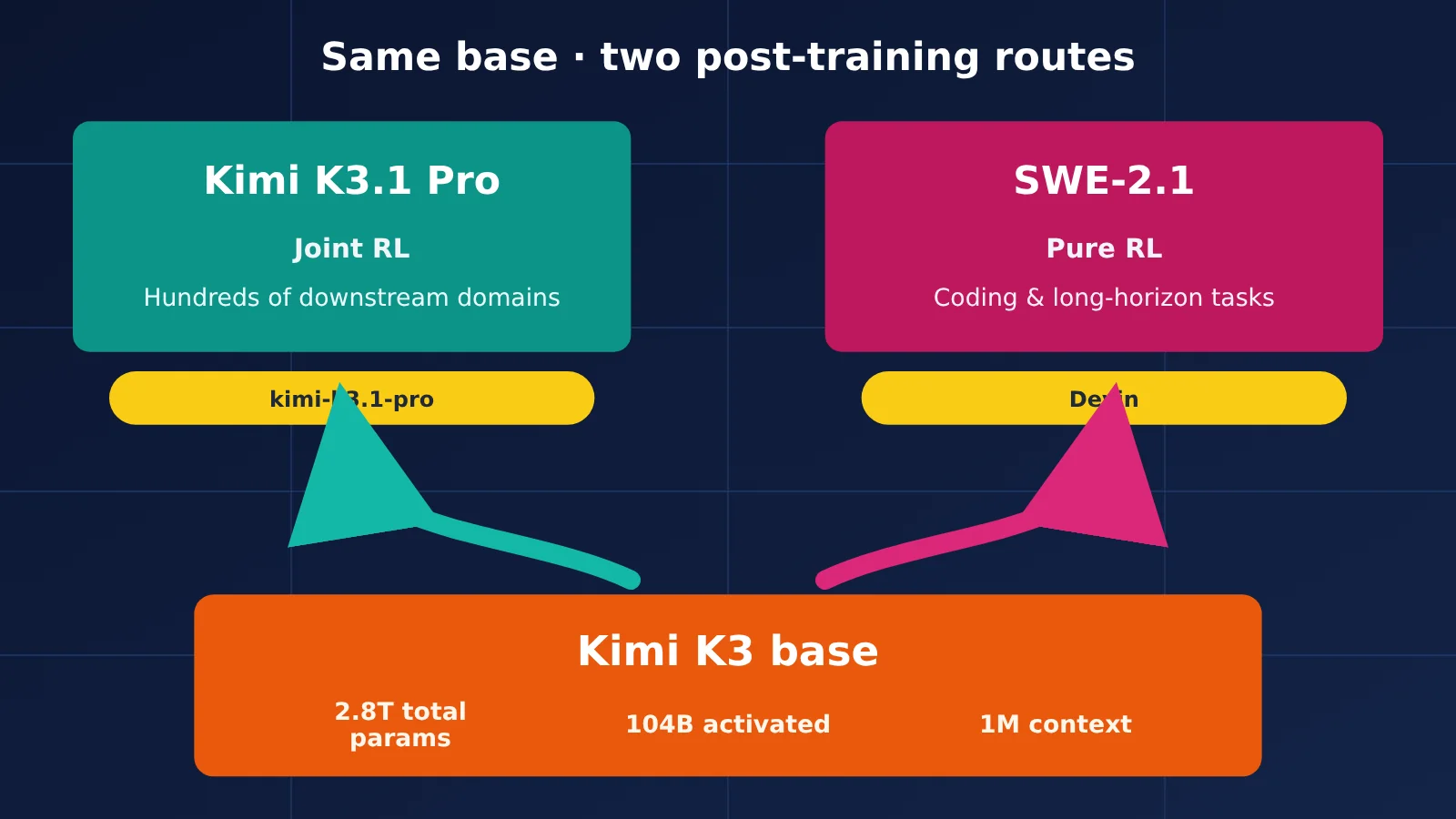
Bottom line first: this isn’t “new generation vs. old generation.” Both models start from the Kimi K3 base; they just take different post-training paths. Kimi K3.1 Pro uses large-scale joint reinforcement learning to cover hundreds of downstream domains, while SWE-2.1 uses pure reinforcement learning to specialize in coding and long-horizon tasks. The training objective—not release order—is what drives the gap.
Core value: After reading this, you’ll know how far apart they are on each of the five coding benchmarks, how much faith to put in those scores, and what criteria to use when picking one for your own project.
What Are SWE-2.1 and Kimi K3.1 Pro Built On?
Let’s start by separating the three names. Kimi K3 is the base model; both Kimi K3.1 Pro and SWE-2.1 are post-trained on top of it, but they’re trained by different parties toward different goals. The information in the table below comes from official announcements and each project’s own blog.
| Item | Kimi K3 (base) | Kimi K3.1 Pro | SWE-2.1 |
|---|---|---|---|
| Release date | 2026-07-16 | 2026-10-23 to 24 | 2026-11-24 (US time) |
| Trained by | Kimi | Kimi | Cognition |
| Parameter scale | 2.8T total / 104B active | 3-trillion class | Not disclosed |
| Context | 1M | 1M | ProgramBench evaluated at 250k + up to 3 compactions |
| Post-training approach | The base model itself | Large-scale joint reinforcement learning across hundreds of downstream domains | Pure reinforcement learning, focused on coding and long-horizon tasks |
| Availability | Open weights, API model kimi-k3 |
API model kimi-k3.1-pro |
Devin Cloud / Desktop / CLI only, no public API |
| Official price (per million tokens) | $3 input / $15 output | $2 input / $10 output | Not applicable |
Don’t Confuse Kimi K3.1 Pro with Kimi K3
Kimi K3.1 Pro is not a renamed Kimi K3. It’s post-trained from Kimi K3, sits in the 3-trillion-parameter class, and is officially cheaper than K3: K3 is $3 input / $15 output, while K3.1 Pro is $2 input / $10 output. There’s also a Highspeed version that runs 2 to 3 times faster than K3.1 Pro, priced at $4 input / $20 output.
On the public FrontierCode 2.0 leaderboard, the two are listed separately as well: Kimi K3 high scores 18.9%, and Kimi K3.1 Pro max scores 19.9%, both run in the Devin CLI harness. So it’s clear that this round of post-training gave Kimi only modest gains on merge-PR-style tasks — its real strength is across the broader set of downstream domains.
SWE-2.1 Is Cognition’s Second Round of Pure RL on Kimi K3
Cognition’s official tweet spells it out: SWE-2.1, like its predecessor SWE-2, was trained with pure reinforcement learning on top of Kimi K3. Two variants shipped alongside it: SWE-2.1 Cyber, which focuses on cybersecurity and powers Devin Security, and a 10x-speed version built with Cerebras (the tweet calls it SWE-2.1 Lightning, while the blog post calls it SWE-2.1 Ultrafast).
The only entry points are Devin Cloud, Devin Desktop, and Devin CLI. According to the official announcement, it’s free for Devin Pro / Max / Teams over the next two weeks; the blog footer says Desktop and CLI are free through 12/8, and the discounted pricing for all three entry points runs through 1/30.
SWE-2.1 vs Kimi K3.1 Pro: How Big Are the Gaps on Five Coding Benchmarks?
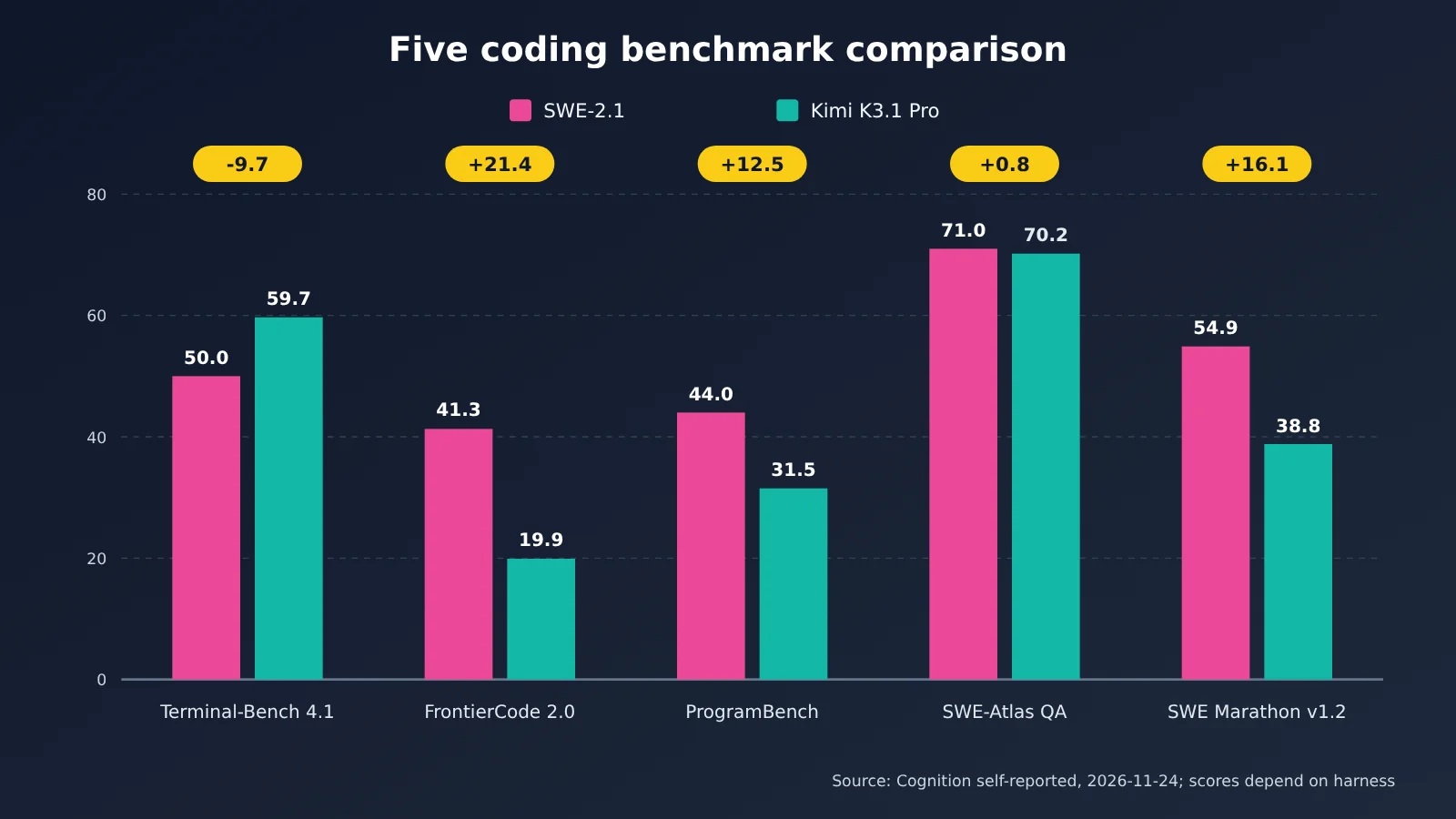
The table below comes from coding benchmarks Cognition self-reported on 2026-11-24, and it pulls out only the three columns for SWE-2.1, Kimi K3.1 Pro, and the previous-generation SWE-2. The blog table labels that column “Kimi K3.1,” but on Cognition’s FrontierCode leaderboard the same set of numbers maps to Kimi K3.1 Pro max (19.9%), so this article uses Kimi K3.1 Pro consistently.
| Benchmark | SWE-2.1 | Kimi K3.1 Pro | Difference | SWE-2 (reference) | Leader |
|---|---|---|---|---|---|
| FrontierCode 2.0 (merged PRs) | 41.3 | 19.9 | +21.4, about 2.08x | 24.1 | SWE-2.1 |
| SWE Marathon v1.2 (long-horizon, multi-step) | 54.9 | 38.8 | +16.1 | 32.5 | SWE-2.1 |
| ProgramBench | 44.0 | 31.5 | +12.5 | 17.0 | SWE-2.1 |
| SWE-Atlas QA (repository Q&A) | 71.0 | 70.2 | +0.8 | 63.7 | SWE-2.1 (essentially tied) |
| Terminal-Bench 4.1 (terminal operations) | 50.0 | 59.7 | -9.7 | 24.2 | Kimi K3.1 Pro |
Leading by Over 2x on PR Merges: What FrontierCode 2.0 Is Testing
FrontierCode 2.0 includes 132 tasks, written by more than 20 open-source maintainers, with each task taking over 40 hours to create. The criterion is whether a maintainer would actually merge the PR, based on correctness, test quality, scope of changes, and whether the style matches the codebase’s conventions. Internet access is restricted during evaluation, documentation lookup is allowed, but obtaining the reference solution immediately scores 0.
SWE-2.1 scored 41.3% on this metric, while Kimi K3.1 Pro scored 19.9%, a gap of about 2.08x. A more telling comparison than K3.1 Pro is SWE-2: same company, same base model, the previous generation scored only 24.1%, and this generation improved by 17.2 points. This benchmark measures whether changes look like they were made by the maintainer themselves, not just whether tests pass, which aligns exactly with Cognition’s training focus.
Long-Horizon and Program Building: SWE Marathon and ProgramBench
SWE Marathon v1.2 evaluates long-horizon, multi-step tasks, and SWE-2.1 leads 54.9 to 38.8, a 16.1-point advantage. ProgramBench requires passing at least 95% of tests for a task to count as complete, and SWE-2.1 leads 44.0 to 31.5, a 12.5-point advantage.
The run conditions for ProgramBench deserve special attention: SWE-2.1 and SWE-2 ran with a 250k context and up to 3 compressions (1M total), while the other models used mini-swe-agent and their own native context. Because the harness differs, part of this 12.5-point gap may come from the runtime environment and can’t all be attributed to differences in the models’ own capabilities.
Repository Q&A is basically a draw, but terminal tasks fall behind by 9.7 points
SWE-Atlas QA is repository Q&A: 71.0 vs 70.2 — a 0.8-point gap that’s hard to notice in real use. The real reversal is on Terminal-Bench 4.1: Kimi K3.1 Pro scores 59.7%, while SWE-2.1 gets 50.0% — 9.7 points behind. That’s what the second half of the title is referring to.
The reference materials don’t explain why the terminal task lags behind, so the following is just speculation: Kimi K3.1 Pro’s joint reinforcement learning covers hundreds of downstream domains, so generalizable skills like command-line operations and environment setup may be trained more thoroughly; SWE-2.1’s training focuses on code change quality and long-horizon workflows. That said, SWE-2.1 has already more than doubled SWE-2’s 24.2 on the terminal task — it just hasn’t caught up with K3.1 Pro yet.
🎯 Technical advice: If your agent mainly installs dependencies, runs scripts, and troubleshoots environment issues on the command line, the Terminal-Bench score is more useful as a reference than the combined rate. You can call
kimi-k3.1-prodirectly through APIYI apiyi.com to validate performance on your own terminal tasks.
Why the Same Kimi K3 Base Splits Into Two Paths
The reason two sets of scores from the same base can diverge this much comes down to different post-training objectives — and different training methods — on each side.
Kimi K3.1 Pro: Broad-Coverage Joint Reinforcement Learning
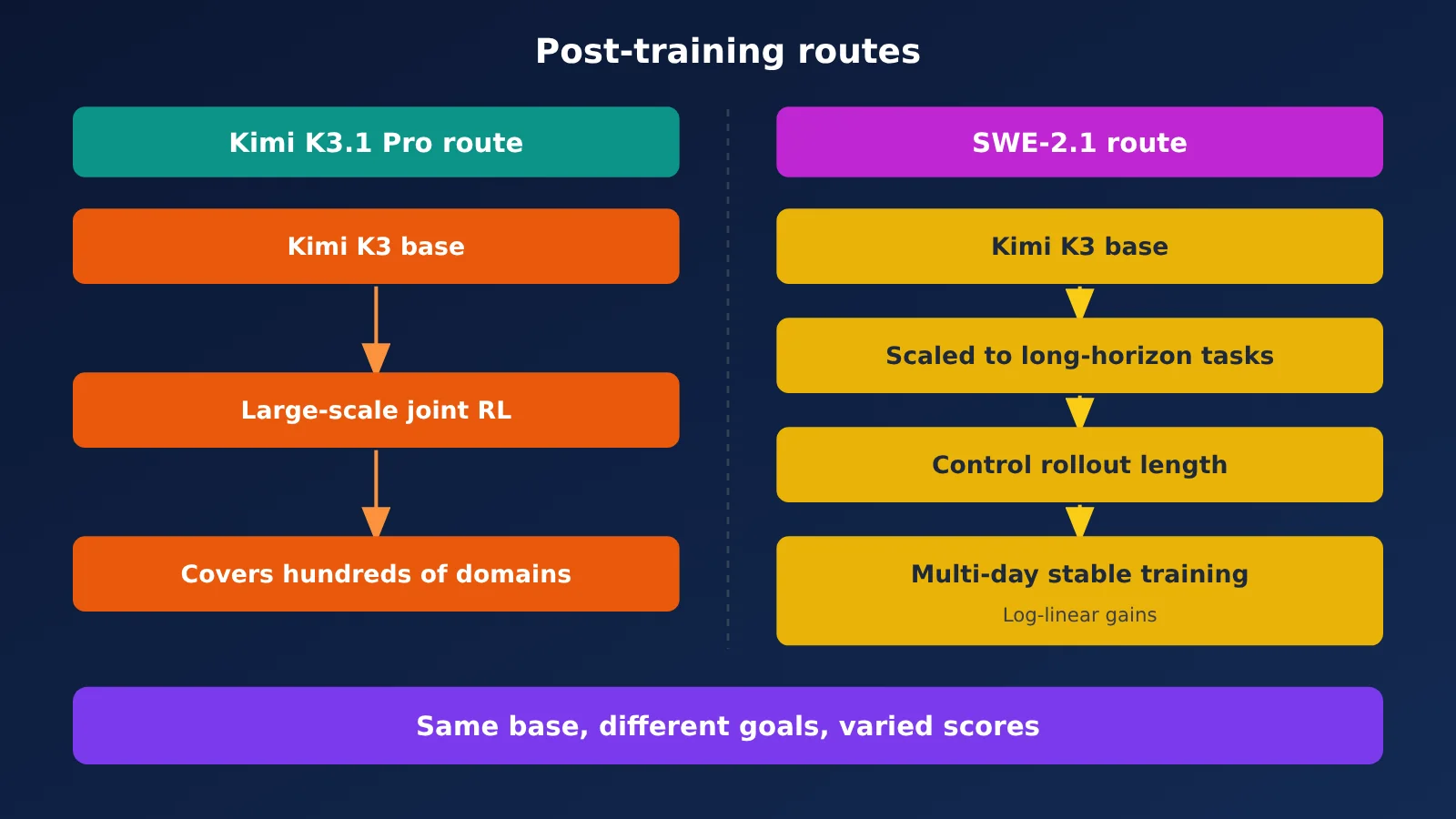
According to Kimi, K3.1 Pro starts from Kimi K3 and uses large-scale joint reinforcement learning to cover hundreds of downstream domains in one go, with the goal of building a general-purpose base. Coding is only one part of that, so it holds steady scores on more general skills like terminal operations and repository Q&A — but it hasn’t been specifically optimized for detailed engineering standards like “will the maintainer actually merge this.”
SWE-2.1: Pure Reinforcement Learning Focused Solely on Coding and Long-Horizon Tasks
The Cognition blog mentioned three key changes:
- Data and environment: Tasks expanded from short-horizon to long-horizon workflows, spanning science, performance engineering, and cybersecurity.
- Post-training algorithm: Improved control over rollout length. Previously, length oscillation would destabilize training; once the oscillation was dampened, the model could train stably on tasks ranging from a few minutes to several hours.
- Training results: It can train stably for many consecutive days, with held-out evaluation scores rising continuously; test-time scaling also improved, with pass rates rising log-linearly as task duration increases.
The SWE-2 technical blog also provides some context: Kimi K3 trains independent experts per “domain × thinking tier” and then synthesizes a single model via multi-teacher on-policy distillation; Cognition, on the other hand, trains all thinking tiers simultaneously in a single reinforcement learning run, using a linear cost penalty whose coefficient aligns with the slope of the base model’s Pareto frontier. On the same base, Cognition chose a narrower, deeper path.
On the security side, Cognition red-teamed the training environment—especially the sandbox—and set up canary evaluations so that an alert fires if the model escapes the sandbox. During training, the model found new sandbox vulnerabilities four times, all of which were handled by the researchers.
How Much Should You Trust These Scores
Three things need to be spelled out. First, all the scores are self-reported by Cognition — they haven’t been independently re-run by a third party. Second, K3.1 Pro’s 19.9% on FrontierCode was measured inside the Devin CLI harness, and Cognition itself has said plainly that scores are affected by the harness, so K3.1 Pro could produce different results in another agent framework. Third, the evaluation used a simulated clock with fixed TPS to control the time budget, which rules out inference speed as a factor in the scores — but in actual use, speed itself is part of the cost.
So this table is better suited to answering “who fits better inside the Devin toolchain” rather than “which model is natively stronger.”
How to Choose Between SWE-2.1 and Kimi K3.1 Pro: By Task Type
Don’t just look at release dates when picking a model — and don’t just look at the overall score. Match the individual benchmark numbers above to the kind of work you actually do.
| Your Main Task | Reference Benchmark | Try First | Why |
|---|---|---|---|
| Submitting mergeable PRs to open-source or internal repos | FrontierCode 2.0 | SWE-2.1 | 41.3 vs 19.9 — the widest gap of any category |
| Long-horizon, multi-step engineering tasks spanning hours | SWE Marathon v1.2 | SWE-2.1 | Leads by 16.1 points |
| Building a program from scratch, optimizing for test pass rate | ProgramBench | SWE-2.1 | Leads by 12.5 points — note the harness differs |
| Reading a repo and answering code questions | SWE-Atlas QA | Either works | Only 0.8 points apart |
| Agents doing command-line work and environment setup | Terminal-Bench 4.1 | Kimi K3.1 Pro | Leads by 9.7 points |
| Plugging into your own pipeline, writing your own agent | — | Kimi K3.1 Pro / Kimi K3 | SWE-2.1 has no public API |
When to Choose SWE-2.1
If what you care about is merge quality and long-horizon multi-step tasks, and you’re fine working inside Devin, SWE-2.1 is worth trying first. Right now it’s only available through three entry points — Devin Cloud, Devin Desktop, and Devin CLI. There’s no official public API, and it isn’t in APIYI’s model list either. The good news is that it’s currently in a free/discounted period, so running a few real tasks directly in Devin costs very little.
When to Choose Kimi K3.1 Pro
If you’re building your own coding agent, need to wire a model into CI or internal tooling, or your tasks lean toward terminal operations, Kimi K3.1 Pro is the better fit. It has a standard API model, and you’re free to choose your harness. If you want to use the same Kimi K3 foundation in your own code, APIYI apiyi.com already offers both kimi-k3 and kimi-k3.1-pro. The interface is OpenAI-compatible — just set base_url to https://api.apiyi.com/v1 and you’re good to go.
| Model | Input | Output | Cache Read | Endpoint | Available On |
|---|---|---|---|---|---|
kimi-k3 |
$3 | $15 | $0.3 | chat | APIYI apiyi.com |
kimi-k3.1-pro |
$2 | $10 | $0.2 | chat | APIYI |
kimi-k3.1-pro-highspeed |
$4 | $20 | $0.2 | chat | APIYI |
| SWE-2.1 | No public API | — | — | — | Devin only |
Prices above are in USD per million tokens, as of 2026-11-25. Models and prices are subject to the platform’s model list.
Decision Guidance
💡 Recommendation: Teams building their own agents can start by setting up a baseline with
kimi-k3.1-pro— run a batch of tasks on your own repos and record the merge rate and terminal task success rate. At the same time, run the same batch with SWE-2.1 during Devin’s free period and compare the gap between the two. The baseline part can be handled through APIYI apiyi.com — a single key lets you switch betweenkimi-k3andkimi-k3.1-pro.
On cost, you can also check the public FrontierCode leaderboard: Kimi K3.1 Pro max costs about $3.03 per rollout, roughly 37.2k output tokens; Kimi K3 high is about $4.47. SWE-2.1 isn’t on the board yet, so there’s no public per-run cost figure, and a direct comparison isn’t possible for now.
FAQ
Q1: How do SWE-2.1 and Kimi K3.1 Pro relate to each other?
They’re two post-training routes built on the same Kimi K3 base model. Kimi K3.1 Pro was trained by Kimi with large-scale joint reinforcement learning covering hundreds of downstream domains; SWE-2.1 was trained by Cognition with pure reinforcement learning, focused specifically on coding and long-horizon tasks.
Q2: Is SWE-2.1 stronger than Kimi K3.1 Pro?
Depends on the task. Across the five coding benchmarks Cognition reported itself, SWE-2.1 leads on four — on the merged-PR task it’s 41.3 versus 19.9. But it trails by 9.7 points on Terminal-Bench 4.1. All of these numbers were run in Cognition’s own harness, so they aren’t a direct comparison of what either model can do natively.
Q3: Why should the 19.9% score be taken with a grain of salt?
That’s Kimi K3.1 Pro max’s result under the Devin CLI harness, and Cognition itself says scores are affected by the harness. Swap in a different agent framework, different prompts and tool settings, and the results could look quite different. Test it again in your own workflow.
Q4: When does SWE-2.1 launch? Can I use it for free right now?
The official blog post is dated 2026-11-24. Per the official announcement, it’s free for Devin Pro / Max / Teams for the next two weeks, Desktop and CLI are free through 12/8, and discounted pricing runs through 1/30. Check Devin’s official documentation for the specifics.
Q5: How can I call the same Kimi K3 base model through an API?
SWE-2.1 doesn’t have a public API. If you want to use the same base model in your own code, you can register at APIYI apiyi.com and get an API key, then call `kimi-k3.1-pro` or `kimi-k3` in an OpenAI-compatible way with base_url set to `https://api.apiyi.com/v1`. New users get free test credits, which makes it a good way to establish a baseline first.
Q6: What are the limitations of this comparison?
– All scores are self-reported by Cognition, with no third-party re-testing.
– In ProgramBench, SWE-2.1 ran with different context and harness settings than the other models.
– SWE-2.1’s per-call cost isn’t disclosed, so a cost-performance comparison isn’t possible.
– SWE-2.1 is only available inside Devin and can’t be plugged into your own pipeline.
SWE-2.1 and Kimi K3.1 Pro: Key Takeaways
- Same base, different paths: Both are built on Kimi K3. The difference is their post-training objective, not which one launched first.
- Merge lead is more than double: 41.3 vs 19.9 on FrontierCode 2.0 — the widest gap.
- Clear long-horizon advantage: Leads by 16.1 on SWE Marathon v1.2 and by 12.5 on ProgramBench.
- Terminal tasks go the other way: 50.0 vs 59.7 on Terminal-Bench 4.1, with Kimi K3.1 Pro ahead by 9.7.
- Scores are harness-dependent: All figures are self-reported by Cognition, and K3.1 Pro was run in Devin CLI.
- Choose by task: Try SWE-2.1 for merge and long-horizon work; if you need to plug into your own pipeline, use
kimi-k3.1-proon APIYI apiyi.com.
Summary
Here’s the short version of SWE-2.1 vs Kimi K3.1 Pro:
- Same foundation: Both come from Kimi K3. Kimi K3.1 Pro uses broad-coverage joint reinforcement learning, while SWE-2.1 uses pure reinforcement learning focused on coding.
- Four wins, one loss: SWE-2.1 leads on merge, long-horizon, program building, and repository Q&A, but trails by 9.7 points on terminal tasks.
- Different access paths: SWE-2.1 is only available through three Devin entry points; Kimi K3.1 Pro has a standard API, so you can choose your own harness.
If you’re already using Kimi K3.1 Pro, there’s no need to rush and switch just because SWE-2.1 launched. First figure out which benchmark your work mainly falls under. If you need to build your own agent, you can use a single API key on APIYI apiyi.com to test both kimi-k3 and kimi-k3.1-pro, then compare them with SWE-2.1 in Devin.
📚 References
-
Cognition Official Blog — Introducing SWE-2.1: SWE-2.1 release notes, coding and safety benchmark tables, and training methodology
- Link:
cognition.com/blog/swe-2-1 - Note: The source for every benchmark score and training detail in this article; the page is dated 2026.11.24
- Link:
-
Cognition Official X Account: The SWE-2.1 launch tweet and details on the free-access period
- Link:
x.com/cognition - Note: Includes info on SWE-2.1 Cyber, SWE-2.1 Lightning, and other models released in the same batch
- Link:
-
APIYI Model List: Kimi series models and pricing
- Link:
docs.apiyi.com/models - Note: Endpoints and per-million-token pricing for
kimi-k3andkimi-k3.1-pro; always check the page for the latest figures
- Link:
Author: APIYI Technical Team
Technical Discussion: You’re welcome to reach out through the APIYI homepage — you’ll find more integration resources in the docs.apiyi.com documentation center