Summary: This article explains which requests will fail outright when you migrate Claude Opus 4.5 to Claude Opus 5.5, which response parsing will silently break, which code you need to change, and how to validate the migration.
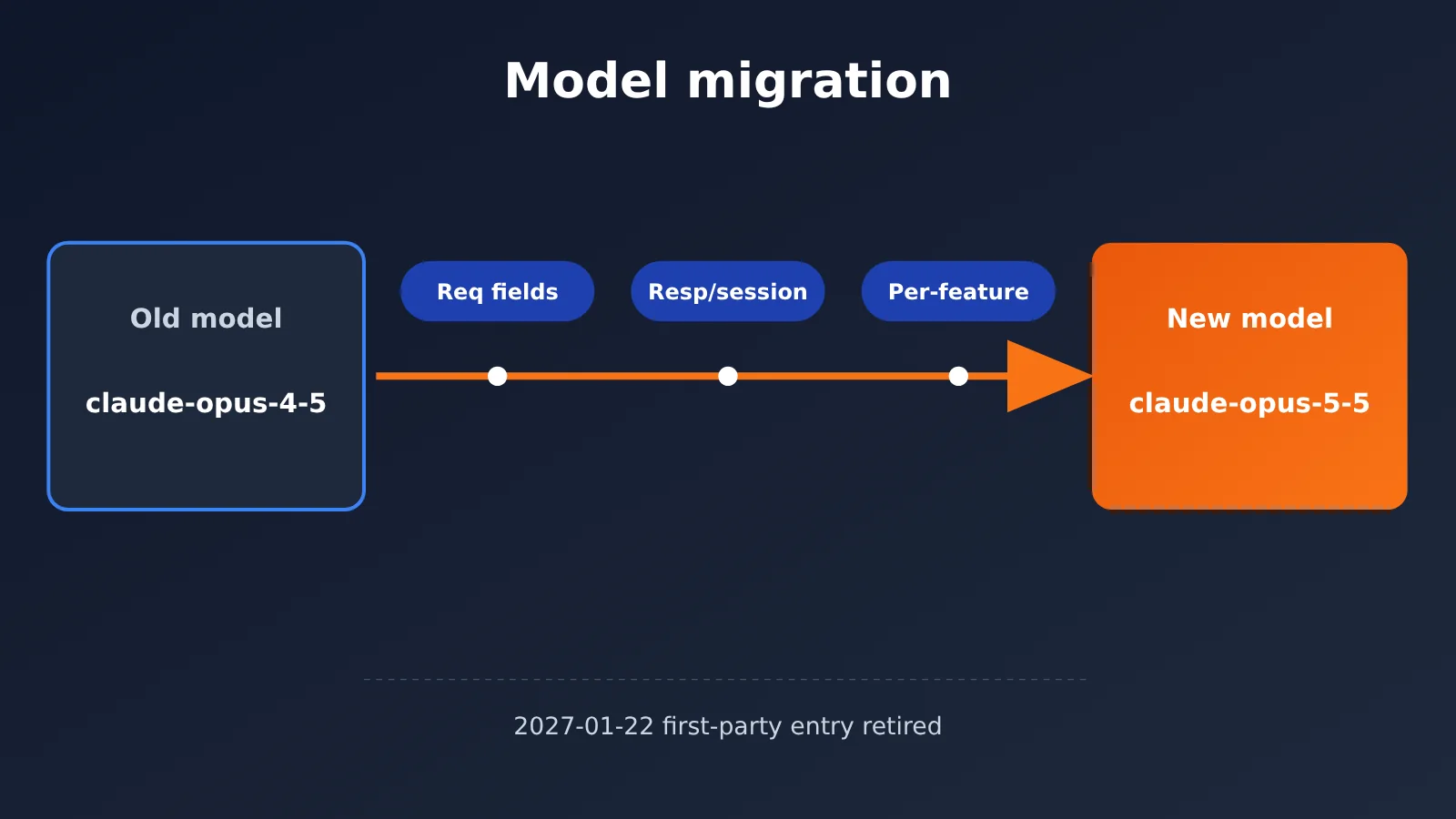
Bottom Line: What You Need to Change When Migrating from Claude Opus 4.5 to Opus 5.5
When migrating from Claude Opus 4.5 to Opus 5.5, you need to change at least four request fields. Otherwise, you’ll get an HTTP 400 right away. First, set model to claude-opus-5-5. Second, remove thinking.type: "enabled", budget_tokens, and disabled, and use output_config.effort to control thinking depth. Third, remove temperature, top_p, top_k, and the trailing assistant prefill. Fourth, tool_choice supports only three forms: omitted, auto, or none.
Once requests go through, you still need to handle response-side changes. Filter the main content by type == "text", because the response may start with an empty thinking block. For multi-turn conversations with tools, you must pass assistant messages back exactly as received, without changing signatures or order. Whether you need to change structured outputs, Computer use, caching, or budgets depends on which features you actually use.
There’s a hard deadline. According to the official announcement dated November 23, 2026, claude-opus-4-5-20251101 and the alias claude-opus-4-5 are scheduled to retire from Anthropic’s first-party Claude API on January 22, 2027. This article is based on the first-party Messages API as verified on November 24, 2026. Other entry points, such as Bedrock, Vertex, and aggregator platforms, have their own model IDs, available features, and lifecycle rules, so you need to confirm each one separately before integration.
Claude Opus 4.5 → Opus 5.5 Migration Knowledge Map
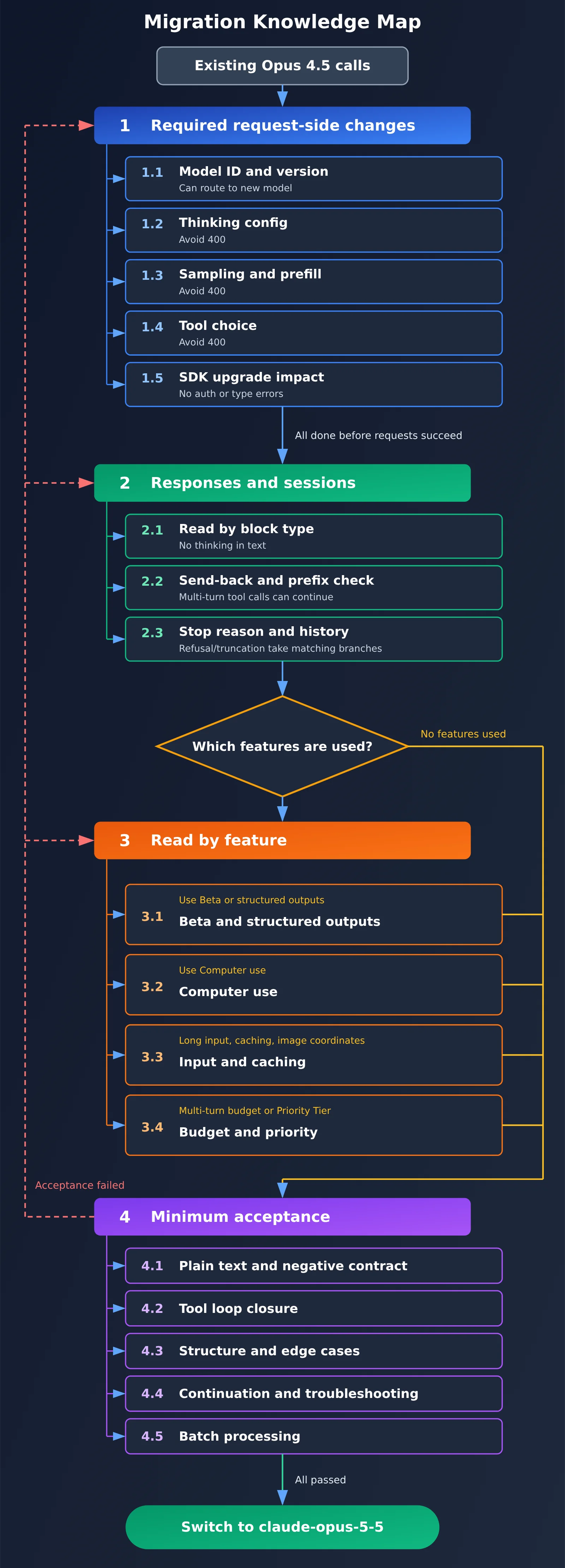
Figure note: the migration proceeds in four layers. Section 1 answers “can the request be accepted?”, Section 2 answers “can the response be read and continued correctly?”, Section 3 walks through the feature checklist item by item, and Section 4 uses five sets of test cases to prove the earlier changes actually work. When acceptance fails, go back to the section with the matching number and troubleshoot there.
Article Index
| # | Section | Prerequisite | What you’ll get out of it |
|---|---|---|---|
| 1 | Required field changes on the request side | Everyone starts here | Requests stop returning 400 |
| 2 | Consuming responses and multi-turn sessions | Depends on Section 1 — requests already return successfully | Text, tools, and thinking blocks each land where they belong |
| 3 | Changes enabled per feature | Parallel to Section 2, consult as needed | Specific features behave consistently on the new model |
| 4 | Minimal acceptance checks | Consolidates Sections 1–3 | A verdict on whether you can ship |
Sections 1 and 2 apply to every project, so read them in order. The four subsections of Section 3 are independent of each other — just read the ones that match your feature list. The acceptance cases in Section 4 map one-to-one to the numbering above, so you can use them directly as a test plan.
To Know: Terminology you need to understand before migrating to Opus 5.5
| Term | Plain-language explanation |
|---|---|
| adaptive thinking | The model decides for itself how much to think. It’s always on in Opus 5.5 and can’t be disabled manually |
| effort | The thinking-depth tier, set in output_config.effort. Accepts low through max, defaults to medium |
| prefill | Placing an assistant message at the end of messages so the model continues writing from that prefix |
| signature | A signature attached to thinking blocks, used for validation when they’re passed back in multi-turn requests. It may be present even when the thinking text is empty |
| prefix validation | The server checks whether the history prefix of a follow-up request matches what it was when the thinking blocks were recorded |
anthropic-version |
The API version request header. It’s independent of the model ID, and each one governs part of the validation rules |
stop_reason |
The reason generation stopped. Judge it separately from the HTTP status code |
1 Migrating Claude Opus 4.5 to Opus 5.5: Required Field Changes on the Request Side
These changes are hard constraints. If you miss any one of them, you’ll get an HTTP 400 or the request will be rejected. The official migration guide accumulates requirements version by version. Projects migrating directly from 4.5 need to handle both the general rules and the 4.5 section—don’t just look at the last section.
First, align the old and new syntax in a table so you can check each item:
| Old Opus 4.5 syntax | New Opus 5.5 syntax | Consequence if unchanged |
|---|---|---|
model: "claude-opus-4-5" or a dated snapshot |
model: "claude-opus-5-5", no date needed |
Unavailable after the retirement date |
thinking: {type: "enabled", budget_tokens: N} |
Omit thinking or write {"type":"adaptive"}; control depth with output_config.effort |
HTTP 400 |
thinking: {type: "disabled"} |
Same as above | HTTP 400 |
temperature / top_p / top_k |
Remove them, and disable the default values injected by the gateway | HTTP 400 when using the 2026-10-21 version |
Trailing assistant prefill |
System instructions + structured output | Request rejected |
tool_choice: any or a specified tool name |
Omit it, or use auto or none |
HTTP 400 |
1.1 Model ID and API Version
Change the model in POST /v1/messages to the fixed ID claude-opus-5-5. If your project also calls the token counting endpoint, update the model ID there too. Before making changes, capture the actual serialized request JSON once, because gateways or legacy templates often carry over fields that aren’t visible in your application code.
The model ID and the anthropic-version request header are two separate settings. If you’re also upgrading the version to 2026-10-21, you’ll need to handle version-specific restrictions as well—for example, assistant messages can’t directly contain document, and user text blocks can’t carry non-empty citations. Also, Python SDK 2.0.0 sends this version by default, so upgrading the SDK is equivalent to upgrading the API version.
1.2 Thinking Configuration: From budget_tokens to effort
Opus 4.5 let you manually extend thinking—thinking.type: "enabled" plus budget_tokens. Opus 5.5 always uses adaptive thinking; omitting thinking has the same effect as explicitly writing {"type":"adaptive"}. The old enabled and disabled values both trigger a 400.
# Old: Opus 4.5
thinking={"type": "enabled", "budget_tokens": 16000}

# New: Opus 5.5
output_config={"effort": "high"}   # low / medium / high / xhigh / max, default medium
There’s no direct mapping table from the token counts in the old budget to effort levels. The safer approach is to pick a batch of representative business samples, run them at several effort levels, and then choose a level based on quality and cost.
1.3 Sampling Parameters and Trailing Prefill
temperature, top_p, and top_k all need to be removed. The real trap is the default values that SDK wrappers, frameworks like LangChain, or an internal gateway quietly add in — so inspect what’s actually being sent on the wire.
Trailing prefill has to go too. The old approach of forcing output to start with { via an assistant prefix can be split into two parts: put the natural-language formatting requirements in the system instruction, and constrain the JSON your downstream program parses with structured output. Completed historical assistant turns are unaffected and stay as-is when you continue the conversation.
1.4 Tool Choice
tool_choice can only be omitted, set to auto, or set to none. any, and a tool with a specified name, both return 400 at the generation entry point and at the counting entry point. If your business flow depends on “this step must call a particular tool,” the application should orchestrate that step explicitly instead. You can also spell out the call timing in the prompt, and add strict: true to the tool to constrain the parameter format.
Strict mode supports only a subset of JSON Schema, and every object at every level must set additionalProperties: false. Handle tool arguments as parsed values; for streaming chunks, concatenate them fully first, then do standard JSON parsing. Unicode and slash escaping may vary, so don’t rely on string comparison to decide whether the arguments are correct.
1.5 The Impact of Upgrading the SDK at the Same Time
The new major versions of the SDK and CLI send the API key via Authorization: Bearer by default, and the Claude API also accepts X-Api-Key. If your gateway’s auth forwarding, log redaction rules, or integration tests are hard-coded to read the old request header, you’ll need to update those as well. In Python SDK v2, MessageParam became a union of per-role types, so old code that treated it as a function call will throw a TypeError — just switch to a dict literal with a role key.
Below is a minimal smoke test using the OpenAI-compatible format, which also confirms no sampling parameters are left over in the request:
from openai import OpenAI

client = OpenAI(
    api_key="YOUR_API_KEY",
    base_url="https://api.apiyi.com/v1",  # APIYI unified endpoint: one key, many models
)

resp = client.chat.completions.create(
    model="claude-opus-5-5",  # for model IDs, refer to the platform's model list
    max_tokens=2048,
    messages=[{"role": "user", "content": "用一句话定义幂等性。"}],
    # note: do not pass temperature / top_p
)
print(resp.choices[0].message.content)
🚀 Quick start: Before migrating, you can request a free trial quota through APIYI at apiyi.com, then use the same key to call Opus 4.5 and Opus 5.5 in parallel — comparing output quality and token usage first. Field pass-through rules can differ between entry points, so for native fields like
output_configand Beta request headers, refer to the platform documentation.
2 Claude Opus 5.5: Consuming Responses and Multi-turn Sessions
Once requests come back successfully, the problem shifts to the parsing layer. Errors here usually don’t throw — they show up as empty content slipping into the body text, a tool chain breaking on the second round, or a refusal being counted as a successful result.
2.1 Read the body by block type
content may begin with one or more thinking blocks, and the body text is only the blocks where type == "text". thinking.display defaults to omitted, in which case the thinking text is empty but may still carry a signature. Set display: "summarized" when you need a readable thinking summary. If you just want to show progress hints between tools to the user, use display: "updates" and add the Beta request header thinking-display-updates-2026-08-18.
A streaming implementation needs to merge chunks by index, then route content to the body text, tool arguments, and signature based on block type and delta type, and finally read the stop reason from message_delta. Here’s the native approach for the first-party Messages API:
import anthropic

client = anthropic.Anthropic()  # first-party endpoint; configure other endpoints per their own docs

response = client.messages.create(
    model="claude-opus-5-5",
    max_tokens=2048,
    messages=[{"role": "user", "content": "Define idempotency in one sentence."}],
    output_config={"effort": "medium"},
)
text = "".join(b.text for b in response.content if b.type == "text")
2.2 Echoing Assistant Messages Verbatim and Prefix Validation
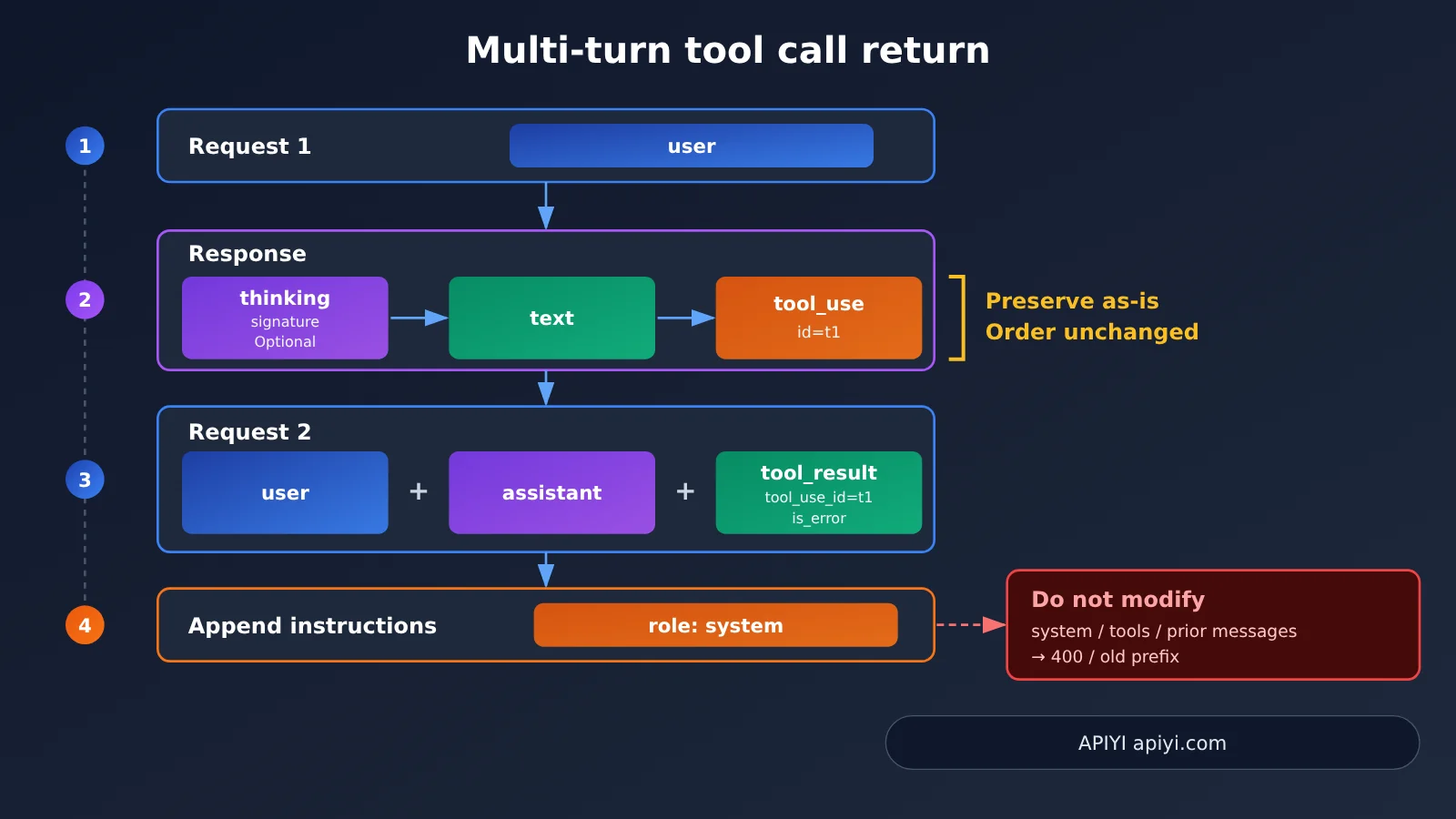
If there’s a client tool call in this round, write the received assistant content into the history of the next request exactly as-is — including empty thinking blocks, signatures, tool blocks, and their order. redacted_thinking carries encrypted data, so preserve it unchanged as well. Immediately after that, add a user message containing the corresponding tool_result, linked through tool_use_id. Even when a tool call fails, you still need to return a result block, marked with is_error: true.
history.append({"role": "assistant", "content": response.content})  # no cleanup whatsoever
history.append({
    "role": "user",
    "content": [{
        "type": "tool_result",
        "tool_use_id": tool_use.id,
        "content": result_text,
        "is_error": failed,
    }],
})
Once Opus 5.5 has recorded thinking blocks, modifying the top-level system, tools, or earlier messages may trigger prefix validation. The result could be an HTTP 400, or the request could succeed while the model keeps using thinking based on the old prefix — the latter case is much harder to detect. An append-only history is the safer approach. When you need to adjust operator instructions, append a role: "system" message in a supported position, for example right after the user message that echoes the full round of tool results.
If your application needs to load or unload tools mid-session, the first-party endpoint can enable the inline-tools-2026-09-15 Beta and modify the tool list in later system messages using tool_addition or tool_removal, so the existing prefix stays untouched. Projects with a fixed tool list can just keep declaring it at the top level.
2.3 Stop Reasons and Backward-Compatibility Considerations
HTTP status codes and stop_reason need to be evaluated separately. refusal may be returned alongside HTTP 200; in that case, read stop_details and enter the refusal branch. max_tokens means the output budget has been exhausted, while model_context_window_exceeded means the context window has been reached.
| stop_reason | Meaning | Suggested handling |
|---|---|---|
end_turn |
Natural completion | Enter the success branch, then run business validation |
tool_use |
Waiting for a tool result | Execute the tool and send the result back as described in 2.2 |
refusal |
Model refusal (can be HTTP 200) | Read stop_details and go to the refusal branch |
max_tokens |
Output budget reached | Treat the result as incomplete; increase the budget or split it into chunks |
model_context_window_exceeded |
Context window reached | Compress the history or split the task |
History compatibility is one-way. Opus 5.5 can read thinking blocks returned by Opus 4.5, so old sessions can continue directly. Conversely, if you switch to a model that can’t read Opus 5.5 thinking blocks, the API automatically discards those blocks and continues processing. The application side should still save the original conversation so you can switch back later.
3 Claude Opus 5.5 feature-by-feature changes
This section’s four subsections are split by feature, so you can skip the parts that don’t apply to your project.
3.1 Beta cleanup and structured outputs
For regular Python calls, switch from client.beta.messages.create() to client.messages.create(). Remove the old effort-2025-11-24, fine-grained-tool-streaming-2025-05-14, and interleaved-thinking-2025-05-14 request headers entirely; features that are still in beta keep their own dedicated configuration.
For structured outputs, move the old output_format dictionary to output_config.format, and effort can live in the same output_config. The Python SDK’s parse() and stream() accept Pydantic models in the form output_format=Model, and the SDK handles the conversion. If you’re still sending the deprecated raw fields for now, include the structured-outputs-2025-11-13 request header.
There are a few edge cases to watch when combining these features:
output_config.formatand strict tools can be used together: the former constrains the final text, and the latter constrains tool input.- Sending
output_config.formatwhile citation annotations are enabled returns a 400. - The server may place required properties before optional ones, so consumers should access values by property name and not rely on field order.
- On refusal or
max_tokenstruncation, the body may not conform to the schema; the success branch should check both the stop reason and the business validation result. - Integrations that previously used forced tool calls to return JSON objects can switch directly to structured text if all they need is valid JSON.
3.2 Computer use
The first-party endpoint uses computer_toolset_20260801 in place of computer_20251124, and drops the old Beta request header along with fields like name and display dimensions from the old declaration. During execution, handle each member tool_use one at a time, dispatching by name and toolset_name, and pass toolset_name back in the result. A single turn can contain multiple steps, so run them in order and decide what happens to the remaining steps when an earlier one fails. Amazon Bedrock’s docs have separate exception rules for the old tool version combined with Beta.
3.3 Budgets, tokenizer, caching, and images
The default context window is 1 million tokens, and the old window Beta request header can be removed. Standard calls max out at 128k output tokens. max_tokens is the total output cap for a single request — both thinking and visible text count toward it, and thinking that’s hidden by default still counts as output usage. The official guidance is to start tuning the xhigh and max levels from a 64k output budget, and high-budget Python calls can go through streaming.
The tokenizer changed too. The same text consumes roughly 1 to 1.35 times as many tokens on the new model as on the old one, depending on the content. You can call /v1/messages/count_tokens twice on your common inputs and compare the returned input_tokens. The counting endpoint returns an estimate; for actual cache usage, trust the fields in the generated response. The minimum cacheable prefix on the first-party endpoint dropped from 4,096 to 512 tokens, so system prompts that previously couldn’t be cached for being too short may now hit the cache. Apps that work with coordinates should treat the coordinates the model returns as one-to-one with actual image pixels, and also re-check the input budget that high-resolution images consume.
💰 Cost estimation tip: After the tokenizer change, monthly cost estimates based on the same word count may come out low. We recommend running a small slice of real traffic with actual business samples on APIYI apiyi.com for a few days — pay-as-you-go billing will directly reflect what you’re really spending under the new accounting.
3.4 Task Budgets and Service Tiers
For multi-turn tool workflows, you can add the task-budgets-2026-03-13 Beta request header and use output_config.task_budget to give the whole task a token budget signal. The budget covers thinking, tool calls, and tool results, and the model will schedule its steps against the countdown. One thing to watch: subsequent requests resend the full history, so if you manually decrement remaining based on the total request length, the budget will drain far too fast. The output of a single generation is still capped by max_tokens.
Organizations that have an Opus 4.5 Priority Tier commitment need to pay particular attention here: old commitments are tied to specific model versions, and Opus 5.5 doesn’t support Priority Tier. Any monitoring metrics or timeout logic that reads usage.service_tier should be re-validated against the tier the new model actually returns.
4 Claude Opus 5.5 Migration Minimum Acceptance Checklist
Whether the changes from the first three sections landed correctly is proven by the five groups of test cases below. The usage, latency, and business impact in the table depend on your environment — you’ll need to go by actual measurements.
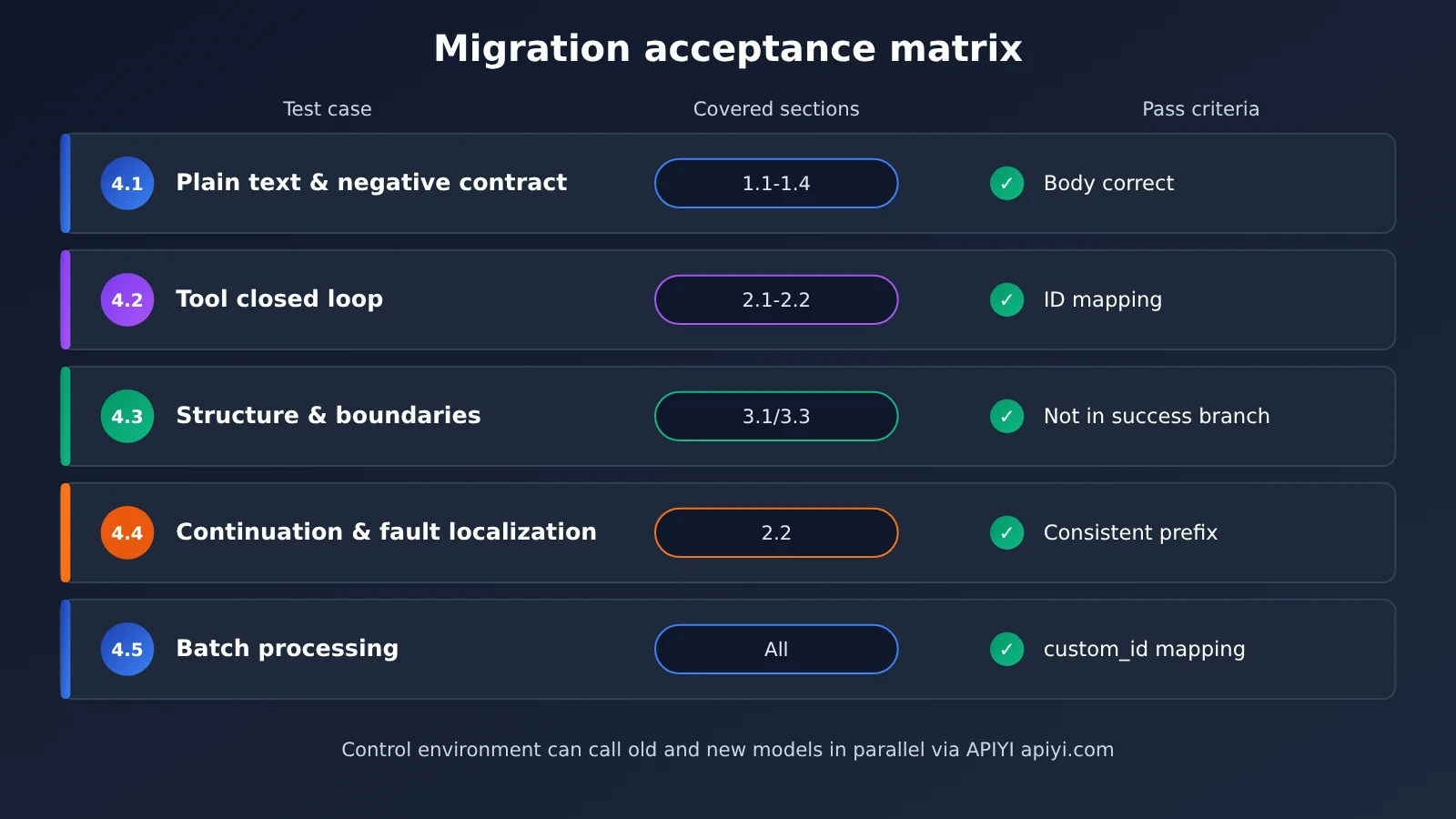
| No. | Test case | Covered sections | Pass criteria |
|---|---|---|---|
| 4.1 | Plain text and negative contracts | 1.1–1.4, 2.1 | Model identifiers are correct on both the regular and streaming entry points, body text is readable, and the stream closes normally; when manual thinking, forced tools, or trailing prefill are added individually, the app classifies the 400 as a parameter error |
| 4.2 | Tool closed loop | 1.4, 2.2 | Using a side-effect-free inventory lookup sample, parameters conform to the constraints, calls and result IDs match one-to-one, signatures round-trip unchanged, and the branch where the model outputs text directly is handled |
| 4.3 | Structure and boundaries | 2.3, 3.1, 3.3 | Simulated responses for refusals, truncation, and context limit hits don’t flow into success branches; output_tokens and the two cache token metrics are aggregated under the new accounting rules |
| 4.4 | Continuation and failure localization | 2.2 | The prefix actually sent in the second round matches the first round |
| 4.5 | Batch processing | All | Success samples and simulated failure samples for each custom_id follow their respective paths |
For 4.2, we recommend additionally constructing simulated streaming chunks containing Chinese characters, slashes, and newlines, to verify that the concatenated JSON decodes correctly. For 4.4, focus on checking three common problem sources: system prompts with dynamic dates, tool descriptions regenerated every round, and serializers that automatically strip empty fields. All of them silently alter the prefix. Test sessions can add the thinking-binding-controls-2026-08-01 request header and inspect thinking_mismatch_allowed in input_transformations, to distinguish between “prefix mismatch but body text was still returned” and a genuine binding error. Looking only at HTTP status codes won’t tell you whether compatibility is actually fine.
For 4.5, projects that have Message Batches need to use the same minimal input set and separately verify each item’s submission parameters, result types, and failure records within the batch. A passing streaming pipeline doesn’t substitute for per-item batch acceptance.
🎯 Acceptance tip: When building a comparison environment, you can use a single API key via APIYI apiyi.com to call both the old and new models at the same time, run samples for 4.1–4.3 side by side, and then decide on the effort tier and
max_tokensbudget.
Once all five groups of test cases pass, you can cut production traffic over to claude-opus-5-5. We recommend retaining the original Opus 4.5 session data until after the January 22, 2027 retirement date before cleaning it up. If a test case fails, go back to the corresponding number using the “covered sections” in the table to troubleshoot — you’ll usually pinpoint the missed field quickly.
References
- Claude Release Notes: Opus 4.5 retirement announcement and Opus 5.5 release information
- Link:
platform.claude.com/docs/en/release-notes/overview
- Link:
- Opus 5.5 Migration Guide: migration requirements accumulated section by section from earlier versions
- Link:
platform.claude.com/docs/en/models/opus-5-5/migration-guide
- Link:
- API Version Migration 2026-10-21: version-level restrictions and SDK changes
- Link:
platform.claude.com/docs/en/api/migration-2026-10-21
- Link:
- Prefix Checks: rules for multi-turn conversations with preserved thinking
- Link:
platform.claude.com/docs/en/build-with-claude/preserved-thinking/prefix-checks
- Link:
- Model Deprecation Table: lifecycle and retirement dates for each model
- Link:
platform.claude.com/docs/en/about-claude/model-deprecations
- Link:
Author: APIYI Technical Team
Technical Support: If you run into compatibility issues during migration, feel free to contact us through the APIYI apiyi.com homepage. For more integration details, see the docs.apiyi.com documentation center.