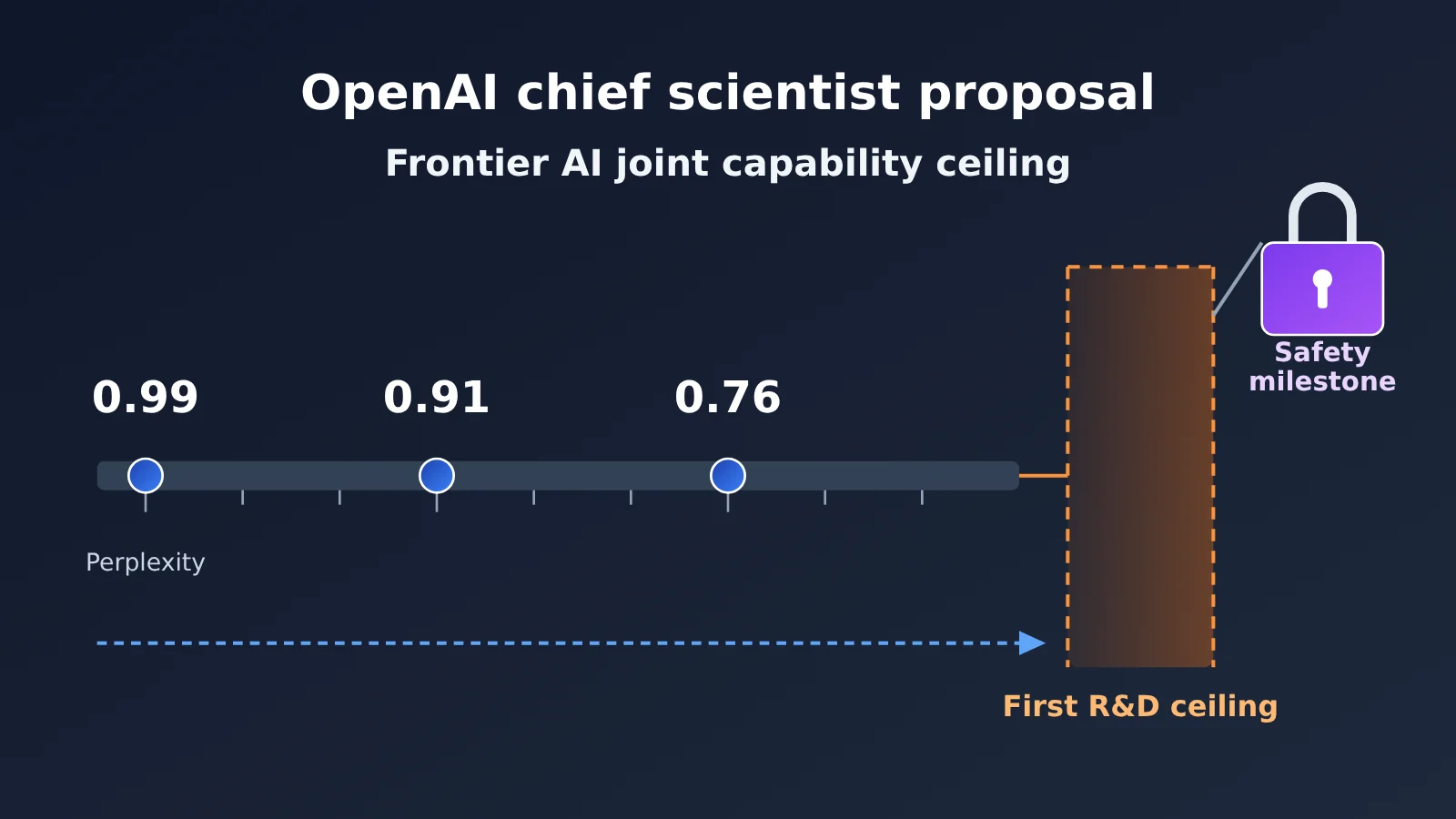
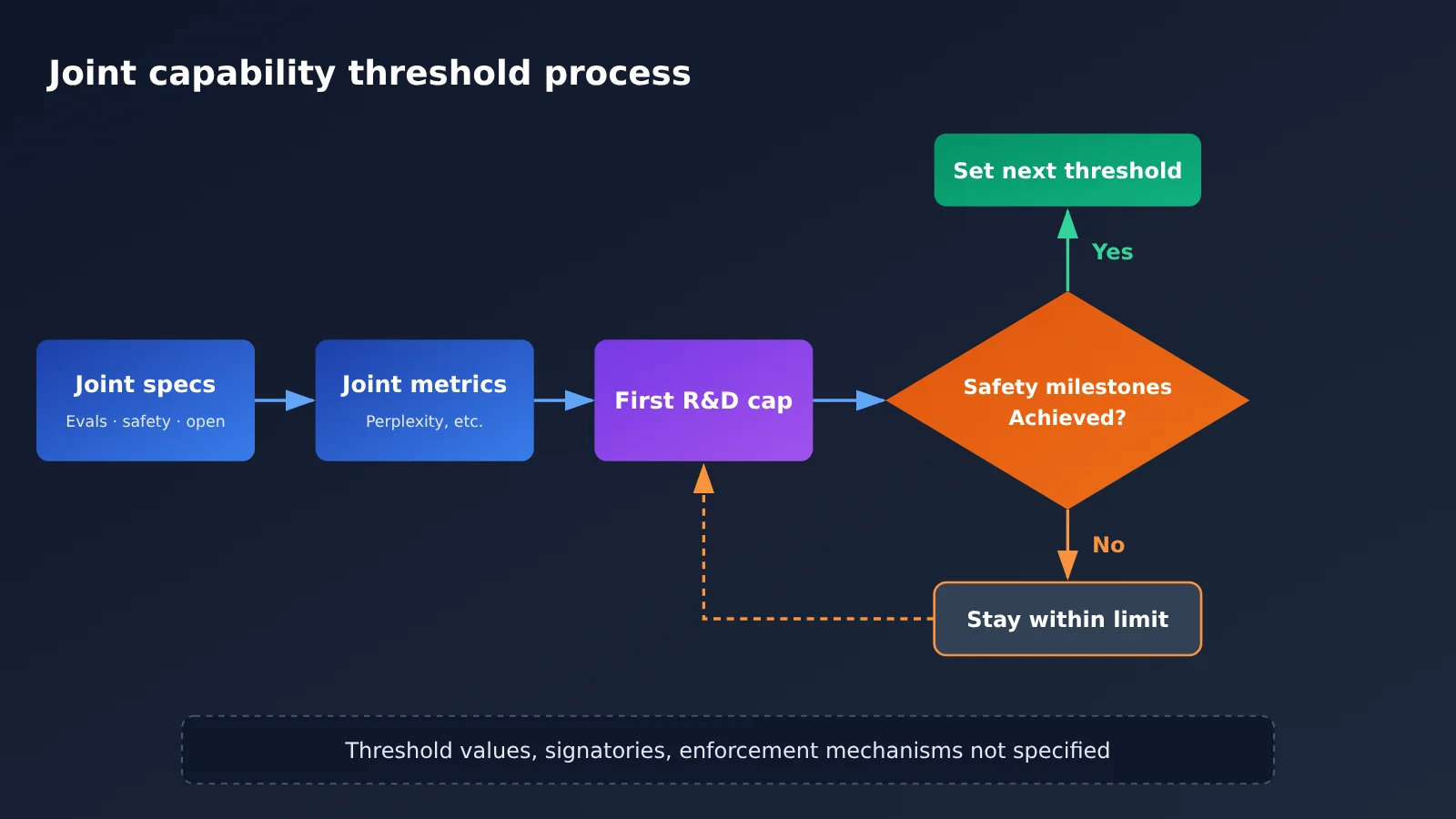
On November 22, 2026, OpenAI Chief Scientist Jakub Pachocki published a bylined article proposing that frontier model developers agree on a “first R&D ceiling” based on measurable metrics such as perplexity. Until the ability to understand and monitor AI behavior reaches a specific safety milestone, participants commit not to cross this line. The proposal puts “how to measure progress” and “what conditions must be met before moving forward” into a single framework. For now, it remains an initiative: the original article gives no threshold numbers, signatories, enforcement mechanism, or effective date. Whether it can be put into practice depends on whether measurements can be aligned across labs and whether safety milestones can be clearly validated.
What you’ll learn from this article
- The proposal’s three-layer structure: what shared standards, the first ceiling, and safety milestones each refer to.
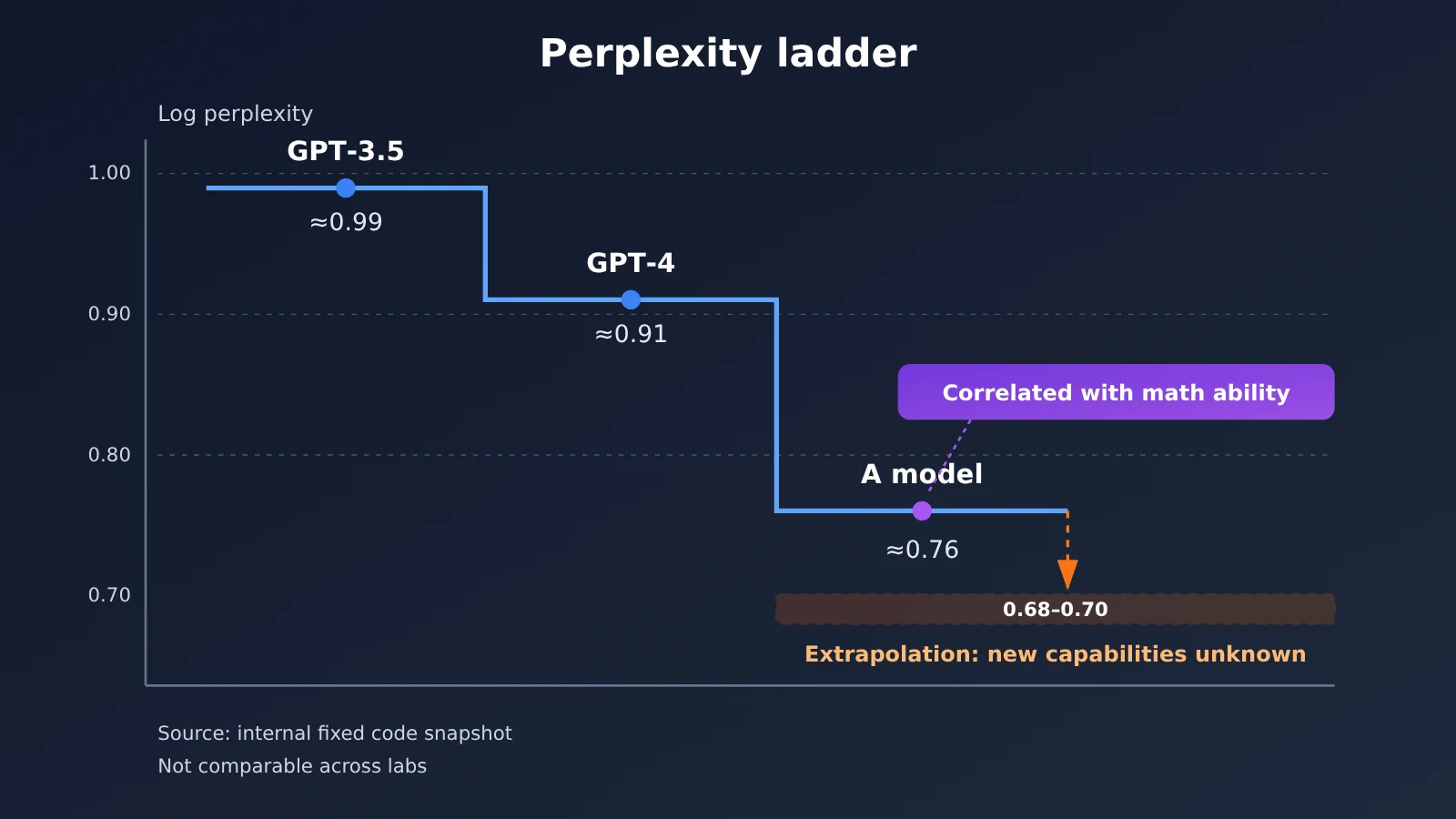
- Why perplexity was chosen, and how to read the numbers 0.99, 0.91, 0.76, and 0.68–0.70.
- The four types of metric limitations the author himself acknowledges, and how they affect enforceability.
- How ordinary API development teams should view the relationship between this kind of “R&D limit” and the pace of model releases.
Index: It starts with a table explaining concepts such as perplexity and CoT monitoring, plus a quick overview of the proposal’s impact on different groups. The “Objective Facts” section lays out the original proposal, the chart numbers, and the limitations listed by the author. The “Analysis and Judgment” section discusses the blind spots of a single metric and the three things that still need to be clarified for the initiative to become an enforceable agreement, before finishing with practical responses for development teams.
To Know: 7 Concepts for Understanding the Shared Capability Ceiling of Frontier AI
| Concept | Brief explanation |
|---|---|
| Frontier AI | The class of AI systems with the most advanced capabilities at any given moment — the target of this proposal’s constraints |
| Pretraining | The training stage where a model learns basic predictive ability from large-scale data; perplexity mainly measures the results of this stage |
| Perplexity | How hard it is for a model to predict the next token; under fixed evaluation conditions, a lower number means better prediction |
| Log perplexity | Perplexity expressed on a logarithmic scale, equivalent to cross-entropy loss — this is what the charts in the original piece use |
| Held-out dataset | A batch of data reserved purely for evaluation and never used in training, so measurements aren’t contaminated by “memorizing the answers” |
| CoT monitoring | A behavior-monitoring approach that watches a model’s reasoning traces (chain of thought) |
| Safety milestone | A safety capability that must be reached and clearly verified before further progress is allowed |
Quick Look at the Impact of the Frontier AI Shared Capability Ceiling Proposal
| Group | Possible impact |
|---|---|
| Frontier lab researchers | If the proposal is adopted, they’ll need to invest collaborative effort in shared eval sets, data-mix disclosure, and result verification |
| AI safety and governance researchers | The discussion shifts from “should we set limits at all” to “what do we measure, who verifies it, and how are milestones accepted” |
| API developers and technical leads | Interfaces won’t change in the short term; over the long run, the pace of generational model upgrades may depend more on safety conditions |
| General users | No direct impact for now — the proposal has no signatories and no effective date |
For development teams, the more practical preparation is to fold “model version changes” into your own regression testing process. With an aggregation platform like APIYI (apiyi.com), you can switch between models from different vendors using the same code base and run comparison checks when new versions ship.
The Facts: OpenAI Chief Scientist’s Proposal for a Shared Capability Ceiling
How to Set the Shared Capability Ceiling: The Proposal’s Three-Tier Structure
This bylined article, titled “Perplexity and Intelligence,” was published on OpenAI’s official website and written by Chief Scientist Jakub Pachocki. The proposal in the article has two steps: first, it recommends that frontier model developers establish common norms for evaluation methods, safety arguments, and transparency; then it recommends agreeing on a “first R&D ceiling” that can be tracked across labs, using perplexity and other metrics.
The ceiling’s “unlock condition” is a specific safety milestone. Until humanity’s ability to understand and monitor AI behavior reaches that milestone, participants commit to staying within the limit. The author’s example of a milestone is “a successor to CoT monitoring”—that is, a monitoring capability that goes a step beyond existing chain-of-thought monitoring. Later stages can follow the same approach, setting new limits and new milestones.
| Proposal element | What the original says | What the original doesn’t specify |
|---|---|---|
| Common norms | Cross-lab norms for evaluation, safety arguments, and transparency | The specific text of the norms |
| First R&D ceiling | Agreed using metrics such as perplexity, trackable across labs | The specific value of the limit |
| Safety milestone | The ability to monitor and understand AI behavior reaches a defined checkpoint; example: a successor to CoT monitoring | Acceptance criteria and the acceptance authority |
| Follow-on stages | Set new limits along the same lines | Cadence and timeline |
| Implementation conditions | Participants commit to comply | Signatories, enforcement mechanism, and effective date |
It’s worth stressing that this proposal is not the same as OpenAI’s existing deployment risk process. OpenAI’s “Managing frontier AI risk,” published on November 18, describes risk management at the deployment level; this signed article discusses capability limits at the R&D stage. The two should be considered separately.
Why Perplexity Was Chosen: Starting From Next-Token Prediction
Perplexity measures a model’s ability to predict the next token. Here’s an analogy: take a fixed set of held-out fill-in-the-blank questions — whichever model assigns higher probabilities to the correct answers will usually have lower perplexity on that set. The appeal of this metric is that it’s continuous, computable, and directly tied to pretraining, which makes it a good “progress gauge.”
But the analogy also reveals its precondition: the evaluation conditions have to stay fixed. Swap in a different set of questions, or change how tokens are split, and comparability between numbers has to be re-established. The evaluation set used in the original charts is a fixed internal code snapshot from OpenAI itself — the footnote says so explicitly.
How to Read the Numbers in the Chart
On this internal code snapshot, the key numbers are as follows. They come from internal measurements, internal observations, and extrapolated predictions respectively — different in kind, and they shouldn’t be conflated.
| Value (log perplexity) | What it corresponds to | Nature |
|---|---|---|
| ~0.99 | GPT‑3.5 | Measured on the internal eval set |
| ~0.91 | GPT‑4 | Measured on the internal eval set |
| ~0.76 | Some model, which the author connects to observations of internal math-problem capability | Internal observation |
| ~0.68–0.70 | Extrapolation suggests new capabilities may emerge in this range; the specific capabilities are unknown | Extrapolated prediction |
| As early as 2027 | The author’s estimate that a wave of foundational pretraining progress may arrive | Author’s prediction |
The author also attributes the 2026 situation: the accelerated drop in pretraining loss comes mainly from long-running research and compute investment, with automated research contributing only a small share. So he doesn’t see current progress as primarily driven by “AI accelerating AI itself.”
The 4 Types of Metric Limitations the Authors List
It’s refreshing that the original text proactively lays out the limitations of perplexity as a governance metric:
- Limited cross-lab comparability: Labs use different evaluation datasets and training-data mixes, so their internal numbers can’t be compared directly.
- No direct mapping to risk: A predictive-capability metric doesn’t correspond to any specific task risk that needs to be controlled.
- Inference-stage workaround: Using CoT at inference time can improve model capabilities, but it doesn’t lower the base model’s pretraining perplexity.
- Unknown theoretical floor: Under a given data distribution, it’s unclear how low perplexity can go.
The original also notes that, for early models, code-prediction capability is a weak proxy for overall capability—meaning progress measured through code snapshots can’t simply be extrapolated to all capability dimensions.
Analysis: Can a Common Capability Ceiling Move from Proposal to Implementation?
The following is editorial analysis based on the original proposal and does not represent the views of OpenAI or any lab.
What a single metric misses
The four limitations the authors list map neatly onto four gaps in a “common capability cap” that’s supposed to actually hold the line. The first gap is comparability. If every lab measures perplexity on its own data, then “0.70” could mean wildly different capability levels at Lab A versus Lab B — and the whole idea of a “common cap” loses its shared yardstick.
The second and third gaps matter more. Perplexity governs pretraining, yet a great deal of today’s capability gains come from post-training and chain-of-thought at inference time. A model whose base perplexity sits below the line can, after reinforcement learning and long-form reasoning, perform far beyond expectations on real tasks. In other words, capping things by perplexity alone leaves room for “compliant on paper, already over the line in practice.” The fourth gap is an unknown floor, which makes extrapolation itself uncertain: the 0.68–0.70 range is the authors’ prediction, not a firm threshold you could write into a contract.
So the sensible reading is this: perplexity works well as a “progress gauge,” not as the sole “brake pedal.” The original text’s phrasing — “perplexity and other measurement metrics” — suggests the authors themselves don’t treat it as a single criterion.
How to Turn a Proposal into an Enforceable Agreement: 3 Things You Need to Nail Down
For this proposal to go from a signed op-ed to a multi-party agreement, it has to answer at least three questions:
- Who maintains the evaluation conditions? You need a shared holdout eval set that everyone agrees on — fixed content, fixed tokenization, and safeguards to keep it out of training data. That alone is infrastructure a neutral party has to maintain long-term.
- Who verifies the results? Numbers self-reported by labs are hard to take at face value. You need some kind of verification authority — say, a third party reproducing the measurements in a controlled environment. That runs straight into the confidentiality boundaries around model weights and training data.
- What counts as meeting the monitoring bar? “A successor to CoT monitoring” is a direction, not an acceptance criterion. Milestones have to be broken down into testable, pass/fail conditions — otherwise “hitting the milestone” just becomes everyone talking past each other.
None of these three were fleshed out in the original piece, and they’re the most important signals to watch going forward. If we start seeing eval sets or verification protocols jointly released by multiple labs, that’s when this proposal begins to move into the execution phase.
What This Means for API Development Teams
Public capability evaluations, vendors’ deployment tiering, and this latest R&D limit proposal each operate at a different layer. For an ordinary development team, what you can see when an API upgrades is the model version number, the permissions you have access to, and your own local regression results; the safety conditions vendors weigh before release are usually invisible to you. If the R&D limit mechanism actually takes effect someday, the most immediate impact you’d likely feel is that release dates for new-generation models become harder to predict, and some capabilities may roll out in stages.
| Layer | What it focuses on | What development teams can observe |
|---|---|---|
| R&D limits (this proposal) | Whether capabilities cross agreed thresholds during training | Essentially invisible; only indirectly sensed through release cadence |
| Deployment risk management | Pre-release risk assessment and tiering | Model cards, usage policies, scope of permission grants |
| Public capability evaluation | Benchmark scores | Third-party leaderboards and vendor announcements |
| Team-local regression | How the model performs on your own business | Fully under your control; test multiple models uniformly via APIYI apiyi.com |
Faced with this uncertainty, what teams can do is turn “insensitivity to model versions” into an engineering capability: fix a set of your own business evaluation questions and run a regression as soon as a new version drops. The code below borrows the idea of perplexity, using logprobs to compute the model’s average negative log probability on a fixed prompt, as an intuitive observation signal.
import math
from openai import OpenAI

client = OpenAI(
    api_key="YOUR_API_KEY",
    base_url="https://api.apiyi.com/v1"  # APIYI unified interface
)

resp = client.chat.completions.create(
    model="gpt-4o-mini",
    messages=[{"role": "user", "content": "补全函数:def add(a, b):"}],
    logprobs=True,
    max_tokens=32,
)
lps = [t.logprob for t in resp.choices[0].logprobs.content]
avg_nll = -sum(lps) / len(lps)
print(f"平均负对数概率: {avg_nll:.3f}  困惑度: {math.exp(avg_nll):.3f}")
One caveat: this code measures the model’s confidence in “content it generated itself,” which is not the same as the pretraining perplexity of the original text measured on a held-out dataset, and the values aren’t comparable to numbers like 0.91 or 0.76. It’s only suitable for observing trends across different model versions on the same prompt set. Also, not every model supports returning logprobs, so confirm before you use it.
View the full regression script
import json
import math
from openai import OpenAI

client = OpenAI(
    api_key="YOUR_API_KEY",
    base_url="https://api.apiyi.com/v1"  # One key, many models
)

# Fixed business evaluation prompt set: content and order stay unchanged to keep results comparable
PROMPTS = [
    "补全函数:def fibonacci(n):",
    "把下面的 SQL 改写为参数化查询:SELECT * FROM users WHERE id = 1",
    "用一句话解释什么是幂等接口。",
]

MODELS = ["gpt-4o-mini", "gpt-4o"]  # Swap in the models you want to compare


def avg_nll(model: str, prompt: str) -> float | None:
    try:
        resp = client.chat.completions.create(
            model=model,
            messages=[{"role": "user", "content": prompt}],
            logprobs=True,
            max_tokens=64,
            temperature=0,
        )
        content = resp.choices[0].logprobs
        if not content or not content.content:
            return None  # This model didn't return logprobs
        lps = [t.logprob for t in content.content]
        return -sum(lps) / len(lps)
    except Exception as e:
        print(f"[{model}] 调用失败: {e}")
        return None


report = {}
for m in MODELS:
    scores = [s for p in PROMPTS if (s := avg_nll(m, p)) is not None]
    if scores:
        mean = sum(scores) / len(scores)
        report[m] = {"avg_nll": round(mean, 4), "ppl": round(math.exp(mean), 4)}

print(json.dumps(report, ensure_ascii=False, indent=2))
🚀 Quick start: the script above runs directly on APIYI apiyi.com, and new users get free trial credits. The platform offers an OpenAI-compatible interface, so a single API key lets you call OpenAI, Claude, Gemini, and other models — handy for building your own model-version regression workflow.
Common Questions About the Shared Capability Ceiling for Frontier AI
Q1: Is this proposal already in effect?
No. It’s a proposal from a signed article by Jakub Pachocki on OpenAI’s official site. The original text doesn’t give a numeric value for the first threshold, participating signatories, an enforcement mechanism, or an effective date.
Q2: Can the 0.91 and 0.76 in the original be compared with other labs’ numbers?
No. Those numbers were measured on OpenAI’s own fixed internal code snapshot. Different labs use different evaluation data and training data mixes, and the author himself points out that comparability is limited.
Q3: Will R&D thresholds affect the model APIs I’m calling today?
Not in the short term. It’s discussing capability constraints at the training stage, not existing endpoints. Teams can access multiple models through a single integration with APIYI (apiyi.com), keeping flexibility to switch between versions and vendors.
Q4: How should development teams handle the uncertainty of model release cadence?
We’d suggest maintaining a fixed business evaluation set, running regressions as soon as a new version ships, and decoupling your business code from any specific model. With APIYI’s (apiyi.com) unified interface, switching models usually means changing just one model parameter, which makes quick comparisons easy.
The value of this proposal isn’t the specific line it draws — it’s that it ties “capability measurement” and “safety conditions” together in a traceable form for the first time. Whether perplexity can carry that role depends on whether three things can be worked out: a shared evaluation set, result verification, and milestone acceptance. The author has already laid out its blind spots candidly. Until the industry reaches consensus, the more pragmatic move for development teams is to keep model evaluation in their own hands and keep validating through multi-model platforms like APIYI (apiyi.com), so that model upgrades become manageable engineering events.
References
-
OpenAI · Perplexity and Intelligence: a piece authored by Jakub Pachocki, 2026-11-22
- Link:
openai.com/index/perplexity-and-intelligence/ - Notes: the original proposal text, the log perplexity chart, and footnotes; the footnotes confirm that the evaluation used a fixed internal code snapshot
- Link:
-
OpenAI · Managing frontier AI risk: OpenAI’s write-up on frontier AI risk management, 2026-11-18
- Link:
openai.com/index/managing-frontier-ai-risk/ - Notes: background on OpenAI’s existing deployment risk processes, attributed separately from this R&D threshold proposal
- Link:
Author: APIYI Technical Team
Technical discussion: Feel free to visit the APIYI apiyi.com homepage to get in touch with us. You’ll find more integration resources in the docs.apiyi.com documentation center.