Sora 2 API Access Solution Comparison
With OpenAI's official release of Sora 2 in September 2025, developer demand for API access has been growing rapidly. However, since the official API isn't fully public yet, two main access solutions have emerged in the market:
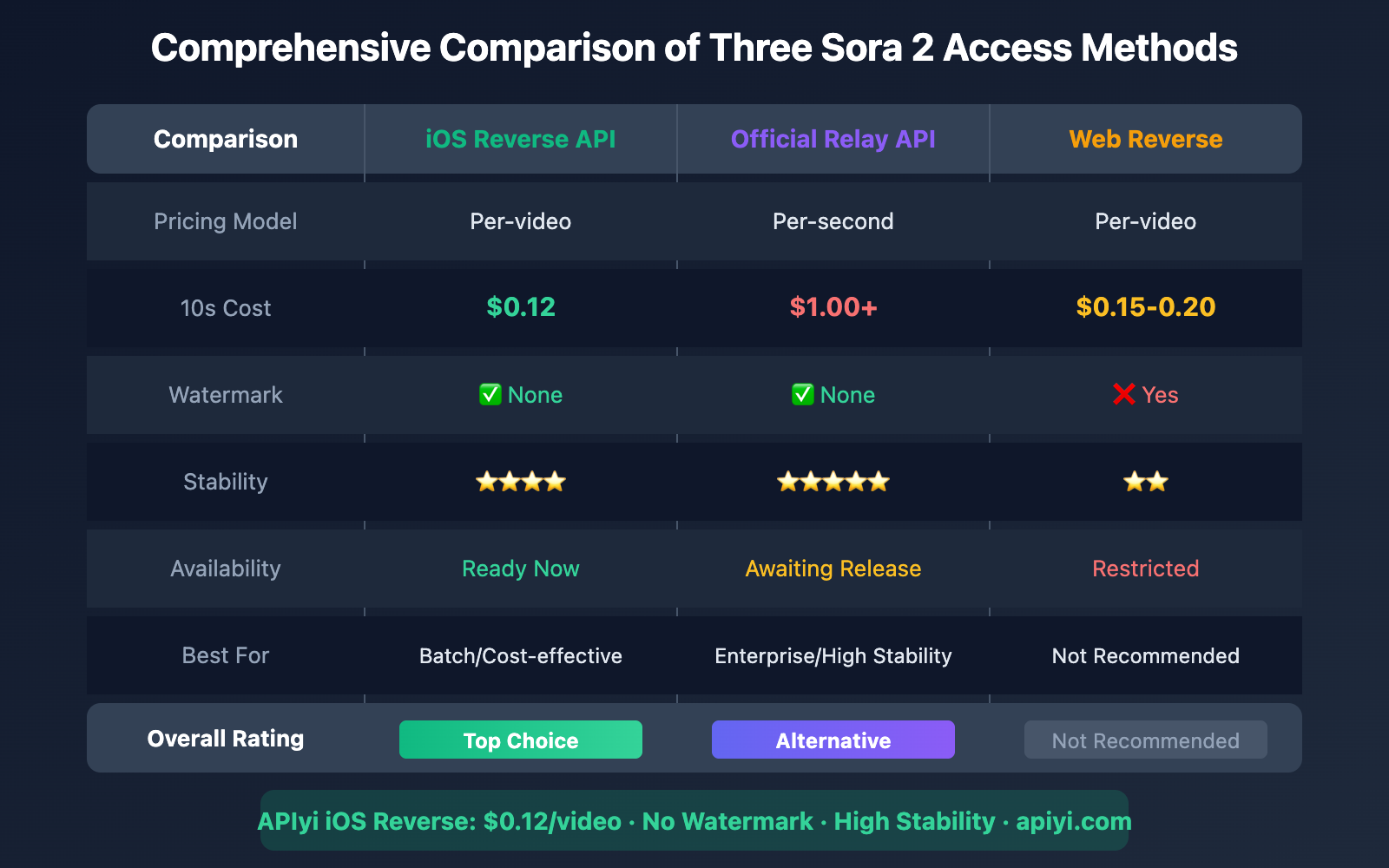
| Solution Type | Billing Method | Cost for 10s Video | Watermark | Stability |
|---|---|---|---|---|
| Reverse API | Per-request | $0.12 | No watermark | Depends on platform countermeasures |
| Official Relay | Per-second | $1.00-5.00 | No watermark | Official guarantee |
| Web Reverse | Per-request | $0.15-0.20 | Has watermark | Less stable |
Understanding the differences between these two solutions is crucial for choosing the right Sora 2 access method.
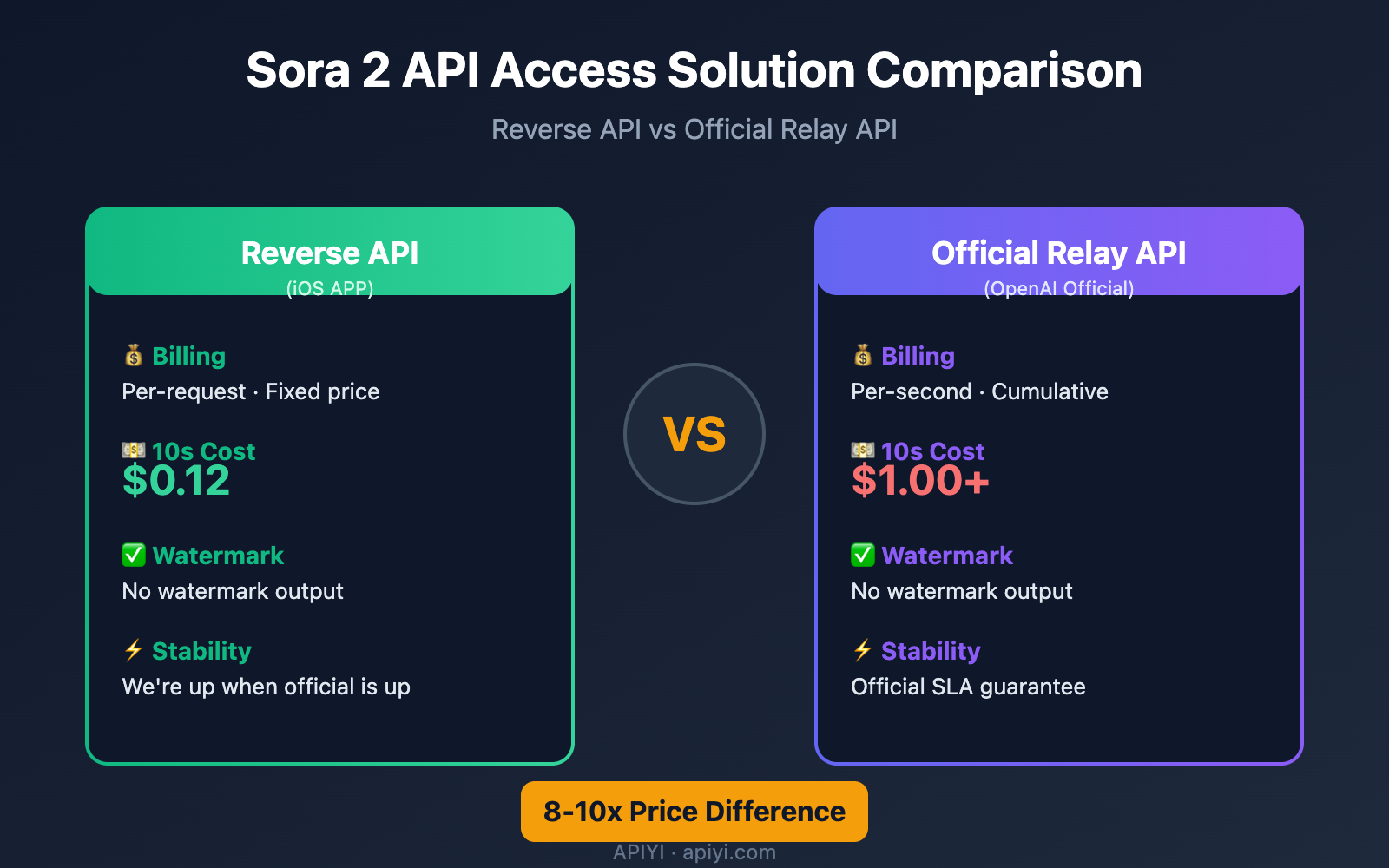
Key Takeaway: Sora 2 reverse API charges per-request (
$0.12/video), while official relay API charges per-second ($0.10-0.50/sec). For a 10-second video, the price difference is nearly 10x. The reverse solution is based on the iOS APP endpoint, generates watermark-free videos, and offers better cost-effectiveness.
Technical Principles of Sora 2 Reverse-Engineered API
What is a Sora 2 Reverse-Engineered API
A reverse-engineered API uses reverse engineering techniques to wrap Sora 2's client-side interface calls into a standardized API format that developers can programmatically access.
Features of APIYi's reverse-engineered solution:
- Based on iOS APP: Unlike web-based reverse engineering, this offers higher stability
- Watermark-free output: Videos generated through the APP are natively watermark-free
- Pay-per-use pricing: Fixed cost per generation, making expenses predictable
- OpenAI-compatible format: Uses standard API calling conventions
How the Sora 2 Reverse-Engineered API Works
# APIYi Sora 2 reverse-engineered API usage example
import openai

client = openai.OpenAI(
    api_key="your_api_key",
    base_url="https://vip.apiyi.com/v1"
)

response = client.chat.completions.create(
    model="sora-2",
    messages=[{
        "role": "user",
        "content": "A golden retriever playing in autumn leaves"
    }]
)
🎯 Integration tip: APIYi (apiyi.com) offers an iOS-based Sora 2 reverse-engineered API at just $0.12 per generation, supports high concurrency, and is ideal for batch video generation scenarios.
Sora 2 Official Forwarding API Pricing Model
Official Per-Second Billing
OpenAI's official Sora 2 API uses a per-second billing model, with prices varying by resolution and quality tier:
| Quality Tier | Resolution | Per Second | 10s Cost | 20s Cost |
|---|---|---|---|---|
| Standard | 720p | $0.10 | $1.00 | $2.00 |
| Pro | 720p | $0.30 | $3.00 | $6.00 |
| Pro | 1080p | $0.40 | $4.00 | $8.00 |
| Pro | 4K | $0.50 | $5.00 | $10.00 |
Official API Advantages and Limitations
Advantages:
- Official service guarantee with highest stability
- Support for latest features and highest quality output
- Enterprise-grade SLA assurance
Limitations:
- Higher pricing creates cost pressure for bulk usage
- API isn't fully public yet – still waiting for access
- Per-second billing means costs scale linearly with video length
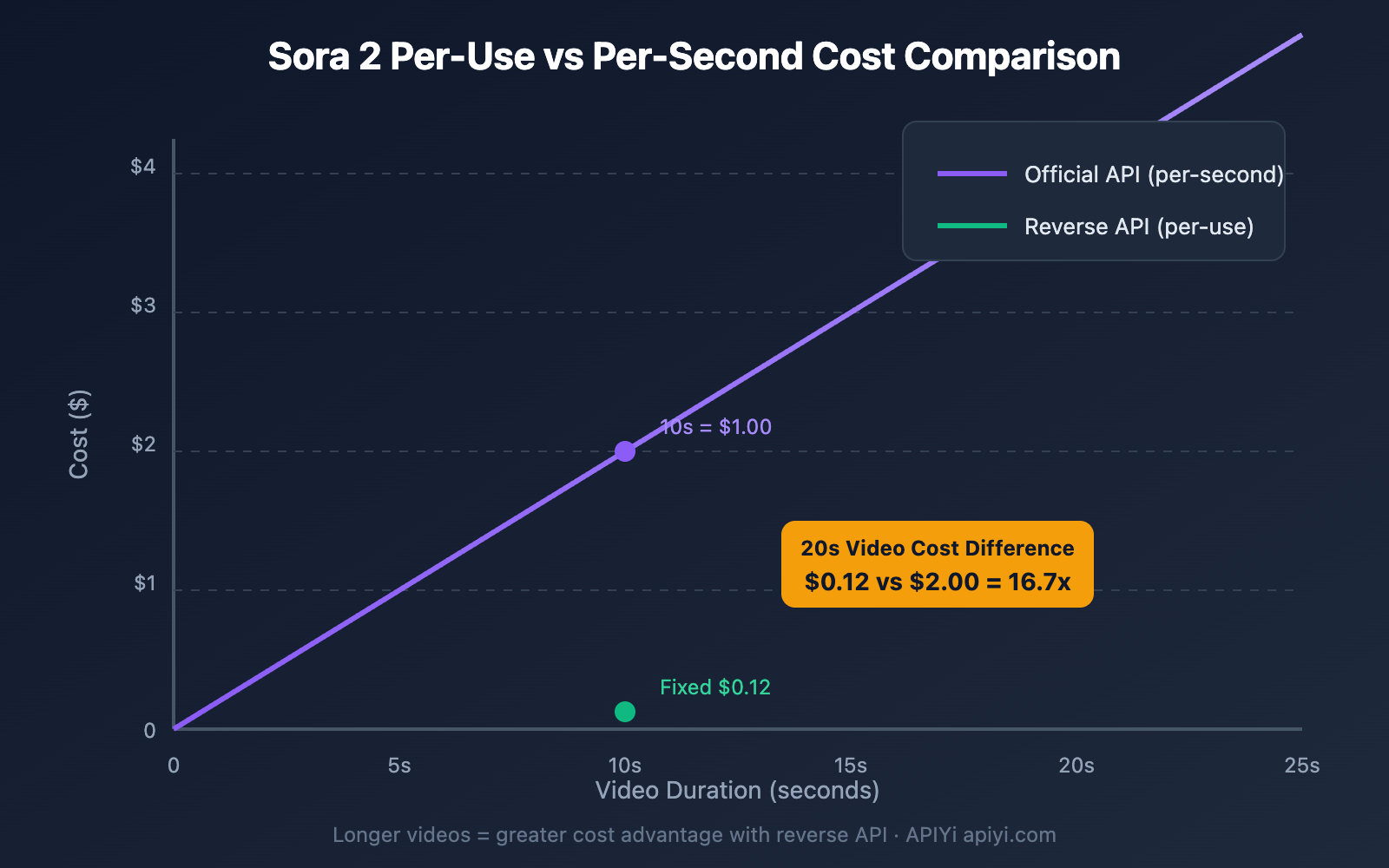
Sora 2 Reverse Engineering vs. Official API: Price Comparison
Understanding the 10x Price Difference
Let's take generating a 10-second 720p video as an example:
| Comparison | Reverse API | Official API | Difference |
|---|---|---|---|
| Single generation | $0.12 | $1.00 | 8.3x |
| 100 videos | $12 | $100 | 8.3x |
| 1000 videos | $120 | $1,000 | 8.3x |
For 20-second videos:
| Comparison | Reverse API | Official API | Difference |
|---|---|---|---|
| Single generation | $0.12 | $2.00 | 16.7x |
| 100 videos | $12 | $200 | 16.7x |
Key insight: The longer the video, the more pronounced the reverse API's cost advantage becomes. The official API charges per second with linearly increasing costs, while the reverse API charges per generation with fixed costs.
Cost Calculations for Different Scenarios
| Use Case | Monthly Volume | Reverse Cost | Official Cost | Savings |
|---|---|---|---|---|
| Individual creator | 50 videos | $6 | $50 | $44 |
| Content team | 500 videos | $60 | $500 | $440 |
| E-commerce business | 2000 videos | $240 | $2,000 | $1,760 |
| Platform service provider | 10000 videos | $1,200 | $10,000 | $8,800 |
💡 Cost optimization: Through APIYI apiyi.com's reverse API solution, businesses can save up to 88% on video generation costs, particularly suited for high-volume production scenarios.
Sora 2 iOS vs. Web Version: Watermark Differences
Why the iOS Version Doesn't Have Watermarks
This is a key advantage of the Sora 2 reverse engineering approach:
| Generation Platform | Watermark Status | Reasoning |
|---|---|---|
| iOS APP | ✅ No watermark | APP designed to be creator-friendly |
| Web version | ❌ Has watermark | Prevents abuse and enables content tracing |
| Official API | ✅ No watermark | Enterprise paid service |
APIYI's technical choice:
- Based on iOS APP reverse engineering, not the web version
- Generated videos are natively watermark-free
- No post-processing needed, ready to use immediately
About C2PA Metadata
It's worth noting that all Sora-generated videos contain C2PA invisible metadata:
- Visible watermark: iOS and official API outputs have no visible watermark
- Invisible signature: All outputs embed C2PA metadata
- Content provenance: Metadata is used to verify AI-generated content
This means that even without a visible watermark, videos can still be identified as AI-generated content—this is OpenAI's safety measure.
Sora 2 Reverse API Stability Analysis
Stability Guarantees of Reverse Engineering Solutions
The stability of reverse APIs depends on their technical resilience against platform countermeasures:
APIyi's Stability Commitment:
"If the official platform doesn't crash, we don't crash" — this is APIyi's core stability promise.
| Stability Factor | Description | APIyi's Response Strategy |
|---|---|---|
| Interface Changes | Platform may update API signatures | Rapid adaptation and follow-up |
| Account Risk Control | Platform may restrict abnormal calls | Multiple account pools for risk distribution |
| Traffic Limits | Peak periods may cause queuing | Intelligent scheduling and load balancing |
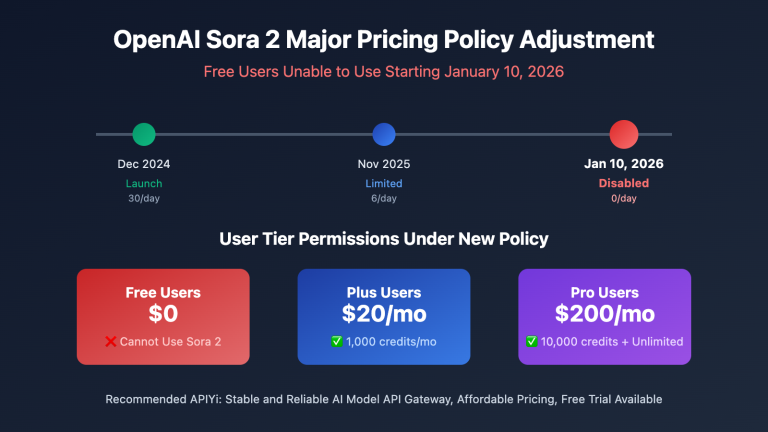
Insights from January 2026 Policy Adjustments
On January 10, 2026, OpenAI adjusted Sora's access policy:
- Web version access restricted for free users
- "We're under heavy load" error displayed
- Actually a policy restriction, not server congestion
APIyi's Rapid Response:
- Immediately identified the real issue
- iOS endpoint remained unaffected
- Service continued operating stably
🔧 Service Guarantee: APIyi (apiyi.com), based on iOS reverse engineering, maintained stable service during the January 2026 platform adjustments, proving the reliability of this technical approach.
Sora 2 API Selection Guide
Choosing the Right Solution for Your Needs
| Use Case | Recommended Solution | Reason |
|---|---|---|
| Limited Budget | Reverse API | Lowest cost, per-video pricing |
| Stability Priority | Official API | Official support, comprehensive SLA |
| Batch Production | Reverse API | Fixed cost, scale advantages |
| Enterprise Compliance | Official API | Legitimate channel, compliance assured |
| Quick Validation | Reverse API | Ready to use, no waiting |
APIyi Sora 2 Access Solution
Solution Advantages:
- ✅ Based on iOS reverse engineering, not web version
- ✅ Watermark-free output, ready for commercial use
- ✅ Per-video pricing at $0.12
- ✅ Compatible with OpenAI API format
- ✅ Supports high-concurrency batch calls
Quick Integration Code:
import openai

client = openai.OpenAI(
    api_key="sk-your-apiyi-key",
    base_url="https://vip.apiyi.com/v1"
)

# Generate 10-second video, only $0.12
response = client.chat.completions.create(
    model="sora-2",
    messages=[{
        "role": "user",
        "content": "Product showcase: iPhone rotating 360 degrees on white background"
    }]
)

video_url = response.choices[0].message.content
print(f"Video URL: {video_url}")
Sora 2 Reverse API Common Questions
Q1: Is reverse API legal?
Reverse APIs exist in a technical gray area. From a user perspective, the legal risk of using third-party services is relatively low, with most risk falling on the service provider. However, keep in mind:
- It may violate OpenAI's Terms of Service
- There's a risk of service disruption
- It's recommended for testing and non-critical business use
Q2: Can reverse APIs suddenly become unavailable?
That's possible, but API Yi mitigates this risk through several measures:
- iOS-based solutions are more stable than web versions
- Multi-node redundant architecture
- Quick response to platform changes
- Service commitment: "If the official service doesn't crash, we won't crash"
Q3: Why doesn't the iOS version have watermarks?
OpenAI uses different strategies for different platforms:
- Web version: Aimed at general users, watermarks added to prevent abuse
- iOS APP: Designed for creators, natively watermark-free
- Official API: For enterprises, paid and watermark-free
Q4: What's the video quality like with reverse APIs?
It's completely identical to the official output:
- Same model generation
- Same video quality
- Supports various resolutions and durations
Summary: How to Choose Between Sora 2 Reverse and Official API
Core Differences at a Glance
| Comparison | Reverse API | Official API |
|---|---|---|
| Billing Method | Per video | Per second |
| 10s Cost | $0.12 | $1.00+ |
| Watermark | None | None |
| Stability | Depends on workarounds | Official guarantee |
| Availability | Instant | Waiting for public release |
| Compliance | Gray area | Fully compliant |
Selection Guide
Choose Reverse API if you:
- Have a limited budget and want cost-effectiveness
- Need to generate videos in bulk
- Can accept some service fluctuations
- Want to start using it right away
Choose Official API if you:
- Need enterprise-level compliance
- Have sufficient budget and prioritize stability
- Can wait for official API public release
- Need SLA service guarantees
🎯 Recommended Solution: For most developers and businesses, API Yi's (apiyi.com) iOS-based reverse solution is currently the best choice—at $0.12/video with watermark-free output and stable service guarantees, it puts Sora 2 video generation within easy reach.
References:
- OpenAI Sora 2 Official Documentation: platform.openai.com/docs/models/sora-2
- Sora 2 API Pricing Comparison: glbgpt.com
- Sora 2 Watermark Explanation: apidog.com