
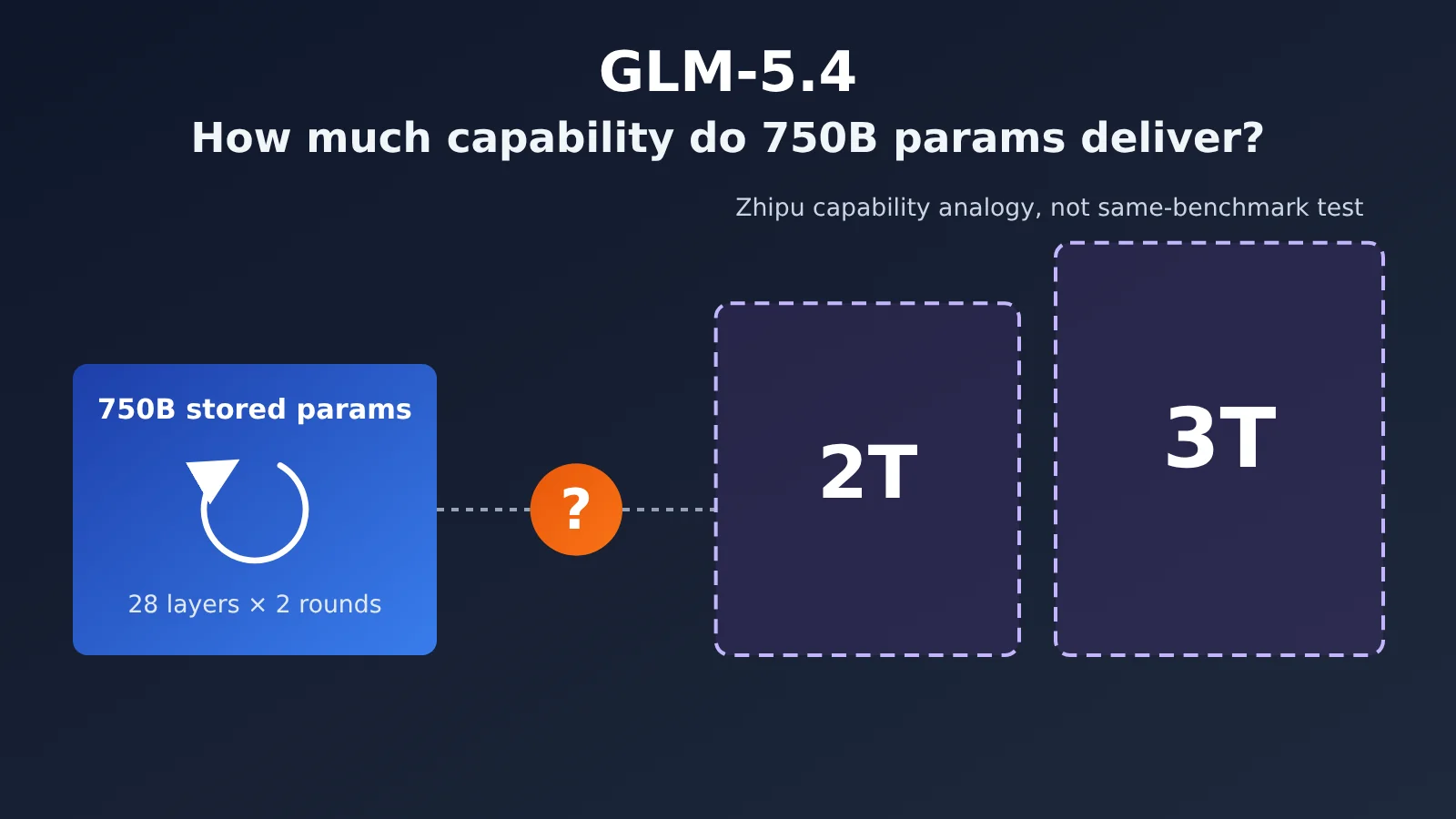
Straight answer: GLM-5.4’s 750B and the “2–3T class” aren’t the same kind of number. 750B is the parameter scale of the pretraining base for the GLM-5 family; “reaches the level of 2–3T parameter models” is Zhipu’s analogy about model behavior, and the company has never published an equal-condition comparison against 2T or 3T models under the same measurement standard. There are three kinds of evidence you can actually check today: the score improvements from the same-parameter 30B recurrence ablation, the paired win rate of the flagship edition across 200 real coding scenarios, and server-side throughput data. The core takeaway is that 750B, through a recurrent design that “executes two rounds over 28 layers of weights,” really does perform extra effective computation on some reasoning tasks. But a conversion like “delivers 2.67 to 4 times the capability” has no basis at present, and 2–3T class should always be read as the vendor’s own judgment about its model.
What you’ll learn from this article:
- What each of these numbers actually counts — 750B, 2T, 3T, 40B, 28.5T — and which ones you can divide by each other and which you can’t;
- The raw scores, score gaps, relative gains, and output-length changes for the recurrent structure across 5 benchmarks in the 30B controlled experiment;
- GLM-5.4’s win/tie/loss coding data against GLM-5.3, Kimi K3.1 Pro, and DeepSeek-V4.1-Flash-1017, and what it doesn’t prove;
- What the deployment-related throughput, context, and plan numbers each measure;
- How to verify the real behavior of the GLM family on your own tasks using the OpenAI-compatible interface.
Index: it starts with a “To Know” table explaining concepts like recurrent layers and active parameters, then an “Impact at a Glance” section on how this differs for developers versus ordinary users. The “Objective Facts” part of the body walks through the parameter measurement standard, the 30B ablation, coding win rates, and serving-engineering data in order; the “Analysis and Judgment” part discusses how much capability 750B actually delivers and how the 2–3T analogy should be cited. The final “Quick Start” gives runnable verification code, and the FAQ answers a few commonly confused questions.
GLM-5.4 Parameters and Capabilities: Key Concepts to Know
| Concept | Brief explanation |
|---|---|
| Total parameters | All the parameters the model needs to store, including expert weights in a mixture-of-experts model that are only activated for some inputs |
| Active parameters | In a mixture-of-experts model, the subset of parameters that actually participate in computation at each position after routing |
| Mixture of Experts (MoE) | Each layer contains multiple “expert” subnetworks, and a router selects a few of them to participate in computation for each token |
| Looped Layers | The weights of the same set of layers are executed repeatedly for multiple rounds—stored once, computed multiple times |
| B / T units | Billion / trillion; can refer to parameter count or training token count, so check the object it modifies |
| BF16 | A 16-bit floating-point format in which each parameter takes 2 bytes |
| KV cache | Key-value vectors cached during attention computation to avoid recomputing historical tokens |
| Sparse KV / sliding window | Keep only some globally important KV entries plus the KV entries in the most recent window, to reduce overhead |
| Ablation experiment | A controlled experiment that changes only one factor (here, whether to use looping) while keeping other conditions as unchanged as possible |
| AIME25 / GPQA-Diamond | Math competition problem set / graduate-level science question set |
| AA-LCR | Artificial Analysis’s long-context reasoning benchmark, which tests reasoning and synthesis across document fragments |
| MMLU-Pro / IFBench | Multidisciplinary knowledge reasoning benchmark / instruction-following benchmark |
GLM-5.4 750B Parameters: Impact at a Glance
- Developers: A 2–3T analogy can’t be used directly to estimate deployment costs or VRAM. When picking a model, look at how it performs on your own tasks, how many tokens it generates, and its end-to-end latency. The loop design turns “how much extra compute each request costs” into something you have to measure, not guess.
- Coding Plan users: For the same quota, you get about 1.5x the usable tokens of GLM-5.3. That comes from the plan’s entitlement settings — it’s a separate matter from any gain in model capability. On complex tasks the model sometimes thinks for too long, and a throughput number doesn’t equal task completion time.
- Researchers and technical writers: The 30B ablation gives you reproducible same-parameter comparison data. When citing it, keep the specific benchmark names and original scores, and don’t present “2–3T class” as a third-party measured conclusion.
GLM-5.4 Objective Facts: Parameters, Experiments, and Service Data
What Do 750B and 2–3T Mean in GLM-5.4?
Zhipu’s release materials give two sets of numbers at the same time. First, GLM-5.4 continues training from a pretrained GLM-5-series base at roughly 750B scale, where 28 layers use the same set of weights for two passes. Second, the vendor says its capability reaches the level of a 2–3T-parameter model. In decimal terms, 750B is about 750 billion, 2T is 2 trillion, and 3T is 3 trillion.
Only when both sides are counted by total parameters are 2T and 3T about 2.67 times and 4 times 750B, respectively. That ratio is a scale ratio, not a capability ratio, compute ratio, or cost ratio. Zhipu also mentions that the looping approach was validated from 1B to 4B to 30B all the way to 750B. That describes a testing process across different scales, and it comes from a different statement than the final “2–3T-class” capability judgment.
Parameter figures for the GLM series from different sources use different accounting conventions. The table below puts them side by side:
| Number | What it counts | Source | Can it be compared directly with 750B? |
|---|---|---|---|
| 744B total parameters / 40B active parameters | Original GLM-5 architecture | GLM-5 technical report | Only for the original GLM-5; cannot be carried over to 5.4 |
| 753B | GLM-5.3 public weights | Value read from the Safetensors info panel on the Hugging Face page | Page-reading convention, different from the naming in the report |
| About 750B | GLM-5.4 pretrained base scale | GLM-5.4 release | The baseline value in this article |
| GLM-5.4 active parameters | — | Not disclosed | No precise value to cite |
| 2–3T | Zhipu’s capability analogy | GLM-5.4 release | The other side’s counting convention is not explained |
| 28.5T | Original GLM-5 pretraining and mid-training token count | GLM-5 technical report | It’s a data volume, not a parameter count |
The looping structure separates “how much is stored” from “how many times it’s used.” Shared weights are counted only once in parameter statistics, but for the same input position, this group of layers is invoked for two passes. The actual computation performed in each pass also depends on which experts are routed, attention processing, and the loop length. So when we talk about active parameters, we also need to specify whether we mean one pass through a layer block, one full forward pass, or the deduplicated set of weights involved across both passes.
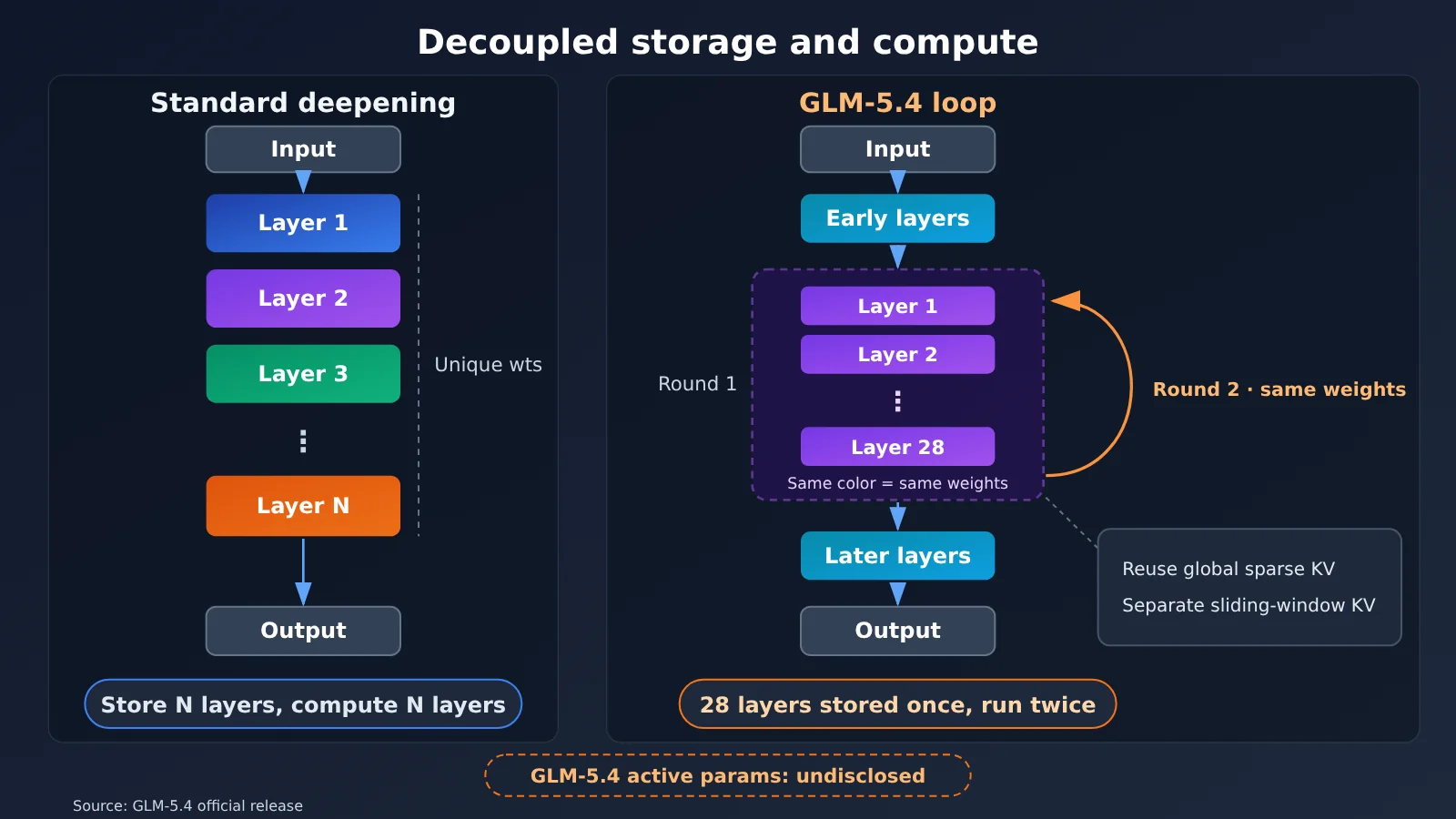
The diagram above shows the execution path Zhipu disclosed. The layer count and number of passes are enough to sketch the compute flow, but to estimate runtime cost precisely, you still need the operation counts and memory-access data from the actual implementation. That part was not provided officially.
GLM-5.4 Recurrent Structure: 30B Parameter-Matched Ablation Data
The most easily verifiable official data comes from the 30B control experiment. Zhipu used a 30B model with the same architecture as the larger base model for a parameter-matched comparison. The caption states that the model underwent 200K long-text supervised fine-tuning and that thinking was enabled during evaluation; the recurrent group’s total training compute is about 10% higher. The score gaps and relative improvements in the table below were calculated by this article from the original initial scores (the original figure’s improvement column keeps only one decimal place); output length changes are taken from the original figure:
| Benchmark (30B, parameter-matched) | Non-recurrent | Recurrent | Score gap | Relative improvement (calculated in this article) | Average output length change |
|---|---|---|---|---|---|
| AIME25 | 19.17 | 30.42 | +11.25 | ≈58.7% | ≈ −2% |
| GPQA-Diamond | 47.58 | 56.26 | +8.68 | ≈18.2% | −11.7% |
| AA-LCR | 40.33 | 47.67 | +7.34 | ≈18.2% | −9.7% |
| MMLU-Pro | 71.65 | 75.05 | +3.40 | ≈4.7% | −14.9% |
| IFBench | 50.20 | 53.47 | +3.27 | ≈6.5% | −13.0% |
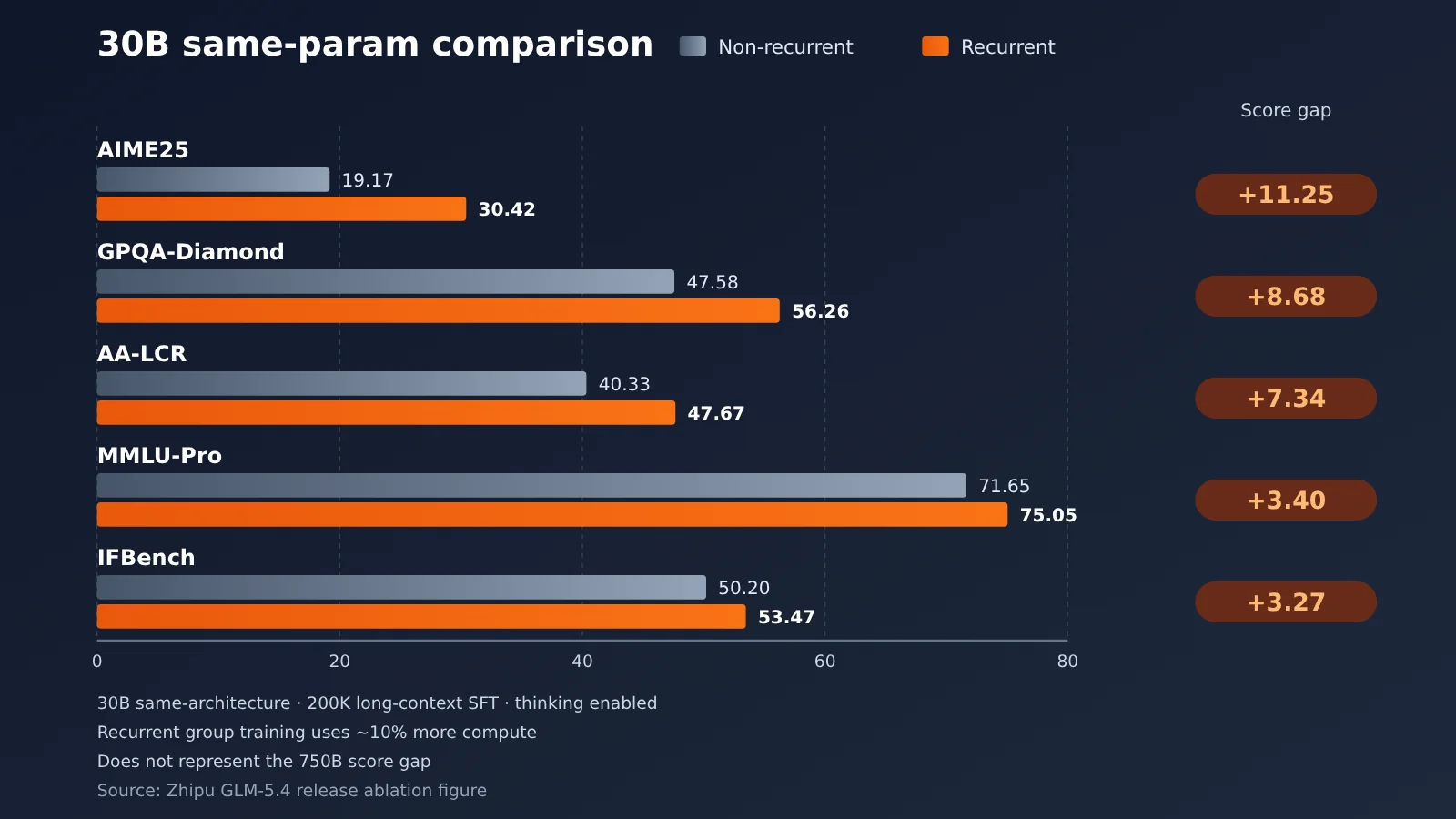
The chart shows that the score gaps are largest on math and science reasoning tasks, and smaller on knowledge and instruction-following tasks. If you want to reproduce a similar “same model family, different versions” comparison on your own business tasks, you can use APIYI apiyi.com to switch model names with the same script and run tests.
There are two things to read alongside these scores. First, output length and score are two separate evaluation metrics: AIME25 has the largest score gap, but average output is only about 2% shorter; MMLU-Pro has the smallest score gap, yet output is 14.9% shorter. Second, relative improvement depends on each baseline — the same score increment looks larger on a low baseline, so percentages must always be tied to the specific benchmark name.
GLM-5.4 Flagship’s Pairwise Coding Win Rates
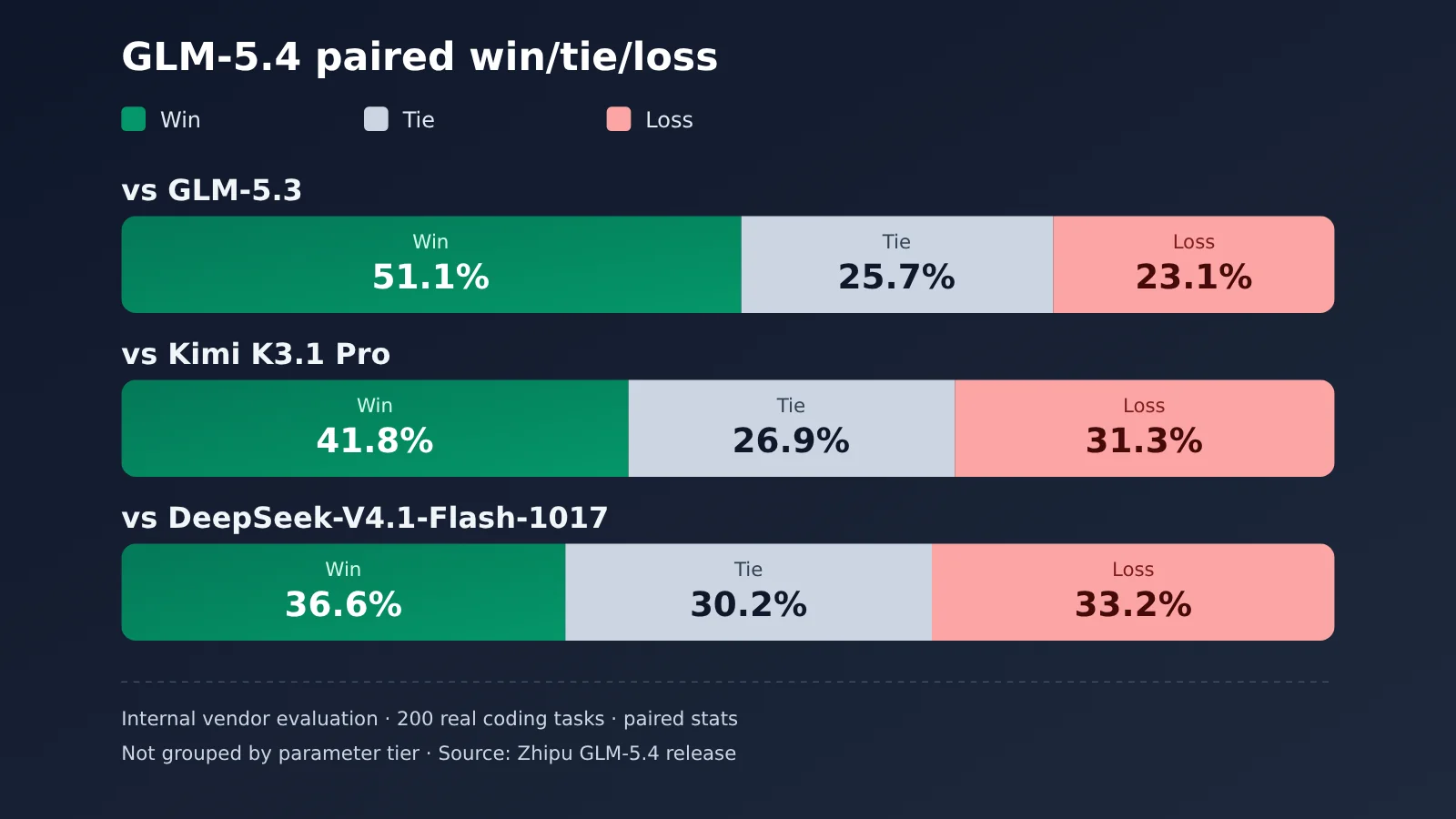
The newly launched flagship also has another set of vendor-internal coding comparisons. The sample covers 200 real-world usage scenarios, with paired win/tie/loss results broken out by specific opponent:
| Opponent | GLM-5.4 win | Tie | Loss |
|---|---|---|---|
| GLM-5.3 | 51.1% | 25.7% | 23.1% |
| Kimi K3.1 Pro | 41.8% | 26.9% | 31.3% |
| DeepSeek-V4.1-Flash-1017 | 36.6% | 30.2% | 33.2% |
The comparison rows in this chart list only model names and win/tie/loss results. They don’t label any row as a “2T group” or “3T group,” nor do they set up controlled experiments matched by parameter tier. It can be cited as evidence of flagship performance, but it’s an internal vendor evaluation; neither the sample nor the judging methodology has been third-party reviewed.
GLM-5.4 Serving Engineering and Usage Specs
Zhipu explained how it reduces extra loop overhead: the second round reuses the global sparse KV selected in the first round, while separately maintaining new KV in the local sliding window; the attention indices generated in the first round are also carried over to the second round; on the serving side, operator fusion further reduces intermediate results moving in and out of VRAM. The vendor reports output speeds of up to 200 token/s off-peak and around 70–80 token/s during peak hours.
On specs, GLM-5.4 supports a 1M context window and 128K maximum output; under the same quota, Coding Plan offers about 1.5x the usable tokens of GLM-5.3. The release team also acknowledges that the flagship model sometimes overthinks on complex tasks.
GLM-5.4 Analysis: How Much Capability Do 750B Parameters Actually Deliver?
The capability ratio can’t be derived from the 750B vs. 2–3T scale ratio
“A 750B model reaching the 2–3T level means it’s delivering the capability of 2.67 to 4 times its parameter count”—that’s the most common misreading. The figures 2.67 and 4 only hold when both sides are counted by total parameters, and the 2–3T side never specifies the counterpart model or the parameter accounting method. Zhipu’s two public evaluations—one a same-parameter 30B control, the other paired win rates against specific models—did not set up a matched-condition experiment of “750B looped model vs. 2T/3T model.”
So a safer answer is this: how much capability 750B delivers can currently only be described by specific scores on specific tasks; it can’t be converted into an “equivalent parameter multiplier.” Without a shared parameter basis, citing official model names and their corresponding results is the only verifiable way to phrase it.
Gains from looping layers concentrate in multi-step reasoning tasks
The 30B ablation supports a narrower but credible claim: at the same parameter count, doing one more round of internal computation yields clearer gains on problem sets that require multi-step reasoning. The 11.25-point gap on AIME25 and the 8.68-point gap on GPQA-Diamond are both far above the roughly 3-point gaps on MMLU-Pro and IFBench. This aligns with the research direction of Saunshi et al., who found that many synthetic problems that can be decomposed into iterative steps can be solved through multiple computations in shared layers.
But a few conditions apply. The looped group’s total training compute is about 10% higher, so this experiment mainly isolates weight scale, not compute. What it shows is “the gain you get from spending more compute at the same parameter count.” In addition, every column of data corresponds to 30B, so you can’t infer that 750B would show the same score gap or the same proportional shortening of output on the same tasks. The paper’s tasks, models, and training conditions are also independent of GLM-5.4’s commercial service; they can only serve as research context.
Deployment efficiency: 750B and 2–3T weight volumes are only ideal estimates
If you want an intuitive sense of the parameter-scale gap, here’s a simple arithmetic example. Assume all weights are stored in BF16 at 2 bytes per parameter. 750B parameters come to roughly 1.5 TB of raw weight data; under the same assumptions, 2T to 3T parameters come to about 4 to 6 TB.
This is only a comparison of capacity scale. It does not represent GLM-5.4’s actual weight format, hardware requirements, or runtime VRAM. Quantization method, expert distribution, KV cache, activations, and concurrent batch size all change usage, and multi-accelerator deployments also add communication and scheduling overhead. More importantly, under a looped structure, “storing less” doesn’t mean “computing less” — the actual cost of the second round of computation depends on the implementation.
Several deployment-related numbers measure different things, so they can’t be summed up with a single multiplier:
| Number | What it measures | Question it answers | What it doesn’t tell you |
|---|---|---|---|
| 1M context / 128K max output | Single-request capacity | How much material fits in one request, how long it can write | Capability tier, speed |
| 200 token/s (off-peak max), 70–80 token/s (peak) | Output rate | How fast it generates per second | Prefill, queuing, tool execution time, total latency |
| Coding Plan ~1.5x token | Plan quota multiplier | How much usage you get for the same quota | How much the model’s capability improves |
| 2–3T class | Vendor capability analogy | Zhipu’s positioning of the capability tier | VRAM, cost, equivalent parameters |
End-to-end time also depends on how many tokens the model generates. The vendor itself notes that thinking runs longer on complex tasks, which means a high per-token rate doesn’t necessarily mean a task finishes quickly. For developers, what’s really worth measuring is “total tokens and total time to complete the same task.”
How to Cite the “2–3T-Class” Claim
If you want to make a point about parameter efficiency, describe the matched-parameter experimental setup and how each score changed. If you want to make a point about compute efficiency, you need to give the training cost, request input, generated tokens, tool time, and comparable hardware. If you want to claim it matches the capabilities of a larger model, you need to name that model and explain how its parameter count was measured, then—on shared tasks under identical tool conditions—spell out which metrics converge and which diverge.
Even when parameter counts are similar, the capability mix shifts once pretraining data, post-training, thinking settings, and external tools change. A pairwise win rate compares a single pair of outcomes in a real-world scenario; it can’t be used to back out “how many parameters are needed for the same capability.” So the safer way to phrase it is: cite the improvements that are measurable in this study, state the scale at which the findings hold, and treat “2–3T-class” as Zhipu’s own capability judgment. Zhipu has also said it will pursue both depth and model scale, so it’s worth watching whether it later publishes a verifiable cross-scale comparison.
🎯 Technical tip: Rather than leaning on “equivalent parameters” analogies, run the comparison on your own real task set. With the unified interface at APIYI apiyi.com, you can use a single script to call the GLM family and other mainstream models in turn, recording scores, output tokens, and end-to-end latency.
GLM-5.4 Quick Start: Validate Its Capabilities on Your Own Tasks
The minimal example below calls the GLM model through an OpenAI-compatible interface. Always use the actual model name from the platform’s model list — the glm-5.4 in the example is only a placeholder.
import openai

client = openai.OpenAI(
    api_key="YOUR_API_KEY",
    base_url="https://api.apiyi.com/v1"  # APIYI's OpenAI-compatible endpoint
)

response = client.chat.completions.create(
    model="glm-5.4",  # use the exact name from the platform's model list
    messages=[{"role": "user", "content": "用三步推理求解:一个数的 3 倍加 7 等于 34,这个数是多少?"}],
)
print(response.choices[0].message.content)
print("输出 token:", response.usage.completion_tokens)
As the main article points out, throughput numbers alone can’t tell you how long a task actually takes. The full script below uses streaming output to record time-to-first-token, total elapsed time, and output tokens separately, so you can compare several models on the same set of tasks.
View the full comparison script
import time
import openai

client = openai.OpenAI(
    api_key="YOUR_API_KEY",
    base_url="https://api.apiyi.com/v1"  # one key to switch between multiple models
)

# model names follow the platform's model list
MODELS = ["glm-5.4", "glm-5.3"]

# swap in your own business tasks, ideally ones with a deterministic reference answer
TASKS = [
    {"prompt": "一个数的 3 倍加 7 等于 34,这个数是多少?只输出数字。", "answer": "9"},
    {"prompt": "列出 1 到 30 中所有质数,用逗号分隔,不要多余文字。",
     "answer": "2,3,5,7,11,13,17,19,23,29"},
]

def run_once(model: str, prompt: str) -> dict:
    start = time.time()
    first_token_at = None
    chunks = []
    usage = None
    stream = client.chat.completions.create(
        model=model,
        messages=[{"role": "user", "content": prompt}],
        stream=True,
        stream_options={"include_usage": True},
    )
    for event in stream:
        if event.usage:
            usage = event.usage
        if event.choices and event.choices[0].delta.content:
            if first_token_at is None:
                first_token_at = time.time()
            chunks.append(event.choices[0].delta.content)
    end = time.time()
    return {
        "text": "".join(chunks).strip(),
        "ttft": (first_token_at - start) if first_token_at else None,
        "total": end - start,
        "completion_tokens": usage.completion_tokens if usage else None,
    }

for model in MODELS:
    correct, total_time, total_tokens = 0, 0.0, 0
    for task in TASKS:
        r = run_once(model, task["prompt"])
        ok = r["text"].replace(" ", "") == task["answer"]
        correct += ok
        total_time += r["total"]
        total_tokens += r["completion_tokens"] or 0
        print(f"[{model}] 正确={ok} 首字={r['ttft']:.2f}s 总耗时={r['total']:.2f}s "
              f"输出token={r['completion_tokens']}")
    print(f"== {model}: 准确 {correct}/{len(TASKS)},总耗时 {total_time:.1f}s,"
          f"总输出 token {total_tokens}\n")
When you use this script, it pays to keep the task set fixed and the thinking/reasoning setting fixed, run several rounds and average them, and test once at peak hours and once off-peak. That way your conclusions line up with the “same methodology” requirement the main article stresses.
🚀 Quick start: New users can sign up at APIYI apiyi.com to get free trial credits. Just fill in the
base_urland your API key from above and you’re ready to run — no need to open a separate account with each provider.
GLM-5.4 FAQ
Q1: Is GLM-5.4 a 750B model or a 2–3T parameter model?
GLM-5.4’s pretraining base is roughly 750B. The 2–3T figure is Zhipu’s analogy for its capability level — it isn’t a parameter count, and no controlled side-by-side comparison against 2T or 3T models was included.
Q2: What is GLM-5.4’s active parameter count? Can we reuse GLM-5’s 40B figure?
Zhipu hasn’t disclosed GLM-5.4’s active parameter count. 40B is the number from the original GLM-5 technical report. GLM-5.4 has 28 layers that execute two rounds, so the active parameter figure depends on what you’re counting — you can’t just carry the old number over.
Q3: In the 30B ablation, AIME25 improved by about 58.7% — does that mean GLM-5.4’s reasoning got nearly 60% better?
No. The 58.7% is the relative gain for the 30B model on AIME25, calculated against a baseline of 19.17, and it applies only to that benchmark and that model size. Zhipu didn’t provide the 750B flagship’s delta on the same task within this comparison.
Q4: Do the looped layers make GLM-5.4 calls slower or more expensive?
Looping means the same position gets computed for an extra round. Zhipu keeps overhead down by reusing sparse KV, reusing attention indices, and fusing operators. What you actually experience depends on total tokens per task and end-to-end latency, so it’s worth testing on your own prompts — for example, use a single script through APIYI apiyi.com to record time-to-first-token and total latency.
Q5: How can I quickly call and compare GLM-5.4 via API?
1. Sign up at APIYI apiyi.com to get an API key and free trial quota;
2. Set the sample code’s base_url to `https://api.apiyi.com/v1`;
3. Confirm the actual GLM model name in the platform’s model list, then run the same prompt set through each model in turn and record the results.
Q6: What are the known limitations of GLM-5.4?
The vendor itself notes that on complex tasks it sometimes thinks for too long, stretching out task time; during peak hours output speed is around 70–80 token/s, clearly below the off-peak maximum. In addition, the 2–3T capability analogy and the coding win rates both come from internal vendor evaluations and still need public, reproducible pairwise benchmark verification.
Back to the question in the title: 750B parameters under the looped design really do perform extra effective computation, the 30B same-parameter comparison gives a reproducible delta, and the flagship wins more than half of 200 coding scenarios against GLM-5.3. But “2–3T-class” can currently only be cited as Zhipu’s capability positioning; whether it converts into a specific equivalent-parameter multiple has to wait for more public comparisons using the same methodology. For teams that need to choose a model, the most reliable approach is still to compare scores, tokens, and total latency on your own tasks — APIYI apiyi.com’s unified interface makes it quick to set up that kind of comparison.
References
- Zhipu GLM-5.4 Chinese release: architecture, 30B ablation, coding win rate, and reasoning notes
- Link:
zhipuai.cn/zh/research/164
- Link:
- Z.ai GLM-5.4 English release: two-round loop design, KV reuse, serving rates, and future roadmap
- Link:
z.ai/blog/glm-5.4
- Link:
- GLM-5 technical report: original total parameters, active parameters, and training token statistics
- Link:
arxiv.org/html/2602.15763v2
- Link:
- GLM-5.3 Hugging Face weights page: Safetensors parameter read values
- Link:
huggingface.co/zai-org/GLM-5.3
- Link:
- Z.ai GLM-5.4 model specification docs: context and maximum output
- Link:
docs.z.ai/guides/llm/glm-5.4
- Link:
- Z.ai Coding Plan description: plan quotas and credits
- Link:
docs.z.ai/devpack/overview
- Link:
- Artificial Analysis AA-LCR description: definition of the long-context reasoning benchmark
- Link:
artificialanalysis.ai/evaluations/artificial-analysis-long-context-reasoning
- Link:
- Saunshi et al. recurrent model paper: research background on repeated computation with shared layers
- Link:
arxiv.org/abs/2502.17416
- Link:
Author: APIYI Technical Team
Technical Contact: Feel free to contact us through the APIYI official website homepage. For more integration docs, visit the docs.apiyi.com documentation center.