
Author’s note: this article is based on the Anthropic official docs dated 2026-11-08 (UTC+8) and the APIYI Claude thinking parameters guide updated at 10:40 on 2026-11-09, with all details fact-checked as of 2026-11-13. It’ll help you sidestep the 400 errors that claude-opus-5-5 and claude-sonnet-5-5 throw when you get the thinking parameter wrong.
If you pass disabled as the type for thinking on claude-opus-5-5, the API comes right back with a 400 — that’s the rule spelled out in the Anthropic official docs as of 2026-11-08 (UTC+8). APIYI (apiyi.com) refreshed its Claude thinking parameters guide at 10:40 on 2026-11-09, laying out the correct syntax for both model IDs. Here’s a quick rundown of what this change means for anyone calling the Claude API.
This isn’t rumor-mill stuff: both key conclusions come straight from the docs — claude-opus-5-5 can’t turn thinking off at all, you can only dial down effort; claude-sonnet-5-5 needs between_tools instead if you want to turn off pre-tool thinking.
The takeaway: 3 minutes gets you the correct syntax for both model IDs, the parameter boundaries of between_tools, and a troubleshooting path for that 400 error.
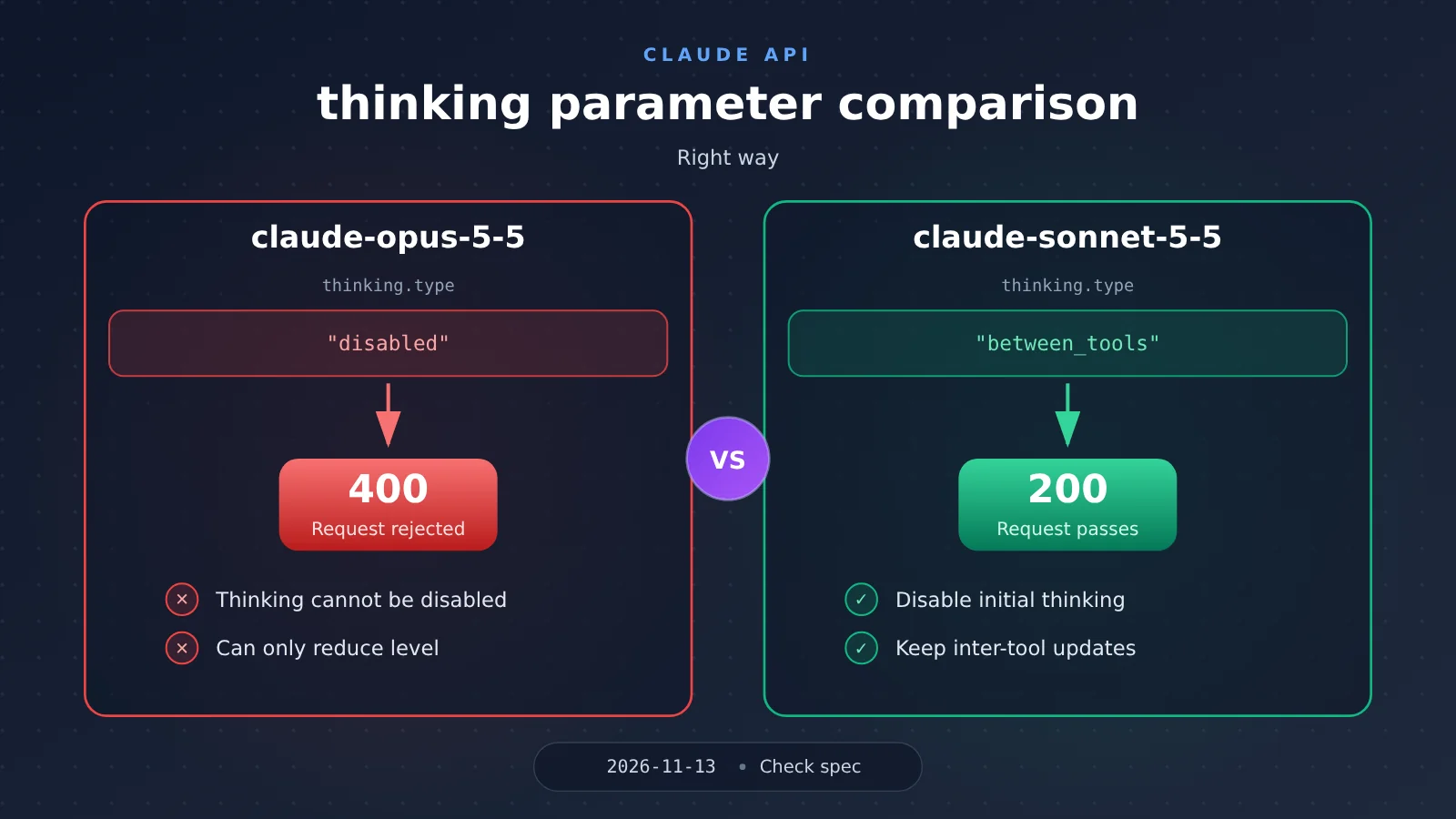
Core Info at a Glance: the thinking Rules for claude-opus-5-5 and claude-sonnet-5-5
Let’s start with the summary table, then go through it point by point:
| Item | Details |
|---|---|
| Official source | Anthropic official docs, 2026-11-08 (UTC+8) |
| APIYI guide update | 2026-11-09 10:40, already synced to docs.apiyi.com |
| claude-opus-5-5 | Omit thinking and it uses adaptive thinking; pass disabled and you get a 400 |
| claude-sonnet-5-5 | Omitting thinking also means adaptive thinking; to turn off upfront thinking, use between_tools |
effort default |
medium for Opus 5.5, high for Sonnet 5.5 |
| Max output | 128000 for both model IDs, with thinking tokens counted inside that budget |
The rules for claude-opus-5-5 are pretty straightforward. When a request doesn’t include the thinking field, the model goes into adaptive thinking and decides for itself whether to think this time and how deeply. But the moment you set thinking‘s type to disabled, the API doesn’t quietly ignore it — it returns a 400 outright. In other words, this model ID has no switch for turning thinking off. The only dial the docs give you is lowering effort, which defaults to medium.
claude-sonnet-5-5 is in a slightly different spot. It also supports adaptive thinking when thinking is omitted, but it has one extra officially blessed off-ramp: set type to between_tools, and you turn off upfront thinking while keeping only progress updates between tool calls. The boundaries of that path are spelled out just as clearly, so it’s worth checking the table below directly:
| Constraint | What the docs say |
|---|---|
effort values |
Only accepts low, medium, high |
| Level ceiling | Can’t be higher than high |
| Combination limits | Can’t be sent together with display or budget_tokens |
| Actual effect | Turns off upfront thinking; keeps only progress updates between tool calls |
Here’s a detail that’s easy to overlook: thinking tokens count toward max_tokens. Both model IDs have a max output of 128000, and if a request squeezes max_tokens too low, thinking can gobble up most of the budget first, and the actual response gets truncated. When you’re debugging a “why did the reply suddenly get so short” problem, it’s worth checking how much thinking is eating up first.
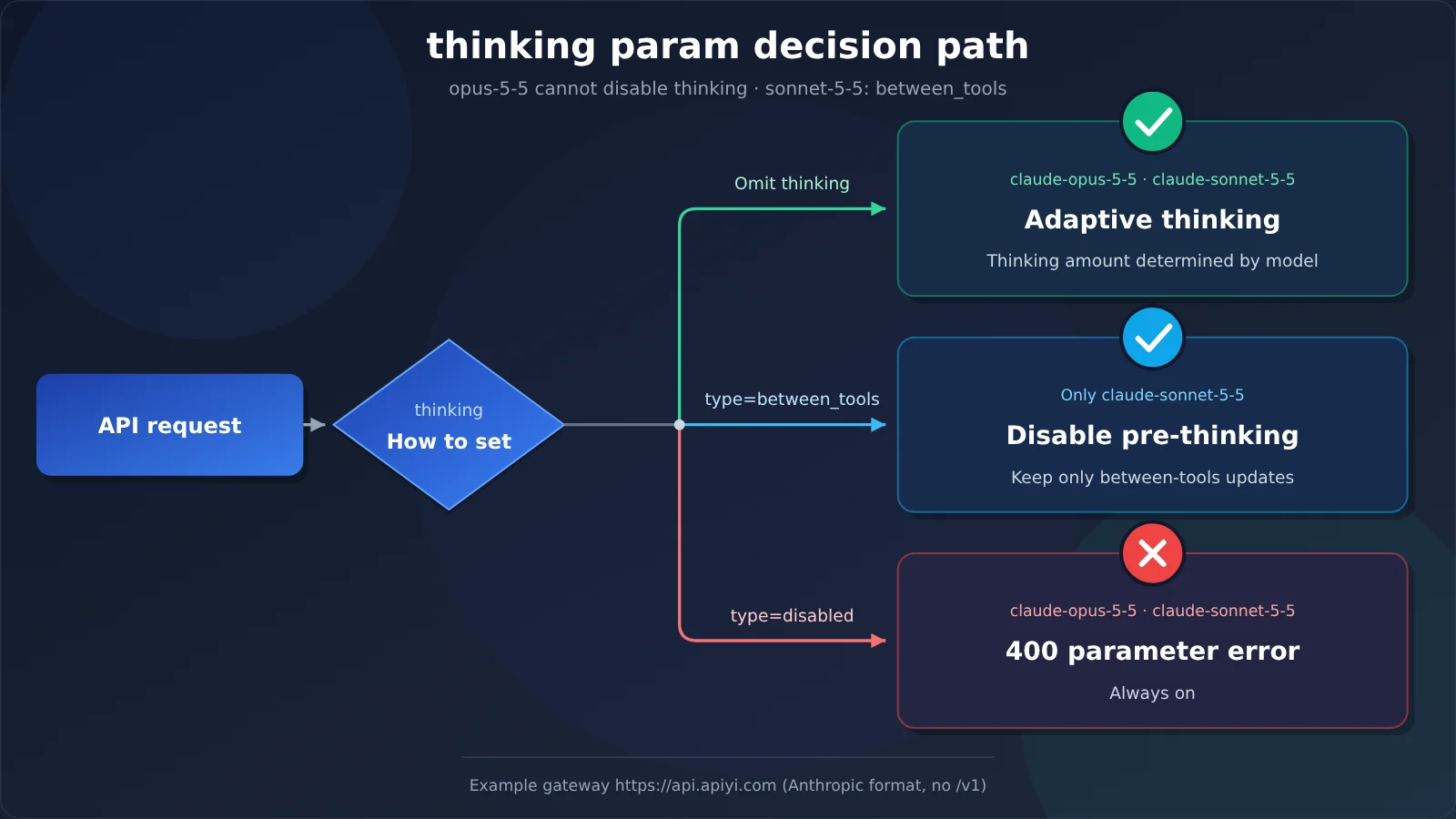
Figure note: the call chain in the diagram uses APIYI’s Anthropic-native-format gateway at apiyi.com as an example. When going through the Anthropic format, the base URL is https://api.apiyi.com — be careful not to write it in the /v1-suffixed form.
Impact Analysis: Who Gets Hit When disabled Returns a 400
This change in the wording hits callers in three places — error handling, parameter combinations, and budget planning. Breaking each one down makes it easier to see.
Impact on Existing Code: Migrating Away from disabled
| Scenario | Old approach | What happens now | Correct approach |
|---|---|---|---|
claude-opus-5-5 wants thinking off |
Pass disabled as type |
Returns 400 | Can’t turn it off; only lower effort |
claude-sonnet-5-5 wants interleaved thinking off |
Pass disabled as type |
Returns 400 | Switch to between_tools |
| Wants fine-grained control over thinking budget | between_tools paired with budget_tokens |
Combination isn’t accepted | The two can’t be sent together; use the three effort levels |
| Worried thinking will crowd out output | Setting max_tokens very low |
Body text gets truncated | Thinking counts toward max_tokens, so leave headroom |
The first impact is that parameter combinations have gotten more restrictive. between_tools can’t appear alongside budget_tokens or display, which means fine-grained thinking-budget control simply doesn’t work on this path — you’re left with indirect tuning through the low, medium, and high levels. Stack that on top of “thinking tokens count toward max_tokens” and you need to rebalance effort against max_tokens.
The second impact is that branching logic needs updating. If your script decides whether to send disabled based on model ID, then these two IDs need their own branches: the first one accepts the reality of “can’t turn it off” and steps effort down; the second switches over to between_tools. Keep that kind of branching in a single config spot so future wording changes touch as little code as possible.
One more thing worth noting: the same page says passing disabled to Fable 5.1 and Fable 5 also returns a 400 — they can’t be turned off either. Haiku 5.5 and Opus 5, meanwhile, can still use disabled as long as effort isn’t higher than high. If your code serves multiple model IDs at once, maintain a per-model toggle matrix instead of applying the same pattern everywhere.
Impact on Cost Structure: Thinking Tokens and Usage
On the APIYI (apiyi.com) master price table, claude-sonnet-5-5 is priced at $2 input, $10 output, and $0.1 cache read. Since thinking tokens count toward max_tokens, whether you turn off interleaved thinking and which effort level you pick both show up directly in token usage. In high-frequency call scenarios that gap gets amplified, so it’s worth running the numbers while you’re in there editing the code.
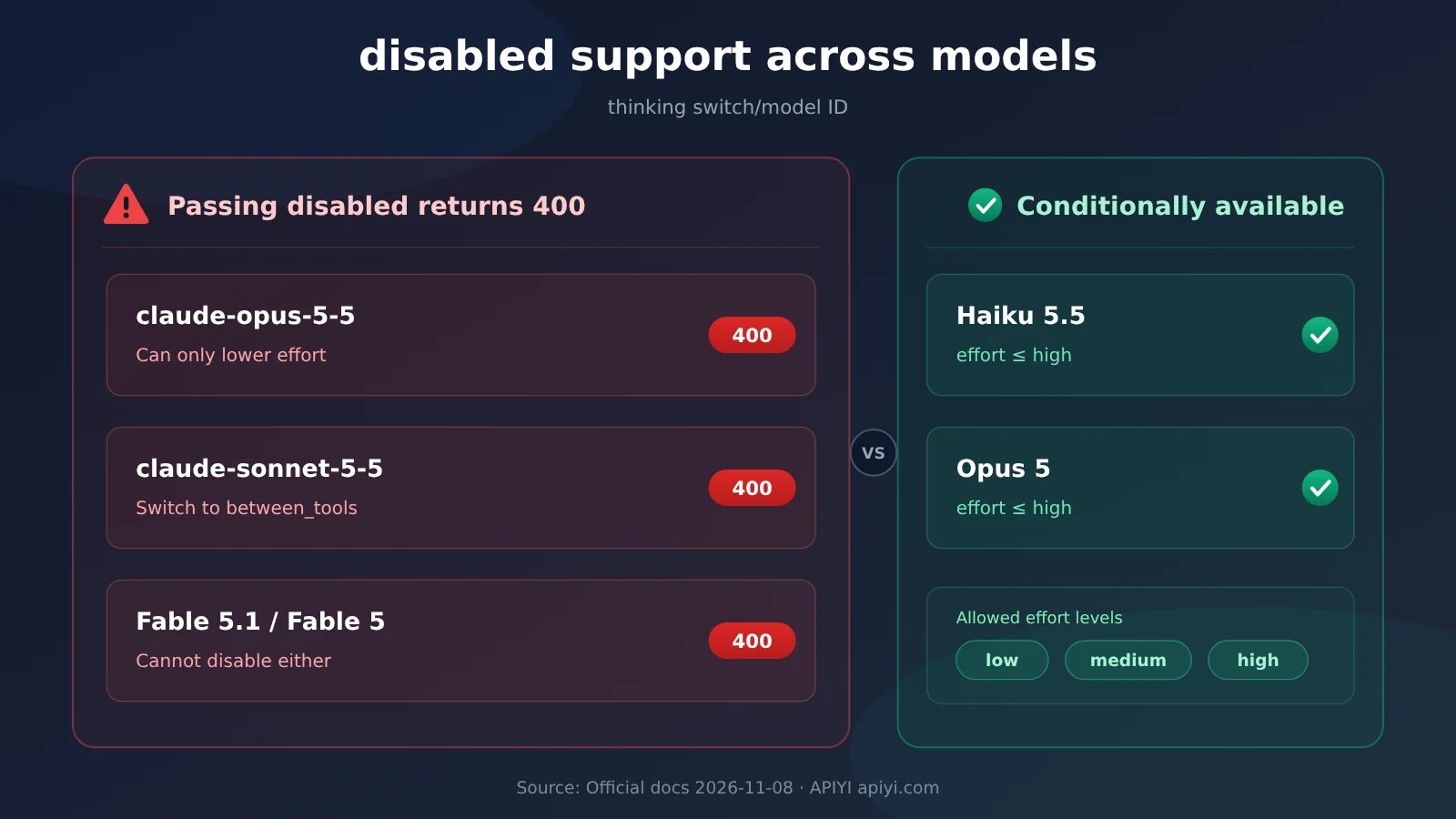
Caption: the wording was compiled from the official docs dated 2026-11-08; you can verify it against the original in the APIYI apiyi.com documentation center.
| Model ID | disabled availability |
Documented wording |
|---|---|---|
| claude-opus-5-5 | Not available, returns 400 | Thinking can’t be turned off; only lower effort (default medium) |
| claude-sonnet-5-5 | Not available, returns 400 | Use between_tools instead (default high) |
| Fable 5.1 / Fable 5 | Not available, returns 400 | Can’t be turned off either |
| Haiku 5.5 / Opus 5 | Available when effort isn’t above high |
The old syntax only holds for these two IDs |
How to Quickly Verify between_tools on claude-sonnet-5-5
Before rolling out the change, it’s a good idea to validate the behavior difference with a small amount of traffic first. Register at APIYI (apiyi.com) and get an API key—new users get free test credits. Send requests to https://api.apiyi.com, set the type of thinking to between_tools in the request body, pick any one of the three effort levels, run one round, then compare against adaptive mode (where you don’t pass thinking at all), and watch how the output structure and token usage change.
🚀 Quick verification tip: Get free test credits through APIYI at apiyi.com, run the same set of prompts through both
between_toolsand adaptive modes, and confirm the difference before changing existing code. The platform supports unified invocation of mainstream models like Claude, OpenAI, and Gemini. The OpenAI-compatible interface is billed by usage, making it easy to compare and switch between models.
FAQ: disabled, between_tools, and 400 Errors
Q1: Can claude-opus-5-5 actually turn off thinking?
No. The official statement dated 2026-11-08 states clearly: passing `disabled` returns a 400, and this model ID has no switch to turn off thinking—you can only reduce thinking depth via `effort`, whose default level is `medium`. If your scenario absolutely requires no thinking at all, you’ll have to switch model IDs.
Q2: Can between_tools on claude-sonnet-5-5 be combined with budget_tokens?
No. The docs explicitly state that `between_tools` can’t carry `display` or `budget_tokens` at the same time, and its corresponding `effort` only accepts three levels—`low`, `medium`, and `high`—and can’t exceed `high`. If you want fine-grained control over the thinking budget, you’ll have to fall back to adaptive mode or switch model IDs.
Q3: Why did my Claude request suddenly return a 400?
First check whether you set the `type` of `thinking` to `disabled` in the request body—on claude-opus-5-5 and claude-sonnet-5-5, that’s the documented trigger condition. Once confirmed, handle it per the comparison table in this article: for the former, lower `effort`; for the latter, switch to `between_tools`. The applicable syntax is based on the official documentation dated 2026-11-08 (UTC+8), and the APIYI page was synced on 2026-11-09 at 10:40.
Q4: How do I quickly verify the effect of between_tools on claude-sonnet-5-5?
Register an account at APIYI (apiyi.com) and get an API key—new users get free test credits. Send requests to `https://api.apiyi.com`, set the `type` of `thinking` to `between_tools`, pick any one of the `effort` levels, and run one round to compare the difference against adaptive mode.
Q5: Do thinking tokens eat into the output budget?
Yes. Thinking tokens count toward `max_tokens`, and the maximum output for both model IDs is 128000. If you set `max_tokens` too low in a request, thinking may consume the budget first and the main content gets truncated, so it’s best to reserve enough room for the main content.
claude-opus-5-5 and claude-sonnet-5-5: Key Takeaways
- claude-opus-5-5 won’t let you turn off thinking: passing
disabledgets you an immediate 400 — the only option is to dial it down witheffort, which defaults tomedium. - claude-sonnet-5-5 switched to
between_tools: this turns off upfront thinking and keeps only the progress updates that happen between tool calls. - Three parameter red lines:
effortaccepts onlylow,medium, andhigh— nothing abovehigh— and it can’t be combined withdisplayorbudget_tokens. - Budget rule: thinking tokens count toward
max_tokens, and both IDs cap out at 128000. - Where to verify: APIYI apiyi.com. The Anthropic-format base is
https://api.apiyi.com— don’t add/v1.
Summary: three moves that keep you out of 400 territory
The whole story on claude-opus-5-5 and claude-sonnet-5-5 boils down to three sentences:
- claude-opus-5-5: passing
disabledtriggers a 400, so thinking can’t be turned off — you can only lowereffort. - claude-sonnet-5-5: turn off upfront thinking by switching to
between_tools, stick to the threeeffortlevels, and don’t pair them withdisplayorbudget_tokens. - Budget: thinking tokens count toward
max_tokens, which tops out at 128000 — so leave some headroom for the actual response.
If you’re stuck on this 400 right now, the quickest path is to head to APIYI apiyi.com, grab the free test quota, and run a round of between_tools to confirm the behavior before you touch your existing code. One API key on the platform gets you OpenAI, Claude, Gemini, and other mainstream models, billed by usage — handy for quick comparisons and switching.
📚 References
- APIYI Claude Thinking Parameters Guide: How to use effort and thinking
- Link:
docs.apiyi.com/api-capabilities/claude-effort-thinking.md -
Description: The version updated on 2026-11-09 10:40; the main source of facts for this article
-
APIYI Guide Refresh Update: Official notes on this round of alignment
- Link:
docs.apiyi.com/live/2026-11/claude-thinking-guide-refresh.md -
Description: Documents the process of aligning with the official documentation on 2026-11-08
-
Anthropic Official Documentation: The original wording for the thinking parameter
- Link:
docs.anthropic.com - Description: Recommended for cross-reading to confirm the latest usage
Author: APIYI Technical Team
Technical discussion: Feel free to reach out via the APIYI website homepage. For more materials, visit the docs.apiyi.com documentation center.