Author’s note: OpenAI plans to acquire Pierre, but the deal hasn’t closed. This article reviews the confirmed facts and explores the strategic significance of Codex expanding into source code management and code review.
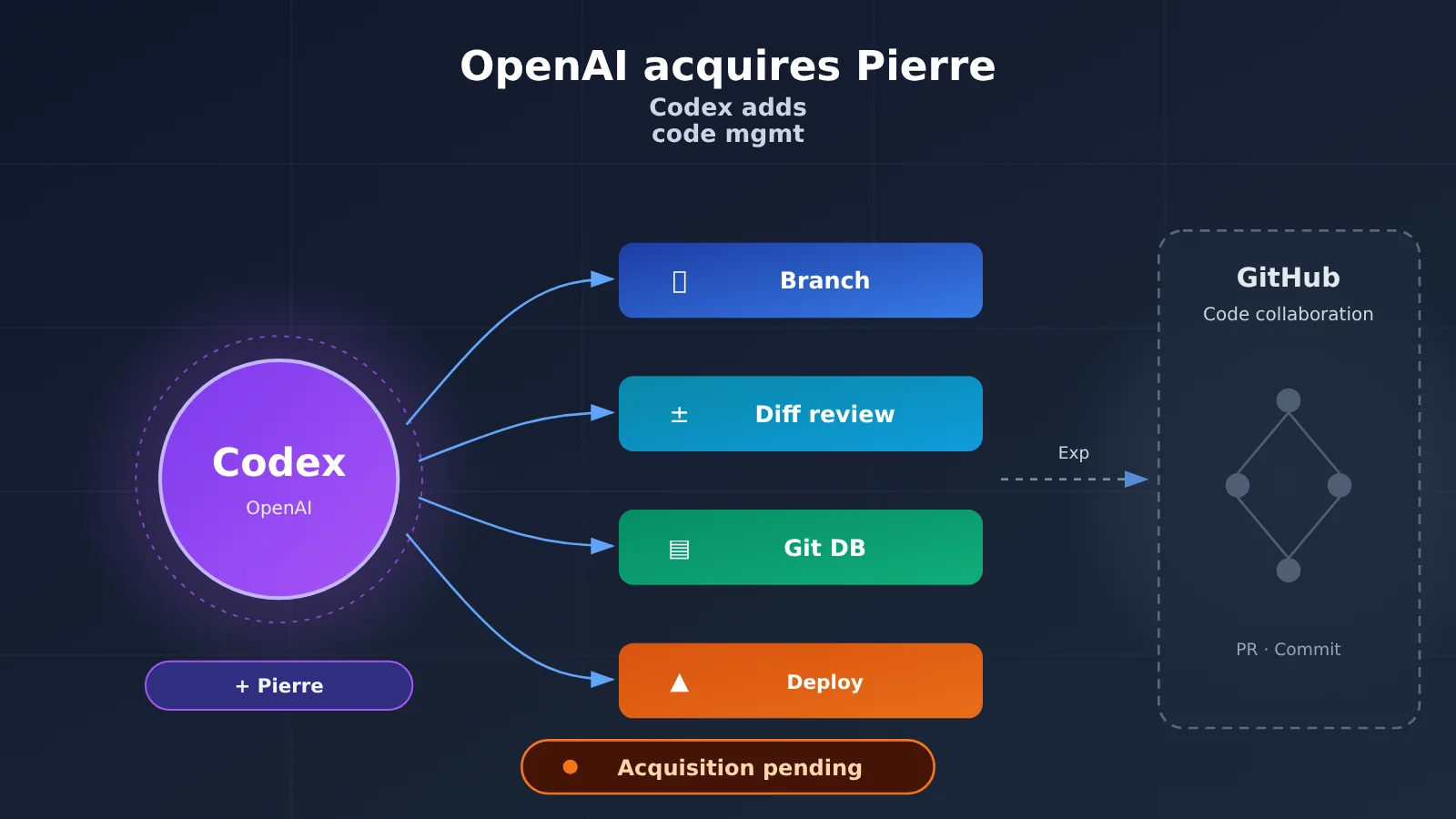
On November 4, 2026, OpenAI announced plans to acquire developer tools company Pierre Computer Company, Inc. Codex’s competitive scope is expanding from “writing code” to “managing and reviewing code.” Pierre’s Trees and Diffs are already used in the Codex App, so this deal isn’t the first technical collaboration between the two companies.
This isn’t an ordinary tool acquisition, but it doesn’t mean OpenAI has launched a GitHub replacement, either. The idea of “challenging GitHub” comes mainly from competitive analysis by outlets such as Axios. OpenAI’s official messaging focuses on expanding Codex’s ability to build, understand, and review code.
Key takeaway: This article covers what’s confirmed about the deal, what remains unknown, and why competition in AI coding is starting to move toward the source code management layer.
OpenAI’s Acquisition of Pierre: Key Facts at a Glance
| Item | What’s been disclosed | What to keep in mind |
|---|---|---|
| Announcement date | November 4, 2026 | Officially announced by OpenAI |
| Deal status | Planned acquisition; not yet closed | Still subject to customary conditions, including regulatory approval |
| Operating arrangements | Both companies will operate independently until closing | Personnel integration plans haven’t been disclosed |
| Deal value | Not disclosed | Valuation and ownership stakes also haven’t been disclosed |
| Open-source commitment | Pierre’s open-source projects will remain open source | Long-term maintenance plans for individual releases remain unclear |
| Existing customers | Can continue using Code Storage after the deal closes | Long-term pricing remains unclear |
What Kind of Company Is Pierre?
Pierre isn’t a Large Language Model company, and it doesn’t sell model APIs like GPT or Claude. It provides software and infrastructure for displaying, editing, storing, and managing code. Its website describes its business as building low-level, composable products for machine-driven workloads.
| Product | Main purpose | Relationship to Codex |
|---|---|---|
| Trees | File tree navigation, search, and Git status indicators | Already used in the Codex App |
| Diffs | Diff display, line-level annotations, and editing within diffs | Already used in the Codex App |
| Highlights | Fast syntax highlighting as code is typed or streamed | A component mentioned in the official announcement |
| DiffsHub | Viewing code changes in public GitHub PRs, commits, and more | A standalone Pierre product |
| Code Storage | Storing code and its history through an API and Git | Planned for gradual integration; no timeline has been announced |
As of November 5, 2026, Pierre’s open-source GitHub repository had around 6,500 stars and used the Apache License 2.0. That doesn’t mean all the code behind the commercial Code Storage service is open source.
Signal 1: Agents Are Changing the Pace of Code Production on GitHub
To understand the timing of OpenAI’s acquisition of Pierre, start with GitHub’s Octoverse report, published on October 28, 2026. Covering October 1, 2025, through September 30, 2026, it highlights both the scale of software production and the growing role of agents.
| Octoverse metric | Official figure | Notes |
|---|---|---|
| Code pushes | 17.9 billion | Over the past 12 months |
| Commits | 34.3 billion | Across public and private repositories |
| Merged pull requests | 1.3 billion | About 3.5 million per day on average |
| GitHub Actions jobs | 45.4 billion | About 1,440 per second on average |
| Share of PRs initiated by agents | Rose from 17% to over 40% | March vs. September 2026 |
| New repositories with agent configuration files | Averaged 8 times as many commits as other new repositories | Shows correlation, not necessarily causation |
The 40% figure refers to the share of PRs initiated by agents. It doesn’t mean that AI independently wrote 40% of all code, or that all those PRs were merged. Still, the data shows that agents have begun to play a significant role in software production.
When a developer runs multiple agents in parallel, each task may create a separate branch, frequently clone and fetch, and repeatedly commit small changes. The pressure comes not just from the volume of code, but also from concurrent reads and writes, branch management, task isolation, and human review.
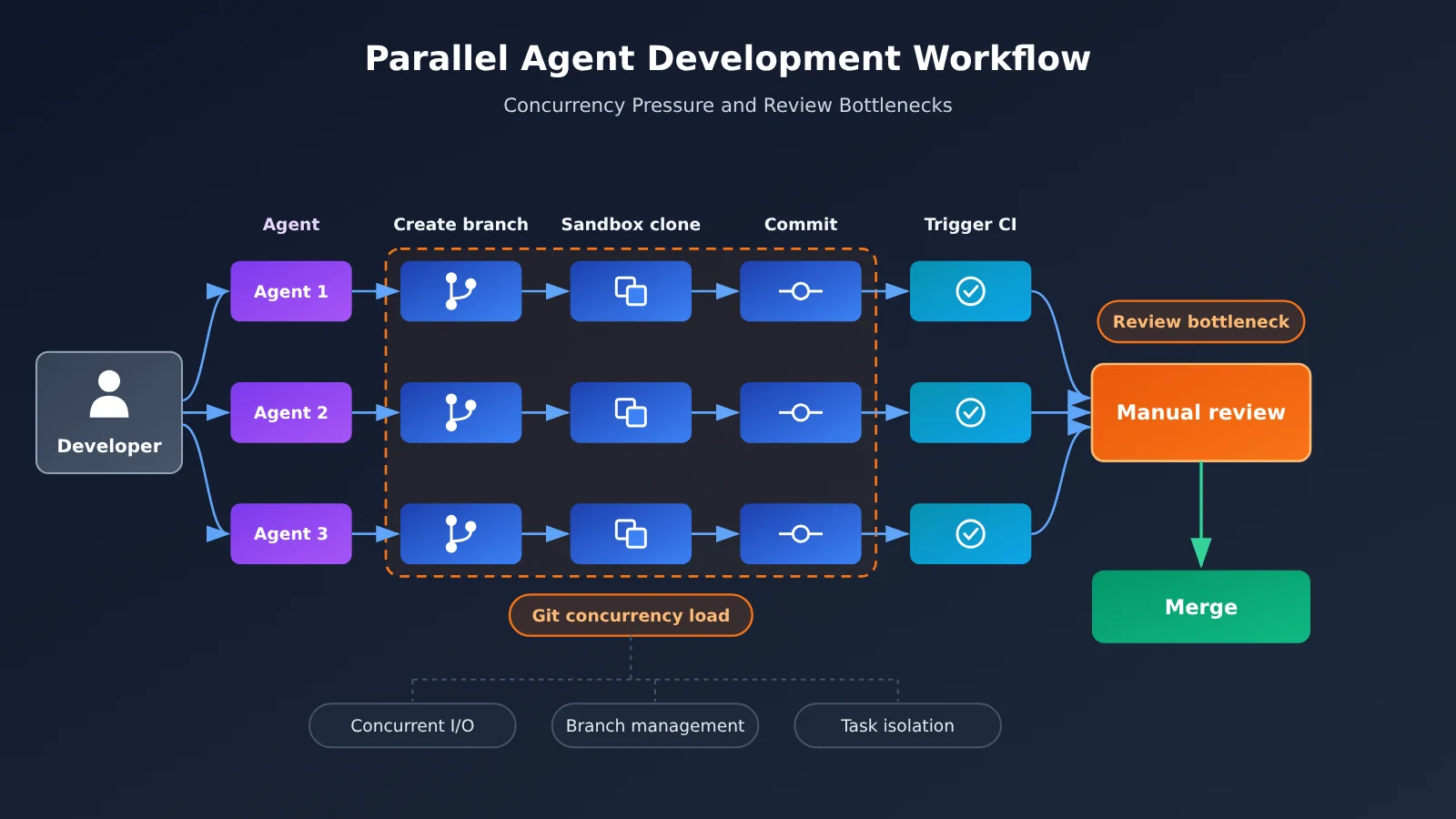
A similar shift has taken place inside OpenAI. In a July 2026 article, the company noted that its weekly internal pull request count had more than doubled since the previous Q4 period. AI has made code production more efficient, but the resulting increase in review demand could become a new bottleneck.
Signal 2: Codex Is Already Using Pierre’s Trees and Diffs
One of the easiest ways to misread this acquisition is to treat all of Pierre’s capabilities as future plans. In fact, Trees and Diffs are already part of the Codex App, handling file directory browsing and code diff display, respectively. The technical collaboration that preceded the acquisition makes the deal look more like a deepening of an existing product relationship.
Diffs’ Edit Mode is especially noteworthy: reviewers can edit a line of code directly in the diff view. After an agent generates a large set of changes, humans often don’t need to start over. They just need to quickly understand the changes, find the relevant lines, and fix what matters.
It’s important to note that Diffs is a code display and editing component, not an AI review model or a Git repository service. Codex already had code review capabilities before this: it could check PRs, understand existing comments, and help prepare fixes.
In a July 2026 rules test, OpenAI reported that the approach using repository rules found 98% of the targeted rule violations, compared with 58.3% for the baseline. That figure comes from a specially designed test set; it isn’t Codex’s detection rate across all defects. OpenAI also made clear that AI review can’t replace tests, branch protection, or required human approval.
Signal 3: Code Storage Brings OpenAI’s Pierre Acquisition to the Source Code Layer
If Trees and Diffs improve the experience of viewing and editing code, Code Storage addresses where that code lives. It’s built on Git and supports creating repositories, managing branches, and reading and writing files through an API. It also supports Clone, Push, Fetch, Webhook, and Git LFS.
Code Storage can also sync with GitHub, GitLab, and Bitbucket, and offers SDKs for TypeScript, Python, and Go. The specifications published on Pierre’s website include a 32TB limit per repository and a 99.99% SLA commitment. These are vendor-published specifications, though, not independent third-party benchmarks.
Pierre’s published customer stories also show new uses for Git in the agent era:
- Lovable: Pierre says its workload adds more than 8 million Git repositories per week, with repository creation peaking at 250 per second.
- Poke: Stores user preferences, workflows, tool configurations, and agent memory in Git-native state storage.
- Skydive: Gives each agent a private repository for role definitions, Skills, and persistent memory.
These examples all come from vendor accounts and shouldn’t be treated as independently audited results, but they offer a useful perspective. Git repositories are no longer just codebases for human collaboration; they’re also becoming a traceable, recoverable working-state layer for agents.
What has been confirmed so far is that OpenAI will gradually explore bringing Code Storage capabilities into Codex. A timeline for full integration hasn’t been announced. There’s no evidence that Codex has migrated all user code to Code Storage, and the Starter plan’s $20 monthly minimum spend shouldn’t be interpreted as a new Codex charge.
Signal 4: Pando and Pierre Solve Different Problems
On November 2, 2026, two days before the acquisition announcement, OpenAI unveiled Pando, its in-house Git backend. As Codex enabled more parallel development, OpenAI’s internal monorepo experienced slow Push and Fetch operations and failed Merges, with reliability falling below 90% at times.
Pando and Pierre are two separate projects. OpenAI didn’t acquire Pando, and Pierre didn’t develop it.
| Comparison | Pando | Pierre |
|---|---|---|
| Origin | Developed in-house by OpenAI | External company slated for acquisition |
| Product | Git backend | Interactive components and Code Storage service |
| Current focus | Supporting development in OpenAI’s internal monorepo | Providing code infrastructure for developers and AI products |
| Disclosed data | Median Push latency reduced by nearly 80%; delivers nearly 1PB of Git data daily | Code Storage specifications and customer case studies, mostly vendor-reported |
| Availability | Exploring how to offer the technology; product details not yet announced | Open-source components and Code Storage are already available externally |
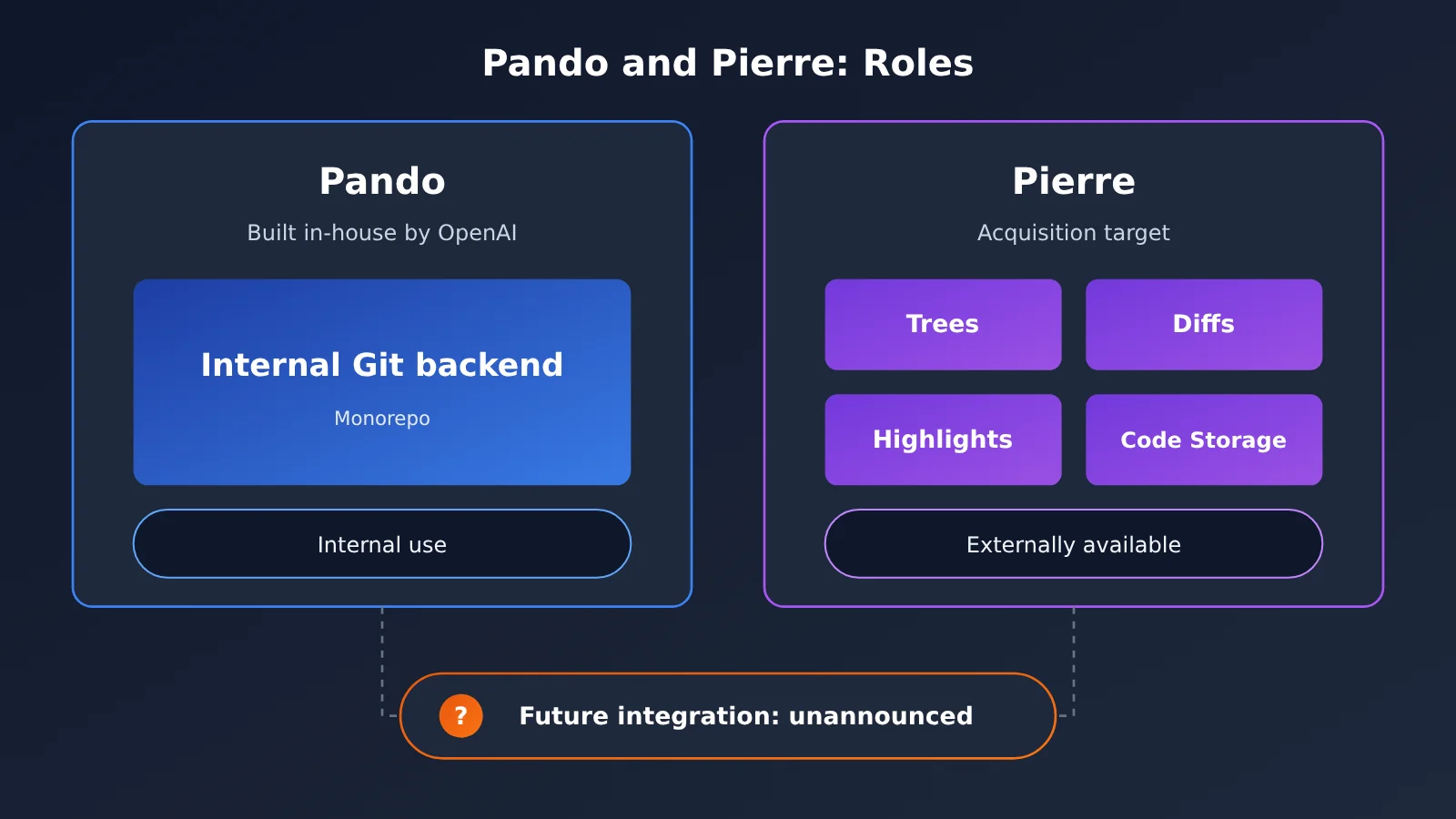
If OpenAI already has Pando, why acquire Pierre? Our take is that Pando demonstrates OpenAI’s ability to solve Git scaling problems internally, while Pierre brings developer interaction components and external products designed for Agents. One offers internal infrastructure expertise; the other brings external product capabilities. They could complement each other.
That’s only an analysis based on the information available. OpenAI hasn’t announced whether the two will share an architecture, merge their technologies, or serve separate workloads.
Signal Five: Codex Is Moving From Writing Code to the Full Development Workflow
In its announcement, OpenAI said it wants Codex to be a place where developers and Agents work together on large software projects, covering everything from an Agent creating its first branch to the code’s final deployment. It also said it wants to connect code to the decisions made by people across a company.
That points to a deeper business strategy. Model capabilities still matter, but code generation alone leaves users relying on other tools for storage, review, discussion, and delivery. The more workflow context a provider controls, the better its chance of turning an Agent product into a platform people use for the long term.
In June 2026, OpenAI disclosed that Codex had more than 5 million weekly users, about 20% of whom were non-developers. That figure doesn’t represent its current real-time scale, but it does show that Codex has built a substantial user base.
Impact Analysis: OpenAI’s Acquisition of Pierre
Impact on GitHub: Competition Is Starting, but Replacement Isn’t Here Yet
Axios sees the deal as a move that takes Codex further into the code hosting and collaboration market long dominated by Microsoft’s GitHub. It also noted that Cursor’s Origin and former GitHub CEO Thomas Dohmke’s startup are competing in the same space. That’s a media interpretation of the competitive landscape; OpenAI hasn’t announced plans to replace GitHub immediately.
| Capability | GitHub | Pierre Code Storage |
|---|---|---|
| Product positioning | Full developer collaboration platform | Headless, API-first infrastructure |
| Primary users | Developers and teams | Software systems, AI products, and Agents |
| Collaboration capabilities | PRs, Issues, code review, CI/CD | Provides repository capabilities; collaboration interfaces are built by products on top |
| Community | Open-source community, developer identities, and social connections | Community isn’t a core focus |
| Relationship with other platforms | A code hosting and collaboration platform in its own right | Can sync with GitHub, GitLab, and Bitbucket |
GitHub’s strengths go beyond storing code. They also include established team workflows, its open-source community, and developer relationships built over time. Code Storage and GitHub aren’t equivalent products, and in the short term, they may coexist in the same workflow through synchronization.
Impact on Developers: Evaluation Needs to Expand From Models to Workflows
- Review capabilities matter more: The more changes Agents produce, the more important Diff readability and efficient human intervention become.
- Rules need to live in the repository: Rule files like AGENTS.md can help Agents review code according to team constraints.
- Check the terms for data questions: Data isolation and usage arrangements after integration haven’t been clarified, so there’s no basis to assume customer code will be used for training.
Practical advice: Tool platforms are still evolving. Teams can start by keeping review rules in their repositories, then compare different models using real Diffs. With APIYI at apiyi.com, you can switch between mainstream models through the same interface, reducing the changes needed for testing.
Impact on the AI Coding Industry: Competition Is Moving Up the Stack
In the past, AI coding products competed primarily on code generation and completion. As Agents begin working in parallel, source code storage, permission isolation, the review experience, and delivery workflows could all become new product differentiators.
Build a Diff Review Prototype with a Model API
It helps to distinguish three layers: Codex is a coding agent product, the GPT model API provides reasoning capabilities, and Code Storage handles Git repository infrastructure. The acquisition announcement didn’t introduce a new model or an integrated API. The examples below simply show how to use a general-purpose model API to analyze a local Git diff.
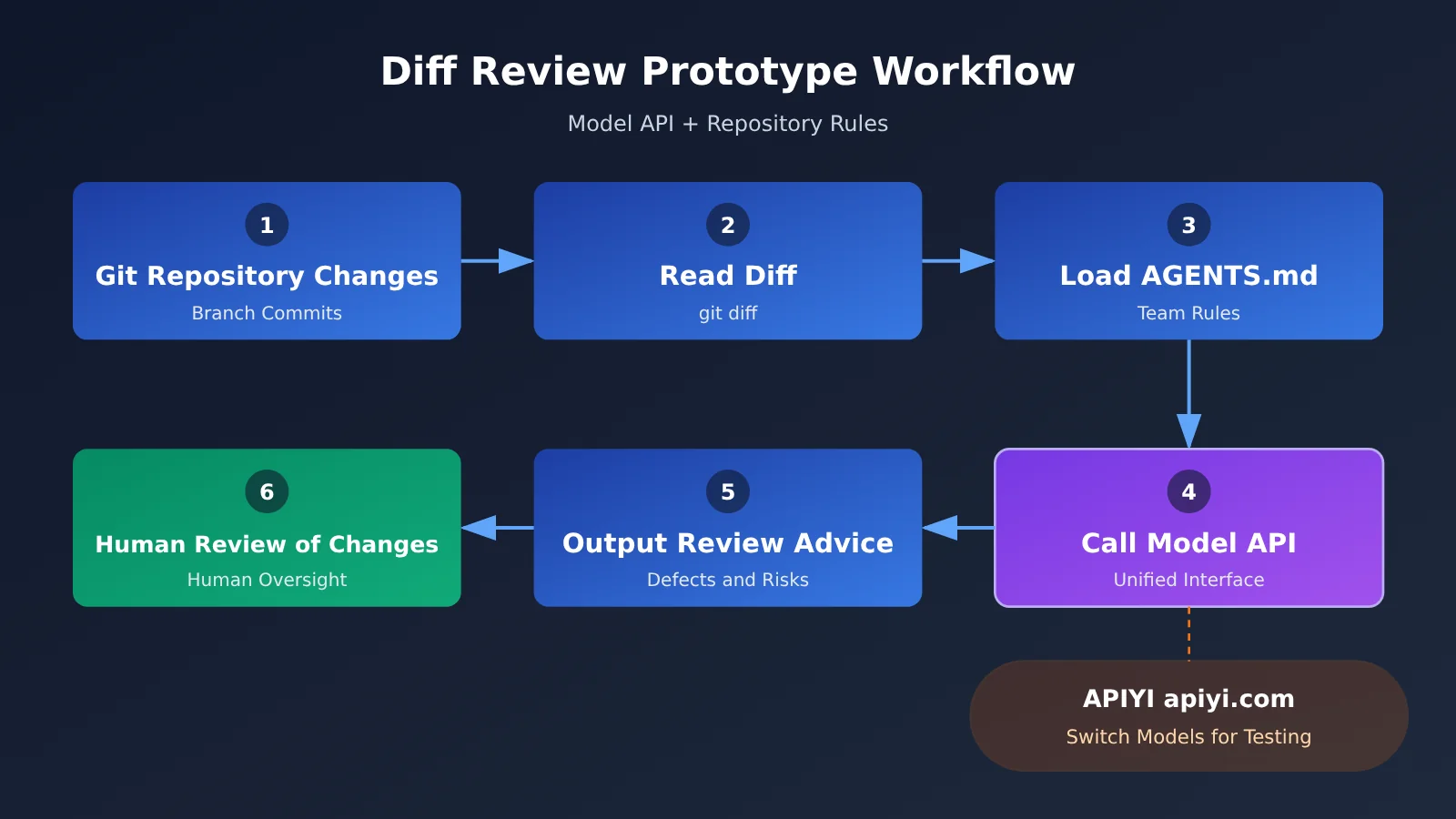
import subprocess
from openai import OpenAI

client = OpenAI(
    api_key="YOUR_API_KEY",
    base_url="https://api.apiyi.com/v1"  # APIYI unified API
)

diff = subprocess.run(
    ["git", "diff", "main...HEAD"],
    capture_output=True, text=True, check=True
).stdout

response = client.chat.completions.create(
    model="gpt-4o-mini",  # Replace with the model you want to test
    messages=[
        {"role": "system", "content": "你是代码审查助手,请指出缺陷和风险。"},
        {"role": "user", "content": diff[:20000]}
    ]
)
print(response.choices[0].message.content)
View the full code with repository rules
import subprocess
from pathlib import Path
from openai import OpenAI

client = OpenAI(
    api_key="YOUR_API_KEY",
    base_url="https://api.apiyi.com/v1"
)


def get_diff(base_ref: str = "main") -> str:
    """Read the code diff between the current branch and the base branch."""
    result = subprocess.run(
        ["git", "diff", f"{base_ref}...HEAD"],
        capture_output=True,
        text=True,
        check=True,
    )
    return result.stdout


def review_diff(model: str = "gpt-4o-mini", max_chars: int = 20000) -> str:
    """Review the diff using repository rules; results still require human confirmation."""
    diff = get_diff()
    if not diff.strip():
        return "没有检测到代码变更。"

    rules_path = Path("AGENTS.md")
    rules = rules_path.read_text(encoding="utf-8") if rules_path.exists() else "无"

    response = client.chat.completions.create(
        model=model,
        messages=[
            {
                "role": "system",
                "content": (
                    "你是代码审查助手。请按严重程度列出缺陷,"
                    f"并参考以下仓库规则:\n{rules}"
                ),
            },
            {"role": "user", "content": diff[:max_chars]},
        ],
    )
    return response.choices[0].message.content


if __name__ == "__main__":
    print(review_diff())
Getting started: You can get free testing credits through APIYI at apiyi.com, then compare results across a few historical diffs with known issues. A prototype like this is useful for testing the idea, but it can’t replace tests, branch protection, or human approval.
Frequently Asked Questions
Q1: Has OpenAI completed its acquisition of Pierre?
No. OpenAI announced its proposed acquisition of Pierre on November 4, 2026. The deal remains subject to customary conditions, including regulatory approval. The two companies will continue to operate independently until closing. Neither the purchase price nor the closing date has been disclosed.
Q2: Is OpenAI acquiring Pierre to replace GitHub?
OpenAI hasn’t said that. The idea that it intends to “challenge GitHub” is primarily a media interpretation of the competitive implications. OpenAI also hasn’t announced plans to end its GitHub integration or migrate all Codex projects to Pierre.
Q3: Which Pierre capabilities does Codex already use?
OpenAI has confirmed that the Codex App uses Trees for file browsing and Diffs for displaying changes. Further integration of Code Storage is planned, but a full timeline hasn’t been announced.
Q4: How are Pando and Pierre Code Storage related?
They’re separate projects. Pando is a Git backend developed by OpenAI, while Code Storage is commercial Git infrastructure developed by Pierre. There’s no official statement on whether they’ll be integrated in the future.
Q5: How can I quickly build a code review prototype with an API?
You can follow these steps:
1. Visit APIYI at apiyi.com to register and get an API key.
2. Use `git diff` to read the changes and pass them to the model as input.
3. Compare outputs from different models against the AGENTS.md rules, then have a human verify the conclusions.
Q6: Will the acquisition affect model API pricing or access?
The announcement didn’t introduce a new model or announce separate new model API rates. Code Storage pricing isn’t the same as model token pricing. APIYI at apiyi.com provides a model API aggregation service, and there’s currently no reliable evidence that it offers access to Pierre Code Storage.
OpenAI’s Pierre Acquisition: Key Takeaways
- Deal status: OpenAI has announced plans to acquire Pierre, but the deal hasn’t closed.
- Existing integrations: Trees and Diffs are already used in the Codex App.
- Future plans: Code Storage will be integrated gradually; no timeline for full integration has been announced.
- Project boundaries: Pando is a backend developed by OpenAI, not the same project as Pierre.
- Industry context: GitHub data shows that agents now initiate more than 40% of PRs.
- Competitive outlook: “Challenging GitHub” is a media interpretation; a complete replacement product hasn’t emerged.
- Practical tip: Use APIYI apiyi.com to compare how different models review diffs.
Conclusion
OpenAI’s acquisition of Pierre hasn’t closed, and there are still plenty of unknowns about what the resulting products will look like. Even so, the deal points to a clear direction:
- Needs have changed: Agents are increasing the pressure on both concurrent development and code review.
- The product is expanding: Codex is moving beyond code generation toward a more complete software development workflow.
- Competition is broadening: Source code management, collaboration, review, and delivery could all become new areas of competition.
For developers, there’s no need to rush to migrate repositories because of this news. A more practical approach is to follow future official announcements, establish review rules and quality gates, and evaluate model capabilities using real code changes.
If you’re building a code review workflow, try using APIYI apiyi.com to quickly compare different models before deciding which approach works best for your team.
📚 References
- OpenAI to acquire Pierre Computer Company, Inc.: OpenAI’s official acquisition announcement
- Link:
openai.com/index/openai-to-acquire-pierre -
Covers: Deal status, product integration, and OpenAI’s stated strategy
-
Scaling Git at OpenAI: An OpenAI engineering article
- Link:
openai.com/index/scaling-git-at-openai -
Covers: Pando’s background, architecture goals, and production data
-
GitHub 2026 Octoverse: GitHub’s official annual report
- Link:
github.blog/news-insights/octoverse/octoverse-commits-pushes-reach-new-highs-in-2026-as-developers-build-with-agents -
Covers: The scale of coding activity and the share of PRs initiated by agents
-
Exclusive: OpenAI targets Microsoft’s GitHub with deal: An Axios exclusive
- Link:
axios.com/2026/11/04/openai-pierre-computer-github -
Covers: A media perspective on the competitive landscape
-
Code Storage Products and Pricing: Official Pierre resources
- Link:
code.storage -
Covers: Product capabilities, service specifications, and customer case studies
-
Custom Code Review rules for Codex: OpenAI’s developer blog
- Link:
developers.openai.com/blog/custom-code-review-rules-for-codex - Covers: Codex review rules and their testing context
Author: APIYI Technical Team
Technical discussions: Contact us through the APIYI homepage. For more resources, visit the documentation center at docs.apiyi.com.