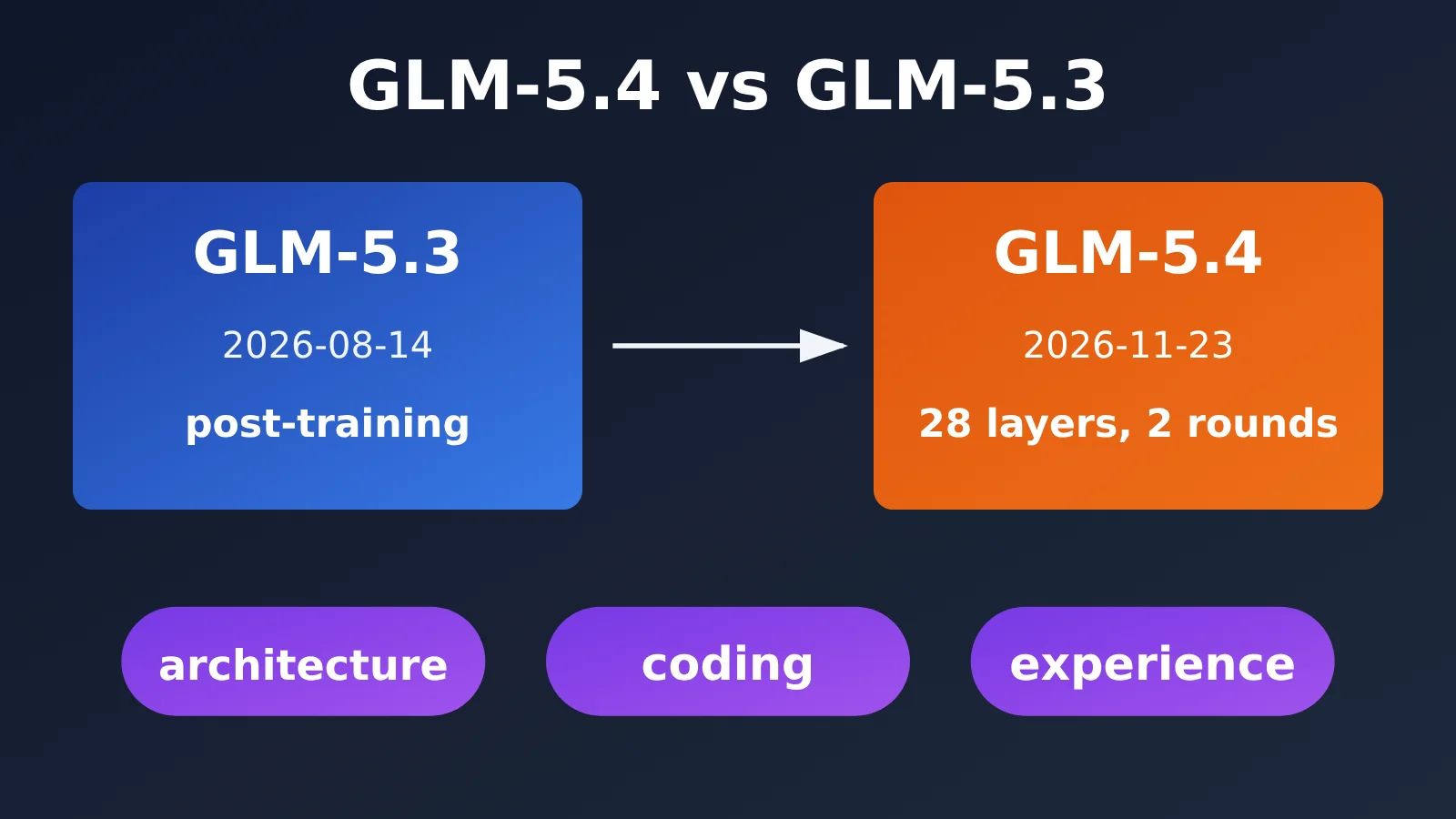
The upgrade is clear, but the three dimensions differ in magnitude and strength of evidence. On architecture, GLM-5.4 runs a selected 28 layers through two rounds of recurrence, while GLM-5.3 reuses the GLM-5.2 base and improves through post-training. On coding, in Zhipu’s internal paired evaluation across 200 real-world scenarios, GLM-5.4 versus GLM-5.3 wins 51.1%, ties 25.7%, and loses 23.1%, a net win of 28.0 percentage points. On user experience, the most obvious change is the addition of image, video, and file inputs, while the advertised 1M context and 128K maximum output remain unchanged.
If you need to handle screenshots and design mockups and can use a plan or client you already have access to, try GLM-5.4 first. If you need a general-purpose API or publicly released weights, you should still choose GLM-5.3 for now.
What will you learn from this article? Four takeaways from GLM-5.4 vs. GLM-5.3
- What changed in each generation, and which causal claims we can’t make yet.
- How to read the 51.1% win rate, and why you can’t subtract it from old benchmark scores.
- The actual differences in input modalities, thinking levels, speed, quotas, and API status.
- A reusable same-condition testing method and logging code.
GLM-5.4 vs GLM-5.3 Index
This article starts with a concept table and a quick impact overview to set the background. The “Objective Facts” section checks specs and architecture, coding data, user experience, and open status in order — useful when you need to look up numbers. The “Analysis and Judgment” section explains the limits of the data, gives selection criteria, and lays out trial steps — useful when you need to make a decision. The FAQ at the end deals with questions that are easy to misread. References [1] through [8] in the body correspond to the numbered sources.
To Know: GLM-5.4 vs GLM-5.3 Concept Explanations
| Concept | Brief explanation |
|---|---|
| Base model and post-training | The base model is obtained through pretraining; post-training further strengthens task capabilities on top of it |
| Recurrent layer | The same set of layers runs for multiple rounds, increasing computational depth |
| Sparse attention | Only some positions participate in attention computation |
| IndexShare | Reuses the position-selection results from sparse attention to reduce redundant cost |
| Key-value cache | Stores the keys and values of processed content for use in later generation |
| Pairwise win rate | Two results for the same task are compared against each other, tallying wins, ties, and losses |
| Net win margin | Win rate minus loss rate; it is not the same as an improvement in task pass rate |
GLM-5.4 vs GLM-5.3: Impact at a Glance
- Front-end and visual programming developers: GLM-5.4 can read screenshots, design references, and videos directly, cutting out the extra step of converting them into text descriptions.
- API integration teams: GLM-5.3 already has general-purpose API call samples; GLM-5.4’s general model API will open up after the safety evaluation.
- Self-deployment and research teams: GLM-5.3 ships with public weights and a license; GLM-5.4’s weights are still just a plan.
- Coding Plan users: On plans with weekly limits, GLM-5.4 offers roughly 1.5× the available tokens of the previous generation, though actual consumption still varies by task.
The Objective Facts: What’s Known to Change in GLM-5.4 vs GLM-5.3
GLM-5.4 vs GLM-5.3 specs: more input types, same context window
Here are the flagship specs from Zhipu’s official Chinese developer documentation [3][4], as of the reference material dated November 24, 2026.
| Item | GLM-5.3 | GLM-5.4 |
|---|---|---|
| Announcement date | 2026-08-14 | 2026-11-23 |
| Input | Text | Text, images, video, files |
| Output | Text | Text |
| Context window | 1M | 1M |
| Max output | 128K | 128K |
Always write out the full model name when comparing. GLM-5.3-Flash is a different model — it’s also the first natively multimodal release in the GLM-5 series that Zhipu launched earlier. Its vision specs don’t count toward the GLM-5.3 flagship.
GLM-5.4 vs GLM-5.3 architecture: from scaling up training to reworking execution structure
GLM-5.3 reuses the GLM-5.2 base model; the gains come from post-training, which covers more coding tasks that are more complex and closer to real expert workflows. It carries forward IndexShare, the long-horizon reinforcement learning algorithm SAO, and the asynchronous training infrastructure [1].
GLM-5.4 keeps training from the pretrained GLM-5 series base, running the selected 28 layers through two rounds. The second round reuses the sparse positional indices generated in the first round; for caching, the two rounds share the distant key-values while retaining the second round’s near key-values [2][5]. Both generations’ materials touch on index reuse — the new version’s focus is on sharing across loop rounds.
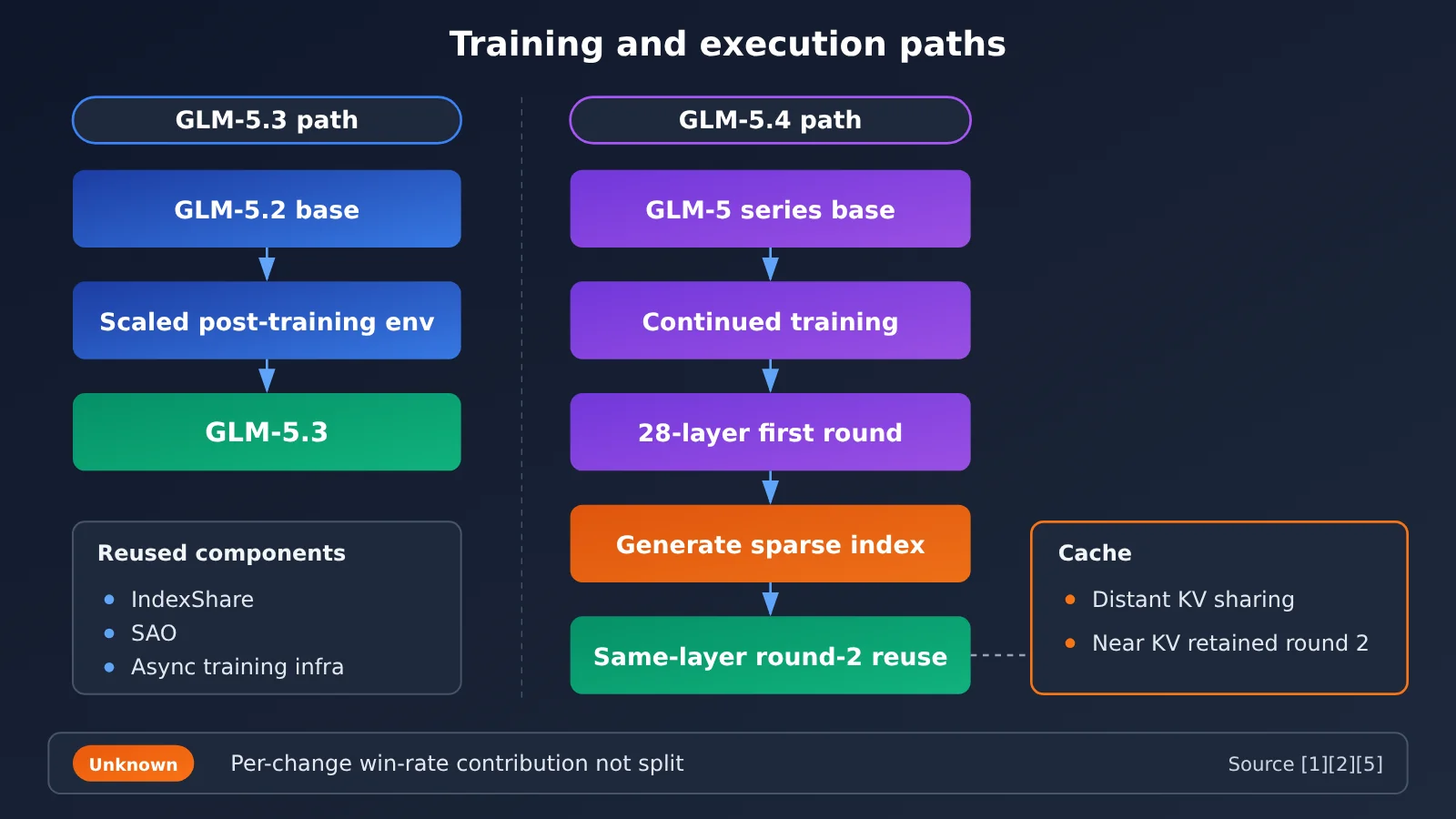
The key difference in the diagram above: GLM-5.3’s public upgrade is concentrated in the training environment, while GLM-5.4 adds a rework of the execution structure. Zhipu also published a 30B looping experiment with the same parameter count, meant to answer whether adding computational depth can produce gains; that’s a different kind of evidence from the flagship’s win rate.
GLM-5.4 vs. GLM-5.3 Coding Ability: A Net Win of 28.0 Percentage Points
Zhipu’s evaluation covers 200 real-world coding scenarios, making it an internal, hands-on vendor evaluation [5]. The official win-rate chart also includes two other opponents:
| GLM-5.4’s opponent | Win | Tie | Loss | Net win margin (percentage points) |
|---|---|---|---|---|
| GLM-5.3 | 51.1% | 25.7% | 23.1% | 28.0 |
| Kimi K3.1 Pro | 41.8% | 26.9% | 31.3% | 10.5 |
| DeepSeek-V4.1-Flash-1017 | 36.6% | 30.2% | 33.2% | 3.4 |
Table note: The net win margin is calculated as win rate minus loss rate. The GLM-5.3 row sums to 99.9%; the chart only displays one decimal place. Each row has a different baseline, so you can’t subtract across rows to infer the direct head-to-head results of other models.
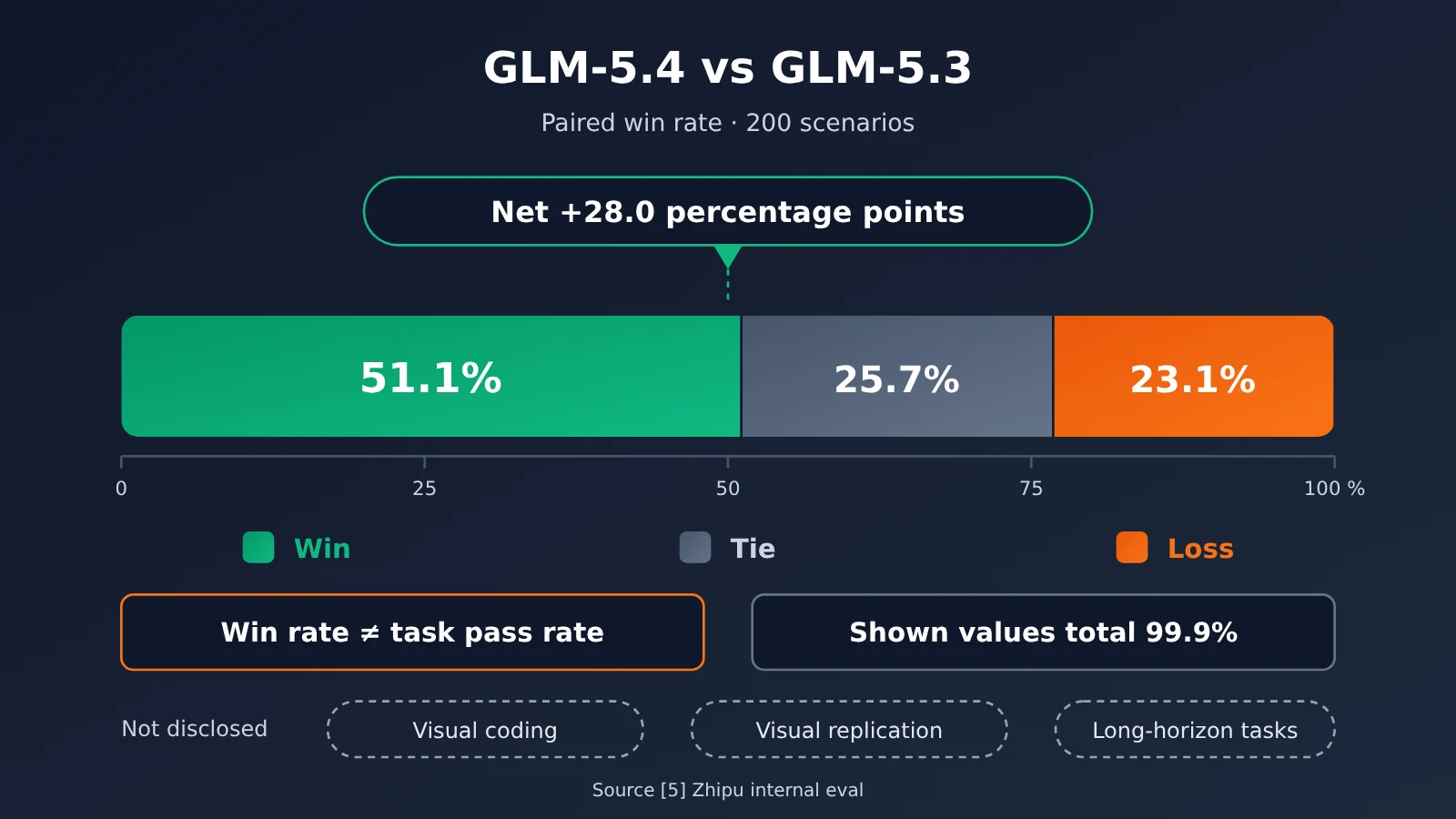
This means the new version is better in more than half of the paired comparisons, but about a quarter end in a tie, and in another 23.1% the older version comes out ahead. Zhipu’s written commentary specifically names visual Coding, visual replication, and long-horizon tasks, yet the chart only shows the overall result — there are no sub-scores for those three categories.
GLM-5.3’s own historical results were the gains over GLM-5.2 [1]:
| Benchmark at GLM-5.3 launch | GLM-5.2 | GLM-5.3 | GLM-5.4 |
|---|---|---|---|
| Terminal-Bench 3.0 | 4.6 | 28.3 | Not provided in this material |
| DeepSWE v1.1 | 46.2 | 66.9 | Not provided in this material |
| Agents’ Last Exam | 23.8 | 28.5 | Not provided in this material |
In addition, GLM-5.3 hit 34.5% accuracy on the Max tier of its own Z.ai Code Bench, outputting roughly 75K tokens per question. These scores and the paired win rates measure different things.
GLM-5.4 vs GLM-5.3: Modalities, Reasoning, Speed, and Quota
Input handling. When you’re modifying an existing page layout, GLM-5.4 can work with a reference image and repo components together, then open a browser through a supported client to check the result. The GLM-5.3 flagship, by contrast, relies on written requirements, logs, and text clues returned by tools. ZCode’s file references and browser control are client features, so they shouldn’t be counted as model architecture capabilities.
Reasoning levels. Both generations offer three levels — low, high, and max — with max as the default; for GLM-5.4, these names come from ZCode. Zhipu has observed that the new version sometimes keeps reasoning for a long stretch, and you can reach the slider to change the level by clicking the model name at the bottom right of the ZCode input box [6].
Speed. Zhipu’s server-side figures for GLM-5.4 are up to 200 token/s off-peak and roughly 70–80 token/s at peak [2]. The release materials don’t give GLM-5.3 speed under the same load and the same input, so there’s no way to calculate a generational speedup.
Quota. In the Coding Plan, which has a weekly cap, GLM-5.4 gives you about 1.5x the tokens of the previous generation — that’s a plan conversion [7]. Regular input, cached input, and output each have their own credit coefficients, and output length, number of reruns, and tool actions all affect what gets billed.
GLM-5.4 vs GLM-5.3 Availability: API and Weights Still Don’t Line Up
| Access method | GLM-5.3 | GLM-5.4 |
|---|---|---|
| Coding Plan | Available | Available |
| ZCode model selection | Selectable | Selectable; existing sessions won’t switch automatically |
| Official general-purpose model API | Call samples available | Opens after safety review |
| Public weights | Already available [8] | Planned |
| Weight license | Published with the repository | Specific license not disclosed |
The difference between the two generations isn’t just model capability — it’s also how they’re delivered. When you access them through an aggregation platform like APIYI apiyi.com, confirm the exact model against the platform’s live model list. Don’t assume a model is live just because the official announcement says so.
The Verdict: How to Choose Between GLM-5.4 and GLM-5.3, and How to Test Them
What Conclusions Can the GLM-5.4 vs. GLM-5.3 Data Support
The 51.1% supports the claim that “the new version comes out ahead in the vendor’s internal same-venue evaluation.” It can’t be read as “coding ability improved by 51.1%,” and you shouldn’t multiply it by 200 to back out the number of rounds either. Dividing 51.1% by DeepSWE’s 66.9, or subtracting the two, doesn’t yield a well-defined magnitude of improvement.
Attribution to architecture also needs room to breathe. The 28-layer recurrence points in a plausible direction of change, and the 30B experiment offers another kind of supporting evidence, but the public materials don’t break the product gains down among recurrence, vision, and the server side. So “getting stronger is all thanks to the recurrent architecture” currently lacks support.
How to Choose Between GLM-5.4 and GLM-5.3
- Choose GLM-5.4: when your task depends on screenshots, design mockups, or video, or when you want to try longer end-to-end coding, and you already have a Coding Plan or a partner client.
- Stay on GLM-5.3: when your existing system depends on general-purpose APIs, when you need to check public model cards, or when you want to compare self-hosted performance.
- Trial both in parallel first: when the task is pure text coding and both generations are selectable in the same client. Overall win rate can’t substitute for how they perform in your repo.
If GLM-5.4 completes its safety evaluation and opens up a general-purpose API, teams in the second category should reconsider their choice. If context capacity is your only reason to upgrade, note that both generations have the same rated value—so that rationale doesn’t hold.
🎯 Technical tip: While the interfaces aren’t fully in place yet, make the model name a configuration item. Managing mainstream models through the OpenAI-compatible API of APIYI apiyi.com means smaller changes when you later switch to a model that’s already listed.
GLM-5.4 vs GLM-5.3: Step-by-Step Trial Under Identical Conditions
- Split the tasks: text-only tasks compare problem-solving on a shared input; visual tasks compare the full workflow. Don’t score them together.
- Fix the conditions: use the same starting repo state, client, tools, reasoning-effort setting, and time limit, and record the model version and the plan you’re on.
- Start a new session: don’t let one side inherit history files and terminal output from the other.
- Time from submission: log total task time separately from model output speed.
- Accept based on results: record test pass rates, patch size, tool success rate, manual edits, and tokens, and save the outputs.
A good long-running task is: add input validation, saving, and regression tests to an existing settings page, and watch how the model adjusts after each failure. Run the visual test as a separate item, recording the layout conditions the user had to write in, whether it ran, and the final screenshot. Even if you compress a long session, keep the patch and test records — don’t let response length stand in for actual completion.
GLM-5.4 vs GLM-5.3 Quick Start: Get the Recording Script Running First
The script below verifies a compatible API endpoint. Start by checking the model list at APIYI apiyi.com, then fill in a model ID that actually works via an environment variable. Don’t assume GLM-5.4 already has a general-purpose API available.
import os
import openai

client = openai.OpenAI(
    api_key=os.environ["APIYI_API_KEY"],
    base_url="https://api.apiyi.com/v1"
)
response = client.chat.completions.create(
    model=os.environ["TEST_MODEL"],
    messages=[{"role": "user", "content": "为邮箱校验函数编写回归测试"}]
)
print(response.choices[0].message.content)
View the full code with elapsed time and token logging
import json
import os
import time
import openai

client = openai.OpenAI(
    api_key=os.environ["APIYI_API_KEY"],
    base_url="https://api.apiyi.com/v1"
)

PROMPT = "为设置页编写输入校验、保存逻辑和回归测试。"
models = [m.strip() for m in os.environ["TEST_MODELS"].split(",") if m.strip()]
records = []

for model in models:
    start = time.perf_counter()
    record = {"model": model}
    try:
        response = client.chat.completions.create(
            model=model,
            messages=[{"role": "user", "content": PROMPT}]
        )
        usage = response.usage
        record["output"] = response.choices[0].message.content
        record["input_tokens"] = usage.prompt_tokens if usage else None
        record["output_tokens"] = usage.completion_tokens if usage else None
    except openai.OpenAIError as exc:
        record["error"] = str(exc)
    record["elapsed_seconds"] = round(time.perf_counter() - start, 2)
    records.append(record)

with open("model_records.json", "w", encoding="utf-8") as file:
    json.dump(records, file, ensure_ascii=False, indent=2)
The script records the total elapsed time for a single text request. It doesn’t control the reasoning-effort setting and doesn’t run any repo tools, so it’s only good for endpoint validation and a first-pass screen. GLM-5.4 should currently be tested inside a client you’ve already wired up — that isn’t directly comparable to the timings from this API snippet.
🚀 Quick start: new users can use the free trial credits at APIYI apiyi.com to verify the request and log format first, then scale up the sample once the model is confirmed working.
GLM-5.4 vs GLM-5.3: Frequently Asked Questions
Q1: Does GLM-5.4 have a longer context than GLM-5.3?
No. Both flagship generations list a 1M context window and a maximum output of 128K. What changed is the input type, along with the looping and caching arrangements.
Q2: Can GLM-5.3 process images directly?
The flagship GLM-5.3 accepts text only. GLM-5.3-Flash is a separate natively multimodal model, so the names shouldn’t be used interchangeably when comparing them.
Q3: How much faster is GLM-5.4 than GLM-5.3?
No like-for-like data has been disclosed. The 200 tokens/s figure is GLM-5.4’s off-peak maximum, and it shouldn’t be compared with how GLM-5.3 feels in other environments.
Q4: Can I call GLM-5.4 through the API now?
According to the current official documentation, the general model API will open after a security assessment. You can check the live model list on APIYI apiyi.com, and keep the model name in your business code as a configuration value.
Q5: Does 1.5x the available tokens mean one-third cheaper?
You can’t convert it that way. It’s a plan-level conversion for a package with a weekly quota, and the actual cost also depends on the credit multiplier, caching, and the number of reruns. If you use APIYI apiyi.com to call other models on a pay-as-you-go basis, you should also compare total cost for completing the same task.
For day-to-day teams, the safest approach is to try one real task first, then decide how much to migrate. If you want to include other mainstream models in the comparison, APIYI apiyi.com lets you connect them through one API key, but you still need to apply the same set of acceptance criteria.
GLM-5.4 vs GLM-5.3 Reference Materials
- GLM-5.3 release blog and benchmarks:
z.ai/blog/glm-5.3 - GLM-5.4 release blog and service description:
z.ai/blog/glm-5.4 - GLM-5.3 official specifications:
docs.bigmodel.cn/cn/guide/models/text/glm-5.3 - GLM-5.4 official specifications:
docs.bigmodel.cn/cn/guide/models/glm-5.4 - GLM-5.4 Chinese technical and evaluation notes:
zhipuai.cn/zh/research/164 - ZCode model Q&A:
zcode.z.ai/cn/docs/qa - Coding Plan quota rules:
docs.z.ai/devpack/overview - GLM-5.3 model repository:
huggingface.co/zai-org/GLM-5.3
Author: APIYI technical team. For more API documentation, visit the documentation center at docs.apiyi.com.