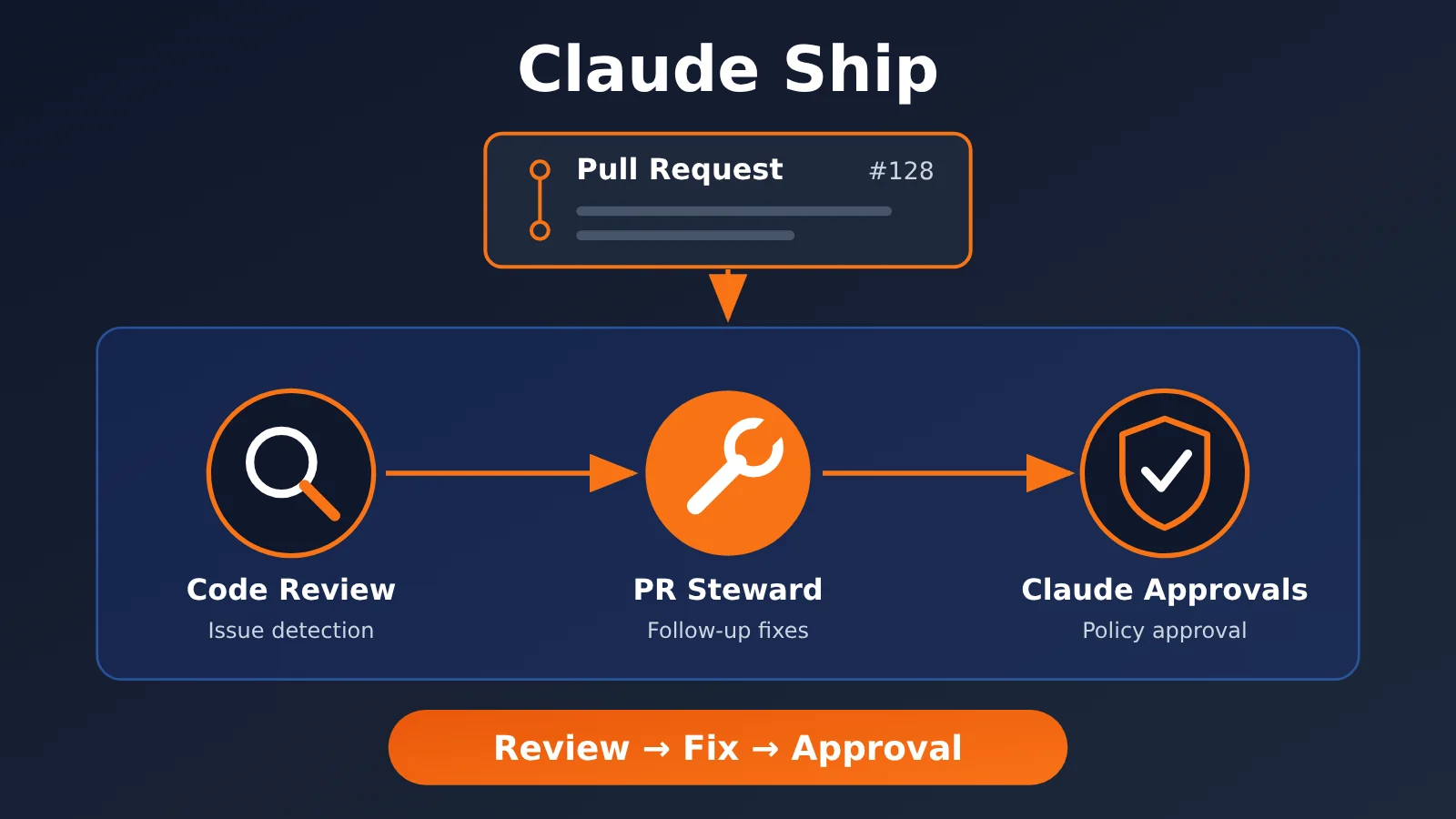
Author’s note: Anthropic publicly launched Claude Ship in beta on November 23, 2026. It divides post-submission work across three components — Code Review, PR Steward, and Claude Approvals — which handle review, fixes, and policy approval respectively. This article explains how it works, where its permission boundaries lie, the order to enable it, and how billing works.
The short answer: Claude Ship hands off the work that happens after a pull request is submitted to three components, each with its own job. Code Review finds the problems, PR Steward follows up on feedback and pushes fixes, and Claude Approvals decides — according to team policy — who else still needs to sign off; when the rules allow it, it submits a GitHub approving review. It’s not a one-click “AI auto-merge.” Whether a PR can actually merge is still governed by GitHub branch protection, required checks, and human approvals together — the AI only acts within the rules the team has written in advance.
What you’ll learn from this article:
- Claude Ship’s release scope and timeline, plus which organizations can’t use it yet
- Each component’s trigger, what it can do, and what it can’t do
- How approval policy stacks on top of GitHub branch rules, and how much weight the AI’s “vote” really carries
- The enablement requirements and recommended order for the org-level and personal
/shipcommands - Billing, how far the official case-study data can be read, and alternative approaches when Claude Ship isn’t available to you
Index: We’ll start with a concept table and a quick impact overview to build context. The “Objective facts” section breaks down release scope, review, fixes, approvals, entry points, and billing in order, all based on official announcements and documentation. “Quick start” gives a step-by-step enablement checklist and a short, runnable lightweight pre-review script. “Analysis and judgment” collects our interpretation, and the FAQ answers the most common questions that come up during rollout.
Claude Ship Key Concepts to Know
| Concept | Brief explanation |
|---|---|
| Claude Ship | Anthropic’s PR post-processing service for GitHub repositories, made up of three independently enableable components |
| Code Review | Multiple agents read code in parallel, verify and grade issues, and present them as inline comments and check results |
| PR Steward | Follows up on PRs in the cloud under the Claude GitHub App identity; can fix CI failures, resolve conflicts, and respond to review feedback |
| Claude Approvals | Reads the .claude/approvals.yml policy, calculates required approvals, and can submit an approving review when the rules allow |
REVIEW.md |
A specification file that adjusts Code Review’s focus; rules are taken from the base branch or default branch |
| observe / enforce | Two modes for the approval policy: the former only displays the judgment results, while the latter allows submitting approvals based on the policy |
| Required check | A check that must pass before merging under GitHub branch protection |
| Merge queue / auto-merge | Native GitHub capabilities that complete the merge automatically according to rules once all conditions are met |
| Zero Data Retention (ZDR) | An organization setting that doesn’t retain request data; such organizations are outside the Claude Ship availability scope |
Claude Ship Impact at a Glance
- Engineering team leads: You can write “who should review and how many reviewers” into a policy file, letting low-risk changes take the fast path while forcing multi-person approval for high-risk changes.
- Front-line developers: CI failures, merge conflicts, and small fixes can be handed off to PR Steward. Locally, you can also use a single
/shipcommand to commit, push, create a PR, and follow up. - Security and compliance staff: You’ll need to check organization eligibility first. Organizations with ZDR, HIPAA configuration, or customer-managed keys enabled can’t use it for now, and Approvals has additional restrictions for FERPA and Access Transparency configurations.
- Finance and platform administrators: Repositories are billed by tokens, and review depth, number of pushes, and fix rounds all affect cost, so you should set monthly and per-PR limits in advance.
Claude Ship: The Facts on Release Scope and Timeline
Anthropic launched the Claude Ship public beta on November 23, 2026, for Claude Team and Enterprise organizations with repositories hosted on GitHub. The three components are enabled repository by repository and can be adopted independently. The service handles both human-written and agent-written code, and members can keep using their existing development tools.
The three components are at different maturity levels. Code Review entered research preview on March 9, 2026, and became generally available on October 15. PR Steward and Claude Approvals are new in this release and remain in public beta.
| Component | Current status | Supported GitHub environments | Core responsibility |
|---|---|---|---|
| Code Review | Generally available (2026-10-15) | github.com and eligible GitHub Enterprise Server instances | Find and triage issues |
| PR Steward | Public beta (2026-11-23) | github.com and eligible GitHub Enterprise Server instances | Fix CI failures, resolve conflicts, and respond to feedback |
| Claude Approvals | Public beta (2026-11-23) | github.com, including GitHub Enterprise Cloud | Calculate required approvals based on policy |
Eligibility restrictions apply to all three components: organizations that enable zero data retention, use a HIPAA configuration, or use customer-managed encryption keys are currently outside the open scope. Claude Approvals has additional restrictions for FERPA and Access Transparency configurations.
How Claude Ship’s Code Review Reviews Code
Code Review runs in Anthropic’s hosted environment. Multiple agents read the diff and surrounding code in parallel, and candidate issues go through code verification, deduplication, and severity grading. Results appear as inline comments, a review summary, and a check named Claude Code Review. There are three common labels: Important marks important issues, Nit marks minor issues, and Pre-existing marks issues that already existed before this change.
Its permission boundaries are fairly clear. The review environment has read-only access to the repository and can leave comments on the PR; its judgments rely entirely on reading code, while builds and tests remain the responsibility of each CI pipeline. Teams can use REVIEW.md to adjust what the review focuses on, and review results can also be used as conditions in approval policies.
Both triggering and depth are configurable:
- Trigger timing: review once when a PR is opened, review on every push, or review manually only. People with write access can start a review manually by commenting
@claude reviewon the PR. - Review depth: Standard is the default tier. Quick is faster and cheaper, Deep reviews more deeply and usually takes longer and costs more. Administrators only choose the depth; the service determines the specific model.
- Time required: In its general availability announcement, Anthropic said a review took about 20 minutes during the preview period, and that at general availability most reviews take 6 to 10 minutes. Actual time varies with the size of the PR diff.
How Claude Ship’s PR Steward Auto-Fixes
PR Steward works in the cloud under the identity of the Claude GitHub App, and its scope covers roughly four categories:
- When a continuous integration check fails and the cause falls within the code touched by this change, it attempts a fix.
- When it hits a merge conflict, it resolves it by merging the base branch into the PR branch.
- When human review comments are small and clear, it makes the change directly and replies; for larger design concerns, it may reply without changing anything.
- It handles findings marked Important by Code Review and follows up on defect feedback from other review bots. If Claude Approvals is waiting on something that a single commit could solve, it keeps working on that too.
Its process is traceable. PR Steward adds labels to the PR to record progress and pushes ordinary fix commits straight to the current PR branch. After pushing, it comments to explain the change and calls out the commit that can be used to revert it. Members with write permission can use @claude steward to enable manual follow-up, @claude stop to stop it, and can remove the corresponding labels according to their permissions.
The official docs walk through the whole process with a date-parsing test. After the test fails, PR Steward first adds a “working” label and leaves a comment saying it will investigate the cause of the failure, then pushes a change that can parse dates without a timezone. The push comment gives both the explanation of the change and the identifier of the revertible commit. When processing finishes, the “working” label is removed, while labels indicating follow-up is still ongoing remain, so the team can distinguish three states: “in progress, fix pushed, continued observation.”
The docs also list several skip cases: the branch comes from a fork, the PR was opened by a bot, or the author lacks write permission on the repository. The most important boundary is that, in Anthropic’s hosted environment, the service rejects approval requests initiated by PR Steward sessions under the GitHub App identity. In other words, “the AI that fixes code” can’t casually cast an approval vote for its own fix.
How Claude Ship’s Claude Approvals Makes Approval Decisions
Claude Approvals reads .claude/approvals.yml on the default branch, matches rules by file path and related conditions, and calculates the required approvals using strict applicability requirements. A policy can specify how many approvers are needed, who’s eligible to approve, and whether Claude is allowed to submit an approving review. Conditions can be based on objective facts like the number of changed lines, the PR author, or the target branch—or they can reference results from claude/code_review or a team-defined natural-language classifier.
Two points deserve extra attention. First, CI results need to be configured as separate required GitHub checks—they aren’t part of the approval policy itself. Second, if a rule lets the author count toward the required number of approvers, teams should use the eligibility scope to explicitly require human reviews independent of the author.
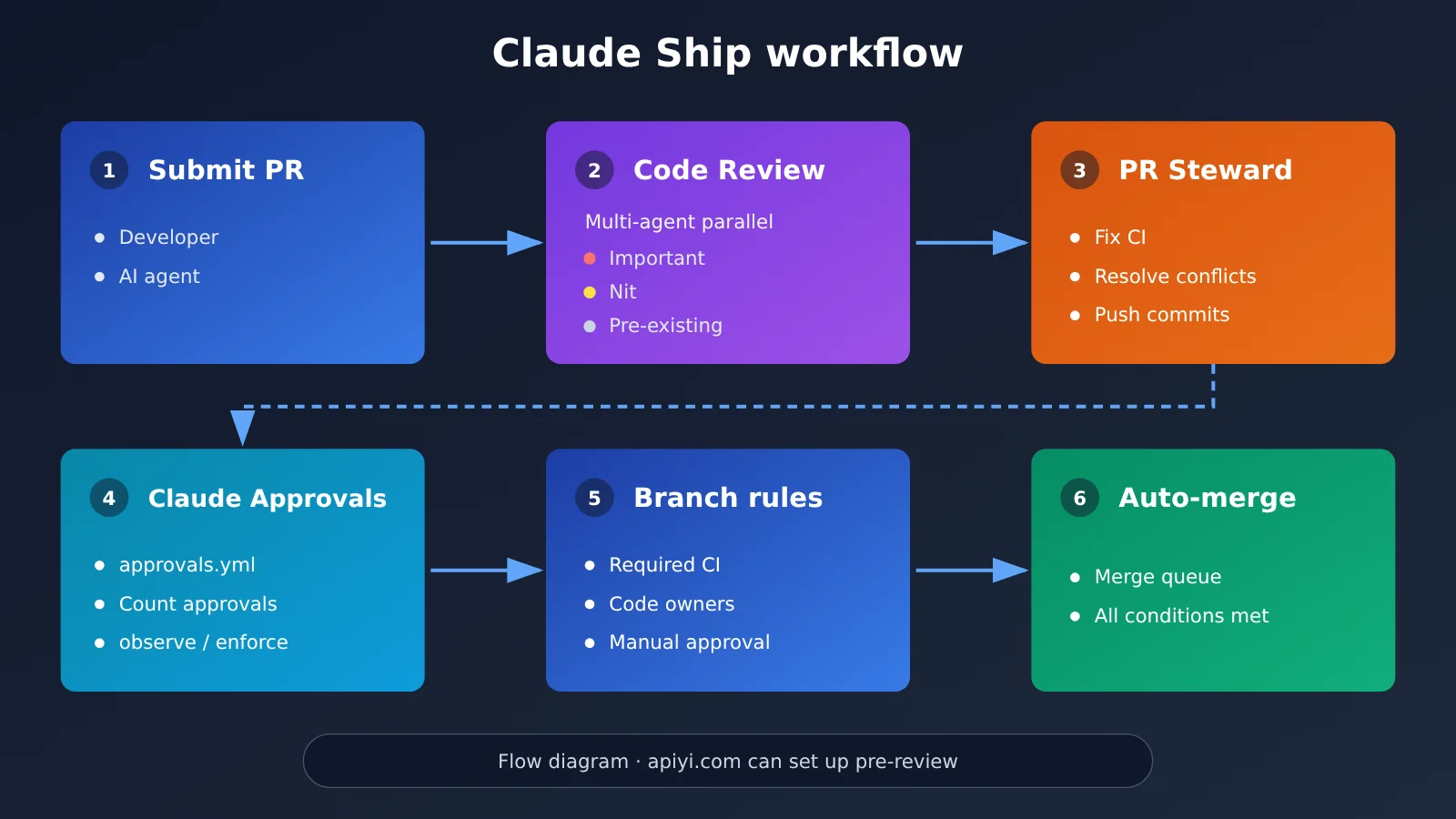
Approvals run in two modes. observe mode only shows what the policy would decide—usually surfaced as a passing status—and won’t submit an approving review. enforce mode lets Claude submit approvals according to the policy. For the approval check to actually serve as a merge gate, a repo admin still needs to set it as a required check in GitHub.
GitHub can count Claude’s approval as one vote under branch rules, but required CI, code owner reviews, and other protection requirements each still apply independently. Repos with auto-merge or merge queues enabled complete the merge per GitHub’s rules once all conditions are satisfied.
The official docs give an example of a tiered policy. For routine documentation changes, you can allow Claude to approve once review passes; for billing logic changes, designate two qualified members to approve, while unit tests remain a required check. Even if PR Steward fixes the tests and pushes the commits, the human approval requirement for billing logic must still be met. New pushes may also trigger re-review and re-counting, depending on the policy and GitHub’s settings for how it handles stale approvals.
Claude Ship’s organization entry point and the personal /ship command
The organization entry point is Claude’s Organization settings → Claude Ship. Organization Owners connect GitHub repositories here and configure Code Review and PR Steward per repository, provided the Claude GitHub App has been authorized for the corresponding repository. PR Steward’s setup guide requires first establishing review rules in GitHub and enabling “new pushes require re-approval.” Members with merge rights on the default branch can enable approval policies in repositories that meet the prerequisites, and Organization Owners can turn off Approvals for the entire organization.
The personal entry point is Claude Code’s /ship command. According to the release announcement, it’s rolling out in Claude Code and the desktop app starting on release day.
| Entry point/command | Where it runs and under which identity | Version or permission requirements | What it does |
|---|---|---|---|
| Organization settings → Claude Ship | Cloud, Claude GitHub App | Organization Owner, GitHub App authorization | Enable the three main components per repository |
@claude review |
PR comments | Repository write permission | Manually trigger a review |
@claude steward / @claude stop |
PR comments | Repository write permission | Start or stop manual follow-up |
/ship |
Local, developer’s own GitHub identity | Claude Code 2.1.330+, GitHub CLI 2.63+, Git 2.38+ | Commit, push, create a PR, review, and keep following up |
/steward |
Local | Same as above | Go straight into follow-up on an existing PR |
/tasks |
Local Claude Code | — | View ongoing follow-up tasks |
The /ship flow is: run the command in your local repository against your own changes; it commits, pushes, and creates a PR, then invokes /code-review to review, and then continuously handles feedback and failing checks. Pushing fixes depends on a signed-in GitHub CLI version 2.63 or higher, and automatically incorporating new commits into the current branch requires Git 2.38 or higher. These operations run under the developer’s own GitHub identity, are subject to account permissions and branch rules, and count toward regular Claude Code usage.
Local ongoing follow-up has prerequisites: the session must stay in the foreground, the computer must stay awake, and the working directory must still have the branch for the corresponding PR checked out. Follow-up ends when the PR is closed or merged, you switch branches, the session ends, or follow-up reaches seven days. For repositories where the organization has enabled cloud PR Steward, the repository configuration takes precedence.
Claude Ship Billing and Official Case Studies
Repository-side usage is billed by tokens and deducted from the organization’s usage allowance. Review costs depend on review depth, the size of the changes, the complexity of surrounding code, and the number of triggers; for repositories set to “review on every push,” the number of reviews increases with the number of pushes. PR Steward is also billed by actual tokens, and organizations can set monthly limits while repositories can set per-PR limits. The documentation notes that actual consumption may briefly exceed the per-PR limit before the agent finishes its follow-up.
Claude Approvals has no base fee, but policy-triggered model classification and Code Review are both billed, including calls initiated in observe mode. For eligible paid Enterprise organizations, the support terms list organizational promotional credits of $10,000 to $50,000. The claim deadline is January 15, 2027, 23:59 UTC; credits are valid for 30 days from the date of claim and are subject to the terms and credit balance.
The announcement includes an internal case: the Analytics API documentation was unclear about the usage scope that admin keys could read, so a product manager used Claude Tag to initiate changes. Code Review found no blocking issues, the documentation reviewer signed off, Claude Approvals checks passed, and the PR merged that evening. The announcement also said that, with Code Review as part of a broader process, the Claude Code team’s merged PR count from June to September more than doubled, while the share of PRs later reverted fell by more than 40% relative.
Both are vendor-internal observations. The statistical period predates this public beta, and the respective contributions of PR Steward and Claude Approvals cannot be isolated from these figures.
Claude Ship Quick Start: Step-by-Step Enablement Checklist
The official recommendation is to “observe first, then delegate.” Combining that with the docs, we put together this enablement sequence:
- Verify eligibility: Confirm your organization is on Team or Enterprise, your repo is hosted on GitHub, and you haven’t enabled ZDR, HIPAA configurations, or customer-managed keys.
- Connect the repo: An organization Owner connects a single pilot repo under Organization settings → Claude Ship and authorizes the Claude GitHub App.
- Turn on review first: Enable Code Review for the pilot repo, start with Standard depth, and for the trigger we recommend “review once when a PR is opened” to keep costs in check.
- Then enable manual Steward: Set up review rules in GitHub and turn on “new pushes require re-approval.” Start PR Steward in manual mode so it only gets involved when someone comments
@claude steward. - Start approvals in observe: Write a
.claude/approvals.ymland run it inobservemode, comparing the policy’s decisions against what humans actually decided to see whether its judgment holds up. - Gradually move to enforce: Once you’re confident the policy is reliable on low-risk paths, switch to
enforce, and then have an admin make the approval check a required check.
One pitfall to watch out for: on paths covered by a policy, if the policy doesn’t reference claude/code_review, automatic review usually stops — even in observe mode. When writing a policy, decide explicitly whether to reference the review results.
REVIEW.md tells Code Review what you care about most. The official docs don’t mandate a fixed format; here’s an illustrative example:
# REVIEW.md (example)
## Focus areas
- Boundary conditions and concurrency issues in billing and auth-related directories
- Whether database migration scripts can be rolled back
## Safe to ignore
- Auto-generated SDK code
- Pure formatting changes
When You Can’t Use Claude Ship: A Lightweight Pre-review Built on Claude Models
If your organization isn’t eligible yet, or you’re on GitLab or a self-hosted Git service, you can start with a general-purpose Claude model to add a lightweight pre-review layer in CI. One caveat: this is a do-it-yourself approach that borrows Claude Ship’s tiering idea — it doesn’t include its multi-agent verification, PR Steward fixes, or policy approval capabilities.
Here’s the simplest example: read the local diff and hand it to the model for review.
import subprocess
import openai

client = openai.OpenAI(
    api_key="YOUR_API_KEY",
    base_url="https://api.apiyi.com/v1"  # APIYI OpenAI-compatible endpoint
)

diff = subprocess.run(["git", "diff", "origin/main...HEAD"],
                      capture_output=True, text=True).stdout

resp = client.chat.completions.create(
    model="claude-sonnet-4-5",  # replace with a model from the platform's model list
    messages=[{"role": "user",
               "content": f"Review the following changes by Important/Nit/Pre-existing level:\n{diff}"}]
)
print(resp.choices[0].message.content)
View the full implementation (including REVIEW.md loading and blocking logic)
import subprocess
import sys
from pathlib import Path
import openai

client = openai.OpenAI(
    api_key="YOUR_API_KEY",
    base_url="https://api.apiyi.com/v1"  # one key can switch between Claude / GPT / Gemini
)

SYSTEM_PROMPT = """You are a senior code reviewer. Judge only from the given diff and context; never speculate about code that isn't shown.
Output a JSON array where each item has file, line, level (Important/Nit/Pre-existing), and reason.
If there are no issues, output []."""

def get_diff(base: str = "origin/main") -> str:
    return subprocess.run(
        ["git", "diff", f"{base}...HEAD"],
        capture_output=True, text=True, check=True
    ).stdout

def load_review_rules() -> str:
    path = Path("REVIEW.md")
    return path.read_text(encoding="utf-8") if path.exists() else ""

def review(diff: str, rules: str, model: str = "claude-sonnet-4-5") -> str:
    if not diff.strip():
        return "[]"
    user_content = f"Team review rules:\n{rules}\n\nChanges to review:\n{diff[:60000]}"
    resp = client.chat.completions.create(
        model=model,
        messages=[
            {"role": "system", "content": SYSTEM_PROMPT},
            {"role": "user", "content": user_content},
        ],
        max_tokens=2000,
    )
    return resp.choices[0].message.content

if __name__ == "__main__":
    result = review(get_diff(), load_review_rules())
    print(result)
    # Simple blocking: fail CI when "Important" shows up and hand it to a human
    if '"Important"' in result:
        sys.exit(1)
🚀 Quick start: A DIY pre-review means you’ll be comparing review quality and cost across models all the time. With APIYI apiyi.com, one API key lets you switch between Claude, GPT, Gemini, and more — new users get free trial credits, which makes it a good way to validate results in a single repo first.
Claude Ship analysis: what it actually changed
The following is the author’s interpretation based on the facts above; predictions are flagged separately.
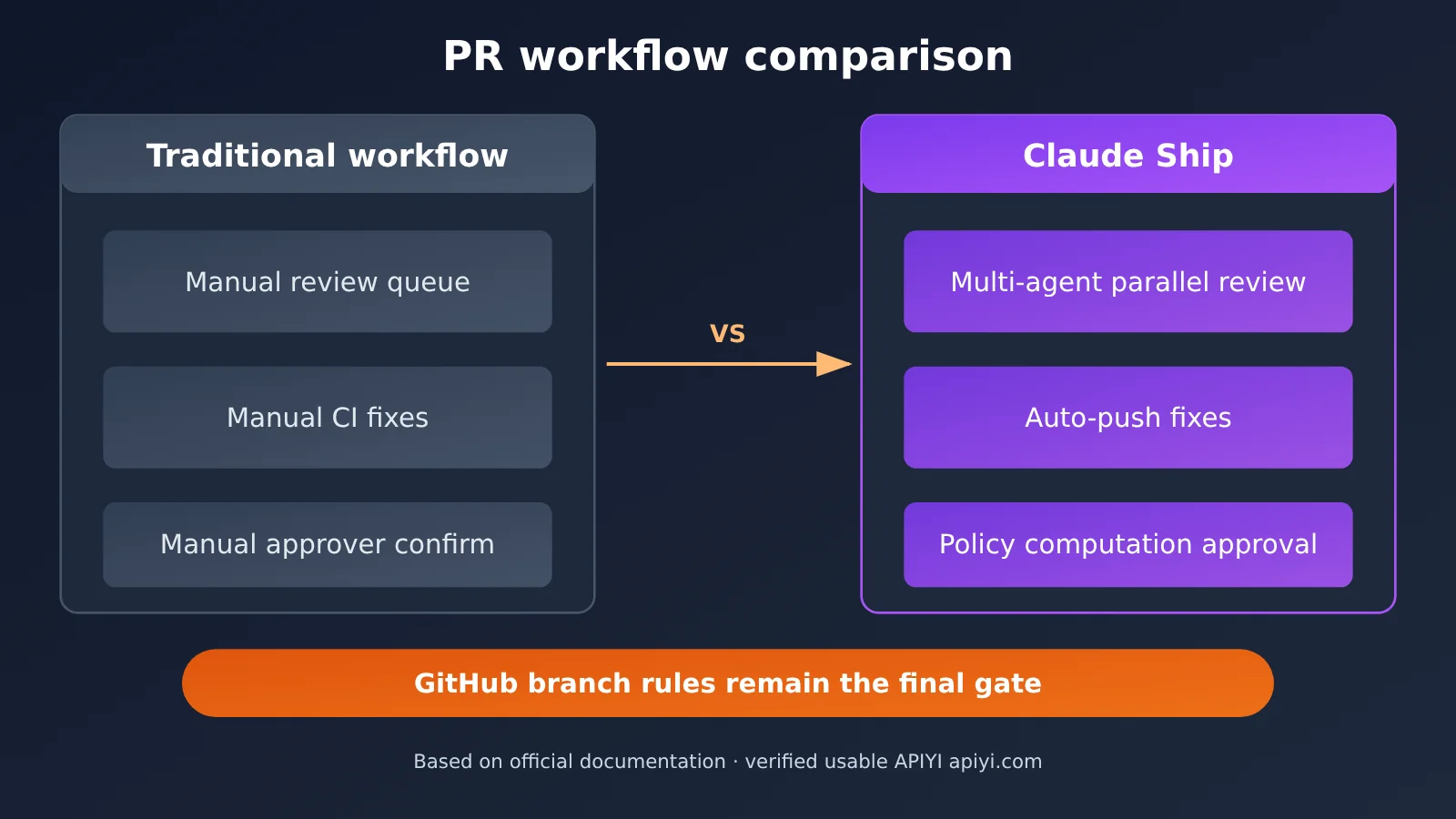
| Stage | Traditional workflow | After Claude Ship | Is human involvement still needed? |
|---|---|---|---|
| Finding issues | Waiting for reviewers to schedule review | Code Review’s multiple agents review in parallel; most take 6–10 minutes | Design-level judgment still requires a human |
| Fixing CI failures | Developer switches back into context to investigate | PR Steward investigates automatically and pushes a revertible commit | Complex failures and cross-module issues need a human |
| Resolving conflicts | Manual rebase or merge | Steward merges the base branch to resolve conflicts | Semantic conflicts require human confirmation |
| Determining approvers | Relies on CODEOWNERS and verbal agreements | approvals.yml calculates based on path, line count, author, etc. |
High-risk paths require human review per policy |
| Final merge | GitHub rules | Still GitHub rules; Claude’s approval counts as at most one vote | Rules stay in the hands of admins |
First, the core value is turning approval rules into code. In the past, “who should review this kind of change, and how many reviewers” mostly depended on team conventions. Now it can be written into .claude/approvals.yml and validated against historical PRs in observe mode first. We think this has more long-term significance than “AI can review code,” because it makes the approval logic itself auditable and reversible.
Second, the permission boundaries are quite restrained. Code Review is read-only, PR Steward can’t vote to approve its own work, Claude Approvals’ vote is constrained by GitHub branch rules, and CI is required as a separate mandatory check. The three roles are deliberately separated so the same agent isn’t both writing and approving code. For security teams, what really needs scrutiny is the policy file, not the AI itself.
Third, cost control needs to be designed upfront. “Review on every push,” the Deep depth setting, and classification calls in observe mode all incur charges, and PR Steward may also briefly exceed the per-PR limit. Our recommendation is to use Standard depth and a single trigger during the pilot, and set both an organization-level monthly cap and a per-PR cap.
Fourth, official data only shows direction; it can’t be applied directly. The doubled merge count and the more than 40% drop in the share of reverted changes come from vendor-internal data, predate this public beta, and can’t separate out the contribution of individual components. Teams should pay more attention to their own metrics: average PR wait time, time to fix CI failures, and rollback rate before and after the pilot.
Prediction (still to be verified): As more PRs are written by agents, a low-risk path of “agent writes, agent fixes, policy approves” may cover changes such as docs, config, and dependency upgrades, while human review focuses on architecture and high-risk paths. As for how PR Steward’s fix quality performs in large monorepos, public information isn’t yet enough to draw a conclusion; it’s worth keeping an eye on.
💡 Selection tip: While you wait for organization access to open up, you can start with a self-built pre-review script to gain experience on “which changes are worth handing to AI.” With APIYI apiyi.com, you can easily compare false positive rates and costs across different models on your codebase, giving you a solid basis for defining approval policies down the road.
Claude Ship FAQ
Q1: Will Claude Ship let AI merge code straight into the main branch?
No — it doesn’t bypass GitHub rules. When Claude Approvals is in `enforce` mode and the policy allows it, Claude submits at most one approving review, which GitHub can count as a vote. Required CI checks, code owner reviews, and other protection requirements still apply separately; the actual merge relies on GitHub’s auto-merge or merge queue.
Q2: Do all three components have to be enabled together?
No. The three components are enabled per repository and can be adopted independently. The official recommendation is to enable Code Review and PR Steward in manual mode on a single repo first, then trial approvals in `observe` mode.
Q3: When is Claude Ship available? Which organizations can’t use it?
Public beta starts November 23, 2026, for Claude Team and Enterprise organizations on GitHub; Code Review itself became generally available on October 15. Organizations with zero data retention, HIPAA configuration, or customer-managed encryption keys enabled are out of scope for now, and Approvals has additional restrictions for FERPA and Access Transparency configurations.
Q4: Can PR Steward handle every CI failure?
No. It only tries to fix failures whose cause lives in the code changed by this PR. Branches from forks, PRs opened by bots, and PRs where the author has no write permission get skipped; for larger design issues it can just reply without making changes.
Q5: If I can’t use Claude Ship, how do I build similar pre-review with the API?
You can read `git diff` in CI, hand it to a Claude model for graded review, and block the pipeline on Important-level issues — see the code in the “Quick Start” section of this article. Register through APIYI apiyi.com to get an API key, set base_url to `https://api.apiyi.com/v1`, and you’re good to go; new users get free credits to validate things.
Q6: How do I estimate and control Claude Ship costs?
Repo-side billing is per token, and the main variables are review depth, change size, number of triggers, and Steward fix rounds. You can set organization monthly limits and per-PR limits, and keep in mind that calls in `observe` mode are billed too. If you want to estimate model invocation costs first, run a small-sample test on APIYI apiyi.com with a similarly sized diff.
Q7: What’s the difference between using `/ship` personally and the cloud PR Steward in an organization?
`/ship` runs locally under the developer’s own GitHub identity, counts against their personal Claude Code usage, requires the session to stay in the foreground with the computer awake, and follows up for up to seven days. Cloud PR Steward runs under the Claude GitHub App identity, bills against repository configuration and organization quota, and doesn’t depend on a personal computer being online.
Claude Ship splits the work after a PR into three stages — discover, fix, approve — and fences in each stage’s permissions with policy files and GitHub rules. For most teams, the safest entry point is to run observe mode on a single repository for a while, see where the AI’s judgment diverges from human decisions, and then decide which paths to open up. Before you’re eligible, you can also call Claude and other models through APIYI apiyi.com to build lightweight pre-review and accumulate your own review rules and cost data.
📚 References
-
Introducing Claude Ship announcement: release scope, the
/shipentry point, and internal case studies- Link:
claude.com/resources/articles/introducing-claude-ship - Notes: gives you the big picture and how the official numbers are defined
- Link:
-
Code Review docs: review workflow, labels, triggers, and depth settings
- Link:
code.claude.com/docs/en/code-review - Notes: must-read before you configure
REVIEW.mdor think about review costs
- Link:
-
PR Steward docs: fix scope, in-PR actions, and safety boundaries
- Link:
code.claude.com/docs/en/pr-steward - Notes: includes a walkthrough of fixing a date parsing test
- Link:
-
Claude Approvals docs: policy files, the classifier, and how they relate to GitHub rules
- Link:
code.claude.com/docs/en/approvals - Notes: the main reference for writing
.claude/approvals.yml
- Link:
-
/shipcommand reference: version requirements and when continuous follow-up ends- Link:
code.claude.com/docs/en/ship-command - Notes: a local usage guide for individual developers
- Link:
-
GitHub protected branches documentation: required checks, approvals, and how stale approvals are handled
- Link:
docs.github.com/en/repositories/configuring-branches-and-merges-in-your-repository/managing-protected-branches/about-protected-branches - Notes: helps you understand how Claude approvals stack on top of branch rules
- Link:
Author: APIYI Technical Team
Technical discussion: reach us on the APIYI apiyi.com homepage, and find more model invocation materials in the docs.apiyi.com documentation center