Author’s note: break down Hy4 flash and DeepSeek-V4.1-Flash-1017 by task across Tencent’s self-reported scores, per-task cost, official price, and APIYI channel price—to help you decide whether to switch for everyday tasks.
On November 16, 2026, Tencent Hunyuan released Hy4 flash, and the official post calls it “the cheapest everyday productivity model.” If you’re currently using DeepSeek-V4.1-Flash-1017, you’re probably wondering whether your everyday tasks are worth moving over. This article puts the two side by side on the same set of tasks: which one scores higher, which one costs less per task, and what tier the official price and APIYI price each land in.
This isn’t a “the new model wins across the board” piece. The blind tests, WorkIndex, appendix scores, and product testimonials in this article all come from Tencent’s research page. They’re Tencent’s own reported figures, not data the author ran independently. Looking at it task by task, the conclusion is clear: for office co-writing and visual question answering, you can look at Tencent’s appendix for Hy4 flash’s cost advantage; on Terminal-Bench 4.0, ProgramBench, DeepSWE, and PPT fixing, DeepSeek still scores higher.
The key takeaway: After reading this, you’ll be able to decide by task type which requests to move to Hy4 flash and which to keep on DeepSeek V4.1 Flash, and you’ll know where each price figure comes from.
Hy4 flash vs DeepSeek V4.1 Flash: Core Differences
Let’s start with the basic specs of the two models. Hy4 flash’s specs come from Tencent’s research page: 224B total parameters, 64B of which are Engram parameters, with 12B activated per token. It’s natively multimodal with a 1M token context. DeepSeek V4.1 Flash’s specs come from DeepSeek’s official pricing page: the invocation name is deepseek-flash, the current version is DeepSeek-V4.1-Flash-1017, 1M context, 384K max output, with vision capability, and it offers both OpenAI-format and Anthropic-format APIs.
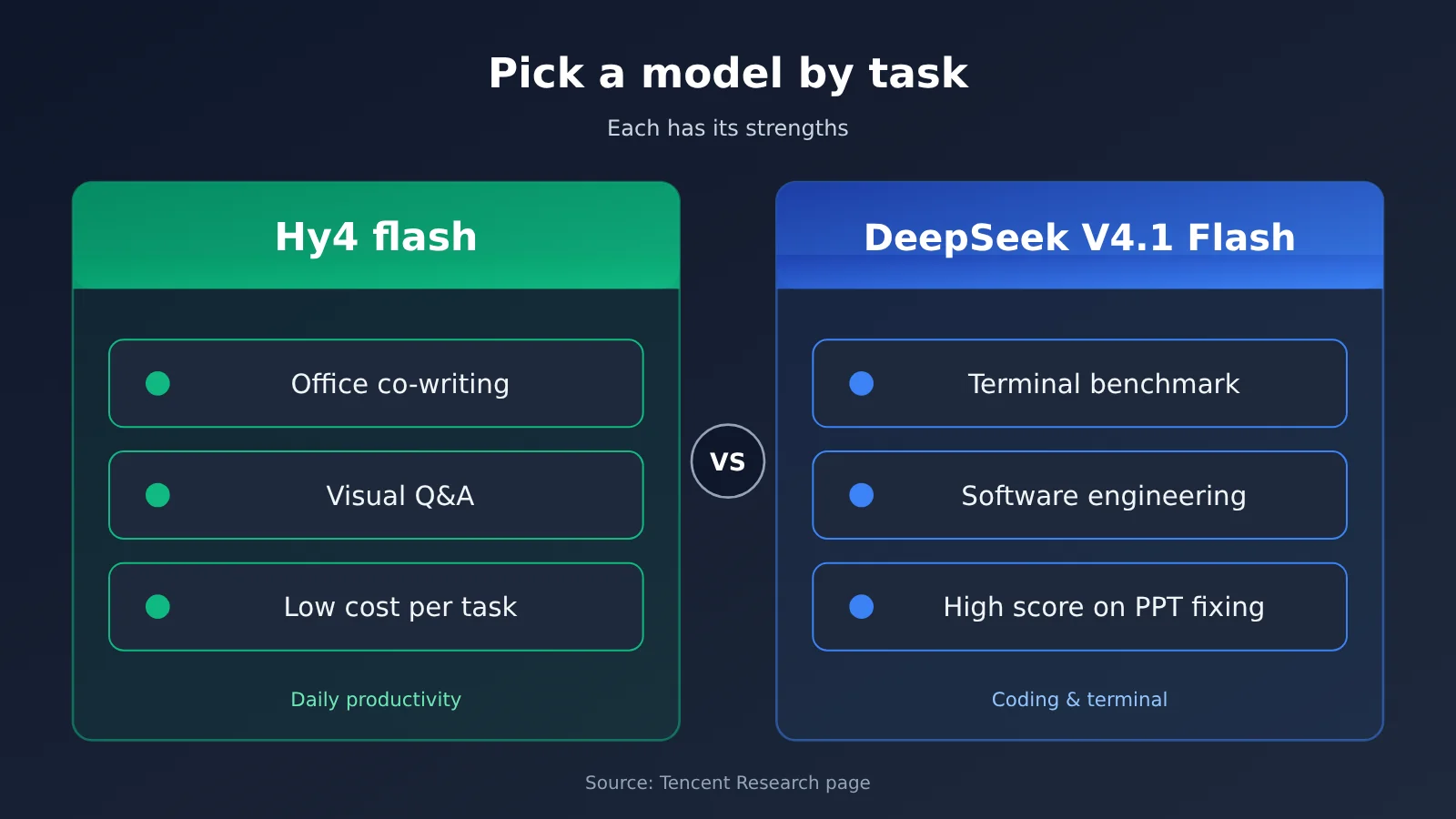
Their positioning differs too. Tencent’s research page recommends Hy4 flash for everyday tasks like deep search, document processing, slide creation, simple frontend demos, and computer use. For complex workloads — especially long-horizon software engineering — Tencent itself suggests sticking with Hy4. DeepSeek V4.1 Flash is a general-purpose Flash-tier model, with thinking mode on by default (you can turn it off).
| Dimension | Hy4 flash | DeepSeek V4.1 Flash (1017) | Available platforms |
|---|---|---|---|
| Parameter scale | 224B total, 12B activated (research page) | Not listed on official pricing page | — |
| Context | 1M token | 1M, 384K max output | — |
| Multimodal | Natively multimodal | Vision support | — |
| Protocol | Research page gives no API model ID | OpenAI format, Anthropic format | — |
| Official channels | Tencent Cloud TokenHub, WorkBuddy, Yuanbao, etc.; OpenRouter coming soon | DeepSeek official API | — |
| APIYI status | Not yet listed | Listed as deepseek-v4.1-flash and others |
APIYI apiyi.com |
Worth noting: the research page doesn’t provide an API model ID for Hy4 flash. This article won’t invent one. When calling it on Tencent Cloud, use the name shown in the TokenHub console.
Why Hy4 flash is cheap: technical notes from the research page
The research page lays out three layers of cost reduction. Pretraining used hybrid attention, LatentMoE, and Engram, with a KV cache that’s 1/24 of Hy3 and 1/6 of Hy4. Post-training distilled from Hy4, and reinforcement learning cut average end-to-end output tokens by 50%. On the inference side, it uses megakernel, 4-bit quantization, and DFly, reaching decoding speeds above 150 tokens/s.
These all point to the same thing: fewer tokens emitted per task, cheaper per token, and faster execution. That explains why almost every cell in the appendix shows Hy4 flash costing less than DeepSeek. But low cost doesn’t mean high scores — let’s break it down task by task.
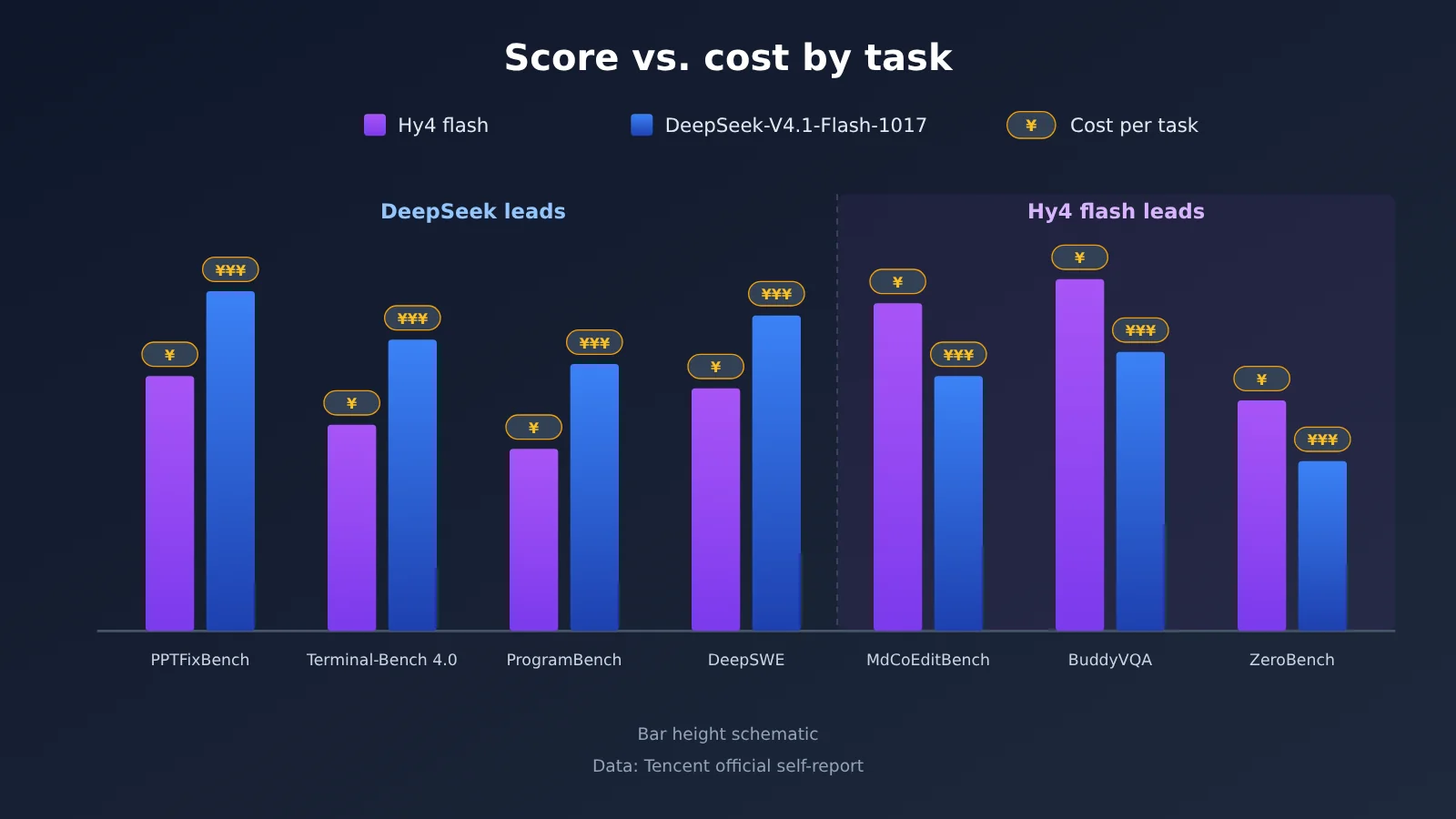
Chart data compiled from the appendix of Tencent’s Hy4 flash research page (Tencent’s own reported figures). You can verify current prices for each DeepSeek channel line by line on the apiyi.com pricing page.
Hy4 flash vs. DeepSeek V4.1 Flash: Blind Test Data
The Tencent research page published a set of human blind tests involving 85 internal WorkBuddy users, 259 tasks, and 27 categories. The table below has three data columns: satisfaction on a 4-point scale, median end-to-end time, and cost per task (RMB). All figures are taken directly from the research page.
| Model | Satisfaction (4-point scale) | Median end-to-end time | Cost per task (RMB) |
|---|---|---|---|
| DeepSeek-V4.1-Flash-1017 (high) | 3.09 | 10.3 minutes | 1.20 |
| Hy4 flash (level not specified) | 2.79 | 6.7 minutes | 0.26 |
| Claude-Haiku-5.5 (high) | 2.81 | 6.8 minutes | 4.73 |
| GLM-5.3-Flash (high) | 2.53 | 7.6 minutes | 0.81 |
There are three key points to get right when reading this table. First, DeepSeek has the highest satisfaction at 3.09, while Hy4 flash is at 2.79, so this blind test shouldn’t be read as saying Hy4 flash is more usable. Second, Hy4 flash is 0.02 points below Claude Haiku 5.5; the research page uses the phrase “close to,” not “exceeds.” Third, the “18x lower per-task cost” in the official post comes from 4.73 divided by 0.26, which is about 18.2; the comparison is against Haiku, not DeepSeek.
Where Hy4 flash actually leads in this table is time and cost. Its median completion time is 6.7 minutes, versus 10.3 minutes for DeepSeek; per-task cost is RMB 0.26 versus RMB 1.20. If your business cares more about wait time and the bill and can accept slightly lower satisfaction, that’s when this data is useful to you.
The research page also provides a summary at the WorkIndex level.
On WorkIndex, Hy4 flash’s average cost per task is 1/8 of DeepSeek-V4.1-Flash-1017 (Max tier, peak pricing).
This 1/8 applies only to WorkIndex. It is based on DeepSeek’s top tier plus peak pricing, and it shouldn’t be used to replace the RMB figures in the blind test table. WorkIndex consists of 8 internal sets covering slide generation, slide editing, human-AI co-writing of slides, Markdown human-AI co-writing, document editing, table repair, audio/video processing, and visual understanding. It’s a Tencent-built evaluation, not a public leaderboard ranking.
Hy4 flash vs DeepSeek V4.1 Flash: task-by-task appendix comparison
The research page appendix gives each task’s score and per-task cost. Costs are calculated using each model’s official API pricing, with 1 USD converted at 7.2 RMB. The DeepSeek column uses peak pricing: 2 RMB per million input tokens, 0.04 RMB for cache hits, and 8 RMB for output. This RMB framing is the basis Tencent used in its spreadsheet—it’s not APIYI’s list price, and you shouldn’t convert it into your bill on any platform. All models are run at their highest reasoning setting.
| Task | Hy4 flash score / cost | DeepSeek-V4.1-Flash-1017 score / cost | Higher score |
|---|---|---|---|
| MdCoEditBench (Markdown co-writing) | 56.9 / 0.057 | 29.2 / 0.194 | Hy4 flash |
| BuddyVQA Atlas (no tools) | 48.5 / 0.007 | 43.7 / 0.059 | Hy4 flash |
| ZeroBench-main (with tools) | 45.8 / 0.077 | 16.5 / 0.095 | Hy4 flash |
| PPTCoEditBench (slide co-writing) | 74.0 / 0.105 | 76.8 / 0.459 | DeepSeek |
| PPTFixBench (fixing PPTs) | 23.7 / 0.253 | 45.3 / 1.672 | DeepSeek |
| DeepSWE v1.1 | 64.6 / 0.290 | 73.8 / 1.304 | DeepSeek |
| ProgramBench (almost solved) | 16.0 / 0.561 | 29.0 / 9.214 | DeepSeek |
| Terminal-Bench 4.0 | 19.2 / 0.558 | 40.0 / 3.882 | DeepSeek |
| OSWorld 2.1 (partial score) | 68.1 / 0.451 | 68.4 / 2.073 | Basically tied |
Two task categories jump out from the table. On the office co-writing and visual QA side, Hy4 flash scores higher on Markdown co-writing, BuddyVQA, and ZeroBench—and costs less too. On slide co-writing it’s 74.0 vs 76.8, a small gap, but the cost is only about a quarter of DeepSeek’s.
On the engineering and repair side, DeepSeek’s score advantage is obvious. Terminal-Bench 4.0 is 40.0 vs 19.2, ProgramBench is 29.0 vs 16.0, DeepSWE is 73.8 vs 64.6, and PPT fixing is 45.3 vs 23.7. For the rest of the appendix—including PPTGenBench, WordEditBench, ExcelFixBench, AudioVideoBench, APEX-Agents, AutomationBench, HLE, and MMMU-Pro—DeepSeek also scores slightly or clearly higher; Hy4 flash’s only advantage on those items is cost.
As for how Terminal-Bench 4.0 was tested, the research page states it used the Claude Code harness, up to 500 rounds, max 13 hours per run, with 16 CPUs and 32 GB of RAM, plus an H100 for the three GPU-dependent tasks. These are Tencent’s evaluation settings and don’t represent official leaderboard rankings.
Product Team Self-Reports: DeepSeek Comparison Scenarios
The research page also includes testimony from Tencent’s internal product teams. The following are the teams’ own accounts, not independent evaluations. WeChat Pay says that, compared with DeepSeek-V4.1-Flash-1017, average scores across four workflows were on par or higher, with about 6% fewer execution steps and about 29% shorter per-turn output. Marvis says satisfaction for app installation, system settings and diagnostics, and documents and research reports was 6.2%, 4.4%, and 6.9% higher, respectively, though overall satisfaction was flat.
The QQ team listed its comparison target as DeepSeek-V4.1-Flash, without the 1017 tag. It says satisfactory response rates in scenarios such as music recommendations and channel interactions were 0.92 to 6.16 percentage points higher, and P90 comment latency was 39% lower. The Honor of Kings team says root-cause localization was comparable, model requests were 22.0% to 39.1% fewer, but tool calls actually increased. These accounts mostly focus on conversation, companionship, and lightweight workflows, which aligns with the appendix’s conclusion: “save money on everyday tasks, but still look to DeepSeek for heavy engineering.”
Hy4 flash vs. DeepSeek V4.1 Flash Pricing: Official Prices, APIYI Channel, and Research Page List Prices
There are three pricing blocks to cover, and each needs its own labeled source — don’t mix them. Units are USD per million tokens throughout.
DeepSeek official pricing (DeepSeek pricing page, read on 2026-11-16) comes in two tiers: peak and off-peak. Peak hours are Monday through Friday, UTC 01:00–04:00 and 06:00–10:00, which works out to roughly 9:00–12:00 and 14:00–18:00 Beijing time, excluding Chinese statutory holidays. Every other time is off-peak — weekends and statutory holidays count all day — and off-peak prices are half the peak price. That off-peak rate belongs to the DeepSeek official API only.
APIYI channel pricing (queried 2026-11-16). For models already listed on APIYI, you use an apiyi.com API key and send requests to https://api.apiyi.com/v1. The DeepSeek entries relevant to this article split into three channels: the main channel covers deepseek-v4.1-flash, deepseek-v4.1-flash-1017, and deepseek-flash, priced to match DeepSeek’s official peak rates. The other two are a standalone channel, deepseek-v4-1-flash-260910, and an economy version, deepseek-v4-1-flash-economy-261017 — neither should be read as the price of that single 1017 model.
Hy4 flash research page list prices are the rates published on Tencent’s research page, not APIYI’s listed prices. Tencent Cloud TokenHub is running a 50% discount through 2026-11-30, and the research page doesn’t print a separate discounted price table. The discounted figures in the table below are derived by dividing the list price by 2; after November 30, prices go back to list.
| Source / Model | Cached input | Input | Output |
|---|---|---|---|
| DeepSeek official · peak | 0.006 | 0.30 | 1.20 |
| DeepSeek official · off-peak | 0.003 | 0.15 | 0.60 |
APIYI · deepseek-v4.1-flash / -1017 / deepseek-flash |
0.006 | 0.30 | 1.20 |
APIYI · deepseek-v4-1-flash-260910 (separate channel) |
0.003 | 0.15 | 0.60 |
APIYI · deepseek-v4-1-flash-economy-261017 (economy version) |
0.006 | 0.24 | 0.96 |
| Hy4 flash research page list price | 0.003 | 0.070 | 0.281 |
| Hy4 flash TokenHub 50% off (derived, through 11-30) | 0.0015 | 0.035 | 0.1405 |
On APIYI, the main channel price lines up with DeepSeek’s official peak price, not the off-peak price. If you want to make calls today, I’d go with deepseek-v4.1-flash or deepseek-v4.1-flash-1017. They cost the same; the difference is in grouping — the former has the ClaudeCode, CodexResponses, Default, and SVIP groups, while the latter has no CodexResponses. Both support the chat endpoint, and deepseek-v4.1-flash also supports the messages endpoint.
Hy4 flash isn’t listed yet — we’ll get this model up as soon as we can, and model names and prices are subject to the platform’s model list. Also, hy4 on APIYI is Hy4, not Hy4 flash, and it’s listed at 0.85 input, 2.55 output, and 0.045 cache read. Those are a separate set of numbers from the research page’s Hy4 list prices of 0.834, 2.501, and 0.042 — each source stands on its own.
Hy4 flash vs DeepSeek V4.1 Flash: Scenario Recommendations
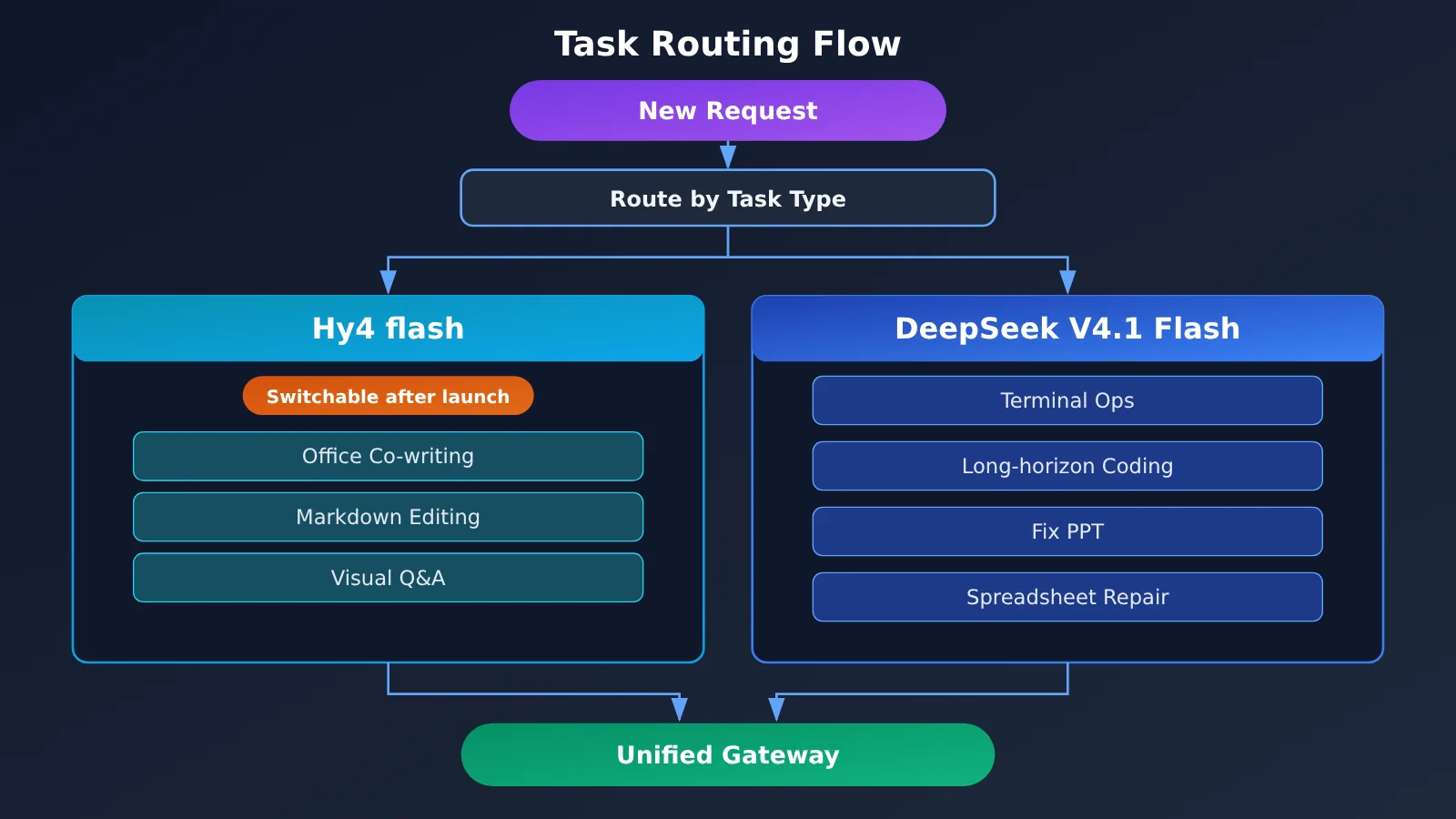
When you look at the blind tests, the appendix, and the pricing together, you can route work by task type instead of picking one model over the other wholesale.
Where Hy4 flash makes sense (once it’s listed)
- Markdown and document co-writing: appendix MdCoEditBench 56.9 vs 29.2, at ¥0.057 vs ¥0.194 per task.
- Visual question answering: Hy4 flash scores higher on both BuddyVQA and ZeroBench, and the per-task cost is lower too.
- Slide co-writing: slightly lower score than DeepSeek, but about a quarter of the cost — a good fit for batch-generating first drafts.
- Latency-sensitive light tasks: median completion time in blind tests is 6.7 minutes, shorter than DeepSeek’s 10.3 minutes.
Where you should stay on DeepSeek V4.1 Flash
- Terminal-operation agents: Terminal-Bench 4.0, 40.0 vs 19.2 — roughly double.
- Software engineering and long-horizon coding: DeepSeek is higher on both ProgramBench and DeepSWE, and Tencent itself recommends higher-tier models for complex engineering work.
- Repair-type office tasks: PPT repair 45.3 vs 23.7, spreadsheet repair 20.0 vs 15.6.
- General deliverables where satisfaction matters: blind-test satisfaction of 3.09 is the highest in the entire table.
| Task type | Recommended model | Basis (Tencent’s own reporting) |
|---|---|---|
| Markdown / document co-writing | Hy4 flash | Higher MdCoEditBench score, lower cost |
| Visual question answering | Hy4 flash | Higher BuddyVQA and ZeroBench scores |
| Batch slide first drafts | Hy4 flash | Small score gap, about a quarter of the cost |
| Terminal / command-line agents | DeepSeek V4.1 Flash | Terminal-Bench 4.0 roughly double |
| Coding and repair | DeepSeek V4.1 Flash | Higher ProgramBench, DeepSWE, and PPTFix |
Hy4 flash vs DeepSeek V4.1 Flash: Decision Recommendations
💡 Recommendation: If engineering and terminal requests make up a large share of your workload, staying with DeepSeek V4.1 Flash is the safer choice. If most of your requests are writing, editing, and image-based Q&A, then once Hy4 flash becomes available, run an A/B comparison on a small batch of real tasks first, then decide what percentage to migrate.
A practical step you can take right now is to integrate with a unified gateway and make the model name a configuration item. In an OpenAI-compatible SDK, set base_url to https://api.apiyi.com/v1 and model to deepseek-v4.1-flash-1017, and you can keep using your existing invocation logic. If your toolchain uses the Anthropic Messages protocol, you can choose deepseek-v4.1-flash, which supports both the chat and messages endpoints.
Once Hy4 flash becomes available, you only need to change the model field for office tasks in your routing table to the name listed in the platform’s model list—no changes to your code structure are needed. The benefit is that you can compare both under the same billing basis, avoiding mixing DeepSeek’s official off-peak rate, APIYI’s channel rate, and Tencent’s list price into one calculation.
One more detail worth noting: DeepSeek’s official off-peak pricing is half price, while APIYI’s main channel bills at peak-time rates. If you can move batch jobs to weekends or nights, and you’re connecting directly to DeepSeek’s official API, the off-peak rate will be lower; if you care more about managing multiple models with a single key, the unified gateway has lower operational overhead. Weigh these based on your own usage hours and protocol needs.
FAQ
Q1: What is Hy4 flash?
Hy4 flash is a lightweight model released by Tencent Hunyuan on 2026-11-16. The research page lists specs of 224B total parameters, 12B activated per token, native multimodality, and a 1M context window. Tencent positions it as a low-cost option for everyday productivity tasks.
Q2: Is Hy4 flash better than DeepSeek V4.1 Flash?
You can’t really say that. In Tencent’s self-reported blind test, DeepSeek-V4.1-Flash-1017 scored a satisfaction rating of 3.09, higher than Hy4 flash’s 2.79. Hy4 flash’s advantages are shorter completion times, lower per-task cost, and higher scores in the appendix for Markdown co-writing and visual question answering.
Q3: Is the 18x cost reduction in the official post compared with DeepSeek?
No. The 18x figure comes from dividing Claude Haiku 5.5’s CNY 4.73 by Hy4 flash’s CNY 0.26 in the blind test table. The DeepSeek-related figure is 1/8 on WorkIndex, based on DeepSeek’s highest tier plus peak-hour pricing.
Q4: Which one should I use for terminal and coding tasks?
According to Tencent’s appendix, DeepSeek V4.1 Flash scores higher on Terminal-Bench 4.0, ProgramBench, and DeepSWE. Tencent’s research page itself also recommends continuing to use models with a higher intelligence ceiling for long-horizon software engineering rather than Hy4 flash.
Q5: How can I call these two models via API right now?
DeepSeek V4.1 Flash is already available on APIYI. Sign up at apiyi.com to get an API key, then set the model name to `deepseek-v4.1-flash` or `deepseek-v4.1-flash-1017`. New users get free trial credits. Hy4 flash isn’t available on APIYI yet. If you want to try it early, you can use Tencent Cloud TokenHub, and the model name should be whatever the console shows.
Q6: What limitations of Hy4 flash should I watch out for?
First, the research page doesn’t publish an API model ID, and the weights are planned for open source, but the page doesn’t say they’ve been released. Second, TokenHub’s 50% discount only runs until 2026-11-30, after which pricing returns to list price. Third, all scores are self-reported by Tencent, and engineering, terminal, and bug-fixing tasks clearly lag behind DeepSeek. Before migrating, we recommend validating with your own task samples.
Q7: How does it compare with Claude Haiku 5.5?
Haiku isn’t in the appendix table, so we can only look at the blind test: satisfaction is 2.81 vs. Hy4 flash’s 2.79, and per-task cost is CNY 4.73 vs. CNY 0.26. Anthropic’s official pricing has two tiers: when the prompt doesn’t exceed 100k tokens, input is 0.10 and output is 0.50; beyond that, the entire request is billed at 0.50 input and 2.50 output. APIYI’s summary table lists 0.10, 0.50, and 0.01; the footnote only covers the second input tier. Refer to the platform’s documentation for actual billing.
Hy4 flash vs DeepSeek V4.1 Flash: Key Takeaways
- Blind-test satisfaction favors DeepSeek: 3.09 vs 2.79 — Hy4 flash wins on time and cost.
- WorkIndex cost at 1/8: the basis is DeepSeek’s top tier plus peak pricing, and it applies only to WorkIndex.
- Office co-writing and visual Q&A: in the appendix, Hy4 flash scores higher and costs less per task.
- Terminal and coding favor DeepSeek: Terminal-Bench 4.0, ProgramBench, DeepSWE, and fixing PPTs are all higher.
- Off-peak pricing belongs only to DeepSeek official: the APIYI main channel corresponds to official peak pricing.
- Models you can call today:
deepseek-v4.1-flashordeepseek-v4.1-flash-1017; Hy4 flash is pending listing.
Summary
The core conclusions from the Hy4 flash vs DeepSeek V4.1 Flash comparison:
- Route by task, don’t replace wholesale: for office co-writing and visual Q&A, you can consider Hy4 flash; for terminal, coding, and repair-type tasks, keep using DeepSeek.
- Label your data sources clearly: the blind tests, WorkIndex, appendix, and testimonials all come from Tencent’s own reporting — verify with your own task samples before migrating.
- Don’t mix pricing bases: DeepSeek official separates peak and off-peak, APIYI has three channels, and Hy4 flash only has research-page list pricing plus a limited-time 50% off.
If you’re already using DeepSeek-V4.1-Flash-1017, the lowest-cost approach is to connect through a unified gateway first, make the model name configurable, and run a small-batch comparison once Hy4 flash is listed. We recommend calling deepseek-v4.1-flash-1017 through APIYI apiyi.com to validate your existing workflow — the platform offers an OpenAI-compatible interface and free testing credits.
📚 Reference Materials
-
Tencent Hunyuan Hy4 flash research page: specs, blind tests, WorkIndex, appendix, and rate card pricing
- Link:
hy.tencent.ai/research/hy4-flash - Note: Every Hy4 flash score and cost figure in this article comes from Tencent’s own official reporting
- Link:
-
DeepSeek official pricing page: DeepSeek-V4.1-Flash-1017 peak and off-peak pricing
- Link:
api-docs.deepseek.com/quick_start/pricing - Note: Includes the peak-hour definition and notes on the invocation name
- Link:
-
Claude Haiku 5.5 official documentation: model specs and two-tier pricing
- Link:
platform.claude.com/docs/en/models/haiku-5-5/overview - Note: Used to verify the comparison context for Haiku in the blind test table
- Link:
-
APIYI model list: models already listed, groups, and endpoints
- Link:
docs.apiyi.com/models - Note: Hy4 flash listing status and DeepSeek pricing across channels are based on this
- Link:
Author: APIYI Technical Team
Technical contact: Feel free to reach out to us via the APIYI website homepage. For model listing progress, keep an eye on updates to the platform’s model list.