Author’s note: This piece unpacks the Grok 4.8 claim that it “rewrote its reinforcement learning and inference systems in C/C++,” splitting the discussion apart by where each piece of information actually comes from — and clarifying that today’s invocation methods haven’t changed.
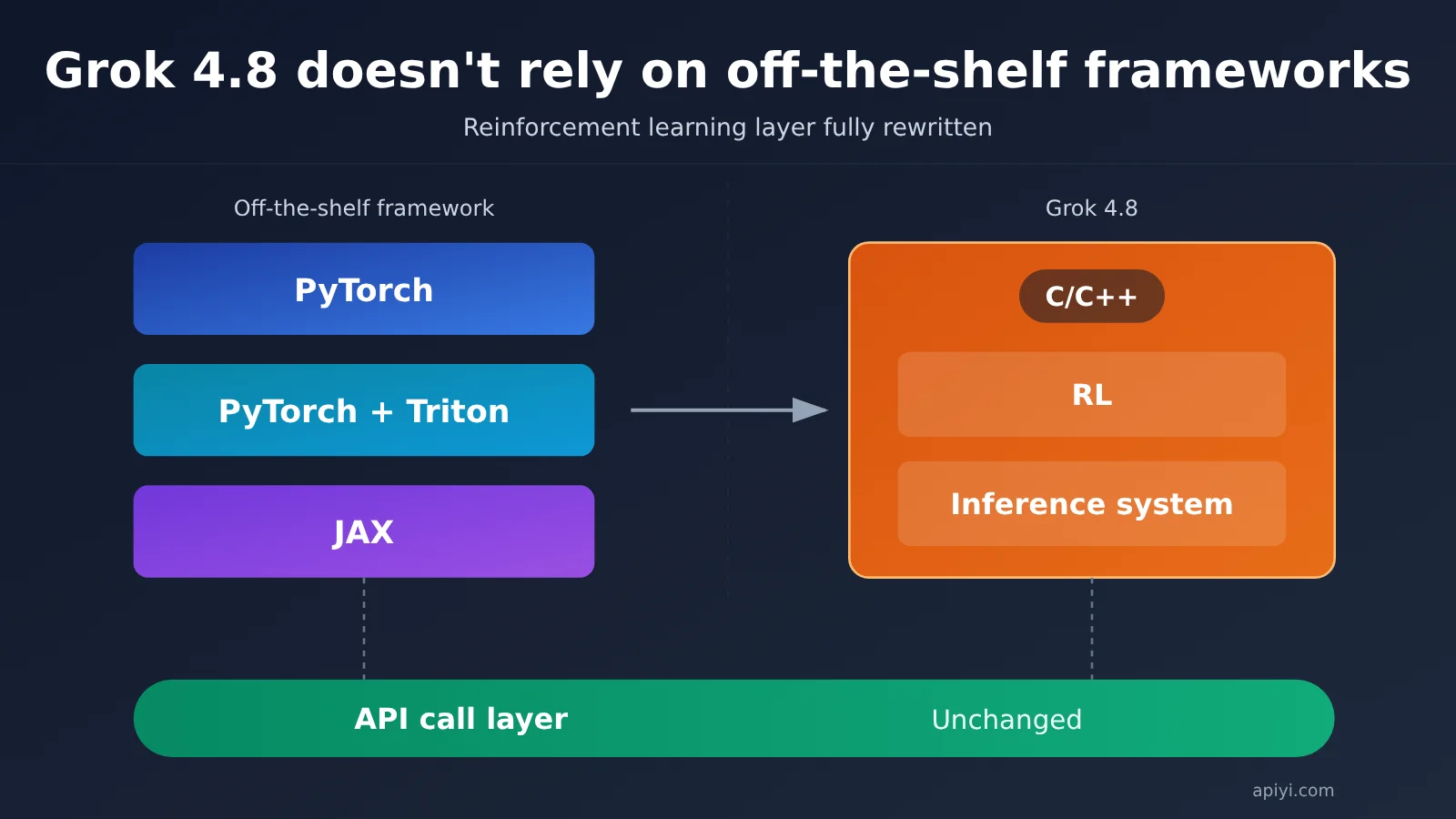
On November 26, 2026, a post that lined up four major Large Language Models’ training stacks side by side started making the rounds on X. The post said Claude runs on PyTorch, GPT runs on PyTorch plus Triton, Gemini runs on JAX, and Grok 4.8 rebuilt its reinforcement learning and inference systems in C/C++. Musk’s only reply under the post was “You’ll see.”
This isn’t a lab white paper — it’s a comparison the poster put together themselves. And Musk’s one-line reply didn’t confirm a single row in that table. This article keeps the original post text, Musk’s reply, the follow-up from the @grok chat account, older posts, and official documentation clearly labeled and separate, and only looks at the framework layer.
The key takeaway: by the end of this article, you’ll know which layer of the training stack the Grok 4.8 C/C++ rewrite claim actually lands on, which parts have real sourcing and which are just discussion, and which model you should be calling today if you want Grok — and what you’ll be billed.
Grok 4.8 Training Stack Discussion: Key Information at a Glance
Let’s start by listing every piece of information from this discussion by source. Times are based on the GMT shown in the posts; the official docs and the APIYI master list were checked on November 27, 2026.
| Item | Details | Source type |
|---|---|---|
| Comparison of four training stacks | Claude: PyTorch; GPT: PyTorch + Triton; Gemini: JAX; Grok 4.8: C/C++ rewrite of the reinforcement learning and inference systems | Original post (myles, 2026-11-26 13:44 GMT) |
| Musk’s response | Just one line, “You’ll see”; no confirmation of PyTorch, JAX, or any percentage | Musk’s reply (2026-11-26 21:21 GMT) |
| Explanation of the rewrite motivation | Abstraction layers waste memory; rewriting in C/C++ can achieve higher MFU and lower compute costs, with no figures given | A follow-up reply from the @grok chat account, not an announcement |
| Earlier statement | No longer relying on JAX and SGLang; rewriting the reinforcement learning and inference stack in C/C++ | An old Musk post (2026-11-10), not a new confirmation on November 26 |
| Models callable today | The official docs don’t include grok-4.8; text tasks still say to use grok-4.7 | Official docs at docs.x.ai |
| Aggregator platform status | APIYI’s master list of 278 models doesn’t include grok-4.8; grok-4.7 is already callable | APIYI apiyi.com model master list |
Where does the Grok 4.8 comparison table come from?
This “four frameworks” comparison comes from a post by user myles. His question was: why did xAI (now named SpaceXSI) choose this path in particular, and is it worth it? The post itself asks a question and makes a comparison; it doesn’t cite a specific technical report. So the Claude, GPT, and Gemini cells should be understood as the poster’s summary of public information, not as each lab’s own full disclosure of its training stack.
What does Musk’s “You’ll see” tell us?
Musk’s reply consists of just those two English words. It can be taken as a hint about the direction, but it doesn’t confirm any of the framework names in the post item by item, nor does it give performance numbers or a launch timeline. Reading “You’ll see” as “the new Grok 4.8 specs have already been announced,” or treating it as an endorsement of the entire comparison table, goes beyond what the words actually say.
Which Layer Did Grok 4.8 Rewrite?
The easiest thing to get confused about in this discussion is what exactly C/C++ replaced. According to the original post, what got refactored was the reinforcement learning system and the inference system. The post doesn’t say whether the pretraining framework was swapped out too, and it doesn’t mention any changes to the external API.
If you break a large language model’s path from training to being called into layers, you get roughly four of them.
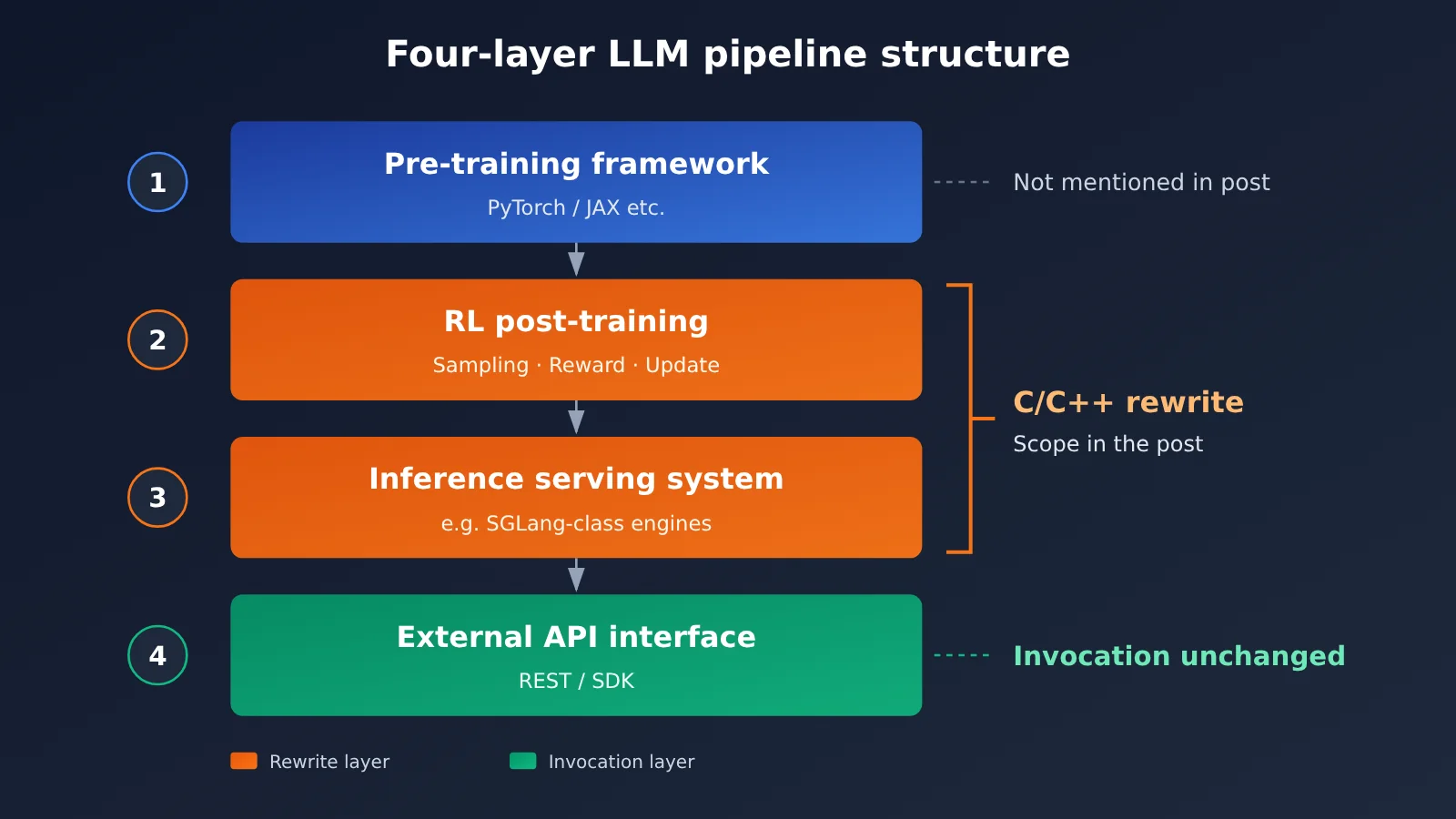
In the diagram above, the orange second and third layers are the rewrite scope the post describes, and the API layer at the bottom hasn’t changed. If you want to check the invocation layer directly, you can call grok-4.7 through the OpenAI-compatible endpoint at APIYI apiyi.com.
| Layer | Typical implementation | Covered by this discussion | Visible to callers |
|---|---|---|---|
| Pretraining framework | PyTorch, JAX, hand-written GPU kernels (like Triton) | The post uses it to compare against the other three companies; it doesn’t say what Grok 4.8’s pretraining uses | Not visible |
| Reinforcement learning post-training | Usually built on top of the training framework, plus sampling and reward computation | Yes: the post says it’s rebuilt in C/C++ | Not visible |
| Inference serving | An inference engine like SGLang or vLLM, or a custom system | Yes: the post says it’s rebuilt in C/C++, and an older post mentions it no longer depends on SGLang | Indirectly visible (speed, price) |
| External API | REST endpoints, SDKs | No | Directly visible |
Why Grok 4.8 went after the reinforcement learning layer
Reinforcement learning post-training has a different workload from pretraining. Pretraining is mostly large-batch forward and backward computation, and frameworks like PyTorch and JAX are already very well optimized for that. Reinforcement learning, on the other hand, repeatedly has the model generate responses, score them, and then update the parameters — and the generation step is essentially inference. That’s why the RL system and the inference system are often considered together, and why the post lumps the two of them into one sentence.
The explanation from the @grok chat account in a follow-up reply is that a general framework’s abstraction layers waste memory, and writing things directly in C/C++ can raise MFU (model FLOPs utilization — the share of hardware peak compute actually spent on model computation), which lowers compute costs. That explanation makes engineering sense, but it comes from a chatbot account’s reply with no numbers attached, so it shouldn’t be treated as an official xAI technical statement.
How Grok 4.8 relates to the older November 10 post
Earlier, on November 10, 2026, Musk posted that xAI would stop depending on JAX and SGLang and rewrite the reinforcement learning and inference stack in C/C++. That older post points in the same direction as the November 26 discussion, but they’re two separate statements. The “You’ll see” on November 26 isn’t a re-confirmation of the old post, and it isn’t a new announcement either. Merging the two into “xAI officially announced” is inaccurate.
Grok 4.8’s C/C++ Approach vs. Mainstream Frameworks
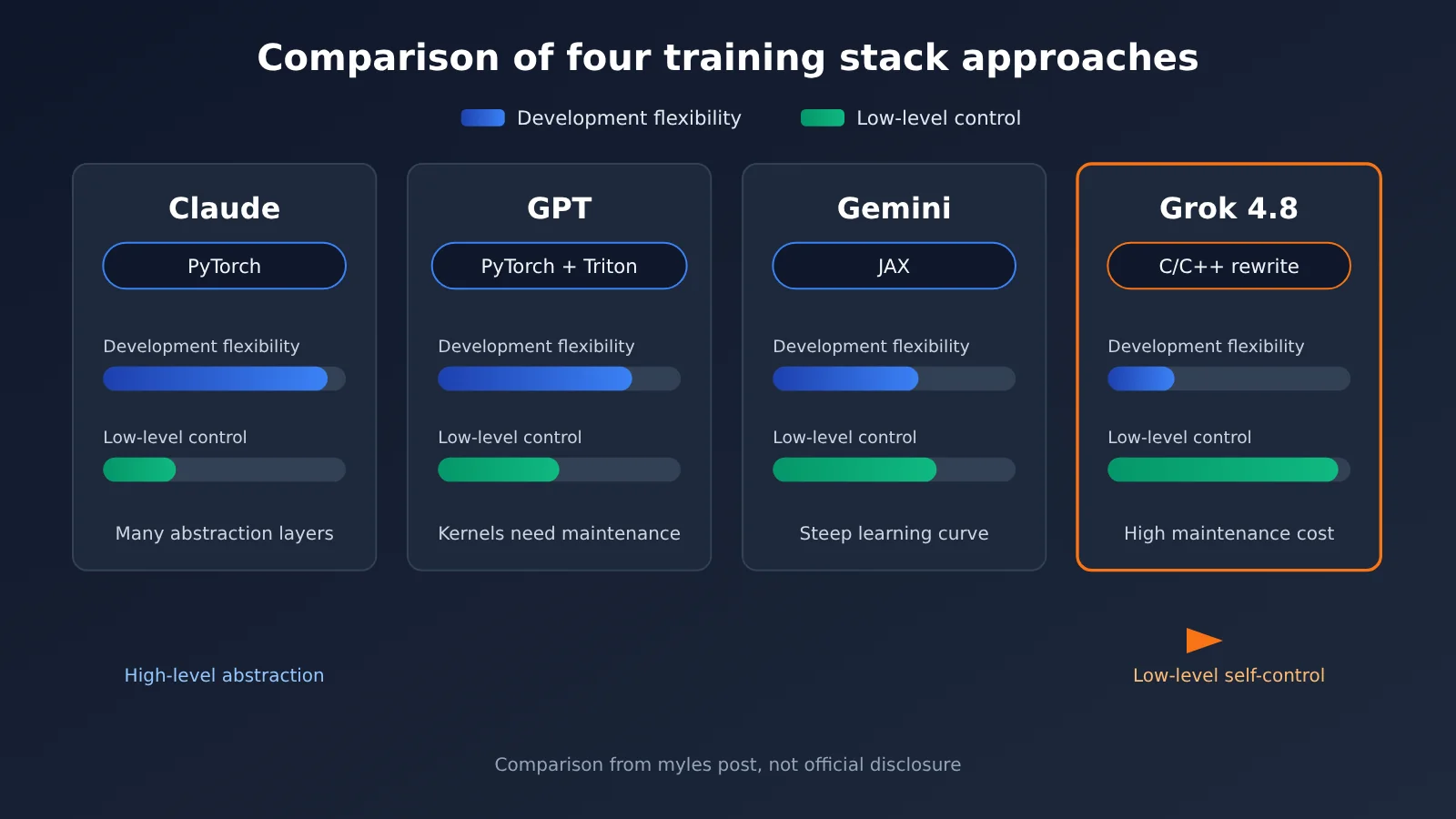
Below, I’ve put the four-way comparison from the post together with the general characteristics of each framework. The first two columns are what the post says; the last two are general engineering traits of these frameworks, not any lab’s internal practices.
| Model (as stated in the post) | Framework stated in the post | General framework traits | Trade-off |
|---|---|---|---|
| Claude | PyTorch | Biggest ecosystem, easy to debug, fast research iteration | Many abstraction layers; peak performance needs extra optimization |
| GPT | PyTorch + Triton | Uses Triton to write key GPU kernels on top of PyTorch | The kernels need dedicated maintenance |
| Gemini | JAX | Functional programming and compiler optimization; well suited to large-scale TPU | Steep learning curve |
| Grok 4.8 | C/C++ rebuild of the reinforcement learning and inference systems | Full control over memory and scheduling | High development and maintenance costs; limited ecosystem reuse |
Grok 4.8 Comparison Analysis
Compared with the PyTorch approach: PyTorch still leads in research iteration speed and community ecosystem, and most paper implementations can be reused directly. But it pays for that generality with abstraction-layer overhead. In workloads like reinforcement learning, where generation and training alternate, it’s hard to push memory usage down to the absolute minimum. According to the post, Grok 4.8 chose to use C/C++ directly in the reinforcement learning and inference layers to control memory and scheduling.
Compared with the JAX approach: JAX excels at compiler optimization and large-scale parallelism, and it’s one of the frameworks Musk explicitly said in an older post that they would no longer rely on. Its advantages depend on the compiler doing the work automatically, while the C/C++ approach hands that work to engineers to write by hand. As for which one has the higher MFU, there are currently no public numbers that let us compare them.
💡 Selection advice: For callers, whether or not the training stack switches frameworks ultimately shows up only in model capability, speed, and price. If you want to compare Grok with Claude, GPT, and Gemini on your own tasks, you can use APIYI at apiyi.com to switch models with the same API key and run a side-by-side comparison.
Grok 4.8 Status: The Model You Can Actually Call Today Is grok-4.7
As of November 27, 2026, xAI’s (SpaceXSI) official model documentation at docs.x.ai has no grok-4.8 — text tasks still point to grok-4.7. grok-4.7 has a 500K-token context window and four reasoning tiers: low, medium, high, and xhigh, with high as the default.
grok-4.7 bills in two tiers based on the token count of a single request, priced per million tokens in USD:
| Billing tier | Condition | Input | Cache read | Output |
|---|---|---|---|---|
| Low tier | Under 200K tokens | 2 | 0.50 | 6 |
| High tier | 200K tokens or more | 4 | 1 | 12 |
On the APIYI platform, the model master list was updated on 2026-11-27 11:59 (UTC+8) and covers 278 models. grok-4.7 is listed there at low-tier pricing: input 2, output 6, cache read 0.5, with the endpoint type set to chat and the groups CodexResponses, Default, and SVIP. High-tier pricing is available through the pricing API: input 4, output 12, cache read 1 — matching the official two tiers. The endpoint is https://api.apiyi.com/v1, and you can verify the latest models and prices in the model list on apiyi.com.
As for grok-4.8, APIYI hasn’t listed it yet, but we’ll get it up as soon as we can. Models and prices are whatever the platform’s model list says they are.
Getting a call working with grok-4.7
APIYI provides an OpenAI-compatible endpoint, so you can use the official OpenAI SDK directly — just swap the base_url:
from openai import OpenAI

client = OpenAI(
    api_key="YOUR_API_KEY",
    base_url="https://api.apiyi.com/v1"  # APIYI apiyi.com unified endpoint
)

resp = client.chat.completions.create(
    model="grok-4.7",
    messages=[{"role": "user", "content": "用三句话解释什么是 MFU"}]
)
print(resp.choices[0].message.content)
If your request might cross the 200K-token billing line, estimate the cost locally first, then decide whether to split the long document:
from openai import OpenAI

client = OpenAI(api_key="YOUR_API_KEY", base_url="https://api.apiyi.com/v1")

# grok-4.7's two pricing tiers, in USD per million tokens
PRICE = {
    "low":  {"input": 2.0, "cache_read": 0.5, "output": 6.0},
    "high": {"input": 4.0, "cache_read": 1.0, "output": 12.0},
}

def estimate_cost(input_tokens, output_tokens, cached_tokens=0):
    tier = "high" if input_tokens >= 200_000 else "low"
    p = PRICE[tier]
    fresh = input_tokens - cached_tokens
    cost = (fresh * p["input"] + cached_tokens * p["cache_read"]
            + output_tokens * p["output"]) / 1_000_000
    return tier, round(cost, 4)

resp = client.chat.completions.create(
    model="grok-4.7",
    messages=[{"role": "user", "content": "总结强化学习后训练的主要步骤"}]
)
u = resp.usage
print(estimate_cost(u.prompt_tokens, u.completion_tokens))
Tier determination follows the official billing rules; the script above is only for a rough estimate.
🚀 Quick start: sign up at APIYI apiyi.com and you’ll get free trial credit for new users — get your workflow running on grok-4.7 first. Once grok-4.8 goes live, you’ll usually only need to change the model field.
Impact Analysis of the Grok 4.8 Training Stack Discussion
What It Means for Developers
- The way you call it doesn’t change: The C/C++ rewrite is about the internals of the training and inference systems, not the external interfaces. The SDK usage, parameters, and endpoints you use today are exactly the same as before.
- The only thing you might notice is the results: If the rewrite really does improve MFU, it could eventually show up in inference speed or pricing. But there are no numbers yet, so don’t plan your budget around a price cut just yet.
- Model names should follow the docs:
grok-4.8hasn’t appeared in the official documentation or APIYI’s master list yet, so don’t hardcode that model name in your code ahead of time.
What It Means for the Industry
- Building your own low-level stack is still a minority choice: The other three companies mentioned in the post all build on mature frameworks. Moving away from existing frameworks takes a huge amount of systems engineering work, and it’s a fit for teams with large compute resources that are willing to maintain the low-level stack for the long haul.
- Reinforcement learning becomes a key optimization focus: Post-training accounts for a growing share of model capability, so expect more discussion about optimizing sampling efficiency and memory usage.
| Who’s affected | Short term (today) | What we’re waiting to learn |
|---|---|---|
| API callers | No change; keep using grok-4.7 | grok-4.8 model name, launch timing, and pricing |
| Cost planning | Use the two grok-4.7 price tiers | Whether the rewrite leads to pricing changes |
| Technology choices | No need to switch training frameworks | Whether the official team discloses specifics like MFU |
FAQ
Q1: Is the claim that Grok 4.8 was rewritten in C something the company officially announced?
No. The four-framework comparison comes from myles’s post, and Musk only replied “You’ll see” without confirming each item. The explanation from the @grok chat account is a follow-up reply, not an announcement. And there’s no grok-4.8 in the official docs right now either.
Q2: Was the rewrite about the training framework or the API?
The post is talking about the reinforcement learning system and the inference system, which are engineering layers inside the model. The external API isn’t part of the discussion, and the way you call it hasn’t changed.
Q3: How does the old November 10 post relate to this discussion?
On November 10, Musk said they were no longer relying on JAX and SGLang and had rewritten the RL and inference stack in C/C++. That’s an earlier statement — the November 26 “You’ll see” isn’t a re-confirmation of it, and the two shouldn’t be merged into a single release.
Q4: How do I call Grok right now?
Use grok-4.7. Get an API key on APIYI at apiyi.com, set base_url to https://api.apiyi.com/v1, and set model to grok-4.7. Under 200K tokens, billing is $2 input / $6 output / $0.5 cache read per million; at or above 200K it’s $4 / $12 / $1.
Q5: When will grok-4.8 be available to call on the platform?
grok-4.8 isn’t listed on APIYI yet, and we’ll get this model listed as soon as we can. Model names and pricing follow the platform’s model list — check apiyi.com for the latest master table.
Q6: What information gaps does this discussion have?
There are no specific MFU or cost-saving figures, no word on whether the pretraining layer was rewritten too, and no launch date or pricing for grok-4.8. Until the official docs are updated, all of this can only be treated as open items.
Grok 4.8 Key Takeaways
- Source of the comparison: The four-framework table comes from myles’s post — it’s the poster’s own compilation, not an official disclosure.
- Musk’s response: Just “You’ll see” — no framework names or numbers were confirmed.
- Scope of the rewrite: What the post describes is the reinforcement learning system and the inference system, not the external API.
- @grok’s follow-up: It offered an explanation of memory and MFU, but no numbers — and it’s not an announcement.
- Separate older post: The November 10 remark about no longer relying on JAX and SGLang is an earlier, independent statement.
- What you can call today: grok-4.7, a 500K context window, two pricing tiers, callable through APIYI’s unified API.
Summary
This discussion about Grok 4.8 boils down to three points:
- The claims come from different layers: You need to read the original post, Musk’s reply, the chat account’s follow-up, the older post, and the official docs separately — right now there’s no official technical write-up.
- The rewrite sits at the internal engineering layer: The C/C++ work replaces the reinforcement learning and inference systems; the calling interface hasn’t changed.
- Use grok-4.7 today: Neither the official docs nor APIYI’s summary table lists grok-4.8 yet, so pricing follows grok-4.7’s two tiers.
For developers, there’s no need to change any code because of this discussion. Get your pipeline working with grok-4.7 first, then switch over once the model officially launches. I’d suggest validating with the free credits on APIYI at apiyi.com — the same key also lets you compare how Claude, GPT, and Gemini perform.
📚 References
-
Official docs: xAI (SpaceXSI) model list: verified 2026-11-27; no grok-4.8, grok-4.7 recommended for text tasks
- Link:
docs.x.ai/developers/models - Note: the source for grok-4.7’s context window, reasoning levels, and two-tier pricing
- Link:
-
APIYI full model list: updated 2026-11-27 11:59 (UTC+8), 278 models
- Link:
api.apiyi.com/v1(access endpoint); see the platform’s official site for the model list - Note: grok-4.7’s lower-tier pricing, endpoints, and groups; see the pricing API for upper-tier pricing
- Link:
-
Original post: myles’s comparison of four training stacks: 2026-11-26 13:44 GMT
- Link:
x.com/mylesBaiM/status/2125948792012784070 - Note: a comparison put together by the poster, not a lab whitepaper
- Link:
-
Reply: Musk’s response: 2026-11-26 21:21 GMT, content was “You’ll see”
- Link:
x.com/elonmusk/status/2126063829398573212 - Note: does not confirm any framework name or number
- Link:
-
Reply: the @grok chat account’s response: an explanation of abstraction-layer memory and MFU
- Link:
x.com/grok/status/2125948913341329460 - Note: a reply from a chatbot account, no numbers, not an announcement
- Link:
Author: APIYI Technical Team
Technical discussion: Feel free to reach us via the APIYI official website homepage; more integration materials are available in the platform’s documentation center