
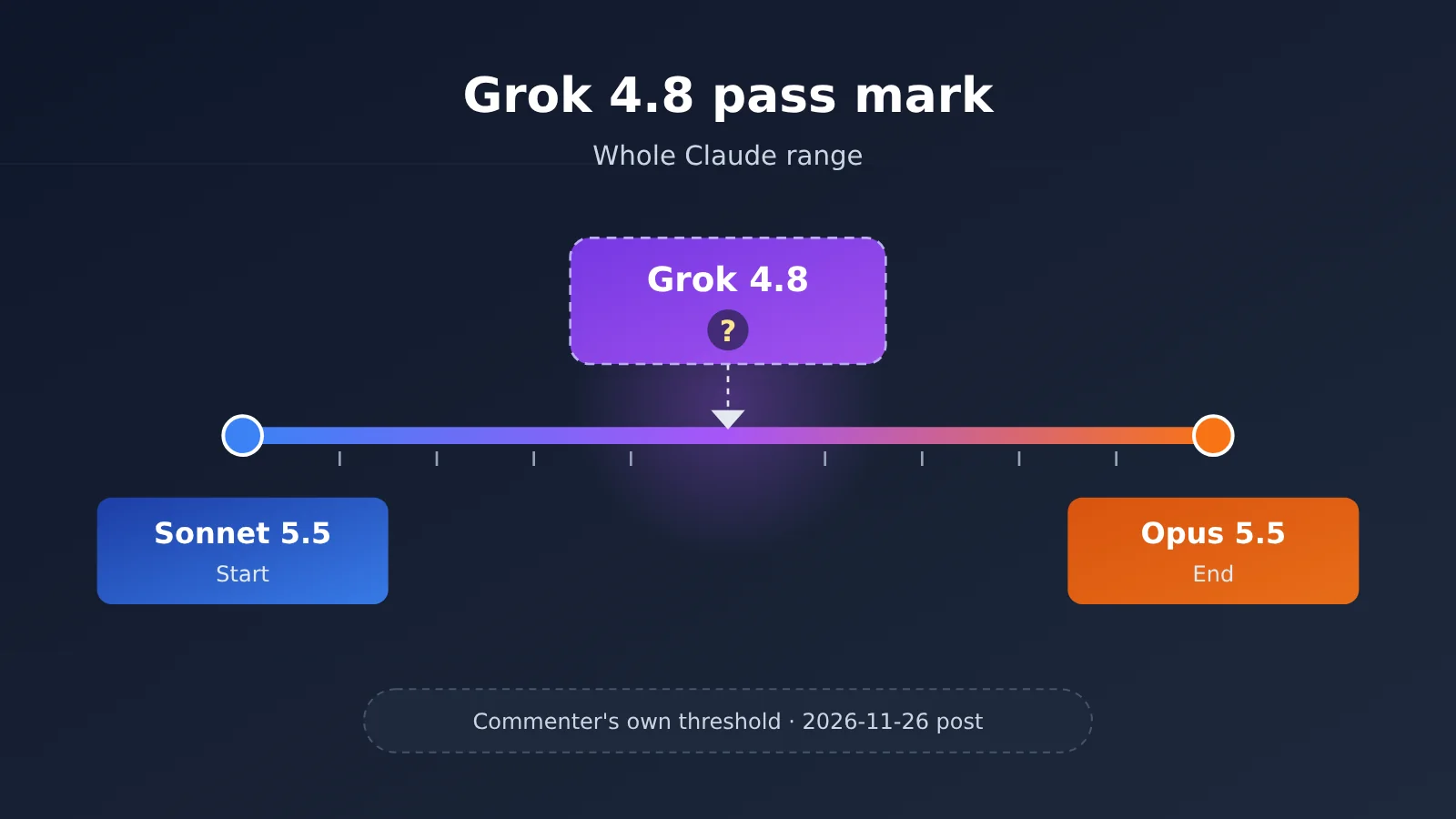
Author’s note: Grok 4.8’s passing bar runs from Sonnet 5.5 to Opus 5.5 — and that line comes from a commenter’s post, not from an xAI spec. This article explains where the line originated and checks the grok-4.7 models you can call today, along with both price tiers.
A recent post discussing Grok 4.8 framed its passing bar like this: Sonnet 5.5 at the low end, Opus 5.5 at the top. Plenty of people saw it and asked the same thing: how strong does Grok 4.8 actually need to be before it counts as good enough?
This is not an official xAI statement, and it’s not the conclusion of any leaderboard. The line is one person’s judgment, posted by Pavel Svitek on 2026-11-26. This article separates four sources — the original post, official docs, the APIYI summary table, and the replies — starting with who drew this bar, then moving on to the models you can actually call today and what they cost.
The key takeaway: three minutes to understand where Grok 4.8’s passing bar came from and how much weight it really carries, plus which model to use now and how you’ll be billed for it.
Grok 4.8 Pass Line: Key Facts at a Glance
Let’s start with the facts we can confirm. The left column is the item, the right column shows where it comes from, so you can judge how reliable it is.
| Item | Detail | Source type |
|---|---|---|
| Publish time | 2026-11-26 13:47 GMT | Original post |
| Author | Pavel Svitek (personal account) | Original post |
| Core claim | Grok 4.8 needs to land at least between Sonnet 5.5 and Opus 5.5 as a baseline | Original post |
| Two side notes | Strip out Grok 4.7’s long-winded reasoning, and also face competition from the Neon model | Original post |
| Does the official source list grok-4.8? | Not present when the model list was checked on 2026-11-27 | Official docs |
| Text model you can call today | grok-4.7 | Official docs / APIYI master list |
Who Drew the Grok 4.8 Pass Line
The gist of the original post: some rumours about Grok 4.8 are finally circulating, and the hard part is that Grok not only has to land at least in the Sonnet 5.5 to Opus 5.5 range as a baseline, but also compete with the Neon model. The post opens with the word rumours, which suggests the author is treating it as a rumour himself rather than relaying official news.
So “starts at Sonnet 5.5, ends at Opus 5.5” is the expectation range this commenter set for Grok 4.8 — a personal judgment. It’s not a performance target published by xAI (now named SpaceXSI), not data from a model card, and not a ranking from any benchmark leaderboard. When you cite this line, write “one commenter believes” — not “the official requirement.”
Two Topics the Grok 4.8 Post Only Names
The post mentions two other things, which this article lists without expanding on. The first is the parenthetical “strip out Grok 4.7’s long-winded reasoning” — the commenter’s take on what using 4.7 feels like. The second is “also has to fight off the Neon model”; the post gives no specifics about Neon, and this article won’t speculate either.
One more point deserves its own sentence: the official docs show that grok-4.7’s default reasoning tier is high, but nothing indicates that this default is what the commenter means by “long-winded reasoning.” Those two things shouldn’t be linked directly.
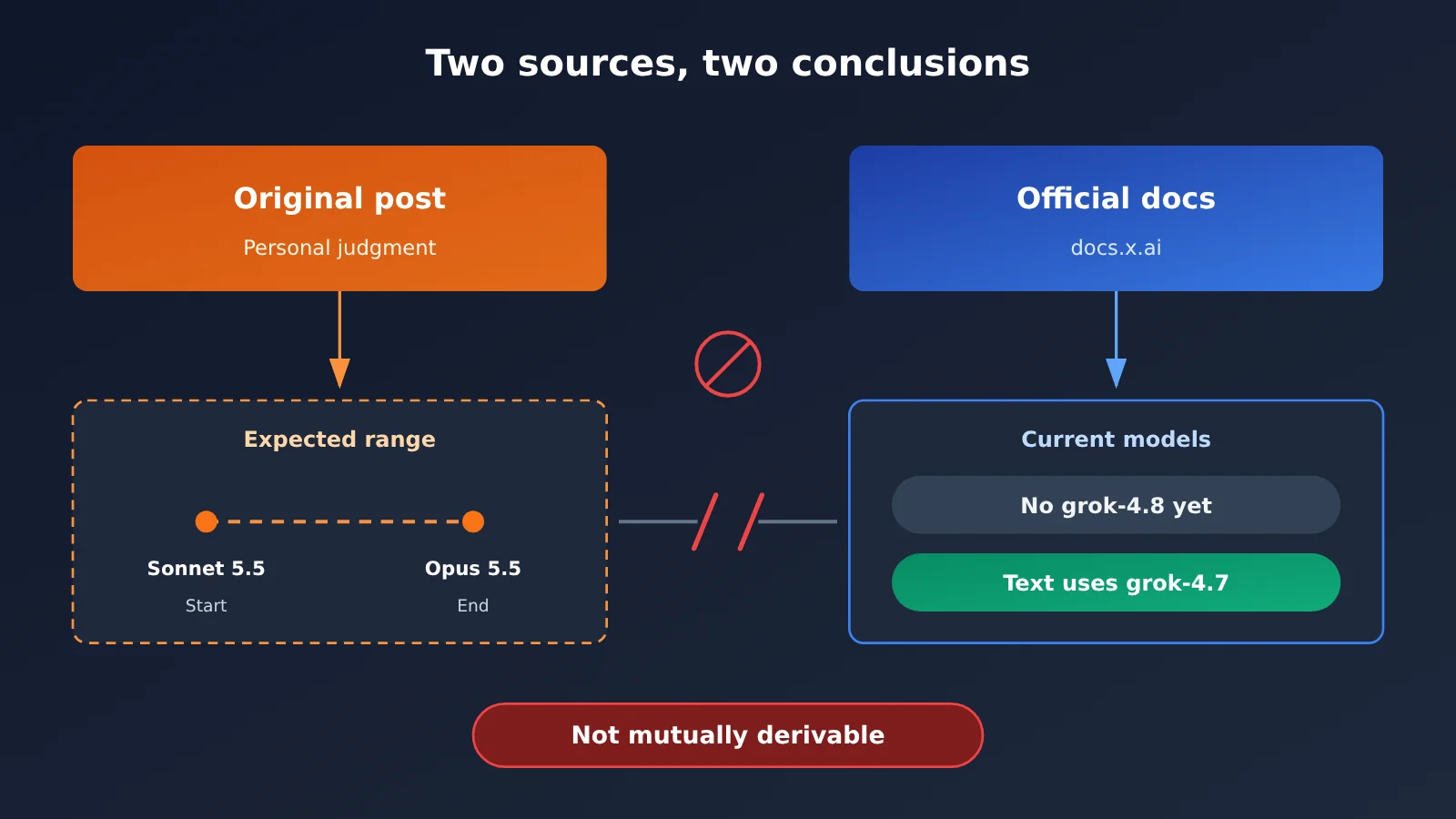
How to Tell Apart the Four Types of Sources Behind Grok 4.8 News
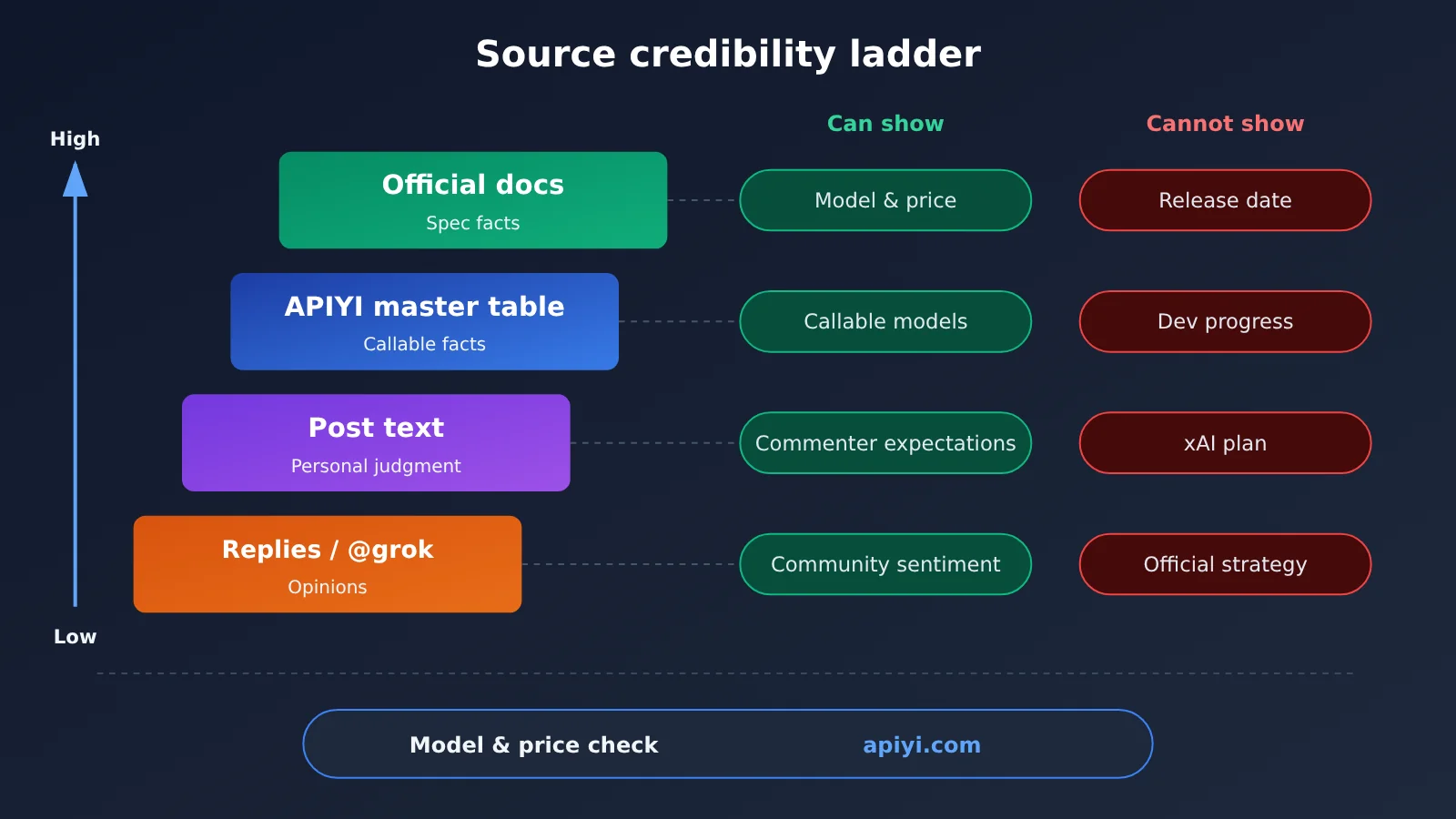
Once the same piece of news gets forwarded around a few times, its sources blur together fast. The table below sorts the four source types by reliability and spells out exactly what each one can—and can’t—tell you.
| Source | How this article uses it | What it can tell you | What it can’t tell you |
|---|---|---|---|
| Original post | Quotes Pavel Svitek directly | What the commenter expects from Grok 4.8 | xAI’s plans or specs |
| Official documentation | Model list verified on 2026-11-27 | Existing model names, context length, reasoning tiers, pricing | When the next-generation model ships |
| APIYI master list | The 2026-11-27 11:59 (UTC+8) version | Models, endpoints, groups, and pricing available on the platform | Official R&D progress |
| Reply comments | Not treated as factual evidence | Community sentiment and where the discussion is heading | Official strategy |
Reply comments deserve a note of their own. Whatever the replies under the post say—whether they back this passing bar or push against it—they reflect only the replier’s personal take and shouldn’t be read as xAI’s product roadmap. And if the @grok chat account chimes in under the post, its answer is still just model-generated conversation, not an official announcement.
grok-4.7 Specs and Two-Tier Pricing You Can Call Today
Before Grok 4.8 officially shows up, grok-4.7 is what you get for text tasks. The official docs currently state that text tasks use Grok 4.7 as well. The data below comes from the official model page, verified on 2026-11-27.
| Item | grok-4.7 (official docs) |
|---|---|
| Context length | 500K tokens |
| Reasoning tiers | low, medium, high, xhigh |
| Default reasoning tier | high |
| Under 200K tokens: input / cached read / output | $2 / 0.50 / 6 (per million tokens) |
| At or above 200K tokens: input / cached read / output | $4 / 1 / 12 (per million tokens) |
Pricing comes in two tiers, split at 200K tokens. Once you hit that usage level, all three unit prices—input, cached read, and output—double compared with the lower tier. If your app regularly sends very long contexts (a whole code repo or a long document, for example), estimate costs using the higher tier, not just the lower-tier quote.
Checking grok-4.7’s model name and pricing on APIYI
On APIYI apiyi.com, the model overview table was updated on 2026-11-27 11:59 (UTC+8), with 278 models total. There’s no grok-4.8, but grok-4.7 is there. The prices from the platform’s overview table and pricing interface map to the two official tiers:
| Comparison | Official docs | APIYI apiyi.com |
|---|---|---|
| Lower tier input / output / cached read | 2 / 6 / 0.50 | 2 / 6 / 0.5 (overview table) |
| Higher tier input / output / cached read | 4 / 12 / 1 | 4 / 12 / 1 (pricing interface) |
| Endpoint | — | chat |
| Available groups | — | CodexResponses, Default, SVIP |
| grok-4.8 | Not in the model list yet | Not listed yet |
About grok-4.8: it’s not listed yet, but we’ll get it up as soon as we can; model names and prices are subject to the platform’s model list.
If you want to integrate right now, just use the OpenAI-compatible approach. Here’s how:
- In your client, set
base_urltohttps://api.apiyi.com/v1; - Fill in your API key and set
modeltogrok-4.7; - Pick a reasoning tier as needed—if you don’t specify one, high is the default;
- Once grok-4.8 is listed, you only need to change the
modelfield; nothing else in your code changes.
🚀 Quick start: If you want to get your workload running on grok-4.7 first and then compare once 4.8 arrives, you can call grok-4.7 and the Claude series models on APIYI apiyi.com with the same key. New users get free test credits, and switching models only takes changing one field.
What the Grok 4.8 “Passing Bar” Actually Means
What It Means for Developers
- Don’t lock in your model choice too early: “Sonnet 5.5 to Opus 5.5” is just one commenter’s expected range. Until grok-4.8 is officially released and there’s public data, it’s not worth changing your production model selection because of this one claim.
- Budget based on grok-4.7 for now: estimate long-context requests at the higher per-token rate for contexts above 200K tokens, so you don’t end up underbudgeting.
- Prepare your eval baseline in advance: if you care whether Grok 4.8 can clear this bar, run your own business samples against grok-4.7 and the Claude family first to establish a baseline, then compare with the same sample set once the new model ships.
What It Means for Industry Discussion
- The reference point has shifted: this post treats Claude’s entire product range as the benchmark, which shows that some developers, when evaluating a new model, compare it directly against the mainstream model of the same generation.
- Rumors get distorted when retold: “the commenter thinks” can turn into “the official target” after a few forwards. When you read news like this, first confirm which of the four categories the source falls into, then decide how much to trust it.
💡 Selection tip: the performance gap on the same task across different models is usually more telling than the gap on a leaderboard. With APIYI apiyi.com, you can put grok-4.7 and the Claude family on the same samples through one unified interface and let your own data tell you which model fits.
FAQ
Q1: Is the passing bar for Grok 4.8 set by xAI officially?
No. “At least landing somewhere between Sonnet 5.5 and Opus 5.5” comes from a post by Pavel Svitek dated 2026-11-26 — it’s a threshold he set himself. The official xAI docs (the company is now called SpaceXSI) currently contain no grok-4.8, and they don’t state any Claude-benchmark targets.
Q2: Can the replies under that post, or @grok’s responses, be treated as official news?
No. Replies only reflect the opinions of the people posting them — they’re not official policy. @grok is a chat account, so its responses are model-generated conversation, not announcements. When you need to judge model versions and pricing, go by the official docs and the platform’s model list.
Q3: When will Grok 4.8 be available for model invocation?
As of 2026-11-27, grok-4.8 isn’t in the official model list, and it isn’t in APIYI’s master table either. It hasn’t been listed yet — we’ll get it up as soon as we can. Model version and pricing are subject to the platform’s model list.
Q4: How is grok-4.7 billed right now?
Two pricing tiers (all rates per million tokens). Below 200K tokens: input $2, cache read $0.50, output $6. At or above 200K tokens: input $4, cache read $1, output $12. On APIYI (apiyi.com), the master table shows the lower-tier price, while the pricing endpoint returns the higher-tier price, matching the official rates.
Q5: What’s the fastest way to call grok-4.7 through the API?
Use an OpenAI-compatible client, point `base_url` at `https://api.apiyi.com/v1`, set `model` to `grok-4.7`, and use the chat endpoint. Available groups are CodexResponses, Default, and SVIP. Reasoning effort can be low, medium, high, or xhigh — it defaults to high if you don’t specify.
Grok 4.8 Passing Bar: Key Takeaways
- Where the bar comes from: The Sonnet 5.5 to Opus 5.5 line traces back to a personal post from 2026-11-26.
- What kind of bar it is: This is one commenter’s personal judgment — not an xAI spec, and not a leaderboard verdict.
- The two things it names: The post mentions verbose reasoning and the Neon model; this article doesn’t dig into either.
- What you can call today: grok-4.7, with a 500k-token context window and a default reasoning level of high.
- Two pricing tiers: Under 200k tokens it’s $2 / $0.50 / $6; at 200k and above it’s $4 / $1 / $12 (input / cache read / output, per million tokens).
- How to call it: Use the unified interface on APIYI apiyi.com to call grok-4.7 — grok-4.8 isn’t listed yet.
Summary
There are three things to remember about the Grok 4.8 passing bar:
- A commenter drew this line: In his 2026-11-26 post, Pavel Svitek set the bar somewhere between Sonnet 5.5 and Opus 5.5 — that’s his personal judgment.
- There’s no official grok-4.8 yet: Checking the official docs and the APIYI master list on 2026-11-27, both only list grok-4.7.
- Current costs come in two tiers: grok-4.7 uses 200k tokens as the dividing line, and the per-unit price doubles once you cross it.
Until Grok 4.8 officially ships, the practical move is to start with grok-4.7 and the Claude series and build your own evaluation baseline. If you need to switch between multiple models with a single key for side-by-side comparisons, you can use the OpenAI-compatible interface that APIYI provides.
📚 References
-
Original post · Pavel Svitek’s post about Grok 4.8: where the passing bar discussed in this article comes from
- Link:
x.com/pavelsvitek/status/2125949509440049436 - Note: posted 2026-11-26 13:47 GMT; this is a personal opinion, not an official model card
- Link:
-
Official docs · xAI (SpaceXSI) model list: grok-4.7 specs and its two price tiers
- Link:
docs.x.ai/developers/models - Note: as of the 2026-11-27 check, grok-4.8 was not listed
- Link:
-
APIYI master table: models callable on the platform and their pricing
- Note: version as of 2026-11-27 11:59 (UTC+8), 278 models in total, includes grok-4.7, does not include grok-4.8
Author: APIYI Technical Team
Technical discussion: If you have questions about model integration or pricing, feel free to reach us on the APIYI apiyi.com homepage.