Author’s note: This breaks down the per-second pricing rules of the AI video model MAGI-2 at $0.08 per second, and provides a runtime conversion table, retry costs, and a comparison against similar per-second video models.
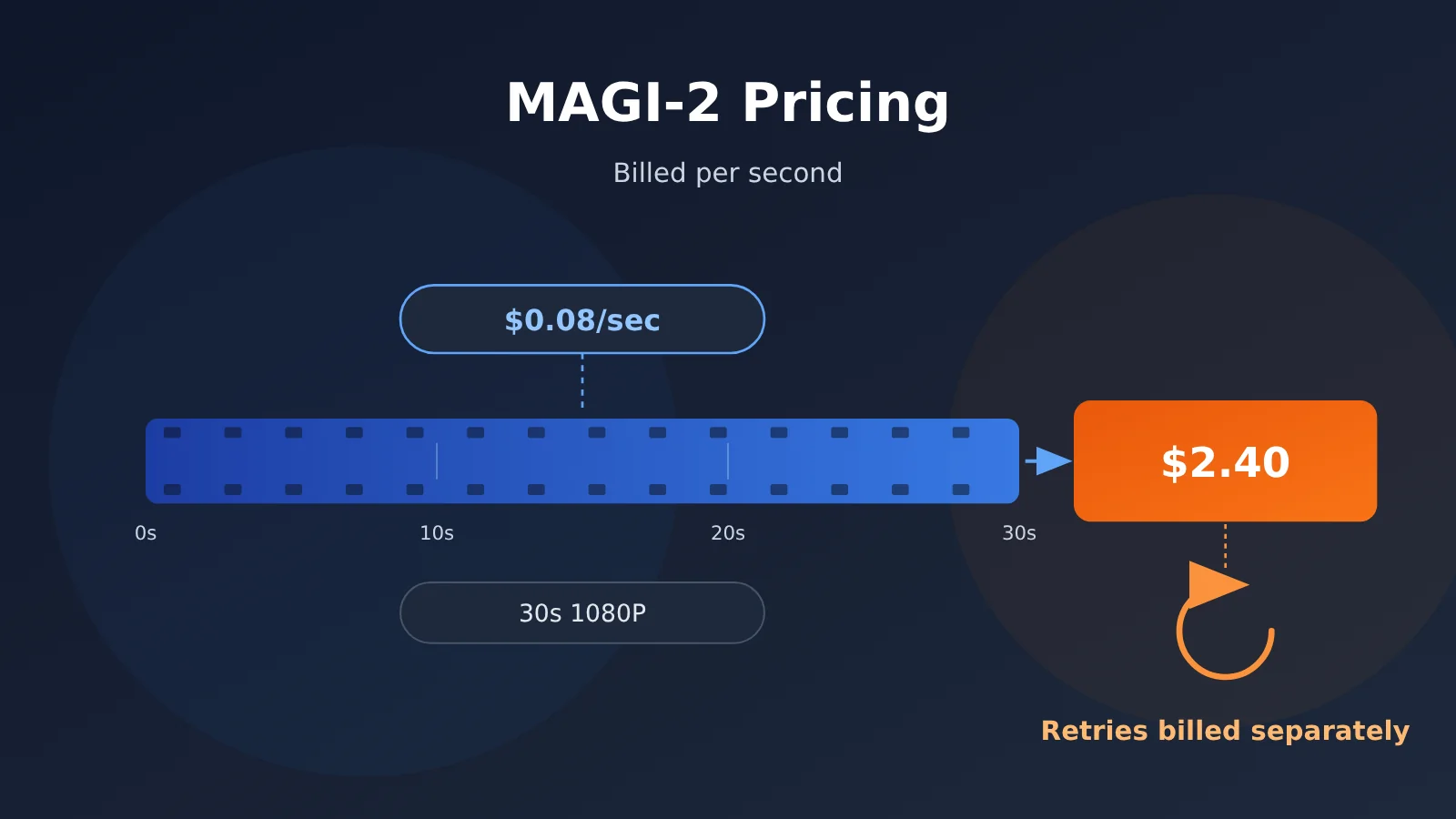
When you quote a client for a 30-second AI video, what you dread usually isn’t a high unit price — it’s quoting the job and only then realizing you’ll have to re-run it three times, tripling the cost. Sand.ai released the AI video model MAGI-2 on 2026-11-24 18:09 UTC (Beijing time 2026-11-25 02:09). The official release post gives just one price figure: $0.08 per second of generated video, which works out to $2.40 for a 30-second 1080P video.
This isn’t a quick news rewrite of the release post. Below, I break the $0.08 into three separate calculations: the first is MAGI-2’s own per-second price, the second is each vendor’s official list price for video models, and the third is the actual price of comparable models you can call through APIYI. The three use different bases and can’t be mashed into a single number.
Core value: By the end, you’ll have four things. First, a runtime conversion table you can multiply yourself; second, the “charge once per generation” billing rule; third, a comparison table of comparable per-second video models; and fourth, three counterexamples showing that cheap doesn’t mean cost-effective.
MAGI-2 Pricing Essentials
MAGI-2 is by Sand.ai and first launched on the Higgsfield platform and its API. The table below summarizes the information from the launch post and official technical blog that directly relates to billing. All spec figures are vendor-reported.
| Key point | Official statement | Impact on quotes |
|---|---|---|
| Billing unit | $0.08 per second of generated video (verbatim from the launch post) | Clip length directly determines per-clip cost; you can estimate it linearly by the second |
| Maximum duration | Up to 30 seconds (third-party onvid.ai stated on 2026-11-24 that the range is 4–30 seconds) | You can generate the full 30 seconds in one pass, with no stitching |
| Visual specs | 1080p, 25fps, 6 aspect ratios | 1080p comes from the upscaling stage, not native generation |
| Audio | A single backbone generates visuals and audio together | Dialogue, Foley, ambient sound, and music are all included in this single generation |
| Reference assets | Up to 20 per generation (10 images, 5 videos, 5 audio clips) | The vendor hasn’t said whether they’re billed separately |
| Failed retries | No separate rule is listed | Build budgets around the assumption that “every generation is billed” |
MAGI-2 Billing Logic: Billed by Generated Seconds, Settled per Generation
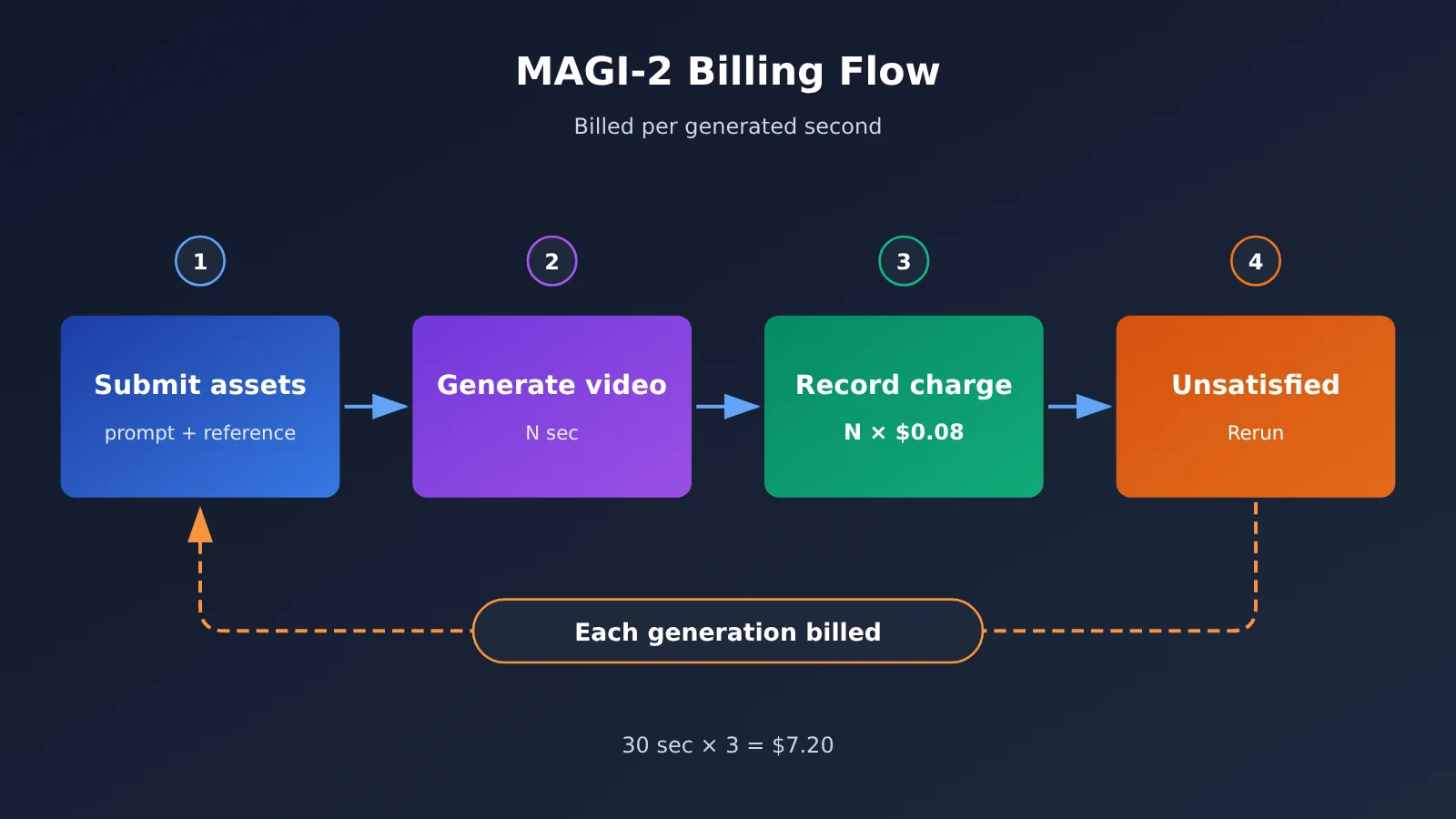
The launch post’s English wording is “$0.08 per second of generated video,” and the billing target is “the seconds of generated video.” Taken literally, billing is tied to the generation action, not to whether you end up using the clip. Submit one 30-second generation and you incur a $2.40 charge. Watch it, decide you’re not happy, tweak the prompt, and run it again—that’s a second $2.40 charge.
This is not the same as billing per delivered final cut, and studios taking on client work should pay particular attention. Writing “a 30-second final cut costs $2.40” on a quote is inaccurate. A more accurate way to phrase it is “$2.40 per generation, with N generations expected.”
MAGI-2 Core Capabilities: What You Get for $2.4
Just looking at the price can obscure one thing: even for the same 30-second 1080p output, what different models deliver varies a lot. According to Sand.ai’s official technical blog (2026-11-24), MAGI-2’s core capabilities can be summed up as follows.
- Model scale: 480B total parameters, about 28B active parameters, built on a Multi-Head Latent MoE architecture. The previous generation, MAGI-2 Preview (2026-08), had 114B total parameters and about 6B active—so this generation is more than 4x larger.
- Training data: Pretraining data was expanded to 4T tokens—roughly 1 billion samples averaging about 4k tokens each, about 3x that of Preview.
- Joint audio-video generation: Picture and sound are generated together by a single backbone, including lip sync, Foley, ambient sound, and music—not added later as post-production dubbing.
- omni-reference: You can pack up to 20 media assets into a single pass, mixing images, videos, and audio.
- Timeline control: You can specify at which second to cut and what shot size to cut to, and also make targeted edits to existing videos.
- Where 1080p comes from: 1080p is produced by upscaling with a latent spatiotemporal upscaler; during upscaling, the original reference image is re-injected to improve consistency of small faces and text legibility in 30-second long-form videos.
In terms of visual quality, the official AA Video Arena v2.1 average Elo across four tasks is 1150.3, versus 998.5 for Preview—a 151.8-point improvement. These are vendor-reported figures, not third-party retests, so treat them as directional reference only.
The open-source messaging is also inconsistent right now. The blog says MAGI-2 “will be open-sourced,” while the release post says “open-source weights with 400B parameters are coming soon.” Officials haven’t explained the two numbers—480B and 400B—and haven’t provided a timeline or license. Third-party orcarouter.ai (2026-11-24), citing the product page, wrote 480B and also pointed out the discrepancy with the release post. onvid.ai (2026-11-24) estimates that 400B weights at 16-bit storage would be about 800GB, and the 114B preview already required 8 data-center GPUs. So self-deployment doesn’t add up to a cost below $0.08 per second in the near term.
MAGI-2 Price Conversion Table: What Each Duration from 4 Seconds to 30 Seconds Costs
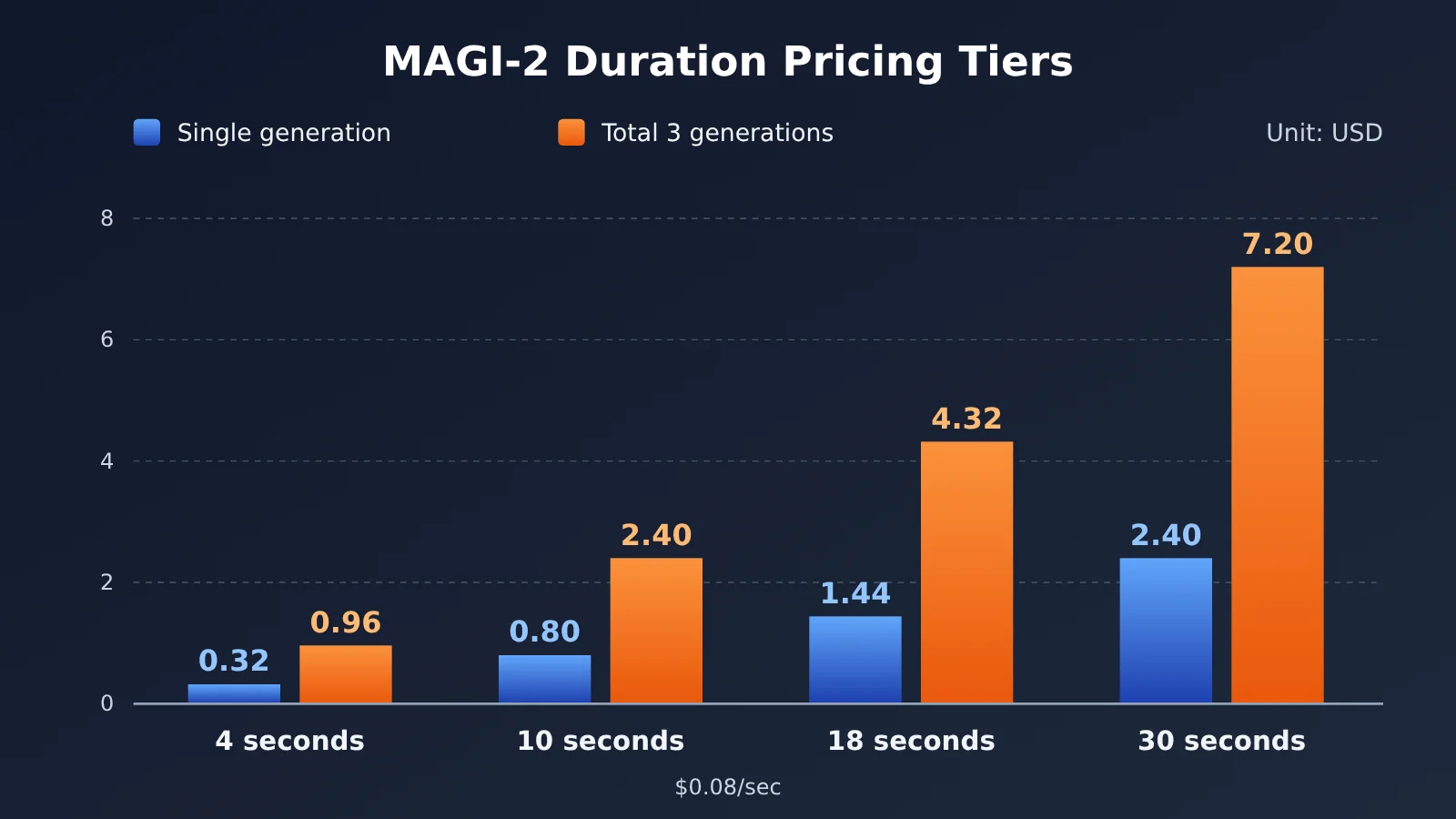
This is the most important table in the whole article. The formula is just one line: seconds × $0.08 × number of generations. The table also lists the cumulative cost for two and three runs, so you can drop it straight into a quote.
| Duration | Single generation | 2 generations | 3 generations | Notes |
|---|---|---|---|---|
| 4 seconds | $0.32 | $0.64 | $0.96 | The shortest tier according to third-party sources |
| 10 seconds | $0.80 | $1.60 | $2.40 | A typical single shot for a short video |
| 18 seconds | $1.44 | $2.88 | $4.32 | Matches the official’s own worked example |
| 30 seconds | $2.40 | $4.80 | $7.20 | The upper limit for a single generation |
The 18-second tier is backed by an official worked example. The launch partner’s official account posted, “This video cost us $1.44” — at $0.08 per second, that works out to about 18 seconds, which confirms that linear per-second pricing matches what the official actually charges. For the 30-second tier, onvid.ai (2026-11-24) also lists $2.40 per video.
📐 How to apply it: You can apply this table’s formula directly to any per-second video model on the APIYI apiyi.com pricing page — just swap 0.08 for the corresponding unit price. The same formula lets you compare models side by side when quoting.
MAGI-2 Retries and Reference Assets: Two Things the Official Docs Don’t Cover
The official docs give only one number: $0.08 per second. The following cost-related points weren’t addressed separately in the launch post or the technical blog, so I’ll flag them honestly here rather than invent rules on the official’s behalf.
- Failed retries: Not specified by the official. Taken literally, “generated video” suggests every generation is billed per second, so a 30-second video run three times costs $7.20. Whether requests that fail and produce nothing are still charged is also unspecified.
- Reference assets: Not specified by the official. You can supply up to 20 assets per generation, and there’s no published rule on whether those inputs are billed separately. Other vendors handle this differently: MiniMax-H3 doesn’t charge extra for reference assets on the APIYI channel, while Gemini Omni 1.2 Flash officially bills input at $1.50 per million tokens.
Until the rules are public, the conservative approach is to budget for 2 to 3 generations and mark reference asset costs as “to be confirmed” for now.
MAGI-2 vs. Official List Prices from Each Provider
The second cost comparison looks at the official list prices published by each video model provider. The table below includes only publicly available official pricing, all normalized to a per-second basis so they line up with MAGI-2’s $0.08.
| Model | Official pricing basis | 1080p per second | One 30-second 1080p run | Key notes |
|---|---|---|---|---|
| MAGI-2 | Per generated second | $0.08 | $2.40 | 1080p is produced in the upscaling stage |
| Kling 4.0 | Per second (no input video) | $0.235 | $7.05 | Up to 30 seconds in a single run; drops to $0.141/sec with input video |
| Gemini Omni 1.2 Flash | Converted from $12 per 1M tokens | About $0.104 | Max 15 seconds per run, about $1.56 | 30 seconds requires extension; 1080p is upsampling |
| MiniMax-H3 (provider API) | Per second | $0.08 from provider | Max 15 seconds per run; cannot produce 30 seconds in one go | Official max is 2K |
Kling 4.0 comparison: Kling 4.0 has broader coverage in aspect ratios (21:9 to 9:16), native 4K and 10-bit HDR, and multilingual and dialect dialogue. But its official 1080p list price is $0.235/sec, or $7.05 for a 30-second clip—nearly three times MAGI-2. If your delivery spec is simply 30-second 1080p and you don’t need HDR, MAGI-2’s per-run cost is clearly lower.
Gemini Omni 1.2 Flash comparison: Gemini Omni 1.2 Flash comes out to about $0.104/sec for 1080p, so its unit price is close to MAGI-2. But it generates a maximum of 15 seconds at a time, so 30 seconds requires multiple extension rounds. During extension, only the last 10 seconds are used as context, and the only aspect ratios available are 16:9 and 9:16. The official API docs also state that the current version doesn’t support audio input. By contrast, MAGI-2 can produce 30 seconds in one go and accepts audio references.
The third cost item is APIYI’s actual on-platform pricing. Let’s get the current situation clear first: after checking APIYI’s model list and pricing page on 2026-11-25, none of the 278 online models had a magi entry. MAGI-2 isn’t listed yet; we’ll get it listed as soon as possible. Models and prices are subject to the platform’s model list.
The table below lists comparable video models currently listed on APIYI that are billed per second. The MAGI-2 row is included at its official price for reference.
| Model ID | Resolution | Unit price (USD/sec) | 10-second cost | Duration | Key limitation |
|---|---|---|---|---|---|
oxygen-1.0 |
480p / 768p at the same price | 0.02 | 0.20 | 4–15 sec | Built-in audio track, uses /v1/videos |
MiniMax-H3 |
768P only | 0.03 | 0.30 | 4–15 sec | Audio track can’t be turned off, uses /hailuo/v2/video_generation |
wan3.0-video |
480P / 720P / 1080P | 0.0294 / 0.0588 / 0.1176 | 0.294 / 0.588 / 1.176 | Up to 30 sec | One ID covers all modes, audio on by default |
wan2.7-t2v / wan2.7-i2v |
720P / 1080P | 0.084 / 0.14 | 0.84 / 1.40 | Per docs | Only driving_audio on wan2.7-i2v supports audio-driven lip sync |
| HappyHorse 1.1 | 720P / 1080P | 0.126 / 0.224 | 1.26 / 2.24 | Per docs | Up to 9 reference images |
| MAGI-2 (reference, not yet listed) | 1080p | 0.08 (official price) | 0.80 | Up to 30 sec | Official docs don’t specify billing for retries and assets |
Looking just at the 30-second 1080P output spec, the listed model that can cover it in a single generation is wan3.0-video: 0.1176 × 30 comes to about $3.53, a fair bit more than MAGI-2’s official price of $2.40. Prices in the table come from APIYI’s video model documentation page; the actual prices on the apiyi.com pricing page prevail.
Seedance 2.5 in Its Own Section: Token-Based Billing, Not in the Per-Second Table
Seedance 2.5 (APIYI’s listed ID doubao-seedance-2-5-260628) is billed by token, calculated as area × duration rather than quoted per second, so it gets its own table and isn’t mixed in with the per-second table above.
| Basis | 720p | 1080p | 30-sec 720p |
|---|---|---|---|
| BytePlus official list price | About $0.231/sec | About $0.569/sec | About $6.93 |
| APIYI actual on-platform price (rechecked 2026-11-16) | $1.3721 for 5 sec (about $0.274/sec) | $3.0873 for 5 sec (about $0.617/sec) | $8.1761 |
The on-platform SeeDance2 group is 0.18x. That’s not a discount; it’s the settlement multiplier after converting the RMB price to USD. At submission, it’s pre-deducted at $0.135/sec. Seedance 2.5’s strength is its cap on reference assets: up to 30 reference images, the highest in its class. Duration is 4–30 sec, with synchronized audio by default. X user @chetaslua posted on 2026-11-24, arguing that MAGI-2 can cover about 90% of Seedance 2.5’s use cases, with pricing nearly 6.5 times lower. This is a personal opinion, not official data, and it shouldn’t be treated as an empirical finding.
MAGI-2 Pricing Pros and Cons: Cheap Doesn’t Mean Cost-Effective
Advantages of MAGI-2 Pricing
- Transparent unit price: There’s just one number—$0.08/second. The quoting formula is simple, and once the video length is fixed, the cost is fixed.
- Long videos in one pass: A single 30-second generation eliminates the stitching issues and second-generation cost that come from 15-second models generating in two segments.
- Audio included: Video and audio are generated in the same pass. The $2.40 price for 30 seconds already includes the audio track.
- Low 1080P tier for long videos: At the 30-second 1080P spec, it’s lower than both Kling 4.0’s official rate card and APIYI’s listed
wan3.0-videoat 1080P.
Limitations of MAGI-2 Pricing
- Incomplete rules: The official documentation doesn’t specify whether reference assets are charged separately or whether failed generations are billed.
- 1080p isn’t native: It comes from an upscaling stage, so projects with extremely high demands for visual detail need to validate with a small sample first.
- Shortcomings the vendor itself acknowledges: In extremely high-speed motion, there are occasional trajectory and continuity issues; in medium and long shots of 2D animation, local motion is too smooth; and complex soundscapes still lack layering and physical realism. The official team also notes that post-training RL makes visual reasoning and cross-language instruction following harder to trigger, which internally is viewed as something like an alignment tax. All of these issues increase retry counts and therefore drive up actual cost.
Three Counterexamples Showing “Cheap Doesn’t Mean Cost-Effective”
- MiniMax-H3 at $0.03/second: The unit price is less than half of MAGI-2’s, but this APIYI channel only offers 768P and a maximum of 15 seconds per generation. When the client needs a finished 30-second 1080P video, it simply doesn’t meet the spec—being cheap is meaningless.
- Oxygen at $0.02/second: The lowest on the entire table, but it only has 480p and 768p tiers and also maxes out at 15 seconds. It’s suitable for drafts and storyboard previews, not for 1080P delivery.
- wan3.0 at $0.0294/second: That’s the 480P price. Switch to 1080P and it’s $0.1176/second, about $3.53 for 30 seconds—actually more expensive than MAGI-2’s $2.40. Looking only at the entry price makes it easy to misjudge.
How to Call MAGI-2-like Video Models via APIYI
Before MAGI-2 launches, you can use the per-second video models already available on APIYI to get the workflow and budget figured out. Once MAGI-2 is live, you’ll only need to swap the model ID. Here are the key steps:
- Use one base URL: For the OpenAI-compatible API, set
base_urltohttps://api.apiyi.com/v1. One token works across all available models, so you don’t need separate accounts for each provider. - Model IDs are case-sensitive:
MiniMax-H3can’t be written asminimax-h3; version numbers use dots, for exampleoxygen-1.0andwan3.0-video. The wrong casing will throw an error, so check the model list on apiyi.com before putting it in your code. - Watch out for different endpoints:
oxygen-1.0uses/v1/videos;MiniMax-H3usesPOST /hailuo/v2/video_generation; Seedance 2.5 task creation usesPOST https://api.apiyi.com/seedance/api/v3/contents/generations/tasks, so don’t submit it to/v1/videos. - Parameter gotchas:
MiniMax-H3can’t turn off the audio track; passinggenerate_audio=falsereturns a 400. For Seedance 2.5,durationdefaults to -1, while the 2.0 series defaults to 5 seconds. It’s best to pass the duration explicitly. - Prevent duplicate charges at the business layer:
MiniMax-H3‘sIdempotency-Keydoesn’t take effect, and billing is based on request duration. If you automatically resend after a network timeout, you’ll end up with two charges, so your retry logic must deduplicate at the business layer.
Step 5 is the same idea as MAGI-2’s “retries are billed separately”: with per-second video models, every submission costs money.
🚀 Quick start tip: First use the free trial credit for new users on APIYI apiyi.com to run a few 10-second samples with
oxygen-1.0orMiniMax-H3. Get the submission, polling, deduplication, and cost calculation workflow working end to end, then decide which tier to use for your production project.
Frequently Asked Questions (FAQ)
Q1: What is MAGI-2?
MAGI-2 is an AI video generation model released by Sand.ai on 2026-11-24. It supports text, image, video, and audio input, and can generate 1080p video with sound up to 30 seconds long. The official tech blog lists 480B total parameters and roughly 28B active parameters, priced at $0.08 per second generated.
Q2: How much does a 30-second 1080P MAGI-2 video actually cost?
A single generation is 0.08 × 30 = $2.40. But that’s the price of one generation, not one finished cut: if you’re not happy and rerun it, you pay again—three runs cost $7.20. When quoting, it’s wise to budget for 2 to 3 generations.
Q3: When was MAGI-2 released, and when will the open-source weights be available?
The release time is 2026-11-24 18:09 UTC, which is 2026-11-25 02:09 Beijing time. On open source, the release post says 400B-parameter open-source weights are coming soon, while the blog says MAGI-2 will be open-sourced. The parameter figures in the two places don’t match, and the official side hasn’t given a timeline or license.
Q4: Do reference materials and failed retries cost extra when using MAGI-2?
Officially, there’s no word on it. Public information only has the single price of $0.08 per second—there are no separate billing rules for reference materials, and no indication whether failed generations are charged. Until the rules are public, it’s best to budget as if every generation is billed.
Q5: Can I access MAGI-2 through APIYI?
MAGI-2 isn’t listed yet, and we’ll add it as soon as we can; model IDs and pricing are subject to the platform’s model list. For now, you can use the same API key on APIYI apiyi.com to call per-second video models such as `wan3.0-video`, `MiniMax-H3`, and `oxygen-1.0`, so you can get your API integration and budgeting workflow in place first.
Q6: How much cheaper is MAGI-2 than Seedance 2.5?
The two use different pricing bases: MAGI-2 charges by the second, while Seedance 2.5 charges by token. In BytePlus’s official rate card, Seedance 2.5 1080p is about $0.569 per second; on APIYI, 1080p/5 seconds is $3.0873. X user @chetaslua argues MAGI-2 is nearly 6.5x cheaper—that’s a personal assessment, not official data. For the exact difference, you can work it out line by line on the apiyi.com pricing page using your own clip length and resolution.
Q7: What are the known limitations of MAGI-2?
The shortcomings the official team acknowledges include: occasional trajectory issues with extremely fast motion; in medium-to-long-shot 2D animation, local motion can look overly smooth; and complex soundscapes can lack realism. Also, 1080p is produced during the upscaling stage, not generated natively. All of these can mean more retries and a higher real cost per finished clip.
MAGI-2 Pricing: Key Takeaways
- Pricing formula: seconds × $0.08 × number of generations — a single 30-second run costs $2.40.
- Retries are billed separately: you pay per second for every generation, so running 30 seconds three times costs $7.20.
- Two things left unspecified: how reference materials and failed retries are billed — the official docs don’t say.
- Strong on long clips: a single 30-second 1080P run costs less than Kling 4.0’s list price and
wan3.0-videoat 1080P. - Not the winner for short clips: for 5–10 second low-resolution work,
MiniMax-H3andoxygen-1.0are cheaper. - Keep three sets of numbers separate: MAGI-2’s per-second rate, each vendor’s official list price, and APIYI’s actual on-site price can’t be mixed together.
- Before launch: on APIYI, run similar models through with a single token, and remember that model IDs are case-sensitive.
Summary
MAGI-2’s pricing boils down to three points:
- Unit price: $0.08/second — 4 seconds $0.32, 10 seconds $0.80, 18 seconds $1.44, 30 seconds $2.40.
- Billing method: each generation is billed separately; re-running means paying again; reference materials and failed retries aren’t covered in the official docs.
- Where it stands: at the 30-second 1080P spec, it’s one of the lowest options in the current per-second tier.
The purchasing advice is straightforward. If you’re delivering a single 30-second 1080P commercial spot, MAGI-2’s $2.40 is one of the lowest rates in the per-second tier — lower than Kling 4.0’s official list price of $7.05 and wan3.0-video 1080P at about $3.53 — but leave room in the budget for retries. If you only need 5–10 second vertical video and 768P will do, MiniMax-H3 at $0.03/second and oxygen-1.0 at $0.02/second are cheaper.
MAGI-2 isn’t listed yet; we’ll get it up as soon as possible. Model names and pricing are subject to the platform’s model list. Before launch, you can use the free test credits on APIYI apiyi.com to run similar per-second models and lock down your cost calculation workflow.
📚 References
-
MAGI-2 official launch post: The first post from @magiai_hq, including the original pricing at $0.08/second.
- Link:
x.com/magiai_hq/status/2125290721003680155 - Notes: Primary source for the pricing, the 30-second 1080p spec, and the open-source positioning.
- Link:
-
Sand.ai official technical blog: MAGI-2 architecture, training data, and limitations.
- Link:
sand.ai/blog/magi-2 - Notes: 480B parameters, omni-reference, upscaler, and the shortcomings officially acknowledged by the team.
- Link:
-
Launch partner cost example post: “This video cost us $1.44”
- Link:
x.com/higgsfield_ai/status/2125365818745921975 - Notes: Official example showing roughly 18 seconds, calculated at $0.08/second.
- Link:
-
onvid.ai third-party analysis (2026-11-24): Duration range and weight size estimates.
- Link:
onvid.ai - Notes: 4–30 second range, $2.40 for 30 seconds, and an estimated 800GB of weights.
- Link:
Author: APIYI technical team
Technical discussion: For currently available video model variants, endpoints, and actual pricing on the site, see the docs.apiyi.com documentation center.