
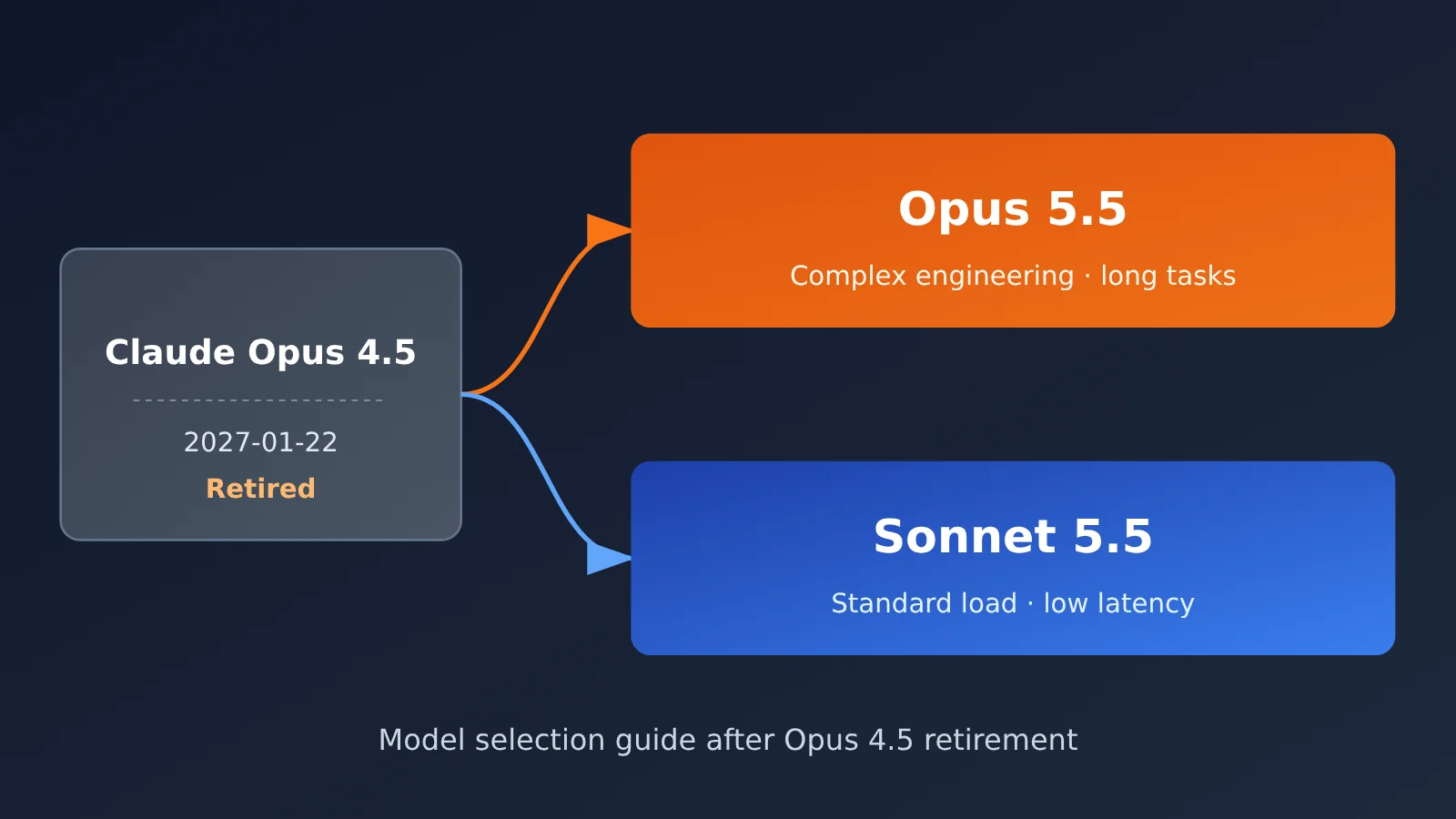
Author’s note: Claude Opus 4.5 is being retired on the Claude API. This article compares Opus 5.5 and Sonnet 5.5, explains how to pick a replacement, and which changing conditions would flip that choice.
The short answer: Anthropic’s designated replacement for Opus 4.5 is Claude Opus 5.5. If your tasks have clear boundaries, can be automatically validated, and are latency-sensitive, you should start by evaluating Claude Sonnet 5.5 with its default configuration. On the SWE-bench Pro subset Anthropic published, its pass rate matches Opus 5.5 at the low tier, and the cost per solved task at list price is slightly lower. For cross-repository refactoring, long-horizon agent workflows, and tasks that require adjudicating across multiple sources, treat Opus 5.5 at the default medium tier as your quality baseline. On the same subset, that tier’s pass rate is about 5 percentage points higher, at roughly twice the cost per solved task.
Two situations change the recommendation above. First, if your application can automatically judge whether a result is correct, routing strategies like “run Sonnet 5.5 first, escalate to Opus 5.5 on failure” or “run Opus 5.5 at a low tier first, then rerun at a higher tier on failure” are often more cost-effective than committing to a single model. Second, if you can identify complex tasks upfront and rework is expensive, route them straight to Opus 5.5 and skip the first round of calls and the waiting that comes with it.
Opus 5.5 vs Sonnet 5.5: Two Replacement Paths at a Glance
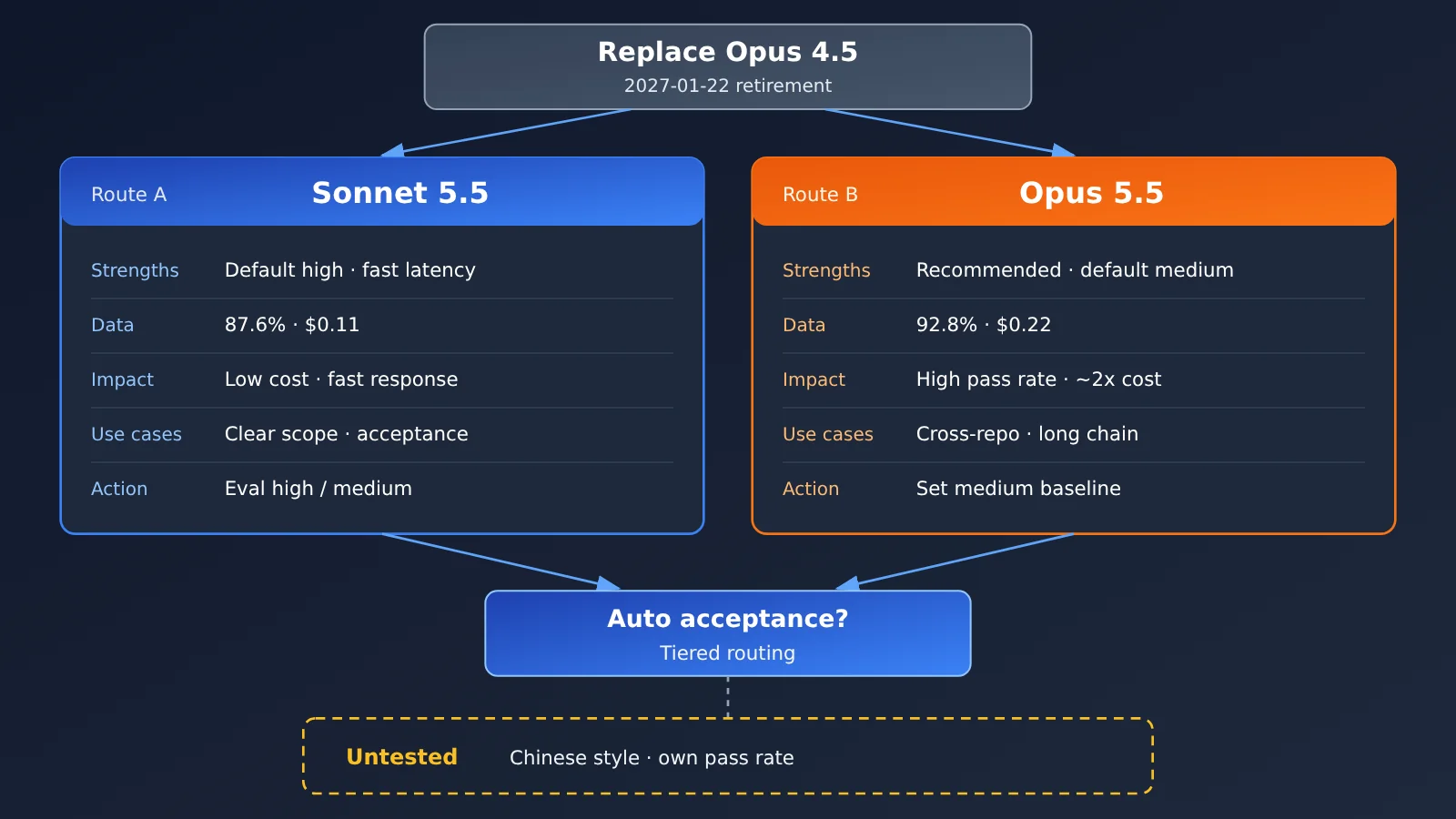
Note: The two paths are parallel options, with no ordering between them. Sonnet 5.5 suits routine workloads with clear boundaries; Opus 5.5 is the quality baseline for hard tasks. Chinese writing style and your own business pass rates aren’t covered by public material — you’ll need to evaluate them with your own samples. Prices in this article follow Anthropic’s first-party figures; when calling through APIYI apiyi.com, refer to the platform’s pricing page.
Suggested reading order: Start with Section 1 to confirm the retirement scope and the shared assumptions behind both models. Then look at the capability evidence in Section 2, run the cost math on a consistent basis in Section 3, and map it to your own scenario using Section 4. Section 5 gives an evaluation script you can adapt directly. If you only care about cost, jump straight to Section 3.
5 Concepts to Know Before Choosing
| Term | Meaning | Why it matters for model selection |
|---|---|---|
effort level |
Controls how much reasoning the model invests; levels include low, medium, high, xhigh, max | Changing levels on the same model shifts both cost and pass rate; the two models have different defaults |
| Cost per solved task | Total spend divided by the number of tasks passed; failed attempts count too | Closer to your real bill than unit price |
| Cache read / write | Reused context is billed as cache, with different rates for writes and reads | Cold-start and warm-cache costs differ a lot on long-context tasks |
| Batch API | Asynchronous batch processing with 50% off standard input and output | Big savings for tasks that don’t need immediate responses |
| Escalation rate | Share of tasks that fail the first round during routing and need a rerun on a stronger model | This ratio determines whether dual-model routing pays off |
1. Claude Opus 4.5 Retirement Scope and Replacement Model Specs
1.1 Claude Opus 4.5 Retirement Date and Which Endpoints It Applies To
Anthropic announced on November 23, 2026 that the two model IDs claude-opus-4-5-20251101 and claude-opus-4-5 are scheduled to retire from the Claude API on January 22, 2027. The officially recommended replacement is Claude Opus 5.5. The release notes also mention that Claude Sonnet 5.5 is a candidate for routine workloads.
That date applies only to the Claude API endpoint — other entry points follow their own lifecycle terms. Also, going straight from Opus 4.5 to Opus 5.5 skips several versions. The official migration guide asks you to walk through the compatibility changes along that path one by one; you can’t just swap the model ID and ship.
1.2 Spec Comparison: What Opus 5.5 and Sonnet 5.5 Share
The two models are broadly matched on baseline capability. The differences come down to default settings and latency positioning.
| Spec | Claude Opus 5.5 | Claude Sonnet 5.5 |
|---|---|---|
| Release date | 2026-09-22 | 2026-09-28 |
| First-party model ID | claude-opus-5-5 |
claude-sonnet-5-5 |
| Official positioning | Long-running coding agents, large-scale refactors, complex systems engineering | Everyday coding, data analysis, content creation, agent tool calls |
Default effort |
medium, adaptive thinking always on |
high |
| Official latency tier | Medium | Fast |
| Input / output | Text and image input, text output, tool calls supported | Same |
| Context / max output | 1M / 128K tokens | Same |
| Available entry points | Claude API, APIYI apiyi.com, and others | Claude API, APIYI, and others |
Both models have a 1M-token context window, so “can it read the same set of materials” isn’t a differentiator. What’s actually worth comparing is task quality and time-to-completion once the same materials are loaded. One caveat on speed: the “30%+ faster output generation” in the Sonnet 5.5 launch blog compares against the previous-generation Sonnet 5, not Opus 5.5. The only apples-to-apples thing you can cite between the two is the official latency tier — there are no same-basis speed figures.
2. Opus 5.5 vs. Sonnet 5.5: Coding Capability Comparison
2.1 SWE-bench Pro Subset: Pass Rate and Cost per Solved Task
This is the only dataset so far that puts pass rate and cost on the same basis. On the 478-task SWE-bench Pro subset adapted to its evaluation framework, Anthropic ran each configuration twice and aggregated the results.
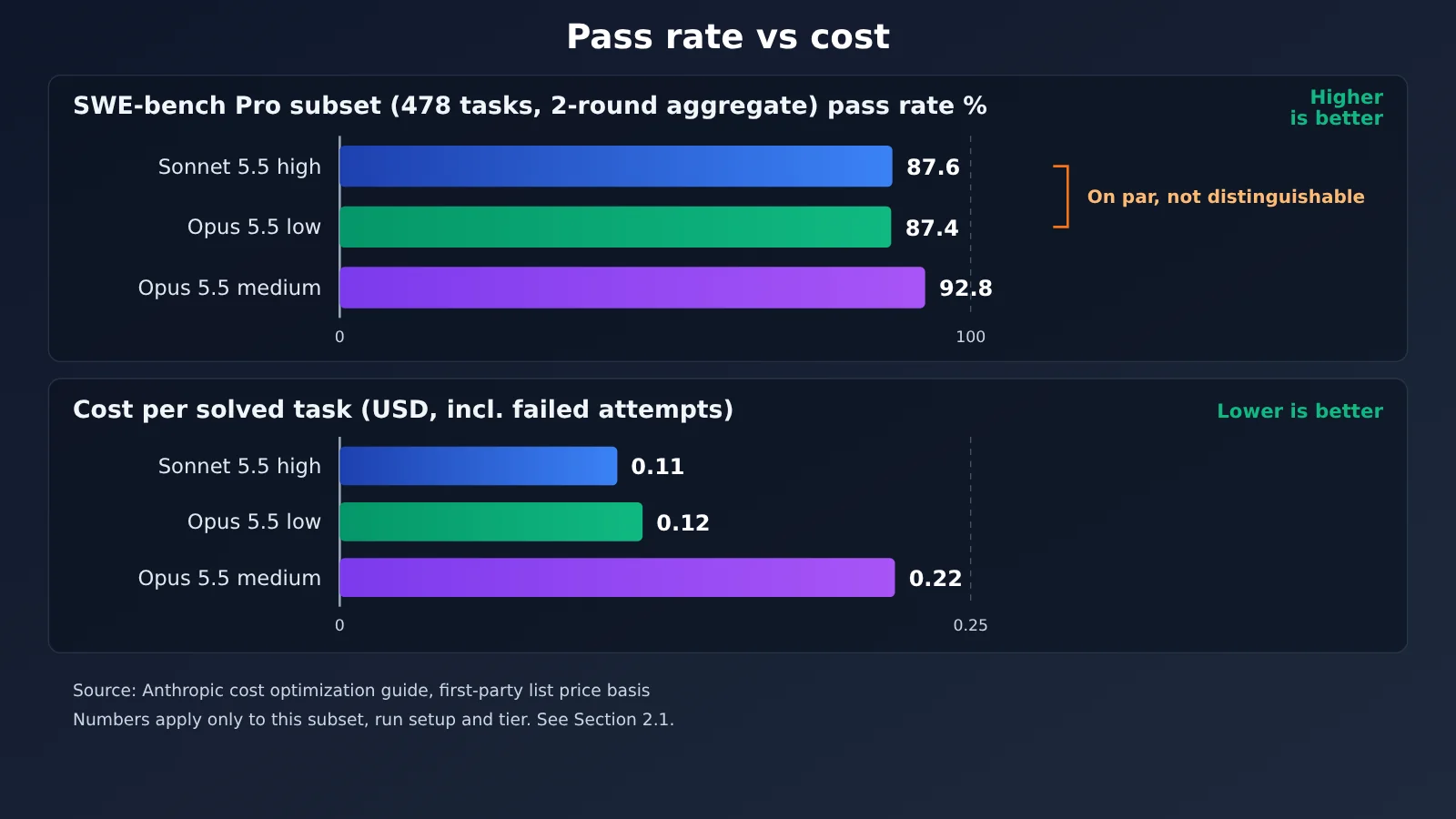
| Configuration | Pass rate | Cost per solved task |
|---|---|---|
Sonnet 5.5, default high |
87.6% | $0.11 |
Opus 5.5, low |
87.4% | $0.12 |
Opus 5.5, default medium |
92.8% | $0.22 |
Sonnet 5.5’s default level and Opus 5.5’s low level differ by only 0.2 percentage points in pass rate—not enough to separate them. Notably, their unit prices differ by a factor of two, yet cost per solved task is very close. The official explanation: under the low level, Opus 5.5’s average output is only slightly more than half of Sonnet 5.5’s default level, and its cache reads are only slightly more than one-third of the latter; lower usage offsets the higher unit price. Opus 5.5’s default level adds 5.2 percentage points of pass rate, at the cost of doubling the cost per solved task.
2.2 CursorBench and FrontierCode: Differences Across Task Types
Sonnet 5.5’s launch page puts both models in the same table. CursorBench 4.0 tasks come from ambiguous, multi-file tasks in real Cursor sessions; Sonnet 5.5 scores 55.5%, Opus 5.5 57.8%. FrontierCode v1.1’s main set tests whether a patch meets merge standards; Opus 5.5 scores 54.4% at the max level. Sonnet 5.5 scores 52.1% at xhigh, but drops to 46.2% at max.
The latter result shows that raising the effort level doesn’t necessarily produce better results. The launch page attributes some cases of Sonnet 5.5’s lower scores at higher effort levels to timeouts or out-of-scope changes caused by extra review. So when evaluating Sonnet 5.5, it’s worth testing both high and medium, rather than defaulting to maxing out the level. When citing these scores, keep the benchmark name and effort level; otherwise the numbers aren’t comparable.
3. Opus 5.5 vs Sonnet 5.5 Pricing and Per-Task Cost
3.1 First-Party Unit Price Comparison
Below are the published prices for Claude API standard mode, in USD per million tokens. Both models bill at the standard rate across their full 1M-token context window.
| Model | Uncached input | Output | 5-minute cache write | 1-hour cache write | Cache read |
|---|---|---|---|---|---|
| Claude Opus 5.5 | 4 | 20 | 5 | 8 | 0.20 |
| Claude Sonnet 5.5 | 2 | 10 | 2.50 | 4 | 0.10 |
A few additional billing rules:
- Batch API: Both models get 50% off standard input and output. Opus 5.5 becomes 2 / 10, Sonnet 5.5 becomes 1 / 5.
- Fast mode: Priced separately for Opus 5.5, at 8 for input and 40 for output.
- Server-side tools: May be billed separately based on usage, so when you’re costing out a task, record them alongside the request cost.
- Claude Managed Agents: On top of token and tool costs, sessions are billed at $0.08 per hour while they’re in a running state.
3.2 Worked Example: Cold Start vs. Warm Cache
Suppose a task accumulates 20,000 uncached input tokens, 50,000 cache reads, and 2,000 output tokens, with the cache already established beforehand. On token fees alone, Sonnet 5.5 comes to $0.065 and Opus 5.5 to $0.130. If those 50,000 tokens were 5-minute cache writes in this run instead, the cost becomes $0.185 and $0.370 respectively.
This example only illustrates the billing structure. In real runs, the model’s input/output volume, cache hit rate, and number of retries will all change your usage. When costing things out, take the five token categories in each request’s usage, multiply each by its corresponding rate, and add them up — and track cold starts and warm caches separately.
3.3 Routing Strategies and Same-Model Tier Comparison
| Strategy (data source) | Cost | Pass rate | Prerequisites |
|---|---|---|---|
| All 1000 tasks on Opus 5.5 (warm cache example) | $130 | Not tested | None |
| Sonnet 5.5 first, 150 upgraded and rerun on Opus 5.5 (hypothetical example) | $84.50 | Not tested | Failures can be identified; two-round latency is acceptable |
Opus 5.5 at high for everything (SWE-bench Pro subset) |
~$0.29 per problem | 95.3% | None |
Opus 5.5 at low first, failed problems rerun at high (same-subset estimate) |
~$0.17 per problem | ~97% | Results can be verified automatically |
The denominator for the last two rows is all tasks, and the cost includes retries after failures. These are per-problem estimates from Anthropic based on existing run results, and they work as a baseline for dual-model routing: if tiering within a single model is already good enough, you don’t need to maintain two sets of model routing. The first two rows compare model costs only; the final decision also depends on pass counts, wait times, and human labor cost.
💰 Cost tip: The payoff of a routing strategy depends on your actual upgrade rate. We recommend using APIYI apiyi.com to call both models with the same API key, measure the upgrade rate on your own traffic, and then decide whether dual-model routing is worth it.
4. Choosing Between Opus 5.5 and Sonnet 5.5 for Coding, Agent, and Content Generation Work
| Work type | When to start with Sonnet 5.5 | When to start with Opus 5.5 | Metrics to track |
|---|---|---|---|
| Coding | Adding unit tests, implementing a single endpoint, explaining build errors | Multi-repo API contract changes, refactors that require mapping state transitions first | First-pass success rate, out-of-scope changes, manual handoff time |
| Agent | Fixed steps: reading materials, calling query tools, drafting responses | Cross-system maintenance plans, recording trade-off conflicts, rebuilding steps after tool failures | Tool parameter accuracy, end-to-end latency, ticket completion rate |
| Content generation | Converting structured material into fixed sections, drafting multiple copy versions per glossary, summaries | Long-form content across sources, inconsistent claims across multiple source documents, need to preserve evidence provenance | Unsupported assertions, citation coverage, glossary compliance rate, rework time |
For coding task evaluations, fix the repo snapshot, tools, tests, and editable scope, and apply the same acceptance criteria every time. That’s how you can tell whether paying more actually buys fewer back-and-forth cycles. For Agent tasks, judge by final ticket completion; successful tool calls and fluent output should only be secondary metrics. Take internal tickets as an example: classification and extraction of existing fields can go to Sonnet 5.5; tickets that span multiple teams and have conflicting attachments can go directly to Opus 5.5, while you check whether its attribution is supported by records.
For content generation, Sonnet 5.5 scores 1844 Elo in GDPval-AA v2.1, and Opus 5.5 scores 1846 Elo—almost no difference. Note that this Sonnet 5.5 score comes from a version deployed before release. This occupational knowledge work score is only a reference for general delivery capability; Chinese style and source consistency need to be scored with your own materials. A practical approach is separate routing: routine first drafts go to Sonnet 5.5, and sections that require cross-source adjudication go to Opus 5.5.
5. How to Migrate from Opus 4.5: A Minimal Model Evaluation
5.1 Evaluation Design
Pick samples that reflect the mix of your live traffic, and separately flag the hardest tail-end tasks. Run three configurations with identical inputs, tools, and acceptance criteria: Sonnet 5.5 at its default high, Opus 5.5 at its default medium, and one lower tier, such as Opus 5.5 on low. Give each configuration its own independent session.
The metrics you’ll want to track include: total cost per task, cost per passing task, time to first output segment and end-to-end latency, and the share of tasks that needed edits or a human takeover. Whether to upgrade should be decided by test results, structural validation, and human spot checks — not by the confidence the model reports about itself. A dual-model setup is only worth the overhead of maintaining two routing paths when it beats an acceptable single-model configuration on pass rate, cost, and latency alike.
5.2 Sonnet 5.5 Minimal Invocation Example
from openai import OpenAI

client = OpenAI(
    api_key="YOUR_API_KEY",
    base_url="https://api.apiyi.com/v1"  # APIYI OpenAI-compatible interface
)

resp = client.chat.completions.create(
    model="claude-sonnet-5-5",  # Model name is subject to the platform's model list
    messages=[{"role": "user", "content": "解释这段构建报错的原因:..."}]
)
print(resp.choices[0].message.content)
print(resp.usage)  # Log usage for per-task cost accounting
View the full dual-model evaluation script
import time
from openai import OpenAI

client = OpenAI(
    api_key="YOUR_API_KEY",
    base_url="https://api.apiyi.com/v1"
)

# First-party reference unit prices (USD per million tokens); actual charges are subject to the bill
PRICES = {
    "claude-sonnet-5-5": {"input": 2, "output": 10, "cache_read": 0.10},
    "claude-opus-5-5": {"input": 4, "output": 20, "cache_read": 0.20},
}

def run_once(model, prompt):
    start = time.time()
    first_token_at, chunks, usage = None, [], None
    stream = client.chat.completions.create(
        model=model,
        messages=[{"role": "user", "content": prompt}],
        stream=True,
        stream_options={"include_usage": True},
    )
    for chunk in stream:
        if chunk.choices and chunk.choices[0].delta.content:
            if first_token_at is None:
                first_token_at = time.time() - start
            chunks.append(chunk.choices[0].delta.content)
        if getattr(chunk, "usage", None):
            usage = chunk.usage
    return "".join(chunks), first_token_at, time.time() - start, usage

def cost_of(model, usage):
    if usage is None:
        return None
    p = PRICES[model]
    details = getattr(usage, "prompt_tokens_details", None)
    cached = getattr(details, "cached_tokens", 0) or 0
    uncached = usage.prompt_tokens - cached
    return (uncached * p["input"] + cached * p["cache_read"]
            + usage.completion_tokens * p["output"]) / 1_000_000

def evaluate(tasks, models, check):
    """tasks: [(prompt, expected)]; check: automatic acceptance function that returns True/False"""
    report = {}
    for model in models:
        passed, total_cost, rows = 0, 0.0, []
        for prompt, expected in tasks:
            text, ttft, total, usage = run_once(model, prompt)
            ok = check(text, expected)
            c = cost_of(model, usage) or 0.0
            passed += ok
            total_cost += c
            rows.append({"ok": ok, "ttft": ttft, "total": total, "cost": c})
        report[model] = {
            "pass_rate": passed / len(tasks),
            "cost_per_task": total_cost / len(tasks),
            "cost_per_pass": total_cost / passed if passed else None,
            "rows": rows,
        }
    return report

if __name__ == "__main__":
    tasks = [("把下列 JSON 字段提取为 CSV:...", "id,name")]
    check = lambda text, exp: exp in text
    result = evaluate(tasks, ["claude-sonnet-5-5", "claude-opus-5-5"], check)
    for m, r in result.items():
        print(m, r["pass_rate"], r["cost_per_task"], r["cost_per_pass"])
The script records time-to-first-token and total time separately, and calculates cost both per task and per passing task. OpenAI-compatible usage typically has no cache-write field, so you’ll need to cross-check cold-start costs against the platform bill. For how the effort tier is passed through the compatible interface, please refer to the platform documentation.
🚀 Getting Started Tip: For migration evaluation, run two or three configurations at the same time. After registering at APIYI apiyi.com, you can use the free trial credits for new users to run the script above, confirm the flow works correctly, and then scale up the sample size.
FAQ
Q1: After Opus 4.5 is retired, can I just swap the model ID to claude-opus-5-5?
Swapping it in directly isn’t recommended. Opus 4.5 to Opus 5.5 spans several versions, and the official migration guide asks you to check compatibility changes along the path item by item. On top of that, Opus 5.5 always runs with adaptive thinking enabled and defaults to the `medium` tier, so both output style and usage can shift — you’ll want regression testing before going live.
Q2: If I call these two models on APIYI, is the billing basis the same as first-party?
The prices and worked examples in this article use Anthropic’s first-party basis, which is meant to compare the relative cost of the two models. For actual per-unit pricing when calling through APIYI at apiyi.com, refer to the platform’s price page. The costing method stays the same: log Token usage by task category, then multiply by the corresponding rate.
Q3: Is Opus 5.5’s Fast mode worth turning on?
Fast mode costs twice the standard rate — that’s $8 input and $40 output per million Tokens. It’s only worth considering when an interactive scenario is highly latency-sensitive and Sonnet 5.5’s quality doesn’t meet the bar. Start by measuring time-to-first-token and time-to-final-result separately on a small sample, and see whether the speedup actually translates into business value.
Q4: Which model should I pick for offline batch jobs?
For tasks that don’t need an immediate response, prioritize the Batch API. Both models get 50% off on input and output, and under the corresponding beta configuration, maximum output can reach 300K Tokens. The model selection principle is the same as for online tasks: use Sonnet 5.5 for routine batch work first, and use Opus 5.5 to establish a baseline for the hard tail tasks. If you want to quickly compare the batch results of both models, you can fire off small-scale trial runs separately through APIYI’s unified interface at apiyi.com.
Recapping the Opus 5.5 and Sonnet 5.5 selection criteria
When you’re replacing Opus 4.5, the key is to first figure out which category your task falls into, not to pick a model first. If any one of these three conditions changes, the conclusion can change too:
- Can the task difficulty be identified up front? If it can, you can route directly: routine tasks go to Sonnet 5.5, difficult tasks go to Opus 5.5. If it can’t, then consider the “run first, upgrade later” routing approach.
- Can the results be validated automatically? If they can, you can use retry-on-failure or tiered upgrades. If they can’t, you have to choose based on the cost of manual rework.
- Does the latency budget allow for a second round of calls? If it doesn’t, the cost advantage of the routing approach gets canceled out by the waiting time.
We recommend completing the evaluations above and finishing the switchover before January 22, 2027. With APIYI apiyi.com, you can access both models through a single API key, which makes it easy to compare them under the same set of acceptance criteria.
References
- Claude API release notes (November 23, 2026): Opus 4.5 retirement announcement and recommended replacement models
- Link:
platform.claude.com/docs/en/release-notes/overview
- Link:
- Model deprecation and retirement documentation: lifecycle terms that apply to each endpoint
- Link:
platform.claude.com/docs/en/about-claude/model-deprecations
- Link:
- Opus 5.5 migration guide: compatibility changes to check when migrating directly from Opus 4.5
- Link:
platform.claude.com/docs/en/models/opus-5-5/migration-guide
- Link:
- Opus 5.5 / Sonnet 5.5 spec pages: default tiers, latency tiers, context and output limits
- Link:
platform.claude.com/docs/en/models/overview
- Link:
- Sonnet 5.5 and Opus 5.5 launch pages: CursorBench, FrontierCode, GDPval-AA evaluations and footnotes
- Link:
anthropic.com/claude-sonnet-5-5
- Link:
- Cost and intelligence optimization guide: per-task cost on the SWE-bench Pro subset, tiered retry methods
- Link:
platform.claude.com/docs/en/about-claude/models/optimizing-for-cost-and-intelligence
- Link:
- Claude API pricing page: standard, batch, Fast mode, tools, and managed session billing
- Link:
platform.claude.com/docs/en/about-claude/pricing
- Link:
Author: APIYI Technical Team
Technical discussion: Feel free to get in touch with us through the APIYI homepage; more integration details are available in the docs.apiyi.com documentation center.