

Author’s note: Making another horizontal short film about the Eight Doors of Qimen, I prefer Opus’s approach of weaving text, camera work, and sound into the Nine Palace grid. Astra’s courtyard metaphor and its sound-plus-captions also have their strengths, and the differences between the two samples are worth picking apart.
Bottom line first: of the two films, I prefer the ink wash version made by Claude Opus 5.5. It uses Chinese characters written stroke by stroke, zooming and panning when switching doors, and a distinct sound for each door to tell a Nine Palace grid as a route you can walk along. GPT-6.2 Astra’s courtyard version isn’t bad either — the metaphor is more intuitive, and it delivered a Chinese male voiceover plus captions. But put them side by side, and Astra’s footage looks more like flipping through slides, while Opus’s looks more like watching a scroll unfold.
What do I want to talk about with you? Both are 60-second, 1080p finished films, both about the Eight Doors of Qimen, and they look like the same question. After actually watching them, I found the difference isn’t in “who’s smarter,” but in three places: how the models understand “making a video,” how they handle easily overlooked details like direction, and how much time and money went into these 60 seconds.
Reading route: First, the prompts and workflows for the two tasks, then the sound and visuals of each film, then a separate discussion of the direction question — “Rest on top or Scenery on top.” Finally, the finished specs, time, and consumption, plus an acceptance checklist for anyone who wants to use Large Language Models to make videos.
What to Know Before Reading This
A few terms from traditional divination and video production will come up repeatedly, so here’s a quick table first.
| Term | What it means in this article |
|---|---|
| Qimen Eight Gates | The eight gate names in traditional Qimen Dunjia diagrams; this film discusses their cultural symbolism |
| Later Heaven Bagua | A traditional mapping of the eight trigrams to directions; this article uses Kan in the north and Li in the south to check the visuals |
| Nine Palaces diagram | A three-by-three directional grid; this article discusses the illustration of the Eight Gates in their original positions, with south at the top and north at the bottom |
| Object imagery | Using real-world objects to represent abstract ideas—for example, a cracked cup for damage, or a door bolt for obstruction |
| Foley | Sounds designed to match on-screen actions or scenes, such as flapping wings or the wind of an opening door |
| Camera movement | Moving, zooming in, or zooming out the camera angle; in animation, this can also be simulated programmatically |
Astra 6.2 and Opus 5.5 Made Two Films on the Same Brief: One Prompt, Two Deliverables
Both tasks used the same environment and workflow, and the same brief: make a roughly 60-second landscape-format explainer on the meaning of the Qimen Eight Gates. The model handles planning, writing the animation, reviewing the cut, and delivering an MP4 at the end. The difference between the two prompts was the voiceover:
| Item | GPT-6.2 Astra | Claude Opus 5.5 |
|---|---|---|
| Original prompt | Make a 60-second landscape-format explainer on the meaning of the Qimen Eight Gates. Chinese male voiceover, Chinese subtitles. You plan it, write the animation, review the cut, and give me an MP4 at the end. | First make a 60-second landscape-format explainer on the meaning of the Qimen Eight Gates. No voiceover needed. You plan it, write the animation, review the cut, and give me an MP4 at the end. |
| Voiceover requirement | Chinese male voice + Chinese subtitles | No voiceover |
| Visual style source | The project used two screenshots with gold lines on a dark background as reference | The project used a Chinese ink-wash style |
| Deliverable format | H.264 video + AAC stereo, embedded subtitles, plus a separate SRT | H.264 video + AAC stereo, inscription text + background music + sound effects, no human voice |
One thing to note in this table: the inputs on the two sides weren’t exactly the same. Astra had to do voiceover and subtitles; Opus didn’t. Astra’s project had reference images with gold lines on a dark background, while Opus’s project went for an ink-wash look.
I’m treating this piece as a record of two same-brief workflows in practice. There’s only one sample film on each side, so I won’t give an overall score or rank them.
What “writing a video” means here
“Writing a video” here doesn’t mean typing one sentence into a text-to-video model and getting a finished clip. It’s a whole pipeline driven by a large language model: the model plans and storyboards first, then writes animation code, renders the visuals, composites sound and picture, reviews its own cut, and finally delivers an MP4.
So the comparison isn’t just about whether the visuals look good. It’s also about whether the model can think through every step and get them to work together.
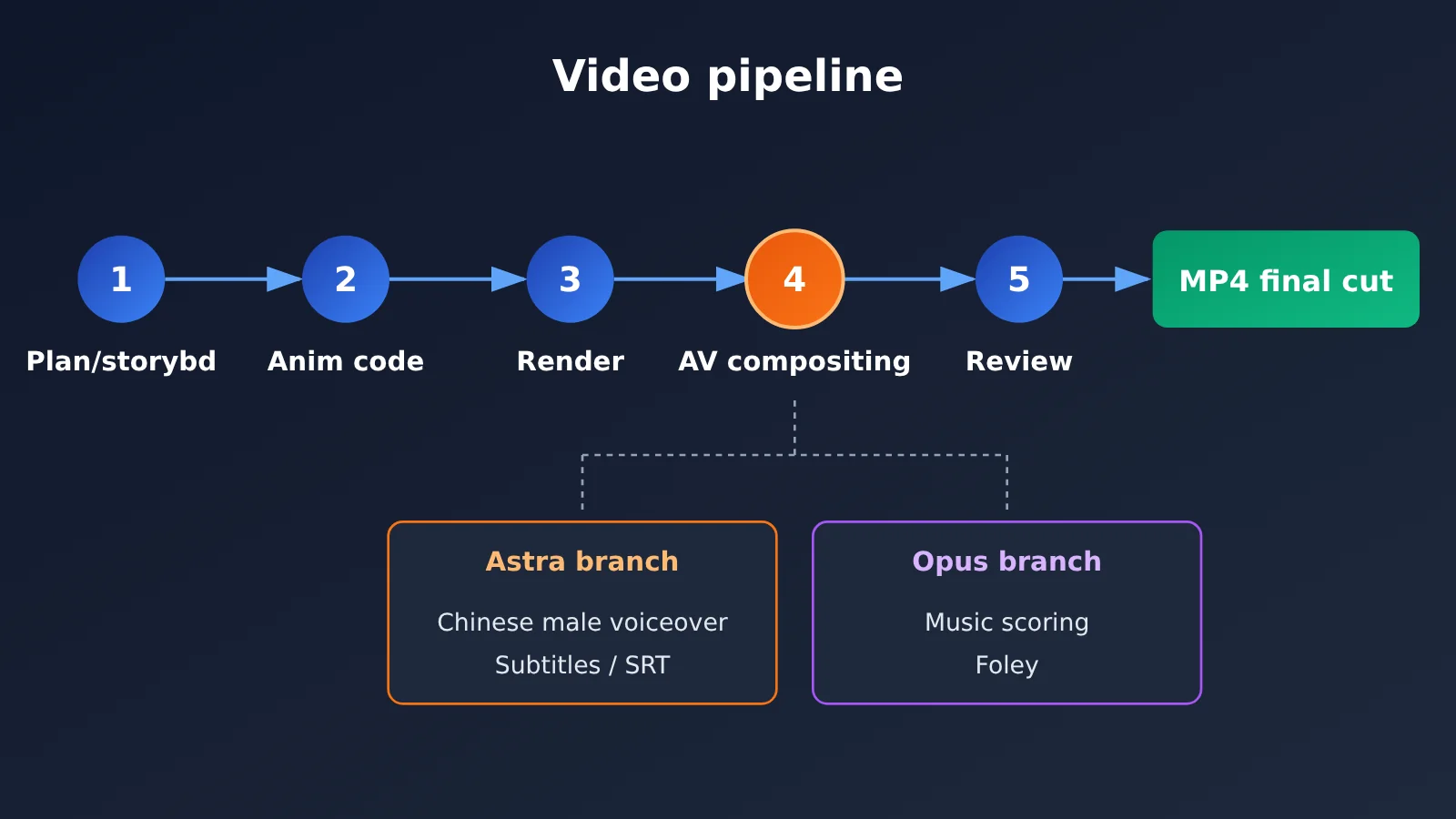
When you look at this flowchart, pay attention to the sound-and-picture compositing step. Astra and Opus took different paths here: one handed the information to voiceover and subtitles, while the other handed the emotion to music and Foley. That split basically determined how the two films felt afterward.
Opus 5.5’s Ink-Wash Nine-Palace Diagram and Astra 6.2’s Courtyard That Tells a Story
Opus 5.5: A Nine-Palace Diagram Written with an Ink Brush
I prefer the ink-wash version, and my reasons are pretty specific.
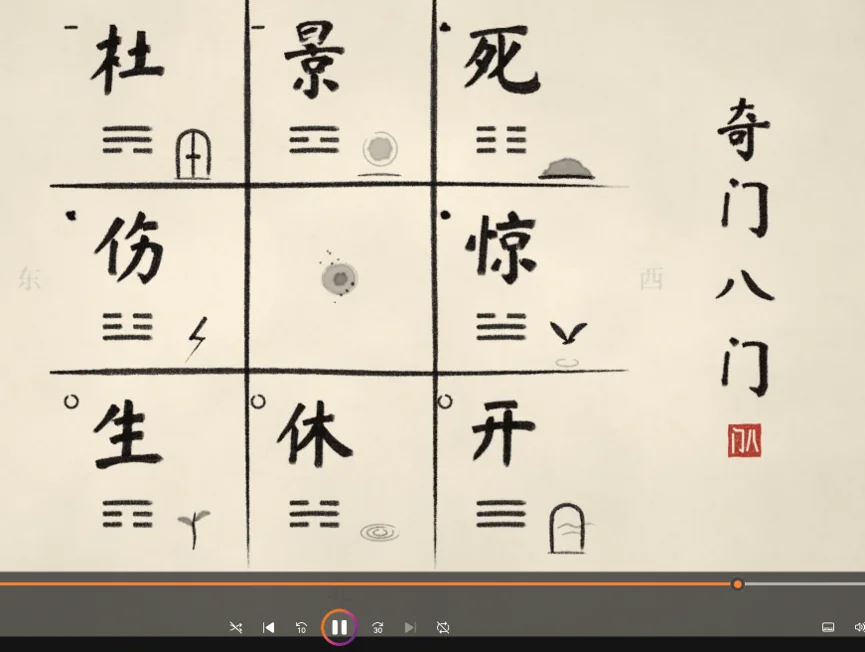
First, the characters. In the video, every Chinese character gets a smooth brush-writing animation — pale paper, dark ink, one stroke at a time. The subject is traditional Chinese divination arts, and the black-on-white ink look fits perfectly.
Second, the camera. After one gate is covered and it cuts to the next, the frame doesn’t simply jump — it zooms and pans, as if the lens were traveling along a nine-palace diagram from one palace to another. You can feel that all eight gates sit on the same diagram and have positional relationships with each other.
Third, the completeness of the content. When the film covers a gate, it also lays out the corresponding hexagram and the original palace position. On the overview shot at 50 seconds, the labels read south on top, north on bottom — the Scenery Gate (景门) at the top, the Rest Gate (休门) at the bottom.
📌 When you look at Figure 1 in the original article, note this: it’s the nine-palace board at the 50-second mark of Opus’s final cut. Watch three things: the diagram explicitly labels south as up and north as down; the Scenery Gate sits at the top and the Rest Gate at the bottom; and each gate is labeled with its corresponding hexagram right beside it. These are exactly the reference points for the discussion of directions later on.
Fourth, the sound. This Opus piece has no human voiceover, but the storyboard and sound-effect materials in the project gave each gate its own distinct sound:
- Harm Gate (伤门) uses thunder, and its reverberation carries right through the next horizontal pan — it feels oppressive.
- Open Gate (开门) is a wind like air flowing in after a door opens; the space suddenly opens up.
- Startle Gate (惊门) — at the time, I heard it as a “buzzing sound.” Only after digging through the project notes did I learn it was labeled as the foley of startled birds flapping their wings.
Let me be clear about this: these sound effects are the creative design of this particular video, not the traditional fixed meanings of the hexagrams. I like it because the sound and the visuals move on the same rhythm, not because “the Harm Gate is supposed to have thunder.”
I once wrote a line in my notes: Opus 5.5 is genuinely thinking about how to make a good-looking video. Looking back now, that line was about how it wove together the three layers of characters, camera, and sound.
Astra 6.2: One Courtyard, Eight Situations
Astra takes a completely different approach. It organizes its narrative around “one courtyard, eight situations,” using a dark ink-green background, fine gold linework, a Chinese male voiceover, and Chinese subtitles.
Where it really shines is the physical imagery. The abstract meanings of the gates get swapped out for actions you can actually see:
- 伤门 (the Harm Gate) is a cracked teacup—the damage reads instantly.
- 杜门 (the Blockade Gate) is a door locked from the inside, with a bolt doing the work of showing you’re shut out.
- 景门 (the Scenery Gate) and 死门 (the Death Gate) share a single lamp: lit for the Scenery Gate, dark for the Death Gate.
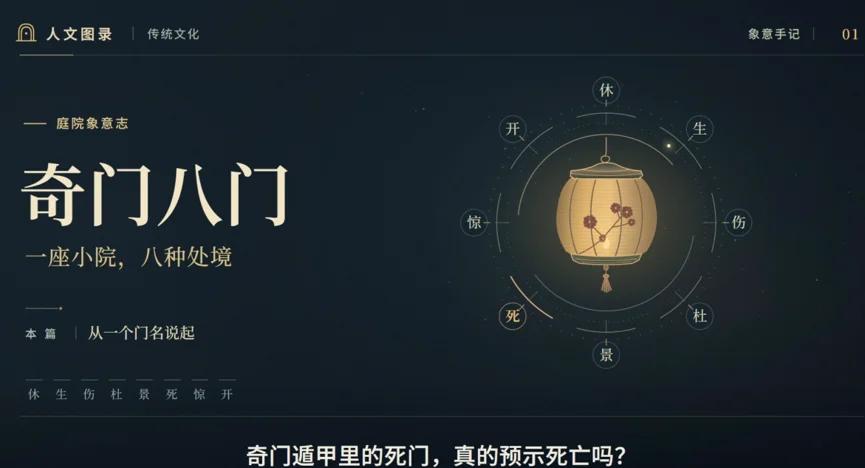
📌 When you look at Figures 2 and 3 in the original, watch for this: Figure 2 is Astra’s 3-second mark, showing lanterns and the Eight Gates ring diagram—pay attention to where each gate sits (top or bottom) on the ring, since we’ll come back to that. Figure 3 is at 29 seconds: a close-up of the door bolt with subtitles. That frame sums up Astra’s whole method: the meaning lands on one concrete object, and the subtitles do the job of spelling it out.
For viewers meeting Qimen Dunjia for the first time, this way of explaining things is very low-barrier. There’s voiceover, subtitles, an SRT file—which also makes it easier to re-edit or produce accessibility captions.
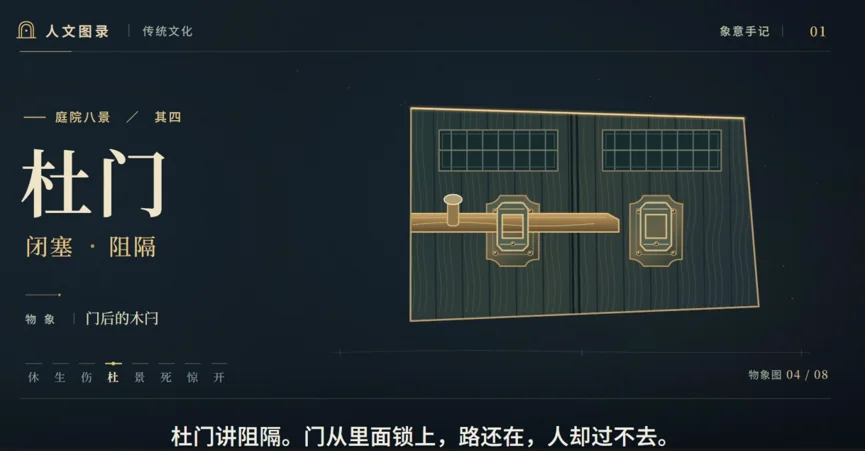
My reservations come down to two points. One is the art style: dark ink-green paired with fine gold lines. I think it’s beautiful, but it’s fairly generic—like a common AI visual style—so creatively it doesn’t hold up to the ink-wash version. The other is transitions: it cuts with a flicker-style transition, like flipping through a slide deck. The action mostly happens on the objects themselves, and the camera rarely takes the lead to walk you through, so the whole piece doesn’t move me the way the ink-wash version does.
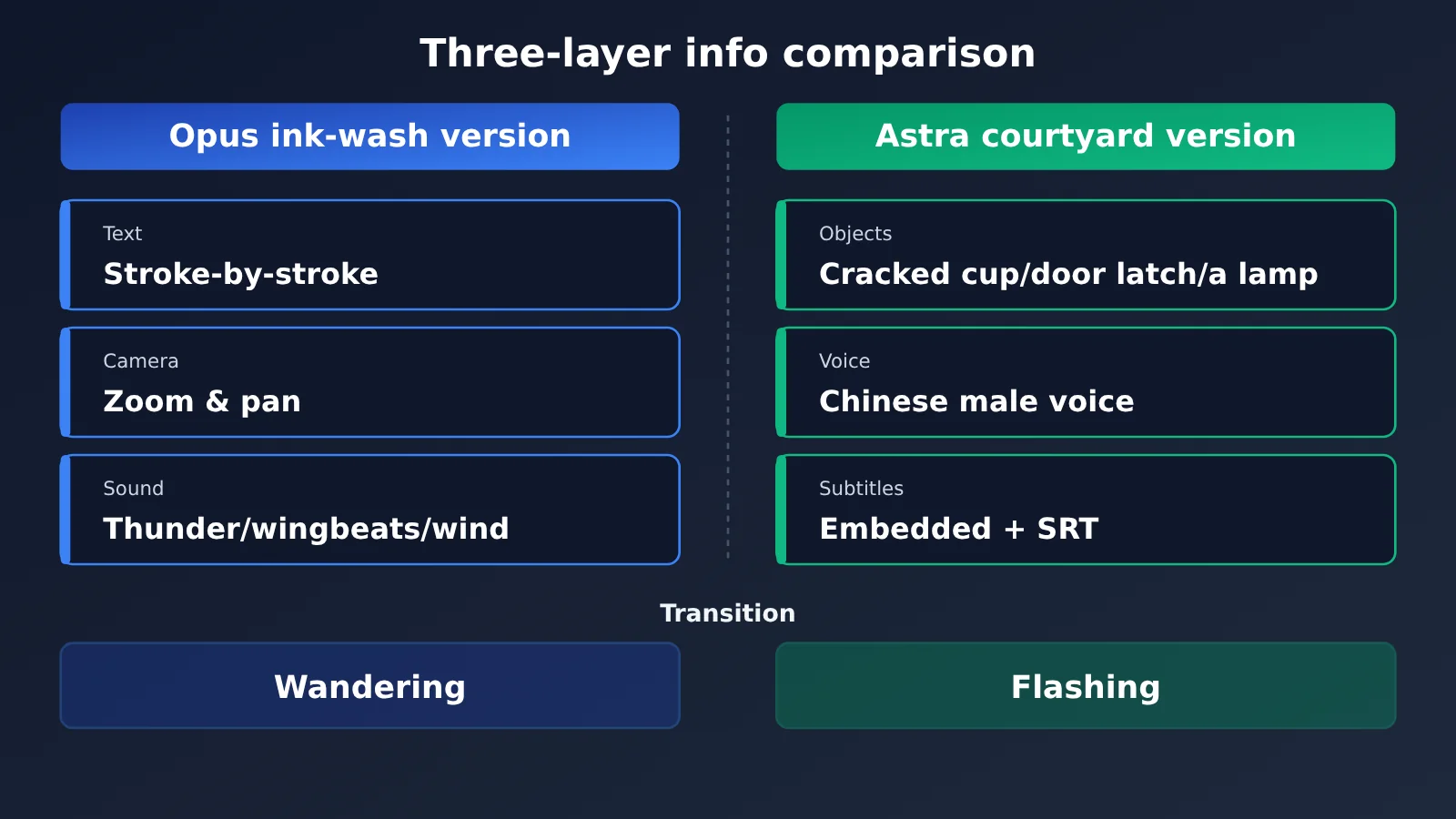
What this comparison chart is getting at: both sides carry three layers of information, but the weight sits in different places. Opus spends its effort on atmosphere and a sense of space; Astra spends its effort on comprehensibility and completeness of delivery. Which one you need more depends on what the film is going to be used for.
This is the detail I care about most when watching the film, and the one I wrote up most heavily in my notes.
In the ring chart in Astra’s opening sequence, “Rest” is on top and “Scenery” is at the bottom. The gate order is fine: Rest, Life, Harm, Concealment, Scenery, Death, Fear, Open. The issue is orientation: compared with Opus’s Nine Palaces chart, which clearly labels south on top and north at the bottom, the gate positions in Astra’s ring chart are effectively rotated 180° as a whole, and the chart doesn’t label the cardinal directions at all.
First, here’s what traditional sources say:
| Source | Content | Inference |
|---|---|---|
| Shuo Gua Zhuan (photocopy of the Ming edition of Zhouyi Gujin Wen Quanshu held by the National Library of China) | Li is south; Kan is due north | With south on top and north at the bottom, Li is on top and Kan at the bottom |
| Ino Takeshi, Basic Research on Qimen Dunjia | Distinguishes the original positions of the Eight Gates from their newly arranged positions; in the original positions, the Rest Gate corresponds to Kan and the Scenery Gate to Li | In the original positions, Rest is at Kan (north) and Scenery at Li (south) |
| Opus final cut, 0:50 | Labels south on top and north at the bottom; Scenery on top, Rest at the bottom | Consistent with the original-position reading with south on top and north at the bottom |
| Astra final cut, 0:03 | Rest on top, Scenery at the bottom; no direction labels | It works if read as north on top and south at the bottom; it’s upside down if read as south on top and north at the bottom |
So if viewers read the chart with the traditional south-up, north-down convention, Scenery should be on top and Rest at the bottom. Under that reading, Astra’s ring chart is inverted. But if it uses a north-up, south-down layout, then Rest on top and Scenery at the bottom also makes sense.
In my notes at the time, I wrote “major error.” Looking at the sources together, the more accurate way to put it is: this isn’t a wrong gate–trigram correspondence; it’s a chart with no orientation label that’s very easy to misread. Neither of the original prompts specified orientation, so I can’t conclude from this that Astra got it wrong.
Still, I think this needs to be made clearer. Most viewers familiar with traditional divination arts default to south-up, north-down, and a chart with no direction labels in the opening sequence can make people think “it’s reversed” at first glance. Adding small “South” and “North” labels costs almost nothing and eliminates the misreading.
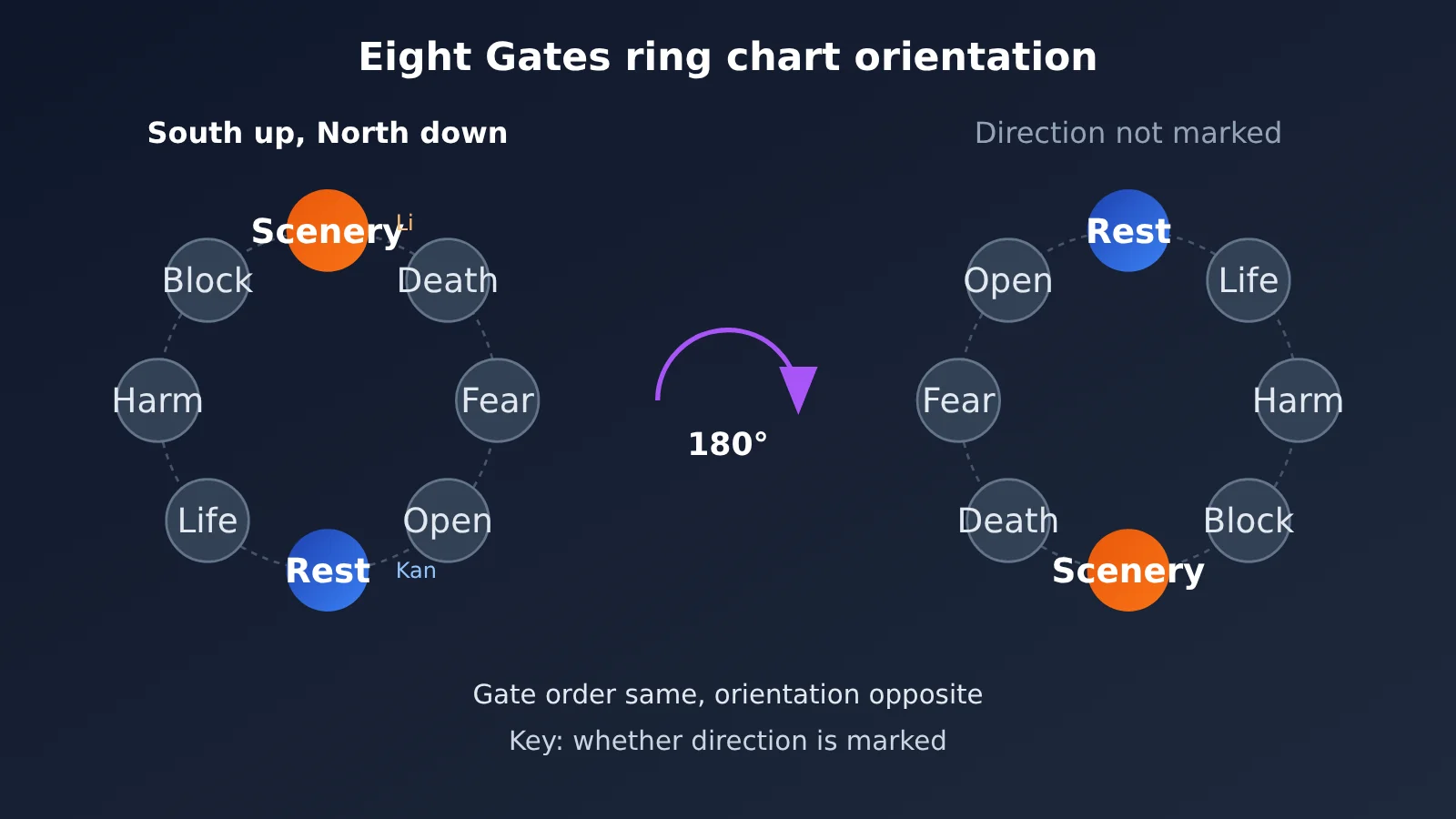
In this diagram, pay attention to the arrow between the two rings: the gate order is exactly the same—the whole chart has just been rotated half a turn. So when judging whether a chart like this is correct, the first step isn’t memorizing the gate order; it’s checking whether the chart labels its orientation.
60-Second Final Cuts from Astra 6.2 and Opus 5.5: How Long They Took, What They Cost
The specs below are based on the verified, matched final cuts:
| Item | Claude Opus 5.5 (ink-wash version) | GPT-6.2 Astra (courtyard version) |
|---|---|---|
| Duration | 60.000 s | 60.000 s |
| Resolution and frame rate | 1920×1080, 30 fps | 1920×1080, 30 fps |
| File size | about 56.81 MiB | about 12.44 MiB |
| Encoding | H.264 + AAC stereo | H.264 + AAC stereo |
| Production time (my estimate) | about 1 hour 30 minutes | about 50 minutes |
| Cost (my records) | about $9 | about 1% of the Pro 100 weekly quota |
A few notes on this table.
In my original notes I had logged Astra as “only 56S” and “12.8M.” The verified matched final cut and its final review record are both 60 seconds, with a file of about 12.44 MiB, so throughout this article I use the final-cut numbers. As for which version the old readings came from, I won’t guess.
Astra’s file is about 22% the size of Opus’s. Both are 1080p, and the size difference has to do with things like compression and how much the picture changes from frame to frame. The ink strokes keep growing and the camera keeps moving, so naturally there’s more data. File size isn’t a score for sharpness or artistic quality.
The times are my end-to-end estimates, start to finish. The cost row has dollars on one side and a percentage of the plan’s weekly quota on the other — different units. I’m not converting between them, and I won’t claim one is “X times cheaper.” This is a record of this one run, not a standard rate.
How to Review a Finished Video Made with Astra 6.2 or Opus 5.5
If you’re also planning to let a Large Language Model drive a short video, my advice is this: when the delivery comes back, don’t rush to praise it — walk through the checklist below item by item. These are checkpoints I distilled from these two videos, not a controlled comparison I’ve already run.
| Check | How to check it | How it went on these two videos |
|---|---|---|
| Duration | Use a player or a media-info tool to see the actual duration; don’t just trust the model’s verbal report | Both final cuts are 60.000 s |
| Voiceover and subtitles | Were they delivered as requested? Are subtitles burned in or delivered as a separate file? Is audio in sync with picture? | Astra has a male voice, burned-in subtitles, and an SRT; Opus has no voiceover, as requested |
| Orientation of key diagrams | Do compass diagrams, maps, and flowcharts mark direction, and does that match domain conventions? | Opus marked south at the top; Astra’s ring chart has no orientation marks |
| Transitions | Are transitions helping the content establish relationships, or are they just there to “cut over”? | Opus uses zoom and pan to link the nine panels; Astra’s are mostly flash-style |
| Sound design | Do sound effects sync with the visual rhythm, and could they be misread as a factual point? | Opus gives each gate its own sound — a creative choice, not a traditional meaning |
The third row is the one to watch most. Problems like duration and subtitles jump out at you, but orientation is easy to let slide — and it’s exactly the thing that most affects a professional viewer’s trust.
FAQ
Q1: Is this a fair head-to-head between GPT-6.2 Astra and Claude Opus 5.5?
No. The two prompts differ in their voiceover, and the art-style references differ too — plus there’s only one sample per side. Think of it as a record of one person running the same brief through a workflow. It’s useful for the approach, not for rankings.
Q2: When were the two models released?
According to their official intro pages, Claude Opus 5.5 launched on 2026-09-22 and GPT-6.2 Astra on 2026-11-17. At the time this was written (2026-11-19), both were available.
Q3: So are Astra’s eight gate positions actually wrong?
The gate order is correct. The gate positions on the ring diagram are rotated 180° relative to Opus’s south-up, north-down layout, and no orientation is labeled. Read it as south-up, north-down and it looks inverted; read it as north-up, south-down and it holds up. The more accurate way to put it is “the orientation needs to be labeled,” not “the correspondences are wrong.”
Q4: Opus’s files are way bigger — does that mean better image quality?
You can’t infer that. Both are 1920×1080 at 30 fps. File size is driven by compression method and how much the frame changes; ink-wash brushwork and continuous camera movement add data, but that isn’t the same thing as sharpness or artistic quality.
Q5: Which style suits my film better?
If you need to explain concepts clearly, keep novice viewers on board, or plan to re-edit later, Astra’s structure — concrete imagery plus voiceover plus subtitles — is more practical. If you’re going for atmosphere and want the imagery to stick in people’s memory, Opus’s three-layer weave of text, camera, and sound is more affecting.
Q6: Are the thunder and wind sounds in the final cut traditional Qimen meanings?
No. Those are sound design choices for this particular piece, used to match the visual rhythm. In the Jingmen segment, the project notes call for a startled-bird wing-flap foley — at the time I heard it as a humming sound. When you watch, treat them as creative choices, not as factual content.
Key Takeaways from the Astra 6.2 vs. Opus 5.5 Same-Prompt Videos
- The tasks weren’t fully equivalent: Astra needed voiceover and subtitles, Opus didn’t need voiceover, and the art-style references were different too.
- Opus wins on atmosphere: stroke-by-stroke writing, zooming and panning, sound assigned door by door — it turns the nine-palace diagram into a kind of wandering journey.
- Astra wins on clarity: a cracking cup, a door latch, a single lamp — the abstract meanings of the doors become visible actions.
- Label the orientation clearly: Astra’s ring diagram had no direction markers, so reading it with south at the top and north at the bottom easily makes it look flipped.
- Judge specs by the finished film: both are 60 seconds at 1080p; a difference in file size doesn’t mean a difference in image quality.
- Don’t convert costs: roughly $9 and about 1% of the weekly quota are measured in different units — these are just personal notes.
Summary
If I could keep only one, I’d keep Opus’s ink-wash version. What moved me was that feeling of “wandering along a single image”: the characters are written out, the camera walks past, and the sound shifts with each door. I’d also recommend Astra’s courtyard version to friends — especially anyone who wants to quickly grasp what the eight doors are about. Its metaphors are spot-on, and the subtitles and voiceover are delivered very completely; it’s just that the transitions and that direction-less ring diagram in the opening left it one step short of “beautiful and professional.”
The biggest takeaway this time wasn’t learning which model is stronger, but realizing that these differences only show up in the film itself. Reading the spec sheet, I’d have assumed the two were about the same: same duration, same resolution. Only after actually watching frame by frame did I see the brushstrokes, the thunder, and that diagram rotated half a turn.
Lu You wrote in “Reading to My Son Ziyu on a Winter Night”: “What you get from paper always feels shallow; to truly know a thing, you must practice it yourself.” It’s the same with having a Large Language Model make videos: no matter how well you write the prompt, in the end you still have to sit down and watch the film from start to finish.
📚 References
-
OpenAI’s official introduction of GPT-6.2 Astra: used to confirm the model name and release date
- Link:
openai.com/index/introducing-gpt-6-2-astra-sol/ - Note: Released 2026-11-17, accessed 2026-11-19
- Link:
-
Anthropic’s official introduction of Claude Opus 5.5: used to confirm the model name and release date
- Link:
anthropic.com/claude-opus-5-5 - Note: Released 2026-09-22, accessed 2026-11-19
- Link:
-
Tsuyoshi Ino, A Basic Study of Qimen Dunjia: Hokkaido University, Research Papers No. 10
- Link:
eprints.lib.hokudai.ac.jp/repo/huscap/all/44606/INO.pdf - Note: Page 177 distinguishes the original positions of the Eight Gates from their newly assigned positions; the original Rest Gate corresponds to Kan, and the Scenery Gate corresponds to Li
- Link:
-
Photocopy of the Ming edition of Zhouyi Gujinwen Quanshu held by the National Central Library: including its “Shuogua Zhuan”
- Link:
upload.wikimedia.org/wikipedia/commons/3/3f/NCL-00087_09_%E5%91%B8%E6%98%93%E5%8F%A4%E4%BB%8A%E6%96%87%E5%85%A8%E6%9B%B8.pdf - Note: Explicitly states that Li is south and Kan is due north; used to check the cardinal directions in the image
- Link:
-
Materials published by the Palace Museum: verification of the original lines of Lu You’s “Reading on a Winter Night, to Show Ziyu”
- Link:
dpm.org.cn/Uploads/File/2022/02/22/u62144e6a4c412.pdf - Note: “What you get from paper always feels shallow; to truly know a thing, you must practice it yourself.”
- Link:
Author: APIYI Technical Team