
Author’s note: At a livestock company with around 120 employees, the general manager built a livestock management system himself using AI coding tools. Rather than repeat the claim that “anyone can develop software,” this article examines what made the case possible—and the limits business professionals still face when building their own systems with AI.
In November 2026, the results of the World Internet Conference Wuzhen Summit’s Leading Science and Technology Award were announced. Qoder, an agent platform under Alibaba, was the only general-purpose Agent product from China to receive an award. One case in the coverage could easily be retold as “business professionals can build their own systems”: Zhang Lifei, general manager of Ningxia livestock company 西鲜记, used AI coding tools to build multiple business systems, including a livestock management system in just over three months.
This isn’t a story about someone with no technical background becoming a programmer overnight. Earlier in his career, Zhang worked in R&D at Huawei and Ericsson. He also knew his company’s livestock, slaughter and processing operations inside out. Those two factors determine both what this case can tell us and what it can’t.
What you’ll learn: By the end of this article, you’ll be able to assess whether your business needs are a good fit for building a system with AI—and understand the three hurdles of describing requirements, checking results and maintaining the system over time.
Business Users Building Their Own Systems With AI: The Case at a Glance
Let’s start with the facts the report confirms before looking at what they mean. The information below comes from GeekPark’s November 5, 2026 report.
| Item | Details |
|---|---|
| Company | Xixianji, a business with around 120 employees spanning sales, livestock farming, slaughter, and processing |
| Background | General manager Zhang Lifei previously worked in R&D at Huawei and Ericsson. He returned to his hometown to start the business in 2015 and is the company’s only technical R&D staff member |
| Business challenge | Three farms and more than 10,000 Tan sheep were managed using complex Excel spreadsheets. The profit on a batch couldn’t be calculated until the sheep were sent to slaughter |
| Previous options | Off-the-shelf software was hard to adapt. Custom development quotes could reach millions of yuan and would require ongoing communication and revisions |
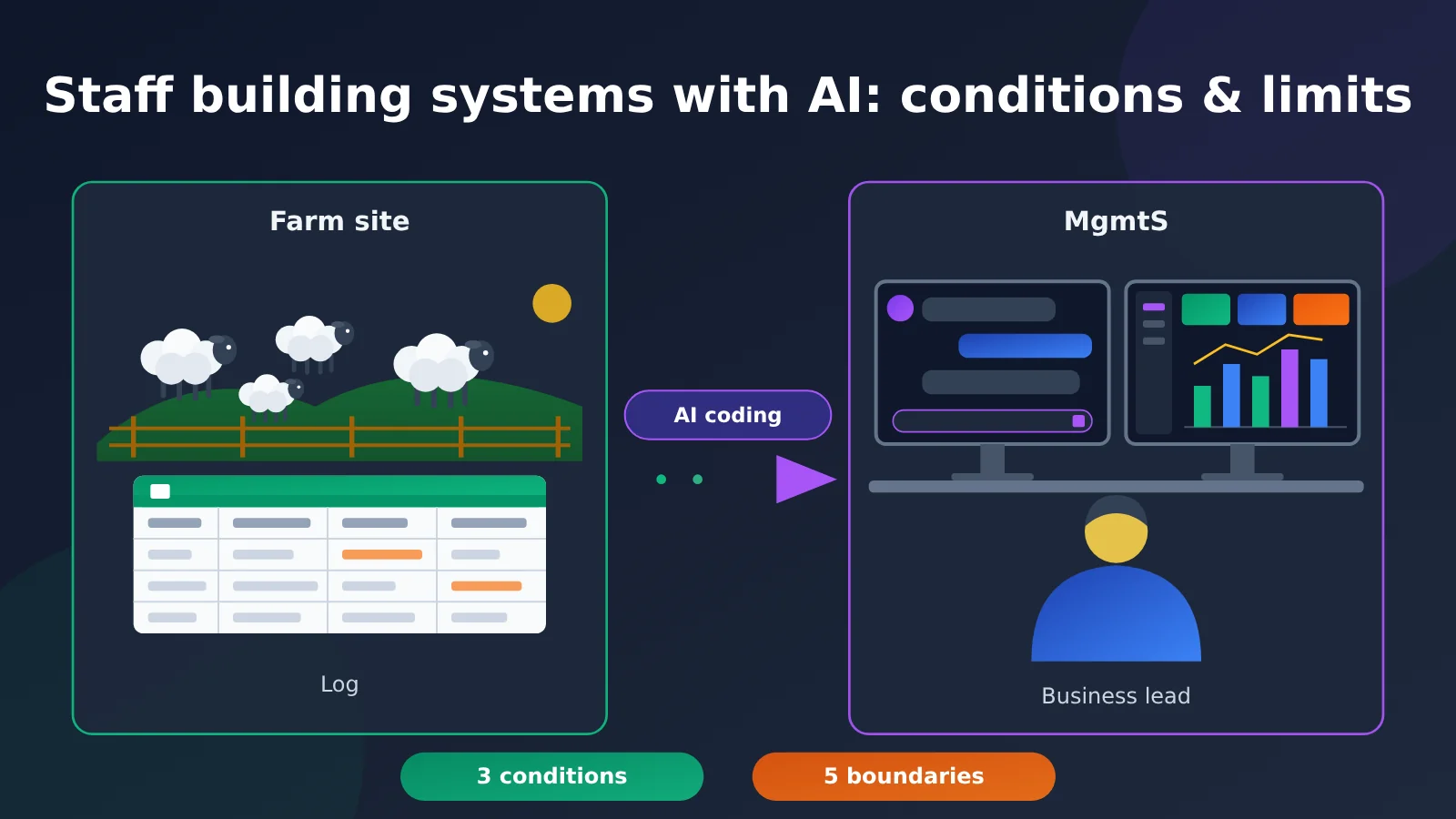
| Development approach | Starting in 2026, Zhang used Qoder after work and between business trips, opening multiple sessions across two computers. He described requirements in natural language, and AI read the project, modified code, and ran tasks. Zhang checked the results himself |
| Results | In just over three months, he built several systems, including a livestock management system used for daily feeding, growth monitoring, and decisions about when to send sheep to slaughter. Some issues that previously surfaced only at slaughter were identified during feeding |
| Company-reported benefit | The company expects to reduce hidden losses by several million yuan per year; the calculation method wasn’t disclosed |
What Building Systems With AI Actually Looks Like for Business Users
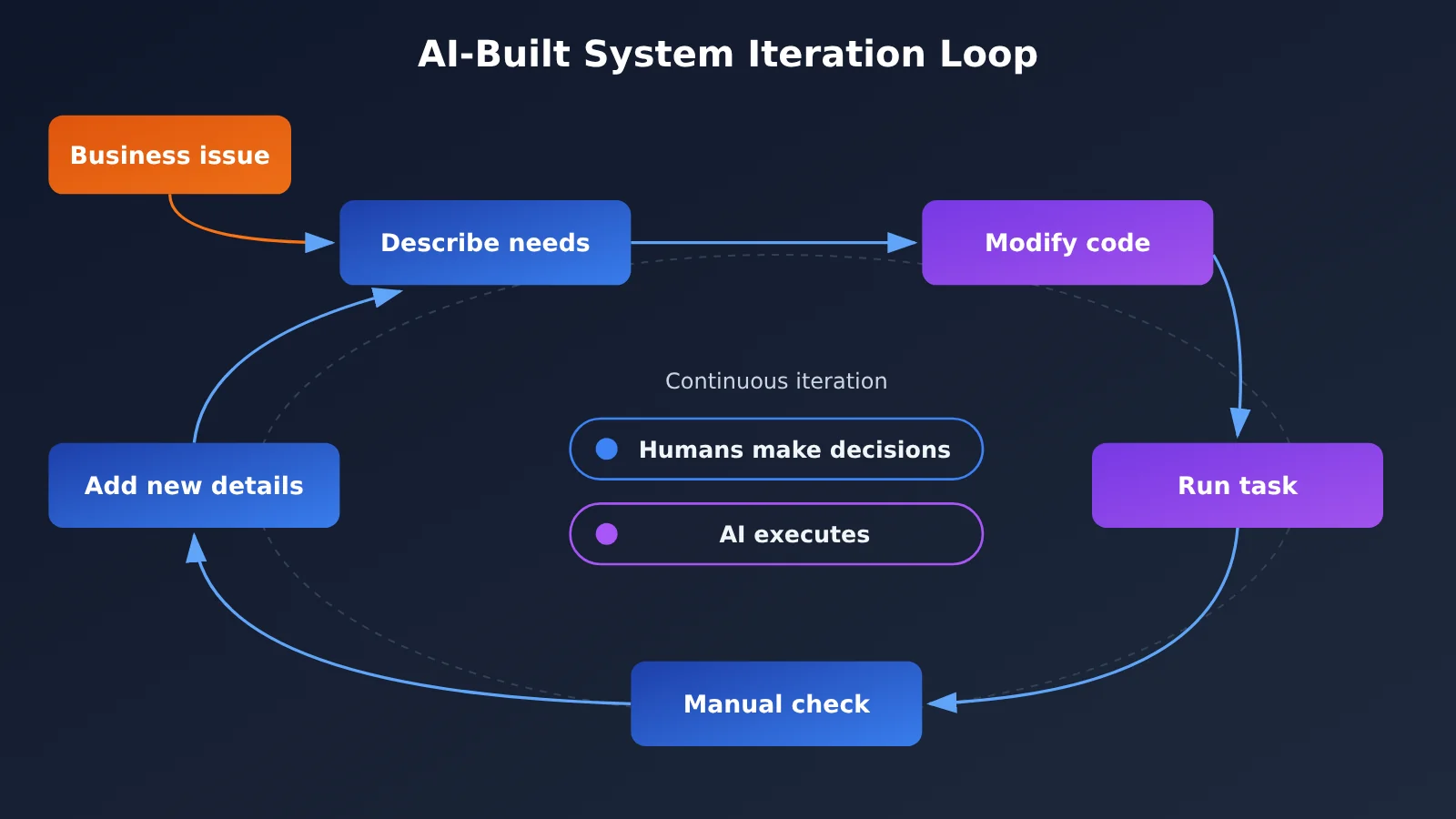
There’s an easily overlooked detail in the report: Zhang didn’t simply “say one sentence and get a finished system from AI.” He kept multiple development sessions open, switching to another while one task was waiting for output. After AI made changes, he checked the results himself and added new information from the business.
This is a collaboration between a business expert and an AI executor. People remain responsible for breaking down requirements, judging whether the results are acceptable, and setting the direction for each iteration. AI handles writing and modifying code and running tasks. Viewed this way, the takeaway from the case becomes clearer.
Business Users Building Systems With AI: What Barriers Does AI Lower?
Building internal tools with AI coding tools essentially redistributes work that once required a small team. The table below compares each stage of traditional custom development with how it was handled in this case.
| Development stage | Traditional custom development | How it was handled in this case | Does AI significantly lower the barrier? |
|---|---|---|---|
| Requirements gathering | A product manager conducts research and writes documentation | The business lead describes the requirements directly | No, it still depends on business understanding |
| Coding and implementation | Front-end and back-end engineers develop separately | AI reads the project and modifies the code | Yes, this is where AI makes the biggest difference |
| Running and debugging | Engineers debug locally | AI runs tasks and a person checks the results | Partially |
| Acceptance testing | Business and development teams communicate over multiple rounds | The business lead checks the results directly | Communication costs fall, but judgment is still essential |
| Ongoing iteration | Submit requests, schedule work, and release updates | Add changes as new business situations arise | Yes, iteration cycles are significantly shorter |
As the table shows, AI makes the biggest difference in turning clear requirements into working code and reducing communication overhead between the people requesting and building the system. For Zhang Lifei, the biggest challenge had been the lack of a team that could turn his ideas into a system—and that’s exactly where AI coding tools can help.
But requirements gathering and acceptance testing haven’t gone away. Instead, more of that work now falls on the business lead. The report itself notes that the new version of Qoder is aimed at people who “have clear goals and can judge the quality of the output.” That qualification matters.
3 Prerequisites for Business Users Building Systems With AI
Based on this case, three things need to be in place for this approach to work:
- Know where the problem is: Zhang Lifei knew that “not knowing how much profit a batch of sheep makes until after slaughter” was the core pain point. The requirements had a clear business goal.
- Be able to explain the requirements clearly: Describe the fields, workflows, and calculation rules, and provide acceptance criteria that can be checked—instead of just saying, “Build me a management system.”
- Be able to judge whether the output is correct: His development background helps him understand the structure, spot logic errors, and correct the AI when it goes off track.
Of these three conditions, most business leads already meet the first. The second and third are the real dividing lines. People without a development background can still do this, but they’ll need to invest extra time in learning. And a single case can’t tell us how often they’ll succeed.
🚀 Quick start: If you want a low-cost way to test whether you can explain your requirements clearly, try using a Large Language Model to organize your business description into a structured requirements document. With APIYI apiyi.com, you can access multiple leading models using a single API key—handy for running a small experiment before deciding whether to invest in full development.
Before Business Users Build a System with AI: Turn Requirements into a Specification
Many self-built projects fail not because AI can’t write the code, but because the requirements are unclear. Before you start building, ask a model to turn your informal business description into fields, rules, and acceptance criteria, then check each item yourself.
Here’s a minimal example that uses an OpenAI-compatible API to turn a business description into a requirements specification:
import openai

client = openai.OpenAI(
    api_key="YOUR_API_KEY",
    base_url="https://api.apiyi.com/v1"
)

desc = "三个养殖场,按批次记录每天饲料消耗和羊的体重,想在出栏前就知道每批羊大概赚多少钱。"
resp = client.chat.completions.create(
    model="gpt-4o-mini",  # Can be replaced with another model available on the platform
    messages=[{"role": "user", "content": f"把以下业务需求整理成数据字段、计算规则和验收条件:{desc}"}]
)
print(resp.choices[0].message.content)
View the full implementation (including follow-up questions for unclear requirements)
import openai
from typing import Optional

SYSTEM_PROMPT = (
    "你是资深业务分析师。请把用户的业务描述整理为:\n"
    "1. 核心数据实体与字段(含单位)\n"
    "2. 计算规则(写出公式)\n"
    "3. 验收条件(每条都必须可被人工检查)\n"
    "4. 需要用户补充确认的问题清单\n"
    "不要假设用户没说过的规则,不确定的地方放进问题清单。"
)

def build_spec(
    business_desc: str,
    model: str = "gpt-4o-mini",
    extra_context: Optional[str] = None,
    max_tokens: int = 1500
) -> str:
    """Turn an informal business description into a verifiable requirements specification."""
    client = openai.OpenAI(
        api_key="YOUR_API_KEY",
        base_url="https://api.apiyi.com/v1"
    )
    content = business_desc
    if extra_context:
        content += f"\n补充背景:{extra_context}"

    try:
        resp = client.chat.completions.create(
            model=model,
            messages=[
                {"role": "system", "content": SYSTEM_PROMPT},
                {"role": "user", "content": content},
            ],
            max_tokens=max_tokens,
        )
        return resp.choices[0].message.content
    except Exception as e:
        return f"调用失败:{e}"

if __name__ == "__main__":
    spec = build_spec(
        business_desc="按批次管理在栏羊,记录每日饲料消耗、体重和生长阶段,"
                      "希望出栏前估算每批羊的成本和利润。",
        extra_context="目前用 Excel 台账,有三个养殖场。"
    )
    print(spec)
This code won’t build the system for you. Its value is in exposing the things you thought you’d explained clearly but hadn’t. The longer the model’s list of questions, the more work your requirements likely need before you hand them to an AI coding tool for implementation.
Can Business Users Build Their Own Systems With AI? A Framework for Deciding
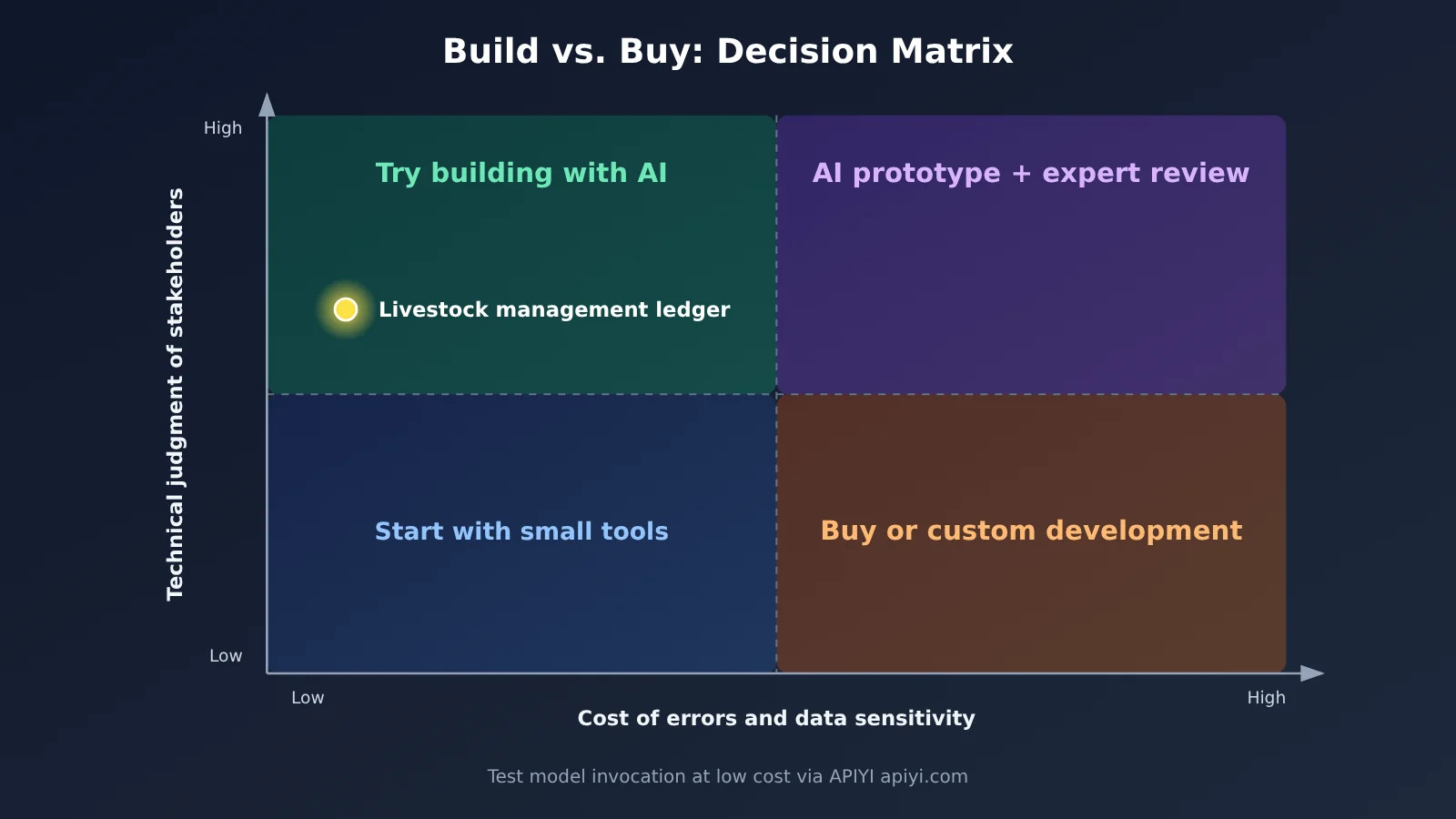
This case shows that, under the right conditions, business users can build their own internal systems with AI. But it doesn’t prove that every system is suited to this approach. The framework below can help you decide what you can build yourself first and where you should bring in a professional team.
| Evaluation criterion | Suitable for building with AI first | Professional team recommended |
|---|---|---|
| Scope | Internal department use, a small number of users | Customer-facing or cross-organization use |
| Data sensitivity | Operational records, internal statistics | Personal information, payments, financial accounting documents |
| Permission complexity | Few roles, simple permissions | Multi-level approvals, granular access controls |
| Cost of errors | Errors can be spotted and corrected manually | Errors can directly cause financial loss, compliance violations, or security incidents |
| System integration | Relatively standalone; import and export are sufficient | Requires integration with ERP, payment, or government regulatory platforms |
| Long-term maintenance | The person who needs the system can maintain it | Requires team collaboration and 24/7 availability |
Xixianji’s livestock management system falls mostly on the left: it’s used internally to support feeding and market-readiness decisions, and someone can spot problems quickly. If your needs fall into the same category, building with AI is worth a try. If several criteria fall on the right, a safer approach is to use AI to create a prototype, refine the requirements, and then hand it over to a professional team or buy an established product.
Comparing Three Paths: Buying, Custom Development, and Building With AI
Putting the three paths side by side makes the differences clearer:
| Path | Key characteristics | Best suited for | Main risks | Available resources |
|---|---|---|---|---|
| Buy off-the-shelf software | Ready to use, standardized features | Processes that match industry norms | May be difficult to adapt to customized workflows | Industry SaaS vendors |
| Commission custom development | Professional team, standardized delivery | Complex, highly sensitive systems with multiple integrations | High cost and lengthy communication cycles | Outsourcing firms or software companies |
| Business users build with AI | Fast iteration, closest fit to business needs | Internal tools where the requester understands the business and can validate the result | Security, permissions, and maintenance depend on an individual | AI coding tools; model invocation can use APIYI apiyi.com |
These paths aren’t mutually exclusive. A common combination is to first build with AI to get the workflow running and validate the requirements. Once the system has more users or handles more sensitive data, you can decide whether to have a professional team rebuild it.
The Impact of Business Staff Building Their Own Systems with AI
Impact on Small and Midsize Business Leaders
- Ideas no longer have to be shelved for lack of a team: Companies like 西鲜记, which has just one technical R&D employee, used to choose between unsuitable off-the-shelf software and expensive custom solutions. Now they have another option to explore.
- Business knowledge becomes more valuable: The people who know the business best can build their expertise directly into a system and refine it through daily use, reducing the information lost when translating business needs into technical requirements.
- Leaders face a greater time commitment: The report says Zhang Lifei worked on development after hours and between business trips. That time is a cost too, so it can’t simply be considered “zero cost.”
Impact on Professional Development Teams and IT Departments
- The role shifts from “writing code” to “providing a safety net”: As business staff build more tools of their own, professionals will be needed to handle security reviews, access controls, data backups, and system integration.
- Shadow IT risks increase: If every business department builds its own AI-powered tools, data can become fragmented, definitions can diverge, and systems may be left without maintainers when employees leave. Standards need to be established early.
5 Questions This Case Hasn’t Answered
The report presents a success story, but the following information is just as important for decision-makers and isn’t covered in the publicly available material:
| Point to verify | Why it matters |
|---|---|
| How the “millions of yuan in hidden losses” were calculated | Without this, it’s impossible to tell whether similar benefits could be achieved in your own business |
| Plans for system security, access controls, and data backups | These determine whether the system can safely handle core business data over the long term |
| Ongoing maintenance and incident resolution | Maintenance is the biggest hidden cost of a self-built system |
| Tool fees and model invocation costs | The “zero cost” cited in the report doesn’t account for tools or time invested |
| Successes and failures among business staff without a development background | A single case can’t represent typical outcomes |
Until these questions are answered, a more reasonable view is to treat this case as evidence that it’s feasible under the right conditions—not that anyone can do it.
Frequently Asked Questions
Q1: Can business professionals without a development background build their own systems with AI?
It’s possible, but considerably harder. The person in this case study had development experience at Huawei and Ericsson, so they could understand code structure and judge whether AI-generated output was correct. Without that background, you’ll at least need to learn to write clear acceptance criteria and be willing to spend time troubleshooting. There aren’t many documented, systematic examples involving people without development experience, so it’s best to start with a small tool.
Q2: How do I choose between building a system with AI and outsourcing custom development?
Consider three things: the cost of errors, data sensitivity, and who’ll maintain the system long term. Building it yourself is a good starting point for internal tools where errors can be corrected manually and the person requesting the system can maintain it. Professional custom development is better suited to systems involving personal information, payments, or cross-system integration. You can also use AI to build a prototype and clarify your requirements before discussing them with an outsourcing provider, which can often reduce rework.
Q3: Is building a system with AI really “zero cost” for business professionals?
No. Even if the tools offer free usage, there may still be subscription fees and model invocation costs, as well as the easily overlooked cost of your time. The person in this case study spent more than three months developing the system after work and between business trips. That investment should be part of your decision.
Q4: How can I validate an idea cheaply before starting full development?
You can use a Large Language Model to turn your business description into a requirements specification and acceptance checklist, then build a minimum viable version. Here’s how:
1. Register at APIYI apiyi.com to get an API key and free testing credits
2. Use the code example in this article and set base_url to `https://api.apiyi.com/v1`
3. Generate requirements specifications with different models and compare which one best fits your business
This step costs very little and can help you spot ambiguities in your requirements early.
Q5: What should I pay the most attention to after launching a self-built internal system?
Prioritize three things: regular data backups, separating accounts and permissions, and documenting critical calculation logic. Self-built systems often depend heavily on their original developer. If that person leaves or the system fails, recovery can be difficult without backups and documentation. As the user base grows, consider asking a professional to review the system’s security and architecture.
Q6: How can I control model invocation costs when my self-built tool needs Large Language Model capabilities?
If your internal tool needs to call a model—for example, to generate report descriptions or recognize documents—choose models based on task difficulty. Use lightweight models for simple tasks and more capable models for complex analysis. With the OpenAI-compatible interface from APIYI apiyi.com, you can switch between models using the same code and pay based on usage. This makes it easier to compare results and costs before settling on an approach.
Key Takeaways: Business Teams Building Their Own Systems With AI
- The case has important caveats: The person behind it had both a development background and deep business knowledge. It doesn’t simply prove that “anyone can build software.”
- AI makes implementation more accessible: Coding and iteration get faster, but people still need to clarify requirements and validate results.
- Good candidates for building in-house: Internal tools that use non-sensitive data and whose errors can be corrected manually.
- Systems that need professional involvement: Those involving personal information, payments, complex permissions, or integration with multiple systems.
- Don’t overlook hidden costs: Factor in time, tool expenses, and long-term maintenance.
- Validate before committing: Use APIYI apiyi.com to call models at low cost and turn requirements into specifications, then decide whether to build, buy, or commission a custom solution.
Conclusion
The Xixianji case shows that when a business leader understands the problem, can articulate the requirements, and can assess the results, AI coding tools can bring previously shelved system ideas to life. There are three key takeaways:
- The barrier to entry really is lower: AI can now handle much of the work involved in turning requirements into working code.
- Human judgment remains essential: People who understand the business are still responsible for describing requirements, checking results, and maintaining the system.
- Set boundaries early: Data security, permissions, and long-term maintenance determine which systems you can build in-house and which need a professional team.
If you’re considering building an internal tool with AI, start with a small process where mistakes are low-cost. Use AI to turn your requirements into a specification and build a prototype, then decide what to do next based on the results. Try APIYI apiyi.com to quickly validate the approach—you can compare multiple leading models with a single API key.
📚 References
- GeekPark – What Helped Qoder Lead China’s AI Coding Market and Win a World Internet Conference Leading Technology Award: Source for the case study facts in this article
- Link:
geekpark.net/news/373542 - Notes: Covers the Xixianji farming management system case study and AI coding practices at companies including Geely and Shanda Huatian
Author: APIYI Technical Team
Technical discussions: For questions about model invocation and internal tool integration, contact us through the APIYI homepage at apiyi.com