Author’s note: Grok 4.8 hasn’t shown up in the official model docs yet, but the outside world has already drafted its to-do list. This article covers just the one extra item on that list: cutting the long reasoning. Who asked for it, whether there’s a rationale behind it, whether it can be tied to the default reasoning tier in the docs — and which model developers can actually call today, and how the pricing works.
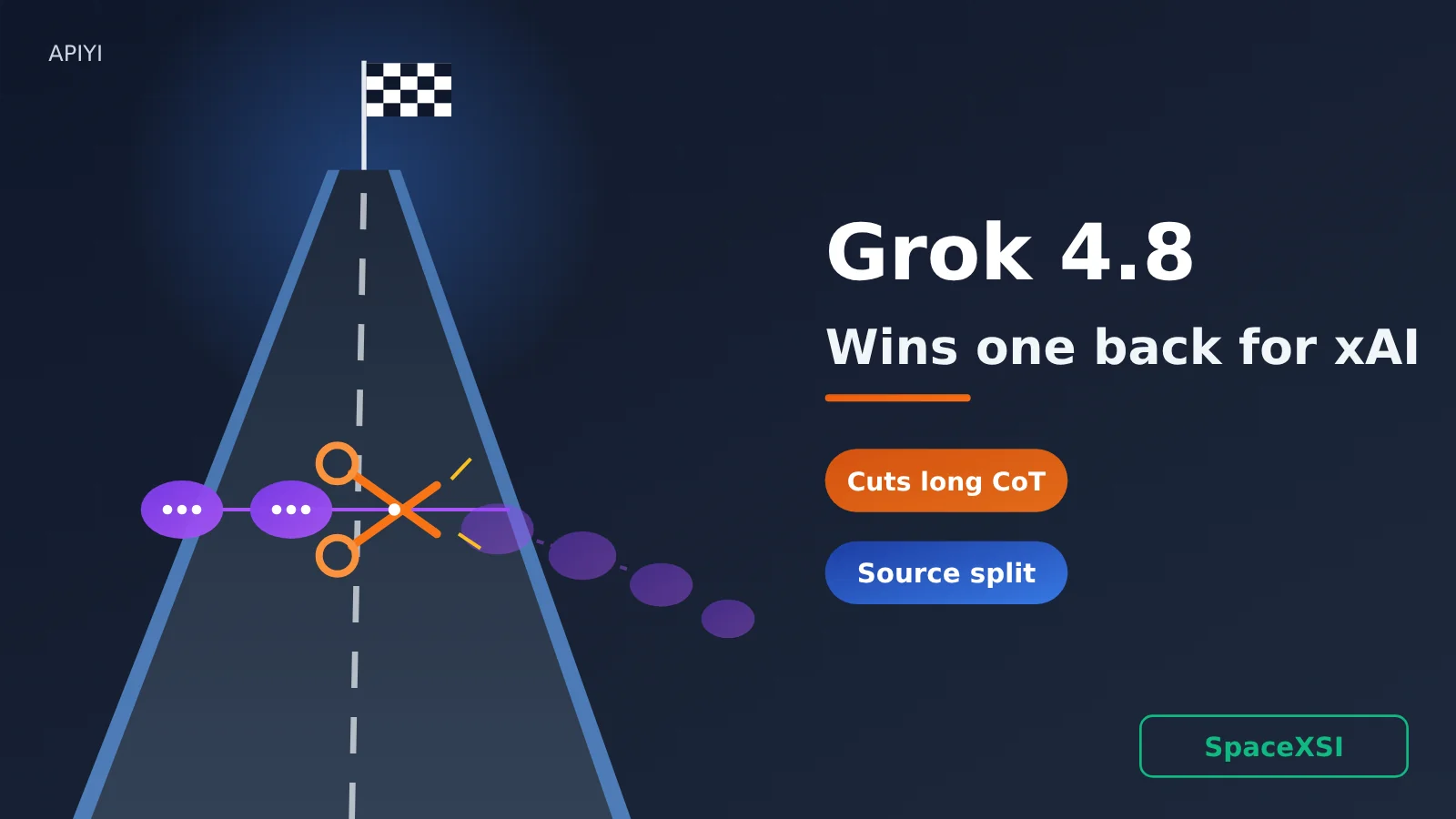
In the discussions around Grok 4.8, “to win one back, you’ve still got to cut the long reasoning” is the line most likely to get garbled in the retelling. It comes from a personal post on X — not an announcement from xAI (now named SpaceXSI), and not an official roadmap.
This isn’t a reading of an official promise. It’s a source breakdown: what the original post said, what the official docs say, and what the APIYI platform master table can tell you — listed separately, not woven together into a cause-and-effect chain.
Core value: In a few minutes, get clear on where Grok 4.8’s “cut the long reasoning” requirement comes from and where its boundaries lie — and know which model to use today and which tier you’ll be billed at.
Grok 4.8: The Core Facts at a Glance
Let’s start with what can actually be confirmed, all in one table. Anything marked “original post” reflects only the poster’s personal opinion; anything marked “official docs” was verified as of 2026-11-27.
| Item | Details | Source |
|---|---|---|
| Has Grok 4.8 shipped? | No grok-4.8 in the official model docs | Official docs (verified 2026-11-27) |
| Recommended model for text tasks right now | Grok 4.7 | Official docs |
| Who proposed “cut the long reasoning” | X user Pavel (@pavelsvitek) | Original post |
| Was a reason given for cutting the long reasoning? | No explanation | Original post |
| Expected capability range | Should land at least between Sonnet 5.5 and Opus 5.5 as a baseline | Original post |
| Is grok-4.8 available on APIYI yet? | Not listed yet — we’ll get this model listed as soon as we can | APIYI master list (2026-11-27 11:59, UTC+8) |
Where the “Winning One Back” Framing for Grok 4.8 Comes From
“Winning one back” is this article’s own summary, not xAI’s announcement language. It maps to the situation Pavel describes in his post: in coding-tool scenarios, the Cursor route may be out of the running, and right now Grok Bot is mostly carrying the load. Against that backdrop, he sets a passing grade for the next-generation model.
His exact words are: needs to land between at least Sonnet 5.5 -> Opus 5.5 as baseline (and remove the lengthy reasoning of Grok 4.7). In other words, it should land at least in the Sonnet 5.5 to Opus 5.5 range as a baseline — and ditch Grok 4.7’s lengthy reasoning. That half-sentence in parentheses is the “extra requirement on the roadmap” this article is here to unpack.
Grok 4.8 Cuts Long Reasoning: What the Original Post Actually Says
When you unpack this half-sentence, there are three boundaries worth holding onto. First, it’s a request Pavel tacked onto the same post, sitting right next to “landing in the Sonnet 5.5 to Opus 5.5 range” — part of his wish list for Grok 4.8. Second, it’s not an xAI commitment; the company hasn’t said a single word publicly about whether Grok 4.8 will shorten its reasoning. Third, he only says he wants it gone — he never explains why.
So “cut the long reasoning” can’t be framed as Grok 4.8’s headline feature, nor as a product direction that’s already settled. It reads more like a user giving direct feedback on the experience: the last generation’s thinking process ran too long, and he’d like the next one to tighten it up.
Replies and @grok Responses Aren’t Official Grok 4.8 Strategy
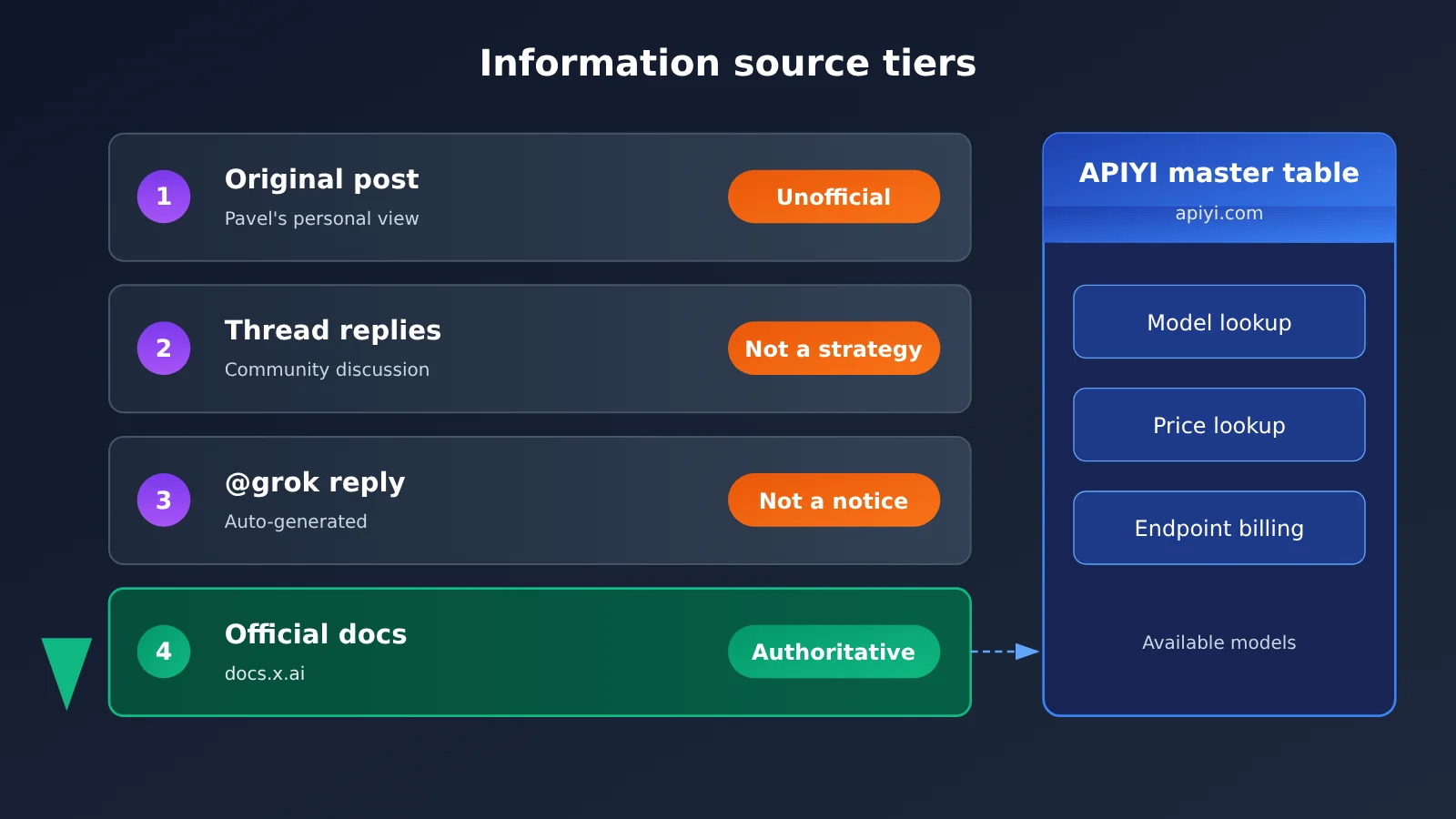
Posts like this usually draw a long thread of replies — some agreeing, some pushing back, some guessing at the reasons. Those comments speak only for the people who wrote them; they can’t be cited as xAI product strategy.
The same caution applies to the @grok chat account. Its replies in a thread are model-generated conversation, not company announcements, and they can’t be used to prove what Grok 4.8 will or won’t do.
| Source type | What it can tell you | What it can’t tell you |
|---|---|---|
| Original post (Pavel) | One user’s hopes and demands for Grok 4.8 | xAI’s product plans or release timing |
| Thread replies | How opinions are distributed in the community | Official strategy, internal decisions |
| @grok chat account replies | Model output within a conversation | Announcements, commitments, or roadmaps |
| Official docs | Currently available models, parameters, and pricing | Capabilities of unreleased models |
| APIYI master table | Models, endpoints, and billing already listed on the platform | Models upstream hasn’t released yet |
Before Grok 4.8: What the docs actually say about grok-4.7 reasoning levels
Since the request specifically calls out the previous generation’s long reasoning, it’s worth checking what the official docs say about grok-4.7’s reasoning levels. This section sticks to documented facts and doesn’t try to infer causality.
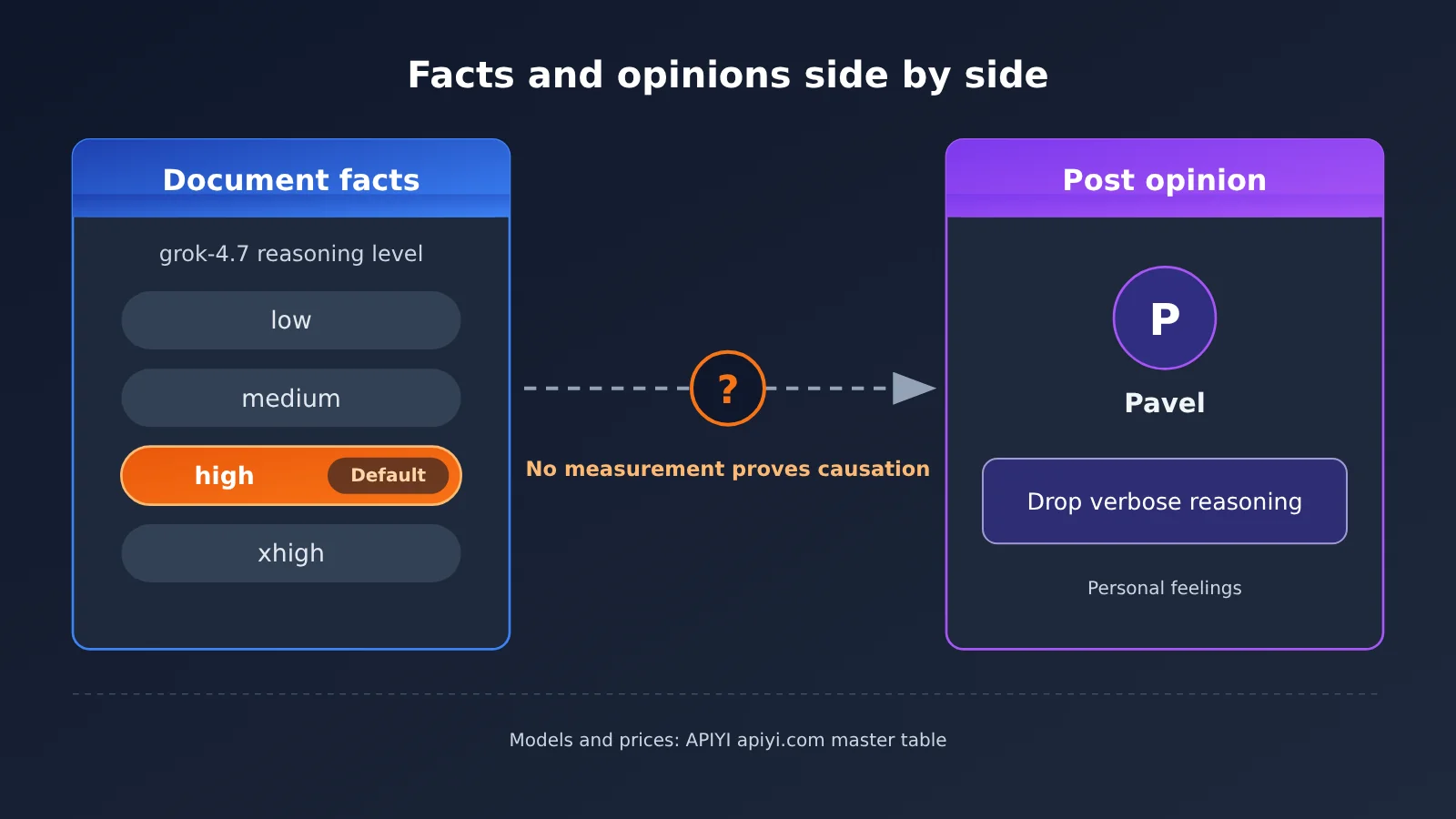
According to the official model documentation checked on 2026-11-27, grok-4.7 has a context length of 500K tokens. Its reasoning levels come in four tiers: low, medium, high, and xhigh. The default is high, with xhigh above it. So when developers don’t configure anything extra, requests use the high level.
| Spec | grok-4.7 documented value |
|---|---|
| Context length | 500K tokens |
| Reasoning levels | low / medium / high / xhigh |
| Default reasoning level | high |
| One level higher | xhigh |
| Applicable tasks | Official docs state text tasks still use Grok 4.7 |
Default high level and long reasoning: not the root cause
When people see “default high” and “reasoning is too long” side by side, it’s natural to assume the former causes the latter. But no public measurement proves that today: there’s no experiment showing that dropping the level from high to medium or low makes responses noticeably shorter, and no data pins the verbosity on the default level.
So this article can only state the two things side by side: the docs say the default is high—that’s a fact; Pavel thinks the reasoning is too long—that’s his impression. There’s currently no evidence of a causal link, so we can’t write the default level up as the root cause of long reasoning.
If your workload really cares about output length and latency, the safer approach is to explicitly set the reasoning level in your own requests and compare how different levels perform on your samples, rather than relying on outside inference.
Before Grok 4.8 Ships: How to Call grok-4.7 Today
Grok 4.8 currently can’t be found in either the official docs or the APIYI master list. The APIYI master list was last updated on 2026-11-27 11:59 (UTC+8) and covers 278 models in total — grok-4.8 isn’t one of them. The platform’s statement on this: it hasn’t been listed yet, and we’ll get this model up as soon as possible; model names and pricing are governed by the platform’s model list, which you can check anytime at apiyi.com.
What you can call today is grok-4.7. On the APIYI platform, it runs through the chat endpoint and belongs to the CodexResponses, Default, and SVIP groups. The base URL is https://api.apiyi.com/v1, the API is OpenAI-compatible, so with your existing OpenAI SDK you just swap base_url to this address and set model to grok-4.7, and you’re ready to send requests.
grok-4.7: Two Pricing Tiers Compared
grok-4.7 billing splits into two tiers based on the context size of a single request, with the dividing line at 200K tokens. All values below are in USD per million tokens, listed separately for the official docs and the APIYI master list and pricing API.
| Billing tier | Input | Cache read | Output | Source |
|---|---|---|---|---|
| Under 200K tokens | 2 | 0.50 | 6 | Official docs |
| 200K tokens or more | 4 | 1 | 12 | Official docs |
| Low tier | 2 | 0.5 | 6 | APIYI master list (apiyi.com) |
| High tier | 4 | 1 | 12 | APIYI pricing API |
As you can see, the two-tier pricing is consistent across the official docs and APIYI’s master list and pricing API. One heads-up: the high tier is double the low tier, and when you max out the 500K context, a single request easily crosses the 200K dividing line — so estimate costs against the high tier.
🚀 Quick start: If you want to get the request path working before Grok 4.8 ships, you can call grok-4.7 through APIYI at apiyi.com with a single API key, setting base_url to
https://api.apiyi.com/v1. New users get free trial credits, which is handy for comparing output length and latency across reasoning tiers on your own samples first.
A Few Practical Tips for Integration
- Set the reasoning tier explicitly: Don’t rely on the default high — pick low, medium, high, or xhigh based on task complexity, then evaluate length and quality with your own data.
- Control context size: If a single request is approaching 200K tokens, first check whether you can cut costs by trimming history or using cache reads.
- Plan ahead for a model swap: Make the model name a config item, so that once grok-4.8 ships you only change the config — model names are governed by the APIYI platform’s model list.
- Separate your sources: When making technical decisions, rely on the official docs and the platform master list; treat posts and replies as reference only.
Grok 4.8 Impact Analysis
Impact on Developers
- No Grok 4.8 to call yet: Neither the official docs nor the APIYI master list includes it, so existing projects can keep using grok-4.7 — there’s no need to rewrite code ahead of time for a rumor.
- You can manage reasoning length yourself today: Since grok-4.7 offers four reasoning levels, developers already have a way to balance length, latency, and quality in their own scenarios. No need to wait for the next generation model to solve it.
- Budget in two tiers: 200K tokens is the key dividing line, so long-context tasks should get their own budget line.
Impact on Industry Discussion
- “Winning a round back” is an outside expectation: The Sonnet 5.5 to Opus 5.5 range Pavel gave is one user’s idea of a passing grade. It reflects what coding-tool scenarios realistically demand from a model, but it’s not a goal statement from xAI.
- Verbose reasoning got called out as an experience problem: This requirement was singled out and bracketed on its own, which suggests at least some users see “thinks too long, says too much” as a real pain point in practice — something model vendors should be paying attention to.
- Layered information matters more: When posts, replies, @grok responses, and official docs circulate side by side, it’s easy to read a personal opinion as an official roadmap. Check each claim against its source as you read.
💡 Recommendation: If you want to compare reasoning length and cost side by side between grok-4.7 and other mainstream models, you can switch model IDs on APIYI apiyi.com through the same OpenAI-compatible interface, run the comparison with identical prompts, and then decide whether it’s worth waiting for Grok 4.8.
FAQ
Q1: Can I use Grok 4.8 right now?
No. As of 2026-11-27, there’s no grok-4.8 in the official model documentation, and it isn’t in the APIYI master table either. The platform notes that it hasn’t been listed yet — we’ll get this model up as soon as we can. Model IDs and pricing are subject to the model list on apiyi.com.
Q2: Did xAI officially say “Grok 4.8 should drop long reasoning”?
No. That was a request X user Pavel added in the same post, grouped together with “at least hit the Sonnet 5.5 to Opus 5.5 range.” xAI (now called SpaceXSI) has made no commitment on it.
Q3: Why did Pavel ask to cut long reasoning?
He didn’t explain his reasoning in the post. The various guesses in the replies reflect only the commenters’ personal views and shouldn’t be cited as official strategy or a firm conclusion.
Q4: grok-4.7 defaults to the high reasoning tier — is that why it’s so wordy?
You can’t draw that conclusion right now. The docs do state that the default tier is high and that xhigh sits above it, but there’s no public measurement showing that lowering the tier makes replies shorter. The two facts can only be stated side by side, not as cause and effect.
Q5: How do I call grok-4.7 through the API?
Sign up at APIYI apiyi.com and get an API key, use the OpenAI-compatible SDK, set base_url to `https://api.apiyi.com/v1`, set model to `grok-4.7`, and hit the chat endpoint. New users get free trial credits, so you can start by checking how the reasoning tier affects output.
Q6: How is grok-4.7 priced?
Pricing has two tiers based on whether a single request reaches 200K tokens: under 200K, it’s $2 per million input tokens, $0.50 for cache reads, and $6 for output; at or above 200K, it’s $4 input, $1 cache read, and $12 output. The figures in the APIYI master table’s low tier and the pricing API’s high tier both match this.
Grok 4.8 Key Takeaways
- Grok 4.8 hasn’t shipped yet: as of 2026-11-27, it appears in neither the official docs nor the APIYI master table.
- Cutting long reasoning is a personal ask: it comes straight from Pavel’s post, tacked on after a capability baseline requirement, with no reason given.
- “Winning one back” is this article’s framing: it maps to the post’s description of Cursor possibly being out while Grok Bot holds the line.
- Defaulting to high doesn’t mean that’s the root cause: right now there’s no measurement linking the documented fact to the hands-on experience.
- Sources need to be tiered: a reply in a thread isn’t policy, and a reply from the @grok chat account isn’t an announcement.
- Use grok-4.7 today: 500K context, four reasoning tiers, billed in two brackets split at 200K tokens.
- How to connect: one key against
https://api.apiyi.com/v1through APIYI apiyi.com.
Summary
The core of Grok 4.8 comes down to three things:
- At the model level: Grok 4.8 doesn’t exist yet in the official docs or the platform master table — text tasks still go by Grok 4.7.
- At the request level: “cut the long reasoning” is a requirement Pavel attached in the same post, not an official promise, and no reason was given.
- At the documentation level: grok-4.7 defaults to the high reasoning tier, but there’s no evidence that this is what makes reasoning so verbose.
Rather than waiting for the next generation of models to solve reasoning length, it’s better to test different reasoning tiers on your own business samples first and keep the trade-off between length, latency, and cost in your own hands. The recommended path: call grok-4.7 through APIYI apiyi.com’s unified interface to validate first, then switch over smoothly once Grok 4.8 goes live.
📚 References
-
Pavel’s original post: on the Grok 4.8 capability baseline and the demand to cut long-form reasoning
- Link:
x.com/pavelsvitek/status/2125949509440049436 - Note: The only source for the “cut long reasoning” requirement discussed in this article; it reflects a personal opinion
- Link:
-
xAI (SpaceXSI) official model docs: currently available models, reasoning tiers, and pricing
- Link:
docs.x.ai/developers/models - Note: Verified on 2026-11-27; grok-4.8 isn’t listed yet, so grok-4.7 specs and the two-tier billing model are treated as the reference here
- Link:
-
APIYI platform model master list: listed models, endpoints, groups, and billing
- Link:
apiyi.com - Note: The master list was updated on 2026-11-27 at 11:59 (UTC+8), and covers 278 models in total
- Link:
Author: APIYI Technical Team
Technical support: Feel free to reach out to us via the APIYI website homepage; for more resources, visit the docs.apiyi.com documentation center