

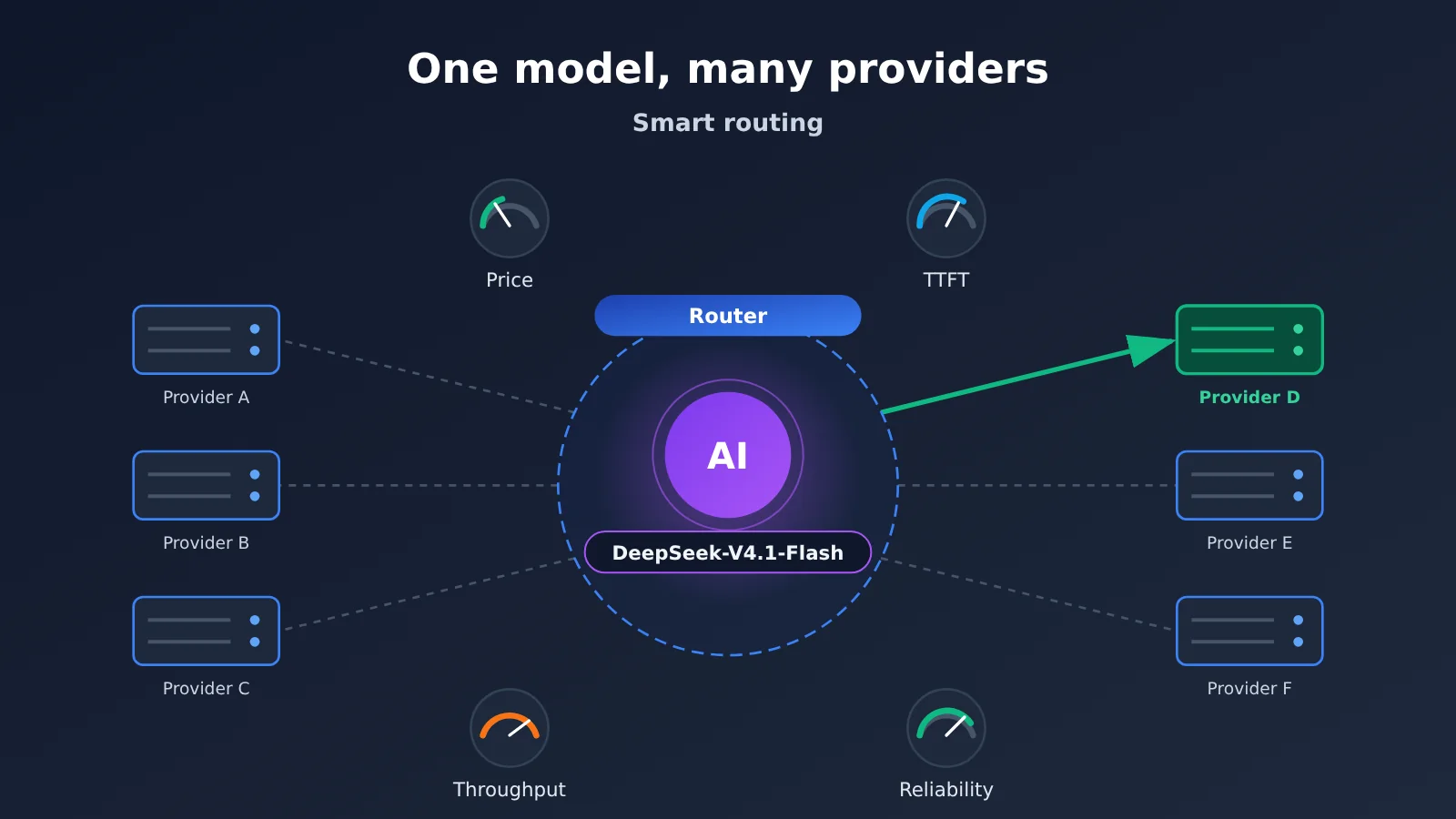
Direct answer: The same open-weight model can be deployed by many different inference providers, which is why you end up with dozens of API providers. OpenRouter doesn’t just look at who has the lowest list price — it picks a provider based on the total cost of one usable response. It evaluates six metrics at once: actual effective price, first token latency, throughput, rate limits, reliability, and response quality. Then it routes the request to whichever provider fits best at that moment, and if that fails, retries with another.
That tells us competition in AI API aggregation has already moved from “offering a unified interface” to “dynamically scheduling providers.” On November 16, 2026, Hugging Face announced it was handing language model routing for Inference Providers over to OpenRouter. The partnership is a concrete sample case — one that makes it clear how these metrics turn into an automatic provider-selection mechanism.
What you’ll get out of this article:
- Why the same AI model can have multiple API providers, and how model developers differ from inference providers
- Which decision metrics provider routing relies on, and what problem each one solves
- What failover can actually do, and where its boundaries are
- How to use metadata from the Hugging Face model catalog API to compare providers yourself
Index: The factual part unfolds in this order: first, where multiple API providers come from; then the decision objects and six metrics behind smart routing; next, the failover flow and its limits; and finally, a walkthrough of how developers can compare providers themselves with the catalog API — with OpenRouter’s published routing experiment data and billing changes woven in along the way. The analysis section discusses where competition among API aggregation platforms heads next, and how developers should weigh tradeoffs and validate them inside their own applications.
Understanding Multi-Provider API Services and Provider Routing: Concepts to Know
| Concept | Brief explanation |
|---|---|
| Provider | A vendor that deploys models and actually serves inference, such as Together AI or Novita |
| Router | The routing layer that decides where a request goes, based on request conditions and the availability of providers |
| Open-weight model | A model whose trained weights are published and can be self-deployed under its license |
| TTFT | Time to First Token — the wait from sending a request to receiving the first token |
| Throughput | The number of tokens generated per unit time, usually measured in tok/s |
| Failover | Automatically switching to another provider and retrying when the current provider fails |
| Prompt Caching | The provider caches repeated input to cut compute overhead and response time |
| BYOK | Bring Your Own Key — you bring your own provider key and draw on that account’s quota |
| P50 / P95 | Statistical percentiles; P50 is the median, and P95 reflects the slower 5% of requests |
A Quick Look at the Impact of Multi-Provider Routing Changes
- Developers: In principle, the code and tokens on the Hugging Face side don’t need to change, but routing decides which provider actually serves the request — the same model ID can land on different providers across requests. Apps that depend on tool calling or structured output need to be regression-tested again. For developers who previously configured their own language model provider key on Hugging Face, that path is now closed, so you’ll need to re-confirm your key and where the billing lands.
- Enterprise procurement and platform teams: Vendor onboarding, disaster-recovery strategy, and data-processing terms all need to be re-evaluated. Organizations can disable specific providers, but that doesn’t amount to full data residency or compliance guarantees — you still have to check each provider’s data policy one by one.
One AI Model, Multiple API Providers: The Objective Facts
Why the Same Model Can Have Multiple API Providers
Model developers and inference providers are two distinct roles. The developer trains the model and releases the weights. For open-weight models, any organization with compute capacity that meets the license terms can deploy those weights onto its own GPU cluster and offer an API. That’s why models like DeepSeek, Qwen, and GLM often run on several inference infrastructures at the same time.
Take deepseek-ai/DeepSeek-V4.1-Flash as an example. A developer requests the same model name, but the inference may actually be executed by Together AI, Novita, or another provider that supports the model. Each one uses different hardware, cluster sizes, scheduling methods, and pricing strategies, so the same model ends up differing in price, speed, and available capacity. Some quote lower prices but hit rate limits during peak hours, some return the first token faster, some support longer context, and some offer more complete support for tool-calling formats.
Scale data shows just how fragmented this market is. In its partnership announcement, OpenRouter disclosed that its platform as a whole supports more than 600 models, connects to over 80 providers, processes more than 800 trillion tokens per month, and serves over 10 million users. These are OpenRouter’s platform-wide figures, not the scale brought by that particular partnership alone. Hugging Face’s provider page also lists more than a dozen service providers such as Baseten, Cerebras, DeepInfra, Fireworks, Nebius, Novita, and Together AI, though the providers available differ from model to model.
When one model maps to multiple providers and each provider’s conditions change in real time, “who should handle this request” becomes a question that needs continuous decisions — and that’s where multi-provider routing comes from.
What Is Smart Routing Actually Deciding?
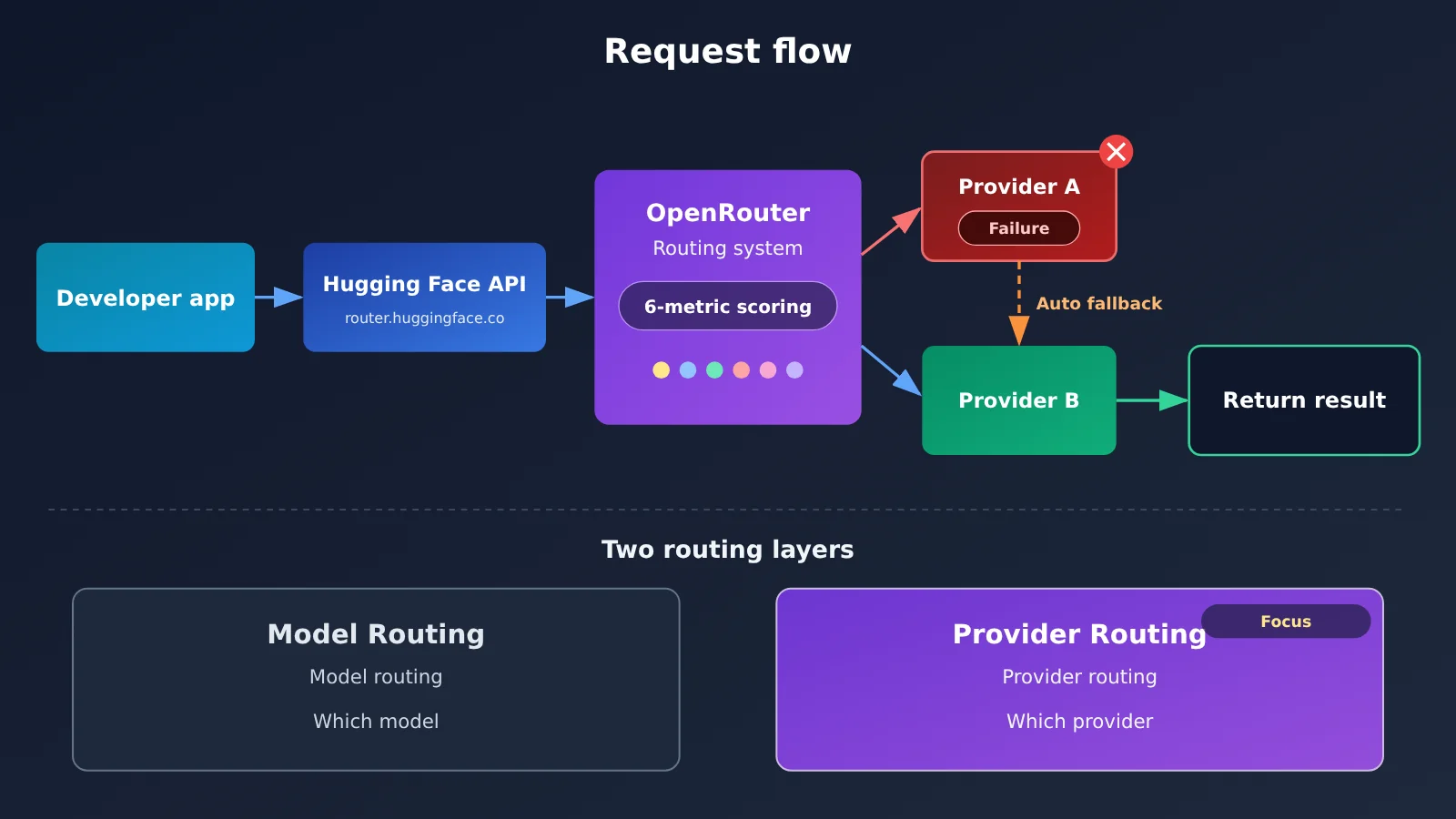
First, let’s distinguish two easily confused concepts. Model Routing decides which model answers — simple questions go to small models, complex ones to a Large Language Model. Provider Routing, given a model that’s already fixed, decides which provider runs the inference. The OpenRouter–Hugging Face collaboration covered here is the latter: the developer specifies the model, and the routing layer only picks the provider — it won’t swap models for you.
After the collaboration, a language model request flows like this: developer app or Coding Agent → Hugging Face API (router.huggingface.co) → OpenRouter routing system → some Provider runs the inference → result returned. OpenRouter handles request routing and provider selection here; it doesn’t run inference for all models. Users still use a Hugging Face Token, billed through their Hugging Face account or organization account. Hugging Face says it doesn’t add any markup on top of Provider inference pricing.
In terms of control, Hugging Face offers three levels:
- Default automatic routing: the official client uses
provider="auto", and the system picks the provider by weighing price, speed, and reliability. - Specifying a Provider: e.g.
provider="together", or adding the suffix:novitaafter the model ID, pins the request to that provider. - Policy routing: the OpenAI-compatible interface supports
:cheapest(price-first) and:fastest(throughput-first) suffixes.
Note that :fastest optimizes throughput, not “fast” in every sense. TTFT, generation speed, and total request time are three different metrics. For short replies of only a sentence or two, first-token latency usually affects the felt experience more than throughput.
| Aspect | Original Hugging Face routing | New OpenRouter routing |
|---|---|---|
| Routing system | Hugging Face’s own router | OpenRouter |
| Provider selection | Existing selection mechanism | Real-time comprehensive evaluation |
| Pricing basis | Existing pricing strategy | Actual effective price |
| Speed factors | Existing performance mechanism | Includes TTFT and throughput |
| Single failure | Might just return an error | Can retry other Providers within the same request |
| Session cache | Existing strategy | Supports keeping the Provider per session |
| User credentials | Hugging Face Token | Continue using the Hugging Face Token |
What metrics should a solid multi-provider routing system track?
OpenRouter announced its next-generation Provider Routing algorithm on October 28, 2026. The old default routing leaned heavily on input token list prices, so cheaper providers tended to pick up more traffic. The new algorithm folds the six categories of signals below into a real-time Routing Cost, with the goal of optimizing the total cost of getting “a successful, usable response” rather than simply chasing the lowest unit price.
① Effective Price solves the “cheap list price doesn’t mean a cheap bill” problem. It combines the unit prices for uncached input, cached input, and output, then weights them by the actual input-to-output ratio of requests and that provider’s cache hit rate. OpenRouter’s example: 40,000 uncached input tokens ($2/M) comes to $0.080, 60,000 cached input tokens ($0.50/M) comes to $0.030, and 4,000 output tokens ($8/M) comes to $0.032, for a total of $0.142. In agent scenarios, cached input often makes up a large share of the total, so comparing only input list prices can land you on the wrong provider.
② TTFT (time to first token) solves the “how long does the user wait before seeing anything” problem. Chat interfaces and agent multi-turn tool calls are the most sensitive to it, since every turn has to wait for the first token.
③ Throughput measures speed once generation has started. The new algorithm looks at generation throughput across the whole response, not just the instantaneous peak. Long-form generation and code completion — tasks with large output volumes — are mainly affected by it.
④ Rate Limits focuses on HTTP 429 errors and solves the “provider doesn’t have enough capacity” problem. When a provider keeps returning 429s, its compute is under strain, and routing will send it less traffic.
⑤ Reliability measures how often requests fail. If a provider’s error rate is clearly higher than other providers serving the same model, the system will reduce its traffic share and, if necessary, pause traffic until it recovers.
⑥ Quality solves the “same model, inconsistent behavior across deployments” problem. According to the current public documentation, the quality signal mainly covers whether tool calls return correctly and whether the structure meets requirements. Providers with malformed tool-call formats or clearly lagging benchmark accuracy get their competitiveness downgraded.
Beyond these six metrics, OpenRouter’s own routing docs also treat data policy as a constraint. For example, data_collection: "deny" can exclude providers that don’t meet data collection requirements, and zdr: true requires a zero data retention endpoint. Hugging Face’s security documentation states that it doesn’t train models on user request data, doesn’t store request bodies or responses during routing, and keeps debug logs for at most 30 days with no user data or tokens. But it also reminds developers that they still need to check the data security policies of the actual provider. A platform’s promise can’t replace each provider’s own data processing agreement.
OpenRouter Routing Experiment Data and Trade-offs
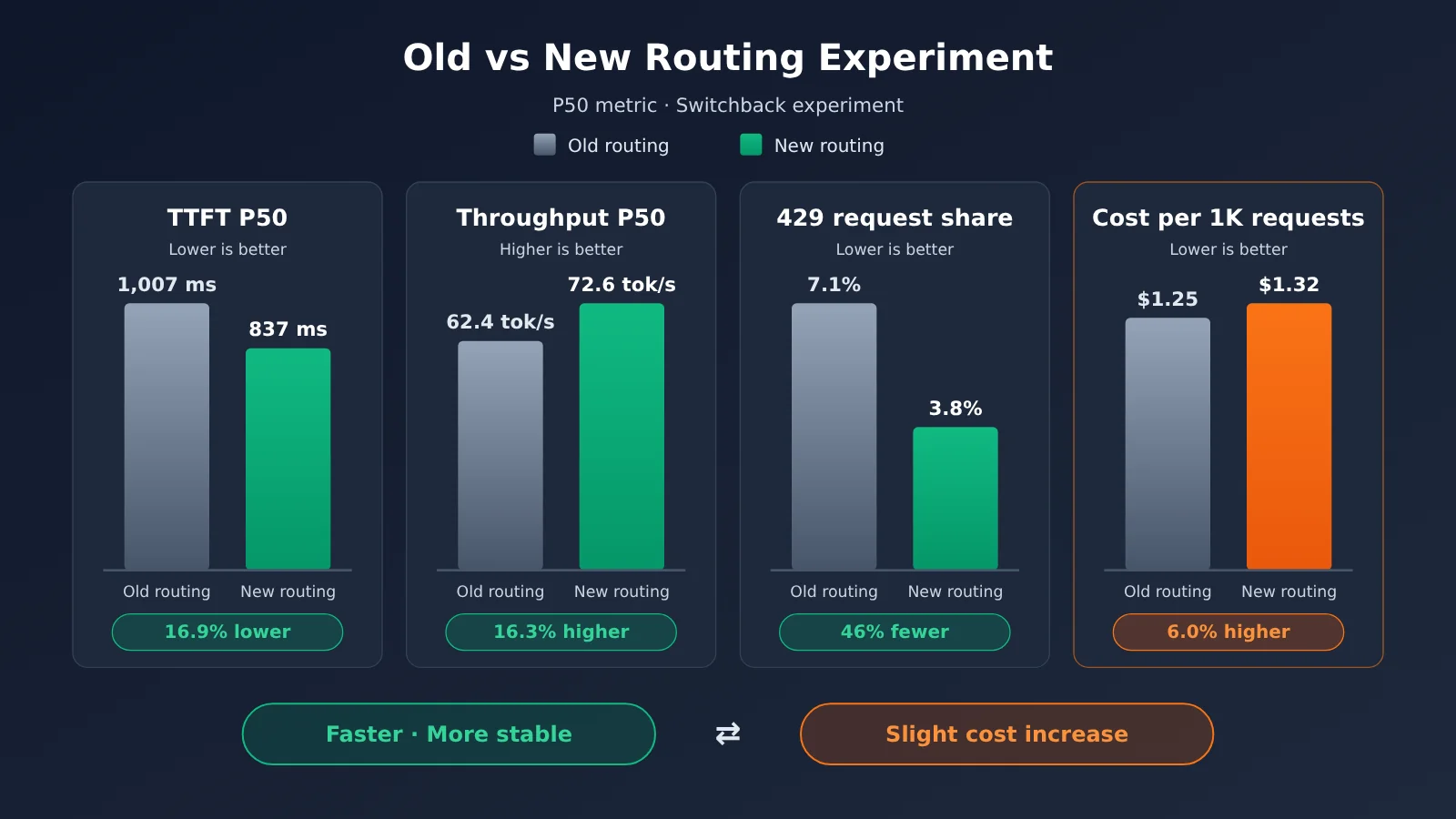
Before the new algorithm launched, OpenRouter ran a one-week switchback experiment in October 2026. Each day was divided into 3-hour blocks; matched blocks used the old and new algorithms respectively, and after each switch, a 1-hour warm-up period was excluded from measurement. In total, the experiment covered more than 24 million requests and 103 billion input tokens. They used a switchback experiment instead of randomizing users because after the new algorithm shifted traffic away from overloaded providers, the old-algorithm group would benefit too, which would distort the comparison.
| Metric | Old routing | New routing | Change |
|---|---|---|---|
| TTFT P50 | 1,007 ms | 837 ms | 16.9% lower |
| TTFT P95 | 4,601 ms | 3,733 ms | 18.9% lower |
| Throughput P50 | 62.4 tok/s | 72.6 tok/s | 16.3% higher |
| End-to-end request latency P50 | 4.00 s | 3.24 s | 19.0% lower |
| Requests with at least one 429 | 7.1% | 3.8% | 46% fewer |
| Requests requiring retry | 10.4% | 6.9% | 34% fewer |
| Cost per 1,000 requests | $1.25 | $1.32 | 6.0% increase |
| Cost per million tokens | $0.301 | $0.324 | 7.3% increase |
This data captures the core trade-off of the new routing: about 6% higher cost per 1,000 requests in exchange for lower latency and fewer capacity errors. A few caveats: the experiment was designed and published by OpenRouter itself and wasn’t independently audited; the sample was a representative set of open models, not representative of all models and providers; and the results are aggregate statistics—they don’t mean every request gets a 16.9% improvement. These figures also come from an OpenRouter experiment run before the partnership, not an independent test after Hugging Face went live.
💡 Testing tip: The routing experiment gives you aggregate statistics; you still need to test how your own workload performs. If you want to compare output quality and cost across several mainstream models in the same codebase, you can call them all through APIYI apiyi.com with a single API key—settle the model-level choice first, then consider provider-level optimization.
How the System Switches When a Provider Goes Down
The typical automatic failover flow goes like this: routing picks Provider A; if A is healthy, the response comes back directly; if A errors out or hits capacity problems, the system tries Provider B within the same request; if B succeeds, it returns the result. In our experiments, “requests that needed a retry” dropped from 10.4% to 6.9%, and the time each request spent on failed attempts fell from 349 ms to 242 ms. What this shows is that good routing isn’t just about retrying — it should also steer clear of unhealthy providers from the very start.
Automatic fallback and specifying a Provider pull against each other. Default routing allows switching, which means higher availability. Specifying a Provider pins the request to a single vendor, satisfying vendor admission requirements, but gives up any room for disaster recovery. OpenRouter’s own API offers only (permit only the specified Provider) combined with allow_fallbacks: false (no automatic fallback), a combination that lets a request fail outright when no compliant provider is available rather than handing it to another vendor. One thing to keep straight: these are parameters of the full OpenRouter API, and shouldn’t be read as meaning Hugging Face’s interface has opened all of them up. The corresponding capability on the Hugging Face side is specifying a Provider and disabling Providers in settings.
Retries have costs too, and they aren’t unlimited:
- Time cost: every failed attempt stretches total latency, which is clearly felt in real-time interaction.
- Streaming output: once a streaming response has started emitting, it can’t seamlessly continue on another provider.
- Duplicate side effects: if a tool call already triggered an external action on the first attempt, a retry may execute it twice, so the application needs to handle idempotency itself.
- Cache loss: Prompt Caching is typically bound to a specific provider, and switching providers can throw away the cache benefit. Hugging Face addresses this with the
X-HF-Session-Idrequest header — a stable UUID that keeps the same session on the Provider holding the cache as much as possible. - No available provider: if a model has only one Provider, or other Providers don’t support the current parameters, there’s nothing to switch to. Insufficient quota, insufficient token permissions, invalid requests, context overflow — routing can’t solve those either.
Hugging Face Billing and Bring-Your-Own Key Changes
This partnership introduces a breaking change: when you call language models through Hugging Face, you can no longer use the provider API key you configured yourself. All such requests are routed through OpenRouter, and the costs are billed to your Hugging Face account or organization account. Your own keys still work for image and video generation tasks, subject to the official documentation.
If developers want to keep using the provider credits they’ve purchased, they can call that provider’s API directly or switch to their own OpenRouter account. According to OpenRouter’s current BYOK documentation: the BYOK free allowance is measured in equivalent inference catalog cost; Pay-as-you-go accounts get $25,000 per month, while Enterprise gets a custom allowance. Anything beyond that is billed at 5% of the equivalent inference cost and deducted from platform Credits. That $25,000 is inference cost measured in dollars, not a request count. Also, falling back to shared capacity may consume platform Credits. Integrating directly with OpenRouter is a separate account and billing relationship, and your existing keys won’t migrate automatically.
In Hugging Face’s current pricing documentation, Free users don’t get a fixed monthly allowance, PRO users get $2 per month, and Team and Enterprise get $2 per seat per month. These are general-purpose Compute Credits that can be applied to services such as Inference Providers, Inference Endpoints, and Spaces. One more thing worth noting: provider pricing mechanisms staying the same doesn’t mean the cost per request stays the same, because routing may choose a slightly more expensive but faster and more stable provider.
How Developers Can Compare Multiple Providers Themselves with the Catalog API
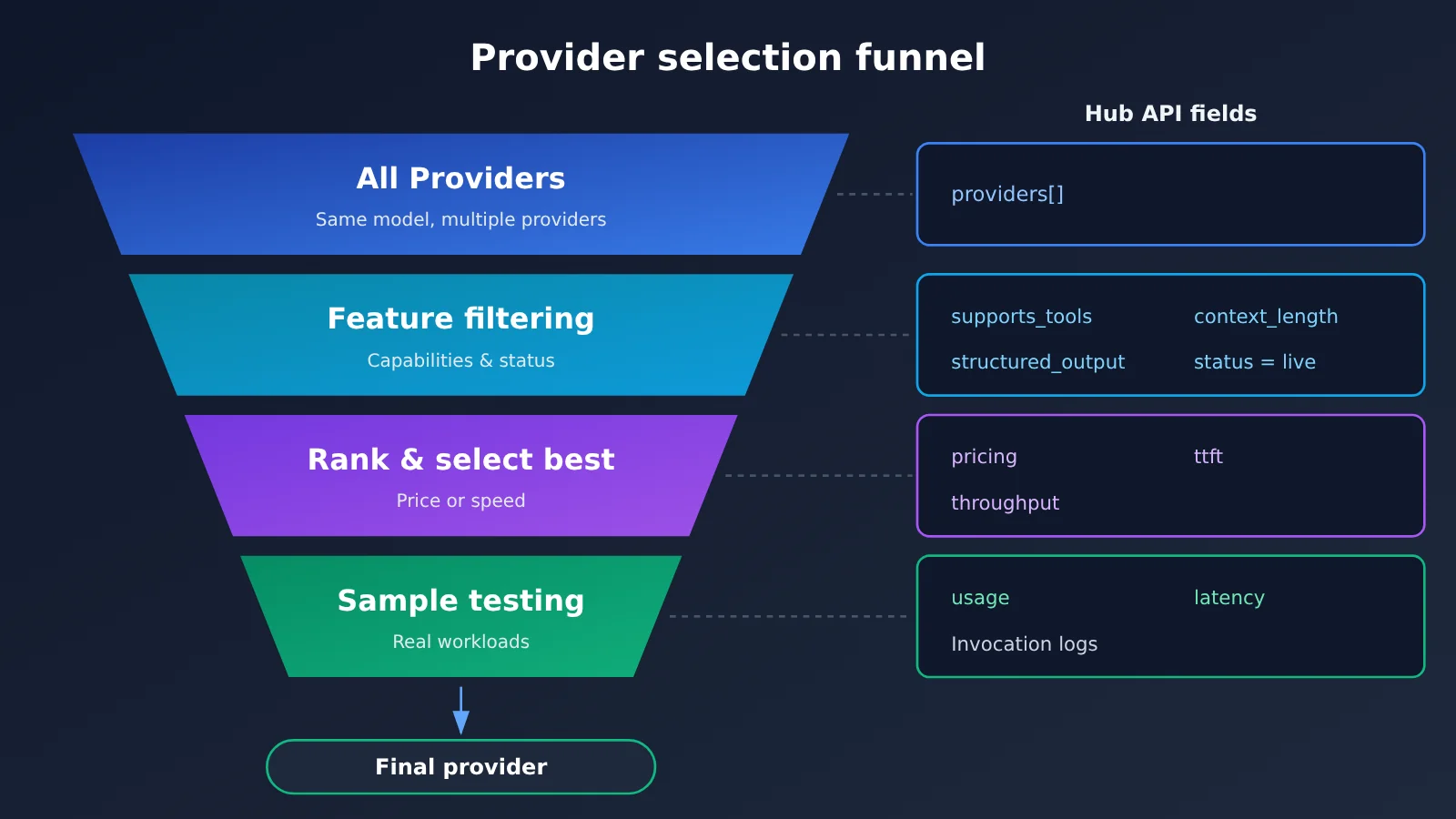
Hugging Face offers a queryable model catalog API, a public window into the data the routing system uses to make decisions:
- All models:
GET https://router.huggingface.co/v1/models - Single model:
GET https://router.huggingface.co/v1/models/deepseek-ai/DeepSeek-V4-Pro
| Field | Meaning | Role in selection |
|---|---|---|
| provider | The provider actually serving inference | Build the candidate list |
| status | Current status, such as live or error | Rule out unavailable providers |
| context_length | Context length supported by that provider | Filter for long-context requirements |
| pricing.input / pricing.output | USD price per million input/output tokens | Sort by cost |
| supports_tools | Whether tool calls are supported | Hard requirement for agent use cases |
| supports_structured_output | Whether structured output is supported | Hard requirement for JSON output |
| first_token_latency_ms | Time to first token in the most recent validation probe | Sort for interactive use cases |
| throughput | Generation speed in the most recent validation probe | Sort for long-output use cases |
| is_free / is_model_author | Temporary free promotion / whether it is the model publisher | Secondary reference |
These fields aren’t fully available for every provider, and the performance data comes from the most recent validation probe—it’s not the same as your own end-to-end real-time performance. A sensible approach is “filter first, then sort”: use capability fields to screen out incompatible providers, then sort by cost or speed. The example below demonstrates this idea; for the response structure, refer to the official Hub API docs:
import os
import requests

HF_TOKEN = os.environ["HF_TOKEN"]
MODEL = "deepseek-ai/DeepSeek-V4.1-Flash"

resp = requests.get(
    f"https://router.huggingface.co/v1/models/{MODEL}",
    headers={"Authorization": f"Bearer {HF_TOKEN}"},
    timeout=30,
)
data = resp.json()
providers = data.get("providers", [])  # Actual structure is subject to the official docs

# Step 1: capability filtering (agents need tool calls + structured output + 64K context)
candidates = [
    p for p in providers
    if p.get("status") == "live"
    and p.get("supports_tools")
    and p.get("supports_structured_output")
    and (p.get("context_length") or 0) >= 64_000
]

# Step 2: sort by output unit price; missing fields go last
candidates.sort(key=lambda p: (p.get("pricing") or {}).get("output", float("inf")))

for p in candidates:
    print(p["provider"], p.get("pricing"), p.get("first_token_latency_ms"), p.get("throughput"))
Once you’ve narrowed down the candidates, you still need to test them with real business requests. Catalog metadata tells you what a provider “claims to support”; it can’t replace your own accuracy, tool-call success rate, and final completion rate on your tasks.
Before fine-tuning at the provider level, you usually need to decide which model to use first. The following code shows how to batch-compare answers from multiple models through the same OpenAI-compatible interface. Replace the model IDs with the actual names from the platform’s model list:
from openai import OpenAI

client = OpenAI(
    api_key="YOUR_API_KEY",
    base_url="https://api.apiyi.com/v1"  # APIYI's unified interface: one key calls multiple models
)

prompt = "用 JSON 返回:{\"city\": 城市名, \"reason\": 一句话理由},推荐一个适合冬季旅行的城市"

for model in ["model-id-a", "model-id-b", "model-id-c"]:
    resp = client.chat.completions.create(
        model=model,
        messages=[{"role": "user", "content": prompt}],
    )
    print(model, resp.usage.total_tokens, resp.choices[0].message.content)
🚀 Quick start: New users can claim free trial credits at APIYI apiyi.com and use the code above to run a set of their own business samples. Backend call logs record the model, token consumption, and cost for each request, making it easy to calculate the real per-task cost instead of just looking at the list price.
It’s worth noting that unified access plus invocation logs and the Provider-level real-time performance data shown by Hugging Face are features at different levels: the former handles “can we connect, and can we account for it,” while the latter goes further to surface the dynamic state of the underlying service providers. The two work well together.
Multiple API Providers and Smart Routing: Analysis and Assessment
Where the Next Competition Lies for API Aggregation Platforms
If you break OpenRouter’s capabilities into layers, you get three: model aggregation solves “how do I access different models,” Provider aggregation solves “who runs inference for the same model,” and dynamic routing solves “who should handle this request.” The unified interface has largely solved access. This partnership shows that the second and third layers are becoming the new battleground. The evidence: Hugging Face chose to give up building its own router and use external routing instead, while OpenRouter has also published its routing algorithm separately and used production experiments to demonstrate its value.
It’s safe to predict that cost optimization, stability, and data governance will become new dimensions on which API platforms are compared. The following predictions still need to be validated: routing transparency will matter more and more, and developers will want to know which provider handled the request, why it was chosen, and how much they paid; data policy constraints could shift from an optional add-on to a must-have condition in enterprise procurement.
That said, routing isn’t a cure-all. Experimental data shows that faster and more stable performance comes at the cost of a higher unit cost. The follow-up plans in the partnership announcement—such as linking accounts on both sides and bringing more tasks into OpenRouter routing—are still just plans. Routing also can’t solve issues with the model itself, such as quality, licensing, and business fit.
Demand for Open-Weight Models and Enterprise Cost Pressure
The demand-side data backs up the argument that “provider routing is becoming important.” OpenRouter’s stats show that, measured by weekly token volume across the top 50 models, open-weight models accounted for 71.7% as of September 28, 2026. That’s a measurement within OpenRouter’s own platform, though — it shouldn’t be generalized into global market share. The more open-weight models get used, the more common it is for a single model to be offered by multiple providers, and the more obvious the value of routing becomes.
On the cost side, Capgemini surveyed 500 CXOs at large enterprises in September 2026: 59% said AI spending had clearly exceeded expectations, and among the affected companies the average overrun was 24%. These figures only represent that survey sample, but paired with the routing experiment’s finding that “speed gains come with higher costs,” they’re a reminder to enterprises: automatic routing optimizes for overall experience by default, not necessarily the lowest bill. For cost-sensitive workloads, you should actively choose a price-first strategy or set a price ceiling, and keep checking against your invocation logs.
How Different Roles Should Choose
- Individual developers and small teams: Default automatic routing already saves you the work of building your own failover, so the priority is validating tool calls and JSON output stability with real samples. Start by picking a model through a unified interface like APIYI apiyi.com, then optimize at the provider level as needed — that’s a low-investment path.
- Interactive products: Focus on TTFT P95 rather than throughput.
:fastestwon’t necessarily improve how snappy short replies feel. - Long-output and batch tasks: Throughput and effective price matter more. Consider a price-first strategy and use session stickiness to preserve cache benefits.
- Enterprises and platform teams: First take stock of which apps depend on your own Provider Keys and which workloads must stay on a fixed provider, then decide whether to allow fallback, restrict providers, or connect directly to providers. Check data processing agreements provider by provider.
Whichever strategy you pick, it all comes down to the same action: run a round with your own requests and your own metrics. Doing a small comparison with free credits on APIYI apiyi.com, or using the Hugging Face catalog API to shortlist candidate providers first, are both very low-cost starting points. The official experiment’s 16.9% is an overall average — how much your own workload gets is something only testing will tell you.
The proof of the pudding is in the eating. (You only know if the pudding is good by eating it; real results have to be verified in practice.)


