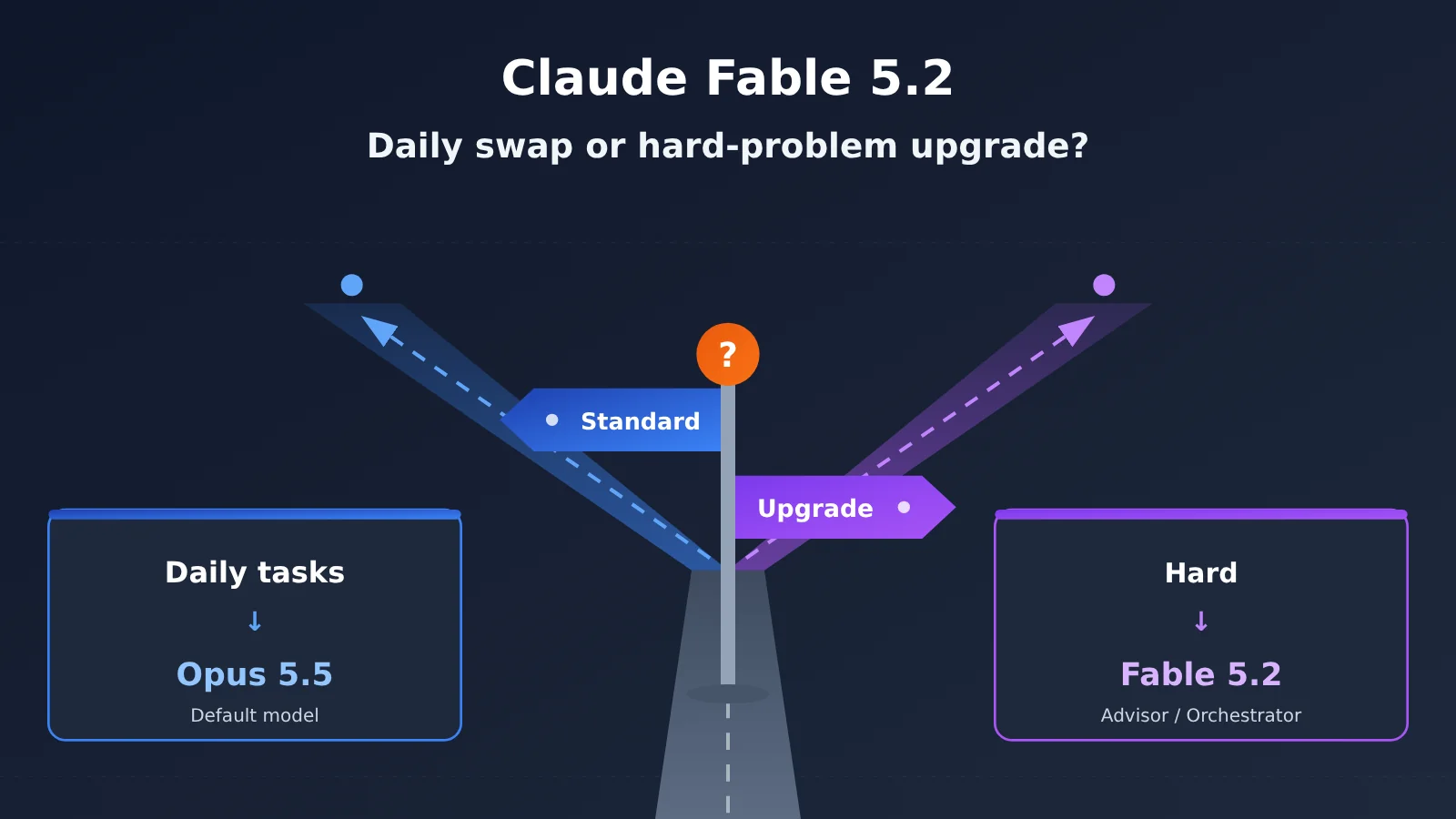
Quick answer: Claude Fable 5.2 is a “hard-problem upgrade,” not a daily driver replacement. In its release notes dated 2026-11-09, Anthropic explicitly recommends that most everyday coding and knowledge work use Opus 5.5 first. Fable 5.2 is better suited as top-tier backup for hard problems: it can act as an Advisor when other models ask for help, or as an Orchestrator that delegates simple tasks outward. For most teams, the sensible move is to plug it into key points in the workflow, not to swap out every default model for it.
What you’ll learn from this article:
- How Claude Fable 5.2 relates to Mythos 5.2, and how the two differ in access methods.
- Official pricing for Fable 5.2’s standard mode and fast mode, plus what the “2.5x faster” figure actually means.
- The official positioning: use Opus 5.5 for everyday tasks, with Fable 5.2 as Advisor or Orchestrator.
- Three dimensions for deciding whether Fable 5.2 is worth adopting: access eligibility, wait-time cost, and invocation scope.
- A cost-estimation code snippet you can adapt directly, plus recommendations by audience segment.
Index: Start with the To Know concept table and the impact-at-a-glance section to build context quickly. The “Objective facts” section only organizes information Anthropic has already published, and separately flags items this article hasn’t verified. The “Analysis and judgment” section discusses why Fable 5.2 isn’t suitable as a daily replacement, breaks down the cost and speed gains of fast mode, and closes with adoption approaches for different audiences and points to watch going forward.
Claude Fable 5.2 To Know: Key Concepts Explained
| Concept | Brief explanation |
|---|---|
| Claude Fable 5.2 | A model Anthropic released on 2026-11-09, with anti-abuse restrictions in the cybersecurity and biological domains |
| Mythos 5.2 | Built on the same underlying model as Fable 5.2, aimed at organizations that pass the verification program and need to apply for access |
| Opus 5.5 | The model the official guidance recommends prioritizing for most everyday coding and knowledge work |
| Anti-abuse restrictions | Safety measures that tighten the model’s response range in specific high-risk areas (here, cybersecurity and biology) |
| Fast mode | Fable 5.2’s high-speed tier, priced at 2x the standard mode; the vendor says token generation is up to 2.5x faster |
| Advisor | Other models turn to Fable when they hit a hard problem, and it provides the approach or the judgment call |
| Orchestrator | Fable breaks the task down and delegates the simpler subtasks to other models for execution |
| End-to-end latency | The total time for a task from initiation to completion, including tool calls, network, and queueing beyond model generation itself |
Claude Fable 5.2 Impact at a Glance
| Audience | Main impact | Suggested action |
|---|---|---|
| Everyday developers | Official guidance doesn’t recommend swapping your everyday model for Fable 5.2 | Keep Opus 5.5 as your default and only upgrade when you hit a blocker |
| Agent / workflow builders | The two roles, Advisor and Orchestrator, map directly onto multi-model architectures | Design a “main model + escalation channel” or an “orchestration + execution” layered setup |
| Security and biology teams | Fable comes with anti-abuse restrictions, so some requests may be limited | Assess whether you need Mythos 5.2 and whether you’re eligible to apply for it |
| Budget owners | $8/$40 in standard mode, $16/$80 in fast mode (per million tokens) | Estimate cost per task, not the payoff based on a “speedup multiplier” |
Claude Fable 5.2: The Objective Facts
This section only covers information published on Anthropic’s official release page. Official page: www.anthropic.com/claude-fable-and-mythos-5-2, published on 2026-11-09; this article was fact-checked on 2026-11-17.
The relationship between Claude Fable 5.2 and Mythos 5.2
According to the official documentation, Fable 5.2 and Mythos 5.2 run on the same underlying model. What differs is how each is released and the scope of its restrictions. Fable 5.2 has anti-abuse restrictions in two areas: cybersecurity and biology. Mythos 5.2, meanwhile, is aimed at organizations that pass a verification program and requires an application to use.
Put another way, this release is two open forms of a single model, not two models with different capability tiers.
Claude Fable 5.2 pricing and fast mode
| Mode | Input price (per million tokens) | Output price (per million tokens) | Official description of speed |
|---|---|---|---|
| Standard mode | $8 | $40 | Baseline |
| Fast mode | $16 | $80 | Token generation up to 2.5x faster (vendor claim) |
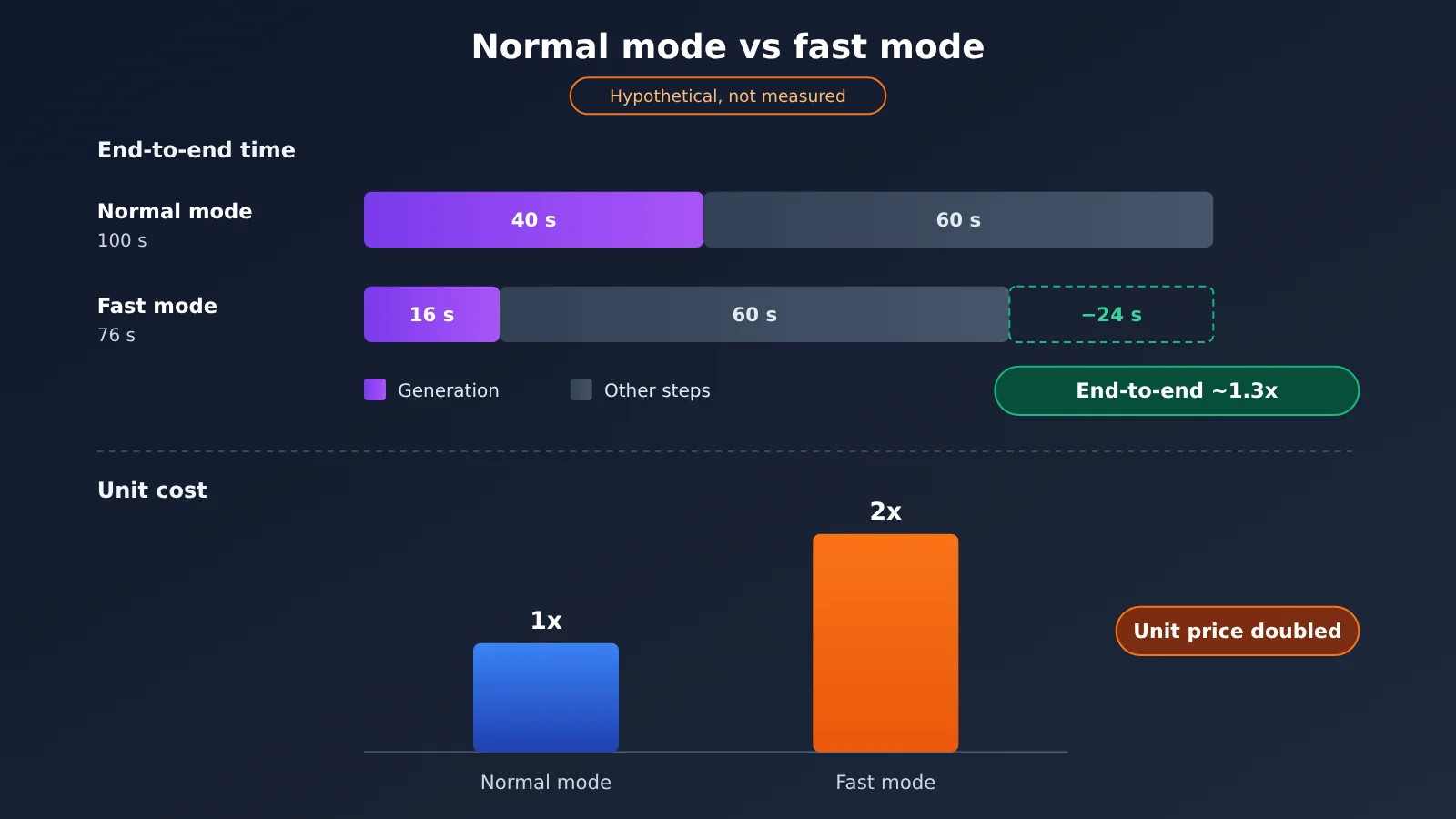
The table above shows the officially published prices. Fast mode costs twice as much as standard mode for both input and output. “Up to 2.5x faster” is the vendor’s description of token generation speed — it refers to a ceiling, not something every call will hit.
Official positioning of Claude Fable 5.2
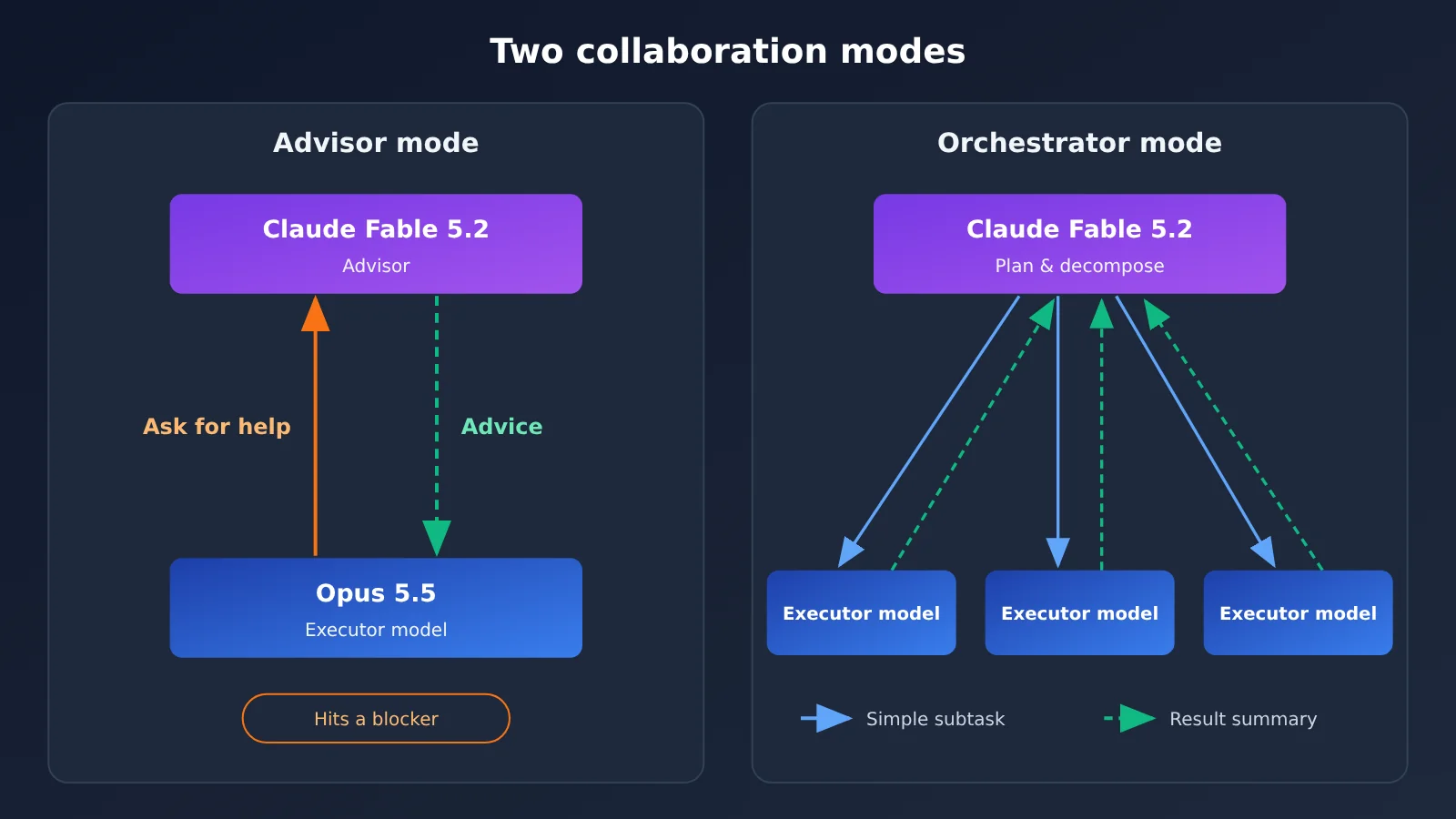
The official guidance is clear: for most everyday coding and knowledge work, start with Opus 5.5. Fable 5.2 is recommended for two collaborative roles:
- Advisor: when other models hit a hard problem mid-task, they consult Fable, which provides a judgment call or a plan.
- Orchestrator: Fable handles decomposition and planning, delegating the simpler subtasks to other models.
What this article did not verify
The following items were not independently validated by this article; keep the distinction in mind when citing them:
- The scientific research results and benchmark showings mentioned in official materials were not independently reproduced here.
- The “up to 2.5x faster” claim for fast mode is a vendor statement; this article did not benchmark it.
- The specific review criteria and timelines of the Mythos 5.2 verification program, and the availability of Fable 5.2 across different accounts, were not verified one by one.
- Opus 5.5’s specific pricing is outside the scope of this article; for a cost comparison between the two, refer to the official price list.
Claude Fable 5.2: Analysis and Assessment
The following is the author’s interpretation based on the facts above. Anything about future trends is a prediction and will be flagged separately.
Why Claude Fable 5.2 Isn’t a Daily Replacement
The most direct evidence comes from the official recommendation itself: start with Opus 5.5 for everyday coding and knowledge work. When a vendor launches a new model and actively steers users toward another one, it’s a sign that Fable 5.2 wasn’t designed to cover every task.
The way its collaborative roles are set up supports that reading, too. Both the Advisor and Orchestrator roles mean Fable 5.2 doesn’t handle all the execution work: the former steps in only when another model gets stuck, while the latter hands off simple tasks. The rationale behind this division of labor is to concentrate high-cost compute on planning and tough judgment calls.
So the answer to “daily replacement or hard-problem escalation?” is clear: Fable 5.2 is an escalation path for hard problems. Making it the global default model is like using expensive resources to handle a flood of simple requests that never needed them in the first place.
Three thresholds for deciding whether to integrate Claude Fable 5.2
It’s better to break the decision into three separate questions rather than just asking “is it powerful?”
| Decision dimension | Core question | What to watch |
|---|---|---|
| Access eligibility | Does your business need Fable or Mythos? | Requests in cybersecurity or biology may trigger Fable’s anti-abuse restrictions; Mythos requires organizations to pass a verification program |
| Waiting cost | How much does being slower actually cost you? | Interactive scenarios are latency-sensitive; batch scenarios usually aren’t |
| Invocation scope | Which steps really need Fable? | Restrict invocation points to the Advisor or Orchestrator role and avoid using it everywhere |
Access eligibility is the hard gate. If your team’s core work happens to fall in cybersecurity or biology, Fable 5.2’s restrictions may directly affect availability. Since both models share the same underlying model, what’s more worth focusing on here is whether you can get Mythos 5.2 through the verification program, rather than hunting for another, more powerful model.
Waiting cost determines whether to turn on fast mode. If developers are waiting in real time for responses in their IDE, or end users are waiting for a page to respond, cutting that wait has direct value. For overnight batch analysis jobs, waiting a few extra minutes usually doesn’t matter — turning on fast mode just means paying more.
Invocation scope determines the total bill. At the same unit price, invoking it only at tricky nodes versus on every request can make the monthly cost differ by an order of magnitude. This matters more than choosing between standard mode and fast mode.
Claude Fable 5.2 Fast Mode: Double the Price Doesn’t Mean 2.5x Faster Tasks
Fast mode costs twice as much as normal mode, and the vendor says token generation can be up to 2.5x faster. Seeing those two numbers, it’s tempting to conclude: “pay twice as much, get more than twice the speed—great deal.” But there are two separate things to unpack here.
First, “up to 2.5x” refers to the token generation step, and it’s a ceiling. A real task’s end-to-end time also includes network round trips, queuing, context processing, tool calls, code execution, and human review. Fast mode can only accelerate the generation portion; everything else takes just as long as before.
Second, in agent-style tasks, model generation is often only part of the total time. Below is a hypothetical example to show the calculation method; the numbers aren’t measured data: suppose a task takes 100 seconds total, with model generation accounting for 40 seconds and the other 60 seconds spent on tool calls and waiting. Even if generation hits the 2.5x ceiling and drops to 16 seconds, total time only falls from 100 seconds to 76 seconds—about a 1.3x end-to-end speedup—while the cost for that portion of tokens doubles.
The Python code below estimates the cost of a single task using the official unit prices, and estimates end-to-end speedup based on the share of time spent on generation. Replace the parameters with measured data from your own workload:
# Official published unit prices (USD per million tokens)
PRICES = {
    "normal": {"input": 8, "output": 40},
    "fast":   {"input": 16, "output": 80},
}

def task_cost(input_tokens: int, output_tokens: int, mode: str) -> float:
    p = PRICES[mode]
    return input_tokens / 1e6 * p["input"] + output_tokens / 1e6 * p["output"]

def end_to_end_speedup(total_sec: float, gen_sec: float, gen_speedup: float = 2.5) -> float:
    """Only the generation stage is accelerated; all other stages take the same time; gen_speedup is the upper bound."""
    new_total = (total_sec - gen_sec) + gen_sec / gen_speedup
    return total_sec / new_total

# Hypothetical example: 200k input tokens, 20k output tokens
print(task_cost(200_000, 20_000, "normal"))   # $2.40
print(task_cost(200_000, 20_000, "fast"))     # $4.80
print(round(end_to_end_speedup(100, 40), 2))  # about 1.32x
The point of this calculation: when evaluating Fast mode, use your own workload’s “share of time spent on generation” to estimate the benefit—don’t take 2.5x as the payoff. The higher the generation share (for example, a long one-shot text output), the closer Fast mode gets to the marketed effect; the more tool-call-heavy the workload, the smaller the benefit.
How Different Groups Should Handle Claude Fable 5.2
| Role | Recommended approach | What to avoid |
|---|---|---|
| Individual developers | Use Opus 5.5 for everyday work, and switch to Fable 5.2 manually only when you hit a problem that keeps stalling you | Making Fable 5.2 your editor’s default model |
| Agent architects | Set up an Advisor escalation channel, or give Fable only the planning layer | Letting Fable execute every sub-step |
| Security / biotech research organizations | First check whether your work triggers Fable’s restrictions, then evaluate a Mythos application | Repeatedly trying to work around the restrictions on Fable |
| Cost owners | Track Fable usage by call site, and enable fast mode only for interactive scenarios | Assuming you’ll capture the full benefit of the “2.5x speedup” |
For agent architects, Advisor mode can be implemented with one simple escalation rule: when the executing model fails several times in a row, or its self-rated confidence drops below a threshold, summarize the current context and hand it to Fable 5.2, then take the advice back and let the executing model finish the job. That way Fable’s call count is tied to the number of “hard problems” rather than the “total request volume,” which keeps costs more controllable.
Orchestrator mode works better for scenarios where the task structure is complex and splittable — say, a large code refactor or multi-document research. Fable handles the decomposition and acceptance checks, while execution goes to cheaper models. One thing to keep in mind: the orchestration layer itself produces long input contexts, and at $8 per million input tokens, those long-context planning calls need to go into your budget too.
Open Questions Worth Watching for Claude Fable 5.2
The following are predictions and areas to keep an eye on — they still need verification:
- Independent benchmark results: The research results and leaderboard standings the official announcement mentions need third-party reproduction before you can use them as a basis for choosing a model.
- Hands-on testing of fast mode: How big the real gap is between end-to-end speedups on different task types and the official “up to 2.5×” claim.
- Where the limits sit: How tightly Fable 5.2 actually restricts cybersecurity and biology work, and whether those restrictions end up hurting legitimate defensive research.
- Mythos 5.2 access bar: The scope and duration of the verification program will determine whether professional organizations can actually use the same underlying model.
- Whether the official positioning shifts (prediction): If pricing changes or the Opus line gets updated down the road, the “start with Opus 5.5 for everyday work” advice may change with it — worth re-evaluating at that point.
Fable 5.2’s value isn’t that it’s “stronger, so replace everything.” It’s about putting the most expensive capability where it’s needed most. Qu Yuan wrote in Bu Ju: “A foot has its shortfalls, an inch has its strengths; things have their deficiencies, and wisdom has its blind spots.” Choosing a model works the same way — everyday tasks and hard problems each have a tool that fits them.