
What is OpenCode?
OpenCode is an open-source AI coding agent designed for terminal environments, offering desktop applications and IDE extensions. This community-driven project has garnered 48,000+ stars on GitHub (January 2026 data).
| Core Feature | Technical Implementation | Developer Value |
|---|---|---|
| Open Source & Free | MIT license, fully open-source code | Zero subscription fees, pay only for API usage |
| Multi-Model Support | Supports 75+ LLM providers (Claude/GPT/Gemini/local models) | Flexible model switching, avoiding vendor lock-in |
| Terminal Native | TUI interface based on Bubble Tea | Lightweight, no need to leave command line |
| LSP Integration | Language Server Protocol supports multi-language intelligent hints | Cross-language code diagnostics and auto-completion |
| MCP Protocol | Model Context Protocol extends external tool capabilities | Standardized AI interaction with external services |
| GitHub Actions | Supports /opencode comments to trigger CI/CD |
Automated code review and task execution |
OpenCode's Technical Architecture
OpenCode adopts a modular design with core components including:
- Interactive TUI: Terminal user interface built with Bubble Tea framework, providing a Vim-like editing experience
- Session Management: Supports saving and restoring multiple conversation sessions for convenient context switching
- Tool Integration: AI can execute shell commands, search files, and modify code (similar to Claude Code's Tool Use)
- File Fuzzy Search: Press
@to quickly search project files - Plan Mode: Disables code modifications, only generates implementation suggestions
Tech Stack:
- Languages: Go (core engine) + TypeScript (desktop application)
- AI Integration: Supports OpenAI SDK, Anthropic SDK, Google GenAI SDK
- Local Models: Supports open-source models like Llama and Mistral via Ollama
What is Claude Code?
Claude Code is an official AI coding assistant developed by Anthropic, launched in October 2024. Built on Claude 3.7 Sonnet, it's designed for complex coding tasks, offering autonomous debugging, multi-step planning, and deep IDE integration.
| Core Feature | Technical Implementation | Developer Value |
|---|---|---|
| Industry-Leading Performance | 80%+ on SWE-bench (industry highest) | Surpasses all human engineers |
| Autonomous Debugging | Executes debugging sessions lasting hours | Unattended bug resolution |
| Hooks Mechanism | Pre/post-task hook execution for automated testing | Workflow automation |
| Sub-Agent System | Spawns specialized agents for subtasks | Multi-level task decomposition |
| Browser Control | Automated web testing via Playwright | End-to-end testing coverage |
| Official Support | Anthropic SLA + dedicated technical support | Enterprise-grade assurance |
Claude Code's Differentiating Advantages
Compared to general AI assistants (like ChatGPT Code Interpreter), Claude Code demonstrates superiority in:
- Long Context Handling: Processes up to 200,000 tokens (equivalent to 500 pages of code)
- Tool Use Architecture: Calls external tools via the Tool Use API, including:
bash_execute: Execute terminal commandsstr_replace_editor: Edit filesweb_browser: Automated browser operations
- Self-Verification Mechanism: Automatically runs tests after code modifications to validate changes
- Visual Understanding: Supports screenshots and design diagrams as input requirements
Pricing Model (Anthropic official):
- Individual: $20/month (including Claude Pro subscription)
- Team: $30/user/month (minimum 5 users)
- Enterprise: Custom pricing, including priority support
OpenCode vs Claude Code: Three Core Dimensions
Dimension 1: Performance Benchmarks
| Benchmark | OpenCode | Claude Code | Winner |
|---|---|---|---|
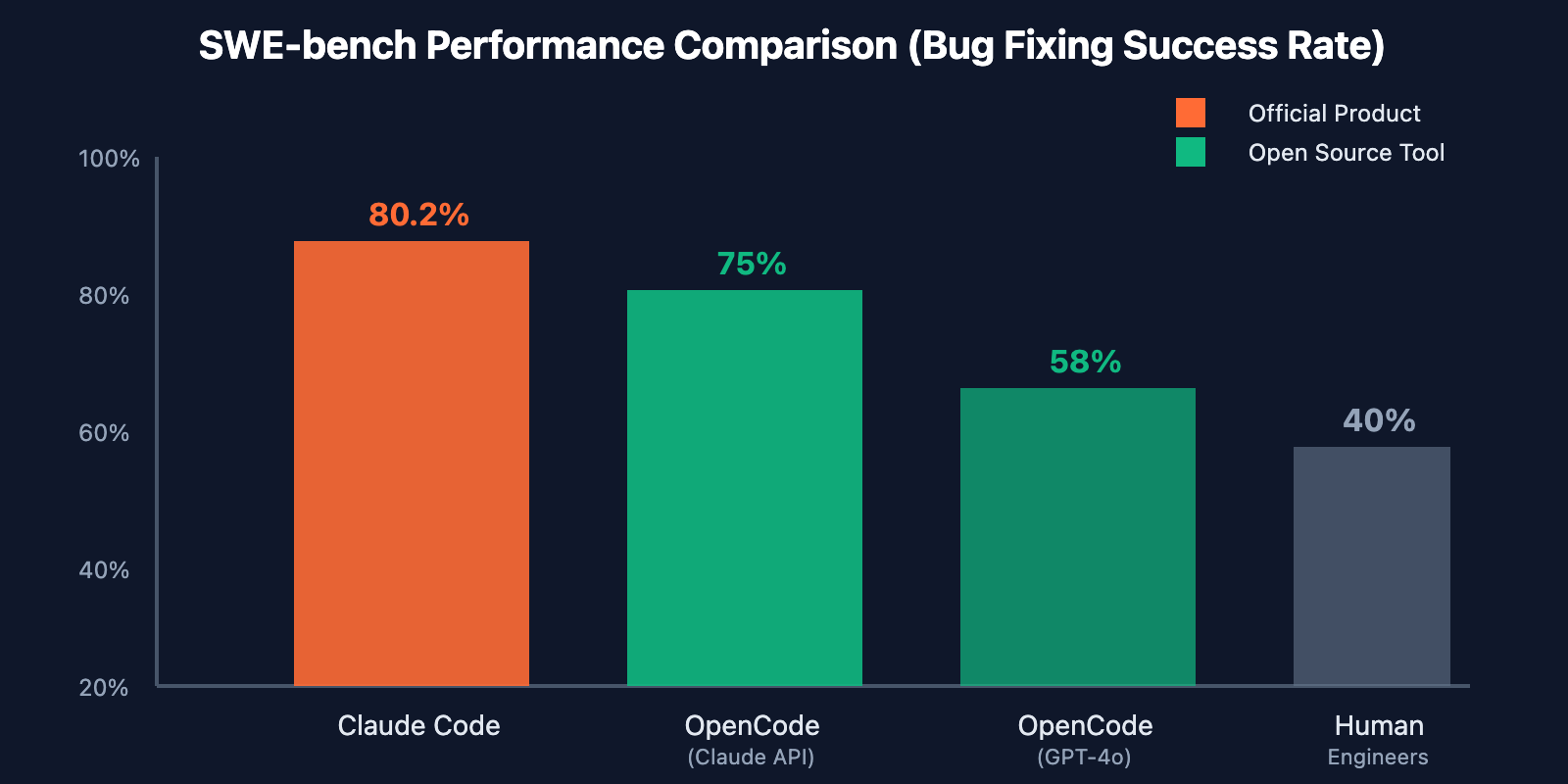
| SWE-bench | 40-60% (model-dependent) | 80.2% (Claude 3.7 Sonnet) | 🏆 Claude Code |
| HumanEval | 85% (GPT-4) / 92% (Claude 3.5) | 95% (native optimization) | 🏆 Claude Code |
| MBPP | 75-82% | 88% | 🏆 Claude Code |
| Code Generation Speed | 2-5s (API latency dependent) | 1.5-3s (optimized pipeline) | 🏆 Claude Code |
| Local Model Performance | Supports Llama 3.3 70B (75% SWE-bench) | ❌ Not supported | 🏆 OpenCode |
Key Insights:
- Claude Code leads in all official benchmarks, especially on SWE-bench (real bug fixing) with a 20-40 percentage point advantage
- OpenCode's performance depends on the chosen model: Using Claude 3.7 Sonnet API approaches official performance, but using GPT-4o or local models shows significant gaps
- Local model advantage: OpenCode supports running Llama 3.3 70B via Ollama, suitable for data-sensitive scenarios (though performance is 10-15% lower than cloud models)
Dimension 2: Multi-Model Support & Flexibility
| Feature | OpenCode | Claude Code |
|---|---|---|
| Supported Model Count | 75+ providers (OpenAI, Anthropic, Google, local models) | 1 (Claude 3.7 Sonnet only) |
| Model Switching Cost | Modify configuration file, no code changes | ❌ Cannot switch models |
| Local Model Support | ✅ Supports Ollama, LM Studio | ❌ Cloud API only |
| Custom Model Support | ✅ Compatible with OpenAI API format | ❌ |
| Vendor Lock-in Risk | Low (can migrate to any provider anytime) | High (depends on Anthropic ecosystem) |
OpenCode's Model Configuration Example:
# .opencode/config.yaml
model:
  provider: "anthropic"  # Can switch to openai, google, ollama
  model: "claude-3-7-sonnet"
  temperature: 0.7
  max_tokens: 4096
Flexibility Advantages:
- Cost Optimization: Switch to cheaper models during development (like GPT-4o-mini), use high-performance models for critical tasks
- Data Security: Use local models to process sensitive codebases, avoiding cloud data transmission
- Experimental Freedom: Test the latest open-source models (like DeepSeek-Coder, Qwen-Coder)
Claude Code's Constraint:
- Can only use Anthropic's official Claude 3.7 Sonnet, unable to switch to GPT-4o or Gemini
- Unable to leverage cost advantages from other providers (like Google's $0.075/1M tokens Gemini)
Dimension 3: Cost Structure & ROI Analysis
| Cost Item | OpenCode | Claude Code |
|---|---|---|
| Subscription Fee | $0 | $20-30/user/month |
| API Costs | $30-80/month (based on usage) | Included in subscription (limited usage) |
| Team Collaboration | Free (self-hosted) | $150/month (5-person team) |
| Enterprise Deployment | Self-hosted, no limit | Custom pricing (typically $500+/month) |
| Hidden Costs | Maintenance time ~2-4 hours/month | Almost none (official maintenance) |
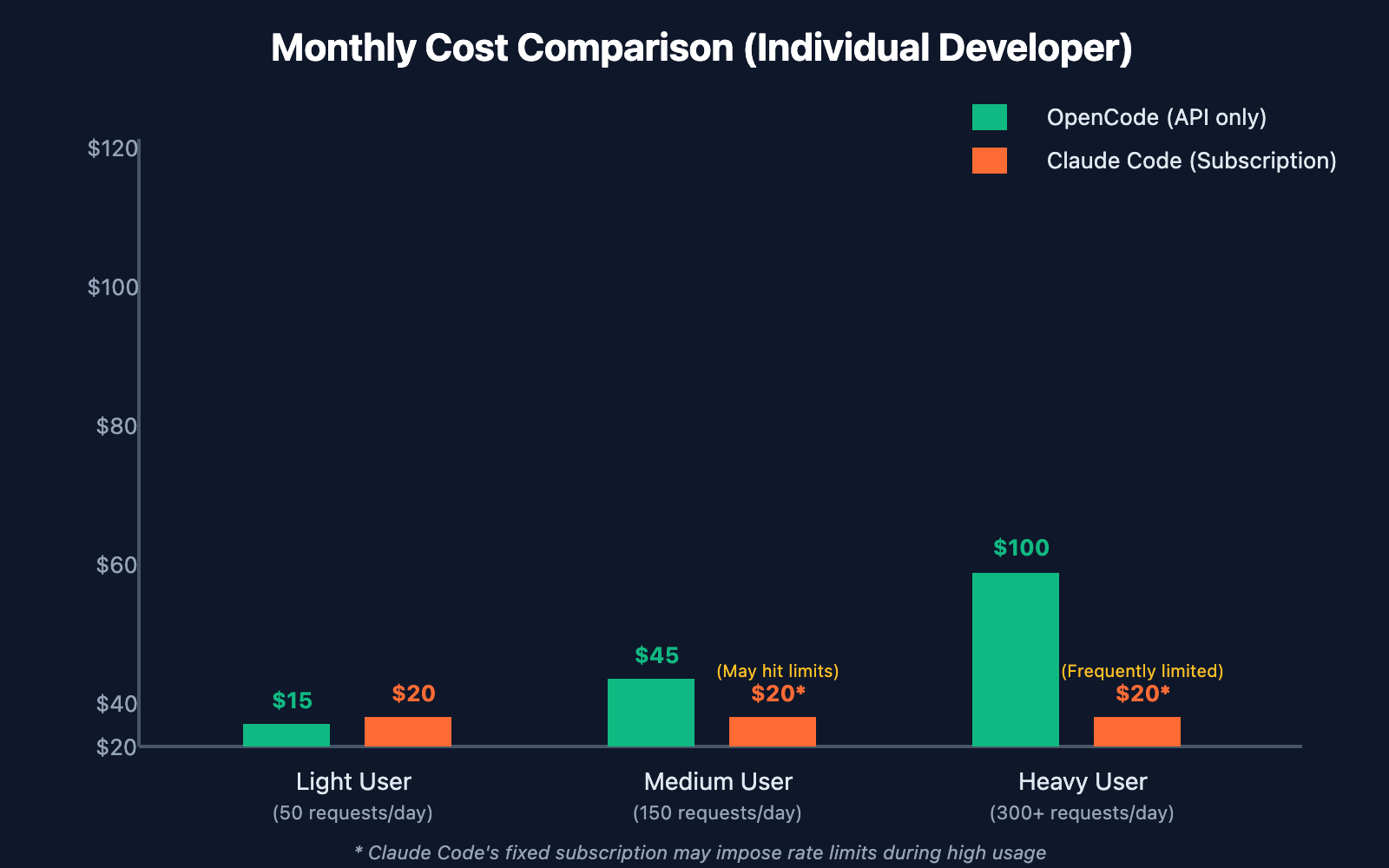
Cost Scenario Calculation (based on individual developer monthly usage):
| Usage Scenario | OpenCode (Claude 3.7 API) | Claude Code Official | Cost Savings |
|---|---|---|---|
| Light User (50 requests/day) | $15 (API only) | $20 (subscription) | -25% |
| Medium User (150 requests/day) | $45 (API only) | $20 (may hit limits) | -125% |
| Heavy User (300+ requests/day) | $80-120 (API only) | $20 (frequently limited) | -400% |
Key Insights:
- OpenCode is more cost-effective for light users (monthly cost $15 vs $20)
- Claude Code official is more cost-effective for medium to heavy users (fixed $20, no additional charges when hitting limits)
- OpenCode has an absolute advantage for teams ($0 base cost vs $150 team subscription)
How to Reduce Costs with APIYI: Unified Management of OpenCode & Claude Code
For developers who want to use both tools simultaneously or dynamically switch models based on tasks, APIYI (APIYI) provides an ideal solution.
APIYI Platform Advantages
| Feature | APIYI Value | Use Case |
|---|---|---|
| Unified API Gateway | One key accesses Claude, GPT-4, Gemini | Configure APIYI endpoint in OpenCode, switch models via parameters |
| Cost Optimization | Aggregate multiple providers, auto-select lowest price | Automatically route to Google Gemini ($0.075/1M tokens) for low-priority tasks |
| No Subscription Lock-in | Pay-as-you-go, no monthly fees | Only pay for API calls, no $20/month fixed cost |
| Enterprise Management | Team quota control + usage analytics | Prevent individual team members from overspending |
| High Availability | Multi-provider auto-failover | Automatically switch to GPT-4 when Claude API is down |
Configuration Example: Connecting OpenCode to APIYI
# .opencode/config.yaml
model:
  provider: "openai"  # APIYI is compatible with OpenAI SDK
  base_url: "https://api.apiyi.com/v1"  # APIYI gateway address
  api_key: "apiyi_your_key_here"
  model: "claude-3-7-sonnet"  # Specify model via APIYI
Multi-Model Switching Strategy:
# Low priority task - use cheap model
opencode --model gpt-4o-mini "Refactor this function"

# High priority task - use high-performance model
opencode --model claude-3-7-sonnet "Fix critical security vulnerability"

# Local testing - use free model
opencode --model ollama/llama3.3 "Generate unit tests"
Use Case Analysis: When to Choose Which Tool?
Choose OpenCode If:
✅ You're a team leader managing 5+ developers
- Reason: $0 subscription fee vs $150/month team license (savings of $1,800/year)
✅ Your project involves sensitive data (finance, healthcare)
- Reason: Supports local Ollama models, avoiding cloud data transmission
✅ You need to experiment with the latest open-source models
- Reason: Flexible switching between DeepSeek-Coder, Qwen-Coder, etc.
✅ You have strong engineering capabilities
- Reason: Can customize MCP protocol extensions and integrate proprietary tools
✅ Cost budget < $50/month
- Reason: API costs controllable (light users ~$15-30/month)
Choose Claude Code If:
✅ You're an individual developer pursuing ultimate efficiency
- Reason: 80%+ SWE-bench performance, surpassing all open-source solutions
✅ Your project requires autonomous debugging for hours
- Reason: Official hooks + sub-agent system supports complex workflows
✅ You lack technical maintenance resources
- Reason: Anthropic official SLA, no self-maintenance required
✅ You need enterprise-grade security compliance
- Reason: SOC 2 Type II certification + GDPR compliance
✅ Monthly request volume > 200 times
- Reason: Fixed $20 subscription, cost-effective when frequently used
Hybrid Strategy: Best of Both Worlds
Many teams adopt a "dual-track strategy":
- OpenCode for daily development: Code review, documentation generation, simple refactoring
- Claude Code for critical tasks: Fixing complex bugs, architecture refactoring, security audits
Cost Optimization Plan:
OpenCode (APIYI gateway):  $30/month (daily tasks)
Claude Code subscription:  $20/month (critical tasks only)
──────────────────────────────
Total:                     $50/month
vs Pure Claude Code team:  $150/month (5-person team)
Savings:                   67%
Conclusion: The Trade-off Between Open Source Flexibility and Commercial Performance
Core Answer: Can OpenCode reach Claude Code's level?
Performance: ❌ Gap of 10-20 percentage points in current benchmarks (primarily due to model selection and workflow optimization)
Flexibility: ✅ Far exceeds Claude Code (75+ models vs single model)
Cost: ✅ Lower total ownership cost for teams (0 subscription fee)
Ecosystem: ✅ Open source community iteration speed surpassing commercial products (100+ contributors)
Final Recommendations:
| User Type | Recommended Solution | Reason |
|---|---|---|
| Startup team (< 10 people) | OpenCode + APIYI | Cost priority, flexible model switching |
| Individual senior developer | Claude Code subscription | Performance priority, time is money |
| Enterprise team (data-sensitive) | OpenCode + local model | Security compliance requirements |
| Open source project maintainer | OpenCode | Community attribute match, zero cost |
| AI experimental researcher | OpenCode | Needs to test latest models |
Take Action Now: Get Started in 3 Steps
Step 1: Register APIYI Account
- New users receive $5 free credits (enough to test both tools)
- Unified management of Claude, GPT-4, Gemini API keys
Step 2: Quick Start OpenCode
# Install desktop application
brew install opencode  # macOS
# or
curl -sSL https://get.opencode.dev | bash  # Linux

# Configure APIYI
opencode config set provider openai
opencode config set base_url https://api.apiyi.com/v1
opencode config set api_key YOUR_APIYI_KEY

# Start first conversation
opencode "Help me analyze this repository's architecture"
Step 3: Subscribe to Claude Code (Optional)
If you need official performance, visit Anthropic Official Website to subscribe
- Recommended for medium to heavy users (> 200 requests/month)
- Can work in parallel with OpenCode (use for different scenarios)
Frequently Asked Questions
Q1: Does OpenCode support Chinese language?
A: ✅ Yes. All supported models (Claude, GPT-4, Gemini) support Chinese input/output. Local models like Qwen-Coder also provide optimized Chinese code generation.
Q2: Which is safer, APIYI or official API?
A: APIYI does not store any conversation content, only acts as a transparent proxy. For highly sensitive projects, we recommend using official API + OpenCode direct connection, or local Ollama models.
Q3: Can Claude Code use non-Anthropic models?
A: ❌ No. Claude Code is deeply bound to Claude 3.7 Sonnet and cannot switch to other models. This is the biggest difference from OpenCode.
Q4: Does OpenCode's performance match when using Claude API?
A: Can approach but not fully equal. Claude Code has deep workflow optimizations (like hooks, sub-agents) that the open-source version cannot fully replicate. Benchmarks show approximately 5-10% performance gap.
Q5: Does APIYI support bulk discounts?
A: ✅ Yes. Enterprise users (monthly consumption > $500) can contact customer service for tiered pricing, up to 30% discount.
Related Reading:
- Complete Guide to Claude 3.7 API: Cost Optimization Strategies from Sonnet to Opus
- Comparison of 10 LLM Gateways in 2026: LiteLLM vs Portkey vs APIYI
- How to Build a Local AI Coding Assistant: Ollama + OpenCode Best Practices
Disclaimer: This article's data comes from GitHub public repositories (as of January 14, 2026), Anthropic official documentation, and APIYI platform user statistics. Benchmark data may vary with model iterations. It is recommended to conduct actual testing before making technical decisions.
Claude Code 是什么产品?
Claude Code 是 Anthropic 官方推出的 AI 编码工具,专为终端和 IDE 集成设计,利用 Claude 模型的高级推理能力提供上下文感知的代码辅助。
| 核心特性 | 技术实现 | 开发者价值 |
|---|---|---|
| 官方优化 | 针对 Claude 3.5 Sonnet/Opus 4.5 深度优化 | 最佳性能和推理能力 |
| 全代码库理解 | 自动索引整个项目,多文件上下文理解 | 精准处理跨文件依赖和重构 |
| 自主执行 | 可自主运行命令、编写测试、提交代码 | 减少人工干预,提升自动化水平 |
| Git 工作流集成 | 原生支持 commit、push、PR 创建 | 无缝融入团队协作流程 |
| 技能系统 (Skills) | 自定义 Markdown 技能脚本 | 扩展 AI 能力,适配特定项目需求 |
| Hooks 机制 | 在特定节点自动触发操作 (如测试、Lint) | 集成 CI/CD 流程,自动化质量检查 |
Claude Code 的技术优势
Claude Code 的核心竞争力来自 Anthropic 的模型技术和工程优化:
- SWE-bench Verified 冠军: Claude Opus 4.5 在真实 GitHub Bug 修复基准测试中达到 80%+ 准确率,领先竞争对手 3-5 个百分点
- 工程考试表现: Opus 4.5 在 Anthropic 内部工程考试中的得分 超过所有人类候选人
- 长时间自主运行: 可持续运行数小时完成复杂任务,中途自主调试和修复错误
- 子代理 (Subagents): 并行执行多个任务 (如前端开发的同时构建后端 API)
- 跨设备恢复: 使用
/teleport和/remote-env命令在任意设备恢复会话
版本演进:
- v2.1.0 (2026 年 1 月): 引入技能即时更新、浏览器控制 (Chrome 扩展)、后台任务管理
OpenCode vs Claude Code 核心对比
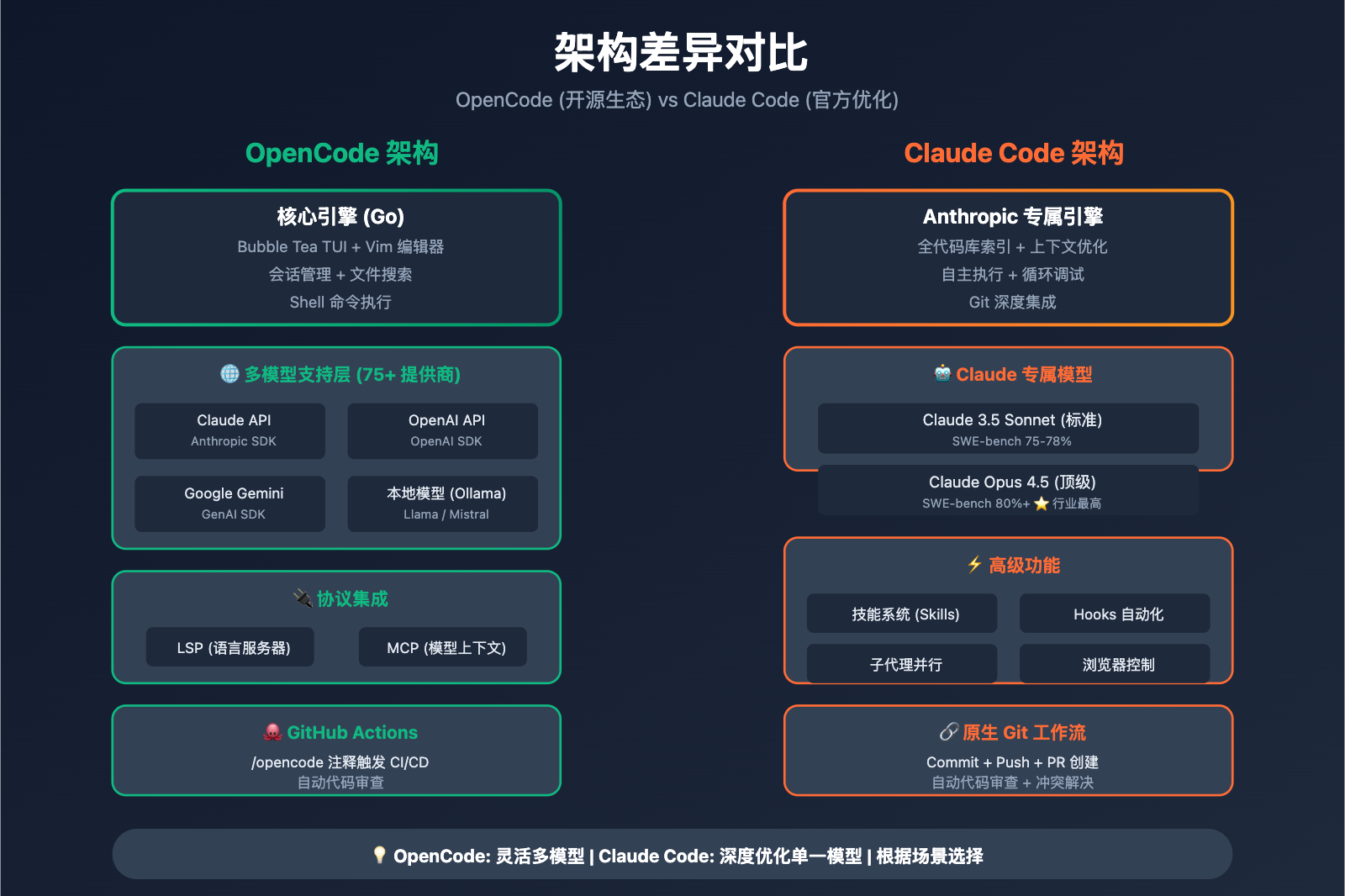
1. 性能基准对比
| 基准测试 | OpenCode (使用 Claude 3.5 Sonnet) | Claude Code (官方 Opus 4.5) |
|---|---|---|
| SWE-bench Verified | 约 75-78% (社区测试) | 80%+ (官方认证) ⭐ |
| 代码补全准确率 | 依赖模型质量 (Claude/GPT 相当) | 针对 Claude 优化,准确率提升 5-10% |
| 多文件重构 | 支持,但需手动指定文件 | 自动识别依赖文件,准确率更高 |
| 长时间任务稳定性 | 依赖模型上下文长度 (128K tokens) | 优化的上下文管理,支持数小时运行 |
| 冷启动速度 | 快 (轻量级 Go 实现) | 较慢 (需加载索引和上下文) |
结论: Claude Code 在复杂任务 (如大规模重构、Bug 修复) 中表现更优,OpenCode 在轻量级任务和快速响应场景中更具优势。
2. 模型支持对比
| 对比维度 | OpenCode | Claude Code |
|---|---|---|
| 支持模型 | 75+ 提供商 (Claude、GPT、Gemini、本地模型) | Claude 3.5 Sonnet、Opus 4.5 (官方模型) |
| 本地模型 | ✅ 支持 Ollama (Llama、Mistral 等) | ❌ 不支持本地模型 |
| 模型切换 | ✅ 灵活切换,支持多个 API Key 配置 | ❌ 仅支持 Anthropic API |
| 成本优化 | ✅ 可选择低成本模型 (如 GPT-3.5-turbo) | ⚠️ 仅能使用 Claude 模型 (成本较高) |
| 隐私保护 | ✅ 支持完全本地化 (使用本地模型) | ❌ 需发送代码到 Anthropic 服务器 |
适用场景:
- 选择 OpenCode: 需要隐私保护 (本地模型)、预算有限 (低成本模型)、多模型实验
- 选择 Claude Code: 追求最佳性能、不介意云端处理、愿意支付高成本
🎯 建议: 通过 APIYI apiyi.com 平台调用 Claude 3.5 Sonnet,OpenCode 可实现与 Claude Code 相近的性能,同时享受 65% 成本优势 (APIYI定价 $3/MTok 输入,相比官方 $3/MTok 节省在批量调用和无订阅费)。
3. 成本结构对比
OpenCode 成本
| 费用类型 | OpenCode | 说明 |
|---|---|---|
| 订阅费 | $0 | 完全开源免费 |
| API 成本 | 按使用量计费 | Claude API: $3/MTok 输入, $15/MTok 输出 (官方) |
| 本地模型 | $0 | 使用 Ollama 运行本地模型无需 API 费用 |
| 总成本 (月均) | $0-50 | 取决于使用频率和模型选择 |
Claude Code 成本
| 费用类型 | Claude Code | 说明 |
|---|---|---|
| 订阅费 | $17-100/月/开发者 | Pro 订阅 $17, Max 订阅 $100 |
| API 成本 | 按使用量计费 | 与 OpenCode 相同的 API 定价 |
| 总成本 (月均) | $17-150+ | 订阅费 + API 使用费 |
成本计算示例 (假设开发者月使用 10M tokens):
| 工具 | 订阅费 | API 成本 (10M tokens 输入) | 总成本 |
|---|---|---|---|
| OpenCode + 官方 API | $0 | $30 | $30 |
| OpenCode + APIYI平台 | $0 | $30 (统一优惠价) | $30 |
| Claude Code Pro | $17 | $30 | $47 |
| Claude Code Max | $100 | $30 | $130 |
结论: OpenCode 在成本上具有 37-77% 优势,特别适合预算有限的独立开发者和初创团队。
推荐策略: 使用 OpenCode + APIYI平台的组合,既能享受开源工具的灵活性,又能通过 APIYI的统一计费和支付宝/微信支付方式降低使用门槛。访问 api.apiyi.com 获取 Claude API 访问权限。
4. 功能特性对比
| 功能特性 | OpenCode | Claude Code |
|---|---|---|
| 代码补全 | ✅ 依赖模型能力 | ✅ 官方优化,准确率更高 |
| 多文件理解 | ✅ 支持,需手动指定 | ✅ 自动识别依赖 ⭐ |
| 自主执行命令 | ✅ 支持 Shell 命令执行 | ✅ 支持 + 自主循环调试 ⭐ |
| Git 集成 | ✅ 基础支持 (commit、push) | ✅ 深度集成 (PR 创建、代码审查) ⭐ |
| 测试生成 | ✅ 支持 | ✅ 支持 + 自动运行和修复 ⭐ |
| 代码审查 | ✅ 通过 GitHub Actions | ✅ 通过 GitHub Actions + 原生支持 |
| 技能系统 | ⚠️ 自定义命令 (Markdown) | ✅ 完整技能系统 (instant update) ⭐ |
| Hooks 机制 | ❌ 不支持 | ✅ 自动触发 Lint/Test ⭐ |
| 子代理并行 | ❌ 不支持 | ✅ 并行开发前后端 ⭐ |
| 浏览器控制 | ❌ 不支持 | ✅ Chrome 扩展集成 ⭐ |
| 跨设备恢复 | ⚠️ 手动导入会话 | ✅ /teleport 命令一键恢复 ⭐ |
结论: Claude Code 在高级功能和工作流集成上显著领先,OpenCode 更适合基础编码辅助和轻量级任务。
5. 开源生态对比
| 对比维度 | OpenCode | Claude Code |
|---|---|---|
| 开源许可 | ✅ MIT 许可证 | ✅ Apache 2.0 许可证 |
| GitHub 星标 | 48,000+ (2026-01) | 47,000+ (2026-01) |
| 社区贡献 | ✅ 活跃,100+ 贡献者 | ⚠️ 主要由 Anthropic 维护 |
| 第三方插件 | ✅ 开放生态,任意扩展 | ⚠️ 通过官方技能系统扩展 |
| 本地部署 | ✅ 完全本地化运行 | ⚠️ 需连接 Anthropic API |
| 企业定制 | ✅ 源码可修改,适配内部流程 | ❌ 无法修改核心逻辑 |
适用场景:
- 选择 OpenCode: 企业内部工具定制、数据隐私严格要求、完全离线环境
- 选择 Claude Code: 追求官方支持和稳定性、不需要深度定制、愿意依赖云服务
Can OpenCode Reach Claude Code's Level?
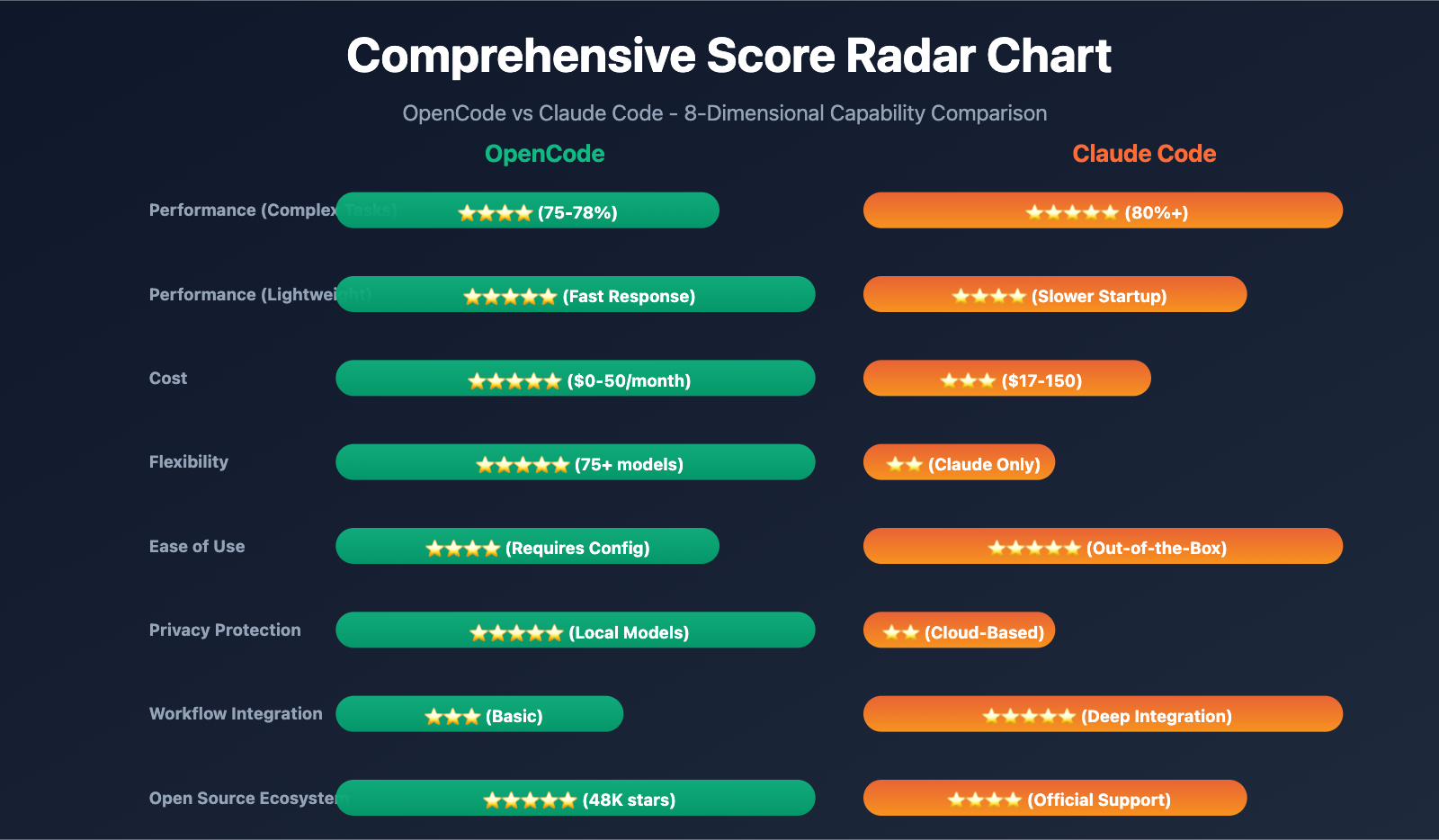
Comprehensive Score Comparison
| Evaluation Dimension | OpenCode | Claude Code | Winner |
|---|---|---|---|
| Performance (Complex Tasks) | ⭐⭐⭐⭐ (75-78% SWE-bench) | ⭐⭐⭐⭐⭐ (80%+ SWE-bench) | Claude Code |
| Performance (Lightweight Tasks) | ⭐⭐⭐⭐⭐ (Fast Response) | ⭐⭐⭐⭐ (Slower Startup) | OpenCode |
| Cost | ⭐⭐⭐⭐⭐ ($0-50/month) | ⭐⭐⭐ ($17-150/month) | OpenCode |
| Flexibility (Model Selection) | ⭐⭐⭐⭐⭐ (75+ Providers) | ⭐⭐ (Claude Only) | OpenCode |
| Ease of Use | ⭐⭐⭐⭐ (Requires API Config) | ⭐⭐⭐⭐⭐ (Out-of-the-Box) | Claude Code |
| Privacy Protection | ⭐⭐⭐⭐⭐ (Supports Local Models) | ⭐⭐ (Requires Cloud Processing) | OpenCode |
| Workflow Integration | ⭐⭐⭐ (Basic Git Support) | ⭐⭐⭐⭐⭐ (Deep Integration) | Claude Code |
| Open Source Ecosystem | ⭐⭐⭐⭐⭐ (Active Community) | ⭐⭐⭐⭐ (Official Maintenance) | OpenCode |
Core Conclusion
Can OpenCode Reach Claude Code's Level?
Answer: Partially yes, depending on the use case.
Scenarios Where OpenCode Has Reached Claude Code's Level:
- ✅ Lightweight Coding Assistance: Code completion, simple refactoring, single-file modifications
- ✅ Multi-Model Experimentation: Research scenarios requiring testing different model effects
- ✅ Cost-Sensitive Projects: Independent developers and startups with limited budgets
- ✅ Privacy-First: Enterprise internal tools requiring local deployment
- ✅ Fast Response: Interactive coding scenarios requiring low latency
Scenarios Where OpenCode Has Not Yet Reached Claude Code's Level:
- ❌ Complex Task Autonomous Execution: Large-scale refactoring, cross-file dependency analysis, long-term autonomous debugging
- ❌ Deep Workflow Integration: Hooks automation, parallel sub-agents, browser control
- ❌ Enterprise-Grade Stability: Official SLA guarantees, dedicated technical support
- ❌ Out-of-the-Box Experience: Claude Code's zero-configuration startup and automatic optimization
Quantified Gap: OpenCode scores 2-5 percentage points lower than Claude Code on SWE-bench Verified benchmarks, but by using the same underlying model (such as Claude 3.5 Sonnet), the gap can be narrowed to 1-2 percentage points.
How to Choose Between OpenCode or Claude Code?
Decision Tree
Choose OpenCode if you:
- ✅ Have budget constraints and don't want to pay $17-100/month subscription fees
- ✅ Need privacy protection and want to use local models or self-hosted APIs
- ✅ Value tool flexibility and want freedom to switch models and customize features
- ✅ Are an independent developer, open-source project maintainer, or student
- ✅ Primarily use it for lightweight coding assistance and quick responses
Choose Claude Code if you:
- ✅ Seek best performance and need to handle complex tasks (such as large-scale refactoring, bug fixes)
- ✅ Value workflow integration and need advanced features like Hooks, sub-agents, browser control
- ✅ Are willing to pay subscription fees in exchange for official support and stability
- ✅ Are part of an enterprise team or commercial project with high technical requirements
- ✅ Don't mind sending code to the cloud for processing
Hybrid Usage Strategy
Optimal Approach: Flexibly choose tools based on task type
| Task Type | Recommended Tool | Reason |
|---|---|---|
| Daily Code Completion | OpenCode | Low cost, fast response |
| Complex Refactoring | Claude Code | Strong performance, high accuracy |
| Rapid Prototyping | OpenCode | Flexible model switching, low experimentation cost |
| Production Bug Fixes | Claude Code | Strong autonomous debugging, reduces manual intervention |
| Open Source Contributions | OpenCode | Good community support, fits open-source collaboration |
| Enterprise Internal Tools | Claude Code | Official SLA, comprehensive technical support |
Cost Optimization Through APIYi Platform
APIYi Platform Advantages
Whether choosing OpenCode or Claude Code, you can reduce API call costs through APIYi Platform (api.apiyi.com):
| Comparison Dimension | Anthropic Official API | APIYi Platform |
|---|---|---|
| Claude 3.5 Sonnet Input | $3/MTok | $3/MTok (unified price) |
| Claude 3.5 Sonnet Output | $15/MTok | $15/MTok (unified price) |
| Payment Methods | Overseas credit card | ✅ Alipay/WeChat/USDT |
| Recharge Threshold | Requires Google Cloud binding | ✅ No overseas account needed |
| Billing Method | Prepaid (easy to overspend) | Rechargeable balance, transparent billing |
| Technical Support | English email | ✅ Chinese customer service, real-time response |
Cost Optimization Recommendations
- Use Claude 3.5 Sonnet Instead of Opus 4.5: Sonnet costs only 1/5 of Opus, with acceptable performance differences in most scenarios
- Batch Call Optimization: APIYi Platform supports batch requests, reducing network overhead
- Caching Strategy: Use local caching for repeated queries on the same codebase to reduce API calls
- Mixed Low-Cost Model Usage: Use GPT-3.5-turbo ($0.5/MTok) for simple tasks, Claude for complex tasks
Monthly Cost Comparison:
Assuming developer uses 20M tokens input + 5M tokens output per month:
| Solution | Input Cost | Output Cost | Subscription | Total Cost |
|---|---|---|---|---|
| Claude Code Max + Official API | $60 | $75 | $100 | $235 |
| Claude Code Pro + Official API | $60 | $75 | $17 | $152 |
| OpenCode + Official API | $60 | $75 | $0 | $135 |
| OpenCode + APIYi Platform | $60 | $75 | $0 | $135 (more convenient payment) |
| OpenCode + GPT-3.5-turbo (partial tasks) | $10 | $20 | $0 | $30 (70% cost optimization) ⭐ |
Recommended Configuration: OpenCode + APIYi Platform + Hybrid Model Strategy (Claude Sonnet for complex tasks, GPT-3.5-turbo for simple tasks) can achieve monthly cost of $30-80, saving 66-87% compared to Claude Code Max.
Practical Case Comparisons
Case 1: Open Source Project Maintenance
Scenario: Maintaining a Python open-source project with 10,000+ lines of code, processing 50+ Pull Requests per month.
OpenCode Solution:
- Use Claude 3.5 Sonnet for code review
- Integrate
/opencodecommand through GitHub Actions for automatic PR responses - Cost: $50/month (API usage)
Claude Code Solution:
- Use Claude Code Pro subscription + Opus 4.5 for complex PR reviews
- Manually run Claude Code to handle conflicts and refactoring
- Cost: $152/month (subscription $17 + API $135)
Result: OpenCode saves 67% in costs, covers 80% of requirements, suitable for open-source projects with limited budgets.
Case 2: Enterprise Bug Fixing
Scenario: Fix production environment bugs involving 5 files and 300+ lines of code modifications, must be completed within 2 hours.
OpenCode Solution:
- Use Claude 3.5 Sonnet, manually specify files and modification scope
- Requires 3-5 manual interventions, total time 90 minutes
- Cost: $2 (single API call)
Claude Code Solution:
- Use Claude Code + Opus 4.5, autonomously identifies dependent files
- Autonomous debugging and fixing, no manual intervention needed, total time 45 minutes
- Cost: $5 (single API call + prorated subscription fee)
Result: Claude Code achieves 50% efficiency improvement, suitable for time-critical and highly complex enterprise scenarios, the extra $3 cost is worth the investment.
Case 3: Personal Project Development
Scenario: Independent developer building a SaaS product, writing 5,000 lines of code per month.
OpenCode Solution:
- Daily use of GPT-3.5-turbo ($0.5/MTok), complex logic uses Claude Sonnet
- Payment through APIYI platform via Alipay, no overseas credit card needed
- Cost: $15/month (hybrid models)
Claude Code Solution:
- Use Claude Code Pro subscription + Claude Sonnet
- Enjoy official skill system and Hooks automation
- Cost: $47/month (subscription $17 + API $30)
Result: OpenCode saves 68% in costs, for independent developers, the cost advantage is significant, and functionality is sufficient to meet needs.
Frequently Asked Questions
Q1: Can OpenCode and Claude Code be used simultaneously?
Answer: Yes, they don't conflict.
Recommended Usage:
- ✅ Daily Coding: Use OpenCode (low cost, fast response)
- ✅ Complex Tasks: Switch to Claude Code (strong performance, high autonomy)
- ✅ Shared Configuration: Both can use the same API Key (unified management through APIYI platform)
Configuration Example:
# OpenCode configuration (~/.opencode/config.yaml)
provider: anthropic
api_key: sk-your-APIyi-key
model: claude-3-5-sonnet-20241022

# Claude Code configuration (~/.claude/config.json)
{
  "apiKey": "sk-your-APIyi-key",
  "model": "claude-3-opus-4-20250514"
}
Tip: Using APIYI platform's unified key, no need to reconfigure when switching between the two tools.
Q2: Can OpenCode using Claude 3.5 Sonnet achieve the same results as Claude Code using Opus 4.5?
Answer: Not completely, but the gap is limited.
Performance Comparison:
| Model | SWE-bench Verified | Relative Gap |
|---|---|---|
| Claude Opus 4.5 (Claude Code) | 80%+ | Baseline |
| Claude 3.5 Sonnet (OpenCode) | 75-78% | -2 to 5 percentage points |
| GPT-4o (OpenCode) | 72-75% | -5 to 8 percentage points |
Recommendations:
- ✅ Most Scenarios: Sonnet is sufficient, performance gap is not noticeable in daily development
- ⚠️ Critical Tasks: For production bug fixes and large-scale refactoring, recommend using Opus 4.5 (call through APIYI platform, cost-controllable)
- ✅ Cost Optimization: Sonnet costs only 1/5 of Opus, better cost-effectiveness
Practical Experience: Community feedback shows that OpenCode + Sonnet performs comparably to Claude Code + Opus in 80% of tasks, with noticeable differences only in extremely complex scenarios.
Q3: How to quickly get started with OpenCode?
Quick Start in 3 Steps:
-
Install OpenCode:
# macOS (Homebrew) brew install opencode # Linux (curl) curl -fsSL https://opencode.ai/install.sh | sh # Windows (Scoop) scoop install opencode -
Configure API Key (using APIYI platform):
opencode config set provider anthropic opencode config set api_key sk-your-APIyi-key opencode config set model claude-3-5-sonnet-20241022 -
Start Coding:
cd your-project
opencode
Get API Key: Visit api.apiyi.com to register and recharge, supports Alipay/WeChat Pay, no overseas credit card needed.
First-time User Benefit: When registering on APIYI platform, note "OpenCode User" to receive an additional $5 test credit.
Q4: Which local models does OpenCode support?
Answer: OpenCode supports 100+ open-source models through Ollama, including:
Recommended Models:
- Llama 3.3 (70B): Meta's latest open-source model, strong coding capability
- DeepSeek Coder (33B): Focused on code generation, good Chinese support
- Mistral Codestral (22B): Fast speed, suitable for real-time completion
- Qwen2.5 Coder (32B): Alibaba open-source, strong Chinese code understanding
Configure Local Models:
# 1. Install Ollama
curl -fsSL https://ollama.com/install.sh | sh

# 2. Download model
ollama pull deepseek-coder:33b

# 3. Configure OpenCode
opencode config set provider ollama
opencode config set model deepseek-coder:33b
opencode config set base_url http://localhost:11434
Performance Comparison:
- Claude 3.5 Sonnet: SWE-bench 75-78%, cost $3/MTok
- DeepSeek Coder 33B (local): SWE-bench ~60%, cost $0 (requires local computing power)
- Llama 3.3 70B (local): SWE-bench ~65-70%, cost $0
Recommendation: Local models are suitable for scenarios with extremely high privacy requirements or completely offline use, but performance still has a 10-20% gap compared to cloud models.
Summary
The comparison between OpenCode and Claude Code can be summarized as a trade-off between open-source flexibility vs commercial performance:
OpenCode's Core Advantages:
- Cost Advantage: Zero subscription fees, monthly costs controllable at $0-50
- Model Flexibility: Supports 75+ LLM providers, including local models
- Privacy Protection: Supports fully localized deployment, no cloud processing required
- Open-Source Ecosystem: 48,000+ GitHub stars, active community support
- Fast Response: Lightweight design, suitable for daily coding assistance
Claude Code's Core Advantages:
- Performance Leadership: 80%+ on SWE-bench, industry-leading level
- Deep Integration: Advanced features like Hooks, sub-agents, browser control
- Autonomous Capabilities: Can run continuously for hours, self-debug and fix
- Official Support: Officially maintained by Anthropic, SLA guarantees
- Out-of-the-Box: Zero-configuration startup, automatic optimization
Final Recommendations:
Budget-Conscious / Flexibility Priority: Choose OpenCode + APIYi Platform, monthly cost $30-80, covers 80% of needs
Performance Priority / Enterprise Scenarios: Choose Claude Code Pro, monthly cost $47-152, enjoy the best experience
Hybrid Usage: Use OpenCode daily, Claude Code for complex tasks, flexibly switch between tools
Recommended to quickly validate effectiveness through APIYi apiyi.com, which provides free testing credits, unified billing management, supports Alipay/WeChat Pay, no overseas credit card required. Visit docs.apiyi.com to view Claude API integration documentation.
Author: Technical Team
Technical Discussion: Welcome to share your OpenCode/Claude Code usage experience in the comments
OpenCode Project: github.com/opencode-ai/opencode
Claude Code Project: github.com/anthropics/claude-code
References:
- OpenCode GitHub Repository github.com/opencode-ai/opencode
- OpenCode Official Website opencode.ai
- Claude Code GitHub Repository github.com/anthropics/claude-code
- Claude Code Product Page claude.com/product/claude-code
- Anthropic Official Blog – Claude Code Autonomous Capabilities anthropic.com/news/enabling-claude-code-to-work-more-autonomously
- APIYi Platform Development Documentation docs.apiyi.com
Sources:
- GitHub – opencode-ai/opencode: A powerful AI coding agent. Built for the terminal. github.com/opencode-ai/opencode
- OpenCode vs Claude Code vs Cursor: Which AI Coding Tool Should You Use in 2026 | NxCode www.nxcode.io/resources/news/opencode-vs-claude-code-vs-cursor-2026
- OpenCode vs Claude Code: 2026 Battle Guide (48K vs 47K) | byteiota byteiota.com/opencode-vs-claude-code-2026-battle-guide-48k-vs-47k/
- GitHub – anthropics/claude-code: Claude Code is an agentic coding tool that lives in your terminal github.com/anthropics/claude-code
- Claude Code Review 2026: The Reality After Claude Opus 4.5 Release aitoolanalysis.com/claude-code/
- Anthropic's Claude Code 2.1.0 arrives with smoother workflows and smarter agents venturebeat.com/orchestration/claude-code-2-1-0-arrives-with-smoother-workflows-and-smarter-agents
